Cantharellus cibarius (Chanterelle) – Identification, Edibility & Lookalikes

Nathan Cole
Mycologist · Author · Fungi Expert
Updated
Apr 11, 2026
What is Cantharellus cibarius?
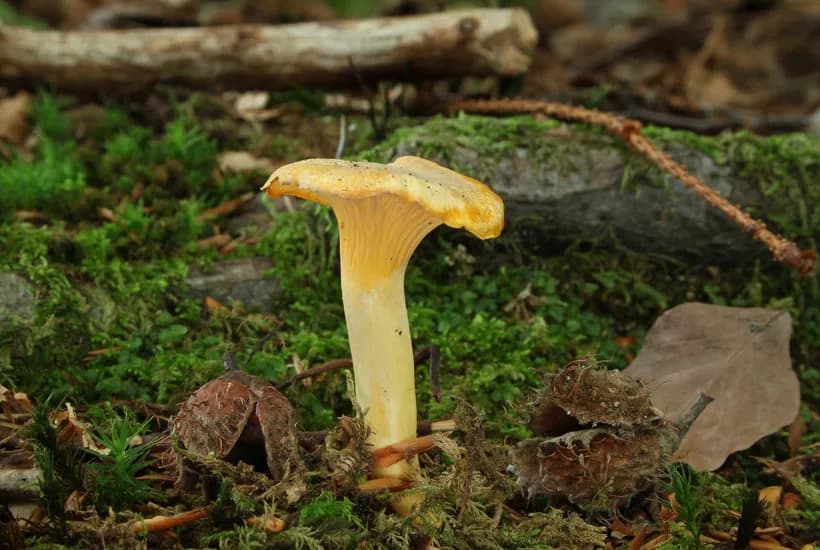
Cantharellus cibarius, commonly known as the chanterelle, is one of the most popular and highly prized wild edible mushrooms in the world. It is recognized for its golden-yellow color, fruity aroma, and unique ridged underside (false gills) rather than true gills. Found across Europe, North America, and Asia, chanterelles are valued in gourmet cooking for their delicate texture and rich flavor.
For identification, the key features include forked ridges instead of gills, a firm flesh, and a mild apricot-like smell. However, they can be confused with toxic lookalikes such as Omphalotus illudens. To improve accuracy, beginners and experts alike often use a mushroom identifier tool or AI mushroom identification app alongside field knowledge.
Scientific Classification & Taxonomy
| Kingdom | Fungi |
| Phylum | Basidiomycota |
| Class | Agaricomycetes |
| Order | Cantharellales |
| Family | Cantharellaceae |
| Genus | Cantharellus |
| Species | Cantharellus cibarius |
Chanterelles belong to a group of fungi characterized by their mycorrhizal relationships with trees, meaning they depend on forest ecosystems to grow. Several closely related species exist worldwide, often grouped under the chanterelle complex.
Key Features (Identification Essentials)
Cap Characteristics
The cap of chanterelles is typically bright yellow to golden-orange, with a smooth or slightly wavy surface. It starts convex and becomes funnel-shaped as it matures. The edges are often irregular or lobed, giving the mushroom a natural, organic appearance.
- Shape: Convex when young, becoming funnel-shaped
- Color: Bright yellow to golden-orange
- Surface: Smooth or slightly wavy
- Size: 3–10 cm diameter
False Gills (Ridges)
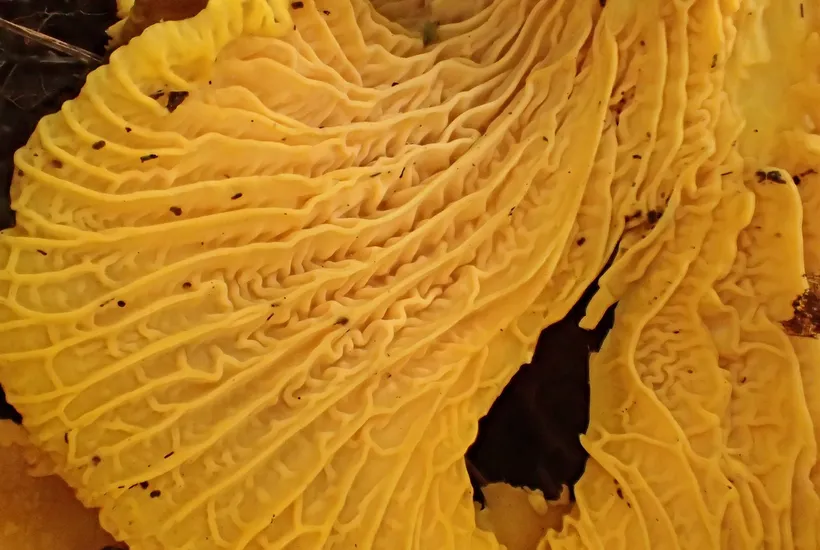
Instead of true gills, chanterelles have thick, forked ridges that run down the stem. These ridges are blunt and widely spaced, unlike the thin, sharp gills of many toxic mushrooms. This is one of the most reliable identification features.
Stem (Stipe)
The stem is solid, firm, and the same color as the cap or slightly lighter. It tapers downward and merges smoothly with the cap, lacking a clear separation. This unified structure helps distinguish chanterelles from many lookalikes.
- Shape: Solid, tapering downward
- Color: Same as cap or slightly lighter
- Structure: Merges smoothly with cap
- Height: 3–8 cm
Color, Smell & Texture
Chanterelles are known for their pleasant fruity aroma, often compared to apricots. The flesh is firm and white inside, maintaining its structure when cut. Their color remains consistent throughout, and they do not exhibit staining or rapid discoloration.
Environment & Habitat
Habitat & Distribution
Chanterelles are found across Europe, North America, Asia, and parts of Africa, particularly in temperate forests. They grow in association with trees such as oak, beech, pine, and spruce, forming beneficial underground partnerships.
Seasonality
They typically appear from late spring to autumn, depending on rainfall and temperature. Moist conditions following rain often trigger their growth.
Growth Pattern
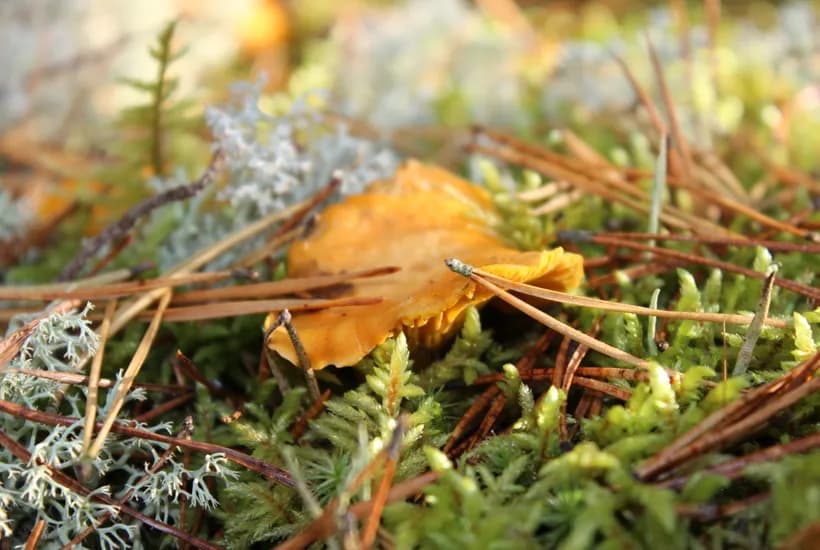
Chanterelles grow singly or in scattered groups, often hidden among leaf litter or moss. They rarely grow directly on wood, which is an important distinction from some toxic lookalikes.
Physical Dimensions & Structure
| Feature | Measurement |
|---|---|
| Cap Diameter | 3–10 cm |
| Stem Height | 3–8 cm |
| Stem Thickness | 1–3 cm |
| Structure | Solid, dense |
Their compact yet sturdy structure makes them easy to handle and transport when foraging.
Edibility & Nutritional Value
Is Cantharellus cibarius edible? Yes — highly edible and considered a gourmet mushroom.
Culinary Uses
Chanterelles are widely used in sautéed dishes, sauces, soups, and fine dining recipes. Their flavor pairs well with butter, garlic, and herbs. They are a staple in French, Scandinavian, and Eastern European cuisines.
Nutritional Benefits
They are rich in vitamins (especially vitamin D), antioxidants, and fiber, contributing to a healthy diet.
Risk Level Assessment
| Factor | Level |
|---|---|
| Edibility | Excellent |
| Toxicity Risk | Moderate (misidentification risk) |
| Fatality Risk | Low |
| Identification Difficulty | Moderate |
Although edible, proper identification is essential to avoid confusion with toxic species. Always verify with a reliable wild mushroom identifier.
Similar Species (Critical Comparison)
Key Lookalike
| Feature | Chanterelle (C. cibarius) | Jack-o’-Lantern (O. illudens) |
|---|---|---|
| Underside | Blunt forked ridges | True sharp gills |
| Growth | On soil, solitary/scattered | On wood, in clusters |
| Glow | No bioluminescence | Bioluminescent |
| Flesh | White, firm | Orange throughout |
| Toxicity | Edible (excellent) | Toxic (causes illness) |
The most dangerous lookalike is Omphalotus illudens (jack-o'-lantern mushroom), which grows in clusters on wood and has true gills. For a detailed breakdown, read our Omphalotus illudens identification guide.
Growth Pattern & Life Cycle
Chanterelles are mycorrhizal fungi, forming symbiotic relationships with tree roots. This allows them to exchange nutrients, supporting forest ecosystems. Their life cycle includes spore dispersal, underground mycelium growth, and seasonal fruiting bodies.
Did you know? Like porcini, chanterelles cannot be commercially cultivated because they require living tree partners. All chanterelles sold in markets are wild-harvested from forests.
Regions Where It Is Found
Chanterelles are widely distributed and especially common in temperate forest regions:
Economic & Ecological Value
Chanterelles have high economic value due to their demand in global cuisine and are often sold fresh in markets. Ecologically, they play a crucial role in forest health by supporting tree growth through nutrient exchange. To learn more about how mushroom structures contribute to these relationships, see our mushroom parts explained guide.
Pros and Cons
Pros
- ✓ Highly edible and flavorful
- ✓ Nutritionally beneficial (vitamin D)
- ✓ Widely appreciated in culinary arts
- ✓ Distinctive appearance aids identification
Cons
- ✗ Seasonal availability only
- ✗ Can be confused with jack-o'-lantern
- ✗ Requires careful identification
- ✗ Cannot be commercially cultivated
How to Identify Cantharellus cibarius Safely
Step-by-Step Identification
For added safety, use a mushroom identifier free by photo tool to verify your findings before consumption.
Expert Identification Tips
Always check multiple features before confirming identification. Avoid mushrooms with sharp gills or those growing directly on wood. Cross-reference with reliable guides or tools, especially if you are new to foraging. For a comprehensive visual reference, explore our mushroom identification book recommendations.
The jack-o'-lantern mushroom (Omphalotus illudens) is the most commonly confused toxic species. Always check that your chanterelle has ridges (not gills), grows from soil (not wood), and has white flesh inside.
People Also Ask (FAQs)
Are chanterelles safe to eat?+
What do chanterelles taste like?+
How do you identify chanterelles?+
Can beginners forage chanterelles?+
Where do chanterelles grow?+
Can AI identify chanterelle mushrooms?+
Final Thoughts
Cantharellus cibarius is one of the most sought-after edible mushrooms thanks to its flavor, appearance, and ecological importance. Its unique features make it relatively easy to identify, but caution is still necessary.
By combining field knowledge with a reliable mushroom identifier tool, you can confidently and safely enjoy chanterelles while avoiding dangerous lookalikes.
Sign in to leave a comment and join the discussion.