Mushroom Parts Explained: Cap, Gills, Stem, Ring & Volva

Nathan Cole
Mycologist · Author · Fungi Expert
Updated
Mar 31, 2026
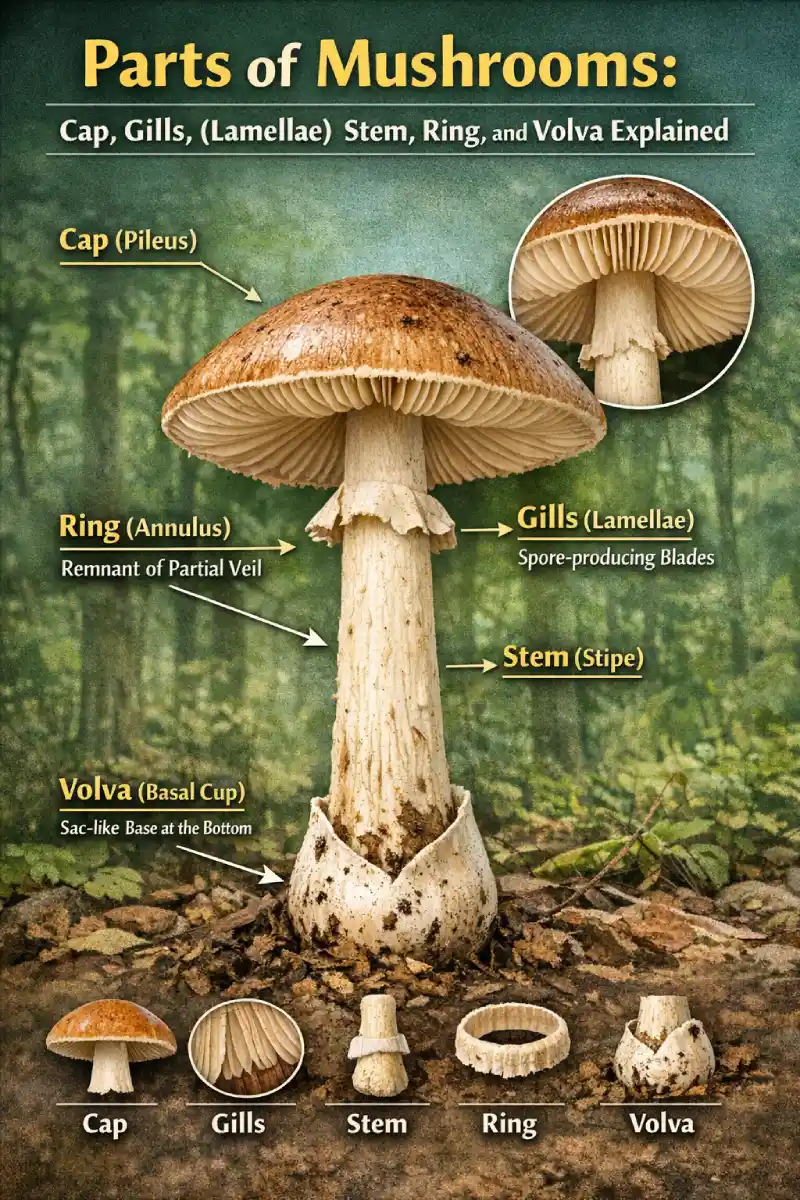
Understanding mushroom anatomy is the foundation of accurate mushroom identification. A mushroom is not the entire organism — it is the visible fruiting body of fungi within the Kingdom Fungi.
Introduction to Mushroom Anatomy and Fungal Structure (Mycology Basics)
Beneath the surface lies a network of mycelium, made of microscopic hyphae, which spreads through soil, wood, or organic matter. The mushroom's job is simple: produce and disperse spores. To do this efficiently, fungi have evolved specialized structures — the cap (pileus), gills (lamellae), stem (stipe), ring (annulus), and volva — each playing a role in reproduction and protection.
Why Mushroom Parts Matter in Identification
In mycology, identifying a mushroom correctly depends on combining multiple features. Two mushrooms may share the same cap color, but differ in:
- Gill attachment (free, attached, decurrent)
- Presence of a ring or volva
- Stem structure and base
- Habitat and substrate (soil, hardwood, conifer wood, moss)
This is why modern tools like a mushroom identifier use AI and computer vision to analyze the full fungal structure rather than relying on a single image or feature.
Safety and Identification Importance
Some of the most dangerous fungi, including species in the Amanita group such as the Death Cap (Amanita phalloides), look similar to edible mushrooms. Features like a volva at the base or a ring on the stem can be critical indicators of toxicity. Understanding mushroom anatomy is not just about learning — it is essential for safe identification of wild fungi.
Complete Overview of Mushroom Parts (Cap, Gills, Stem, Ring, Volva Explained Together)
Before diving into each part, it helps to understand how the main structures work together as a system.
The Five Key Mushroom Parts
| Part | Scientific Name | Function |
|---|---|---|
| Cap | Pileus | Protects spore-producing structures |
| Gills | Lamellae | Produce and release spores |
| Stem | Stipe | Elevates cap for spore dispersal |
| Ring | Annulus | Remnant of partial veil |
| Volva | Volva | Base from universal veil |
How These Parts Work Together
Cap
Protects the delicate spore-producing surface
Gills
Generate and release spores into the air
Stem
Lifts the cap higher to improve dispersal
Ring
Shows the mushroom's growth stage
Volva
Reveals early developmental structures
Veil Structures Explained
Mushrooms develop with protective layers called veils:
- Partial veil → covers gills → becomes the ring (annulus)
- Universal veil → surrounds entire mushroom → becomes the volva
How AI Uses These Structures
A mushroom identifier app analyzes cap shape and texture, gill structure, stem features, ring and volva presence, and habitat and growth pattern. By combining all these entities, AI can narrow down possible fungal species matches more accurately.
Mushroom Cap (Pileus): Shape, Surface Texture, and Identification Features
The mushroom cap (pileus) is the most visible and often the most photographed part of a mushroom. It plays a key role in protecting the gills or pores where spores are produced.
Cap Shapes and Growth Stages
Mushroom caps change shape as they mature:
Convex
Young stage
Bell-shaped
Early growth
Flat / Expanded
Mature stage
Umbonate
Raised center
Cap Surface and Texture
The cap surface can vary widely:
- Smooth → common in many edible mushrooms
- Scaly or warty → often linked to veil remnants
- Slimy or sticky → influenced by moisture
- Dry and fibrous → typical in certain woodland fungi
For example, some Amanita species have warty caps due to remnants of the universal veil, while Morchella esculenta (morel) has a distinctive honeycomb-like cap structure unlike any other common species.
Cap Color and Its Limitations
Cap color is useful but unreliable on its own because it changes based on age, moisture, sun exposure, and environmental conditions. This is why a wild mushroom identifier by picture does not rely only on color.
How AI Identifies the Cap
A mushroom identifier uses image recognition to analyze shape geometry, color distribution, surface texture, and edge structure. These features are compared with labeled fungal datasets to identify likely species.
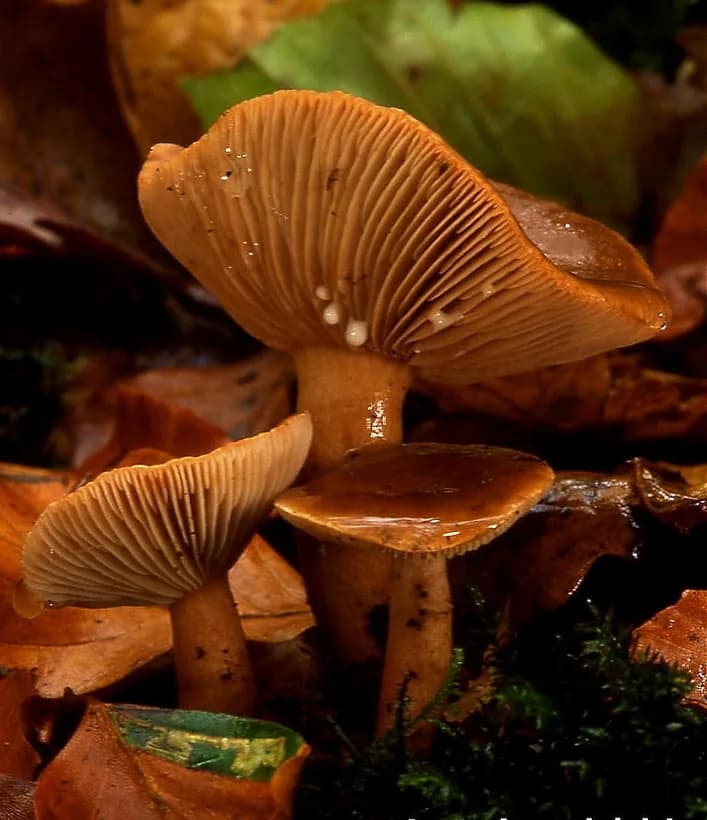
Close-up of mushroom gills (lamellae) — Lactarius subdulcis showing gill attachment and spacing
Source: commons.wikimedia.org/wiki/File:Lact.sub.jpg — CC BY 3.0, Zonda Grattus
Mushroom Gills (Lamellae): Spore Production, Gill Attachment, and Variations
The gills (lamellae) are the most important reproductive structure in many mushrooms. They are located beneath the cap and are responsible for spore production and dispersal.
Function of Gills
Gills increase surface area, allowing mushrooms to produce and release millions of spores into the environment. These spores help fungi reproduce and spread.
Types of Gill Attachment
Gill attachment is a key identification feature:
- Free gills → not attached to the stem
- Attached gills → directly connected
- Decurrent gills → extend down the stem
This single feature can immediately narrow down fungal species groups.
Other Important Gill Traits
- Spacing → crowded vs widely spaced
- Thickness → thin vs thick
- Color changes → white to pink to brown in some species
Gills vs Pores vs Teeth
Not all fungi have gills:
| Fungi Type | Underside Structure |
|---|---|
| Boletes | Pores (spongy underside) |
| Tooth fungi | Spines or teeth |
| Polypores | Tubes |
Recognizing these differences is critical in mushroom classification. For example, Boletus edulis (porcini) has a spongy pore surface rather than gills, which is one of the first features that separates boletes from gilled mushrooms.
How AI Uses Gill Patterns
A mushroom identifier app analyzes gill spacing and pattern, attachment type, color and contrast, and underside structure. These patterns are among the strongest indicators in AI mushroom identification systems.
Mushroom Stem (Stipe): Structure, Function, and Identification Clues
The stem (stipe) supports the cap and plays a crucial role in positioning the mushroom for effective spore dispersal.
Stem Structure Variations
Stems can vary significantly:
- Hollow vs solid
- Smooth or fibrous texture
- Thin or thick
- Straight or curved
These variations provide strong identification signals.
Stem and Base Connection
The base of the stem connects to:
- Mycelium underground
- Basal bulb in some species
- Volva in certain toxic fungi
This area is often overlooked but extremely important.
Role of the Stem
- Elevates the cap for better airflow
- Supports reproductive structures
- Helps spores spread more efficiently
Identification Clues from the Stem
Look for: color changes, presence of a ring (annulus), bulb or swelling at the base, and surface texture. These features help distinguish between similar-looking mushrooms.
How AI Identifies the Stem
A mushroom identifier evaluates length and thickness, surface texture, connection to cap, and base structure. Combining stem features with cap and gill data improves accuracy in identifying wild fungi.
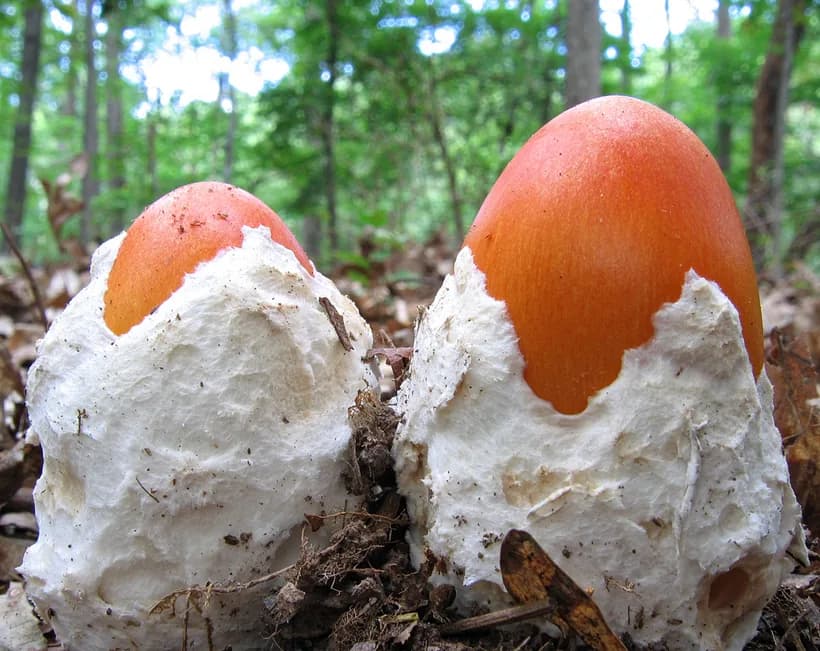
Amanita jacksonii — clearly showing cap, stem, and volva emerging from universal veil
Source: commons.wikimedia.org/wiki/File:Amanita_stirps_Hemibapha_45069.jpg — CC BY-SA 3.0, hrdb via Mushroom Observer
Mushroom Ring (Annulus): Veil Remnants and Identification Importance
The mushroom ring (annulus) is a circular band found on the stem (stipe). It forms from the partial veil, a protective membrane that covers the gills (lamellae) during early growth stages.
How the Ring Forms
When a young mushroom develops:
- The partial veil protects the gills
- As the cap expands, the veil tears
- The remaining tissue forms a ring around the stem
This makes the ring a key indicator of a mushroom's growth stage.
Types of Mushroom Rings
Rings vary across species:
- Thick and prominent (easy to see)
- Thin and fragile (may disappear quickly)
- Double rings (layered structures)
- Movable rings (can slide along the stem)
In some mushrooms, the ring may fade or vanish as the mushroom matures.
Why the Ring Matters in Identification
The presence or absence of a ring is a strong diagnostic feature:
- Many edible mushrooms → may have no ring or a simple ring
- Some toxic species → have a distinct ring + volva combination
How AI Detects the Ring
A mushroom identifier uses image recognition to detect the circular band on the stem, texture difference from the rest of the stem, and position relative to cap and base. These features help the system distinguish between closely related fungal species.
Mushroom Volva (Basal Cup): The Most Important Safety Feature
The volva is a cup-like or sac-like structure at the base of a mushroom. It forms from the universal veil, which initially surrounds the entire young mushroom.
How the Volva Forms
- The mushroom starts enclosed in a universal veil
- As it grows, the veil breaks apart
- The remaining tissue stays at the base → forming the volva
Types of Volva Structures
Volvas can appear as:
- Cup-shaped (clearly visible)
- Sac-like (wrapped around the base)
- Bulbous base (thickened stem bottom)
In many cases, the volva is partially or completely buried underground, making it easy to miss.
Why the Volva is Critical for Identification
The volva is one of the most important features in mushroom safety:
- Common in Amanita species
- Often associated with toxic mushrooms
- Rare in many edible species
How to Properly Check for a Volva
How AI Identifies the Volva
A mushroom identifier app analyzes base shape and structure, presence of cup-like formations, and relationship between stem and surrounding substrate. This helps prevent confusion between dangerous look-alike species.
Additional Mushroom Structures (Advanced Mycology Entities)
Beyond the main five parts, several additional structures are important for deeper fungal identification.
Mycelium and Hyphae
- Mycelium → underground network of fungi
- Made of microscopic threads called hyphae
- Connects fungi to soil, wood, and plant roots
This network is responsible for nutrient absorption and ecological roles.
Spore Print
A spore print is created by placing a mushroom cap on paper to collect spores. Key uses:
- Identifying spore color groups
- Distinguishing similar species
- Confirming classification
Veil Remnants
Fragments of the universal veil may appear as warts or patches on the cap. Common in some toxic mushrooms, these remnants are important clues in species identification.
How Mushroom Parts Help in Accurate Identification
Correct identification requires combining all features together — not relying on a single trait.
Key Identification Combination
| Features Combined | What It Reveals |
|---|---|
| Cap + Gills | Structure and spore type |
| Stem + Ring | Developmental stage |
| Volva + Base | Safety indicators |
| Habitat + Substrate | Ecological context |
Role of Habitat and Environment
Fungi grow in specific environments:
- Forest soil → mycorrhizal species
- Hardwood logs → wood-rotting fungi
- Conifer wood → specialized fungal groups
- Moss or leaf litter → moisture-loving species
This is why a wild mushroom identifier by picture includes location and habitat input.
How AI Combines All Features
A mushroom identifier uses cap analysis, gill pattern recognition, stem structure detection, ring and volva identification, and habitat and seasonality data. This multi-layer analysis improves species matching accuracy.
Common Mistakes When Identifying Mushroom Parts
Even experienced foragers can make mistakes. Here are the most common ones:
Ignoring the Base (Volva)
Failing to check the base can lead to missing a volva, which is critical for identifying toxic Amanita species.
Relying Only on Cap Color
Cap color changes with age, weather, and sun exposure. It should never be used alone.
Confusing Gills with Pores
Many beginners mistake pores (boletes) for gills, or teeth fungi for gilled mushrooms.
Missing Ring or Veil Remnants
Some mushrooms lose their ring over time, making identification harder.
Ignoring Habitat Context
Not noting whether the mushroom grows on soil, wood, or moss can lead to incorrect identification.
Dangerous Look-Alikes Based on Mushroom Structure
Certain structural patterns are linked to high-risk mushrooms.
Amanita Pattern (High Risk)
Puffball vs Young Gilled Mushrooms
- Puffballs → solid inside
- Young gilled mushrooms → developing internal structures
Chanterelles vs Look-Alikes
- True chanterelles → ridges (not true gills) — see our full guide on Cantharellus cibarius (chanterelle) identification
- False chanterelles → true gills
Understanding these differences improves both manual and AI-based identification.
Beginner Field Checklist for Mushroom Parts
Before using a mushroom identifier, collect complete data:
👁 What to Observe
- Cap shape, color, texture
- Gills, pores, or teeth
- Stem structure
- Ring presence
- Volva or base
- Habitat (soil, wood, moss)
📷 What to Photograph
- Top view (cap)
- Underside (gills)
- Side profile
- Stem and base
- Surrounding environment
This improves results when using a mushroom identifier app.
FAQ: Mushroom Parts Explained
What are the main parts of a mushroom?+
The main parts are the cap, gills, stem, ring, and volva, each playing a role in spore production and identification.
What is the function of mushroom gills?+
Gills produce and release spores, enabling fungi to reproduce and spread.
What is a mushroom ring?+
The ring (annulus) is a remnant of the partial veil that once protected the gills.
What is a volva in mushrooms?+
The volva is a cup-like structure at the base, often found in toxic species, making it critical for identification.
How do mushroom parts help identify species?+
By combining cap shape, gill structure, stem features, ring, volva, and habitat, both experts and AI mushroom identifiers can narrow down species accurately.
Final Thoughts
Learning mushroom parts explained — cap, gills, stem, ring, and volva — gives you a powerful foundation in mycology and fungal identification.
When combined with tools like a mushroom identifier, this knowledge helps you:
- Identify mushrooms more accurately
- Avoid dangerous look-alikes
- Understand fungal ecology
- Explore nature with confidence
For further reading on how anatomy knowledge applies in the field, explore our mushroom identifier book guide for the best field references. You can also test your knowledge with our mushroom identification quiz to see how well you can recognize key mushroom parts in practice.
 GeneralYard Guide
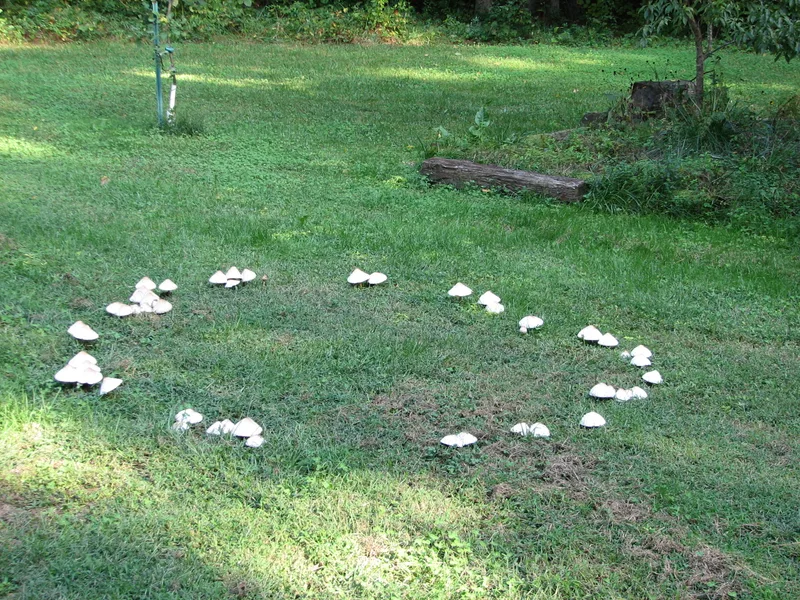
Mushrooms grow in your yard because underground fungi (mycelium) are actively breaking down organic matter in moist, shaded soil.
 GeneralLawn Guide
Remove lawn mushrooms fast by fixing moisture, drainage, and organic matter. Full step-by-step guide to stop mushrooms coming back.
 GeneralGuide
A mushroom identifier book helps you recognize fungi by cap shape, gills, habitat, season and spore print. Find the best field guide for your skill level.