Ultimate Guide to Laetiporus Sulphureus: A Practical Guide

Nathan Cole
Mycologist · Author · Fungi Expert
Updated
Apr 30, 2026
Last September I stood at the base of a fire-scarred white oak in the Blue Ridge foothills and pulled twelve pounds of Laetiporus sulphureus from a single trunk, the same trunk I'd harvested from for four autumns running. The cap glowed a sulfur-yellow so saturated you could see it from the road. Fresh growing margins are tender, salmon-tinted, and faintly lemony in scent. That's the textbook picture, and it's also exactly the picture that gets foragers in trouble when they meet an orange shelf on a hemlock or a gilled impostor at the base of a stump.
You can read every paragraph ever written about this species and still misidentify it without a clear photo of the pore surface, the host bark, and the growing margin in the same frame. That's the entire reason this guide leans on visual checks at every stage. Print the field-sequence section, take it with you, and confirm everything below with a certified mycologist through your regional NAMA society before anything reaches the pan.
Why You Cannot Identify Laetiporus sulphureus from Text Alone
Color is the loudest signal this fungus sends, and it's also the easiest to read wrong. Laetiporus sulphureus runs from sulfur-yellow through orange to a salmon wash near the margin, and the gradient shifts depending on age, light, and host vigor. A photograph captures all three at once. A paragraph captures none of them.
The pore surface is the diagnostic that closes the identification, but pores are easy to mistake for tightly packed gills if you've never seen them at macro range. In a clear close-up, you'll count two to four angular pores per millimeter, with shallow tubes one to four millimeters deep. No text description gets a beginner there. You need the picture.
Substrate is the third visual layer that no amount of prose replaces. A bracket on a white oak is a different conversation than a bracket on a Pacific hemlock, even when the cap looks identical from ten feet away. The bark, the leaf litter, the surrounding canopy, all of that has to register at once.
Add in the visual contrast against Omphalotus illudens, Hapalopilus rutilans, and the conifer-growing Laetiporus huroniensis, and the case for image-led identification writes itself. If you can't see it side by side, you can't safely call it. Confirm any first-time find with a certified mycologist before consumption, and call Poison Control at 1-800-222-1222 if a reaction follows any tasting.
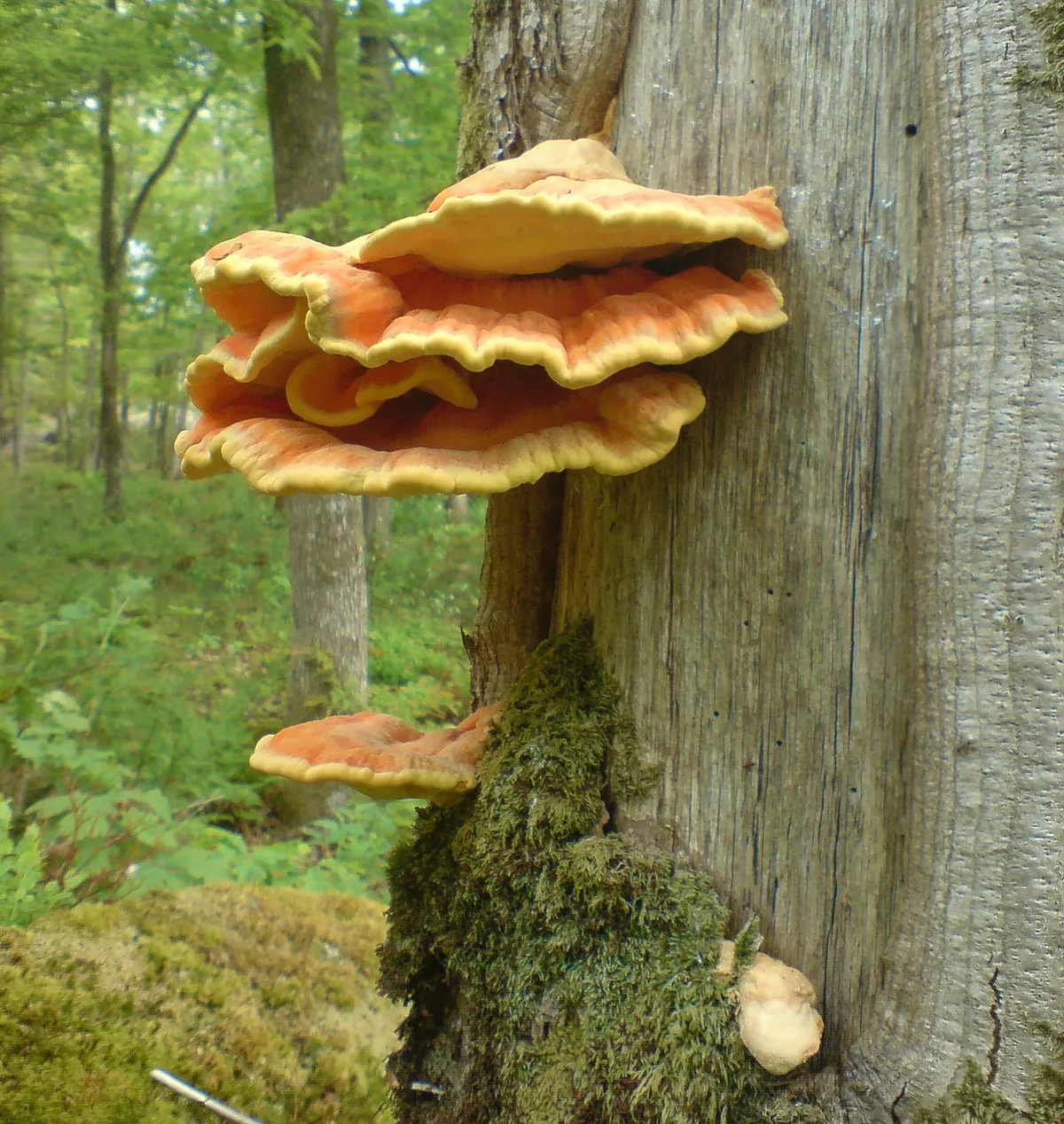
Visual 1: The Sulfur-Yellow to Salmon-Orange Cap Gradient on Oak
The cap of a fresh Laetiporus sulphureus fruiting on white oak shows three distinct color zones in one frame. The inner attachment is the deepest sulfur-yellow, the middle pileus runs vivid orange, and the outer growing margin fades to apricot or salmon. That gradient is the fingerprint.
In a good field photograph, you'll see the suede-like surface texture catch the light along the fan-shaped brackets. Healthy specimens fuse laterally into rosette clusters that can stretch a meter across the trunk. Single caps run five to thirty centimeters wide, and a full flush often weighs twenty pounds or more.
| Visual cue | What you should see |
|---|---|
| Inner zone | Saturated sulfur-yellow |
| Middle pileus | Vivid orange |
| Growing margin | Salmon to apricot |
| Surface | Suede-like, finely wrinkled, faintly zonate |
| Cluster habit | Overlapping shelving brackets |
If a specimen looks uniform pumpkin-orange with no yellow zone at all, stop. That's a cue for Omphalotus illudens, the eastern Jack-O'-Lantern, and the next visual section explains why the underside settles the question.
Visual 2: The Pore Surface That Separates Laetiporus from Omphalotus illudens
Flip the bracket. That single motion eliminates the most dangerous lookalike in the eastern United States.
Laetiporus sulphureus shows a bright sulfur-yellow pore surface with two to four angular pores per millimeter. Omphalotus illudens shows true gills, decurrent and crowded, running down toward the stem base. The two surfaces look nothing alike at macro range, and that's the whole point of the visual check.
Pore Density and Tube Depth at Macro Range
A close-range photograph of the underside should resolve the angular pore mouths and the shallow tubes behind them. Tube depth runs one to four millimeters, deepening as the bracket matures. The yellow pore color stays vivid in fresh specimens and dulls toward cream as the flush ages out.
If your photo shows ridged lines radiating from a central attachment instead of a honeycomb of pores, you're looking at gills. That ends the Laetiporus identification on the spot.
Why a Gilled Underside Ends the Identification
Omphalotus illudens contains illudin S, a sesquiterpene that triggers severe vomiting and abdominal cramping within two hours of ingestion. It's not lethal in healthy adults, but every September I get calls from emergency rooms across the Southeast about foragers who skipped the underside check. The gilled underside is non-negotiable evidence the specimen is not edible.
If you suspect any ingestion, call Poison Control at 1-800-222-1222 and bring a photograph of the specimen and the host substrate to the ER.
The Host Tree Decision Diagram: Oak vs Hemlock vs Eucalyptus
Substrate determines edibility more than any morphological feature. Two specimens can look identical and behave differently in the gut depending on what they grew out of.
| Host substrate | Likely species | Edibility status |
|---|---|---|
| Oak (Quercus spp.) | Laetiporus sulphureus | Edible when young, fully cooked |
| Cherry, beech, maple, sweet chestnut | L. sulphureus | Edible on same standards |
| Hemlock, spruce, fir | L. huroniensis or L. conifericola | GI distress in many eaters |
| Eucalyptus | L. gilbertsonii | Irritant risk, not recommended |
| Black locust (Robinia pseudoacacia) | Possible L. sulphureus | Avoid, host-derived irritants |
| Yew (Taxus) | Avoid regardless of species | Do not consume |
| Cedar, Thuja | Avoid regardless of species | Do not consume |
In a useful identification photo, the host bark, leaf litter, and surrounding canopy share the frame with the bracket. A close-up of the cap alone strips away the single most important data point.
I've watched skilled foragers in mixed Cascade forests confidently call a flush L. sulphureus because the cap looked right, only to realise after harvest that the substrate was western hemlock. The flush wasn't sulphureus at all. It was L. conifericola, and the eaters spent the night nauseated. Run the call past a certified mycologist before you cook anything from a host tree you can't immediately name.
Correct vs Incorrect: Laetiporus sulphureus Beside Omphalotus illudens, Hapalopilus rutilans, and Pycnoporus cinnabarinus
A side-by-side comparison teaches faster than any standalone photograph. Lay the four species out together and the visual logic of Laetiporus sulphureus identification snaps into focus.
Laetiporus sulphureus sits on a hardwood trunk in shelving brackets, sulfur-yellow grading to salmon, with a yellow pore surface. Omphalotus illudens clusters at the base of a stump or buried oak root, solid pumpkin-orange, with true gills running down the stem. The two are unmistakable side by side, and impossible to confuse once you've seen the comparison once.
Hapalopilus rutilans is the quieter danger. It's a smaller cinnamon-orange polypore, never sulfur-yellow, and the flesh turns violet on contact with potassium hydroxide. That KOH reaction is diagnostic. Hapalopilus contains polyporic acid, which causes neurological symptoms and acute kidney injury, and it's mistaken for young Laetiporus every season by foragers who don't know the chemical test.
Pycnoporus cinnabarinus is the cinnabar polypore, a deep red bracket fungus much smaller than Laetiporus sulphureus and more leathery in texture. Color alone separates it. If your bracket is closer to fire-engine red than school-bus yellow, it isn't chicken of the woods.
| Species | Color | Underside | Substrate | Risk |
|---|---|---|---|---|
| Laetiporus sulphureus | Sulfur-yellow to salmon | Yellow pores | Hardwood | Conditional edible |
| Omphalotus illudens | Pumpkin-orange | True gills | Oak base, buried roots | Toxic, illudin S |
| Hapalopilus rutilans | Cinnamon-orange | Pores, KOH violet | Various hardwoods | Toxic, polyporic acid |
| Pycnoporus cinnabarinus | Cinnabar-red | Pores, very fine | Hardwood | Inedible, leathery |
That table is the closest a printed page gets to a side-by-side photograph. Memorise it before your next foray, and confirm any unusual find with a certified mycologist through your regional NAMA-affiliated society before you cook anything. Call Poison Control at 1-800-222-1222 for any suspected ingestion of Omphalotus illudens or Hapalopilus rutilans.
Detail Callout: The Tender Growing Margin and Why Only the Outer 2 to 4 cm Goes in the Basket
Every flush of Laetiporus sulphureus has a usable zone and a wasted zone. The usable zone is the outer two to four centimeters of the growing margin, the part that bends slightly when you press it and breaks cleanly under a knife. Anything inboard of that quickly turns chalky.
In a fresh specimen, the margin is paler than the rest of the cap, almost translucent against backlight, and it weeps a faint yellow moisture when cut. That's the texture you want in the basket. Cut anything firmer than your earlobe and you'll regret it at the stove.
The inner portions of the bracket are tough, fibrous, and bitter. They also harbor most of the beetle larvae that colonize aged flushes within days of peak. I leave the inner mass attached to the trunk so the mycelium keeps fruiting next year, and I take only what cooks tender in fifteen minutes.
If a single bracket is already firm at its outer rim, the whole flush is past prime. Walk on. There's another oak.
Field Sequence: Substrate Check, Pore Check, Margin Check, Smell Check
I run the same four-step sequence every time, in the same order, and I've done it for forty years. Skip a step and you've earned whatever happens next.
| Step | Check | Pass condition |
|---|---|---|
| 1 | Substrate | Hardwood, ideally oak |
| 2 | Pore surface | Bright sulfur-yellow, 2 to 4 angular pores per mm |
| 3 | Growing margin | Tender outer 2 to 4 cm, weeps faintly when cut |
| 4 | Smell | Faintly fungal, lemony, never sour |
If any step fails, the specimen stays on the log. There's no override, no "close enough," no "I've eaten worse." A failed substrate check alone has put more foragers in clinics than any other error I've consulted on through NAMA poisoning case work.
The KOH Test That Rules Out Hapalopilus rutilans
Carry a small dropper of 3 to 10 percent potassium hydroxide solution in your foray kit. Drop one bead onto the cut flesh of a suspect bracket. A vivid violet reaction means Hapalopilus rutilans and a probable trip to the nephrology ward.
Laetiporus sulphureus shows no significant color change with KOH. That negative reaction, combined with the sulfur-yellow pore surface and hardwood substrate, is one of the cleanest exclusions in field mycology. Iron salts (FeSO₄) also stay negative, which separates it from a handful of less common confusables.
If you've never used KOH in the field, your regional NAMA-affiliated society almost certainly runs an introductory chemistry workshop in spring. Take it before your first autumn foray.
The Bioluminescence Check for Omphalotus illudens
Fresh Omphalotus illudens glows faintly in pitch darkness. Take a suspect specimen into a closed closet, give your eyes ten minutes to adjust, and look at the gills. A soft greenish glow confirms Omphalotus.
Laetiporus sulphureus never bioluminesces. It also has pores rather than gills, so if you've already run the pore check this test is a confirmation rather than a discovery. I still run it on any orange cluster found at the base of an oak that isn't clearly attached to a trunk, because Omphalotus loves to fool foragers from buried oak roots.
If the glow appears, photograph the specimen, leave it where it grew, and call Poison Control at 1-800-222-1222 if any handler has put fingers to lips before washing.
Regional Visual Variants: Appalachian Oak, Pacific Northwest, California Savanna, British Isles
The same species looks different from one continent to the next, and even one foothill ridge to another. A field photograph from Tennessee won't match a field photograph from Sussex, and that confuses foragers who learned the species from a single regional guide.
Appalachian oak country produces the textbook flush. Saturated sulfur-yellow caps, broad orange middle, salmon-tinted margins, often more than fifteen pounds in a single rosette on white oak (Quercus alba). Peak runs September through October, and a wet August almost guarantees a strong autumn.
Pacific Northwest specimens at lower elevations come off Oregon white oak (Quercus garryana) and Pacific madrone, with a slightly paler yellow and a longer fruiting window. I've harvested clean flushes in Cascade foothill oak savannas as late as mid-November. Above the oak line, anything orange you find will almost always be Laetiporus conifericola on western hemlock and shouldn't go in the basket.
California oak savannas push the season into early winter. Coast live oak (Quercus agrifolia) and valley oak (Quercus lobata) host enormous flushes from October into January in good rain years. The British Isles favor English oak (Quercus robur) and beech (Fagus sylvatica), with peak fruiting from June through October and a tendency toward smaller, more delicate clusters than the American Southeast produces.
| Region | Primary host | Peak season | Visual signature |
|---|---|---|---|
| Appalachia | White oak | Sep to Oct | Deep sulfur-yellow, large rosettes |
| Pacific Northwest | Oregon white oak | Sep to Nov | Paler yellow, extended window |
| California | Coast live, valley oak | Oct to Jan | Massive flushes, orange-saturated |
| British Isles | English oak, beech | Jun to Oct | Smaller, delicate, tighter clusters |
The Laetiporus Species Complex: Visual Distinctions Between sulphureus, cincinnatus, huroniensis, conifericola, gilbertsonii, and persicinus
The Lindner and Banik phylogenetic work published in Mycologia in 2008 split what used to be called "chicken of the woods" into a complex of distinct species. That split is the single most useful bit of taxonomy a forager can learn this decade.
Laetiporus sulphureus is the eastern hardwood standard, sulfur-yellow above and yellow-pored below, on oak and other hardwoods. Laetiporus cincinnatus fruits as terrestrial-looking rosettes from buried oak roots, with a white pore surface rather than yellow. The white underside is the cleanest visual separator in the genus, and cincinnatus is edible on the same hardwood standards as sulphureus.
Laetiporus huroniensis lives on Great Lakes conifers, especially eastern hemlock, and looks almost identical to sulphureus from above. The host tree is your only reliable cue. Laetiporus conifericola fills the same role in the Pacific Northwest on western hemlock, Douglas fir, and Sitka spruce. Both conifer species cause meaningful GI distress in many eaters and don't belong in the pan.
Laetiporus gilbertsonii is the western oak and eucalyptus species, and the eucalyptus flushes carry enough host-derived irritants that I tell foragers to skip them entirely. Laetiporus persicinus is the southeastern "white chicken," paler overall, and edible on the same standards as the yellow species when fully cooked.
| Species | Pore color | Substrate | Region | Edibility |
|---|---|---|---|---|
| L. sulphureus | Yellow | Hardwood (oak) | Broad temperate | Conditional edible |
| L. cincinnatus | White | Buried oak roots | Eastern North America | Edible, hardwood standards |
| L. huroniensis | Yellow | Conifer (hemlock) | Great Lakes | Not recommended |
| L. conifericola | Yellow | Conifer (hemlock, fir) | Pacific Northwest | Not recommended |
| L. gilbertsonii | Yellow | Oak, eucalyptus | Western North America | Avoid eucalyptus |
| L. persicinus | White | Hardwood | Southeastern US | Edible when cooked |
Confirm any species in this complex with a certified mycologist before consumption. Call Poison Control at 1-800-222-1222 if symptoms follow any tasting from a substrate you couldn't immediately name.
Aged vs Fresh: The Visual Cues That Tell You to Leave It on the Log
A fresh flush and an aged flush look like two different organisms, and the visual difference is the single best protection you have against a rough night. Fresh specimens are vivid, succulent, and faintly moist. Aged specimens are dull, chalky, and tunneled.
Color is the first cue. A fresh cap is saturated yellow with an orange wash and a salmon margin. An aged cap fades toward bone-white, especially along the margin, and the surface dries into a brittle, papery texture. If the salmon tones are gone, the flush is past prime.
The pore surface tells the same story from underneath. Fresh pores are bright sulfur-yellow and slightly moist. Aged pores dull to cream, then to a dirty tan, and the tube layer crumbles when you press it. Beetle larvae colonize the inner mass within days of peak, and you'll see fine sawdust-like frass dropping from tunnels in the flesh.
Smell closes the case. A fresh specimen smells faintly fungal and lemony. An aged specimen smells sour, vaguely like wet cardboard or mild ammonia. Trust your nose. The same compound that produces that sour scent is also part of why aged specimens cause GI distress regardless of host tree, and no amount of cooking removes it.
If a flush has gone over, leave it. The mycelium is still alive in the heartwood, and next season's flush will fruit from the same trunk. There are old mushroom hunters, and there are bold mushroom hunters. Choosing patience over a borderline harvest is exactly how you stay in the first category.
Summary: The Five-Image Identification Checklist Before Anything Reaches the Pan
Before I cook a single bracket of Laetiporus sulphureus, I want five clear photographs in hand. Each one closes a specific question that text alone can't answer.
The first image is the host substrate at full context, with bark, leaf litter, and surrounding canopy in frame. That's the substrate check from the field sequence, captured in pixels rather than memory. If the bark is rough oak with acorns nearby, you're on solid ground. If the needles in the litter say hemlock, the photograph alone disqualifies the harvest.
The second image is the cap from above, in natural light, showing the sulfur-yellow to salmon gradient across the bracket. The third is the underside at macro range, showing two to four angular yellow pores per millimeter. The fourth is a clean cut through the growing margin, showing the pale flesh that weeps faintly when fresh. The fifth is a close-up of a single bracket edge, demonstrating the tender outer two to four centimeters that will actually go in the basket.
| Image | What it confirms |
|---|---|
| 1, host context | Hardwood, ideally oak |
| 2, cap from above | Yellow to orange to salmon gradient |
| 3, underside macro | Pores not gills, sulfur-yellow |
| 4, cut margin | Pale flesh, faint moisture, no violet KOH reaction |
| 5, growing edge | Tender outer 2 to 4 cm |
Send those five images to a certified mycologist through your regional NAMA-affiliated society before any first-time harvest reaches the pan. I've been doing this for forty years and I still photograph every unusual flush before I cut it. That habit is the difference between a good story at the table and a phone call to Poison Control at 1-800-222-1222.
Frequently Asked Questions
How do I tell Laetiporus sulphureus from Omphalotus illudens?
Flip the specimen. Laetiporus sulphureus has a sulfur-yellow pore surface with two to four angular pores per millimeter, while Omphalotus illudens has true gills running down toward the stem base. Pores versus gills closes the question in seconds.
If the specimen is at the base of an oak rather than on the trunk, also run the bioluminescence check in a dark closet. Omphalotus illudens glows faintly green. Laetiporus never does.
Is Laetiporus sulphureus from a conifer safe to eat?
No. A bracket on hemlock, spruce, or fir is almost always Laetiporus huroniensis in the Great Lakes or Laetiporus conifericola in the Pacific Northwest, and both species cause meaningful GI distress in many eaters. The cap looks identical to L. sulphureus from above. The host tree is the only reliable cue.
Stick to oak and other confirmed hardwoods. If you ate a conifer specimen and feel sick, call Poison Control at 1-800-222-1222.
What does the KOH test do?
A drop of 3 to 10 percent potassium hydroxide on the cut flesh of Hapalopilus rutilans turns vivid violet within seconds, because of the polyporic acid in the tissue. Laetiporus sulphureus shows no significant color change. That single chemical reaction rules out one of the most dangerous polypore lookalikes in the field.
Carry a small dropper in your foray kit and learn to use it through your regional NAMA society's chemistry workshops.
How much of the bracket can I actually eat?
Only the outer two to four centimeters of the growing margin. That's the tender, slightly translucent zone that bends under finger pressure and weeps faint yellow moisture when cut. Anything inboard turns chalky, fibrous, and bitter, and it's where beetle larvae colonize first.
A twenty-pound flush often yields three or four pounds of usable margin. Leave the rest attached to the trunk so the mycelium keeps fruiting next season.
Can I eat Laetiporus sulphureus raw?
Never. Raw or undercooked specimens cause GI distress almost without exception, even from textbook hardwood hosts. Cook a minimum of fifteen minutes at simmer or sauté before any taste, and start with a two-tablespoon test portion if you've never eaten it before.
About one in ten eaters reports sensitivity even from confirmed safe specimens, so the test portion isn't optional. Call Poison Control at 1-800-222-1222 if a reaction follows.
Where can I get a positive identification confirmed?
Your regional NAMA-affiliated mycological society. NAMA maintains a directory of certified identification consultants, and most regions run autumn forays with experts on hand. Bring photographs of the host substrate, the cap, the pore surface, and a cut cross-section.
iNaturalist research-grade observations are useful for photo comparison, never as a sole identification source. The same goes for the published field guides by David Arora, Gary Lincoff, and the McKnights. Combine them.
When You Have Eaten a Specimen and Something Feels Wrong
Call Poison Control at 1-800-222-1222 first. They'll triage your specific scenario and tell you whether to ride it out at home or head to an emergency room. Bring or photograph the remaining mushroom and the host substrate before you leave the house.
Onset within thirty minutes to four hours typically points to a GI irritant pattern, which is what Laetiporus causes in sensitive eaters and what Omphalotus illudens and the conifer-growing Laetiporus species cause more reliably. Onset delayed past six hours is a different and far more dangerous pattern, characteristic of amatoxin-bearing Amanita species. If you cannot rule out an Amanita foray earlier in the day, treat the case as an emergency and go to the ER immediately.
A photograph of the substrate can save hours of diagnostic work. Emergency physicians are not trained mycologists, and a clear image of the host bark and leaf litter helps the regional poison center identify the likely culprit faster than any verbal description.
There are old mushroom hunters, and there are bold mushroom hunters. The patient ones who photograph everything, run the four-step field sequence, confirm with a certified mycologist, and call Poison Control at 1-800-222-1222 at the first hint of trouble are the ones who keep coming back to the same white oak every September for forty seasons.
Sign in to leave a comment and join the discussion.
 Safety
Can Two Mushrooms Look Identical But Differ in Toxicity? Absolutely, and the gap between dinner and a liver transplant can come down to a single feature you...
 Safety
The Ganoderma lucidum group is not a single species. It's a complex of at least a dozen related polypore fungi, including Ganoderma tsugae , Ganoderma...