Mushroom Gummies for ADHD: What the Evidence Says
— views
No mushroom gummy has been shown to treat ADHD. We found no human trial of any mushroom gummy, or of lion's mane, in people with ADHD. Lion's mane research is small, and it mostly covers healthy adults or older adults with memory problems. Standard ADHD care is medication and psychosocial treatment, so a gummy should not replace your care plan or delay an evaluation.
This page on mushroom gummies for ADHD sets out what the studies show, what standard care looks like, what is known about gummies with ADHD medicine, and why no gummy is recommended for a child. It also explains how the FDA regulates supplements and how to read a label.
Key Takeaways
- No mushroom gummy has been shown to treat ADHD in adults or children.
- A PubMed search on November 2, 2026 found no human trial of lion's mane, reishi or cordyceps in ADHD.
- Two lion's mane studies in healthy young adults found no overall gain in cognition.
- The National Institute of Mental Health names medication and psychosocial interventions as standard ADHD treatments.
- We found no study of mushroom gummies taken with ADHD medicine, so ask your prescriber or pharmacist first.
- No supplement is recommended here for a child.
- The FDA does not approve dietary supplements before they are sold.
Mushroom Gummies for ADHD: Evidence Table
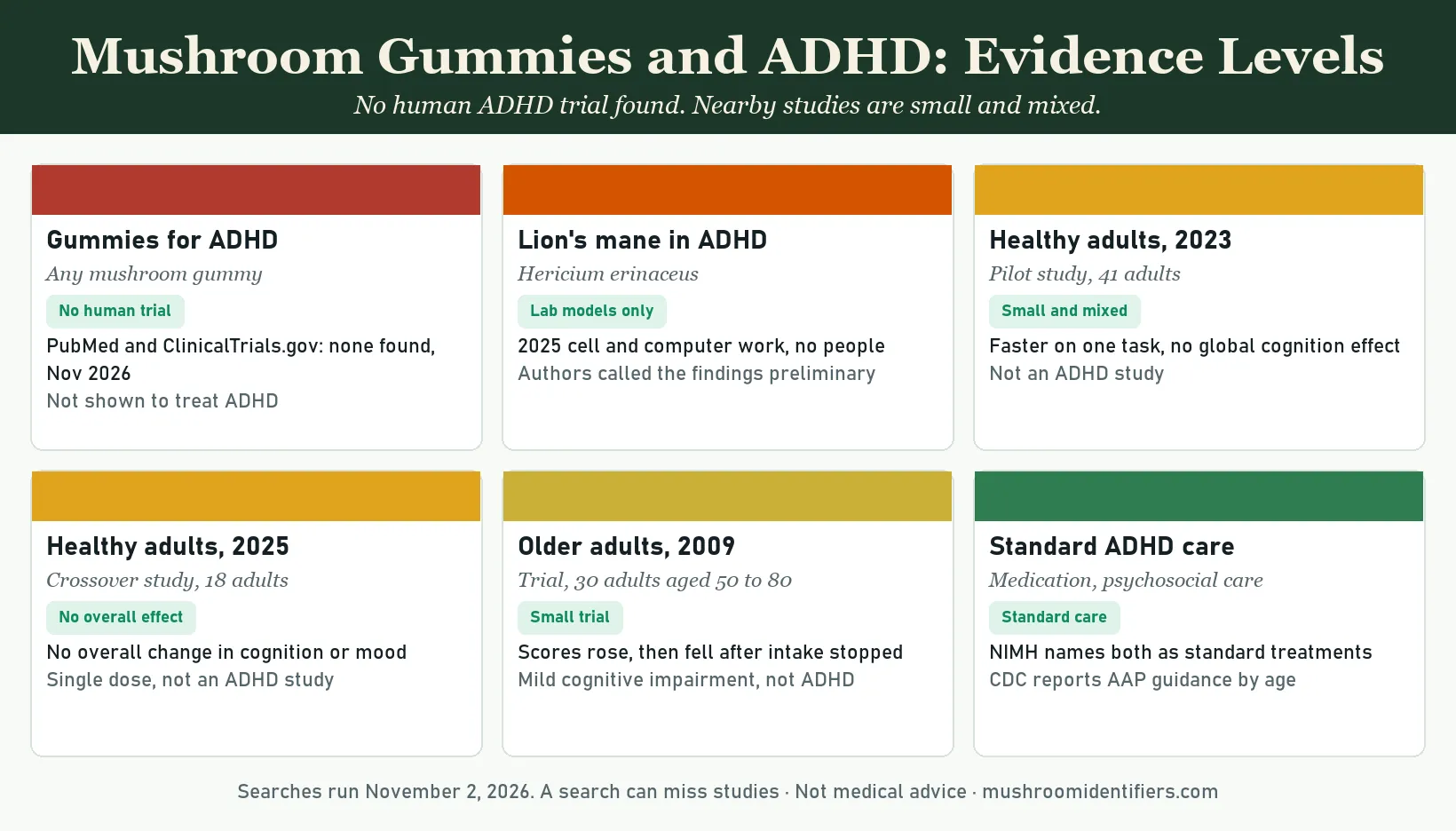
Direct evidence for mushroom gummies in ADHD is missing, and the nearby evidence for lion's mane is small and mixed. This table separates each claim from what studies show.
| Claim | What studies show | Quality of evidence |
|---|---|---|
| Mushroom gummies treat ADHD | No human trial found | None |
| Lion's mane helps ADHD | One 2025 paper using cells and computer models, with no people | Preliminary lab work only |
| Reishi or cordyceps helps ADHD | No human ADHD trial found | None |
| Lion's mane sharpens thinking in healthy adults | Two small studies, one faster task score, no overall gain | Low and mixed |
| Lion's mane helps older adults' memory | One 2009 trial of 30 adults with mild cognitive impairment | Low, and not ADHD |
| Other supplements help ADHD | NCCIH calls omega-3 results unclear and herb research limited | Mixed or limited |
| Medication and behavior therapy | Named as standard care by NIMH and in AAP guidance | Standard treatment |
We searched PubMed on November 2, 2026 for lion's mane, reishi or cordyceps together with ADHD. The search returned 2 records, and neither was a human trial of a mushroom. A ClinicalTrials.gov search the same day returned no registered study. A search can miss work, so treat this as what we could find.
In this table, NIMH is the National Institute of Mental Health, NCCIH is the National Center for Complementary and Integrative Health, and AAP is the American Academy of Pediatrics.
Does Lion's Mane Help ADHD?
Lion's mane has not been shown to help ADHD, because we found no human trial of it in people with ADHD. The closest research tested other groups, and none of it tested a gummy.
- Lab and computer work, 2025: A paper in ACS Omega tested a lion's mane extract on cells and used computer models to predict binding to an ADHD-linked target. No person took the extract. The authors described the findings as preliminary.
- Healthy young adults, 2023: A pilot study in Nutrients followed 41 adults aged 18 to 45 for 28 days. One speed test improved after a single dose. Global cognition showed no treatment effect, and the placebo group improved more on delayed word recall.
- Healthy young adults, 2025: A crossover study in Frontiers in Nutrition gave 18 adults one dose. It found no significant overall effect on cognition or mood. Flanker task scores, a measure of attention control, were worse after the extract than after placebo, and the authors called that inconclusive. Two authors worked for a company that uses lion's mane in its products.
- Older adults, 2009: A Japanese trial followed 30 adults aged 50 to 80 with mild cognitive impairment for 16 weeks. Scores rose in the lion's mane group. They fell significantly 4 weeks after intake stopped.
A 2025 review of 10 human studies said lion's mane shows limited effectiveness in clinical trials. It cited small samples and short study periods, and it did not mention ADHD. Memorial Sloan Kettering does not mention ADHD or attention on its lion's mane page. It lists abdominal discomfort, nausea and skin rash as possible side effects. Our lion's mane guide covers the fungus itself.
What Is Proven to Help ADHD?
Medication and psychosocial interventions are the standard ADHD treatments. The National Institute of Mental Health (NIMH) names both. Its psychosocial examples include cognitive behavioral therapy, parent training and school interventions.
| Who | What guidance says | Source |
|---|---|---|
| Children under 6 | Behavior therapy first, before trying medication | AAP, reported by the CDC |
| Age 6 and older | Medication combined with behavior therapy, and schools can help | AAP, reported by the CDC |
| Adults | Medication and psychosocial interventions, with no separate age advice on this page | NIMH |
The CDC calls stimulants the most widely used ADHD medications. It says nonstimulants act more slowly, but their effects can last up to 24 hours. The CDC page does not mention supplements.
Other supplements have not filled the gap. NCCIH, in a page last updated in 2019, said it is unclear whether omega-3 fatty acids help ADHD. It also said research on carnitine and various herbs is limited and has not shown improved symptoms. That page does not mention any mushroom.
Treatment choices belong to you and your clinician. Keep following your care plan, and raise any supplement at your next visit.
Are Mushroom Gummies Safe With ADHD Medicine?
Nobody can say mushroom gummies are safe with ADHD medicine, because we found no study of the combination. Ask your prescriber or pharmacist before you start one, and bring the bottle. If you are pregnant or breastfeeding, ask first as well, because NCCIH says many supplements have not been tested in those groups.
| Ingredient | What sources report | Ask about |
|---|---|---|
| Lion's mane | Can interact with some medicines, with none named | Every medicine you take |
| Reishi | Can raise bleeding risk with blood thinners, may not be safe with immunosuppressants, and has liver injury reports | Blood thinners, immunosuppressants |
| Cordyceps | May raise bleeding risk and may lower blood sugar | Blood thinners, diabetes medicines |
| Ashwagandha, in some blends | May cause drowsiness and may interact with several drug groups | Sedatives, diabetes, blood pressure, thyroid, seizure and immune medicines |
These sources do not name stimulant or nonstimulant ADHD medicines. That is a gap in the evidence, not a safety finding. Our guides to reishi and cordyceps describe the fungi.
Hidden ingredients add another risk. A 2024 CDC report tested gummies sold as mushroom nootropics or psychedelics. It found unlabeled psilocybin or psilocin in 4 of 6 packages. It also found caffeine, ephedrine and the kratom compound mitragynine in the products tested. Stimulants on top of ADHD medicine are a question for your prescriber, so avoid any gummy with an unexplained "nootropic blend."
Why Should Children Not Take Mushroom Gummies?
No mushroom gummy is recommended for a child, because we found no trial of one in children with ADHD. NCCIH says many dietary supplements have not been tested in children. The AAP guidance reported by the CDC is behavior therapy first for children under 6 and medication with behavior therapy from age 6.
A child also faces accident risks. In the 2024 CDC report, a 3-year-old had drowsiness and vomiting after eating a gummy and was discharged the next day. Sweet gummies can pass for candy, so store them out of a child's reach and sight.
If you are worried about a child's attention, ask the pediatrician for an evaluation. Tell the pediatrician about anything the child already takes.
How Does the FDA Regulate Mushroom Gummies?
The FDA does not approve mushroom gummies or any other dietary supplement before they are sold. The FDA says it has no authority to do so under the law that governs supplements. Manufacturers and distributors hold the first responsibility for safety.
- Disease claims: a supplement cannot claim to treat, diagnose, cure or prevent a disease. A product that does meets the definition of a drug.
- Function claims: a phrase such as "supports focus" is a structure or function claim. The maker must have substantiation for it.
- Required disclaimer: the label must say the FDA has not evaluated the statement and that the product is not intended to diagnose, treat, cure or prevent any disease.
- Problems: see your health care provider first, then report the event through the FDA Safety Reporting Portal.
A word like "focus" on a label is marketing language, not evidence about ADHD.
How to Read a Gummy Label
A useful gummy label names each mushroom, states an amount per serving, and makes no promise about ADHD. Check these points before you buy.
- Species: look for each mushroom by name.
- Amount: look for an amount per mushroom, not only a blend total.
- Serving: check how many gummies make up the stated amount.
- Other actives: look for ashwagandha, caffeine and anything your prescriber should see.
- Quality words: NCCIH warns that "standardized," "verified" or "certified" does not necessarily guarantee quality or consistency.
- Red flags: skip any ADHD treatment claim and any mention of Amanita, muscimol, a trip or a microdose.
Our guide on how many mushroom gummies to eat explains serving sizes and when to call for help.
What We Could Not Confirm
We could not confirm that any mushroom gummy changes ADHD symptoms in anyone. These questions remain open.
- Whether any mushroom gummy is safe with stimulant or nonstimulant ADHD medicine.
- What amount of lion's mane, if any, would matter for attention.
- Whether the 2025 cell and computer findings apply to people.
- Whether the 2023 and 2025 studies excluded people with ADHD, because their main reports do not name it.
- Whether the amounts on a listing match what is in the bottle.
- Whether daily lion's mane is safe over the long term.
If an Adult Still Wants to Try a Lion's Mane Gummy
These gummies are not ADHD treatments, and nothing here suggests they help ADHD. We did not test or score them for this page. They appear only because each listing states a lion's mane amount. Talk to your prescriber first, and follow the serving on the label.
Troomy Focus Lion's Mane Gummies, 30 Count: 400 mg lion's mane in each gummy, per the listing.
WellYeah Lion's Mane Gummies for Adults: 2,000 mg per serving of 2 gummies, per the listing.
Our best mushroom gummies page compares these listings with five others. Our editorial policy explains how we write these guides.
Frequently Asked Questions
Do mushroom gummies help ADHD?
No mushroom gummy has been shown to help ADHD. We found no human trial of a mushroom gummy in people with ADHD. Treat any claim that one works as unproven.
Does lion's mane help ADHD?
Lion's mane has not been shown to help ADHD. The one 2025 paper on ADHD used cells and computer models, with no people. Human studies covered other groups, and two in healthy young adults found no overall gain in cognition.
Can you take lion's mane with ADHD medication?
We found no study of lion's mane taken with ADHD medication, so safety is unknown. Memorial Sloan Kettering says lion's mane can interact with some medicines but names none. Ask your prescriber or pharmacist before you combine them.
Can mushroom gummies replace ADHD medication?
No. No mushroom gummy has been shown to treat ADHD, so a gummy cannot stand in for prescribed care. Talk with your prescriber about any change to your treatment.
Can children take mushroom gummies for ADHD?
No supplement is recommended here for a child. We found no trial of a mushroom gummy in children with ADHD, and NCCIH says many supplements have not been tested in children. Ask the pediatrician about attention concerns.
What is proven to help ADHD?
NIMH names medication and psychosocial interventions as standard ADHD treatments. The CDC reports AAP guidance of behavior therapy first for children under 6. From age 6, that guidance combines medication with behavior therapy.
Do magic mushrooms help ADHD?
We found no randomized trial of psilocybin in people with ADHD in a November 2026 PubMed search. NCCIH said in 2024 that psilocybin is a Schedule I substance and that possession is illegal at the federal level. This page gives no dose of any kind.
Are mushroom gummies FDA approved?
No. The FDA does not approve dietary supplements before they are sold. Manufacturers and distributors hold the first responsibility for safety.
Why do some gummy labels mention focus?
A phrase such as "supports focus" is a structure or function claim. The label must add that the FDA has not evaluated the statement. The phrase is not evidence that a gummy helps ADHD.
Final Safety Reminder
A mushroom gummy is not an ADHD treatment. Do not let a gummy replace prescribed care or delay a diagnosis. Keep gummies out of the reach and sight of children. If anyone feels unwell after a mushroom product, call Poison Help at 1-800-222-1222. Call 911 for a seizure, collapse, trouble breathing or someone who cannot be woken. Never eat a wild mushroom to treat a symptom. Our free mushroom identifier helps with mushrooms you find outdoors, and it cannot tell you what is inside a gummy.
About this guide: we compared government, hospital and journal sources with current Amazon listings and did not test these products. As an Amazon Associate, Mushroom Identifiers earns from qualifying purchases at no extra cost to you. Prices and availability are shown on Amazon.
Sign in to leave a comment and join the discussion.
 Guide
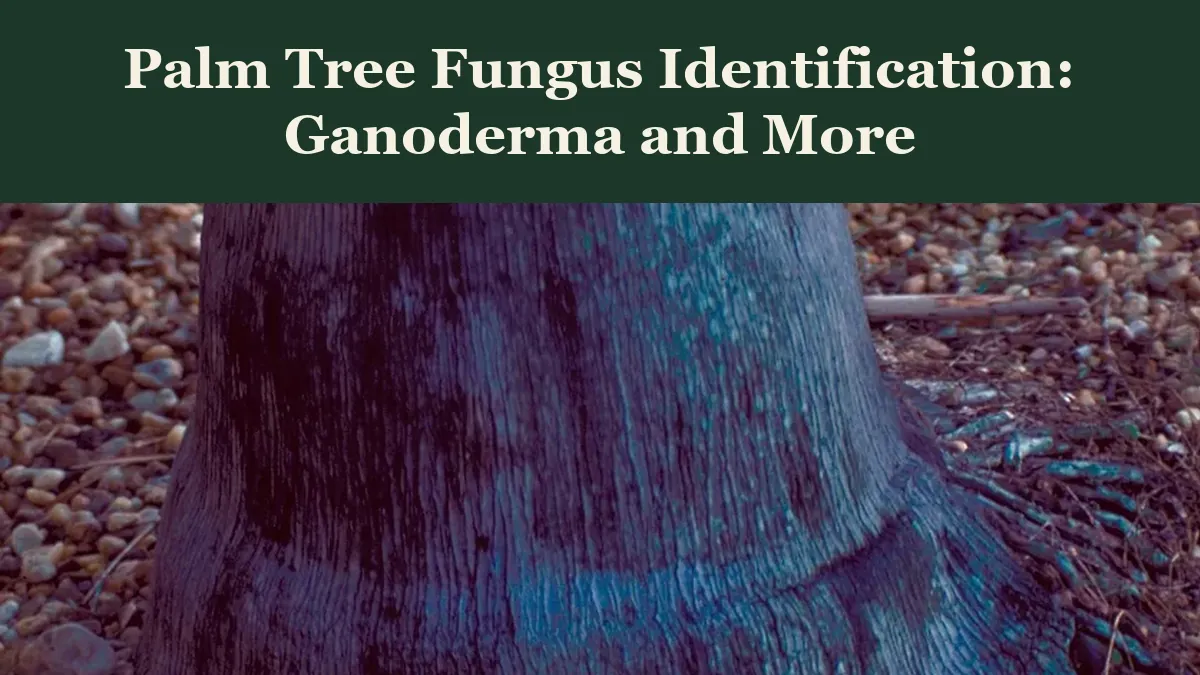
The fungus people notice most on a palm tree is Ganoderma butt rot, a lethal trunk decay with no cure, or a leaf problem that is cosmetic or not caused by a...
 Guide
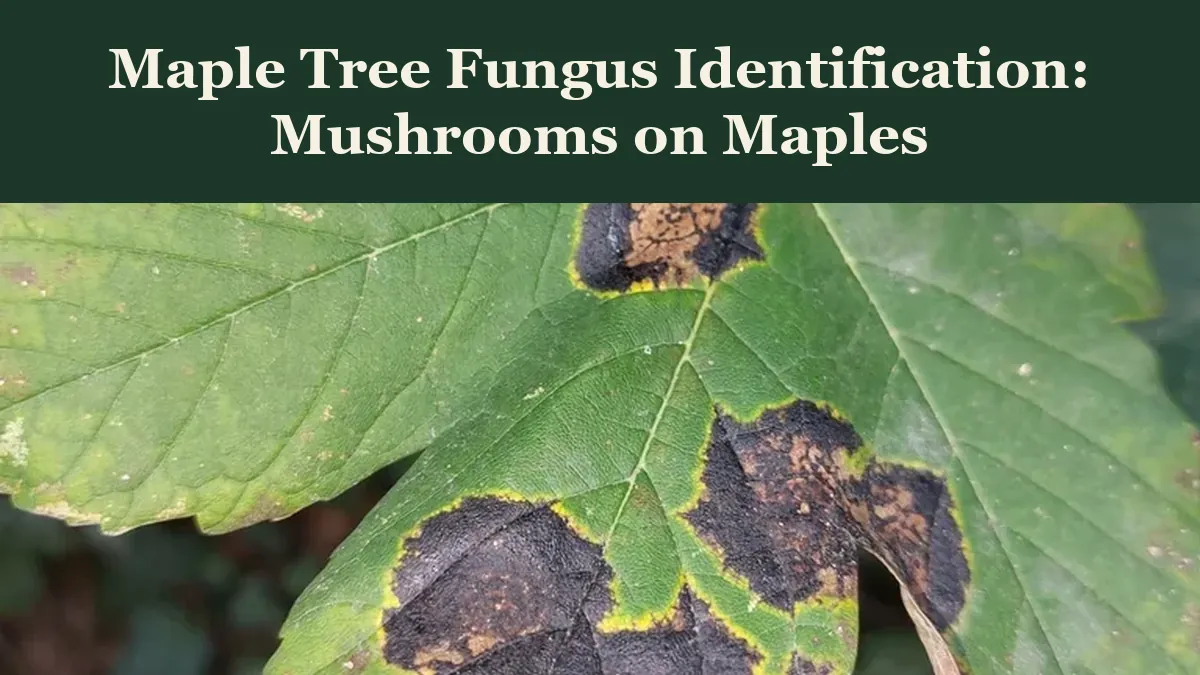
Most maple tree fungus is either a leaf spot that looks alarming but rarely hurts the tree, or a decay fungus fruiting from wood that is already rotting...
 Guide
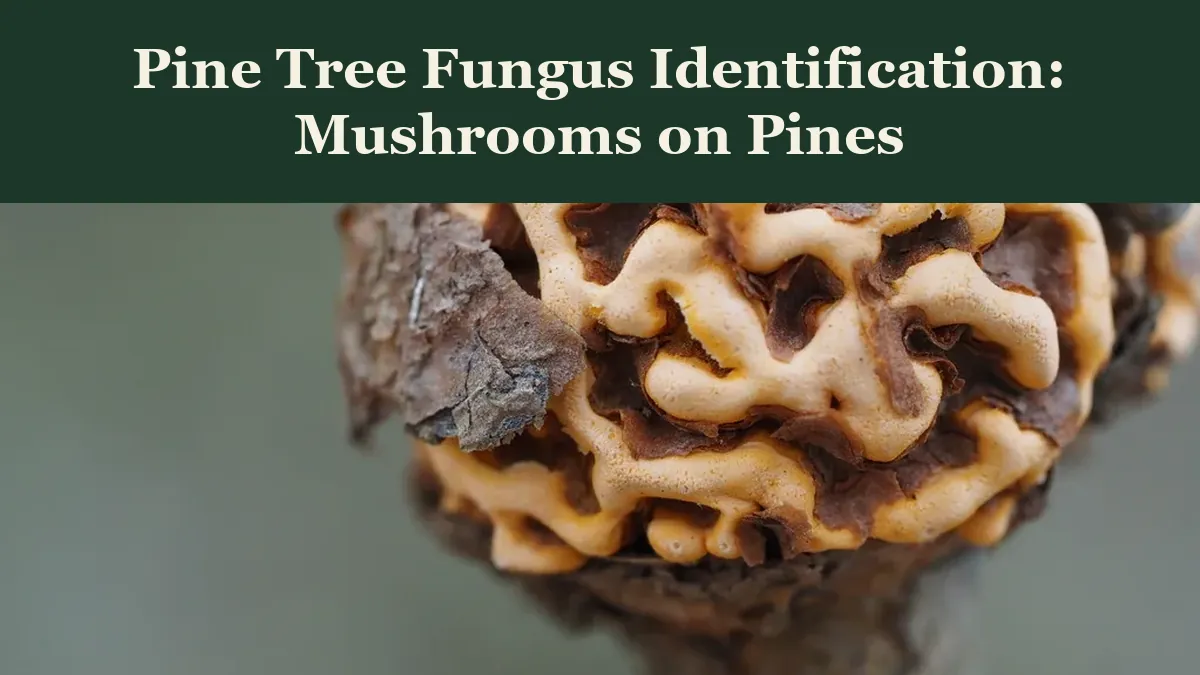
Pine tree fungus identification starts with color and place: orange powder on a woody gall is a rust, brown dead shoot tips are a blight, a conk at the base...