Cup Fungus Identification Chart With Pictures
— views
A cup fungus is a mushroom shaped like a cup, saucer or goblet, with no gills, that makes its spores on the inner surface. The most common US cups are red scarlet cups on spring sticks, the orange peel fungus on bare soil and brown Peziza-type cups. Brown cups are hard to identify, one is poisonous raw, and the false morel genus includes cup-shaped species, so no cup should be eaten without expert confirmation.
This cup fungus identification chart with pictures covers the cups people find most often in the US, how the three scarlet elf cup species differ, the bird's nest fungi that look like cups but are not, a month-by-region season guide and what sources say about eating them.
Key Takeaways
- "Cup fungus" is an informal name for several families of ascomycetes. The shape alone does not tell you the species or whether it is safe.
- Bright red cups on sticks in early spring are scarlet cups. In the East they are Sarcoscypha dudleyi or S. austriaca, not S. coccinea, which grows only on the West Coast.
- A bright orange cup with no stem on bare, disturbed soil is the orange peel fungus, Aleuria aurantia.
- Brown cups need a microscope for most identifications, and the bay cup is reported to be poisonous raw or undercooked.
- Bird's nest fungi hold tiny "eggs" and belong to a different group, closer to gilled mushrooms than to cup fungi.
- Few cups are worth eating, and none should be eaten without expert confirmation.
Cup Fungus Identification Chart
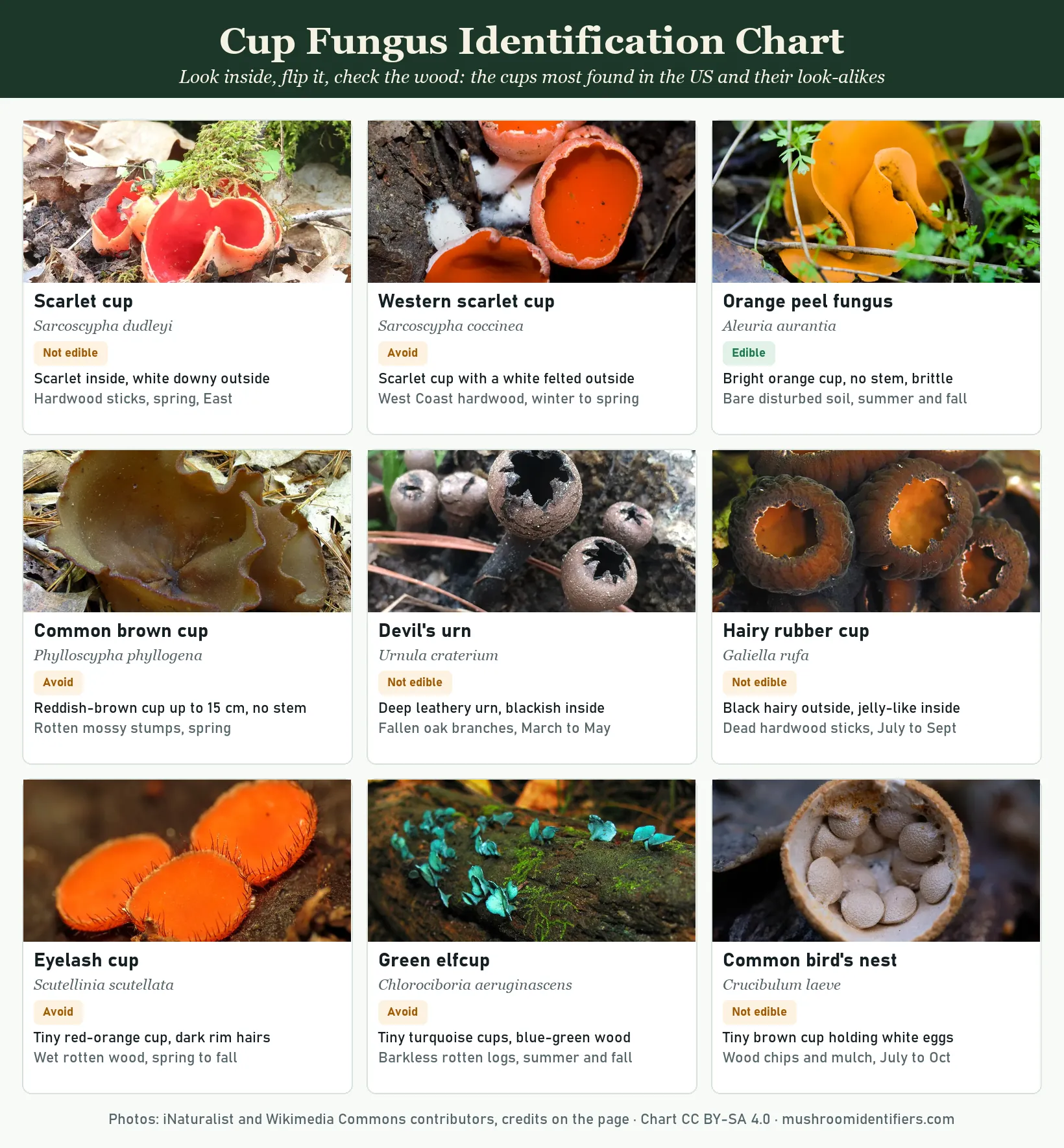
Match the inside color first, then check the outside, the stem and what the cup grows on. Season is the next clue, because most cups fruit in a narrow window. Brown cups are the exception: most of them need an expert with a microscope.
| Cup | Key features | Where and when | Edibility or risk |
|---|---|---|---|
| Scarlet cup (Sarcoscypha dudleyi, S. austriaca) | Scarlet inside, whitish downy outside, 2 to 7 cm, little or no stem | Hardwood sticks, sometimes buried; spring; east of the Rockies | Not edible, per Missouri Department of Conservation |
| Western scarlet cup (Sarcoscypha coccinea) | Scarlet inside, white felted outside, no marginal hairs | Buried or fallen hardwood branches, often oak; late winter and spring; West Coast only | "Questionable," per MykoWeb |
| Orange peel fungus (Aleuria aurantia) | Bright orange inside, paler powdery outside, no stem, brittle | Bare, disturbed soil on trails and roadbanks; summer and fall, late fall to spring in California | Edible but "of no consequence," per MykoWeb |
| Common brown cup (Phylloscypha phyllogena) | Reddish-brown to olive-brown cup up to 15 cm, no stem | Rotten, mossy stumps or the ground; spring to early summer | Avoid; brown cups need a microscope |
| Bay cup (Peziza badia) | Bay-brown, scurfy outside, olive-tinted inside, no stem | Compacted soil and footpaths; fall | Poisonous raw or undercooked, per First Nature |
| Devil's urn (Urnula craterium) | Deep, leathery urn, blackish inside, on a short hairy black stalk | Fallen oak branches; March to May | Not edible |
| Hairy rubber cup (Galiella rufa) | Reddish-brown inside, black hairy outside, rubbery jelly flesh | Dead hardwood sticks; July to September | Not edible |
| Eyelash cup (Scutellinia scutellata) | Red to orange cup under 1.5 cm with dark "eyelash" hairs on the rim | Wet rotten wood or damp soil; spring to fall | No edibility data; tiny and insubstantial |
| Green elfcup (Chlorociboria aeruginascens) | Turquoise cups 1 to 15 mm; wood stained blue-green | Barkless rotten logs; summer and fall | No edibility data |
| Common bird's nest (Crucibulum laeve) | Tiny brown cup holding white "eggs"; not a true cup fungus | Wood chips, mulch, dead wood; July to October | Not edible |
Sources for each row are linked in the sections below. For cups found on garden mulch and lawns, see our backyard mushroom identification guide.
What Is a Cup Fungus?
"Cup fungus" is an informal name for mushrooms shaped like cups, saucers or goblets, not a scientific group. Cup-shaped fungi span several families and genera, all in the Ascomycota. The spore-producing surface is the upper, inner side of the cup. The outer side is sterile, and its hairs, color and texture are some of the best clues.
Cup fungi have relatives that look nothing like cups. Morels and false morels are ascomycetes too. One field guide's cup key even includes several cup-shaped species of Gyromitra, the genus of the false morel. Many cups were long assumed to be decomposers, but work since 2006 suggests that many may be mycorrhizal partners of trees.
Brownish, stemless cups are especially difficult and often need a microscope.
How Do You Identify a Cup Fungus?
Use the flip test: look inside, flip the cup to check the outside and the stem, then check what it grows on and the month. The inside color sorts the cups into groups. The outside often separates look-alikes in the same group. Substrate and season then narrow it further, and a hand lens helps with the hairs on the rim.
| Check | What to look for | What it points to |
|---|---|---|
| 1. Inside color | Red, orange, brown, black or turquoise | Red: scarlet cups or eyelash cups. Orange: orange peel. Brown: Peziza-type cups or hairy rubber cup. Black: devil's urn. Turquoise: green elfcup. |
| 2. Outside | Flip it over and use a hand lens | White and downy: scarlet cup. Pale and powdery: orange peel. Black and hairy: hairy rubber cup. Long dark hairs on the rim: eyelash cup. |
| 3. Stem | Lift the cup and look at the base | No stem: orange peel, brown cups, eyelash cup. Short hairy black stalk: devil's urn. A long stalk on a tiny red cup: stalked scarlet cup. |
| 4. Substrate | Dig gently under the cup | Sticks or buried wood: scarlet cups, devil's urn, hairy rubber cup. Bare soil: orange peel. Mulch with "eggs" inside: bird's nest fungi. |
| 5. Texture | Press or tear the flesh | Brittle: orange peel. Tough and rubbery: devil's urn. Jelly-like inside: hairy rubber cup. |
| 6. Month | Note the date and region | Spring, March to May in Missouri: scarlet cups and devil's urn. July to September: hairy rubber cup. Late winter on the West Coast: S. coccinea. |
Our guide to identifying a mushroom you found covers how to collect and photograph a find.
Common Cup Fungus Types in the US
The cups people find most often in the US are scarlet cups in spring, the orange peel fungus on bare soil, brown cups on stumps and paths, and the devil's urn on oak branches. The eyelash cup and green elfcup are common too, but easy to miss.
Scarlet Cup (Sarcoscypha dudleyi)
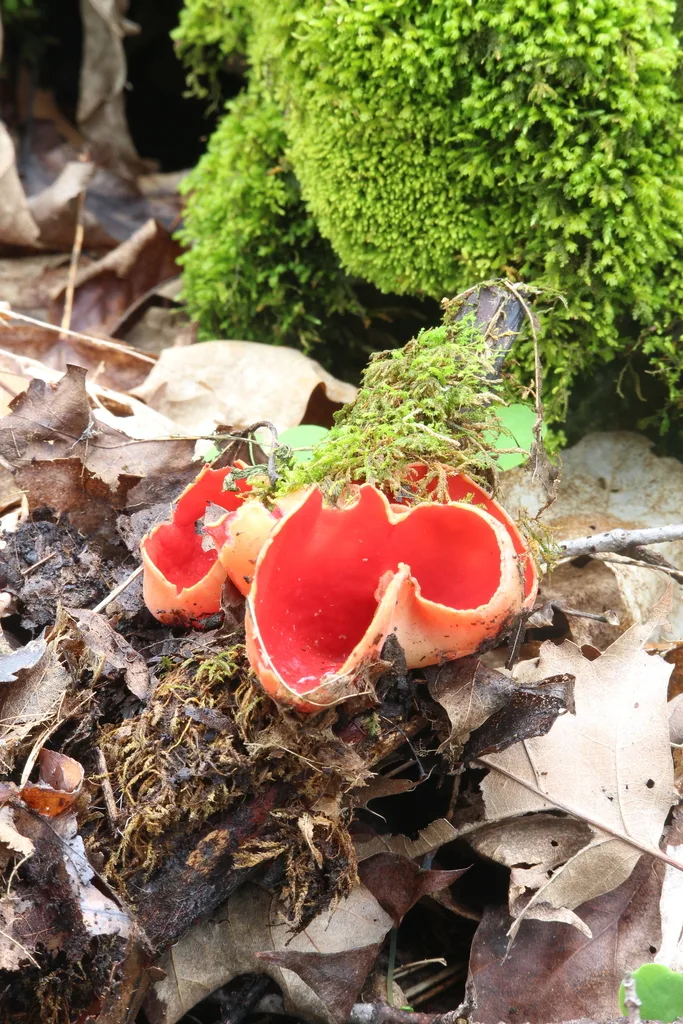
This is the bright red cup of early spring in the East. The Missouri Department of Conservation describes a shallow cup 3/4 to 2 inches wide, scarlet inside and white with tiny hairs outside, usually without a stalk. It grows on fallen wet sticks and branches in damp hardwood forests from March to May. MDC calls it one of the earliest Missouri mushrooms to emerge in spring and lists it as not edible. The wood is sometimes buried, so the cups can seem to grow from soil, and that morel hunters often find it.
A second eastern species, Sarcoscypha austriaca, looks identical to the naked eye. It reaches 2 to 7 cm and often becomes wrinkled near the center with age. Both are widely distributed east of the Rocky Mountains, and only a microscope separates them.
Western Scarlet Cup (Sarcoscypha coccinea)
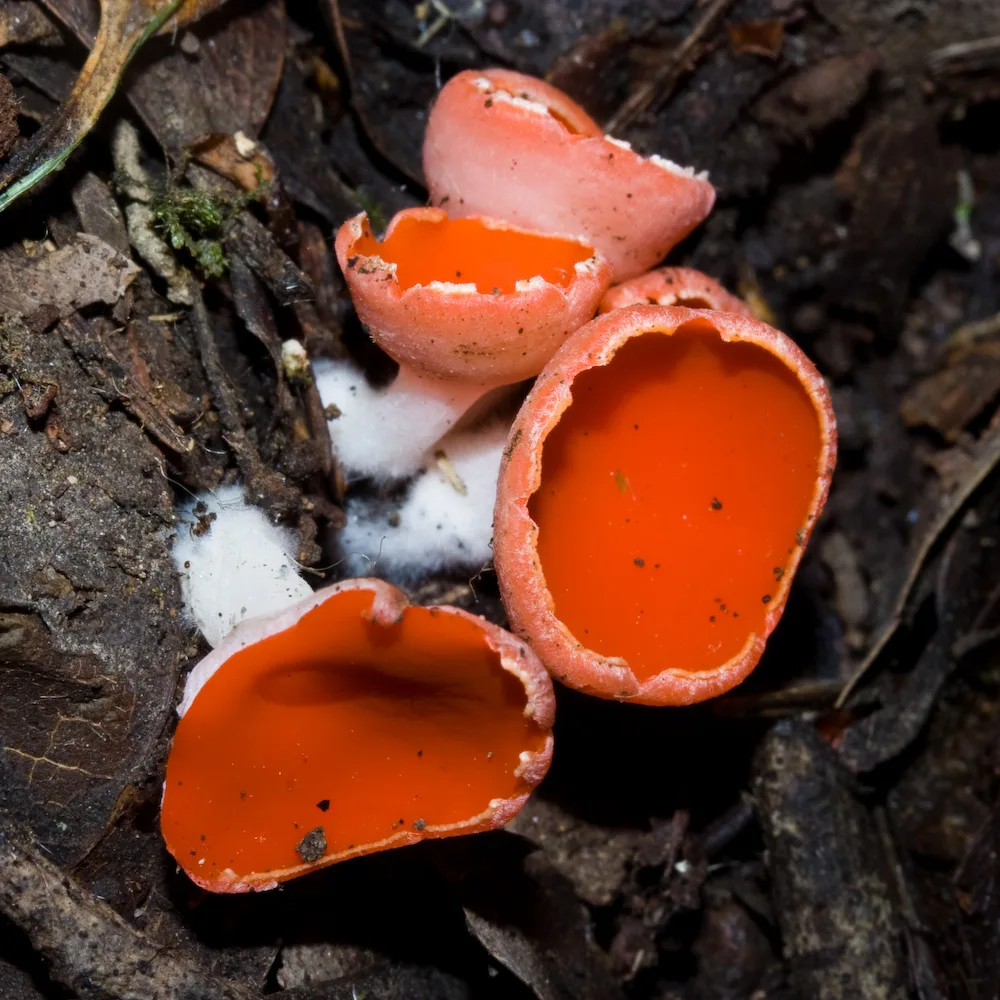
The true Sarcoscypha coccinea grows only on the West Coast. Field guides often present it as widespread in North America, but in the strict sense it occurs only in the Pacific Northwest and California. MykoWeb describes cups 1 to 5 cm wide on buried or fallen hardwood branches, especially oaks. In California it fruits in late winter and spring and seldom appears before January. MykoWeb rates its edibility as questionable and untried in its area.
Orange Peel Fungus (Aleuria aurantia)
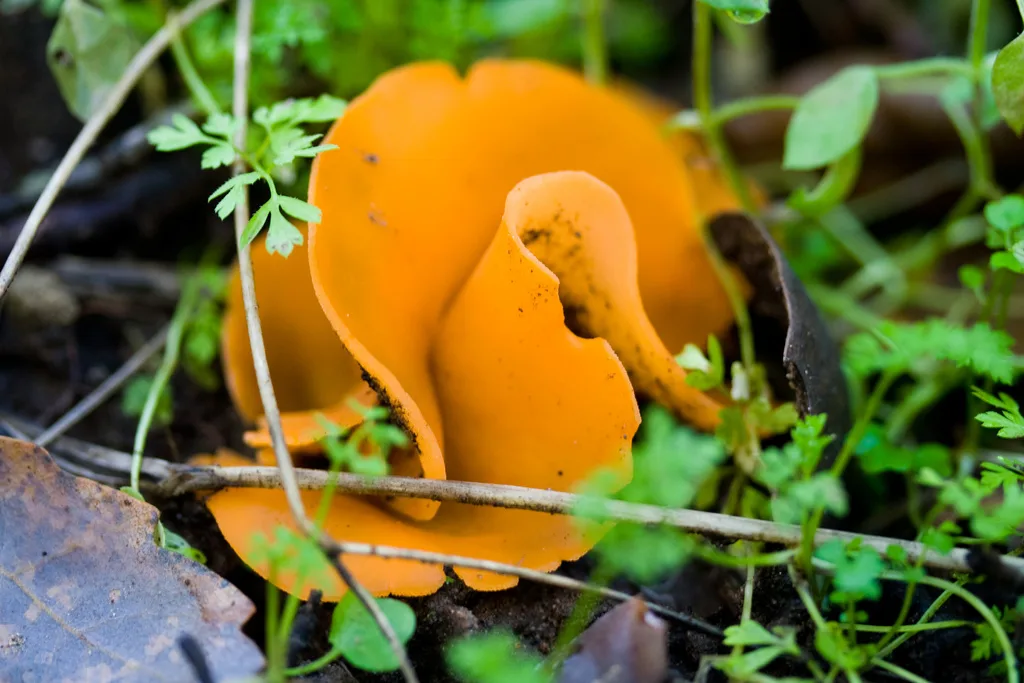
This bright orange cup looks like a piece of orange peel dropped on a trail. A North American field guide describes a cup 1.5 to 7 cm across with no stem, pinched together where it attaches, and brittle flesh. It grows in clusters on clayey or disturbed ground such as roadbanks, trails and urban landscaping. It fruits in summer and fall, or over winter in warm climates. MykoWeb calls it the orange cup, places its California peak from November through January, and lists it as edible but of no consequence.
Common Brown Cup (Phylloscypha phyllogena)
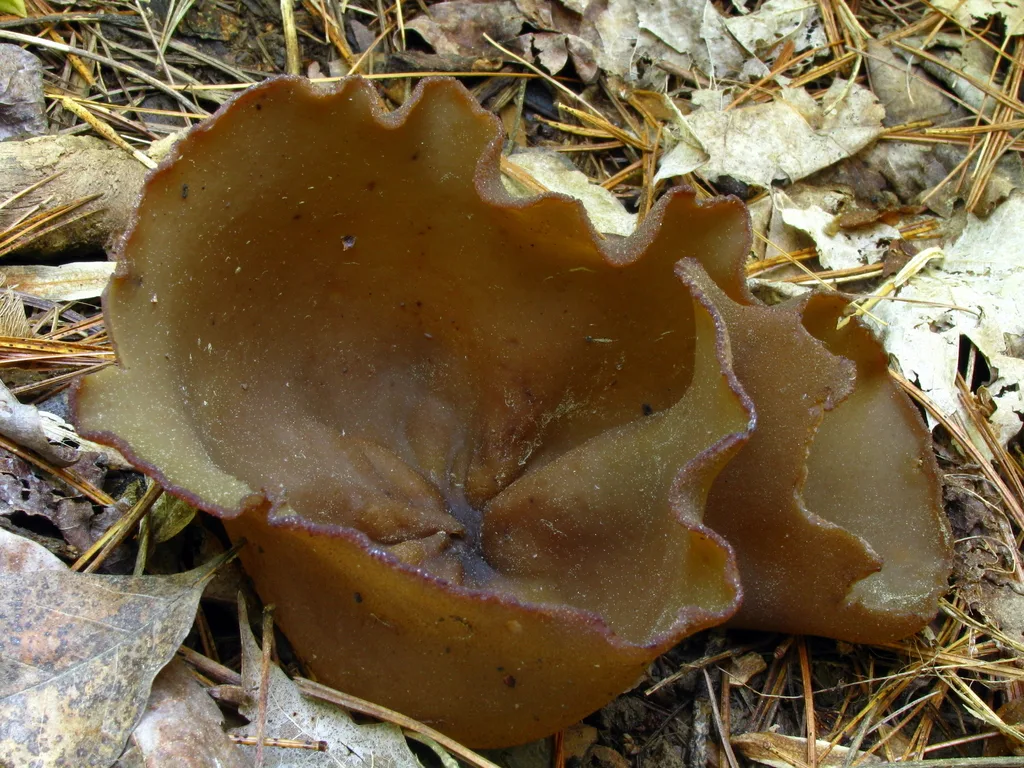
This is the large brown cup of spring stumps, and it has a new name. The Fungi on Wood guide hosted by one species account lists it as Phylloscypha phyllogena, with Peziza phyllogena and Peziza badioconfusa as older names. It reaches 15 cm, has no stem, and is reddish brown to olive brown inside. It grows on well-decayed, often mossy stumps or on the ground from spring through early summer. It resembles the bay cup, which fruits later in the year and has different spores.
Bay Cup (Peziza badia)
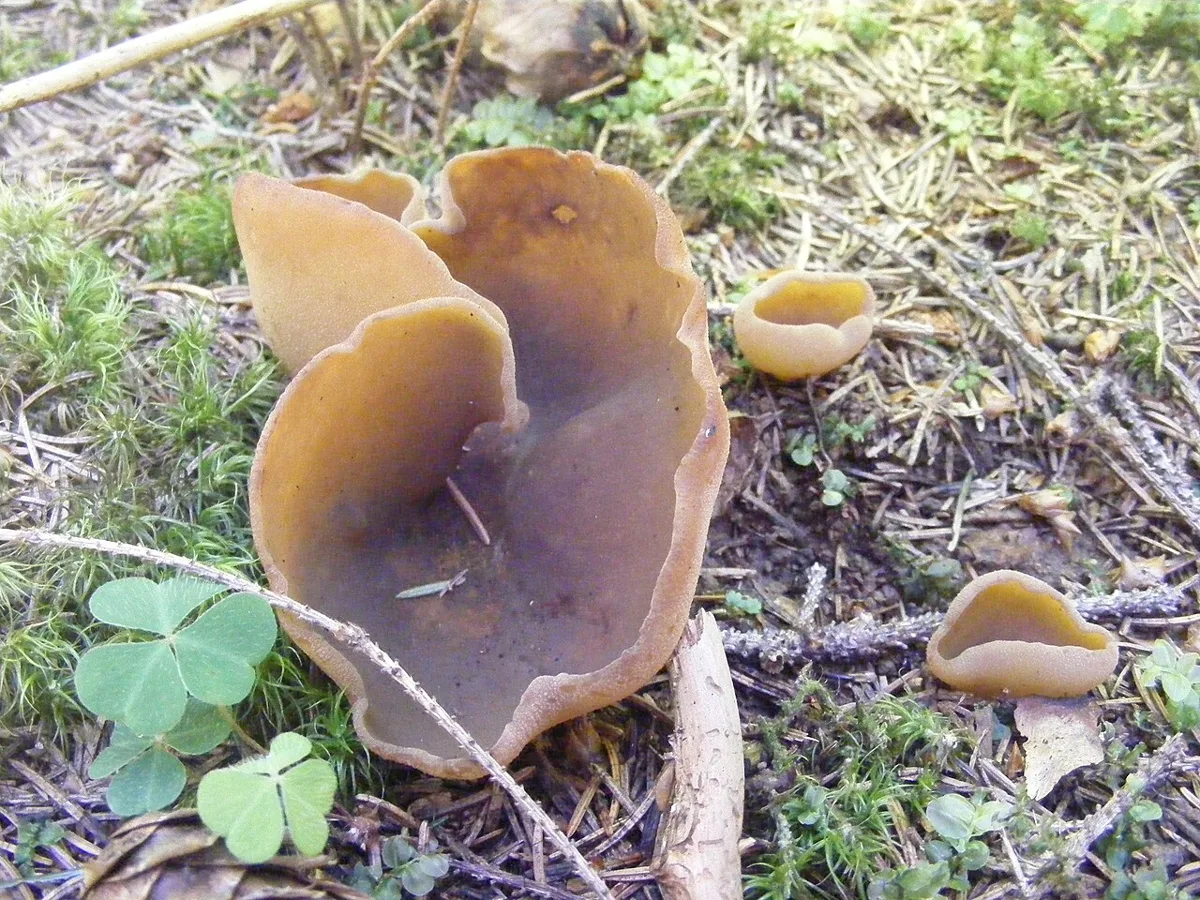
The bay cup is the brown cup with the clearest toxicity warning. First Nature describes a stemless cup 2 to 8 cm across, bay brown and scurfy outside and often olive-tinted inside, on compacted soil and forest paths. It is reported from North America. First Nature states that it is poisonous if eaten raw or not cooked enough and can cause severe stomach upset. The same source counts at least 100 Peziza species, most of them fawn or brown, and says definite identification is rarely possible without a microscope.
Devil's Urn (Urnula craterium)
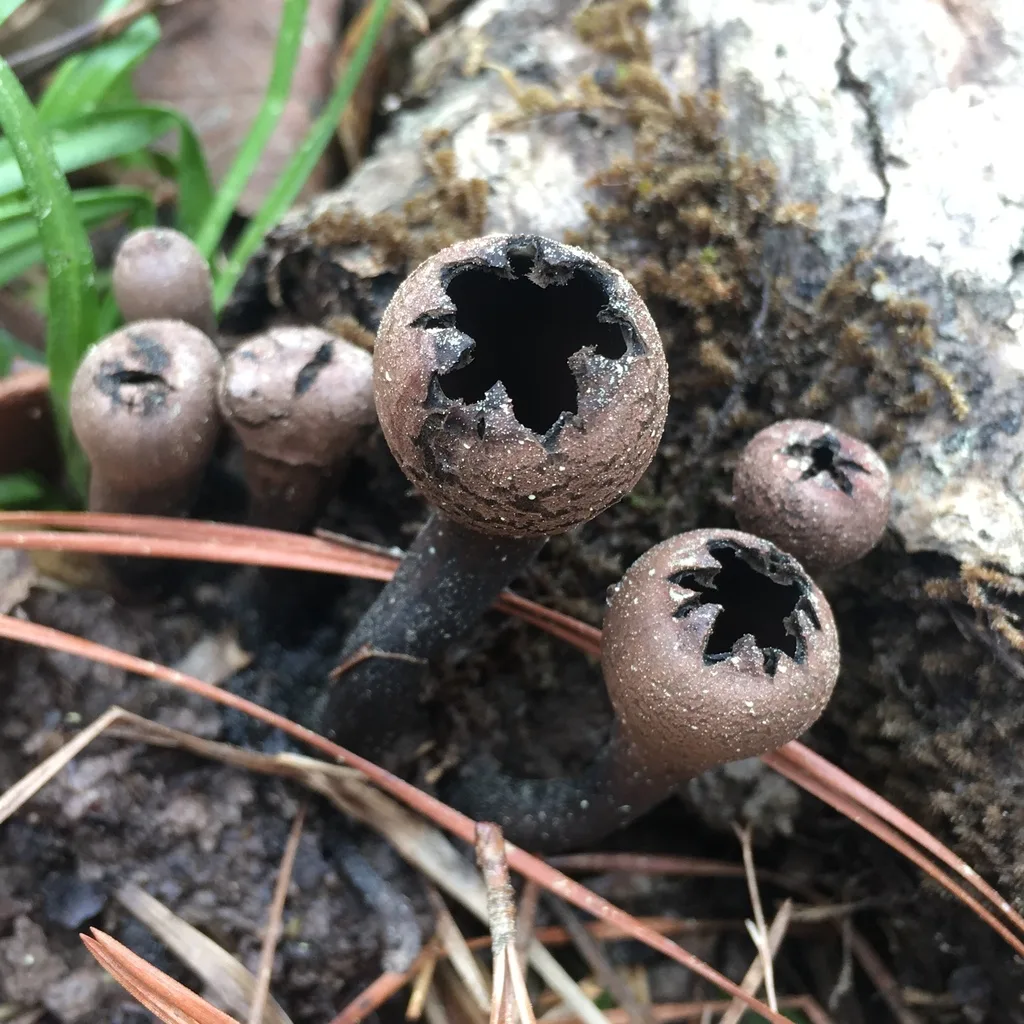
The devil's urn is a deep, dark goblet on oak branches in spring. The Missouri Department of Conservation describes a leathery cup 1 3/4 to 3 1/4 inches wide that starts closed and opens into an urn, with a tough, rubbery texture and a blackish, finely hairy stalk. It grows in clusters on decaying hardwood branches, especially fallen oak, often touching the soil, from March to May. MDC lists it as not edible.
Hairy Rubber Cup (Galiella rufa)
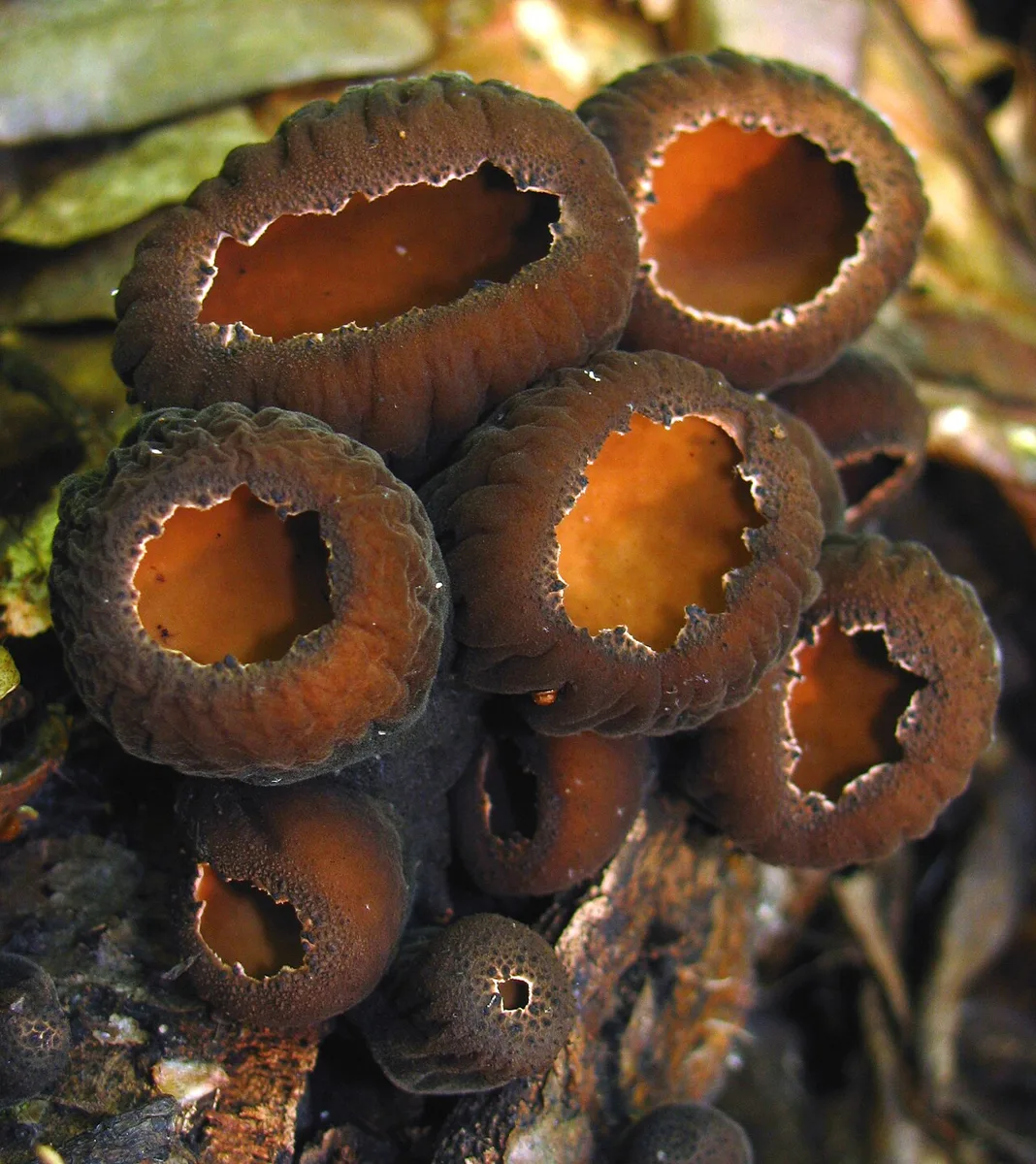
This is the brown cup that feels like rubber. The Missouri Department of Conservation describes cups 3/4 to 1 1/4 inches wide with a reddish to brownish inside, a blackish-brown hairy outside and a gelatinous, rubbery interior. It grows in clusters on dead hardwood sticks and small logs from July to September. MDC notes that no other brown to black cup has such thick, gelatinous flesh, and lists it as not edible. Older books call it Bulgaria rufa.
Eyelash Cup (Scutellinia scutellata)
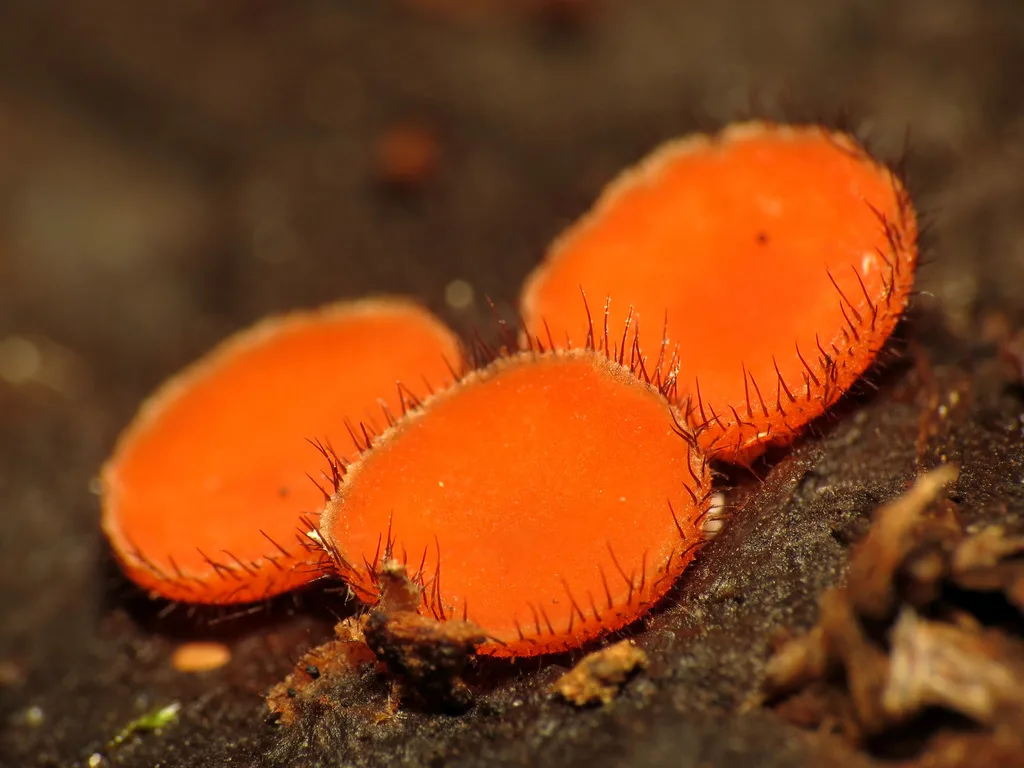
This tiny red to orange cup has a fringe of dark hairs around the rim. One species account gives a size of up to 1.5 cm, with no stem and thin, insubstantial flesh. It grows in groups on wet, rotted wood or damp soil nearby from spring through fall, across North America. There are many Scutellinia species, and naming one for certain depends on its spores and hairs under a microscope.
Green Elfcup (Chlorociboria aeruginascens)
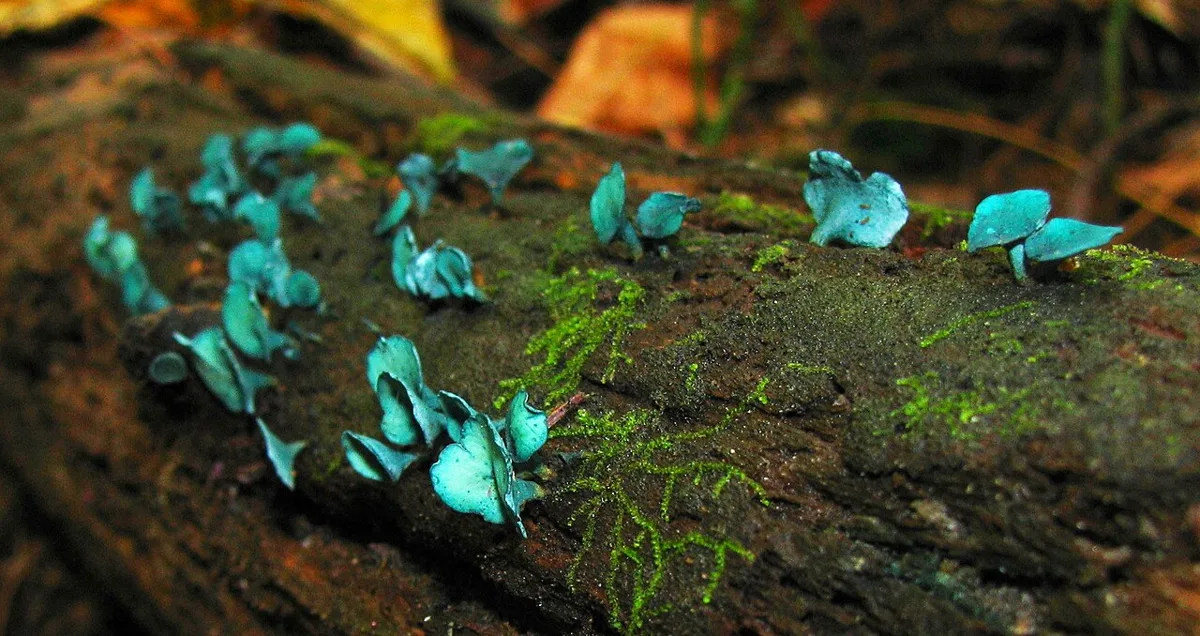
Most people see this fungus as blue-green wood before they ever see a cup. The stained wood turns up much more often than the turquoise cups, which are only 1 to 15 mm across on a tiny stem. It grows on well-decayed, barkless logs and sticks of hardwoods and conifers. The stain is visible all year, while the cups usually appear in summer and fall. North America has a second species, Chlorociboria aeruginosa, that looks practically identical.
Scarlet Elf Cup: How the Three US Species Differ
The scarlet elf cup name covers three species in the US, and where you found it matters more than how it looks. The two eastern species look identical without a microscope, while the true Sarcoscypha coccinea is confined to the West Coast. Many field guides still label eastern finds as S. coccinea.
| Feature | S. dudleyi | S. austriaca | S. coccinea |
|---|---|---|---|
| US range | East of the Rockies | East of the Rockies | Pacific Northwest and California |
| Season | Spring | Spring | Winter and spring |
| Size | 2 to 5 cm | 2 to 7 cm | Up to 4 cm |
| Hairs on the outside (microscope) | Straight or slightly curved | Elaborately twisted and intertwined | Slightly curved, not twisted |
| Spores (microscope) | Fully sheathed, two large oil drops | Not fully sheathed, many small oil drops | Many small oil drops |
The details come from the field guide species pages linked above. Their author knows of no published DNA study showing that North American S. austriaca is the same as the original Austrian species. MDC adds that the stalked scarlet cup (Sarcoscypha occidentalis) has a long stalk, a cup rarely over 1/2 inch and a later season.
Cup Fungus Look-Alikes: Side-by-Side Comparison
The look-alikes that matter are bird's nest fungi, which are not cup fungi at all, the cup-shaped relatives of the false morel, and brown cups that can be poisonous raw. Dead man's fingers and the cinnabar chanterelle can also be confused with closed or red cups.
| Look-alike | How it differs | Grows on | Risk |
|---|---|---|---|
| Bay cup and other brown Peziza | Brown, stemless, needs a microscope | Soil, paths, wood | Bay cup poisonous raw or undercooked |
| Cup-shaped Gyromitra | Cup-shaped species in the false morel genus; separated by microscope features | Wood or soil | Avoid; false morel relatives |
| Common bird's nest (Crucibulum laeve) | Tiny cup holding whitish "eggs" on cords | Wood chips, mulch, dead wood | Not edible |
| Stalked scarlet cup (Sarcoscypha occidentalis) | Long stalk, cup under 1/2 inch | Hardwood sticks, later in the season | Treat like other scarlet cups |
| Cinnabar chanterelle (Cantharellus cinnabarinus) | Red, but has a cap and stem | The ground | Needs expert confirmation |
| Dead man's fingers (Xylaria polymorpha) | Black club that never opens | Base of hardwood stumps | Not edible |
Common Bird's Nest (Crucibulum laeve)
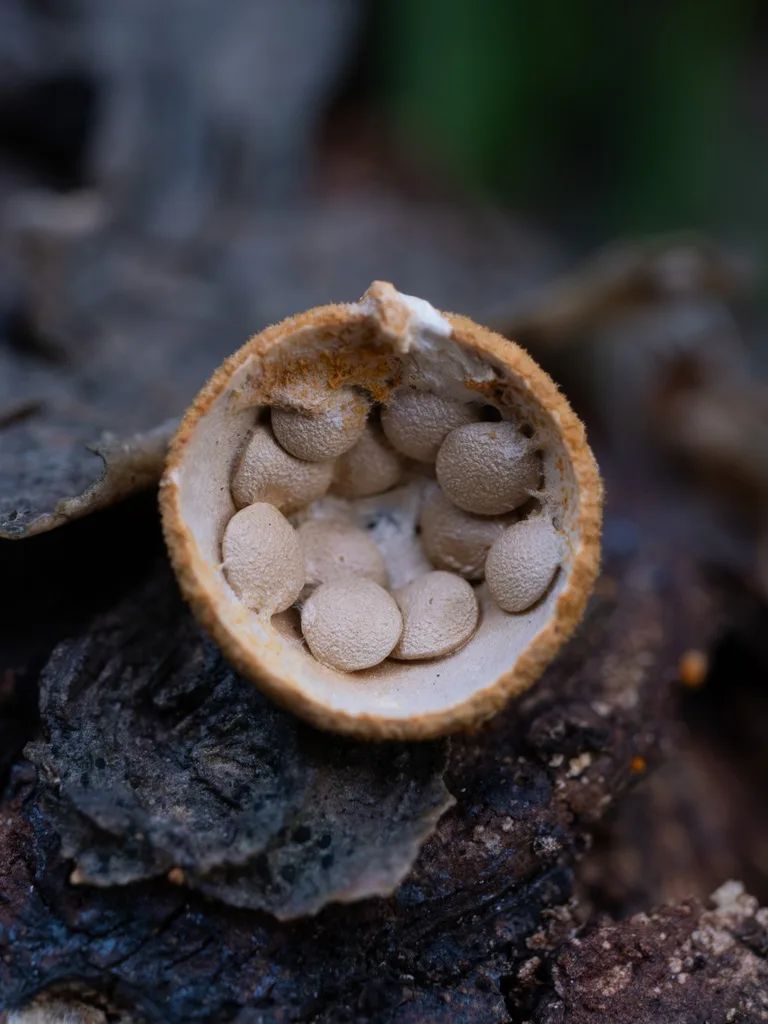
Bird's nest fungi look like tiny cups full of eggs, but they are a different group. A standard reference places them in the Agaricales, the order of most gilled mushrooms, and explains that the nests work as splash cups: raindrops knock out the spore-filled "eggs." The Missouri Department of Conservation describes the common bird's nest as a cup 1/4 to 5/8 inch wide, yellowish inside and woolly brownish gray outside. It grows in clusters on dead wood, debris and wood chips, and it is common on landscaping mulch from July to October. MDC states that raindrops throw the eggs about 3 or 4 feet, and lists it as not edible.
Are Cup Fungi Edible or Poisonous?
Most cup fungi are listed as not edible or too small to matter, the bay cup is poisonous raw or undercooked, and cup-shaped false morel relatives need a microscope to rule out. The Missouri Department of Conservation lists the scarlet cup, devil's urn and hairy rubber cup as not edible. MykoWeb lists the orange peel fungus as edible but of no consequence. Nobody should eat a cup fungus based on this page.
Brown cups carry the most risk. First Nature reports that the bay cup is poisonous if eaten raw or not cooked enough. One field guide's cup key separates the cup-shaped Gyromitra species from other cups by microscope features, so a brown cup cannot be ruled out as a false morel relative by eye. A North American field guide gives no edibility data for the tiny eyelash cup and green elfcup.
Our poisonous vs edible mushrooms guide explains why simple rules fail. Do not breathe in spores either: MDC notes that blowing into a mature scarlet cup releases its spores and advises against inhaling them. If a pet eats a cup fungus, follow our steps on what to do if your dog ate a mushroom.
When Do Cup Fungi Appear? A Season Guide by Region
In the East and Midwest, cup fungus season starts with scarlet cups and devil's urns from March to May, moves to hairy rubber cups and bird's nests in summer, and ends with orange peel and bay cups in fall. In California, the scarlet cup fruits from January into spring and the orange peel peaks from November to January.
| Region and months | Cups to expect |
|---|---|
| East and Midwest, March to May | Scarlet cups (S. dudleyi, S. austriaca) and the devil's urn, per MDC in Missouri |
| Spring to early summer | Common brown cup on mossy stumps |
| Midwest (Missouri), July to October | Hairy rubber cup (July to September), common bird's nest (July to October) |
| Summer and fall, widespread | Orange peel fungus, green elfcup, eyelash cup (spring to fall) |
| California, November to January | Orange peel fungus at its peak |
| West Coast, January to spring | Western scarlet cup (S. coccinea) on hardwood branches, often oak |
Spring cups and morels overlap. MDC reports that experienced morel hunters treat mature devil's urns as a sign that morels are emerging notes that morel hunters often find scarlet cups. See our morel identification guide, and our guide to mushroom habitat for how wood and soil fungi differ.
Common Identification Mistakes
Calling an Eastern Scarlet Cup Sarcoscypha coccinea
Many field guides do this. East of the Rockies, a scarlet cup is S. dudleyi or S. austriaca, and only the West Coast has S. coccinea.
Naming a Brown Cup From a Photo
Brown, stemless cups are among the hardest fungi to identify, and some cup-shaped fungi belong to the false morel genus. Treat every brown cup as unidentified until an expert checks it under a microscope.
Missing the Buried Stick
Scarlet cups, devil's urns and hairy rubber cups often grow from buried wood and seem to grow from soil. Dig gently under the cup before deciding on the substrate.
Mistaking a Bird's Nest for a Cup Fungus
Look inside. Bird's nest fungi hold small "eggs," while true cup fungi have a smooth or wrinkled inner surface with nothing in it.
Frequently Asked Questions
What is a cup fungus?
A cup fungus is a mushroom shaped like a cup, saucer or goblet, with spores made on the inner surface. The name is informal and covers several families of ascomycetes. Scarlet cups, the orange peel fungus and brown Peziza-type cups are common examples.
Is scarlet elf cup edible?
The Missouri Department of Conservation lists the eastern scarlet cup as not edible, and MykoWeb calls the western species questionable. They are small and easy to confuse with other red cups. Do not eat one without expert confirmation.
Where do scarlet elf cups grow?
Scarlet cups grow on fallen hardwood sticks and branches, often partly buried, in damp woods. In the East they fruit from about March to May. On the West Coast, Sarcoscypha coccinea fruits from winter into spring, often on oak branches.
Is orange peel fungus edible?
MykoWeb lists the orange peel fungus as edible but of no consequence. It is a bright orange, stemless, brittle cup on bare soil. Like any wild mushroom, it needs expert confirmation before anyone eats it.
Are brown cup fungi poisonous?
Some are. First Nature reports that the bay cup is poisonous if eaten raw or undercooked and can cause severe stomach upset. Most brown cups need a microscope to identify, and some cup-shaped fungi belong to the false morel genus.
Is a bird's nest fungus a cup fungus?
No. Bird's nest fungi look like tiny cups, but they hold spore-filled eggs and belong to the Agaricales with most gilled mushrooms. Rain splashes the eggs out of the nest to spread them.
What is the black cup fungus on oak branches in spring?
A deep black goblet on fallen oak branches from March to May is usually the devil's urn, Urnula craterium. It is tough and leathery, and the Missouri Department of Conservation lists it as not edible. Morel hunters treat it as a sign that morels are coming.
What fungus stains rotten wood blue-green?
Blue-green stained wood is a sign of Chlorociboria, the green elfcup fungus. The stain shows all year, while the tiny turquoise cups appear mainly in summer and fall. The stained wood is far more common than the cups.
Are cup fungi related to morels?
Yes. Cup fungi, morels and false morels are all ascomycetes, and some cup-shaped species belong to the false morel genus Gyromitra. Scarlet cups and devil's urns also fruit in morel season.
Final Safety Reminder
Cup fungi are some of the first mushrooms of spring, but brown cups and false morel relatives are not beginner finds. Never eat a wild mushroom based on a chart, a photo or an app. Photograph the inside, the outside and the base using our guide on how to photograph mushrooms for identification, then check them with our free mushroom identifier and a local mycological club. If someone may have eaten a poisonous mushroom in the US, call Poison Control at 1-800-222-1222.
Sign in to leave a comment and join the discussion.
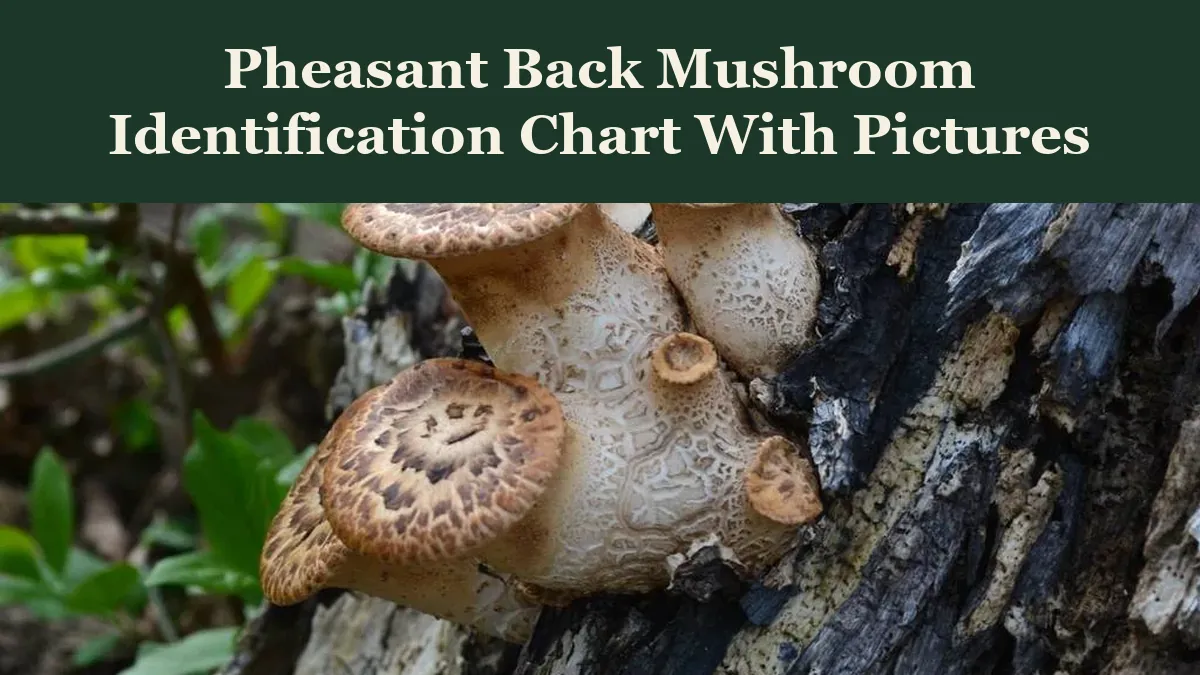 Species Guide
A pheasant back mushroom is a large, fan-shaped polypore with brown scales on a cream to tan cap, big angular pores underneath and a short stem that is...
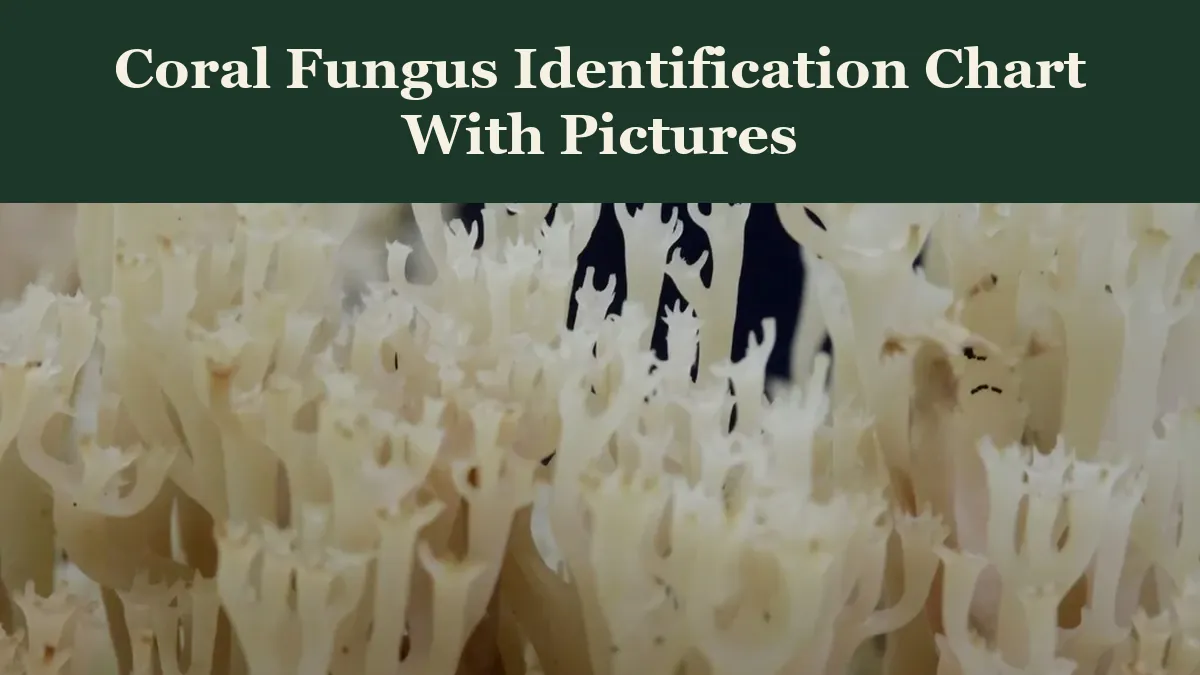 Species Guide
A coral fungus is a mushroom shaped like branching sea coral or a tuft of upright clubs, with no cap and no gills. Most US corals grow from soil in the...
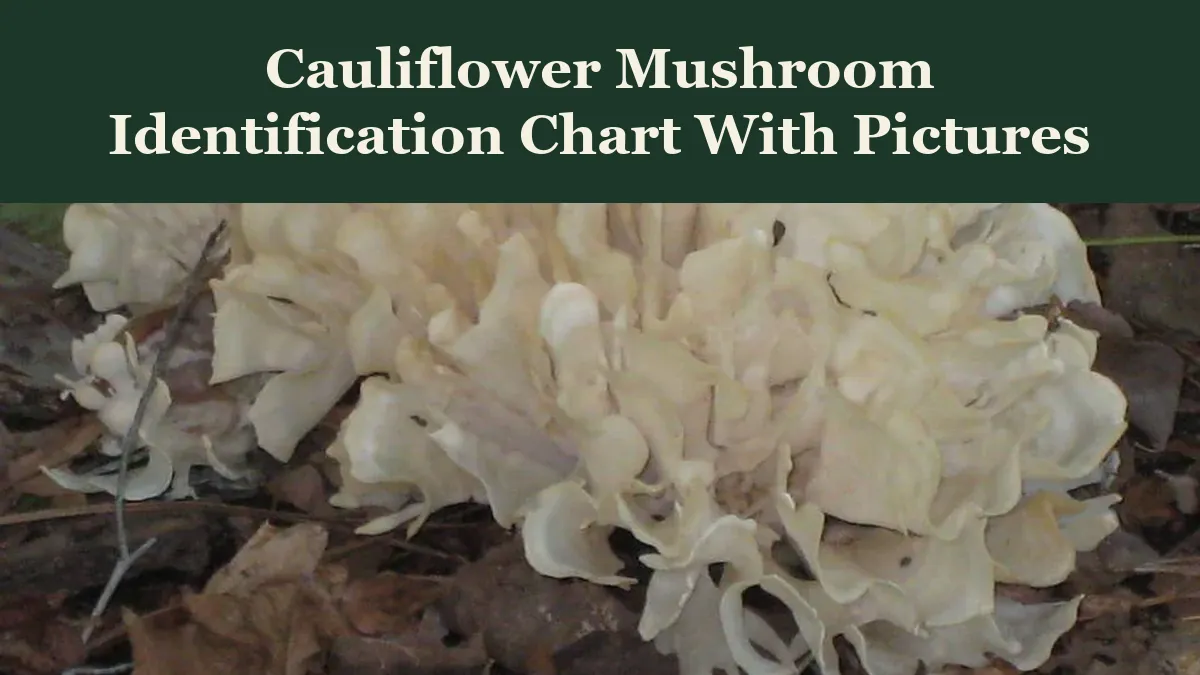 Species Guide
A cauliflower mushroom ( Sparassis ) is a large, cream-colored rosette of flat, wavy, ribbon-like lobes that grows at the base of a tree. It has no caps, no...