Mushroom Habitat: Where Mushrooms Grow and What It Tells You
— views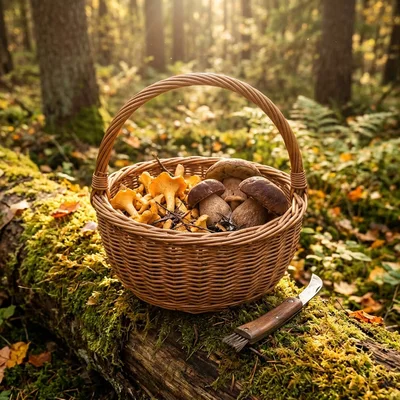
Mushroom habitat is the place and material a mushroom grows from, such as tree roots, dead wood, lawn thatch, mulch, dung or burned ground. Mushrooms grow where their food is. Saprobic mushrooms eat dead material, mycorrhizal mushrooms trade with living roots, and parasitic mushrooms feed on living hosts. Habitat narrows the list of possible species. It never proves that a mushroom is safe.
This guide explains the three ways mushrooms feed, then shows what grows in seven common US habitats and what to check in each. Start with the table if you have a find in front of you. Record the habitat before you pick anything, because that clue is lost once the mushroom leaves the ground.
Key Takeaways
- Note two things first: what the mushroom grows from, and which living trees stand nearby.
- Saprobic mushrooms eat dead material, mycorrhizal mushrooms partner with living roots, and parasitic mushrooms feed on living hosts.
- A 2014 Forest Service article says most if not all trees in natural settings are mycorrhizal.
- In California, the death cap grows mainly with coast live oak, and it shares that tree with the deadly western destroying angel.
- A mushroom on a living tree can signal advanced decay, so trees near homes should be checked by a qualified arborist.
- Lawn mushrooms are not automatically benign. NAMA calls the green-spored parasol the most common mushroom cause of human poisoning in North America.
- Habitat is one clue. It cannot show that a wild mushroom is safe to eat.
Mushroom Habitat Chart: What Grows Where
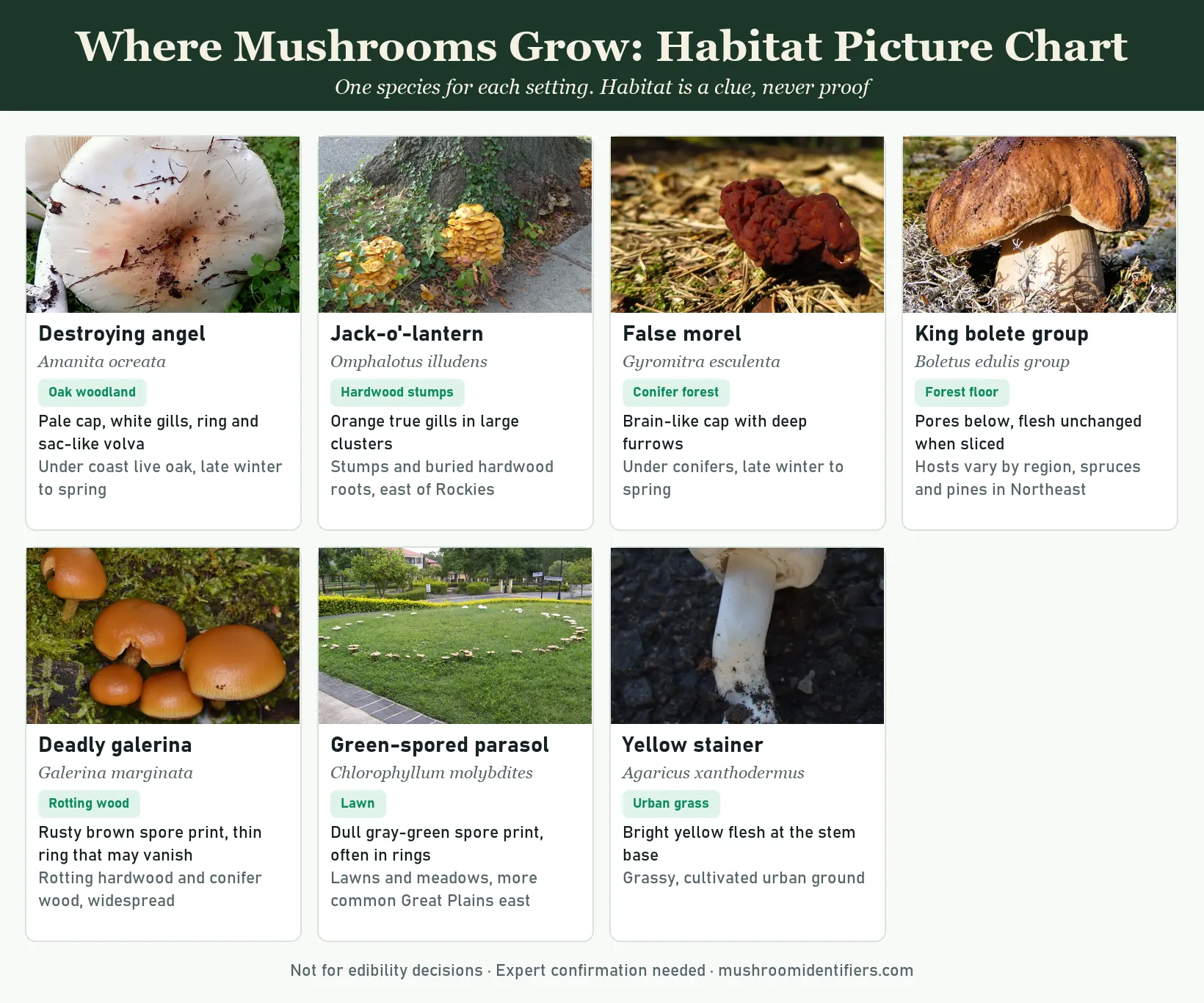
Use this mushroom habitat chart by finding what your mushroom grows from, then working through the checks in the last column. The examples are well-documented mushrooms, not full lists. Species vary by region and season.
| Habitat | What grows there | What to check |
|---|---|---|
| Oak | Death cap, western destroying angel, hen of the woods at the tree base | Dig out the base and look for a sac. Note the oak and the season. |
| Conifer | Slippery jack with pines, king bolete group with spruces and pines, false morel in spring | Name the tree. Check for pores, gills or a brain-like cap. |
| Dead wood | Deadly galerina, jack-o'-lantern, honey mushrooms | Take a spore print. Check for a ring. Look for buried roots. |
| Lawn | Green-spored parasol, yellow stainer, meadow mushroom, puffballs | Check gill color and spore print. Slice the stem base. |
| Mulch | Stinkhorns, bird's nest fungus, artillery fungus, puffballs, inkcaps | Cut any round, egg-like form from top to bottom. |
| Dung | Dung roundhead on horse and cow dung | Note the dung or manured pasture. Take a spore print. |
| Burn sites | Morels, often most abundant in the first year after fire | Compare the cap with false morels. Note the forest type. |
The table draws on MykoWeb, Iowa State University Extension and the species sources linked below. The picture chart covers settings where a matching photo exists, so mulch, dung and burn sites appear in this table only.
What Do Saprobic, Mycorrhizal and Parasitic Mean?
Saprobic, mycorrhizal and parasitic describe how a mushroom gets its food: from dead material, from a root partner or from a living host. The fungus itself is mostly hidden threads in wood or soil. The mushroom is only the part you see, so its position is a clue to what the hidden fungus is eating.
| Type | Food source | Where you see it | Examples |
|---|---|---|---|
| Saprobic | Dead wood, leaves, thatch, dung | Logs, stumps, mulch, lawns | Galerina marginata, Chlorophyllum molybdites |
| Mycorrhizal | Sugars from living roots | Soil near trees | Amanita phalloides, Suillus luteus |
| Parasitic | Living tissue | On or at the base of living trees | Armillaria, Laetiporus |
Saprobic Mushrooms
A saprobic mushroom is a decomposer. A 2014 article by Kevin T. Smith of the USDA Forest Service says many lawn mushrooms digest the grass thatch layer. The same article says this breakdown releases nutrients for trees and soil microbes. Our article on mushrooms as decomposers covers this role in more depth.
Mycorrhizal Mushrooms
A mycorrhizal mushroom is the fruiting body of a fungus that partners with living roots. The word means "fungus-roots." The Forest Service article says the fungus takes sugars from the plant. In return, the tree takes up minerals better, especially phosphorus, and copes better with root disease and drought. The article adds that many common mushrooms on lawns and forest floors are mycorrhizal, so a mushroom in grass may still be tied to a nearby tree.
Parasitic Mushrooms
A parasitic mushroom feeds on a living host. The Forest Service article calls Armillaria root disease likely the most important decay disease in North American rural and urban forests. Armillaria mushrooms grow in clumps at the base of trees or stumps, or from shallow and buried roots. Our honey mushroom guide covers these in detail.
Mushrooms That Do More Than One Job
These three labels overlap. One field guide describes hen of the woods, Grifola frondosa, as weakly parasitic on living hardwoods and also saprobic on dead wood. It grows near the bases of trees, especially oaks. The Forest Service article says Armillaria can persist for years in stumps and woody roots after the tree dies.
Why Does Mushroom Habitat Help With Identification?
Mushroom habitat helps with identification because each species grows only in certain places, which removes many candidates before you look at the cap. A pine partner such as Suillus luteus belongs near pines. It was originally Eurasian and has been introduced widely, including into North America.
Habitat cannot finish the job, though. The two deadly Amanitas below grow under the same California tree. Our death cap guide covers the full feature list.
| Feature | Death cap | Western destroying angel |
|---|---|---|
| Scientific name | Amanita phalloides | Amanita ocreata |
| Main tree | Coast live oak | Coast live oak |
| Season | Early fall to mid-winter | Late winter to spring |
| Base | Thin, white, sac-like volva | Thin, white, sac-like volva |
| Ring | Membranous, hanging | Thin, ragged, often collapsed |
| Risk | Deadly poisonous | Deadly poisonous |
These details come from MykoWeb's pages on Amanita phalloides and Amanita ocreata. MykoWeb calls the death cap very abundant under oaks in the San Francisco Bay Area, especially in warm, wet years. It also fruits sporadically in summer where areas are watered or get coastal fog drip, so season is not a hard rule either.
Why Is a Mushroom Growing on My Tree?
A mushroom growing on a tree means a fungus is feeding on wood, and on a living tree it usually signals decay inside. University of California IPM says fruiting bodies usually show up with advanced decay. The rot may extend well above or below the mushroom. UC IPM says sulfur fungus conks "indicate extensive internal damage."
| Feature | White rot | Brown rot |
|---|---|---|
| What it breaks down | Lignin and cellulose | Mainly cellulose and hemicellulose |
| Wood feels | Moist, soft, spongy or stringy | Dry and fragile, crumbles into cubes |
| Common in | Flowering trees | Conifers |
| Example | Armillaria mellea, Ganoderma applanatum | Laetiporus gilbertsonii, Laetiporus conifericola |
A mushroom on a tree does not always mean the tree must come down. The Forest Service article says the mere presence of decay should not be a reason for removal. UC IPM advises having trees near structures inspected regularly by a qualified expert. Hazardous trees should be assessed by a qualified arborist.
For species on trunks and logs, see our tree mushroom identification guide. Our oak tree fungus guide focuses on oaks.
Why Do Mushrooms Grow in Lawns and Mulch?
Mushrooms grow in lawns and mulch because both hold dead plant material that fungi can feed on. A North American field guide describes the green-spored parasol as a saprobe of lawns and meadows that often forms troops or fairy rings. The Forest Service article notes that the meadow mushroom, Agaricus campestris, decomposes lawn thatch. See why mushrooms grow in your yard for more causes.
Iowa State University Extension lists stinkhorns, slime molds, bird's nest fungi, artillery fungus, puffballs and inkcaps in landscape mulch. It says stinkhorns, slime molds, bird's nest fungi, puffballs and inkcaps do not harm landscape plants. Artillery fungus shoots sticky black spore packs that are hard to remove from siding and cars. That page does not address safety for children or pets, so do not read it as a safety statement.
Lawn mushrooms need the same care as forest mushrooms. NAMA says Chlorophyllum molybdites causes severe gastrointestinal distress and can poison pets. NAMA recommends removing these mushrooms from yards. The Forest Service article adds that stamping out lawn mushrooms does not remove the fungus below, so more can appear.
Which Mushrooms Grow on Dung and Burn Sites?
Dung and burn sites host specialist mushrooms, including the dung roundhead on horse and cow dung and morels on burned forest ground. Both are narrow habitats, so the setting itself is a strong clue.
Dung
MykoWeb says Protostropharia semiglobata grows on horse and cow dung or in manured pastures. MykoWeb gives a cap about 2 to 4 cm across, pale yellow and sticky when moist. Its spore print is purple-brown. MykoWeb says it fruits through the mushroom season, especially after rainy periods.
Burn Sites
A 2016 study in Forest Ecology and Management, listed by the Northern Rockies Fire Science Network, surveyed morels in old-growth mixed-conifer forest in Yosemite National Park. The summary says morel harvests are often largest in the first year after fire, when some species fruit prolifically. The study estimated about 1,693 morels per hectare in the first growing season after a fire.
A burn does not prove that a morel-like mushroom is a morel. MykoWeb places the false morel, Gyromitra esculenta, under conifers from late winter to spring. It calls that species "potentially deadly, especially raw." Our false morel guide shows how the cap differs.
How to Record a Mushroom's Habitat
The best way to record a mushroom's habitat is to note the trees, the material it grows from and the date before you touch it. A good record takes a few minutes and makes every later step easier.
- Look up. Name the living trees around the mushroom, not just the closest one.
- Look down. Note whether it grows from soil, wood, mulch, grass, dung or burned ground.
- Check for hidden wood. Dig gently around the base and look for buried roots or chips.
- Note the pattern. Record whether it grows alone, in a cluster, in a troop or in a ring.
- Add date and weather. Write down the month and any recent rain.
- Photograph it in place. Take the picture before you move anything.
A field guide lists the habitat of each species, so you can compare your notes with the entry. Our mushroom identifier book guide covers regional options.
Common Identification Mistakes
Most habitat mistakes come from trusting one clue, or from applying a rule from the wrong place. These are the errors to avoid.
Assuming a Mushroom on the Ground Has No Wood Below It
The jack-o'-lantern grows on stumps or buried hardwood roots. It can appear to grow from the ground, which is one reason people confuse it with chanterelles.
Treating a Tree Rule as Fixed
Tree partners are patterns, not laws. Suillus luteus is mainly tied to hard pines in Europe, yet one species account records it under eastern white pine in the Midwest with no hard pines nearby.
Using a Habitat From Another Continent
European habitat notes may not fit US mushrooms. It is unresolved whether true Boletus edulis occurs in North America at all. Its key lists hosts that change by region, from live oak on the West Coast to loblolly pine on the Gulf Coast.
Assuming Wood Means One Kind of Mushroom
Several species share dead wood. Galerina marginata grows on rotting hardwood and conifer wood. NAMA lists it among the amatoxin mushrooms, the same toxin group as the death cap. The spore print separates it from Armillaria: rusty brown for the galerina and white for Armillaria.
Believing Habitat Separates Look-Alikes
Look-alikes often share a habitat. The death cap and the western destroying angel share an oak. The green-spored parasol and the shaggy parasol share lawns. Use habitat to build a list of suspects, then check every other feature.
What We Could Not Confirm
Some common mushroom habitat claims could not be confirmed, so this page leaves them out or marks them as unknown.
- How far from its tree a mycorrhizal mushroom can fruit. We found no reliable distance, so this page gives none.
- Soil pH ranges for particular mushrooms. We found no source for the figures that circulate online.
- Whether morel timing is the same everywhere. The 2016 study covered one Yosemite plot in the first growing season after a fire.
- The exact role of some species. The ecological role of Hygrocybe conica is uncertain.
Frequently Asked Questions
What is a mushroom habitat?
A mushroom habitat is the place and material a mushroom grows from. It includes the substrate, such as wood or soil, and nearby living trees. Habitat helps narrow an identification but never proves one.
Where do mushrooms grow?
Mushrooms grow wherever their food is available and conditions are moist enough. Common US habitats include woods near oaks and conifers, dead wood, lawns, mulch, dung and burned ground. Some mushrooms grow from buried roots, so the food source may be hidden.
What does mycorrhizal mean?
Mycorrhizal means a fungus lives in partnership with plant roots. The fungus takes sugars from the plant, and the plant gets better access to minerals such as phosphorus. Many forest mushrooms, including Amanitas, work this way.
What does saprobic mean?
Saprobic means a fungus feeds on dead material such as wood, leaves, thatch or dung. Saprobic mushrooms are decomposers. They release nutrients that trees and soil microbes can use.
What is a parasitic mushroom?
A parasitic mushroom feeds on a living host, usually a tree. Armillaria is the classic example, and it causes root disease. Some parasitic fungi keep feeding on the wood after the host dies.
Why is a mushroom growing on my tree?
A mushroom on a tree means a fungus is feeding on the wood. UC IPM says fruiting bodies usually show up with advanced decay. Have a qualified arborist check trees near homes or other structures.
Do mushrooms on a tree mean the tree is dying?
Not always. The mushroom shows decay, but a 2014 Forest Service article says decay alone should not be a reason for removal. A qualified arborist can judge whether the tree is hazardous.
Why do mushrooms grow in mulch?
Mulch is dead plant material, so it feeds decomposing fungi. Iowa State University Extension lists stinkhorns, bird's nest fungi, artillery fungus, puffballs and inkcaps in mulch. Keep children and pets away from unknown mushrooms in any setting.
Why do morels appear after a fire?
Some morel species fruit heavily after fire, and harvests are often largest in the first year. The exact reason was not covered by the sources used for this page. False morels also grow in conifer forests, so a burn does not confirm a morel.
Can habitat prove a mushroom is safe to eat?
No. Deadly mushrooms grow in the same habitats as mushrooms that people collect for food. Expert confirmation of the whole mushroom is needed before anyone eats a wild mushroom.
Final Safety Reminder
Habitat is a strong clue, but no habitat can show that a wild mushroom is safe to eat. Never eat a wild mushroom based on where it grew, a chart, a photo or an app. Have an expert examine the whole mushroom, including the base. Keep children and pets away from unknown mushrooms. If someone may have eaten a poisonous mushroom, call Poison Help at 1-800-222-1222 right away, even with no symptoms. For a second opinion, photograph the mushroom in place, along with its underside and base, then check the pictures with our free mushroom identifier and a local expert.
Sign in to leave a comment and join the discussion.
 Guide
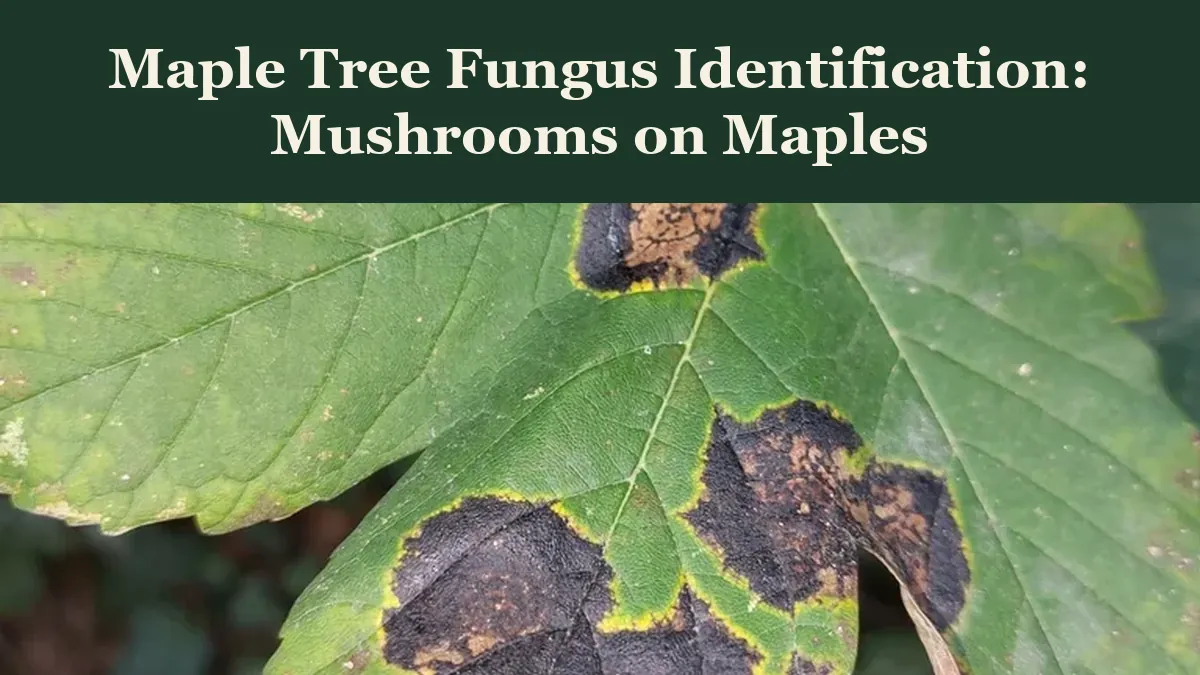
Most maple tree fungus is either a leaf spot that looks alarming but rarely hurts the tree, or a decay fungus fruiting from wood that is already rotting...
 Guide
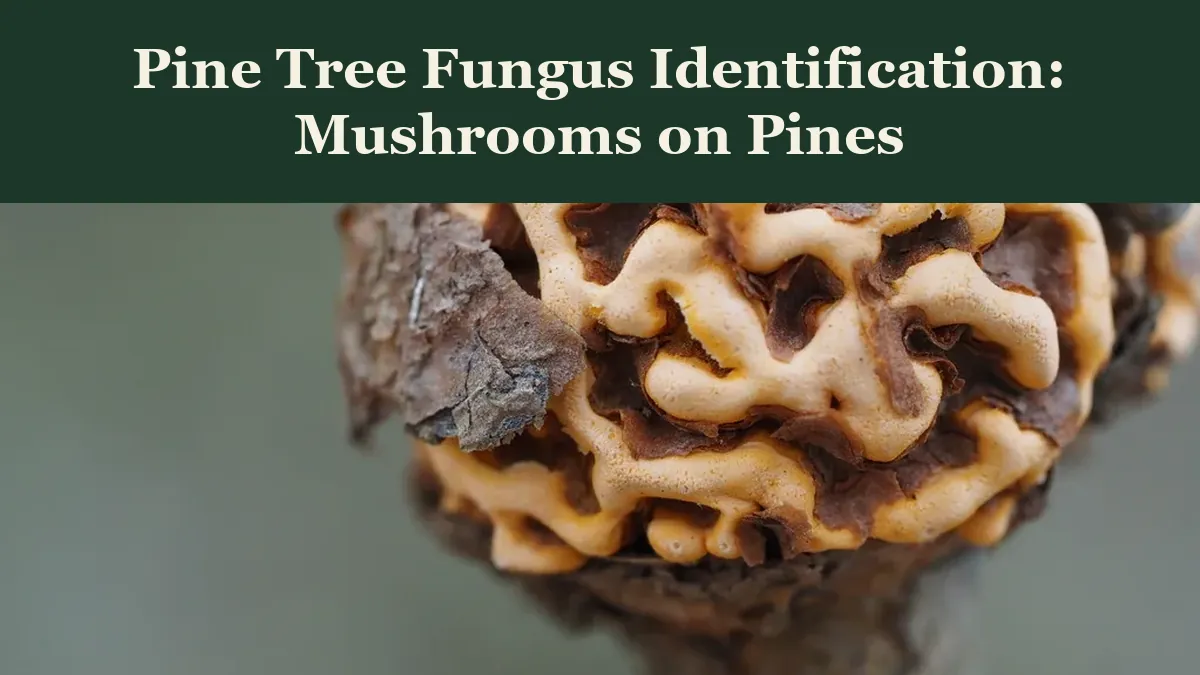
Pine tree fungus identification starts with color and place: orange powder on a woody gall is a rust, brown dead shoot tips are a blight, a conk at the base...
 Guide
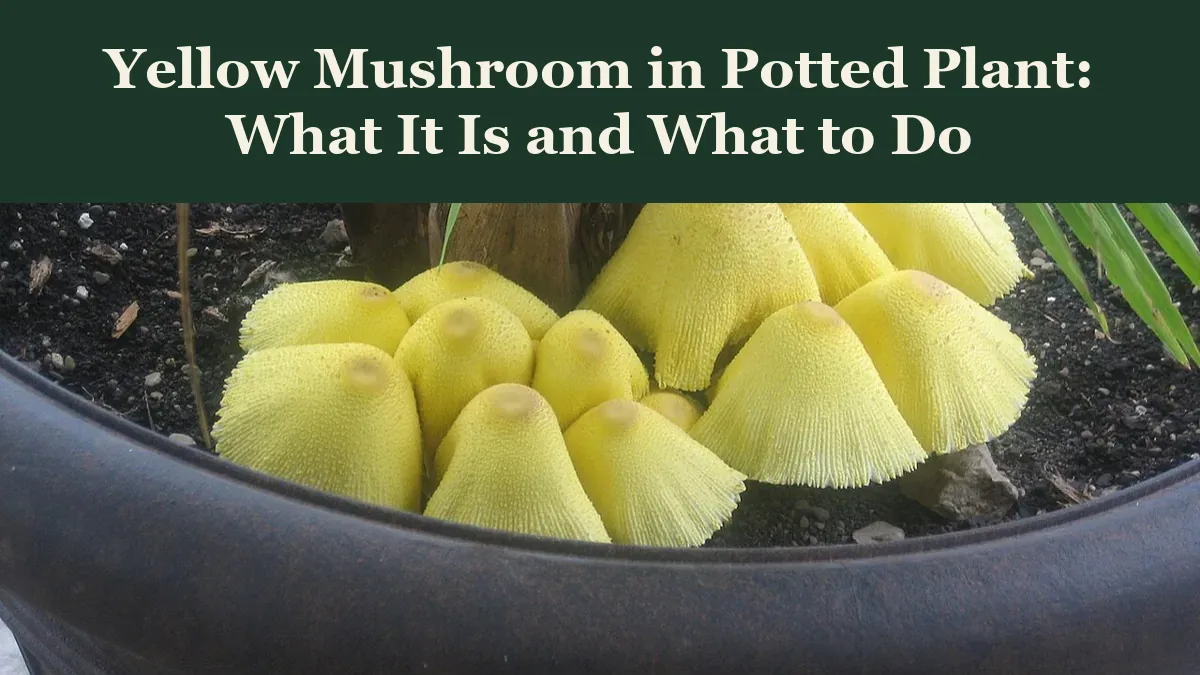
A yellow mushroom in a potted plant is almost always the flowerpot parasol, Leucocoprinus birnbaumii , a lemon-yellow mushroom that feeds on dead organic...