Yellow Mushroom in Potted Plant: What It Is and What to Do
— views
A yellow mushroom in a potted plant is almost always the flowerpot parasol, Leucocoprinus birnbaumii, a lemon-yellow mushroom that feeds on dead organic matter in potting mix. Iowa State University Extension says it does not harm living plants. Sources disagree on how toxic it is, and Iowa State regards it as poisonous to people and animals. Pick the mushrooms and keep them away from children and pets.
This page shows how to confirm the yellow houseplant mushroom, why it appears, what the sources say about toxicity, and what to do about it. It also covers the other things that turn up in pots and planters: white look-alikes, bird's nest and cannon fungi, slime molds, white mold and fungus gnats.
Key Takeaways
- A lemon-yellow mushroom with a bell-shaped, finely scaly cap, a grooved edge and a thin ring on the stem is the flowerpot parasol.
- The fungus lives on dead organic matter in the potting mix. It does not attack the plant's roots or leaves.
- Sources conflict on toxicity, from "regarded as poisonous" to "not known to be poisonous." Treat it as poisonous and never eat it.
- Remove the mushrooms as they appear if children or pets share the home. Touching them is not poisonous.
- Fungicides are generally ineffective against mushrooms, and the plant does not need one.
- University of Maine Cooperative Extension says herbs growing in a pot with this mushroom are fine to eat once washed, because the fungus cannot colonize the leaves.
Potted Plant Mushroom Identification Chart
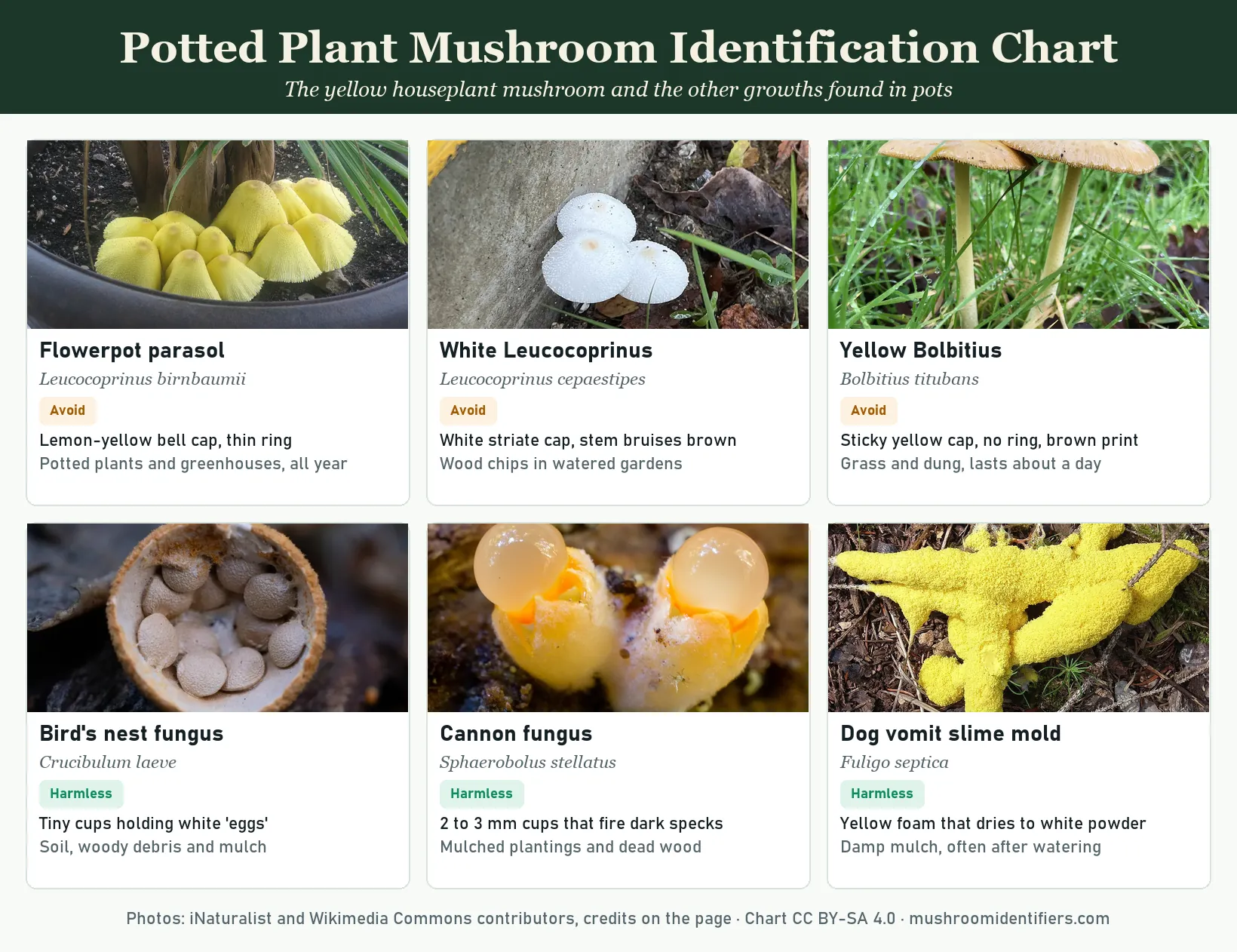
Match what you see in the pot to a row, then read the section for that organism. Color, a ring on the stem and the shape of the growth separate most of them at a glance.
| What you see in the pot | Most likely | Key features | Harm to the plant | Risk to people and pets |
|---|---|---|---|---|
| Lemon-yellow umbrella mushroom | Flowerpot parasol (Leucocoprinus birnbaumii) | Bell cap 2 to 5 cm, grooved edge, thin ring, fades pale | None | Sources conflict; treat as poisonous |
| White umbrella mushroom | White Leucocoprinus (Leucocoprinus cepaestipes) | White to cream cap, grooved edge, stem bruises brown | None known | Poorly known; do not eat |
| Slimy yellow cap, no ring | Yellow Bolbitius (Bolbitius titubans) | Sticky cap, rusty brown spore print, lasts about a day | None known | Do not eat any wild find |
| Tiny cups holding "eggs" | Bird's nest fungus (Crucibulum laeve) | Cups 3 to 7 mm, white disc-shaped eggs | None | Harmless; too small to matter as food |
| Pinhead balls and sticky dark specks | Cannon fungus (Sphaerobolus stellatus) | Cups 2 to 3 mm that shoot a dark spore mass | None | Specks stick to walls and cars |
| Yellow or orange foam | Dog vomit slime mold (Fuligo septica) | Foamy patch that dries to white powder in days | None | Not known to be harmful |
| White cottony threads on the soil | Mycelium of a saprophytic fungus | Thread-like web across the surface | Usually none; a sign of wet soil | Concern only for strong mold allergy |
| Tiny black flies around the pot | Fungus gnats (Bradysia and Orfelia) | Adults 1/16 to 1/8 inch; whitish larvae in the soil | Larvae can damage seedling roots | Adults do not bite |
Details come from MykoWeb, Iowa State University Extension and the sources named in each section below.
What Is the Yellow Mushroom in My Potted Plant?
The yellow mushroom in houseplant soil is Leucocoprinus birnbaumii, known as the flowerpot parasol, yellow parasol or yellow houseplant mushroom. Iowa State University Extension describes small, lemon-yellow mushrooms 1 to 3 inches tall, with oval or bell-shaped caps 1 to 2 inches across, growing alone or in clusters. Older books call it Lepiota lutea.
Check four features. The cap is bright yellow and finely scaly, with a grooved, striate edge. The gills are free from the stem and pale yellowish. A thin, collar-like ring sits high on the stem. Tom Volk's Fungus of the Month page notes that the spores are white. Our guide to the parts of a mushroom explains each term, and a spore print on dark paper confirms the white spores.
Volk adds that it resembles an inky cap but never dissolves into black liquid the way the inky cap mushroom does. Color is the one clue that changes. MykoWeb notes that fresh caps fade quickly in sunlight to a dingy pale yellow, so a washed-out mushroom in the afternoon can be the same species that was bright yellow in the morning.
Why Do Yellow Mushrooms Grow in Houseplant Soil?
Yellow mushrooms grow in houseplant soil because the fungus arrived in the potting mix or as an airborne spore, and it is feeding on dead organic matter in the pot. Iowa State University Extension explains that the fungus body, a web of threads called mycelium, may have come in with the mix, or a spore may have landed in the pot. The mushroom is only the fruiting body of that hidden fungus.
Warmth and rich soil bring the mushrooms up. Volk describes the species as common in houseplants, greenhouses and anywhere with organically rich soil and warm temperatures. MykoWeb records it fruiting year-round in greenhouses, but outdoors only in late summer or early fall in California. A heated home works like a greenhouse, so pots can produce it in winter. The fungus is a decomposer, which our page on whether mushrooms are decomposers explains in more detail.
Will the Yellow Mushroom Hurt My Plant?
No, the yellow houseplant mushroom does not harm the plant it grows with. Iowa State University Extension states that the fungus breaks down dead organic matter in the potting soil, does not harm living plants, and does not need to be removed for the plant's sake. Volk also states that the mushrooms are not known to harm plants.
Edible plants in the same pot are a common worry. A reader asked University of Maine Cooperative Extension about rosemary growing beside it. Seanna Annis of UMaine Extension answered that the rosemary can be eaten if washed as normal. She explained that the fungus cannot colonize the rosemary leaves and does not produce chemicals in the plant. Its spores break down quickly on the plant's surface.
Is the Yellow Houseplant Mushroom Poisonous to People and Pets?
Treat the yellow houseplant mushroom as poisonous, because the sources do not agree and none of them recommends eating it. The spread of opinion is wide. Children and pets are the ones most likely to put a mushroom in their mouths, so the safe choice is to remove the mushrooms as they appear.
- Iowa State University Extension: regarded as poisonous to people and animals.
- MykoWeb: possibly poisonous, to be avoided.
- Tom Volk, 2002: reports conflict, with some evidence of stomach upset in a very small percentage of people and other animals. He advises against eating it.
- Tom Volk's mulch fungi page: not known to be poisonous to animals or people.
We found no published veterinary case report that names this species. That is not proof of safety. If a dog or cat eats one, follow our steps for what to do if your dog ate a mushroom and call your vet. If a child eats one, call Poison Control at 1-800-222-1222. Touching the mushroom is not a risk. Volk calls the idea that touch can poison you completely false, unless a person is allergic to the mushroom.
How to Get Rid of Yellow Mushrooms in a Potted Plant
Pick the mushrooms as they appear, let the soil surface dry between waterings, and repot in fresh mix only if you want the fungus gone, because no spray removes it. Iowa State University Extension says fungicides are generally ineffective against mushrooms. The plant is not harmed, so there is no plant-health reason to treat the pot at all.
- Pick the caps early. Twist or cut them at the soil line and bag them for the trash.
- Keep the pot away from children and pets until the mushrooms stop appearing.
- Water less often. Let the top of the mix dry before watering again, empty the saucer, and make sure the pot drains.
- Replace the top layer of mix if you want a quick cleanup. The mycelium lives in the potting mix below, so mushrooms may still return.
- Repot into fresh potting mix for the most thorough fix, and wash the old pot. Spores can still drift back in, as Iowa State notes, so a repot reduces the chance rather than guaranteeing it.
The fungus itself is not a sign of a sick plant. It is a sign of moist, organic-rich mix in a warm room.
Common Mushrooms and Look-Alikes in Potted Plants
Six organisms cover the growths most likely to be confused with the yellow houseplant mushroom: the flowerpot parasol itself, a white relative, a yellow lawn mushroom, two tiny cup fungi and a slime mold. None of them attacks the plant. The species below are described from MykoWeb, Iowa State University Extension and Tom Volk's pages.
Flowerpot Parasol (Leucocoprinus birnbaumii)
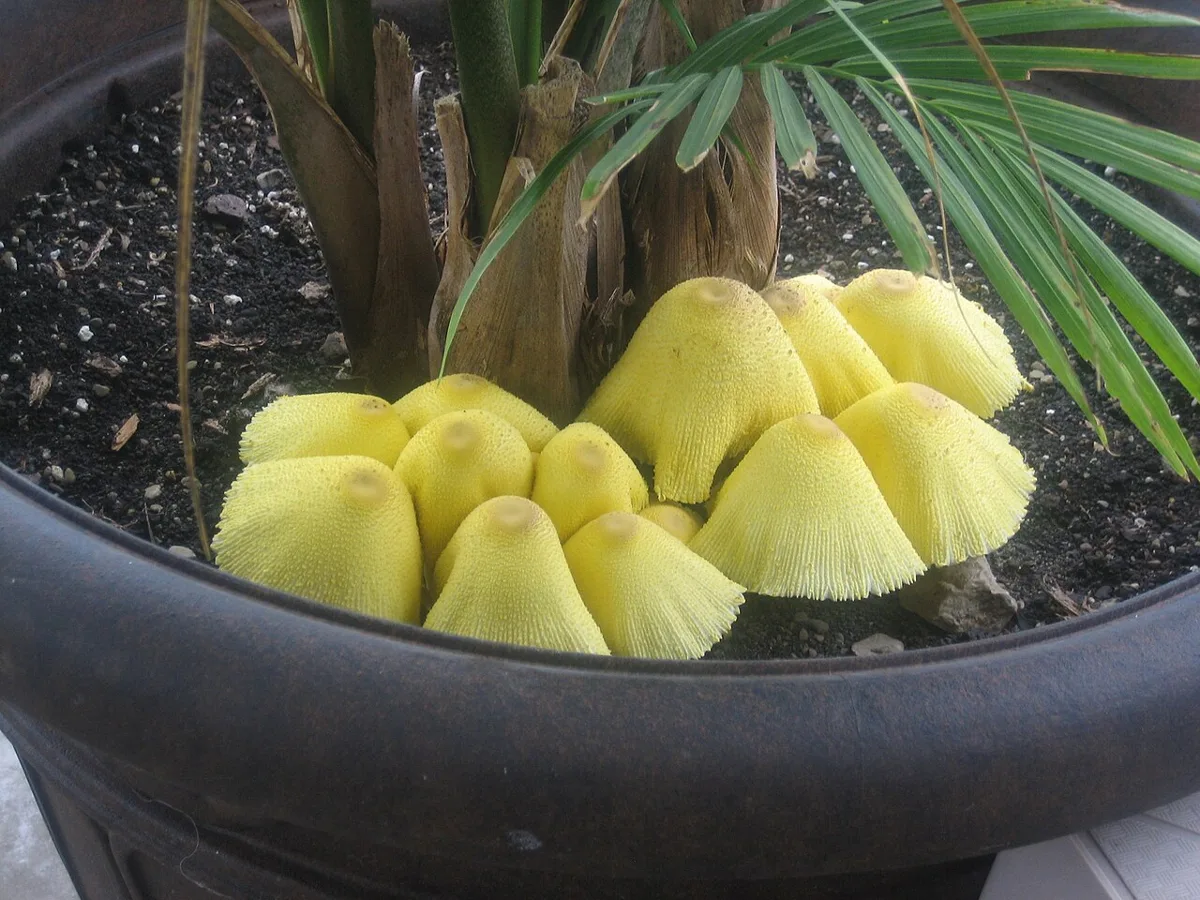
MykoWeb gives a cap 2 to 5 cm wide, conic to bell-shaped, bright to fluorescent yellow, with a conspicuously striate edge and a finely scaly surface. The flesh is thin and fragile. The stem is 2.5 to 7 cm long and only 2 to 6 mm thick, often with an enlarged base, and it carries a narrow, fragile ring. It grows alone or in clusters on the soil of potted plants and occasionally outdoors in grass or well-decayed wood chips. Volk notes it can grow outdoors in warm southern climates, especially in mulched flower beds.
White Leucocoprinus (Leucocoprinus cepaestipes)
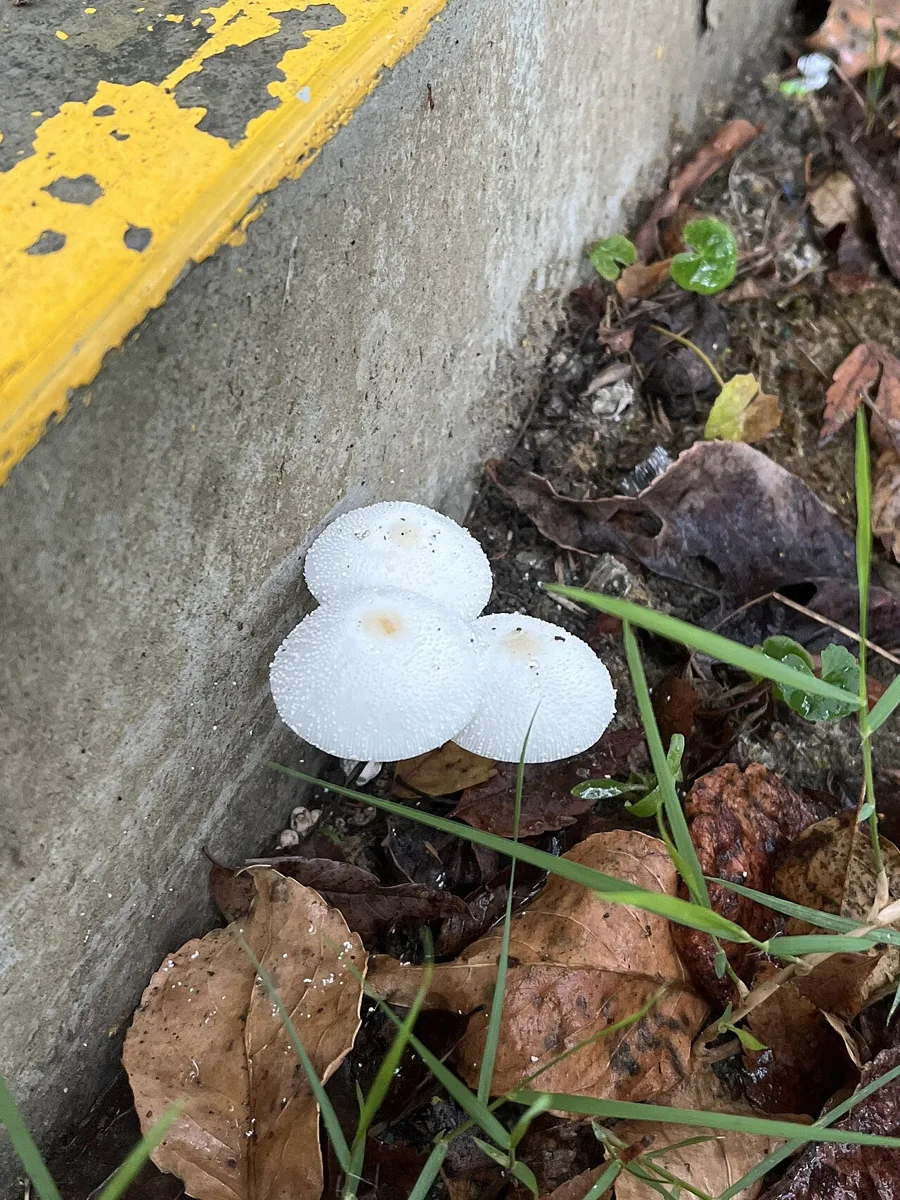
This close relative looks like a white flowerpot parasol. MykoWeb describes a white to cream cap 1.5 to 4.5 cm wide with a striate edge and small scales that turn buff-brown. The gills are free and white, the spore print is white, and the stem discolors yellowish brown to brown when handled. MykoWeb records it on wood chips and woody debris in watered parks and gardens, and rates it "maybe edible but poorly known." The name is also spelled cepistipes. Any white mushroom deserves extra care, so read our guide to white poisonous mushrooms before handling one found outdoors.
Yellow Bolbitius (Bolbitius titubans)
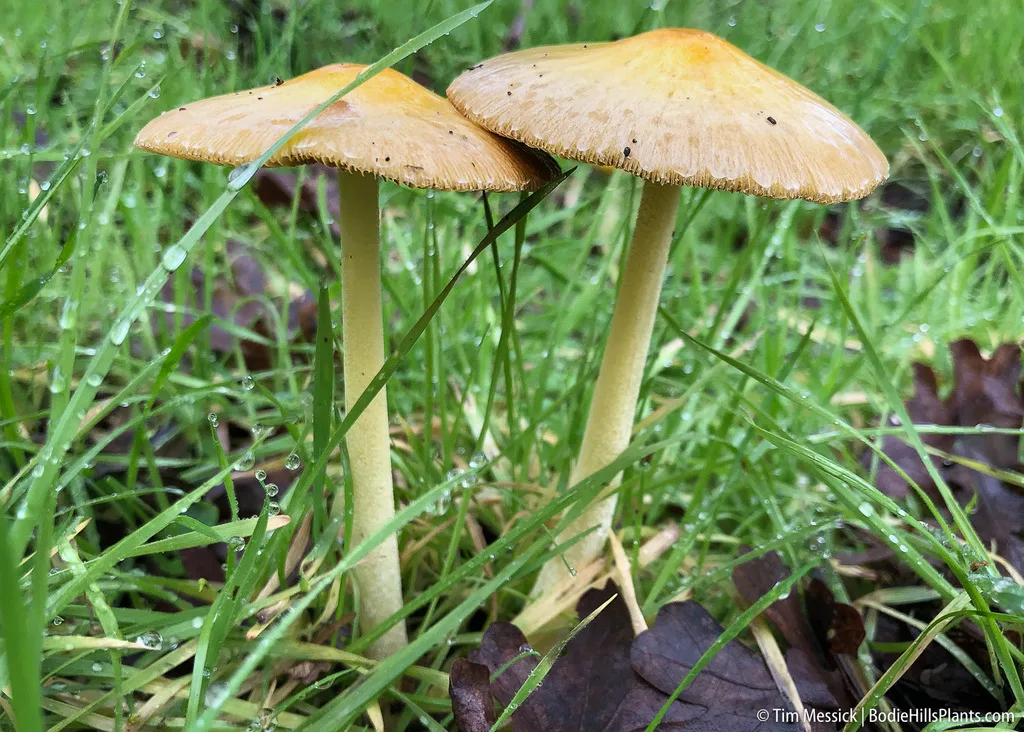
A yellow mushroom in grass or a manured bed, rather than in a pot, may be Bolbitius titubans, formerly Bolbitius vitellinus. MykoWeb describes a sticky, smooth, yellow cap 2 to 6 cm wide that fades to whitish or gray. It has no ring, and its spore print is rusty brown, not white. It grows on grass and dung, and each mushroom usually opens in the morning and shrivels by evening. The missing ring and brown print separate it from the flowerpot parasol.
Bird's Nest Fungus (Crucibulum laeve)
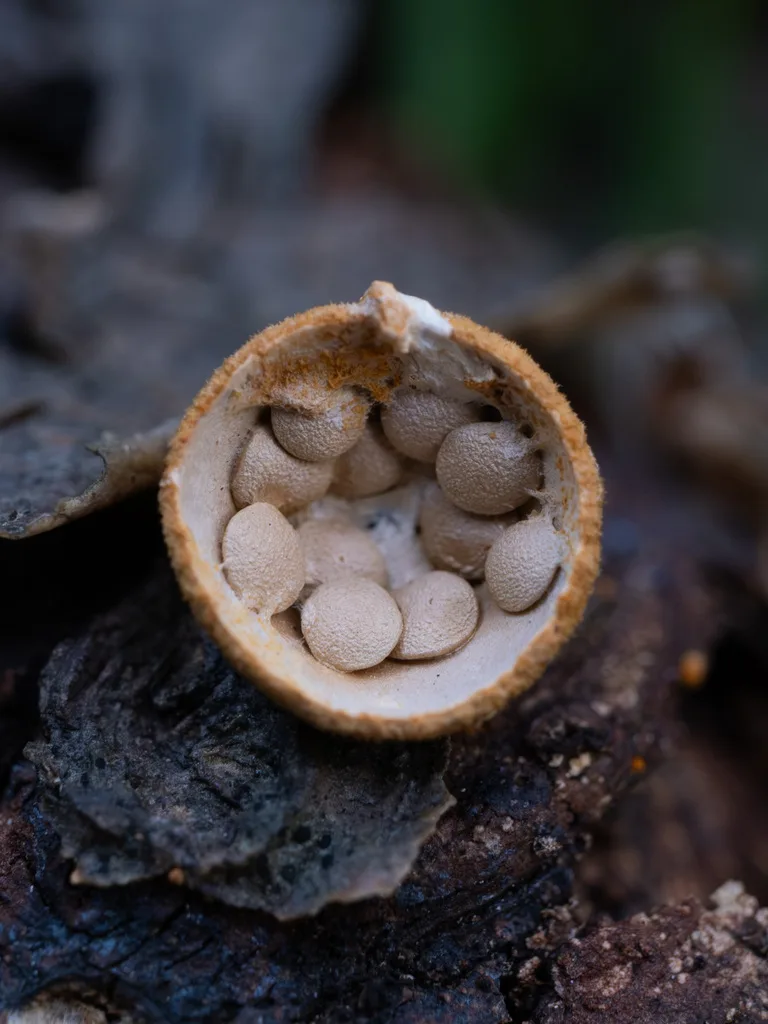
Bird's nest fungi look like tiny cups full of eggs. MykoWeb describes cups 3 to 7 mm high, buff-brown outside, holding flattened white "eggs" 1 to 2 mm wide, each tied to the cup by a thin cord. Iowa State University Extension explains that the eggs hold the spores and that raindrops splash them out of the nest. They do not harm plants. Loosening a bark or mulch top-dressing so it dries makes conditions less favorable, and fungicides do not control them.
Cannon Fungus (Sphaerobolus stellatus)
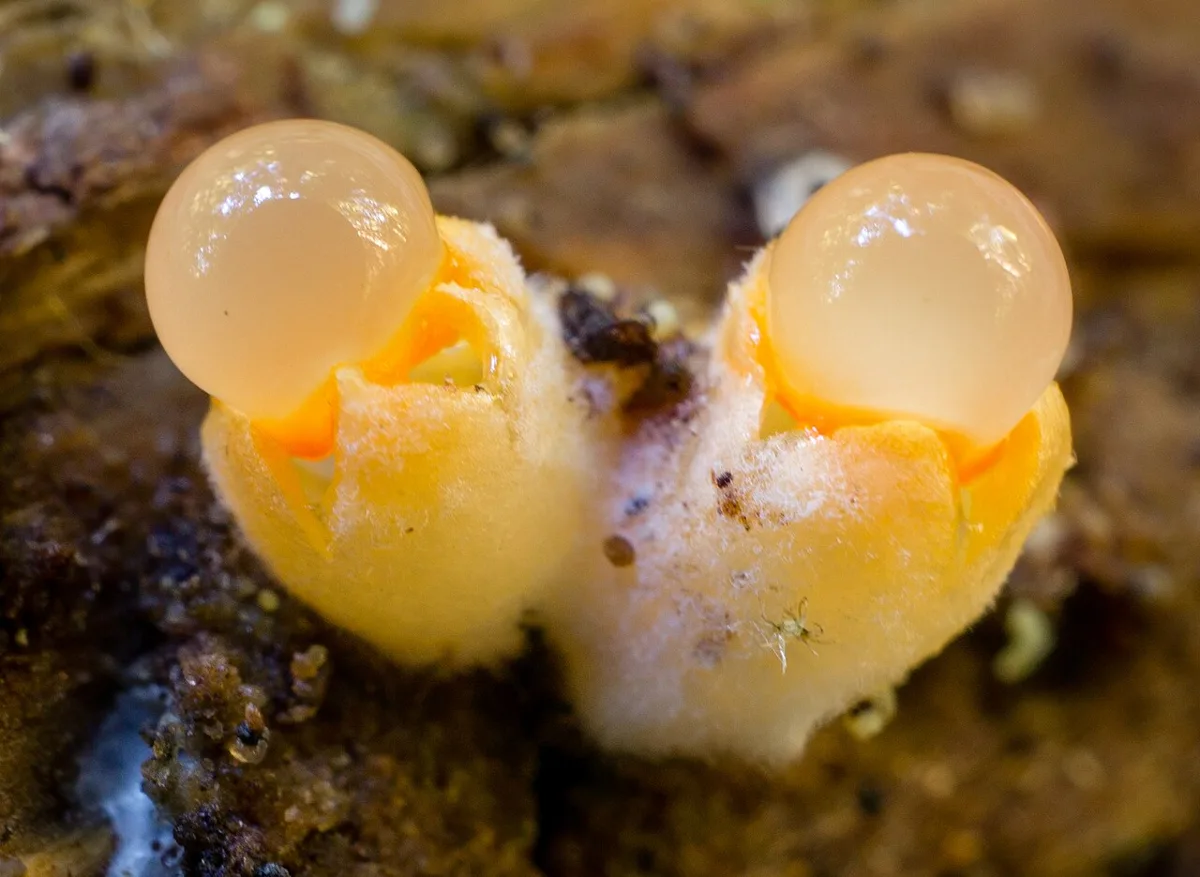
The cannon fungus, also called artillery fungus, forms cream to ochre cups only 2 to 3 mm across. MykoWeb explains that each cup suddenly turns inside out and fires a sticky, dark brown spore mass, sometimes many feet. In mulched plantings, those pinhead specks stick to cars and buildings. Iowa State University Extension says the spots cause no structural damage but are hard to remove and must be soaked with soapy water.
Dog Vomit Slime Mold (Fuligo septica)
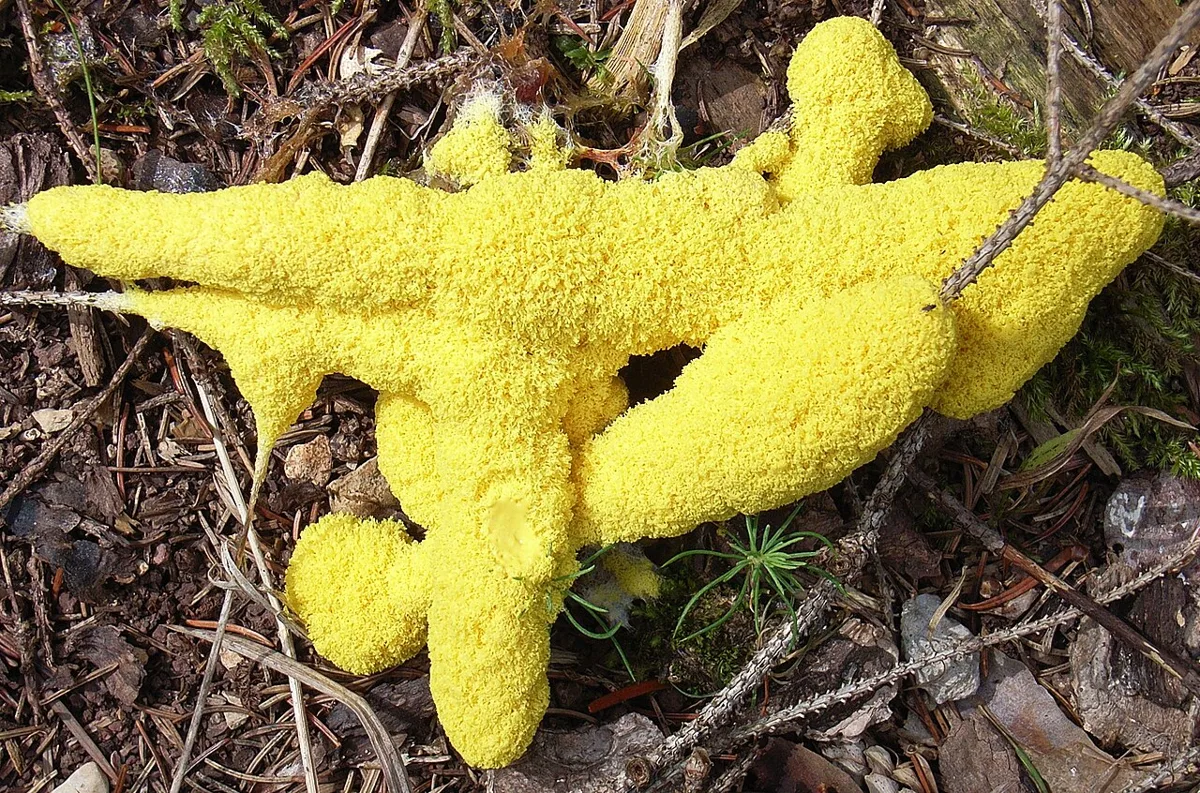
A bright yellow or orange foamy patch on mulch or bark chips is a slime mold, not a mushroom. Iowa State University Extension calls slime molds primitive, fungus-like organisms that feed on bacteria and other microbes, and says they do not harm plants. Within a few days the foam dries into a white, powdery mass. Tom Volk identifies the common one as Fuligo septica, the dog vomit slime mold, and calls it not known to be harmful. Scoop it up and discard it, or let it fade.
White Mold and Fungus Gnats in Houseplant Soil
White fuzz on the soil and tiny flies around a pot are the two pot problems most often mistaken for a mushroom problem, and both point to soil that stays too wet. Neither one is a mushroom. White fuzz is usually a harmless fungus feeding on organic matter, and the flies are insects whose larvae live in damp mix.
White Mold on the Soil
A white, thread-like web across the surface of the mix is the mycelium of a saprophytic fungus, one that feeds on dead material. Douglas County Master Gardeners (OSU Extension) say this growth is usually not damaging to people unless someone has an extreme mold allergy. They name poor watering as the main cause, along with poor potting soil, drainage, light and air circulation. Repotting is not necessary. Scrape off the top of the soil and add fresh mix, then fix the watering, or the mold returns.
Fungus Gnats
Fungus gnats are small flies, not fungi. UC IPM describes adults 1/16 to 1/8 inch long that look like tiny mosquitoes, and larvae with a shiny black head and a whitish, legless body. The larvae feed on fungi and organic matter in moist potting mix and also chew roots. Large numbers can stunt seedlings and young plants. Adults do not bite. UC IPM advises letting the soil surface dry between waterings, yellow sticky traps for adults, raw potato chunks cut side down to draw out larvae, and the biological larvicide Bti.
Yellow Houseplant Mushroom Look-Alikes: Side-by-Side Comparison
Three yellow or white umbrella-shaped mushrooms can be confused with each other, and the ring and the spore print tell them apart. None of the three should be eaten. The bigger risk is assuming that a white mushroom found outdoors is a harmless pot species, which is why the white Leucocoprinus deserves a careful look.
| Feature | Flowerpot parasol (Leucocoprinus birnbaumii) | White Leucocoprinus (L. cepaestipes) | Yellow Bolbitius (Bolbitius titubans) |
|---|---|---|---|
| Cap color | Bright yellow, fading pale | White to cream | Yellow, fading to whitish or gray |
| Cap surface | Finely scaly, striate edge | Dry, small scales, striate edge | Sticky and smooth, striate edge |
| Ring | Thin collar on the upper stem | Partial ring or veil scraps | None |
| Spore print | White | White | Rusty brown |
| Where | Potted plant soil, greenhouses | Wood chips in watered gardens | Grass and dung |
| Risk | Sources conflict; treat as poisonous | Poorly known; do not eat | Too small and fragile to eat |
Common Identification Mistakes
Assuming the Plant Is Sick
The mushroom feeds on the potting mix, not the plant. If the plant itself looks unwell, check watering and drainage first.
Spraying a Fungicide
Fungicides are generally ineffective against mushrooms. They add chemicals to the home and do not remove the fungus.
Treating a Pale Cap as a Different Species
Fresh caps fade quickly in sunlight. Check for the ring, the grooved edge and the free gills instead of relying on color.
Calling Foam or Fuzz a Mushroom
Yellow foam is a slime mold, and white cottony threads are mycelium. Neither needs the same response as a mushroom.
Trusting One Source on Toxicity
Extension pages and fungus references disagree on how toxic the flowerpot parasol is. Treat it as poisonous until the evidence is settled.
Frequently Asked Questions
What is the yellow mushroom growing in my potted plant?
It is almost always Leucocoprinus birnbaumii, the flowerpot parasol or yellow houseplant mushroom. It has a lemon-yellow, bell-shaped cap with a grooved edge and a thin ring on the stem. It feeds on dead organic matter in the potting mix.
Are yellow mushrooms in houseplants poisonous?
Sources disagree. Iowa State University Extension regards them as poisonous to people and animals, while other sources call the toxicity unclear. Do not eat them, and remove them where children or pets could reach them.
Are yellow houseplant mushrooms poisonous to cats and dogs?
Iowa State University Extension regards them as poisonous to animals, though no published veterinary case naming the species turned up in our search. Remove them as they appear, and call your vet if a pet eats one.
Will the yellow mushroom kill my plant?
No. The fungus breaks down dead organic matter in the soil and does not harm living plants. The mushrooms do not need to be removed for the plant's sake.
How do I get rid of yellow mushrooms in my plant?
Pick them as they appear, let the soil surface dry between waterings, and repot into fresh potting mix if you want the fungus gone. Fungicides are generally ineffective against mushrooms. They may return from spores even after repotting.
Why do mushrooms keep coming back in my houseplant?
The mushrooms are only the fruiting bodies. The fungus itself lives as threads in the potting mix, so it fruits again whenever the pot is warm and the mix stays moist.
Is it safe to touch the yellow mushroom?
Yes. Touching it is not poisonous unless a person is allergic to the mushroom. Wash your hands afterward and keep the mushrooms away from children's mouths.
Can I eat herbs from a pot with yellow mushrooms?
University of Maine Cooperative Extension says rosemary growing beside the mushroom can be eaten if washed as normal. The fungus cannot colonize the herb's leaves or put chemicals into the plant. Never eat the mushroom itself.
Are mushrooms in houseplant soil a sign of overwatering?
Often. Fungus gnats and surface mold both thrive in soggy mix, according to UC IPM and OSU Extension Master Gardeners. Letting the surface dry between waterings discourages both, and it gives the mushroom fungus less moisture to fruit.
Final Safety Reminder
The yellow mushroom in a potted plant is a harmless guest for the plant but not a snack for anyone in the home. Pick the mushrooms, keep children and pets away from the pot, and never eat one. Mushrooms in the yard are a different matter, because outdoor species include deadly ones; our guides on why mushrooms grow in your yard and how to identify a mushroom you found cover the next steps. For a first opinion, photograph the cap, gills, ring and base and check them with our free mushroom identifier, then with a local expert. If a person eats any wild mushroom, call Poison Control at 1-800-222-1222.
Sign in to leave a comment and join the discussion.
 Guide
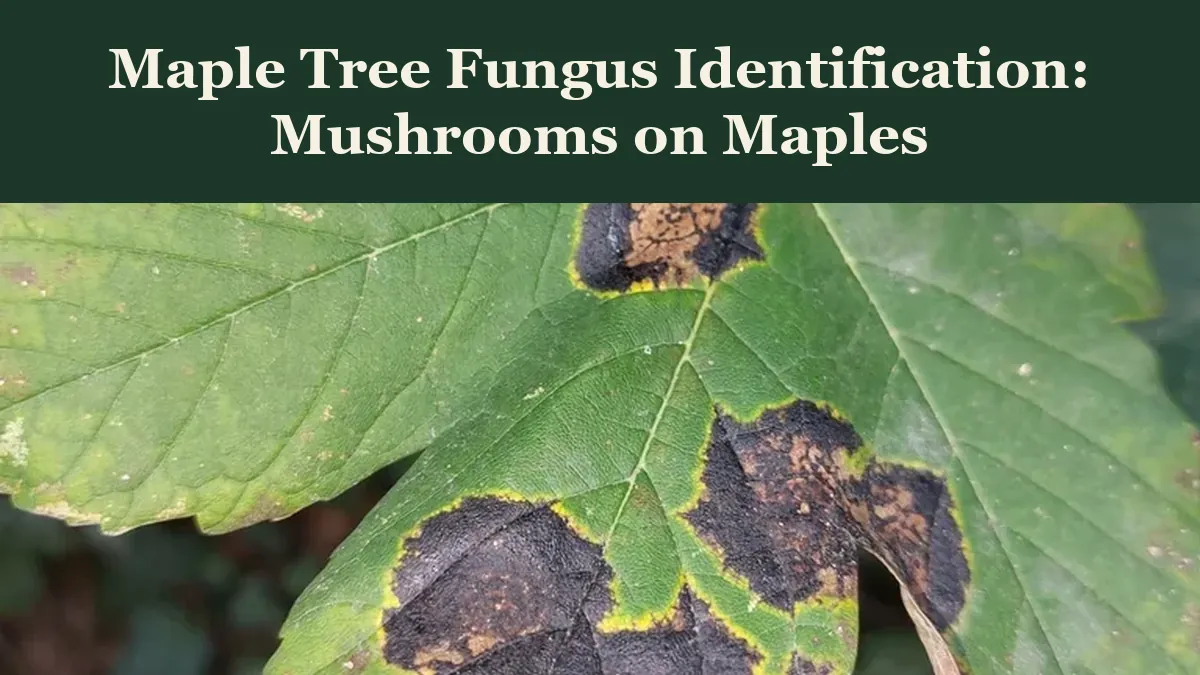
Most maple tree fungus is either a leaf spot that looks alarming but rarely hurts the tree, or a decay fungus fruiting from wood that is already rotting...
 Guide
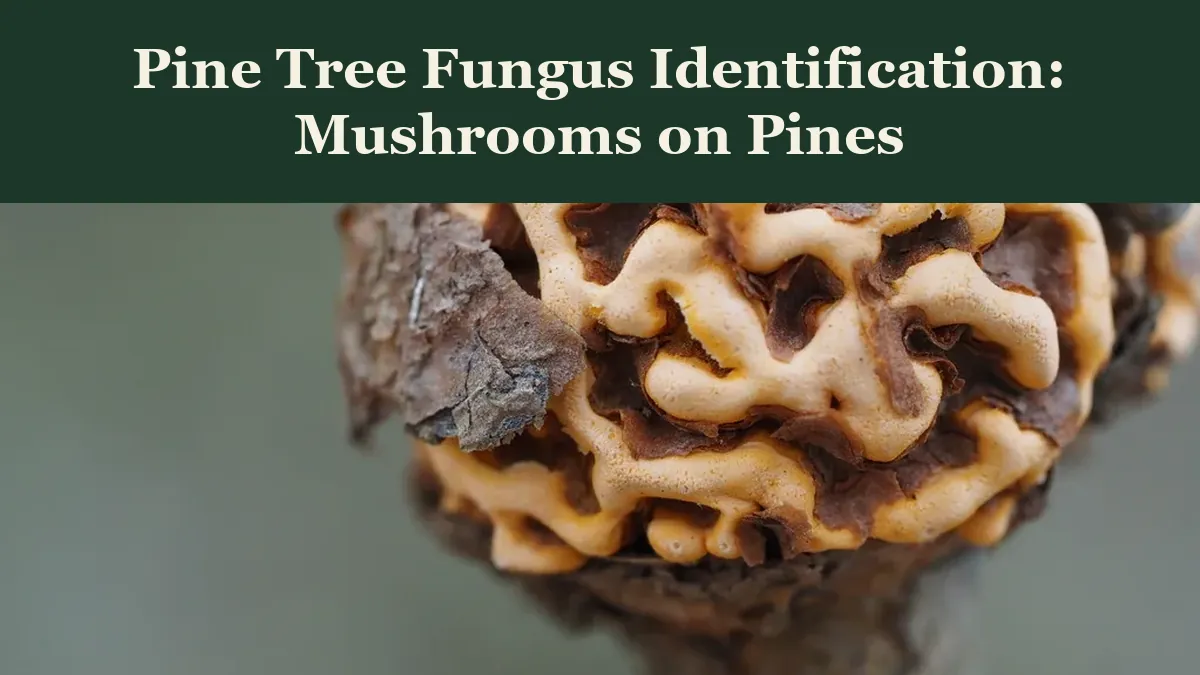
Pine tree fungus identification starts with color and place: orange powder on a woody gall is a rust, brown dead shoot tips are a blight, a conk at the base...
 Guide
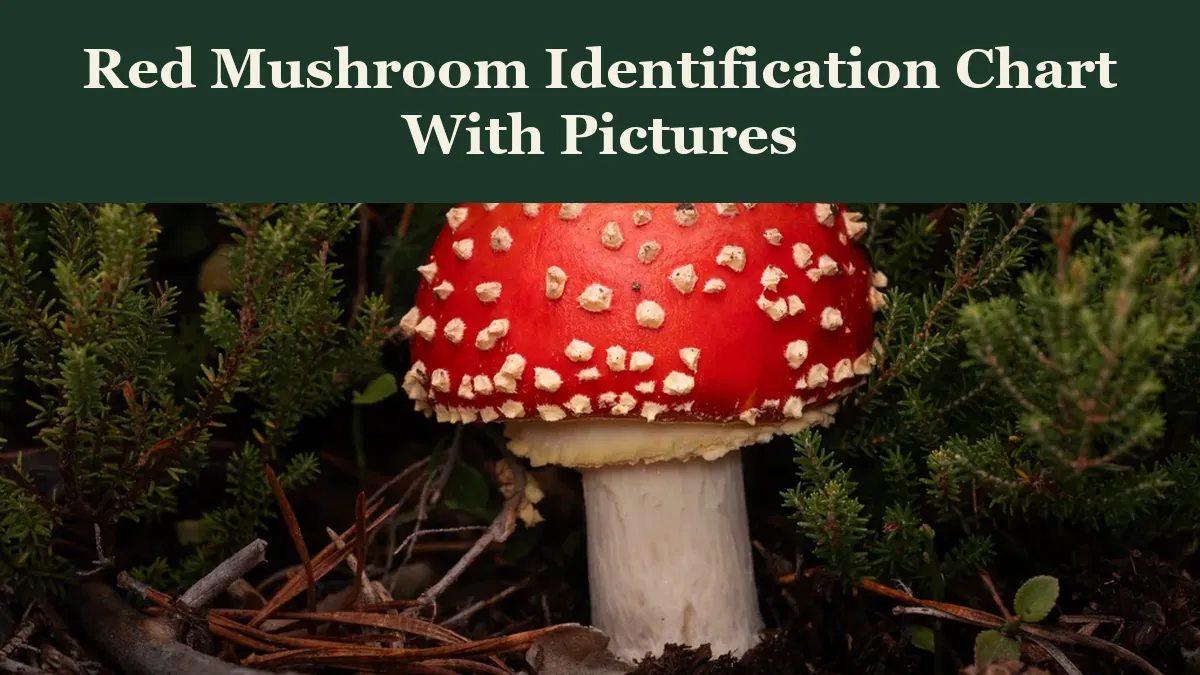
A red mushroom in the US is most often a fly agaric, a red Russula, a waxcap, a red-pored bolete or a shiny reishi shelf on a tree. The red mushrooms most...