Inky Cap Mushroom Identification Chart With Pictures
— views
An inky cap mushroom is a gilled fungus whose cap and gills dissolve into a black, ink-like liquid within hours of appearing. The common inky cap, Coprinopsis atramentaria, also causes a harsh reaction when eaten near alcohol, while the shaggy mane is a separate species that is widely eaten. Inky caps grow on buried wood, stumps and lawns, and they do not harm grass.
This inky cap mushroom identification chart with pictures covers the main US types, the alcohol reaction, the differences between shaggy manes and common inky caps, the look-alikes that matter and what to do if inky caps appear in your lawn.
Key Takeaways
- Inky caps are easiest to recognize by a bell-shaped cap that turns black and liquid from the edge upward.
- Most inky caps leave a black spore print, which separates them from many small lawn mushrooms.
- The common inky cap contains coprine, which blocks the breakdown of alcohol and causes flushing, a racing heart and tingling.
- Sources put the alcohol risk window at 3 days to a week after eating, and NAMA advises avoiding the mushroom altogether.
- People have eaten the toxic green-spored parasol by mistake for shaggy manes, so check the spore color.
- Inky caps do not harm lawns. Pick them by hand, and remove buried wood if they keep returning.
What Is an Inky Cap Mushroom?
"Inky cap" is the common name for mushrooms whose caps and gills dissolve into black liquid. They were once all placed in the genus Coprinus. DNA studies then split the group. The shaggy mane stayed in Coprinus, while most others moved to Coprinopsis, Coprinellus and Parasola.
That is why older field guides call the common inky cap Coprinus atramentarius. The name atramentaria comes from a Latin word for a black substance, especially ink, as First Nature explains.
Inky Cap Mushroom Identification Chart
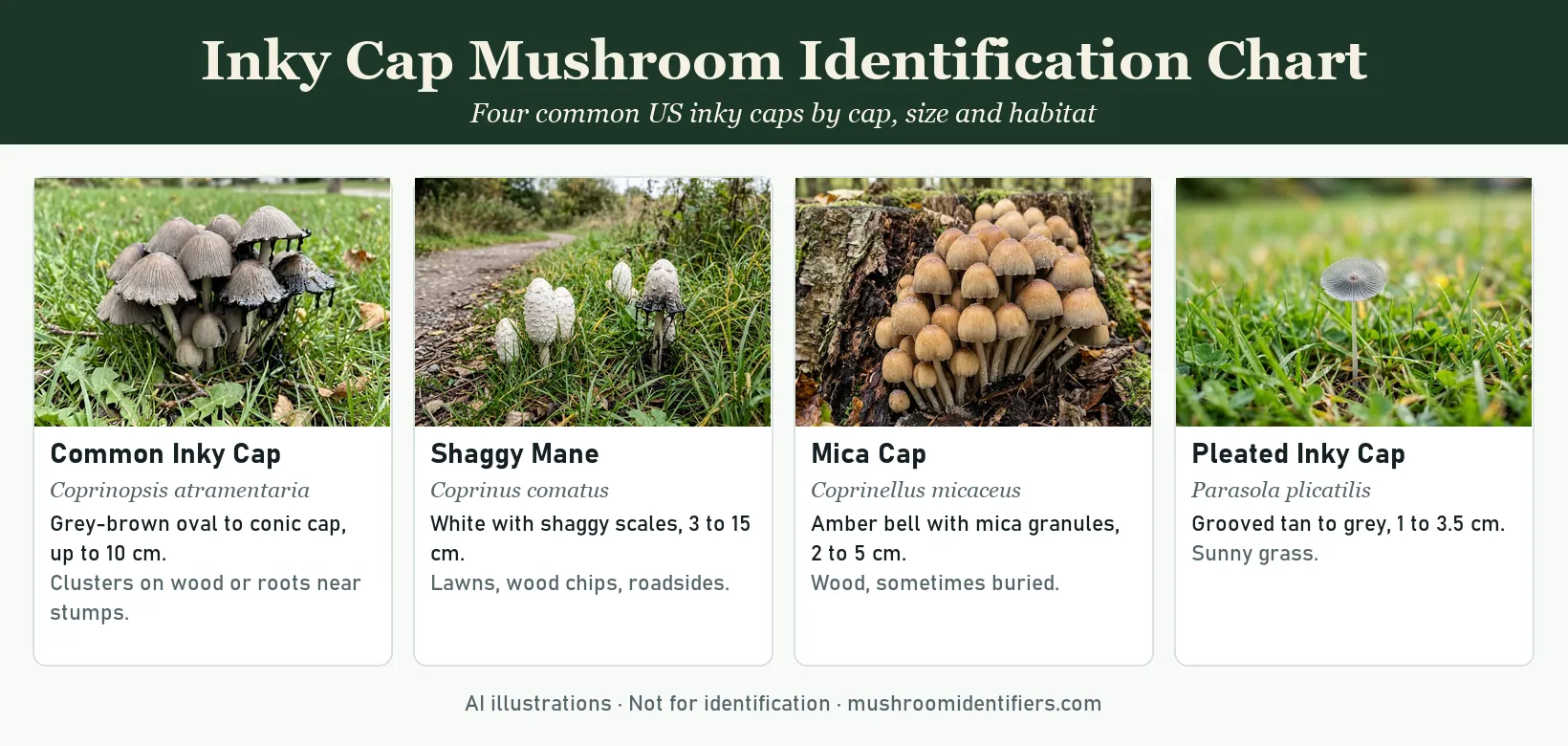
Match the cap color and size first, then check where the mushroom is growing. Inky caps look very different from one another, so the habitat helps a lot.
| Inky cap | Cap | Size | Where it grows | Season |
|---|---|---|---|---|
| Common inky cap (Coprinopsis atramentaria) | Gray-brown, oval to conic | Up to 10 cm | Wood and roots near stumps | Spring to fall |
| Shaggy mane (Coprinus comatus) | White with shaggy scales | 3 to 15 cm | Lawns, wood chips, roadsides | Summer to fall |
| Mica cap (Coprinellus micaceus) | Amber bell with mica granules | 2 to 5 cm | Wood, sometimes buried | Spring to fall, fall to spring in California |
| Pleated inky cap (Parasola plicatilis) | Grooved, tan to gray | 1 to 3.5 cm | Sunny grass | Summer to fall |
| Coprinopsis variegata | Brownish yellow with veil patches | 3 to 8 cm | Hardwood logs | Summer to fall |
| Coprinellus disseminatus | Gray-brown | Up to 2 cm | Stump bases, in large groups | Spring to fall |
Details come from MushroomExpert.com and MykoWeb. The chart pictures are AI illustrations of the typical form, so compare your find with real photographs too.
Why Do Inky Caps Turn to Ink?
Inky caps dissolve to free their spores, in a self-digesting process called deliquescence. Their gills are packed tightly together, and the spores ripen from the bottom edge upward. Each section of gill digests itself after its spores are released, which opens up space for the next section, as mycologist Tom Volk explains.
Genetic work supports this. A genetic study found that genes for chitinase and beta-1,3-glucanase rise before the cap breaks down. These enzymes dismantle the fungal cell wall.
It happens fast. University of California IPM says inky caps can dissolve within hours of appearing. Not every species does this, though. Coprinellus disseminatus does not dissolve, and Parasola plicatilis shrivels instead.
Core Identification Features
Check the cap, the gills, the spore print and the habitat together. Our guide to the parts of a mushroom explains each term.
Cap Shape
Young inky caps are oval or bell-shaped and hug the stem. Older caps spread and curl upward as the edge dissolves. Shaggy manes keep a tall cylinder shape until they blacken.
Gills
Young gills are pale. They darken to black from the cap edge inward. Black dripping gills are the strongest single clue that you have an inky cap.
Spore Print
Most inky caps leave a black spore print. Coprinellus disseminatus runs from black to blackish brown, according to MushroomExpert.com. This is a useful check against the brown-spored mushrooms that share lawns with them.
Growth Pattern
Common inky caps and mica caps grow in clusters, usually from wood. Shaggy manes stand in loose groups in grass or chips. Pleated inky caps tend to stand alone in short grass.
Habitat and Season
Look near stumps, dead roots, buried wood and mulch, especially after rain or irrigation. Iowa State University links them to cool, damp weather. Mica caps fruit from fall to spring in California, so November finds are normal there.
Common Inky Cap Types in the US
These four inky caps show the main forms found on US lawns and stumps. The pictures are AI illustrations of the typical form.
Common Inky Cap (Coprinopsis atramentaria)
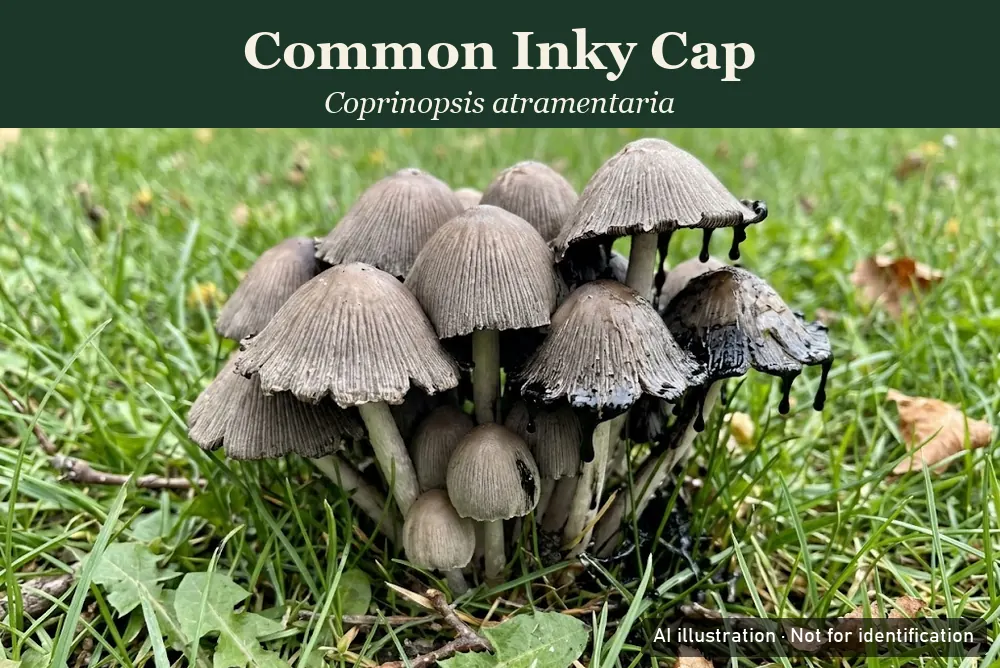
This gray-brown mushroom grows in clusters near stumps and over buried roots. Its smooth, oval cap reaches about 10 cm and has no shaggy scales. It is the classic alcohol-reaction mushroom, sometimes called tippler's bane. See the alcohol section below.
Shaggy Mane (Coprinus comatus)
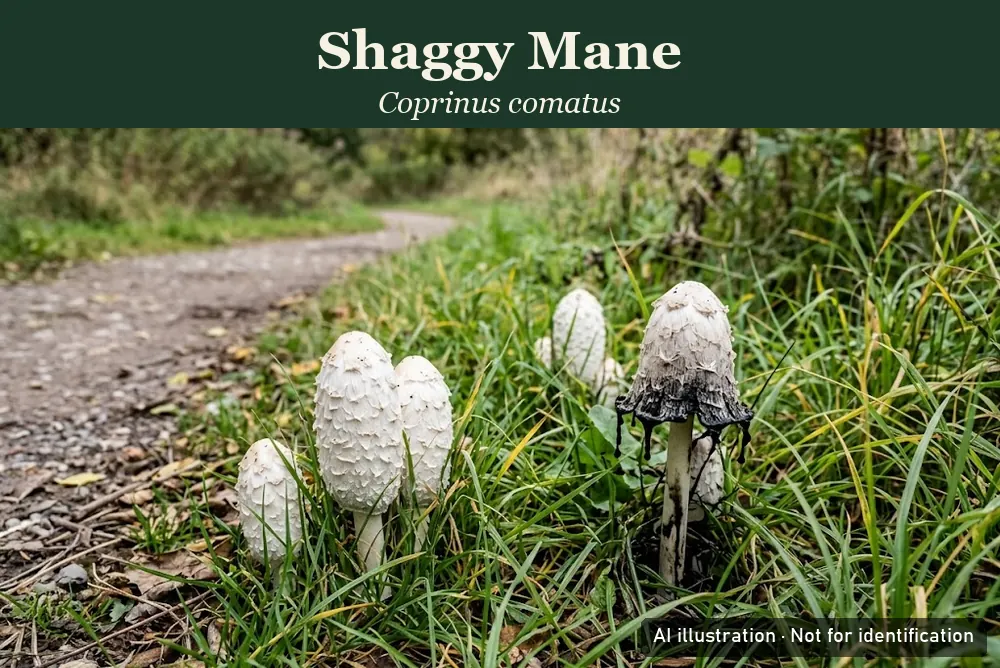
The shaggy mane is a tall white cylinder covered in upturned scales. It grows in lawns, wood chips and along roadsides. It also has a strange side: a published study found that its mycelium kills nematodes using spiny balls and several toxins.
Mica Cap (Coprinellus micaceus)
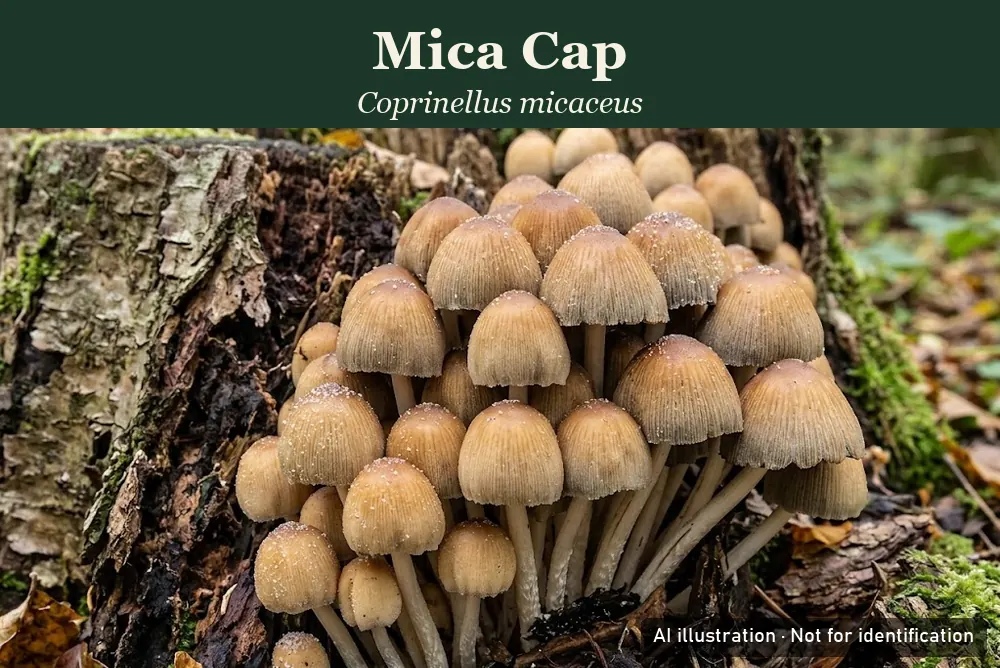
Mica caps are small amber bells dusted with tiny glistening granules that look like mica. They grow in dense clusters on wood, including wood that is buried. The granules wash off in rain, so older caps can look plain. NAMA reports record three people made ill after eating them raw.
Pleated Inky Cap (Parasola plicatilis)
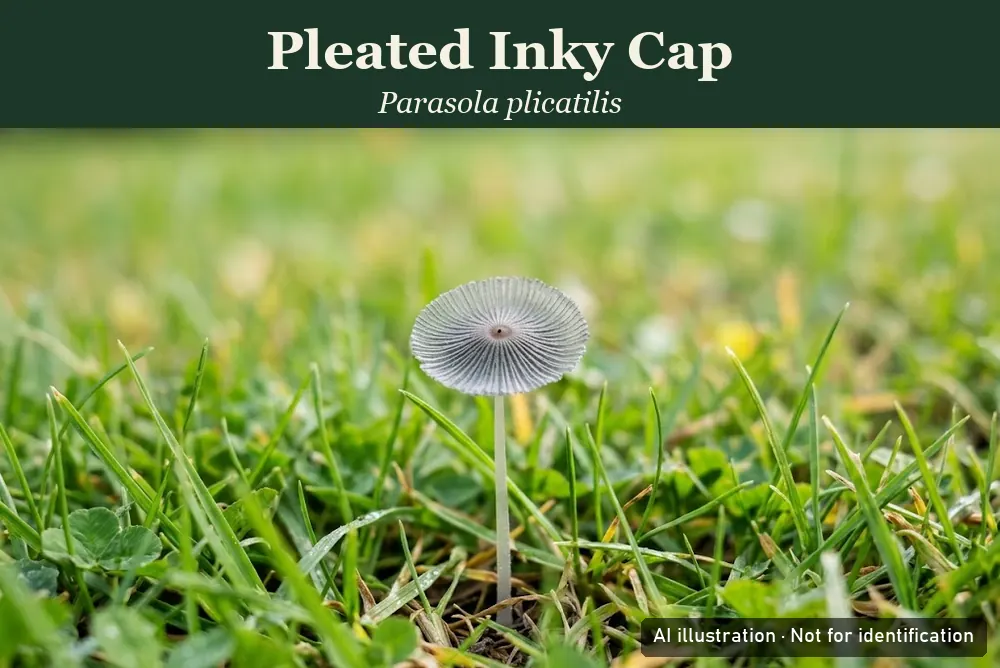
This tiny, grooved umbrella stands on a thin stem in sunny grass. It is too small to eat and shrivels rather than dissolving.
Inky Caps and Alcohol: The Coprine Reaction
The common inky cap contains coprine, which causes a sudden, unpleasant reaction if alcohol is in the body. Coprine converts to a compound that blocks aldehyde dehydrogenase, the enzyme that clears a toxic alcohol by-product, so acetaldehyde builds up. MykoWeb explains the mechanism, which works like the anti-alcohol drug Antabuse.
| Question | What sources say |
|---|---|
| Which species contain it? | Coprinopsis atramentaria, C. insignis, C. variegata and C. quadrifidus, according to NAMA |
| Symptoms | Flushing, racing heart, tingling limbs, headache |
| Onset after alcohol | Minutes to about 2 hours, depending on the source |
| Alcohol before the meal | Alcohol up to 8 hours before also counts, according to MykoWeb |
| Risk window after eating | Sources range from 3 days to a week |
| How long an episode lasts | Usually about 45 minutes, occasionally 2 to 3 hours |
| Treatment | Supportive care, fluids and anti-nausea medicine |
| Severity | Usually short-lived, though one fatal esophageal rupture is on record |
The sources are NAMA, MykoWeb, First Nature and an emergency medicine review. Because they disagree on timing, the safest reading is the longest one: a full week. NAMA goes further and advises avoiding the mushroom regardless of alcohol, and also raises long-term concerns, as does a published review.
Anyone who feels unwell after eating a wild mushroom should call Poison Control at 1-800-222-1222.
Shaggy Mane vs Common Inky Cap
The shaggy mane is white, tall and scaly, while the common inky cap is gray-brown, smoother and usually clustered on wood. Telling them apart matters because only the second is a confirmed coprine mushroom.
| Feature | Shaggy mane | Common inky cap |
|---|---|---|
| Scientific name | Coprinus comatus | Coprinopsis atramentaria |
| Cap | White, tall, shaggy scales | Gray-brown, smooth, no shaggy scales |
| Size | 3 to 15 cm | Up to 10 cm |
| Growth | Loose groups in grass and chips | Clusters near wood and roots |
| Alcohol reaction | Not the Antabuse syndrome, per NAMA | Yes |
| Edibility rating | Choice, per MykoWeb | Avoid, per NAMA |
The evidence on shaggy manes deserves a caveat. A published review says they contain no coprine, but it cites general references, and we could not find a direct lab test. NAMA reports include one adult who flushed after eating them with alcohol on the table. NAMA also mentions possible stomach upset.
Shaggy manes also spoil fast. Sources advise using them within 1 to 6 hours of picking, before the ink stage begins. The same review notes that they accumulate mercury, so they should not be collected from polluted ground.
Inky Cap Look-Alikes
The dangerous confusion is the green-spored parasol mistaken for a shaggy mane. NAMA reports include people who ate Chlorophyllum molybdites believing it was a shaggy mane. It has grayish-green spores and gills that turn green with age, as MushroomExpert.com notes. See our Chlorophyllum molybdites guide.
Spore color also helps with the small mushrooms that share a lawn or stump with inky caps:
| Mushroom | Where | Spore print | Note |
|---|---|---|---|
| Inky caps | Lawns, wood | Black | Gills dissolve in most species |
| Conocybe apala | Lawns | Cinnamon-brown | Collapses by midday |
| Panaeolus foenisecii | Lawns | Dark to purple-brown | Mower's mushroom |
| Psathyrella candolleana | Lawns, wood | Dark purplish brown | Fragile pale cap |
| Galerina marginata | Wood | Rusty brown | Deadly, contains amatoxins |
A small brown mushroom on a stump is never one to guess at, because deadly Galerina grows there too. See our guides to Galerina marginata, the mower's mushroom and small brown mushrooms.
Can You Eat Inky Cap Mushrooms?
The shaggy mane is widely eaten, the common inky cap should be avoided, and other inky caps are too small or poorly documented to recommend. Nobody should eat a wild mushroom based on this page.
- Shaggy mane: rated choice by MykoWeb when young and white, and used quickly.
- Common inky cap: NAMA advises avoiding it, with or without alcohol.
- Mica cap: listed as edible, but do not eat it raw. NAMA has a report of three people made ill.
- Pleated inky cap: inedible because of its size.
Our poisonous vs edible mushrooms guide explains why simple rules fail.
Are Inky Caps Poisonous to Dogs?
Evidence is thin, and the alcohol reaction is unlikely to matter for dogs because it needs alcohol. A veterinary toxicology brief calls the reaction unlikely in veterinary medicine. The Merck Veterinary Manual overview does not include inky caps.
That is not an all-clear. NAMA's voluntary registry has one dog with tremors after Coprinopsis atramentaria and one presumed case of abdominal pain linked to the mica cap group. Veterinary guidance is to treat wild mushrooms as toxic until proven otherwise, so read what to do if your dog ate a mushroom and call your vet.
Why Are Inky Caps in My Lawn?
Inky caps in a lawn usually mean there is dead wood or old roots under the grass. They feed on dead roots, buried wood and mulch, and they fruit in cool, damp weather after rain or irrigation, according to Iowa State University. They do not harm plants.
University of California IPM also links lawn mushrooms to wet spells, overwatering and poor drainage. Fairy rings are the exception that can affect turf. See our article on why mushrooms grow in your yard.
How to Get Rid of Inky Caps
Pick them by hand, and remove the buried wood if they keep coming back. Inky caps fade on their own within days, so removal is mostly about tidiness and safety.
- Pick them early. Remove them before children or pets reach them, and before they turn to ink.
- Find the food source. Dig out buried wood and old roots where you can.
- Improve the lawn. Remove thatch and aerate compacted soil.
- Fix the water. Reduce overwatering and improve drainage.
- Replace old mulch if they grow in beds.
Picking leaves the fungus alive, as UC IPM notes, so expect some to return. Mississippi State University describes fungicides as a temporary fix. For other species, see how to get rid of mushrooms in grass and our backyard mushroom identification guide.
Common Identification Mistakes
Assuming All Inky Caps Are the Same
The shaggy mane and the common inky cap are in different families. A rule that applies to one does not apply to the other.
Skipping the Spore Print
A black print supports an inky cap. A green, brown or rusty print rules it out. Learn the method in our guide to identifying a mushroom you found.
Mistaking a Green-Spored Parasol for a Shaggy Mane
This error appears in NAMA poisoning reports. Check the gills and the spore color on every collection.
Thinking the Alcohol Risk Ends at Dinner
The risk can last for days. A drink the next evening can still trigger a reaction.
Treating Mica Cap Granules as a Permanent Feature
Rain washes them away. A plain amber cap on a stump may be something else, so do not rely on one clue.
A Fact Worth Knowing: Real Mushroom Ink
The black liquid is more than a curiosity. Tom Volk notes that the ink of inky caps was once used for writing.
Frequently Asked Questions
What is an inky cap mushroom?
An inky cap is a gilled mushroom whose cap and gills dissolve into a black, ink-like liquid. The name covers several genera, including Coprinopsis, Coprinellus and Parasola. Shaggy manes are the best-known relatives.
Are inky cap mushrooms poisonous?
The common inky cap is toxic when combined with alcohol because it contains coprine. Reactions include flushing, a racing heart and tingling. NAMA advises avoiding it altogether. Other inky caps vary, so identify each species.
Can you eat inky cap mushrooms?
The shaggy mane is widely eaten when young and white. The common inky cap should be avoided. Mica caps are listed as edible, but should not be eaten raw. Never eat a wild mushroom without expert confirmation.
What happens if you drink alcohol after eating an inky cap?
Coprine blocks the enzyme that clears acetaldehyde, so symptoms can appear within minutes to about 2 hours of drinking. They include flushing, racing heart, tingling limbs and headache. Episodes usually last about 45 minutes.
How long after eating inky caps can you drink alcohol?
Sources range from 3 days to a week. Since they disagree, a full week is the cautious answer. Alcohol taken up to 8 hours before the meal can also trigger a reaction, according to MykoWeb.
Why do inky caps turn black?
They digest their own gills to free their spores, a process called deliquescence. Spores ripen from the gill edge upward, and each spent section dissolves to open space for the next. This can happen within hours.
Is a shaggy mane an inky cap?
Yes, in everyday language. The shaggy mane, Coprinus comatus, is often called the shaggy inky cap. DNA studies place it in a different family from the common inky cap, and it is not known to cause the same alcohol reaction.
Are inky caps bad for my lawn?
No. Inky caps feed on dead roots and buried wood, and they do not harm plants, according to Iowa State University. They usually fade within days. Removing buried wood reduces repeat appearances.
Are inky caps poisonous to dogs?
Evidence is thin. The alcohol reaction is unlikely in dogs, but NAMA's registry has one dog with tremors after a common inky cap. Treat every wild mushroom as toxic and call your vet if your dog eats one.
What color is the inky cap spore print?
Most inky caps leave a black spore print. Coprinellus disseminatus can be blackish brown. A rusty, cinnamon or green print means you are looking at a different mushroom.
Final Safety Reminder
Inky caps are fascinating and mostly harmless to your garden, but they are not a beginner's dinner. Never eat a wild mushroom based on a chart, a photo or an app. To check a find, take clear pictures using our guide on how to photograph mushrooms for identification, then try our free mushroom identifier and ask a local expert.
Sign in to leave a comment and join the discussion.
 Species Guide
Mushrooms growing on a living tree almost always mean the wood inside is decaying. The fungus has usually been feeding on dead heartwood or wounded sapwood...
 Species Guide
Chanterelle mushroom identification starts under the cap: a true chanterelle has blunt ridges or a nearly smooth surface running down the stem, never sharp,...
 Species Guide
A king bolete, also called porcini, is a large brown-capped mushroom with a sponge of pores instead of gills, a swollen stem with a fine white net near the...