How to Identify a Mushroom By Picture You Found?

Nathan Cole
Mycologist · Author · Fungi Expert
Updated
Apr 25, 2026
How to Identify a Mushroom You Found?
Found a mushroom and wondering what it is? Start by examining five physical features: the cap, gills or pores, stem, spore print, and the surface it's growing on. Cross-reference these observations with a regional field guide or a trusted app like mushroomidentifiers.com.
Never eat a mushroom based on a single feature — confirmation requires multiple matching characteristics. This guide walks you through every step of the identification process, using the same methods mycologists and experienced foragers actually rely on.
1. Start With Physical Features
Physical features are the foundation of mushroom identification. Before reaching for any app or field guide, your own careful observation is the most powerful tool you have. Most misidentifications happen because people notice one or two features and stop — a fatal mistake when toxic look-alikes are involved.
Work top to bottom: cap → gills/pores/teeth → stem → base. Take notes or photos at each stage. Good lighting and a white background (a piece of paper works) make colors accurate.
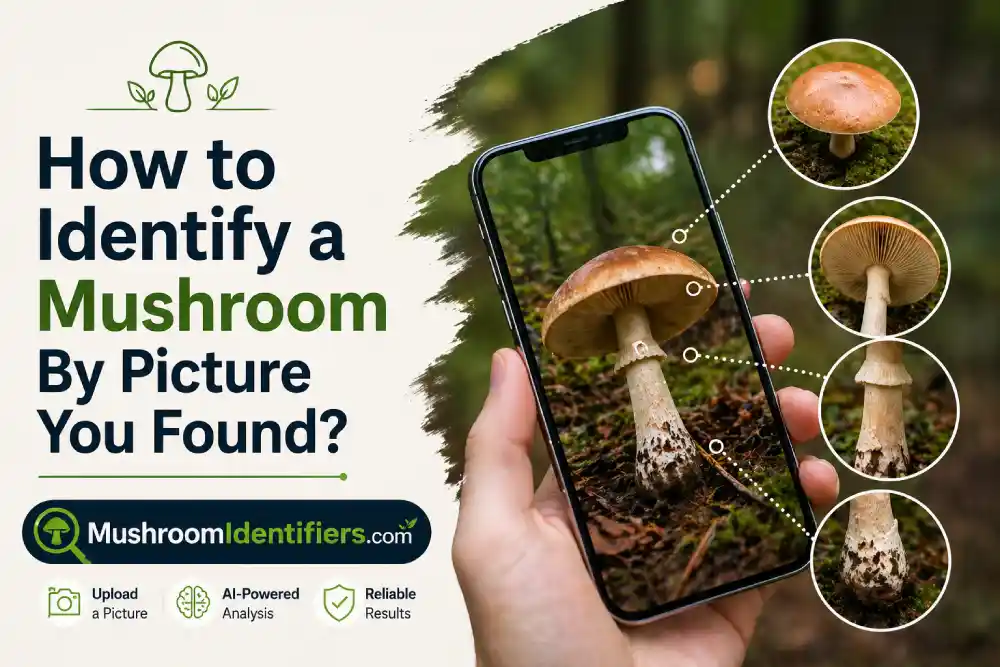
1.1 Cap — Shape, Color, Size, Texture & Margin
The cap, or pileus, is usually the first thing you see. It holds more information than most beginners realize.
Shape changes as a mushroom matures, so note what stage you're looking at:
| Shape | Description | Example Genus |
|---|---|---|
| Convex | Rounded, dome-like | Agaricus |
| Flat/Umbonate | Flat with a central bump | Russula |
| Funnel-shaped | Depressed center, edges curve up | Cantharellus |
| Bell-shaped (campanulate) | Narrow, like a bell | Mycena |
| Irregular/Wavy | No clear symmetry | Gyromitra |
Color is useful but unreliable on its own — sun, rain, and age all shift it. Always note color at the center and at the edge separately. A cap that is dark brown at the center and pale tan at the margin tells a different story than a uniformly colored one.
Size matters for narrowing genera. Measure cap diameter in centimeters if you can.
Texture categories:
- Dry / smooth / viscid (sticky when wet) / slimy
- Fibrous, scaly, or cracked
- Powdery (pruinose)
Margin (the edge of the cap):
- Smooth, wavy, lobed, or striate (lined)
- Whether it extends beyond the gills underneath
A striated margin, for example, is a reliable indicator in Amanita species — which also happen to contain the most deadly mushrooms in the world.
1.2 Gills, Pores, or Teeth — Attachment, Color & Spacing
Flip the mushroom over. What you see on the underside is one of the most diagnostic features in all of fungal identification.
Gills are blade-like structures running from the margin toward the stem. Pores are tiny holes (found on boletes and bracket fungi). Teeth or spines hang downward (as in Hydnum species). Knowing which type you have immediately narrows your options significantly.
For gilled mushrooms, note:
Attachment to the stem:
- Free — gills don't touch the stem (Agaricus, Amanita)
- Adnate — gills meet the stem squarely
- Decurrent — gills run down the stem (Cantharellus)
- Notched (sinuate) — a small notch just before meeting the stem (Tricholoma)
Color: White, cream, pink, brown, black, gray — and does the color change with age or when bruised? Pink gills that turn brown-black is classic Agaricus. Gills that stain red when cut narrow things further.
Spacing: Crowded, close, well-spaced, or widely spaced. Forked gills (as in chanterelles) versus true gills are a critical distinction — many toxic Jack-o'-lantern mushrooms (Omphalotus) are misidentified as chanterelles partly because people don't check whether the gills are true or false.
Waxy texture: Waxy gills are a defining feature of the Hygrocybe family.
1.3 Stem — Shape, Color, Hollow/Solid & Base Type
The stipe (stem) is examined for both external and internal features.
External:
- Color and texture — smooth, fibrous, scaly, twisted
- Presence of a ring (annulus) — where it is, how thick, whether it moves
- Overall shape — cylindrical, club-shaped, tapered, bulbous at base
Cut it open. Is it:
- Solid — dense tissue throughout
- Hollow — empty center (common in Marasmius, some Agaricus)
- Stuffed — filled with pith-like material
A hollow stem in a species expected to be solid is a red flag to double-check your ID.
Base type is critically important, especially for ruling out Amanita species:
| Base Type | What It Looks Like | Associated Risk |
|---|---|---|
| Plain / tapered | Nothing unusual | Common in many edibles |
| Bulbous | Swollen at the base | Seen in some Amanita |
| Volva present | Cup-like sac at the base | Amanita — HIGH RISK |
| Mycelial mat | White root-like threads | Many wood-rot fungi |
Always dig up the base — don't just pull the cap. The volva (cup) on Amanita phalloides (Death Cap) is often buried in soil and missed entirely, leading to deadly misidentification.
1.4 Ring (Annulus) & Volva — Presence & Position
These two structures come from the universal veil and partial veil — protective membranes that cover a developing mushroom and tear away as it grows.
Ring (annulus):
- A skirt-like structure on the upper portion of the stem
- Can be thick and persistent, thin and fragile, or absent entirely
- Position (high, mid-stem, low) and whether it's moveable are both ID clues
- A double ring (two layers) is distinctive in Agaricus campestris (meadow mushroom)
Volva:
- The remains of the universal veil at the base of the stem
- Can appear as a cup, a bag, or just a rim of loose tissue
- Present in all Amanita species — the genus responsible for roughly 90% of fatal mushroom poisonings worldwide
- Often buried; digging carefully around the base is essential
If you find a white mushroom with free gills, a ring, and a bulbous or cupped base — stop. Do not eat it. Verify exhaustively before proceeding.
1.5 Flesh — Color, Texture & Color Change When Cut
Slice the mushroom vertically through cap and stem. Observe immediately, then watch for changes over 1–5 minutes.
What to record:
- Color of fresh flesh — white, cream, yellow, gray, red
- Texture — firm, brittle, fibrous, gelatinous
- Does the color change when exposed to air?
Color change reactions are highly diagnostic:
| Reaction | Color Change | Genus Clue |
|---|---|---|
| Bluing | White → blue/green | Boletus (some toxic, some edible) |
| Reddening | White → pink/red | Russula, some Amanita |
| Yellowing | White → yellow | Some Agaricus (can indicate toxicity) |
| No change | Stays white/cream | Common in many species |
For boletes: flesh that turns blue instantly when cut is a significant marker. Some blue-staining boletes are edible; others (like Boletus satanas) are toxic. The reaction alone doesn't confirm safety — it narrows the field.
1.6 Odor & Taste (With Caution)
Smell is an underused identification tool. Mycologists rely on it heavily.
Common odor descriptors:
- Anise / licorice (Clitocybe odora)
- Fishy or rancid (Tricholoma sulphureum)
- Floury or mealy (Russula spp.)
- Fruity (Hygrophorus)
- Radish-like (several Mycena)
- Faintly mushroomy (neutral — common)
- Sickly sweet or honey-like (check Armillaria)
On tasting: A tiny amount of flesh placed on the tip of the tongue — chewed briefly and spat out — is used by experts for Russula identification (mild vs. acrid taste). This is only appropriate after you have significant experience and have already ruled out dangerous genera. Never taste any mushroom you have not already tentatively identified to genus level. Amatoxins have no taste — the Death Cap is reportedly pleasant-tasting, which is part of why it kills.
2. Take a Spore Print
A spore print is one of the most reliable single-feature identification tools available to any forager. It costs nothing and takes 30 minutes.
2.1 How to Make a Spore Print
- Cut the cap from the stem cleanly
- Place it gill/pore-side down on a piece of paper — use half white, half black to capture all print colors
- Cover with a bowl to prevent air movement
- Wait 30–60 minutes (some species need up to 4 hours)
- Carefully lift the cap and photograph the print immediately before it smudges
Store the print by spraying lightly with hairspray if you need to keep it for reference.
2.2 Reading Spore Color for Identification
Spore color directly links to genus-level classification. It is non-negotiable for accurate ID.
| Spore Print Color | Associated Genera |
|---|---|
| White | Amanita, Russula, Cantharellus, Tricholoma |
| Cream / pale yellow | Agaricus (some), Lepiota |
| Pink / salmon | Entoloma, Pluteus, Clitopilus |
| Brown (various shades) | Agaricus, Cortinarius, Inocybe |
| Rusty / cinnamon brown | Cortinarius, Pholiota |
| Purple-brown | Agaricus bisporus (common cultivated mushroom) |
| Black / dark gray | Coprinus, Panaeolus |
A white-spored mushroom cannot be Agaricus (which prints purple-brown). This single test eliminates enormous categories of possibilities. Any mushroom you suspect is an Amanita should always be tested — white spore print plus free gills plus ring plus volva is their signature pattern.
3. Note the Ecological Context
Where and how a mushroom grows tells you as much as its physical features. Fungi are not random — they have specific relationships with substrates, trees, and ecosystems that narrow identification dramatically.
3.1 What It's Growing On (Substrate)
The substrate — what the mushroom is physically emerging from — is an immediate diagnostic filter.
| Substrate | What Grows There | Notes |
|---|---|---|
| Soil in woodland | Amanita, Russula, Boletus | Check for buried volva |
| Rotting hardwood | Pleurotus (oyster), Ganoderma | Wood-rot fungi |
| Living tree (wound) | Laetiporus (chicken of the woods) | Bracket fungi |
| Dung / manure | Panaeolus, Psilocybe (some) | Coprophilous fungi |
| Leaf litter | Marasmius, Mycena | Decomposers |
| Buried wood / roots | Armillaria (honey fungus) | Often in clusters |
| Other fungi | Asterophora, Hypomyces | Mycoparasites |
A mushroom growing in a tight cluster from buried wood almost never belongs to the same genus as one growing alone from open soil, even if they look similar from above.
3.2 Nearby Trees & Mycorrhizal Hosts
Many fungi form mycorrhizal associations — mutual symbiotic relationships with specific tree species. These are obligate partnerships: without the host tree, the fungus cannot fruit.
This means the trees around your find are not background scenery — they are part of the identification.
Key pairings:
- Boletus edulis (porcini) — oak, pine, spruce, beech
- Amanita muscaria (fly agaric) — birch, pine
- Cantharellus cibarius (golden chanterelle) — oak, beech, fir
- Tricholoma matsutake (matsutake) — red pine
- Lactarius deliciosus — pine specifically
- Tuber (truffles) — oak, hazel, beech
Finding a mushroom under a lone birch tree in an otherwise oak forest? That birch matters. Finding boletes under spruce when you're in a pure oak woodland is a red flag that your ID may be off.
3.3 Habitat Type — Forest, Meadow, Urban
Habitat type narrows the field further:
- Deciduous forest: Highest diversity — Amanita, Russula, Boletus, Chanterelle
- Coniferous forest: Lactarius, Suillus, Tricholoma, Cortinarius
- Grassland / meadow: Agaricus, Marasmius, Hygrocybe, fairy rings
- Urban / disturbed ground: Coprinus, Psilocybe (in wood chips), Agaricus xanthodermus (toxic)
- Wetlands / bogs: Galerina (highly toxic), Cortinarius
Urban and disturbed habitats often harbor Galerina marginata — a deadly small brown mushroom that grows in wood chip mulch in parks and gardens worldwide. It contains the same amatoxins as the Death Cap.
3.4 Geographic Region & Season
Region determines which species are even possible. A mushroom found in the Pacific Northwest has a completely different shortlist than one found in the UK, Japan, or Eastern Australia. Always use a field guide written for your specific region — generic guides miss regionally endemic species and include species that don't occur near you.
Season also narrows dramatically:
| Season | Notable Species |
|---|---|
| Spring | Morels (Morchella), St. George's mushroom |
| Summer | Chanterelles, early boletes, Agaricus |
| Autumn | Peak season — boletes, Amanita, Russula, Cortinarius |
| Winter | Velvet shank (Flammulina), oyster mushrooms, Pleurotus |
A morel-shaped mushroom appearing in October in your region warrants extreme scrutiny — it may be a false morel (Gyromitra), which contains toxic gyromitrin.
4. Use the Right Identification Tools
No single tool identifies a mushroom reliably. Professionals use a combination — and so should you.
4.1 Regional Field Guides & Dichotomous Keys
A regional field guide is the single most important investment any forager makes. Generic national or international guides are a starting point, but regional guides reflect what actually grows in your specific ecosystem.
Recommended approach:
- Use the key at the front to narrow to a genus
- Compare your specimen against every species in that genus for your region
- Verify every feature — not just the ones that match, but specifically the ones that would rule it out
- Check for toxic look-alikes listed under that species
Dichotomous keys force systematic comparison: at each step, you choose between two options (gills vs. pores, ring present vs. absent), eliminating possibilities until you reach a name. They're slower than apps but far more reliable because they prevent confirmation bias.
Strong regional guides by region:
- UK: Roger Phillips' Mushrooms
- North America (East): Audubon Society Field Guide to Mushrooms
- North America (Pacific NW): All That the Rain Promises and More — David Arora
- Europe: Mushrooms of Europe — Courtecuisse & Duhem
4.2 Apps — iNaturalist, Seek, PictureThis
AI mushroom identification apps have improved significantly, but come with critical limitations.
iNaturalist is the most robust option — your observation gets confirmed by human experts and the broader community, not just an algorithm. The Seek app (also by iNaturalist) provides on-device real-time ID using computer vision.
How to use apps correctly:
- Submit multiple photos: top of cap, underside (gills/pores), stem, base, habitat
- Include something for scale
- Note substrate, nearby trees, and region in your observation
- Treat the AI suggestion as a starting hypothesis — then verify against a field guide
- Never eat based solely on app identification
PictureThis and similar apps are trained primarily on photos, not mycological expertise. They misidentify toxic species as edible at documented rates. Use them for curiosity and initial direction, not confirmation.
4.3 Microscopy & DNA Barcoding (Advanced)
When field features are insufficient — particularly for small brown mushrooms (LBMs — little brown mushrooms), Cortinarius, or Inocybe — microscopy and molecular tools become necessary.
Microscopy examines:
- Spore shape and ornamentation under magnification
- Gill tissue structure (trama)
- Presence of cystidia (specialized cells)
- Clamp connections in hyphae
This level of ID requires a microscope (400–1000x), chemical reagents (Melzer's, KOH), and species monographs.
DNA barcoding uses the ITS (Internal Transcribed Spacer) region of fungal DNA to produce a genetic sequence matched against databases like UNITE or GenBank. Community science projects like iNaturalist increasingly incorporate eDNA data. For critical safety questions, a sequence is definitive in a way no photograph can be.
4.4 Local Mycological Societies & Expert Help
The most underused resource in mushroom identification is other people.
Mycological societies run forays, workshops, and ID sessions where experienced members examine your actual physical specimen. This matters because a photograph cannot convey smell, texture, spore print color under proper lighting, or the feel of the stem — all things an expert will check in 30 seconds.
How to find them:
- North American Mycological Association (NAMA) maintains a society directory
- British Mycological Society lists UK clubs
- Facebook groups like "Mushroom Identification" (100k+ members) have active expert contributors
- Universities with mycology departments often have public contacts
When in doubt about edibility, bring the whole specimen (including the base, wrapped carefully — not in plastic, which causes rapid decay) to a local expert. Many societies offer free identification days.
5. Understand Basic Fungal Taxonomy
Taxonomy is the filing system of the living world. Understanding how fungi are classified turns a confusing mass of names into a navigable hierarchy — and makes field guides and keys make sense.
5.1 Order → Family → Genus → Species
Fungal classification works from broad to specific:
Kingdom Fungi → Phylum → Class → Order → Family → Genus → Species
For practical identification, you mostly work with the bottom three:
| Level | Example 1 | Example 2 |
|---|---|---|
| Order | Agaricales | Boletales |
| Family | Amanitaceae | Boletaceae |
| Genus | Amanita | Boletus |
| Species | Amanita phalloides | Boletus edulis |
Why this matters for safety:
Once you identify a genus, you immediately inherit everything known about that genus — toxicity patterns, ecological associations, key diagnostic features. Knowing you have an Amanita means you now know you're looking at a genus where some species are among the world's finest edibles (A. caesarea, A. rubescens) and others are responsible for the majority of fatal mushroom poisonings (A. phalloides, A. ocreata, A. bisporigera). That context shapes every decision you make.
5.2 Common Name vs. Scientific Name — Why It Matters
Common names are unreliable for identification and occasionally dangerous.
The name "death cap" refers specifically to Amanita phalloides in most English-speaking countries — but in some regional traditions, it's used loosely for other deadly white Amanita species. The name "inky cap" covers multiple species across several genera, some edible, some causing violent illness when combined with alcohol (Coprinopsis atramentaria).
The core problem: Common names vary by country, region, and even family tradition. Scientific binomial names (Genus species) are universal — a mycologist in Japan, Germany, and Brazil all mean exactly the same organism when they write Cantharellus cibarius.
Practical rule: Use common names for conversation. Use scientific names — at minimum the genus — for identification and any decision about eating. When a field guide entry lists both, always cross-reference the scientific name against multiple sources before trusting edibility claims.
Next up: Section 6 — Know the Safety Rules, covering edible vs. toxic categories, dangerous look-alikes, key toxins, and the non-negotiable golden rule.
6. Know the Safety Rules
Everything in the previous sections — physical features, spore prints, ecological context, taxonomy — exists in service of one practical question: is this safe? This section is where identification becomes consequential. Mushroom poisoning is not a hypothetical risk. Roughly 100 people die from mushroom poisoning annually in Europe alone, and the majority of serious cases involve experienced foragers who made a single error in identification. The rules here are not precautionary suggestions — they reflect decades of toxicological data and medical case literature.
6.1 Edible vs. Toxic vs. Deadly Categories
Mushrooms do not divide neatly into "safe" and "dangerous." The reality is a spectrum, and where a species falls on that spectrum depends on preparation method, quantity consumed, individual physiology, and sometimes alcohol consumption.
The four practical categories:
Edible — Species with a long, well-documented history of safe consumption by many people across different populations. Even within this category, all wild mushrooms should be cooked. Raw Agaricus bisporus (the common cultivated button mushroom) contains small amounts of agaritine, a hydrazine compound that is largely destroyed by heat. Raw wild Gyromitra (false morel) can be toxic even though dried or parboiled preparations are traditional foods in parts of Finland.
Conditionally edible — Species that are edible with specific preparation but toxic otherwise. Gyromitra esculenta is the clearest example: it contains gyromitrin, which hydrolyzes to the volatile toxin monomethylhydrazine (MMH). Parboiling twice in open water with ventilation removes most of it. But "most" is not "all," and gyromitrin also absorbs dermally — people have been poisoned just by inhaling steam while cooking it. Conditional edibility requires full understanding of conditions, not just the conclusion.
Toxic — Species that cause illness ranging from gastrointestinal distress to organ damage but are rarely fatal in healthy adults with prompt medical treatment. This category includes:
| Species | Toxin | Symptom Onset | Main Effect |
|---|---|---|---|
| Omphalotus olearius (jack-o'-lantern) | Illudin S | 1–3 hours | Severe GI distress |
| Agaricus xanthodermus | Phenol compounds | 15 min–2 hrs | GI, sweating |
| Boletus satanas | Unknown | 15 min–2 hrs | Violent vomiting |
| Coprinopsis atramentaria | Coprine | Only with alcohol | Flushing, palpitations |
| Scleroderma (earthballs) | Unknown | 1–6 hours | GI distress |
Deadly — A small group of species where ingestion of even small amounts can cause irreversible organ failure. These are the species responsible for virtually all mushroom fatalities. The Amanita genus dominates this category, but it is not the only one.
A critical point often missed: many toxic and deadly mushrooms cause no immediate symptoms. The absence of immediate nausea after eating is not evidence of safety.
6.2 Dangerous Look-Alikes (Death Cap & Others)
Look-alike misidentification is the primary cause of serious mushroom poisoning worldwide. In almost every case, a toxic or deadly species shares one or two surface features with a commonly sought edible — and the forager stopped checking too soon.
Death Cap (Amanita phalloides)
The single most lethal mushroom in the world, responsible for approximately 90% of all fatal mushroom poisonings globally. Young specimens emerging from the volva are white and egg-like — frequently mistaken for puffballs (Calvatia, Lycoperdon). Mature specimens are often mistaken for:
- Paddy straw mushroom (Volvariella volvacea) — a common edible in Southeast Asian cooking. Fatal A. phalloides poisonings among immigrant communities in California, Australia, and Europe have been documented repeatedly because this confusion is exactly predictable.
- Caesar's mushroom (Amanita caesarea) — a prized edible across southern Europe; distinguished by orange-yellow coloring vs. the greenish-yellow of phalloides
- Field mushrooms (Agaricus campestris) — white-capped and common in similar habitats
Distinguishing A. phalloides positively:
- Greenish-yellow to pale olive cap (but can be near-white in some variants)
- White gills, free from the stem
- White ring on upper stem
- Prominent white volva (cup) at base — often buried
- White spore print
- Faint sweet or honey-like odor in mature specimens
Destroying Angels (Amanita bisporigera, A. virosa, A. ocreata)
Pure white from cap to base, growing from woodland soil across North America and Europe. Mistaken for: young Agaricus species, white Lepiota, or simply assumed to be a "harmless white mushroom." There is no harmless white woodland mushroom with free gills, a ring, and a volva. Every specimen fitting that description should be treated as potentially deadly until comprehensively proven otherwise.
Jack-o'-Lantern (Omphalotus olearius / O. illudens)
Bright orange, growing in clusters at the base of hardwood trees or from buried roots. The most common misidentification target is golden chanterelle (Cantharellus cibarius) — one of the most popular and distinctive edible mushrooms.
The critical difference:
| Feature | Golden Chanterelle | Jack-o'-Lantern |
|---|---|---|
| Gills | False ridges (forked, blunt, run down stem) | True thin gills (sharp, crowded) |
| Growth | Solitary or scattered from soil | Dense clusters from wood/roots |
| Color | Egg-yolk yellow, consistent | Vivid orange, often darker center |
| Smell | Fruity, apricot-like | Strong, unpleasant fungal |
| Bioluminescence | None | Gills glow faintly green in dark |
Running your finger across the underside is the fastest check: the blunt, forking false ridges of a chanterelle feel fundamentally different from true gills.
Funeral Bell (Galerina marginata)
Small, brown, unremarkable. Grows in clusters on rotting wood and wood chip mulch in urban parks, gardens, and trails. Contains the same amatoxins as the Death Cap in equivalent lethal concentration per gram. Mistaken for:
- Honey fungus (Armillaria mellea) — a popular edible that also grows in clusters on wood
- Magic mushrooms (Psilocybe spp.) — this misidentification has killed people foraging Psilocybe in the Pacific Northwest
Galerina has a ring, brown gills, a rusty brown spore print, and a mealy smell. Armillaria has white gills and a white spore print. The spore print difference alone should catch this confusion — but only if you take one.
Fool's Webcap (Cortinarius rubellarius) and Related Species
The Cortinarius genus contains several thousand species, most identified only by microscopy or DNA. C. rubellarius, C. orellanus, and related species cause orellanine nephrotoxicity — irreversible kidney failure with a uniquely delayed onset of 2–3 weeks. By the time symptoms appear, the window for effective treatment has often closed. Misidentified as various edible brown-capped woodland mushrooms and chanterelles.
6.3 Key Toxins — Amatoxins, Muscarine, Ibotenic Acid
Understanding the toxins themselves — not just the species that contain them — gives you a framework for understanding why symptoms present when they do, and why some poisonings respond to treatment while others are nearly untreatable.
Amatoxins
The most clinically significant fungal toxins known. Found primarily in Amanita (Death Cap, Destroying Angels), Galerina marginata, and some Lepiota species.
Mechanism: Amatoxins inhibit RNA polymerase II, blocking protein synthesis in cells. This preferentially destroys hepatocytes (liver cells) and renal tubular cells.
Clinical timeline:
- 0–6 hours: No symptoms — the silent phase. The mushroom has been eaten and digested; nothing feels wrong.
- 6–24 hours: Violent GI onset — severe vomiting, watery diarrhea, cramps. Often misattributed to "food poisoning."
- 24–72 hours: False recovery — GI symptoms subside, patient feels better. This is the most dangerous phase clinically; organ destruction is ongoing while the patient may refuse hospitalization.
- 3–5 days: Fulminant liver and kidney failure. Jaundice, coagulopathy, encephalopathy.
- Outcome: Without liver transplant, fatality rate in severe cases approaches 10–30%.
There is no specific antidote. Treatment is supportive — aggressive IV fluid replacement, N-acetylcysteine, silibinin (milk thistle extract) in some protocols, and liver transplant when failure is irreversible.
The key implication: The 6-hour silent phase means that by the time someone seeks help, a significant toxic dose has already been absorbed. Anyone who has consumed a suspected amatoxin-containing species must go to an emergency room immediately, without waiting for symptoms.
Muscarine
Found in Inocybe species (many), Clitocybe species (some), and in trace amounts in Amanita muscaria (despite the name, muscarine is not its primary toxin).
Mechanism: Overstimulates muscarinic acetylcholine receptors throughout the body.
Symptoms — the SLUDGE syndrome:
- Salivation
- Lacrimation (tearing)
- Urination
- Defecation
- Gastric distress
- Emesis (vomiting)
Plus bradycardia (slow heart rate), bronchospasm, and excessive sweating. Onset is fast — typically 15–30 minutes.
Treatment: Atropine is a direct antidote and is highly effective when administered promptly. Muscarine poisoning, while intensely unpleasant, is rarely fatal with treatment.
Why it matters for ID: Small brown Inocybe mushrooms are extremely common across woodland habitats worldwide and are easily mistaken for edible species by beginners. Their fibrous, silky cap texture and faint musty smell are distinctive to experienced eyes but not to someone without prior exposure.
Ibotenic Acid & Muscimol
The primary psychoactive compounds in Amanita muscaria (fly agaric) and Amanita pantherina (panther cap). A. pantherina is more potent and more frequently involved in serious poisoning.
Mechanism: Ibotenic acid is a structural analogue of glutamate (excitatory). It partially converts to muscimol in the body; muscimol acts on GABA receptors (inhibitory), producing sedation, dissociation, and hallucination.
Symptoms: Confusion, delirium, involuntary movements, deep sleep or stupor, visual disturbance. In overdose — particularly with A. pantherina — seizures and respiratory depression.
Onset: 30 minutes to 3 hours, typically peaking at 3 hours, lasting 4–8 hours.
The cultural complication: Amanita muscaria has a long history of intentional ceremonial use in Siberian and some Indigenous North American traditions. It is currently sold in some jurisdictions as a legal supplement. This has produced a population of people intentionally experimenting with it — and misidentifying A. pantherina as A. muscaria with significantly worse outcomes.
Orellanine
Produced by Cortinarius orellanus, C. rubellarius, and related species. A bipyridyl compound that causes selective destruction of proximal tubule cells in the kidney.
The defining feature: Delayed nephrotoxicity with onset 2–3 weeks post-ingestion. By the time symptoms appear — fatigue, thirst, frequent urination progressing to oliguria — the damage is often irreparable. Chronic renal failure requiring dialysis or transplant is the typical outcome in serious cases. There is no antidote.
Gyromitrin (MMH precursor)
In Gyromitra (false morels) and some related species. Metabolized to monomethylhydrazine, which causes hemolysis (destruction of red blood cells), liver damage, and neurological symptoms. Primarily a problem when consumed raw or improperly prepared; also absorbed dermally and via inhalation during cooking.
6.4 The Golden Rule & Poison Control
The golden rule of mushroom foraging has never changed:
When in doubt, throw it out.
This rule exists not as timidity but as statistical rationality. The benefit of eating a foraged mushroom is a meal. The cost of a misidentification in the wrong genus can be liver failure or death. No meal justifies that risk when certainty is not present.
What "certain" actually means:
Certainty in mushroom identification is not a feeling — it is a process. You have identified a species with confidence when:
- Every diagnostic feature matches — not most, all
- You have actively checked for look-alike species and eliminated them
- The ecological context (substrate, host tree, habitat, season, region) is consistent
- A spore print has been taken and matches
- At least one additional source (field guide, expert, society) confirms the identification
Confirmation bias is the enemy of safe foraging. Once you have a name in mind, the brain actively filters for features that confirm it and discounts features that don't. The dichotomous key approach forces you to consider ruling-out features, which is why it exists.
Poison Control — Know the Number Before You Need It
| Country | Poison Control Number |
|---|---|
| United States | 1-800-222-1222 |
| United Kingdom | 111 (NHS) / 0344 892 0111 (NPIS) |
| Canada | Varies by province — find at www.poison.ca |
| Australia | 13 11 26 |
| Germany | +49 228 19240 |
| EU (general) | Check EAPCCT directory |
If you suspect mushroom poisoning — act immediately:
- Call Poison Control or go to an emergency room. Do not wait for symptoms if amatoxin exposure is possible.
- Bring the mushroom. Wrap remaining specimens in paper (not plastic) and bring them with you to the hospital. Identification of the species directly affects treatment decisions.
- Record the timeline — when it was collected, when eaten, quantity consumed, and when any symptoms began.
- Do not induce vomiting unless specifically instructed by a medical professional.
For Amanita-type exposures specifically: tell the emergency physician immediately that amatoxin poisoning is possible. Treatment protocols (silibinin, aggressive fluid replacement, liver monitoring) must begin before organ damage becomes apparent, not after.
A final word on risk calibration:
Mushroom foraging is practiced safely by millions of people worldwide. The fatality rate per foraging event is extremely low when basic protocols are followed. The goal of these rules is not to discourage foraging — it is to make the practice as safe as the activity of driving a car: something where most trips are uneventful precisely because people follow systematic protocols rather than relying on intuition alone.
Build your knowledge incrementally. Start with species that have no dangerous look-alikes in your region — giant puffballs (Calvatia gigantea) when young and white throughout, chicken of the woods (Laetiporus sulphureus), chanterelles (once you've distinguished false ridges from true gills), and hen of the woods (Grifola frondosa). Join a local mycological society. Go on forays with people who have found and eaten these species dozens of times. Let experience compound.
Sign in to leave a comment and join the discussion.
 Guide
GuideCan Mushroom Coffee Raise Blood Pressure? A Mycologist's Honest Answer The short answer is: it depends on the blend. Mushroom coffee can raise blood...
 Guide
GuideCan Chickens Eat Mushrooms? Yes — but with conditions. Chickens can safely eat certain mushrooms, like button, oyster, shiitake, portobello, and cremini....
 Guide
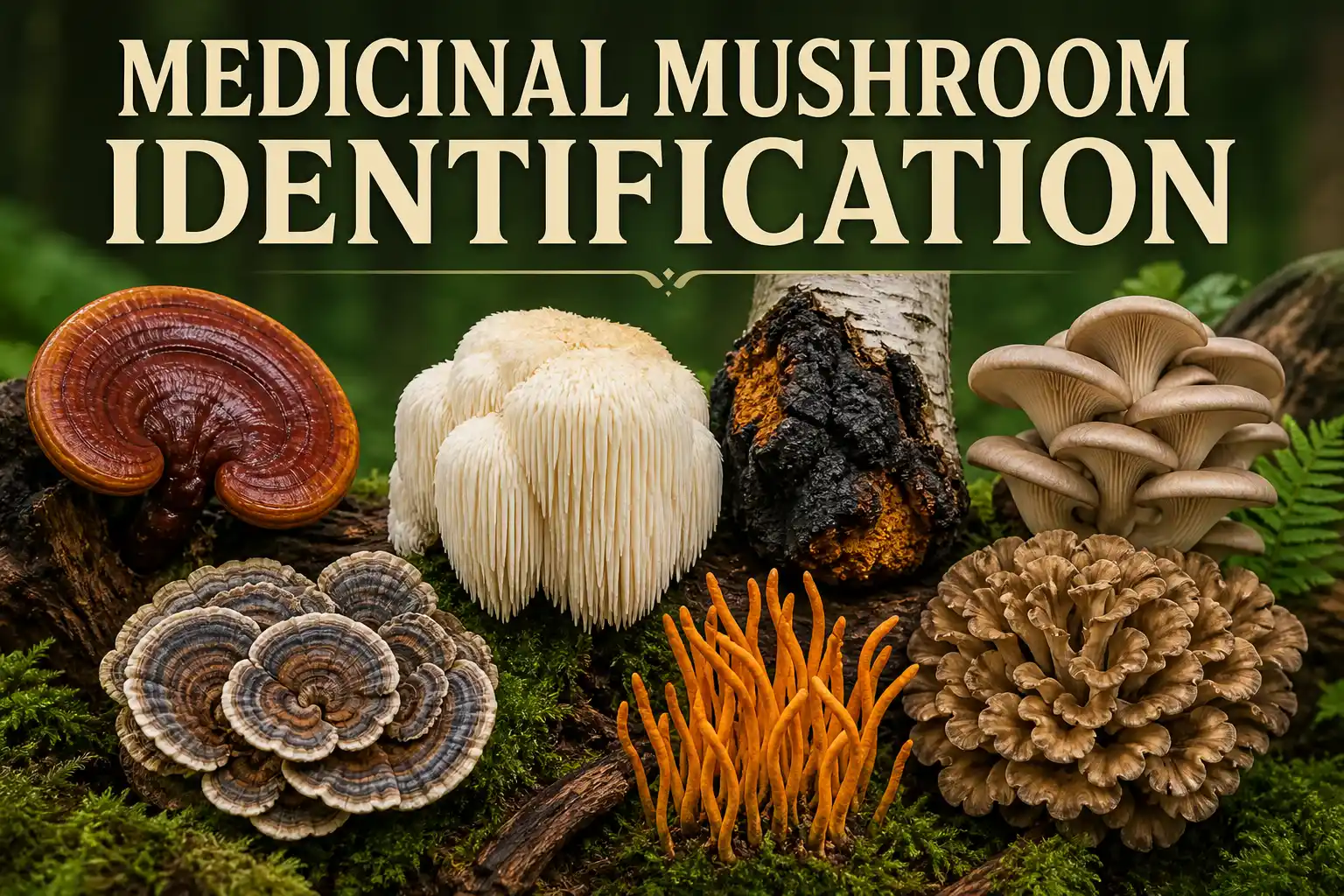
GuideMedicinal mushroom identification means accurately recognizing fungi with proven health-supporting compounds —and distinguishing them from toxic lookalikes....