Medicinal Mushroom Identification: How to Identify, Compare, and Use Them Safely?

Nathan Cole
Mycologist · Author · Fungi Expert
Updated
May 1, 2026
Medicinal mushroom identification means accurately recognizing fungi with proven health-supporting compounds—and distinguishing them from toxic lookalikes. In practice, you identify species by combining morphology (cap, pores/gills), habitat (tree type, season), and simple tests (like a spore print).
Well-known examples include Ganoderma lucidum, Hericium erinaceus, and Trametes versicolor—each tied to distinct compounds such as Beta-glucan or Hericenones.
Because dangerous species like Amanita phalloides can look similar, correct identification is essential for safety. When in doubt, don’t consume.
What Are Medicinal Mushrooms? (Context from Mycology and Traditional Systems)
Medicinal mushrooms are fungi used to support health due to bioactive compounds and long-standing use in systems like Traditional Chinese Medicine and Ayurveda.
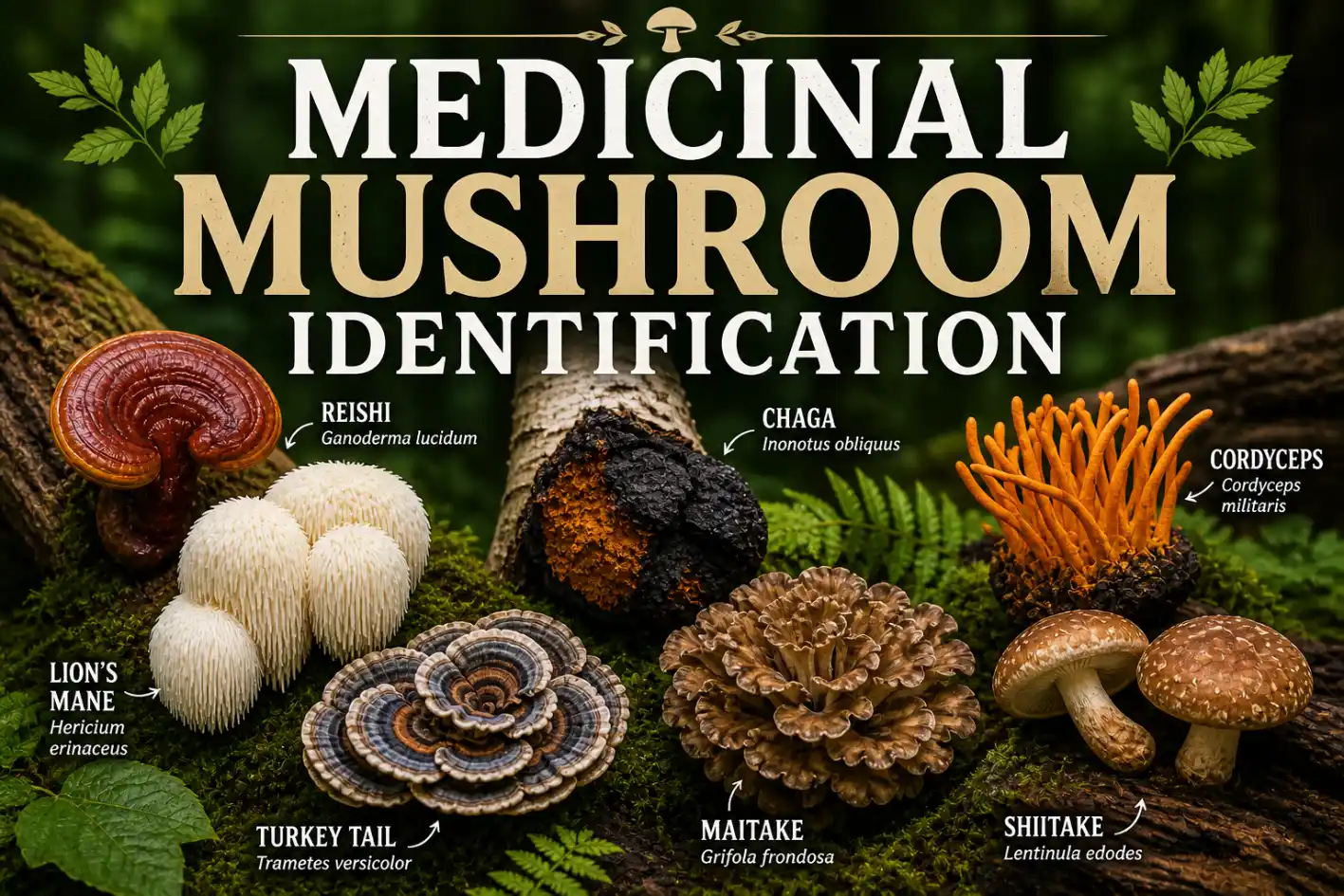
How they differ:
- Edible mushrooms: Safe food (e.g., shiitake)
- Medicinal mushrooms: Valued for compounds (e.g., beta-glucans)
- Toxic mushrooms: Harmful or deadly
Why this matters: Identification sits at the intersection of biology (mycology) and traditional knowledge, ensuring you’re using the right species for the right purpose.
Key Identification Features (Morphology, Habitat & the Spore print)
Use a multi-signal approach—never rely on a single trait.
1) Physical (Macroscopic) Traits
- Cap & shape: shelf-like, clustered, or toothed
- Underside: pores vs gills vs teeth (many medicinal species are Polypore)
- Texture: woody, gelatinous, or fleshy
2) Habitat & Ecology
- Host tree (birch, oak, hardwoods)
- Growing mode: Saprotrophic fungi vs Parasitic fungi
- Seasonality and climate
3) Simple Tests
- Spore print color (white, brown, etc.)
- Odor and firmness (with caution)
Best practice: Confirm at least 3–4 matching traits before naming a species.
Core Species Profiles: Ganoderma lucidum, Hericium erinaceus, Inonotus obliquus & Trametes versicolor
Species | Key ID Features | Habitat | Notable Compounds | Common Confusions |
|---|---|---|---|---|
Reishi | Glossy, lacquered, kidney-shaped bracket; pores underneath | Hardwood logs | Triterpenoids, Beta-glucan | Other Ganoderma spp. |
Lion’s Mane | White cascading “teeth,” no cap/gills | Dead/dying hardwood | Hericenones, Erinacines | Coral fungi (similar shapes) |
Chaga | Black, cracked mass; orange interior | Birch trees | Polysaccharides, antioxidants | Burnt wood or cankers |
Turkey Tail | Thin fans with concentric color bands; tiny pores | Logs/branches | Beta-glucan | Stereum ostrea |
Field tip: Turkey Tail’s pores (not smooth undersides) and Chaga’s birch association are quick discriminators.
Toxic Lookalikes & Safety: Avoiding Amanita phalloides and Galerina marginata
Misidentification can be life-threatening. Focus on red flags:
- Volva + ring (annulus) on stem → common in deadly Amanita
- Rusty-brown spores + wood habitat → could indicate Galerina
- Smooth underside on “Turkey Tail–like” fans → likely Stereum ostrea
- Bright orange, gilled clusters on wood → beware Omphalotus illudens
Safety rules:
- Never eat a wild mushroom unless 100% confirmed
- Cross-check with multiple sources and local experts
- When uncertain, do not consume
Identification Chart: Quick Comparison for Beginners
| Feature | Reishi | Lion’s Mane | Chaga | Turkey Tail |
|---|---|---|---|---|
| Underside | Pores | Teeth | Solid mass | Pores |
| Texture | Woody | Soft/spongy | Hard, charcoal-like | Thin/leathery |
| Host | Hardwood | Hardwood | Birch | Logs/branches |
| Ease | Easy | Medium | Medium | Easy |
| Key Check | Glossy top | Hanging spines | Birch-only | Concentric bands + pores |
Bioactive Compounds Behind Medicinal Benefits
Medicinal mushrooms are valued because their visible traits often reflect their chemistry, and that chemistry explains why they’re used in traditional and modern wellness practices. For example, the hard, varnished surface of Ganoderma lucidum corresponds with a dense profile of Triterpenoids, while the soft, cascading spines of Hericium erinaceus are linked to compounds like Hericenones and Erinacines.
These compounds are not just abstract science—they directly connect identification with use. Mushrooms rich in Beta-glucan, such as Turkey Tail, are widely associated with immune support, while ergosterol in fungi contributes to vitamin D pathways when exposed to sunlight. This is why experienced foragers don’t separate identification from function: the structure, habitat, and chemistry all reinforce each other.
Health Benefits of Medicinal Mushrooms
When correctly identified and properly prepared, medicinal mushrooms offer a range of supportive health effects. These benefits are not instant cures but gradual, system-level support rooted in their bioactive compounds.
Many species are associated with immune balance, particularly those containing beta-glucans. Others, like Lion’s Mane, are frequently discussed in the context of brain health and focus. Adaptogenic mushrooms such as Reishi are traditionally used to support stress resilience, while Cordyceps militaris is often linked to energy and endurance.
In practical use, people consume these mushrooms in different forms—teas, powders, or extracts—depending on the species. Woody mushrooms like Reishi typically require long boiling to extract their compounds, while softer varieties like Lion’s Mane are easier to incorporate into daily diets. However, all of these benefits depend on one critical factor: accurate identification.
Step-by-Step Guide to Identifying Medicinal Mushrooms
Identifying medicinal mushrooms is a layered process that starts with observation and ends with confirmation. The first step is always to study the mushroom in its natural environment. Notice how it grows—whether it appears as a shelf on wood, a clustered mass, or a hanging structure. These initial cues already narrow down many possibilities.
Next comes the most important physical check: the underside. This is where many beginners make or break their identification. Mushrooms with pores instead of gills often belong to the Polypore category, which includes many medicinal species. In contrast, tooth-like structures point strongly toward Lion’s Mane.
Habitat adds another layer of confirmation. For instance, if you find a black, hardened mass on a birch tree, it strongly suggests Inonotus obliquus. Tree association is often more reliable than color or size alone because many fungi are host-specific. Understanding whether a mushroom is acting as a Saprotrophic fungi or a Parasitic fungi further strengthens identification.
For additional confirmation, a Spore print can be used. While not always necessary for well-known polypores, it becomes valuable when distinguishing between similar species.
The final step is cross-checking. A reliable identification should match multiple features—shape, underside, habitat, and texture. If even one major characteristic does not align, it’s safer to assume the identification is incorrect. This cautious approach is essential because toxic species like Amanita phalloides can be mistaken for harmless ones with serious consequences.
Tools & Resources for Mushroom Identification
Learning mushroom identification effectively requires combining field experience with reliable references. Traditional field guides remain one of the most trusted resources, especially when they are region-specific. Digital tools, including mobile apps and online communities, have made identification more accessible, but they should be used as support rather than the sole source of truth.
The scientific field of Ethnomycology bridges traditional knowledge with modern understanding, helping explain how different cultures have used medicinal mushrooms over time. This context adds depth to identification, turning it from a simple recognition task into a broader understanding of fungi and their role in human health.
In practical terms, even a simple field kit can make a big difference. A small knife allows you to inspect the base of a mushroom without damaging it, while a notebook or phone helps document findings for later comparison. These small habits significantly improve accuracy over time.
Common Mistakes Beginners Make
Most identification mistakes come from relying on incomplete or misleading information. One of the most common errors is focusing too heavily on color, which can vary due to age, moisture, or environmental conditions. Another frequent issue is ignoring the habitat—many mushrooms can only grow on specific trees or substrates, making this detail crucial.
Beginners also tend to skip examining the underside, even though it often provides the most definitive clues. Similarly, young mushrooms can look very different from mature ones, leading to confusion if growth stages are not considered.
The safest way to avoid these mistakes is to slow down and verify multiple characteristics. Instead of trying to identify many species at once, it is far more effective to learn a few well-known medicinal mushrooms in depth. This builds confidence and reduces the risk of dangerous misidentification.
Wild vs Cultivated Medicinal Mushrooms
Understanding the difference between wild and cultivated mushrooms helps set realistic expectations, especially for beginners. Wild mushrooms grow in natural environments and require careful identification, which introduces a level of risk. Cultivated mushrooms, on the other hand, are grown in controlled conditions and are already verified for safety.
Wild specimens may offer more variability in potency due to environmental factors, while cultivated varieties provide consistency and accessibility throughout the year. For someone new to medicinal mushrooms, starting with cultivated options is often the safer and more practical choice, while wild foraging can be explored later with proper knowledge and guidance.
Seasonal Guide to Medicinal Mushroom Identification
Season plays a subtle but important role in mushroom identification. Different species appear at different times of the year, and understanding these patterns helps narrow down possibilities.
During warmer months, species like Lion’s Mane and Turkey Tail are more commonly observed, thriving in humid conditions. Autumn often brings peak growth for mushrooms such as Reishi and Maitake, while winter makes certain species like Chaga easier to spot due to the absence of foliage.
Recognizing these seasonal trends not only improves accuracy but also helps you know where and when to look, making the identification process more efficient.
Medicinal Mushrooms in the United States (Regional Identification Guide)
Across the United States, medicinal mushrooms are widely distributed and well-documented, making it easier for beginners to learn identification with reliable field guides and local communities. From the hardwood forests of the East Coast to the conifer-rich Pacific Northwest, different ecosystems support distinct species.
In general, many of the most recognized medicinal mushrooms grow on decaying wood, fallen logs, or living trees, especially in moist, forested environments. For example, Ganoderma lucidum is commonly found on hardwoods, while Trametes versicolor appears abundantly on fallen logs across multiple regions.
Where Medicinal Mushrooms Grow in the U.S?
Different regions offer unique identification opportunities:
-
Pacific Northwest (Oregon, Washington):
Dense forests with high humidity make this one of the best مناطق for species like Turkey Tail and Lion’s Mane -
Northeast (New York, Pennsylvania):
Rich hardwood forests support Chaga and Maitake -
Midwest (Ohio, Michigan):
Seasonal growth with a mix of polypores and wood-decaying fungi -
Southeast (North Carolina, Georgia):
Warm, humid climate encourages diverse fungal growth year-round
FAQ
Can you identify medicinal mushrooms from a photo?
Yes, photos help, but accuracy improves with multiple angles and habitat context. Always verify.
Are medicinal mushrooms always safe?
No. Safety depends on correct identification, preparation, and dosage. Some lookalikes are toxic.
What is the easiest medicinal mushroom to identify?
Hericium erinaceus is often easier due to its unique spines.
How do I avoid poisonous lookalikes?
- Check underside features (gills vs pores vs spines)
- Include the base in photos
- Use a spore print and consult experts when unsure
Final Thoughts: Safe and Accurate Identification
Medicinal mushroom identification is best approached as a long-term skill rather than a quick checklist. It requires patience, observation, and a willingness to learn from both successes and mistakes.
The most reliable approach combines visual identification, environmental context, and scientific understanding. Over time, patterns become easier to recognize, and confidence grows naturally.
However, safety should always remain the priority. Even experienced foragers double-check their findings, and beginners should be especially cautious. When uncertainty exists, the correct decision is always to avoid consumption.
In the end, successful identification is not just about recognizing mushrooms—it’s about understanding them in their full ecological and biological context.
Sign in to leave a comment and join the discussion.
 Guide
GuideCan Mushroom Coffee Raise Blood Pressure? A Mycologist's Honest Answer The short answer is: it depends on the blend. Mushroom coffee can raise blood...
 Guide
GuideCan Chickens Eat Mushrooms? Yes — but with conditions. Chickens can safely eat certain mushrooms, like button, oyster, shiitake, portobello, and cremini....
 Guide
GuideHow Many Mushroom Gummies Should I Eat: A Practical Guide Straight answer: how many mushroom gummies should i eat depends entirely on what's actually in the...