Dog Ate a Mushroom: Toxic Mushroom Chart With Pictures
— views
Dog ate a mushroom right now? Call first. Do not wait for symptoms.
Your vet or nearest emergency vet, or:
Pet Poison Helpline: (855) 764-7661, 24/7, $99 per incident
ASPCA Animal Poison Control: (888) 426-4435, 24/7, a fee may apply
If your dog ate a mushroom, treat it as an emergency and call your vet or a pet poison helpline immediately, even if your dog seems fine. The deadliest mushrooms cause no signs for 6 to 24 hours, and treatment works best before those signs appear. Do not make your dog vomit unless a vet tells you to. Bring a sample and photos.
Most mushroom calls end well, but you cannot tell a harmless lawn mushroom from a deadly one by looking at it. This toxic mushroom identification chart with pictures shows which groups matter, how fast each one acts and what to tell the vet.
Key Takeaways
- Call a vet or poison helpline as soon as you know or suspect your dog ate a wild mushroom.
- Waiting for symptoms is the most dangerous mistake, because amatoxin signs can take 6 to 24 hours to appear.
- Regard every wild mushroom as toxic until an expert proves otherwise.
- Never induce vomiting at home without veterinary instructions. Never use salt or ipecac.
- Keep a sample in a paper bag and take photos of the cap, gills, stem and surroundings.
- A dog that improves after a day of vomiting may be in the false recovery phase, not out of danger.
- Most reported cases involve young dogs, so walks and yards need extra attention with puppies.
What Should I Do If My Dog Ate a Mushroom?
Call your vet or a poison helpline first, then collect the evidence, and go in if you are told to. Pet Poison Helpline warns that waiting for signs is too late. Follow these steps in order.
- Remove your dog from the area. Take away any pieces still in the mouth if you can do it safely.
- Call now. Phone your vet, an emergency vet or one of the helplines above.
- Note the details. Write down the time, how much your dog ate, your dog's weight and any signs.
- Collect a sample. Pick a whole mushroom, including the base, from the same spot. Wear gloves.
- Take photos. Photograph the top, the gills, the stem and the surroundings.
- Do not give home remedies. Give nothing unless the vet or helpline tells you to.
- Follow the instructions. If they tell you to come in, bring the sample and your notes.
Tell them if the mushroom came from a treated lawn. The North American Mycological Association (NAMA) points out that lawns may carry pesticides, which can confuse the picture.
Should I Make My Dog Vomit?
No, not unless a vet or poison control specialist tells you to. Pet Poison Helpline, the ASPCA and Cornell University all leave this decision to a professional.
- Vomiting is unsafe if your dog already shows signs or weighs under 10 pounds, according to Pet Poison Helpline.
- Hydrogen peroxide should be used only under veterinary guidance, according to the ASPCA.
- Salt and ipecac should never be used.
Time matters here, which is another reason to call quickly. Veterinary sources say induced vomiting helps most soon after eating. For amatoxins, one veterinary toxicology reference gives a window of 1 to 2 hours.
Are Mushrooms Poisonous to Dogs?
Some wild mushrooms are deadly to dogs, many cause illness, and many are harmless, but no one can sort them safely by appearance. The Merck Veterinary Manual says identification is hard even for mycologists. Pet Poison Helpline advises treating all wild mushrooms as toxic until proven otherwise.
The numbers explain why vets take every case seriously:
| Data source | What it found | What it means |
|---|---|---|
| ASPCA call data | 23 deaths in about 5,000 calls (0.49%), mushroom usually unknown | Most reported exposures do not end in death |
| Norwegian study | 98.6% of dogs survived | Most dogs in that study recovered |
| NAMA reports 2018 to 2020 | 25 amatoxin dogs, 20 deaths | Amatoxins are far deadlier than average |
| US study of confirmed amanitin cases | 13 of 59 dogs survived to discharge | About 22% survived |
Read those figures together. The average mushroom call is usually survivable, but a confirmed amatoxin case is usually not. Since you cannot know which one you have at home, every case gets the same first step: call.
Toxic Mushroom Identification Chart for Dogs
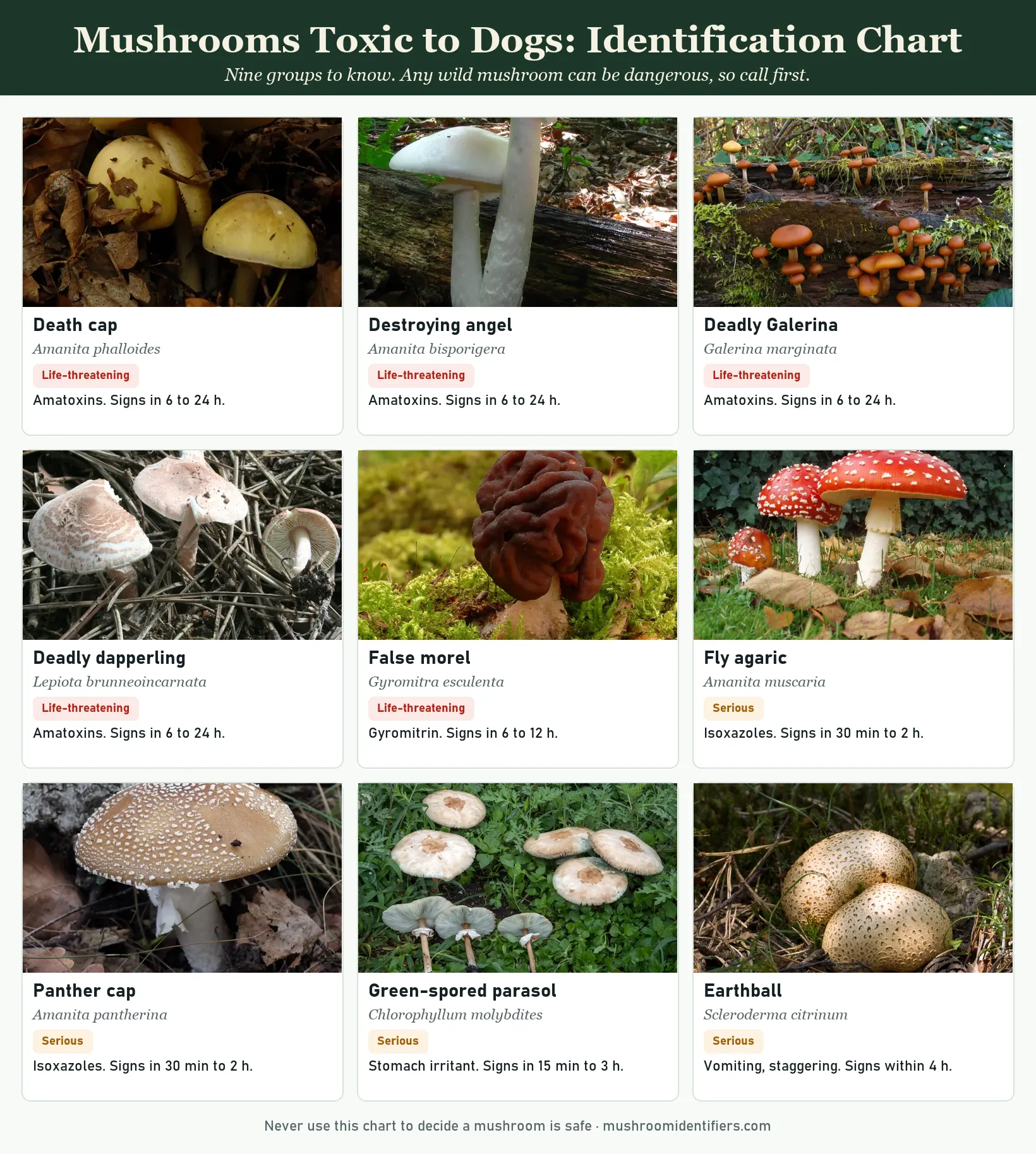
Use this chart to describe what you found to your vet, never to decide that a mushroom is safe. Many harmless mushrooms look like these, and many toxic ones are not shown here.
| Toxin group | US examples | First signs | Main effects | Severity |
|---|---|---|---|---|
| Amatoxins | Death cap, destroying angels, deadly Galerina, some Lepiota and Conocybe | 6 to 24 hours | Vomiting, diarrhea, then liver and kidney failure | Life-threatening |
| Gyromitrin | False morel | 6 to 12 hours | Vomiting, seizures, liver and kidney damage | Life-threatening |
| Isoxazoles | Fly agaric, panther cap | 30 minutes to 2 hours | Disorientation, seizures, coma | Serious |
| Muscarine | Clitocybe, Inocybe | 5 minutes to 2 hours | Drooling, tearing, vomiting, slow heart rate | Serious |
| GI irritants | Green-spored parasol, Russula emetica | 15 minutes to 3 hours | Vomiting, bloody diarrhea | Death is rare |
| Psilocybin | Psilocybe, Panaeolus, Gymnopilus | 30 to 60 minutes | Stumbling, vocalizing, seizures | Recovery in about 6 hours |
| Other | Earthballs (Scleroderma) | Up to 4 hours | Vomiting, staggering | A dog death is recorded |
The onset times follow the Merck Veterinary Manual, with earthball data from NAMA case reports. Sources do vary. Merck calls isoxazoles and muscarine usually not life-threatening, while the Norwegian study and NAMA record deaths from both, so this chart labels them serious.
Dog Mushroom Poisoning Symptoms by Time
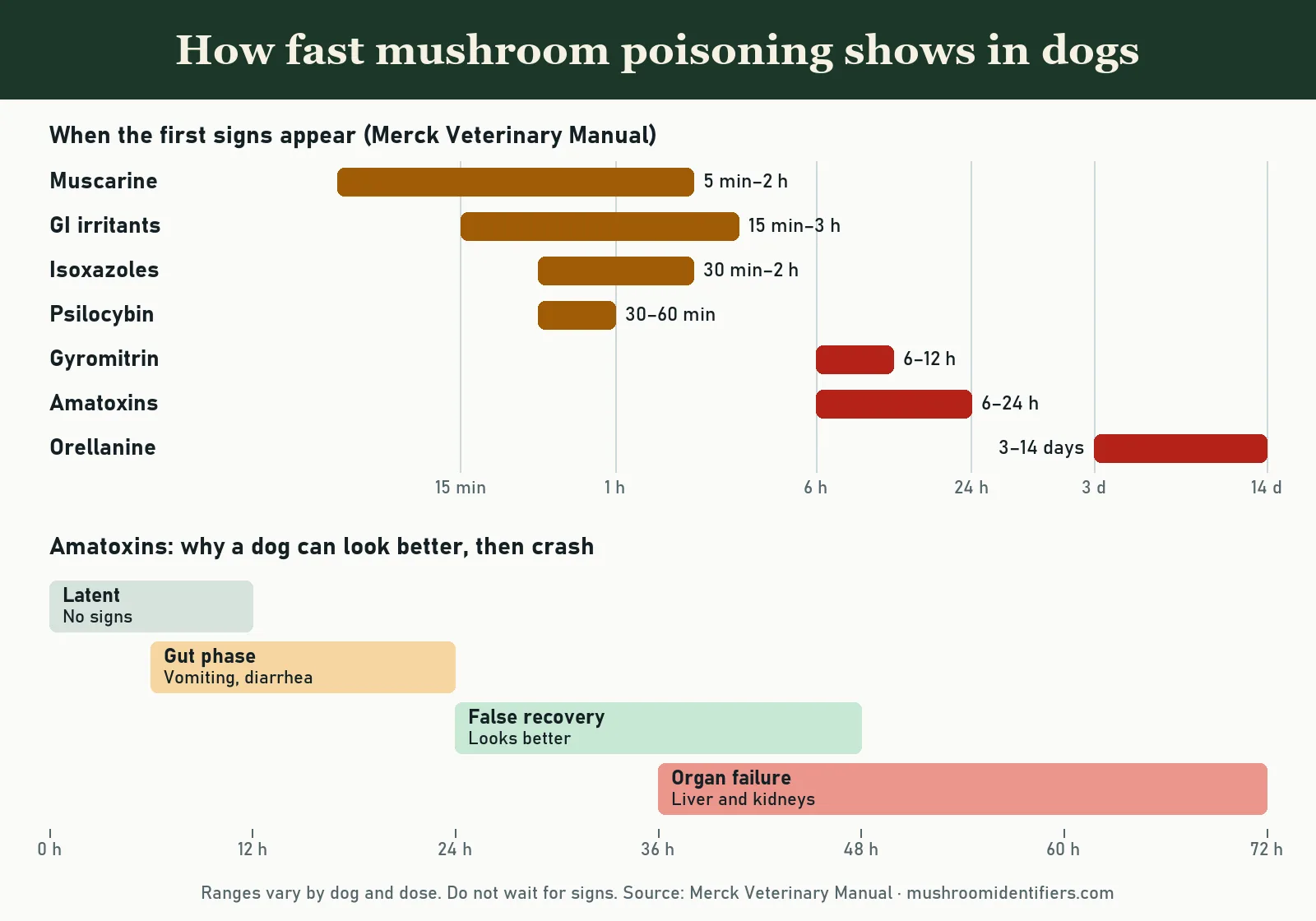
Early signs within a few hours usually point to less deadly groups, while signs that begin 6 hours or more after eating are the most worrying. That rule is a guide for vets, not a reason to wait, because a dog can eat more than one kind of mushroom.
Call the vet right away if you see any of these after a possible mushroom meal:
- Vomiting or diarrhea, especially with blood
- Drooling, watery eyes or a slow heart rate
- Stumbling, disorientation or unusual vocalizing
- Tremors, seizures or collapse
- Yellow gums or eyes, or sudden lethargy
- Drinking or urinating much more or less than usual
What Is False Recovery in Mushroom Poisoning?
False recovery is a phase of amatoxin poisoning when a dog seems to improve while the liver is being destroyed. This phase is the reason an owner can feel relieved a day before the crisis.
The Merck Veterinary Manual describes four stages:
| Stage | Time after eating | What you see |
|---|---|---|
| Latent | First 6 to 12 hours | No signs |
| Gastrointestinal | Up to 24 hours | Vomiting and diarrhea |
| False recovery | Up to 24 to 48 hours | Your dog appears better |
| Liver and kidney failure | 36 to 72 hours | Severe illness, with recovery or death in the next 7 to 14 days |
Puppies, and dogs that eat large amounts, can die within 24 hours, according to Merck. Other veterinary sources give somewhat different timings, so treat these ranges as approximate.
Are Yard and Garden Mushrooms Poisonous to Dogs?
Some are, and a yard is not a safe place by default. NAMA has reports of death caps found in yards after puppies died. Lawn mushrooms grow from buried wood, roots and rich soil, so the same yard can produce harmless and dangerous species together.
White mushrooms deserve no special trust, and neither do small brown ones. Our guides to white poisonous mushrooms and small brown mushrooms show why color tells you very little. Do not rely on the idea that mushrooms growing on trees are always safe, because deadly Galerina grows on wood.
Common Toxic Mushrooms Dogs Find
The species below appear repeatedly in veterinary and NAMA reports, and each links to a full identification guide.
Death Cap (Amanita phalloides)
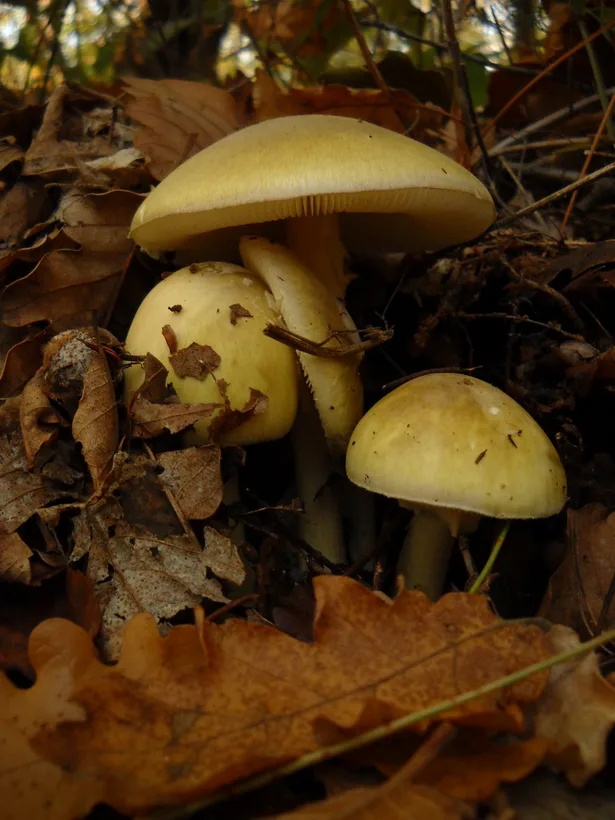
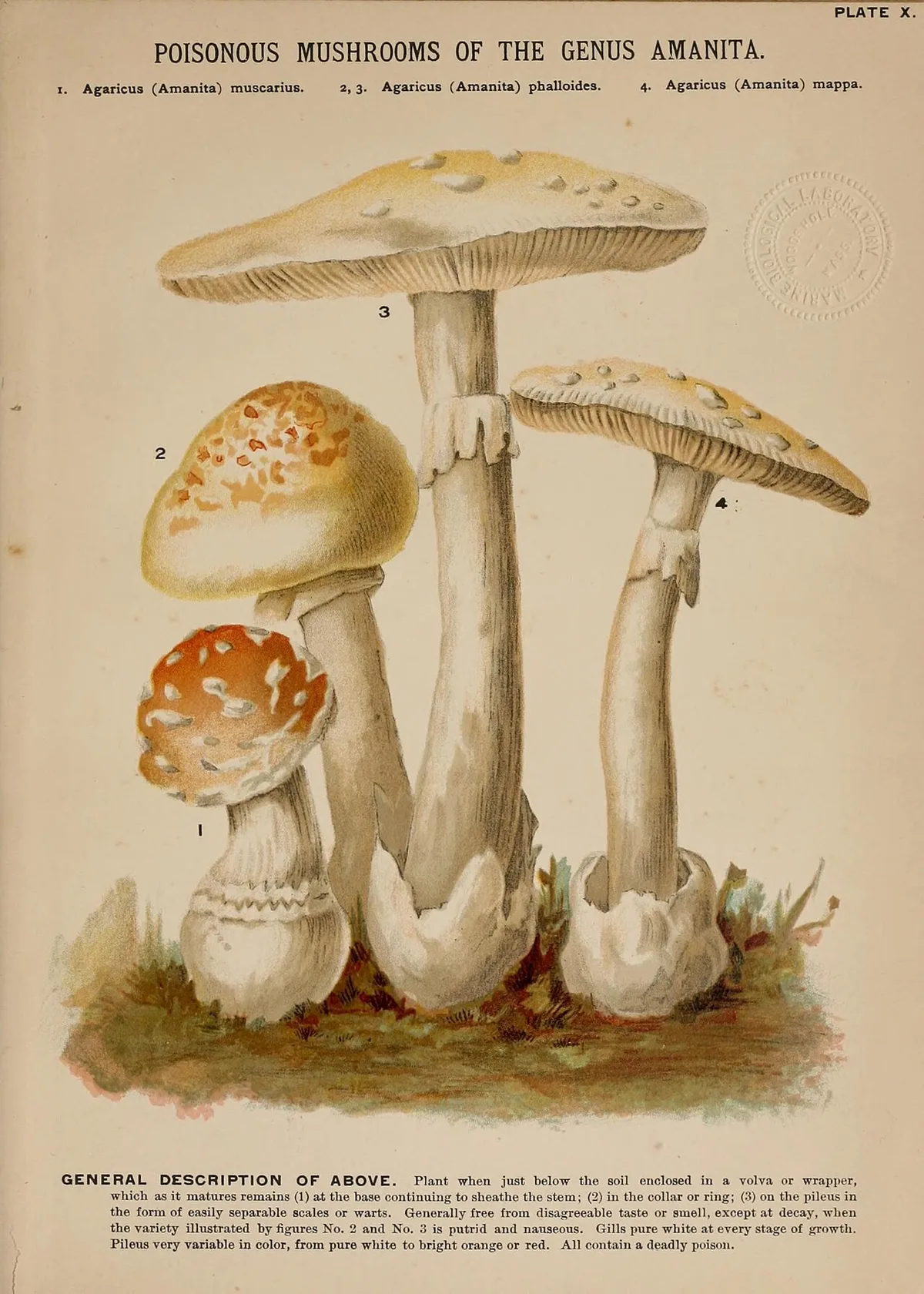
The death cap is the classic amatoxin mushroom. It has a pale greenish to yellowish cap, white gills, a ring and a sac at the base. NAMA suggests that its fishy smell may attract dogs. See our death cap guide.
Destroying Angels (Amanita bisporigera and A. ocreata)
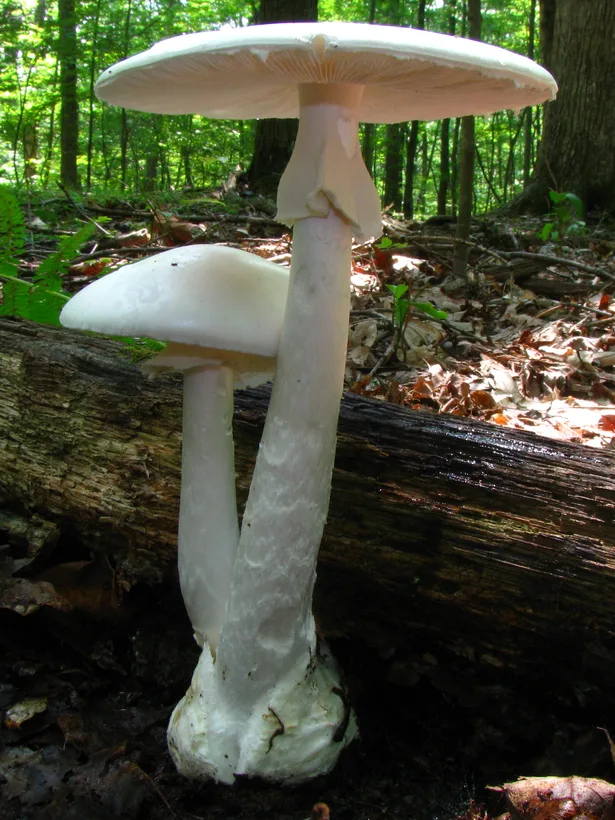
Destroying angels are all white, with white gills, a ring and a sac. They contain the same amatoxins. Read the destroying angel guide and our Amanita ocreata guide for the western species.
Deadly Galerina (Galerina marginata)
Deadly Galerina is a small brown mushroom on rotting wood, and it also contains amatoxins. It is easy to overlook on stumps, logs and wood chips. See the Galerina marginata guide.
False Morel (Gyromitra esculenta)
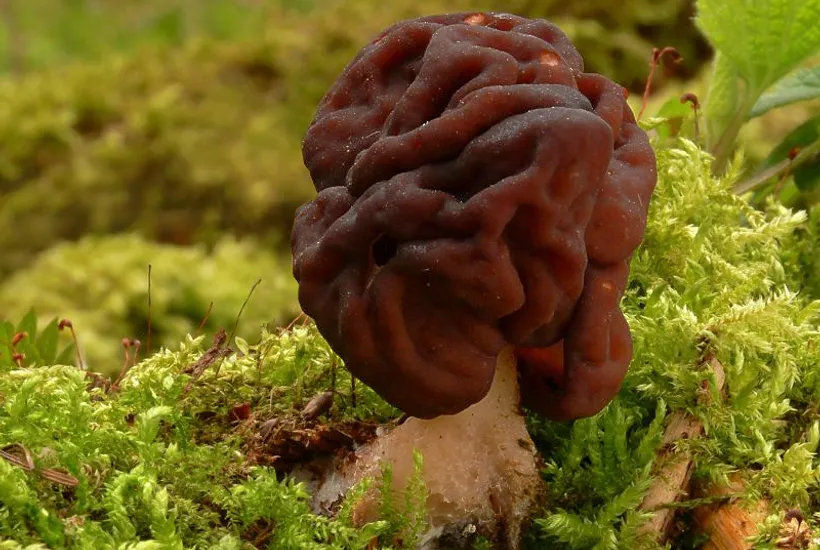
False morels have a brain-like, wrinkled reddish-brown cap and appear in spring. Gyromitrin can cause seizures and liver damage. See the false morel guide.
Fly Agaric and Panther Cap (Amanita muscaria and A. pantherina)
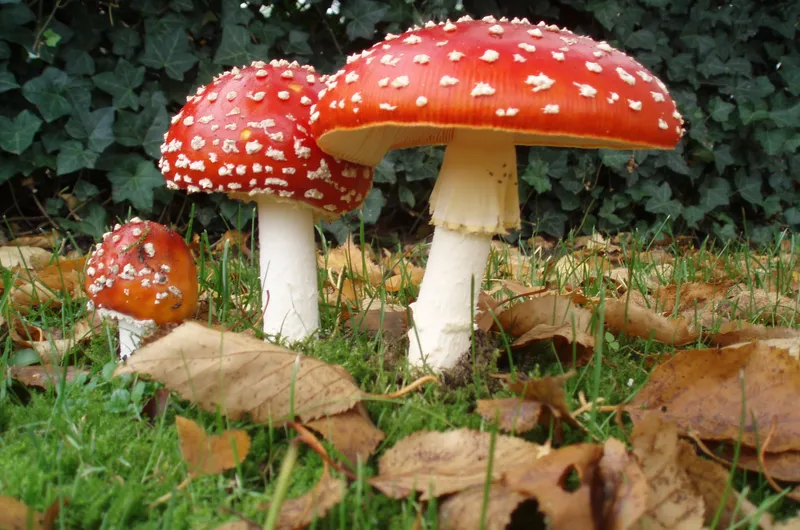
NAMA notes that dogs frequently eat these isoxazole Amanitas. Signs appear quickly and include disorientation and seizures. Treatment differs from muscarine poisoning, which is one reason the vet needs a sample. See the guides to Amanita muscaria and Amanita pantherina.
Green-Spored Parasol (Chlorophyllum molybdites)
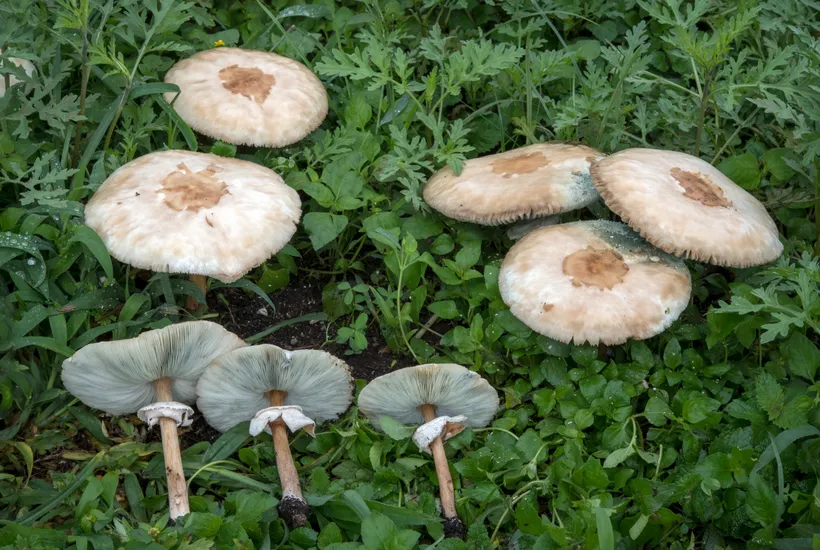
This large white lawn mushroom is a stomach irritant that causes vomiting and bloody diarrhea. It often grows in rings. See the Chlorophyllum molybdites guide.
Earthballs (Scleroderma species)
Earthballs look like firm puffballs and are common in yards and mulch. NAMA records dogs vomiting and staggering after eating them, including one death. See the Scleroderma citrinum guide.
Stinkhorns
Stinkhorns often appear in mulch and smell of rotting meat. Evidence for dogs is limited, but they should be handled like any other unknown mushroom. See our stinkhorn mushroom identification chart.
How to Collect a Mushroom Sample for the Vet
Keep a whole mushroom in a paper bag, not plastic, and photograph it where it grew. A good sample helps the vet or a mycologist narrow down the toxin group.
Photos to Take
- The top of the cap
- The gills or pores underneath
- The whole stem, including the base
- The surroundings, including nearby trees or wood
Our guide on how to photograph mushrooms for accurate identification shows each angle. NAMA also works with volunteer mushroom identifiers, so your vet or poison center may be able to reach one.
Storing the Sample
- Dig up the whole mushroom, including the base, wearing gloves.
- Wrap it in a paper bag or waxed paper, not plastic, as NAMA advises. AKC suggests a damp paper towel, so either is fine if that is all you have.
- Keep it in the refrigerator if you are not leaving immediately.
- Label it clearly so nobody eats it, and take it to the clinic.
If your dog vomits, take a photo of the vomit too, and ask the clinic whether to bring it. Do not delay your call to gather any of this.
You can also upload a photo to our free mushroom identifier to give the vet a starting point. Never use an app result to decide your dog is safe. Our article on whether AI can identify poisonous mushrooms safely explains the limits.
What Will the Vet Do?
Treatment is decontamination and supportive care, because no proven antidote exists for mushroom poisoning. This comes from the Merck Veterinary Manual. Depending on the toxin and timing, care can include:
- Induced vomiting, if the dog has no signs and it is early enough
- Activated charcoal
- Intravenous fluids and dextrose
- Vitamin K1 and blood products for liver failure
- Atropine for severe muscarine cases, but not for isoxazole cases
Silibinin, a milk thistle extract used against amatoxins, is not approved in the US, according to Merck. A small report on the Santa Cruz protocol recorded 5 of 5 dogs surviving, which is promising but too small to count on.
Why Do Dogs Eat Mushrooms?
Dogs eat mushrooms mainly because they eat almost anything, and reported cases skew young. Merck points to indiscriminate eating and roaming. NAMA suggests that a fishy odor may attract dogs to some Amanita and Inocybe species, although we found no controlled study that tests this.
Age is the clearest pattern. In a study of confirmed amanitin cases, 36 of 59 dogs were under one year old. In the Norwegian study, the median age was 5 months and 72.4% of dogs were juveniles. Those figures show who gets reported, not a measured risk.
How to Keep Your Dog Away From Mushrooms
Remove mushrooms as they appear, because nothing you can apply to a lawn will prevent them. Iowa State University advises raking or mowing them when they show up.
- Walk the yard before letting a puppy out, especially after rain.
- Pick mushrooms by hand with gloves and bag them, so pieces do not stay in the grass.
- Check mulch beds, stumps and shady edges, not only open lawn.
- Keep puppies on a leash in parks and woods.
- Teach "leave it" and reward it.
- Stay alert all year, as the University of Illinois veterinary college advises.
For repeat problems, see how to get rid of mushrooms in grass and our backyard mushroom identification guide.
Common Mistakes After a Dog Eats a Mushroom
Waiting to See What Happens
This is the costly one. Amatoxin signs start late, and early treatment has the best chance of working.
Assuming a Small Bite Is Harmless
A small amount can matter with the deadliest species, especially in a puppy. The size of the bite does not remove the need to call.
Trusting Your Dog's Instincts
Dogs do not avoid toxic mushrooms. If they did, vets would not see these cases.
Giving Salt or Other Home Remedies
The ASPCA warns against salt and ipecac. Some home remedies are dangerous on their own.
Relaxing Too Soon
A dog that stops vomiting may be entering false recovery. Finish any monitoring and blood tests your vet recommends.
Throwing the Mushroom Away
A sample can change the treatment plan. Keep it until the vet says otherwise.
Frequently Asked Questions
What should I do if my dog ate a mushroom in the yard?
Call your vet or a pet poison helpline right away, even if your dog seems normal. Pet Poison Helpline is (855) 764-7661 and ASPCA Animal Poison Control is (888) 426-4435. Keep a sample in a paper bag and take photos.
How long after eating a mushroom will a dog get sick?
It depends on the toxin. Muscarine and stomach irritants can act within minutes to 3 hours. Amatoxins usually take 6 to 24 hours, and orellanine can take 3 to 14 days, according to the Merck Veterinary Manual.
Are mushrooms in the yard poisonous to dogs?
Some are, and they cannot be told apart safely by appearance. NAMA has reports of death caps found in yards after puppies died. Treat every wild mushroom in your yard as toxic until an expert proves otherwise.
What are the symptoms of mushroom poisoning in dogs?
Signs include vomiting, diarrhea, drooling, stumbling, tremors, seizures and lethargy. Yellow gums or eyes can mean liver damage. A dog can look normal for hours and still have eaten a deadly mushroom.
Will my dog be OK if he ate a small piece of mushroom?
Many dogs recover, but nobody can promise that without knowing the species. Small amounts of the deadliest mushrooms can be dangerous, especially for puppies. Call a vet or poison helpline rather than waiting.
Should I make my dog throw up after eating a mushroom?
No, not unless a vet or poison control specialist tells you to. Pet Poison Helpline says it is unsafe if your dog already has signs or weighs under 10 pounds. Never use salt or ipecac.
Can dogs eat mushrooms from the store?
Plain store-bought mushrooms are generally safe for dogs, according to the American Kennel Club. Avoid dishes containing garlic or onion. This does not apply to wild mushrooms from your yard or from walks.
Can a dog survive mushroom poisoning?
Most dogs reported to poison centers survive, with 23 deaths in about 5,000 ASPCA calls. Confirmed amatoxin poisoning is far worse: 13 of 59 dogs survived to discharge in one study. Quick treatment gives the best chance.
Why does my dog keep eating mushrooms?
Dogs, especially puppies, eat almost anything they find. NAMA suggests that the fishy odor of some mushrooms may attract them. Remove mushrooms from the yard, supervise puppies and train a reliable "leave it."
Can I use an app to check if the mushroom is safe for my dog?
No. An app can suggest a name for your vet to consider, but it cannot clear a mushroom as safe. Merck notes that identification is hard even for mycologists, so call a professional first.
Final Safety Reminder
This guide is educational and does not replace veterinary care. If your dog may have eaten a wild mushroom, stop reading and call your vet, an emergency clinic, Pet Poison Helpline at (855) 764-7661 or ASPCA Animal Poison Control at (888) 426-4435. A call costs far less than the delay.
Sign in to leave a comment and join the discussion.
 Safety
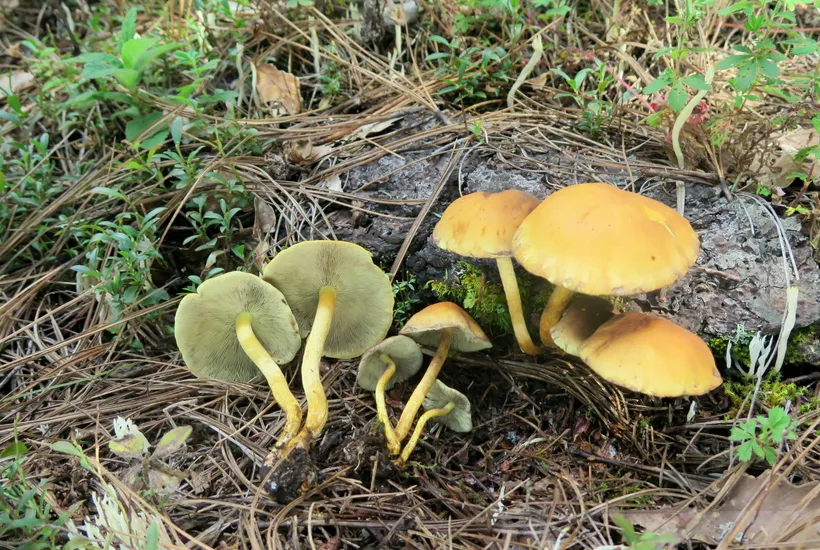
Sulfur tuft ( Hypholoma fasciculare ) is a poisonous yellow mushroom that grows in tight clusters on stumps, logs and buried wood. Its gills start yellow,...
 Safety
To tell a morel from a false morel, cut the mushroom in half lengthwise, from the tip of the cap to the base. A true morel is hollow from top to bottom, and...
 Safety
Can Two Mushrooms Look Identical But Differ in Toxicity? Absolutely, and the gap between dinner and a liver transplant can come down to a single feature you...