Stinkhorn Mushroom Identification Chart With Pictures
— views
A stinkhorn mushroom is a fungus in the order Phallales that grows from a soft white egg, rises in a few hours, and coats itself in foul-smelling slime that attracts flies. Most US stinkhorns appear in wood mulch, lawns and garden beds after rain. They do not harm plants, and most people simply remove them.
This stinkhorn mushroom identification chart with pictures covers the main US types by shape, plus the egg stage, the smell, the safety questions and the removal steps that extension services recommend. If you found something strange in your mulch, start with the chart and then compare the side-by-side tables.
Key Takeaways
- Stinkhorns are easiest to identify by three features together: a rotting smell, dark olive slime and a sac or egg at the base.
- US stinkhorns come in four main shapes: a stalk with a cap, a capless spike, a cage or columns, and arms or tentacles.
- Every stinkhorn starts as a soft egg. Cutting an egg in half separates it from a puffball or a deadly young Amanita.
- Stinkhorns are not plant pathogens. They feed on dead wood and leaf litter, so mulch is their usual home.
- Fungicides are typically ineffective. Digging out eggs, bagging them and changing the mulch works better.
- Evidence on eating stinkhorns is thin and mixed, so nobody should eat a wild one. Call a vet if a dog eats one.
What Is a Stinkhorn Mushroom?
A stinkhorn is a fruiting body of a fungus in the order Phallales, usually placed in the family Phallaceae. Some authors keep the cage and arm types in separate families, such as Clathraceae and Lysuraceae, so you may see different family names in different guides.
The visible stinkhorn is only the reproductive part. The rest of the fungus lives as thread-like hyphae in wood chips, leaf litter or soil. UF/IFAS Extension notes that stinkhorns do not rely on wind to spread. They rely on animals instead.
That strategy explains everything odd about them. The slime, called the gleba, holds the spores. The smell brings in flies and other invertebrates. The insects eat the slime and carry the spores away.
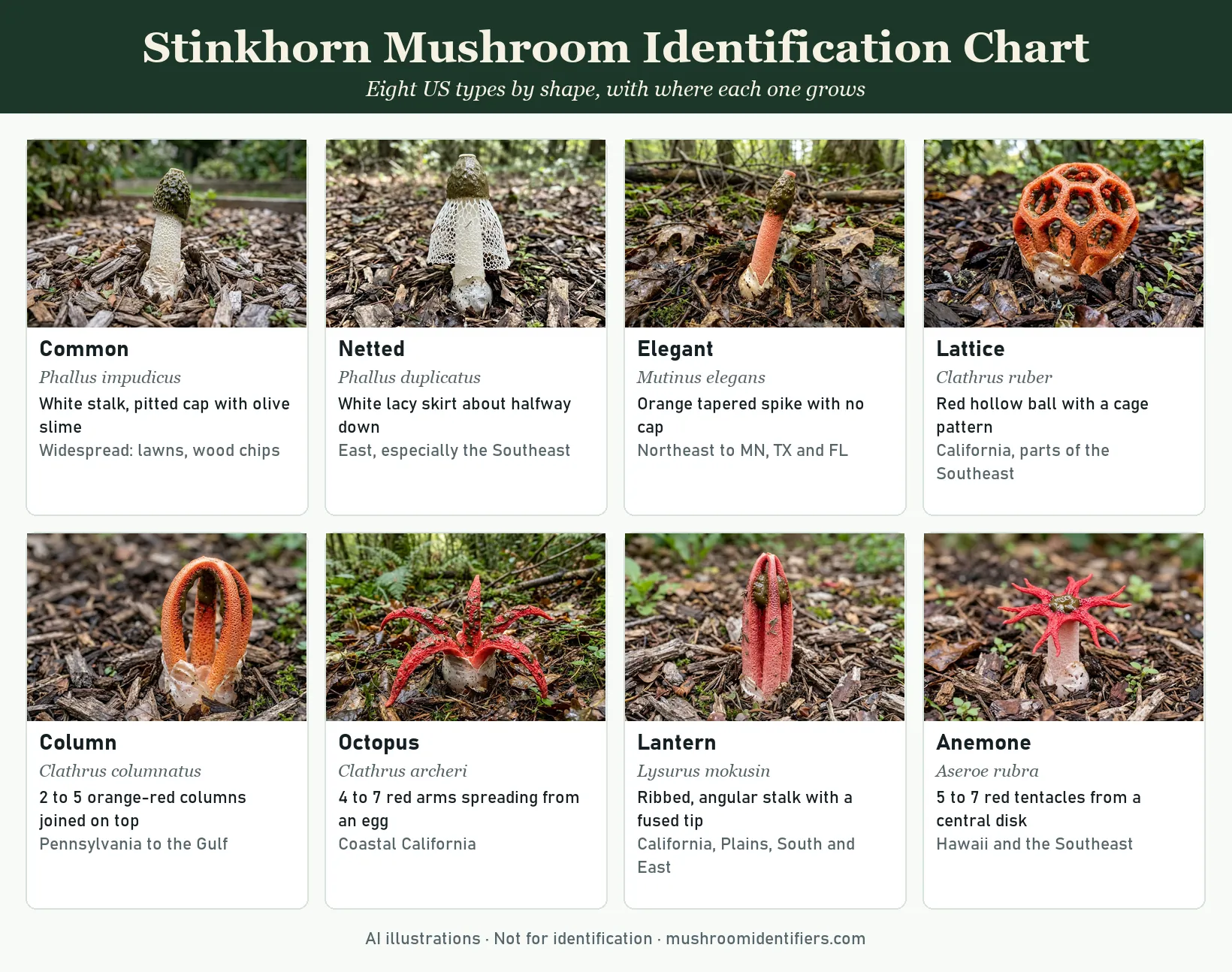
Stinkhorn Mushroom Identification Chart
Use this chart by matching the overall shape first, then the color, then your location. Shape is the most useful first clue because the four groups look nothing alike.
| Type | Scientific name | Shape and color | Where the slime sits | US range |
|---|---|---|---|---|
| Common stinkhorn | Phallus impudicus | White stalk, pitted cap | On the cap | Widespread |
| Ravenel's stinkhorn | Phallus ravenelii | Creamy stalk, smoother cap | On the cap | Midwest, Southeast, Northeast |
| Netted stinkhorn | Phallus duplicatus | White stalk, lacy skirt halfway down | On the cap | East, especially the Southeast |
| Elegant stinkhorn | Mutinus elegans | Orange tapered spike, no cap | Upper quarter to half | Northeast to Minnesota, Texas and Florida |
| Lattice stinkhorn | Clathrus ruber | Red hollow cage | Inside the arms | California, plus scattered eastern states and Hawaii |
| Column stinkhorn | Clathrus columnatus | 2 to 5 orange-red columns joined on top | Inside the columns | Pennsylvania to the Gulf |
| Octopus stinkhorn | Clathrus archeri | 4 to 7 red arms | Inside the arms | Santa Cruz and Monterey, California |
| Lantern stinkhorn | Lysurus mokusin | Ribbed, angular stalk, fused tip | Between the ribs | California, Plains to Texas, South and East |
| Lizard's claw | Lysurus cruciatus | Round stalk, separate orange arms | On the arms | Widespread in lawns and gardens |
| Anemone stinkhorn | Aseroe rubra | 5 to 7 radiating red tentacles | Central crown | Hawaii and the Southeast |
Ranges and descriptions follow MushroomExpert.com and MykoWeb. The chart pictures are AI illustrations of the typical form, so confirm any find against real photographs.
Why Do Stinkhorns Smell So Bad?
Stinkhorns smell like rotting meat because the slime releases sulfur compounds that attract flies. A toxicology review from the American College of Emergency Physicians names dimethyl sulfides, mainly dimethyl trisulfide, as the main compounds, alongside linalool and trans-ocimene.
The smell does a real job. Research cited in FUNGI magazine counted spores in the hundreds of thousands in small flies and more than a million in large carrion flies. The spores still germinated after that trip.
Many homeowners notice the smell before they see the fungus. If your garden smells like something died, check the mulch first.
What Does a Stinkhorn Egg Look Like?
A stinkhorn egg is a soft, whitish to purplish ball that sits at or just below the surface, attached to white cords. The egg of the common stinkhorn measures about 3 to 6 cm long and 2.5 to 4 cm wide, according to MushroomExpert.com. Inside, the developing stinkhorn sits in a layer of brownish jelly.
Once it hatches, it moves quickly, although sources give different figures:
- Wisconsin Horticulture says a stinkhorn can grow up to 4 to 6 inches per hour.
- Nebraska Extension describes 3 to 5 inches of total growth over 4 to 6 hours.
- UF/IFAS notes that emergence can sometimes take only minutes.
All three agree on the practical point: a stinkhorn can appear between breakfast and lunch. The mature fruiting body does not last long either. Some collapse in about 12 hours, and others remain for a few days to a week.
Core Identification Features
Identify a stinkhorn by checking several features together, because no single clue is enough. Start with the basic parts of a mushroom, then look for the features below.
Overall Shape
Sort your find into one of four groups: stalk with a cap, capless spike, cage or columns, or arms. This step removes most of the options straight away.
Spore Slime (Gleba)
Fresh stinkhorns carry a wet, dark olive-brown slime. Its position matters. It sits on the cap in Phallus, on the upper spike in Mutinus, and on the inner surfaces in cage and arm types. Older specimens may look clean because insects have eaten the slime.
Smell
A strong rotting odor is the most distinctive field clue. Young eggs smell far less, so an absent smell does not rule out a stinkhorn. Our mushroom smell and texture chart covers other useful odors.
Base and Volva
Every stinkhorn rises from the torn remains of its egg, which forms a soft sac at the base. Dig around the base rather than pulling, so you can see it. This also matters for safety, because deadly Amanitas have a sac too.
No Gills
Stinkhorns do not have gills or pores. If you see gills under a cap, you are looking at a different kind of mushroom. Our backyard mushroom identification guide covers the gilled species that also grow in lawns.
Habitat and Season
Look in wood chips, leaf litter, stumps and rich lawns. Stinkhorns follow rain more than the calendar. UF/IFAS reports June to September in Florida, with Clathrus columnatus from December to February and fruiting possible in any rainy month. Iowa State points to cool, wet weather in late summer and early fall.
Common Stinkhorn Types in the US
The types below cover the main shapes found in the US, and each has one feature that identifies it quickly. The pictures are AI illustrations of the typical form.
Common Stinkhorn (Phallus impudicus)
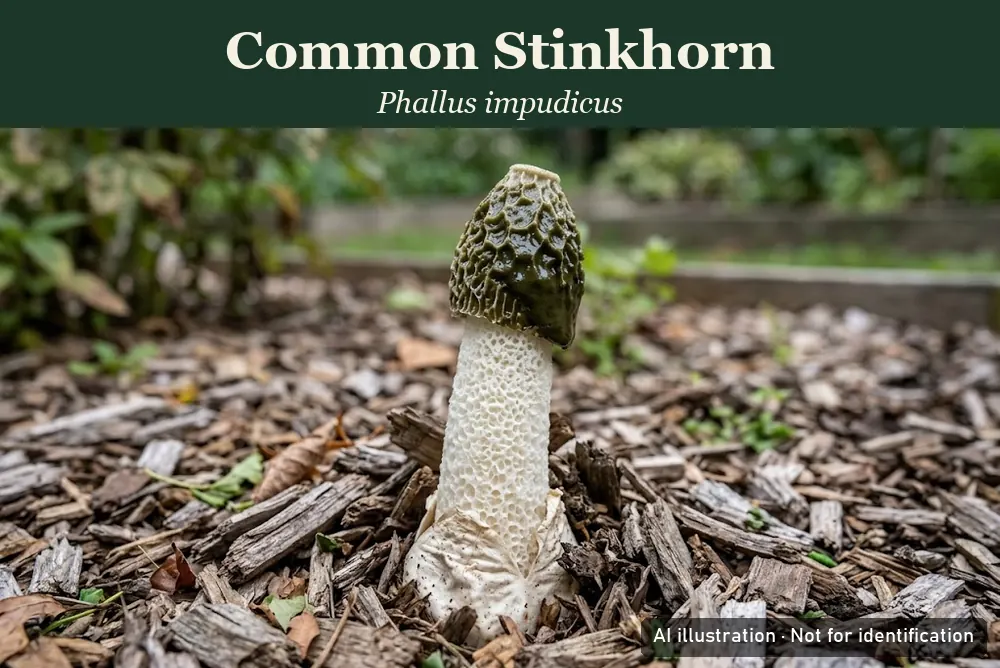
The common stinkhorn has a white, spongy stalk and a pitted cap covered in olive slime. It grows in lawns and wood chips, and MushroomExpert.com treats it as widespread. Wikipedia places it mostly west of the Mississippi, so sources differ on its range.
Ravenel's Stinkhorn (Phallus ravenelii)
Ravenel's stinkhorn looks similar but has a creamy stalk and a smoother cap. MushroomExpert.com records it in the Midwest, Southeast and Northeast, in mulch and on rotting logs. It was described from South Carolina.
Netted Stinkhorn (Phallus duplicatus)
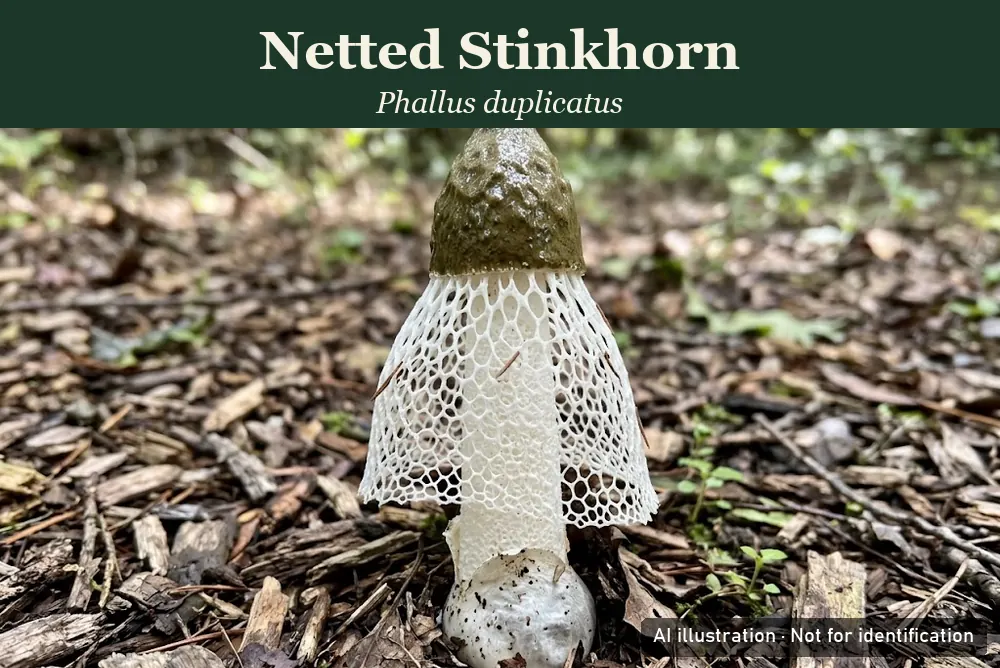
The netted stinkhorn wears a white lacy skirt that hangs about halfway down the stalk. It grows in eastern wood chips, especially in the Southeast. The tropical bridal veil stinkhorn, Phallus indusiatus, has a skirt reaching almost to the ground, and MushroomExpert.com does not list it for the US. Some databases merge the two names, so you will see both used.
Elegant Stinkhorn (Mutinus elegans)
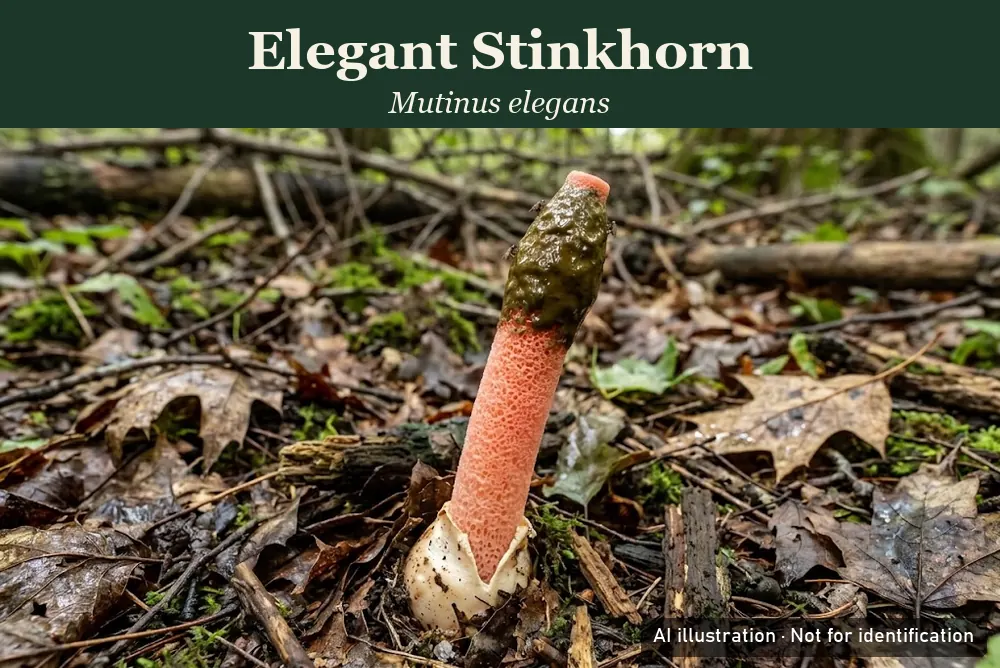
The elegant stinkhorn is an orange, tapering spike with no cap. Slime covers the upper quarter to half. MushroomExpert.com describes it as indigenous and records it from the Northeast to Minnesota, Texas and Florida.
People often call this the dog stinkhorn, but that name belongs to Mutinus caninus, a mainly European species with a small distinct head. MushroomExpert.com has it documented only from Ohio in the US, and the Missouri Department of Conservation notes that the two may be the same species.
Lattice Stinkhorn (Clathrus ruber)
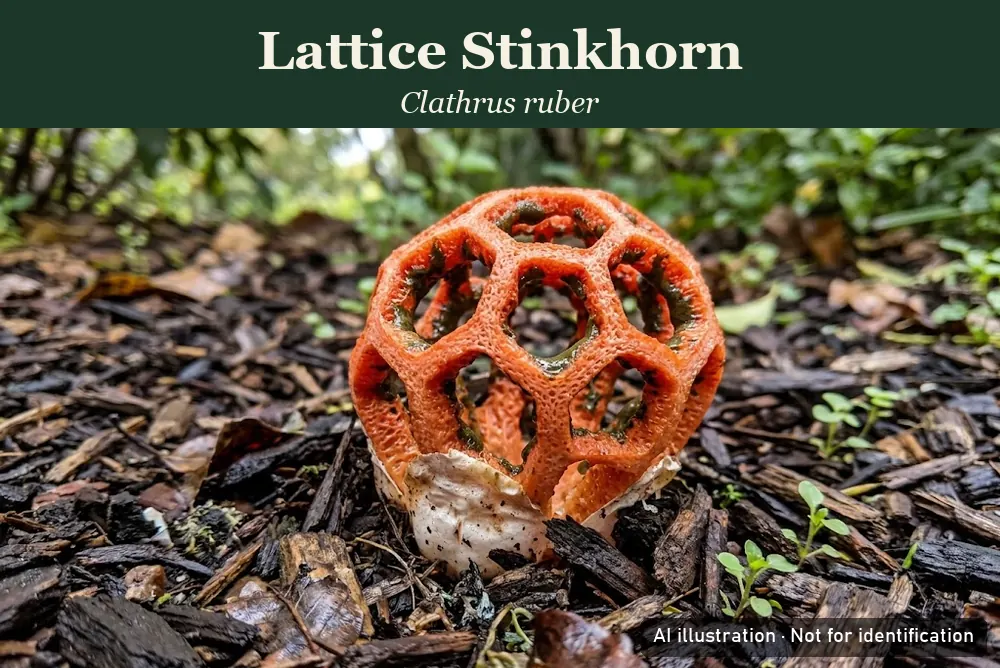
The lattice stinkhorn, also called the basket stinkhorn or red cage, is a hollow red ball with a cage pattern. It is probably introduced to the US. It appears in California and in scattered states such as Florida, Georgia, Alabama, Virginia, North Carolina, New York and Hawaii. MykoWeb links its increase around the Bay Area to parks chipping fallen trees, which shows how closely these fungi follow wood chips.
Column Stinkhorn (Clathrus columnatus)
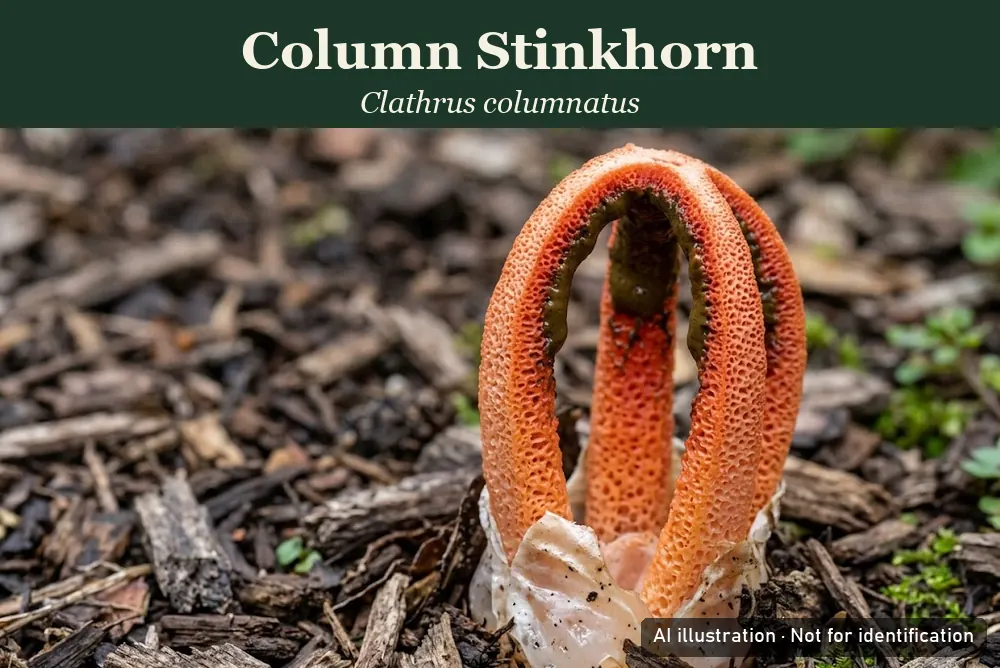
The column stinkhorn has two to five orange-red columns joined at the top, like a small arch. It ranges from Pennsylvania to the Gulf in mulch. You may also see the older names Linderia columnata and Laternea columnata. Sources disagree on whether it is native.
Octopus Stinkhorn (Clathrus archeri)
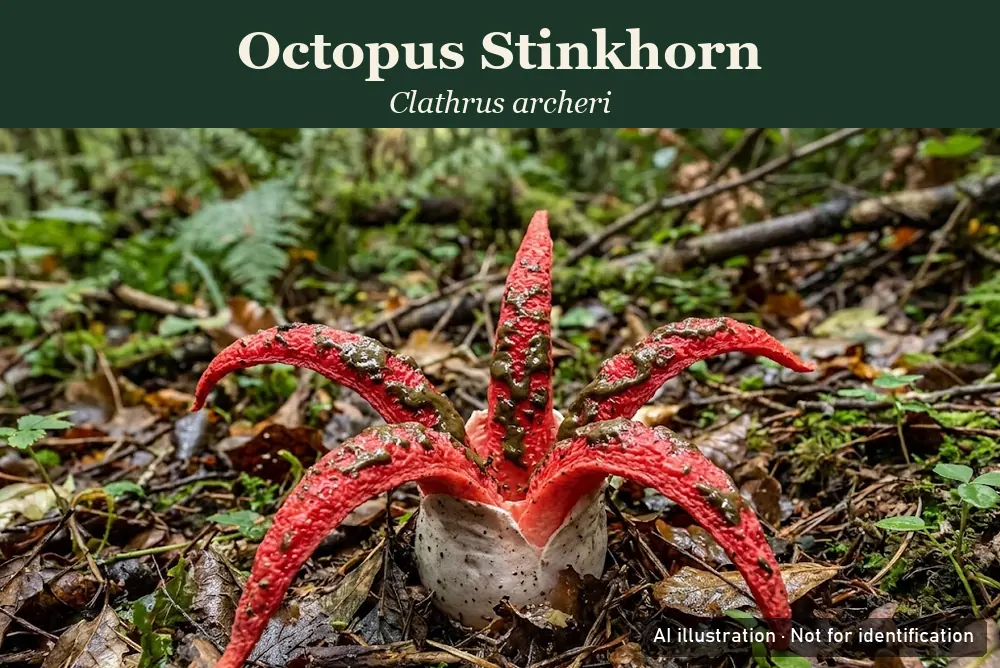
The octopus stinkhorn spreads four to seven red arms from its egg. In the US, MykoWeb records it only around Santa Cruz and Monterey, California, where it arrived with bamboo stock. A find elsewhere would be unusual and worth reporting to a local mycological club.
Lantern Stinkhorn (Lysurus mokusin)
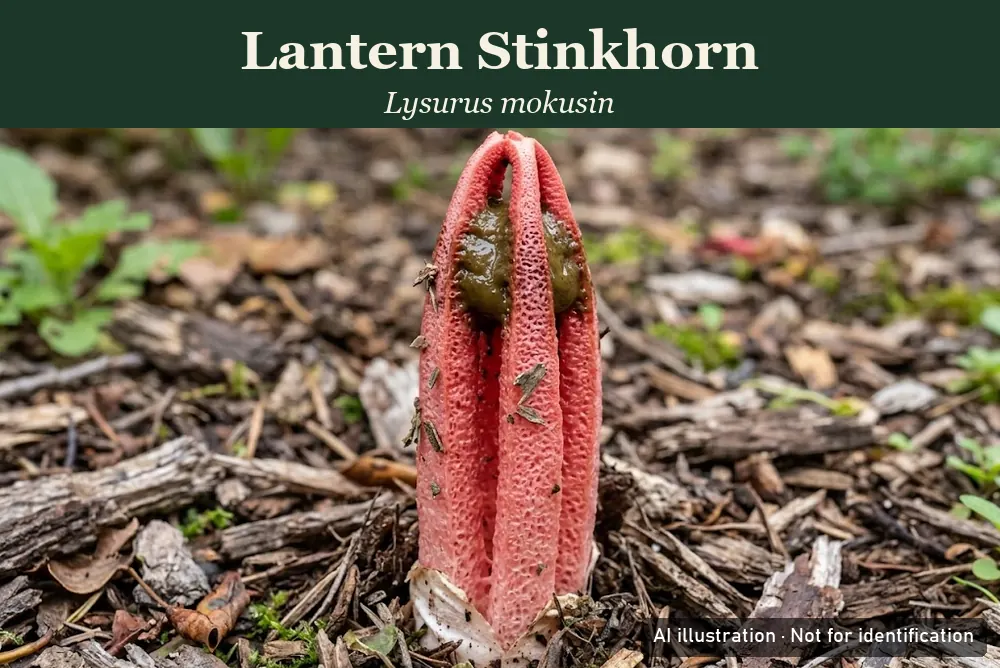
The lantern stinkhorn has a ribbed, angular stalk whose ribs fuse at the tip. It is nonnative. MushroomExpert.com records it in California, the Plains to Texas, and the East below Maryland and St. Louis, mostly in mulch. The similar lizard's claw, Lysurus cruciatus, has a round stalk and separate orange arms.
Anemone Stinkhorn (Aseroe rubra)
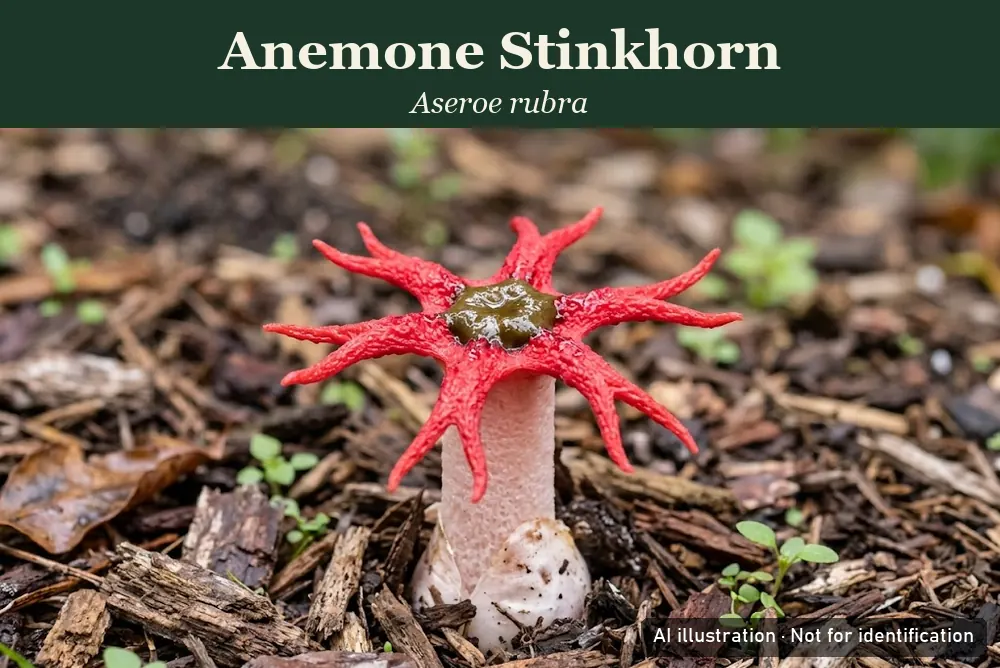
The anemone stinkhorn has five to seven red tentacles radiating from a central crown of slime. MushroomExpert.com describes it as apparently introduced, with records in Hawaii and the Southeast.
Are Stinkhorns Poisonous?
Stinkhorns are not generally considered poisonous, but the evidence is thin and they should not be eaten. UF/IFAS says they are not poisonous but does not recommend eating them. The ACEP review found no recorded human deaths.
People
Some stinkhorn eggs are eaten. UF/IFAS reports that the eggs of Phallus impudicus are said to taste like hazelnuts, and that Phallus indusiatus is grown commercially in China. Two old exceptions justify caution, though. In an 1854 report, a person who ate Clathrus ruber had convulsions and a stupor of about 48 hours. An 1890 report linked Clathrus columnatus to dead hogs and a girl with convulsions.
The greater risk is misidentification. A young stinkhorn egg and a young deadly Amanita can look alike from the outside, as the next section explains.
Dogs
Evidence for dogs is limited. We found no published study on stinkhorn poisoning in dogs. The ACEP review mentions veterinary reports of stomach irritation, and a UF/IFAS county article calls them not poisonous to animals. Queensland Poisons Information mentions unpublished anecdotes of nervous-system effects.
Treat a stinkhorn like any unknown mushroom: follow our guide on what to do if your dog ate a mushroom and call your vet.
Stinkhorn Look-Alikes: Side-by-Side Comparison
The most important comparison is the egg stage, because a young stinkhorn can resemble a puffball or a deadly Amanita. Cutting the egg lengthwise shows the difference.
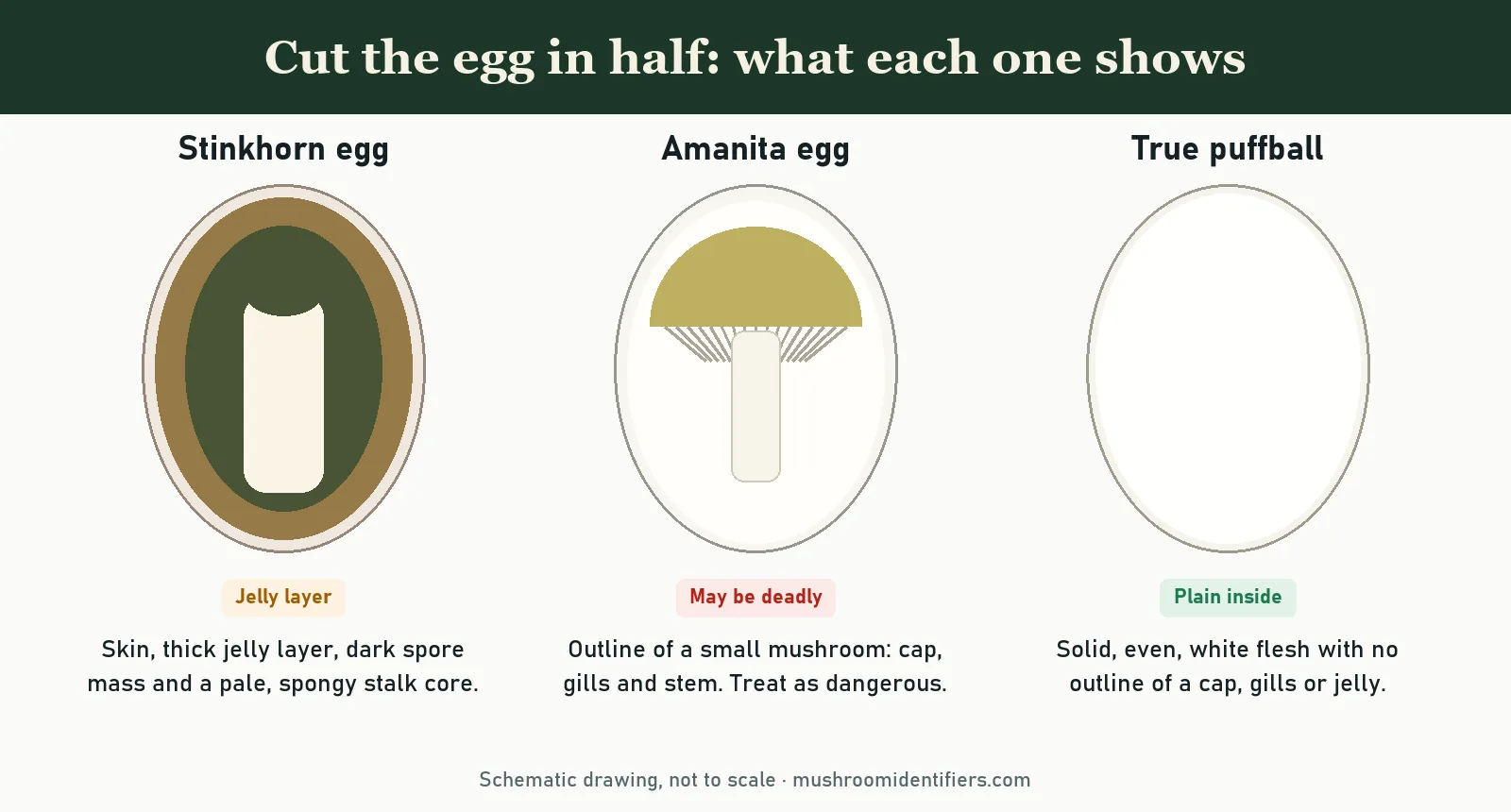
Stinkhorn Egg vs Amanita Egg vs Puffball
| Feature | Stinkhorn egg | Amanita egg | True puffball |
|---|---|---|---|
| Inside when cut | Thick jelly around a dark spore mass and pale stalk | Outline of a tiny mushroom: cap, gills, stem | Plain, even flesh |
| Risk | Not recommended as food | May be deadly | Needs expert confirmation |
| Action | Bag and bin it | Keep away from children and pets | Have an expert confirm it |
The features come from MushroomExpert.com, the University of Saskatchewan fungi key and the Missouri Department of Conservation. Amanitas form eggs too, so get expert identification when in doubt. Our puffball mushroom identification chart shows the cut test in detail. Read more in our death cap guide.
Stinkhorn vs Morel
| Feature | Common stinkhorn | Morel |
|---|---|---|
| Cap | Pitted, with slime when fresh | Pitted and ridged, dry |
| Smell | Rotting meat | Mild and earthy |
| Base | Sac from the egg | No sac |
| Season | Usually summer and fall | Spring |
MushroomExpert.com notes that older common stinkhorns, once insects have cleaned the slime, are occasionally mistaken for morels. See our morel guide for full details.
Why Are Stinkhorns Growing in My Mulch?
Stinkhorns grow in mulch because they feed on dead plant material such as wood chips, leaf litter and old stumps. Fresh hardwood mulch gives them food and moisture together. Nebraska Extension notes that they favor hardwood over pine mulch.
Their presence is not a plant disease. Wisconsin Horticulture confirms that they do not harm plants. There is one exception worth checking. A fungus growing from a living tree can signal decay, as a UF/IFAS county article points out. Our article on why mushrooms grow in your yard explains the wider picture.
How to Get Rid of Stinkhorns
The most reliable way to reduce stinkhorns is to remove eggs and fruiting bodies, then change the conditions that feed them. UF/IFAS advises leaving them alone if you can tolerate the smell, since they do no harm. If you cannot, follow these steps.
- Dig out eggs first. Eggs have not released slime yet, so this stops the smell before it starts.
- Remove mature stinkhorns. Dig up the base as well as the stalk, seal everything in a bag and put it in the trash.
- Rake the mulch. Raking breaks up the area and exposes eggs you missed.
- Remove excess mulch. Do not add new mulch on top, because NC State Extension reports that this fails.
- Switch mulch. Use pine bark or pine straw instead of hardwood mulch.
- Remove the food source. Grind stumps, and increase sun and airflow where you can.
- Consider groundcovers. Nebraska Extension suggests them as an alternative to deep mulch.
| Method | Does it work? | Why |
|---|---|---|
| Digging out eggs | Helps short term | Stops the next fruiting bodies |
| Replacing hardwood mulch | Helps | Removes much of the food source |
| Grinding stumps | Helps | Removes a long-term food source |
| Adding fresh mulch on top | No | The fungus stays underneath |
| Fungicides | Typically no | UF/IFAS calls them typically ineffective |
Set realistic expectations. Hyphae remain in the ground and can fruit again, so complete eradication is nearly impossible. For other lawn species, see how to get rid of mushrooms in grass.
Common Identification Mistakes
Judging by Smell Alone
Eggs and very young stinkhorns may barely smell. Dead animals and rotting compost can smell similar, so confirm with the shape and the slime.
Pulling Instead of Digging
Pulling a mushroom leaves its base behind. You lose the sac, which is one of the most useful features for identification and for safety.
Treating Every Egg as a Puffball
A round white object in mulch can be a puffball, a stinkhorn egg or an Amanita. Only a lengthwise cut shows which, and even then you should not eat it.
Assuming a Cleaned Stinkhorn Is a Morel
Insects can strip the slime quickly. A pale, pitted cap on a spongy stalk may be a stinkhorn, even if it does not smell strongly anymore.
Assuming a Fungicide Will Solve It
UF/IFAS calls fungicides typically ineffective for stinkhorns. Time and money are better spent on removal and on the mulch itself.
A Short History of Stinkhorn Hunting
Stinkhorns have embarrassed people for a long time. Charles Darwin's daughter Etty Litchfield reportedly hunted them by smell with a pointed stick, then burned them behind a locked door. Her niece Gwen Raverat wrote in the memoir Period Piece that this was done for the sake of "the morals of the maids." Popular Science retells the story.
Frequently Asked Questions
What is a stinkhorn mushroom?
A stinkhorn mushroom is a fungus in the order Phallales that grows from a soft egg and coats itself in foul-smelling slime. Flies feed on the slime and carry the spores away. Stinkhorns usually appear in mulch and lawns after rain.
Are stinkhorn mushrooms poisonous?
Stinkhorns are not generally considered poisonous, and no human deaths are recorded in the ACEP review. UF/IFAS still does not recommend eating them. Two old reports describe convulsions after eating cage-type stinkhorns, so wild ones should never be eaten.
Are stinkhorn mushrooms poisonous to dogs?
The evidence is limited. Sources range from "not poisonous to animals" to veterinary reports of stomach irritation, and no published dog study was found. Because a dog may have eaten something else nearby, call your vet or a pet poison helpline.
Can you eat a stinkhorn egg?
Some cultures eat stinkhorn eggs, and one species is grown commercially in China. Eating a wild egg is unsafe because it can be confused with a young deadly Amanita. Do not eat a wild egg based on a web page.
How long do stinkhorn mushrooms last?
Stinkhorns usually last from about 12 hours to a few days, and some remain for up to a week. The smell often fades as insects remove the slime. New ones can appear from eggs nearby.
How fast do stinkhorns grow?
Stinkhorns grow in hours. Wisconsin Horticulture reports up to 4 to 6 inches per hour, and Nebraska Extension describes 3 to 5 inches over 4 to 6 hours. Either way, one can appear in a single morning.
Why does my yard smell like something died?
A stinkhorn is a common cause if the smell is near mulch or a stump. The slime gives off sulfur compounds that imitate rotting meat. Look for flies gathering on something low in the mulch.
Do stinkhorns harm plants?
No. Stinkhorns feed on dead plant material, and Wisconsin Horticulture confirms that they do not cause plant disease. Fungus growing from a living tree is different and may be worth checking with an arborist.
What kills stinkhorn mushrooms?
Nothing kills them completely. Fungicides are typically ineffective, according to UF/IFAS. Removing eggs, bagging fruiting bodies and replacing hardwood mulch with pine bark or pine straw reduces them.
What is the difference between a stinkhorn and a morel?
A stinkhorn smells of rot, carries slime and rises from a sac. A morel has no sac, a dry cap and a mild smell. Morels usually appear in spring, while most stinkhorns appear in summer and fall.
Final Safety Reminder
Stinkhorns are harmless to your garden, but they share mulch with mushrooms that are not harmless. Never eat a wild mushroom based on a chart, a photo or an app. Keep children and pets away from unknown mushrooms. If you want a second opinion, take clear pictures of the top, the underside and the base, using our guide on how to photograph mushrooms for identification, and check them with our free mushroom identifier and a local expert.
Sign in to leave a comment and join the discussion.
 Species Guide
Mushrooms growing on a living tree almost always mean the wood inside is decaying. The fungus has usually been feeding on dead heartwood or wounded sapwood...
 Species Guide
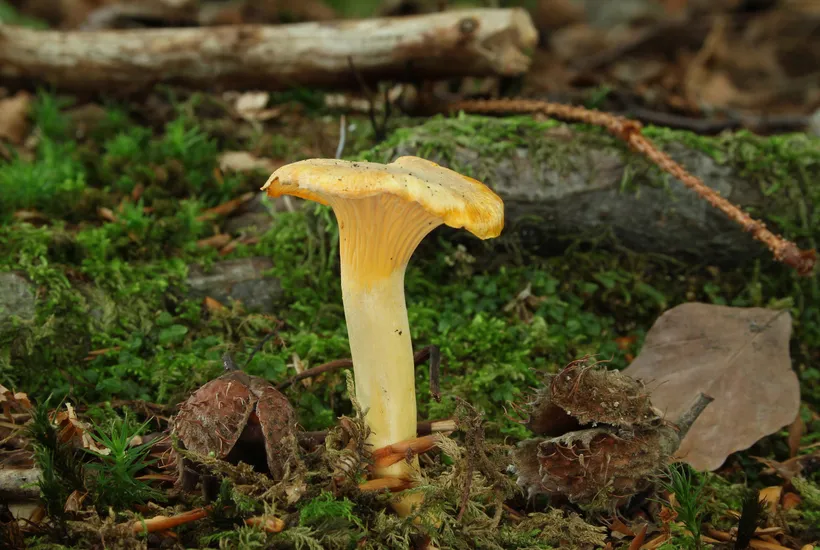
Chanterelle mushroom identification starts under the cap: a true chanterelle has blunt ridges or a nearly smooth surface running down the stem, never sharp,...
 Species Guide
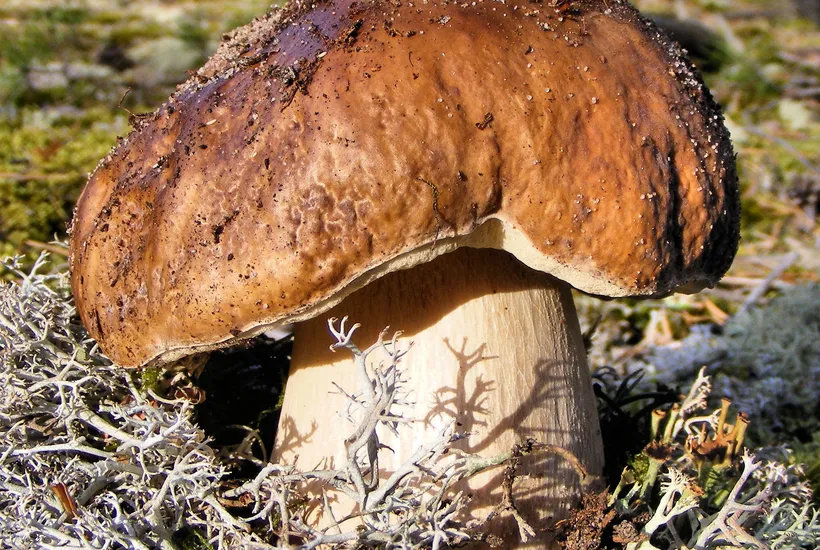
A king bolete, also called porcini, is a large brown-capped mushroom with a sponge of pores instead of gills, a swollen stem with a fine white net near the...