Red Mushroom Identification Chart With Pictures
— views
A red mushroom in the US is most often a fly agaric, a red Russula, a waxcap, a red-pored bolete or a shiny reishi shelf on a tree. The red mushrooms most likely to poison someone are the fly agaric and the red Russulas, such as the sickener, and red-pored boletes are a known risk. A few red mushrooms are eaten, but none is safe until an experienced identifier confirms it in person.
This red mushroom identification chart with pictures covers the red mushrooms Americans find in lawns and woods. It sorts them by where they grow and by month, gives a quick snap, flip and bruise test, and names the poisonous ones plainly.
Key Takeaways
- A red cap with white warts, white gills and a ring is the fly agaric. It is poisonous, and NAMA warns that dogs and cats can die from its toxins.
- A red cap on a stem that snaps like chalk is a Russula. The sickener, Russula emetica, causes vomiting, and many red Russulas look alike.
- Red pores that bruise blue mean a bolete to avoid. A red-pored bolete was linked to a death in Oregon in 1974.
- A hard, shiny, red-brown shelf at the base of a tree is reishi (Ganoderma), and it signals root and butt rot.
- Red in a yard usually comes from wood chips, mulch or tree roots. Red in the woods usually comes from soil.
- Never eat a red mushroom based on a chart or an app. Get an in-person expert check and keep children and pets away.
Red Mushroom Identification Chart
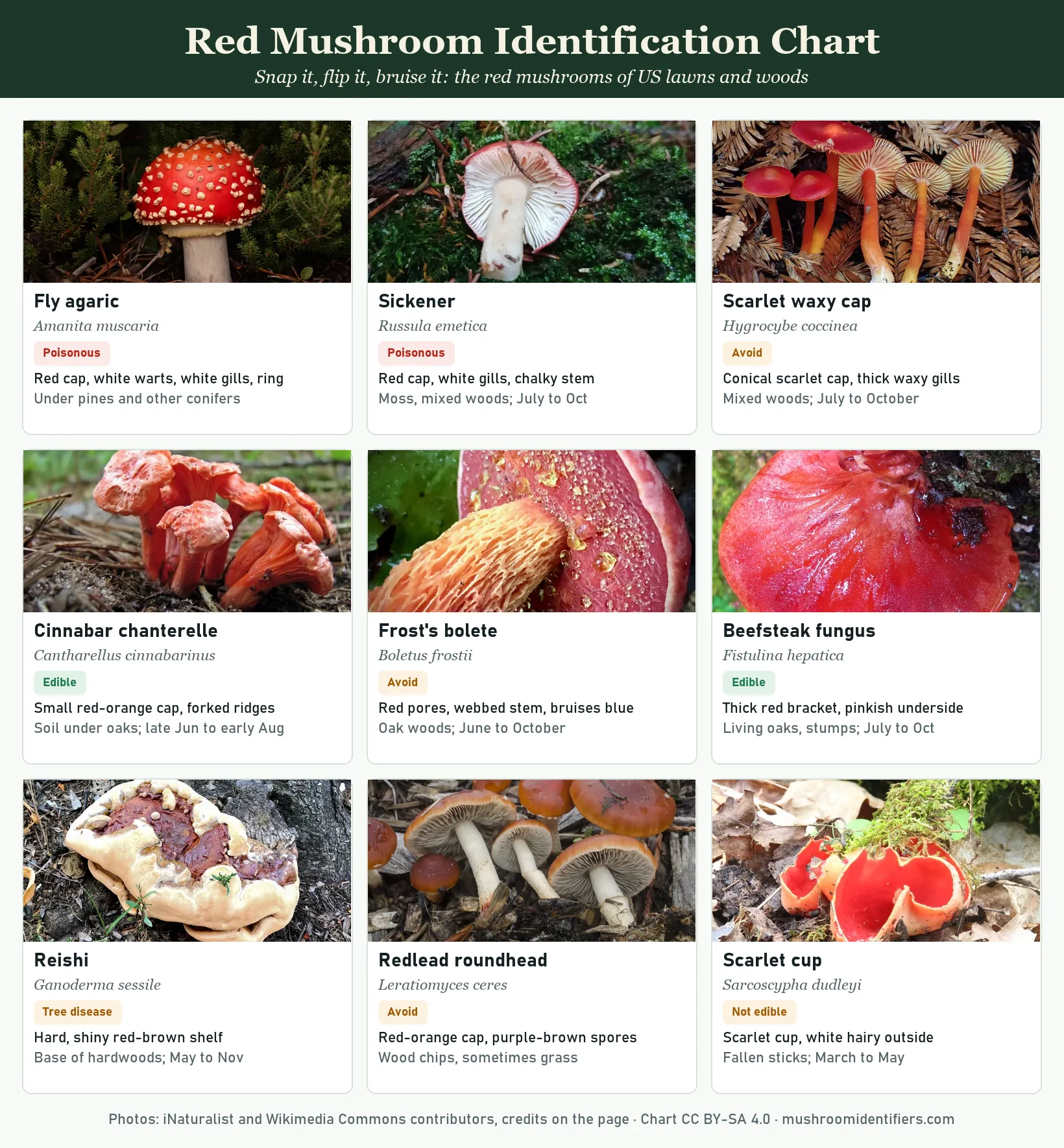
| Red mushroom | Key features | Where and when | Edibility or risk |
|---|---|---|---|
| Fly agaric (Amanita muscaria) | Red cap with white or yellowish warts, white gills, ring, bulb with rings at the base | Under pines and other conifers; early winter in California | Poisonous |
| Sickener (Russula emetica) | Uniformly red cap 1 to 4 in, white gills, brittle white stem | Moss and mixed woods; July to October | Poisonous: vomiting |
| Scarlet waxy cap (Hygrocybe coccinea) | Conical scarlet cap ½ to 2 in, thick waxy gills, orange-red stem | Ground in mixed woods; July to October | Listed as edible by MDC; look-alikes |
| Cinnabar chanterelle (Cantharellus cinnabarinus) | Small red-orange cap, forked ridges, no true gills | Soil under oaks, paths, grass; late June to early August | Edible after expert confirmation |
| Frost's bolete (Boletus frostii) | Blood-red sticky cap, red pores, webbed red stem, bruises blue | Oak woods; June to October | Not recommended |
| Red-pored bolete (Rubroboletus pulcherrimus) | Brownish cap, dull red pores, red-netted stem, bruises blue | Coastal forests north of San Francisco; late fall to early winter | Poisonous; one death on record |
| Beefsteak fungus (Fistulina hepatica) | Thick red to rusty bracket, pinkish-yellow tube surface | Base of living oaks, stumps; July to October | Edible after expert confirmation |
| Reishi (Ganoderma sessile) | Hard, shiny, dark red to brown shelf, whitish to brown pores | Base of hardwoods and stumps; May to November | Tree disease; too tough to eat |
| Redlead roundhead (Leratiomyces ceres) | Red-brown to orange-brown cap, purple-brown spore print, fragile ring | Wood chips, sometimes grass | Edibility unknown |
| Scarlet cup (Sarcoscypha dudleyi) | Scarlet cup ¾ to 2 in, white hairy outside | Fallen sticks in damp hardwood forest; March to May | Not edible |
| Bleeding tooth (Hydnellum peckii) | Pale cap beading red droplets, spines underneath | Soil under conifers; late summer to winter | Inedible |
Narrow your find down with the chart, then check the underside, the stem and any color change before you trust a match. Details come from Missouri Department of Conservation (MDC) field guide entries, MykoWeb's California Fungi pages and First Nature. Seasons are for Missouri unless a region is named.
Is a Red Mushroom Poisonous?
Many red mushrooms are poisonous, but red is not a reliable warning sign on its own. The fly agaric and the sickener are red and poisonous. The cinnabar chanterelle and the beefsteak fungus are red and eaten. Identify the species, never the color. Our guide to poisonous vs edible mushrooms explains why rules of thumb fail.
| Red mushroom | Toxin or effect | Onset | What happens |
|---|---|---|---|
| Fly agaric | Ibotenic acid and muscimol | 30 minutes to 2 hours | Confusion, visual distortion, drowsiness, sometimes convulsions |
| Sickener and other red Russulas | Stomach irritant | Usually 20 minutes to 4 hours for this group | Vomiting |
| Red-pored boletes | Stomach irritant, possibly more | Stomach symptoms first | Usually stomach upset; one 1974 death |
The onset times come from NAMA's mushroom poisoning syndromes page. NAMA reports no reliably documented human deaths from fly agaric toxins in the past 100 years, but it states that dogs, and especially cats, can die from them. If anyone may have eaten a wild red mushroom, call Poison Control at 1-800-222-1222.
Red Mushroom in the Yard vs Red Mushroom in the Woods
A red mushroom in a yard usually grows from wood chips, mulch, a stump or the roots of a planted tree, while a red mushroom in the woods usually grows from soil or fallen sticks. Dig gently at the base to see what the mushroom is attached to, and note the nearest trees, because many red mushrooms partner with specific trees.
| Where you found it | Most likely red mushrooms | First check |
|---|---|---|
| Lawn under pines or other conifers | Fly agaric | White or yellowish warts, white gills, a ring and a bulb |
| Wood chips or mulch | Redlead roundhead, red stinkhorns | Purple-brown spore print, or a foul smell and an egg-like base |
| Base of a yard tree or stump | Reishi, beefsteak fungus | A hard, shiny shelf, or a thick, gelatinous red bracket |
| Fallen sticks in early spring | Scarlet cup | A cup with no gills and a white outside |
| Forest floor, moss, leaf litter | Red Russulas, scarlet waxy cap, cinnabar chanterelle, lobster mushroom | Snap the stem and flip the cap |
| Oak woods | Frost's bolete, cinnabar chanterelle, beefsteak fungus | Pores, ridges or tubes underneath |
| Conifer forest soil | Fly agaric, bleeding tooth | Warts, or spines and red droplets |
Red stinkhorns are common in mulch. A University of Florida extension office answers the question "What is the awful smelling red mushroom growing in my mulch?" by saying stinkhorns are common and no cause for concern. They grow from an egg-like sac on dead organic matter. See our stinkhorn mushroom identification chart for the red cage and column types.
The Snap, Flip and Bruise Test for Red Mushrooms
Three quick checks sort most red mushrooms into the right group before you look at any single species: snap the stem, flip the cap and press the underside. None of them proves a mushroom is safe. They tell you which group you have and which look-alikes to compare. Never taste a wild mushroom as a test.
| Check | What you see | What it points to |
|---|---|---|
| Snap the stem | Breaks cleanly like chalk | Russula, per MDC |
| Flip it | White gills, ring, bulb | Fly agaric or another Amanita |
| Flip it | Thick, waxy gills | Waxcap |
| Flip it | Blunt forked ridges, no true gills | Cinnabar chanterelle |
| Flip it | Sponge of pores | Bolete, or a shelf fungus if it grows on wood |
| Flip it | Spines or teeth | Bleeding tooth |
| Press the pores | Red pores turn blue | Red-pored bolete: avoid |
| Spore print | Purple-brown | Redlead roundhead, not the sickener |
The Missouri Department of Conservation advises avoiding boletes with orange to red pores and boletes that bruise blue. Blue bruising alone is not a toxin test, as our guide to mushroom color changes and bruising explains. Learn the underside terms in gills vs pores vs ridges.
When Do Red Mushrooms Appear? A Month-by-Month Window
Red mushrooms follow a calendar: scarlet cups open the year in early spring, most red gilled mushrooms and boletes fruit from summer into fall, and the West Coast species peak from late fall into winter. Knowing the month helps rule species in or out. The table uses Missouri dates for the central US and California dates for the West Coast, and other regions can differ.
| Months | Central US (Missouri data) | West Coast (California data) |
|---|---|---|
| March to May | Scarlet cup on fallen sticks; reishi from May | Redlead roundhead when moisture allows |
| June to August | Frost's bolete from June, cinnabar chanterelle late June to early August, reishi | Redlead roundhead when moisture allows |
| July to October | Sickener, scarlet waxy cap, beefsteak fungus, lobster mushroom, Frost's bolete | Bleeding tooth from fall |
| November to February | Reishi through November | Fly agaric in early winter, red-pored bolete, redlead roundhead, bleeding tooth to midwinter |
The Missouri months come from MDC field guide entries. The California months come from MykoWeb, which notes that the redlead roundhead can fruit in any month when moisture is available.
Common Red Mushroom Types in the US
These are the red mushrooms Americans most often find, from the poisonous toadstools to the shelves and cups that are not mushrooms in the everyday sense at all. Compare your find with several real photographs, because colors fade with rain and age.
Fly Agaric (Amanita muscaria)
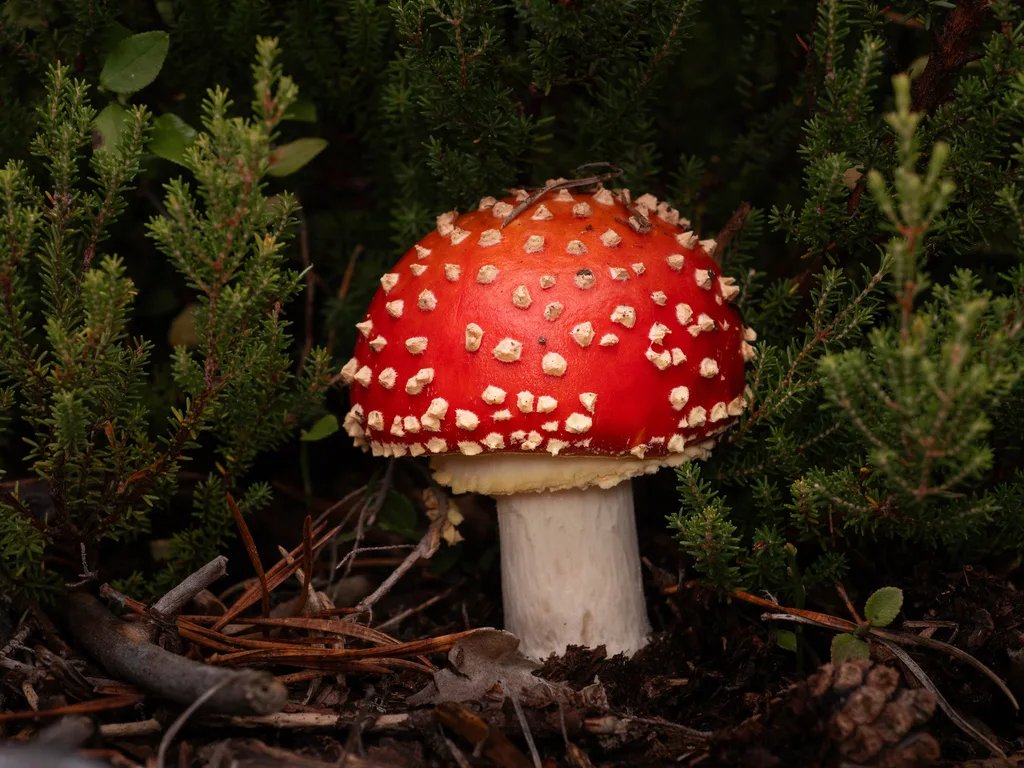
The fly agaric is the red toadstool with white spots. MykoWeb describes a red cap 6 to 39 cm across with white warts, or yellowish warts in var. flavivolvata. The gills are white to cream, the stem has a skirt-like ring, and the bulb carries two to three concentric rings. In California it fruits in early winter under pines. Tom Volk at the University of Wisconsin places the red form mostly in the West and Deep South, with orange and yellow forms farther east. He warns that it can be mistaken for deadly Amanitas. See our Amanita muscaria guide.
The Sickener and Other Red Russulas (Russula emetica)
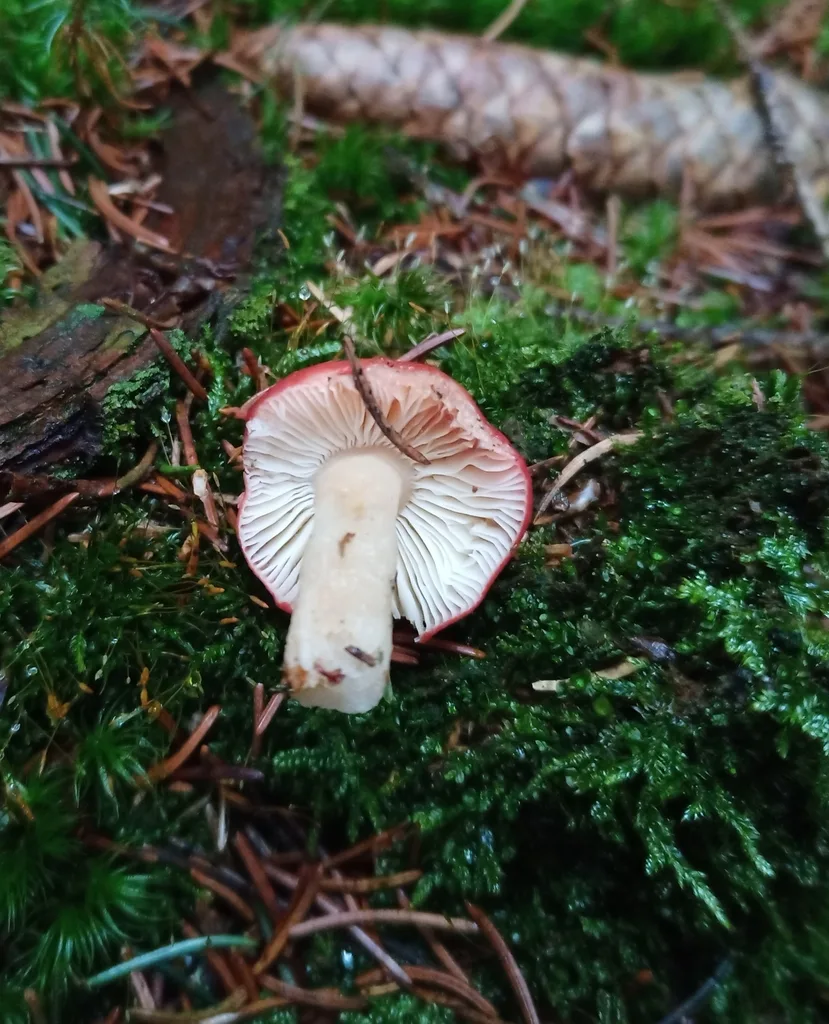
The sickener has a uniformly red cap 1 to 4 inches wide, white to off-white gills, and an off-white stem with white flesh. It grows alone or in groups on moss and in mixed woods from July to October. The Missouri Department of Conservation lists it as poisonous and says it will cause vomiting if eaten. MDC also notes that there are many red Russulas and that they are often difficult to tell apart. Russulas break apart like a piece of chalk. Treat every red Russula as one to avoid.
Scarlet Waxy Cap (Hygrocybe coccinea)
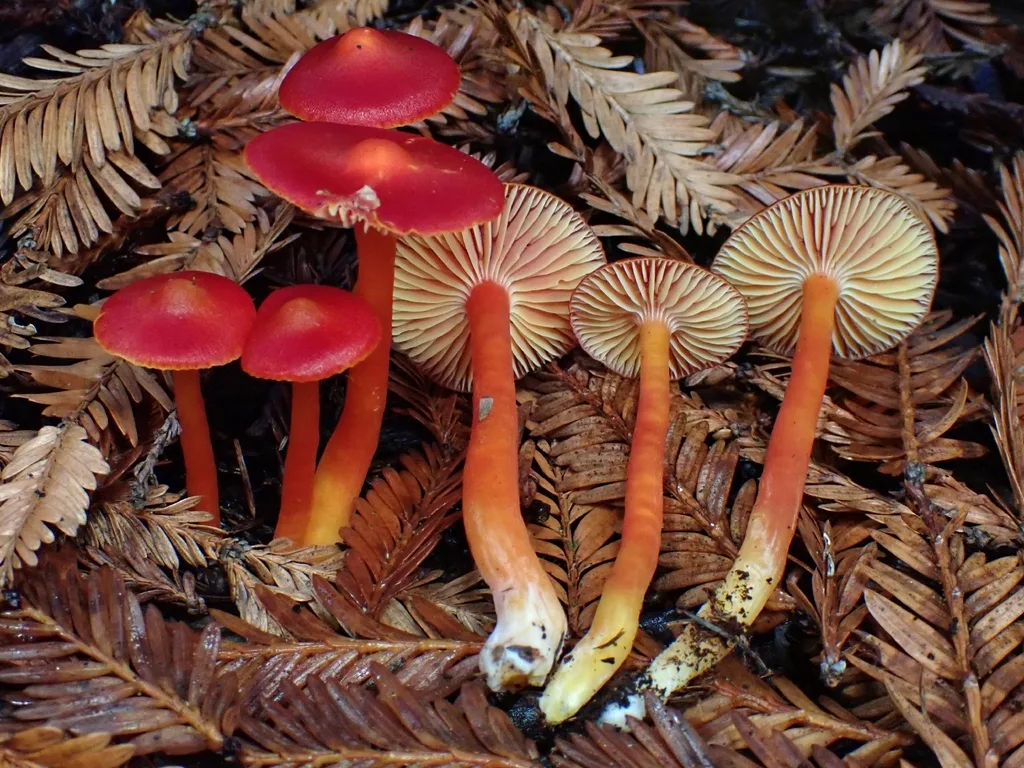
The scarlet waxy cap is a small, conical, scarlet to blood-red mushroom with a moist cap. Its gills are thick, waxy and bright reddish yellow, and its hollow stem is orange-red. The spore print is white. It grows on the ground in mixed woods from July to October. The Missouri Department of Conservation lists it as edible but warns that other Hygrocybe species look alike. Red waxcaps and red Russulas can share the same woods. The thick waxy gills and hollow orange-red stem separate a waxcap.
Cinnabar Chanterelle (Cantharellus cinnabarinus)
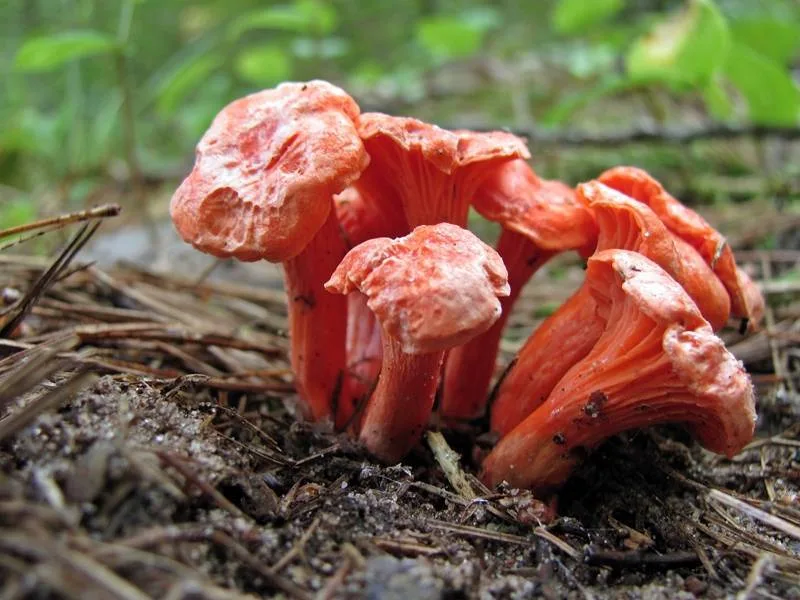
The cinnabar chanterelle is a small red-orange chanterelle, ¼ to 1½ inches across, that turns pinkish with age. It has forked, cross-veined ridges running down the stem and no true gills. It grows in soil among moss, leaves and grass, on paths and under oaks, from late June to early August. The Missouri Department of Conservation considers it a good edible, with the usual warning to be certain of the identification first.
Frost's Bolete (Boletus frostii)
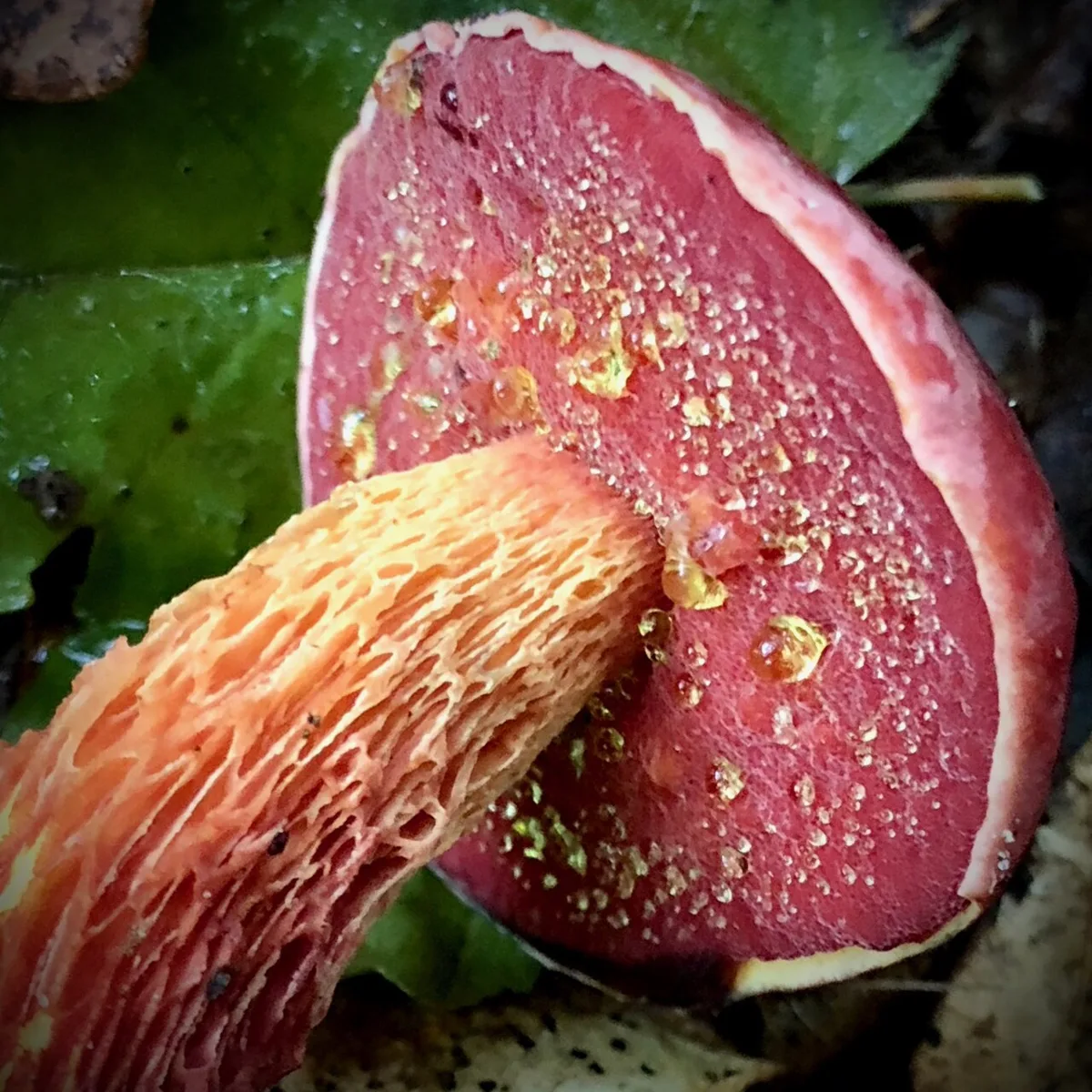
Frost's bolete has a sticky, blood-red cap 2 to 6 inches wide and deep red pores. Its red stem is covered in raised yellowish webbing. Every part bruises blue, including the yellowish flesh. It grows scattered on the ground in oak woods from June to October. MDC says it is edible but does not recommend it, because it can be confused with poisonous red-pored boletes.
Red-Pored Boletes in the West (Rubroboletus pulcherrimus)
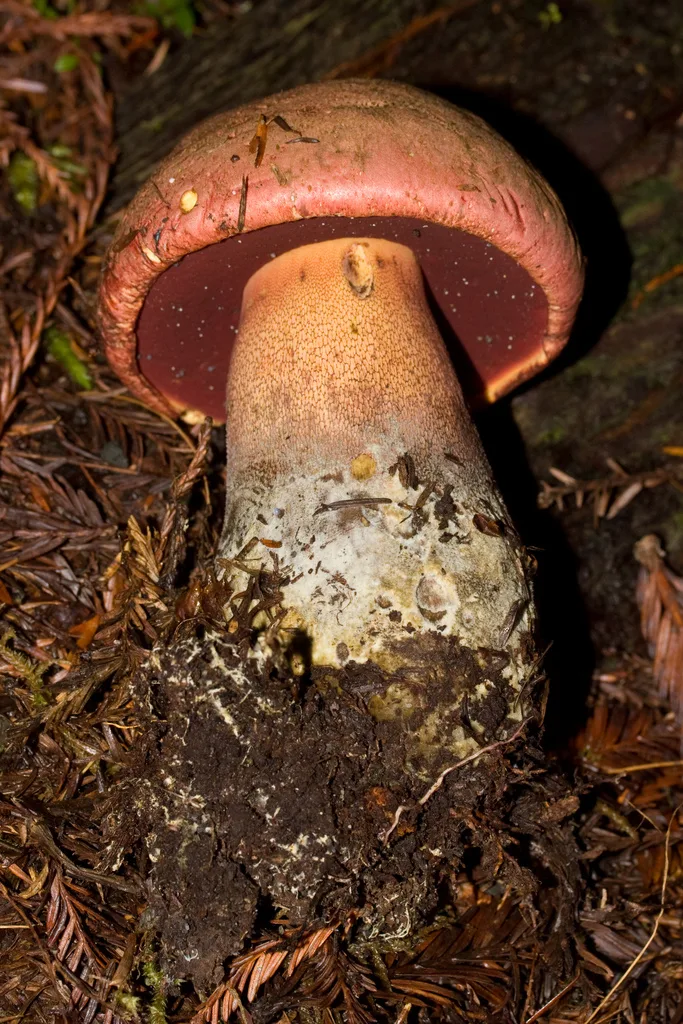
This large western bolete has a brownish cap 9 to 17 cm across, often reddish at the edge, with dull red pores. The upper stem is covered in red netting, and the pores and stem bruise blue. MykoWeb lists it as toxic and knows it from coastal forests north of San Francisco, from late fall to early winter. In 1974 an Oregon couple fell ill after eating it, and the husband died suddenly, according to Toxic Fungi of Western North America. His autopsy showed small bowel death from lack of blood supply. Some encyclopedia entries date the case to 1994 instead.
Beefsteak Fungus (Fistulina hepatica)
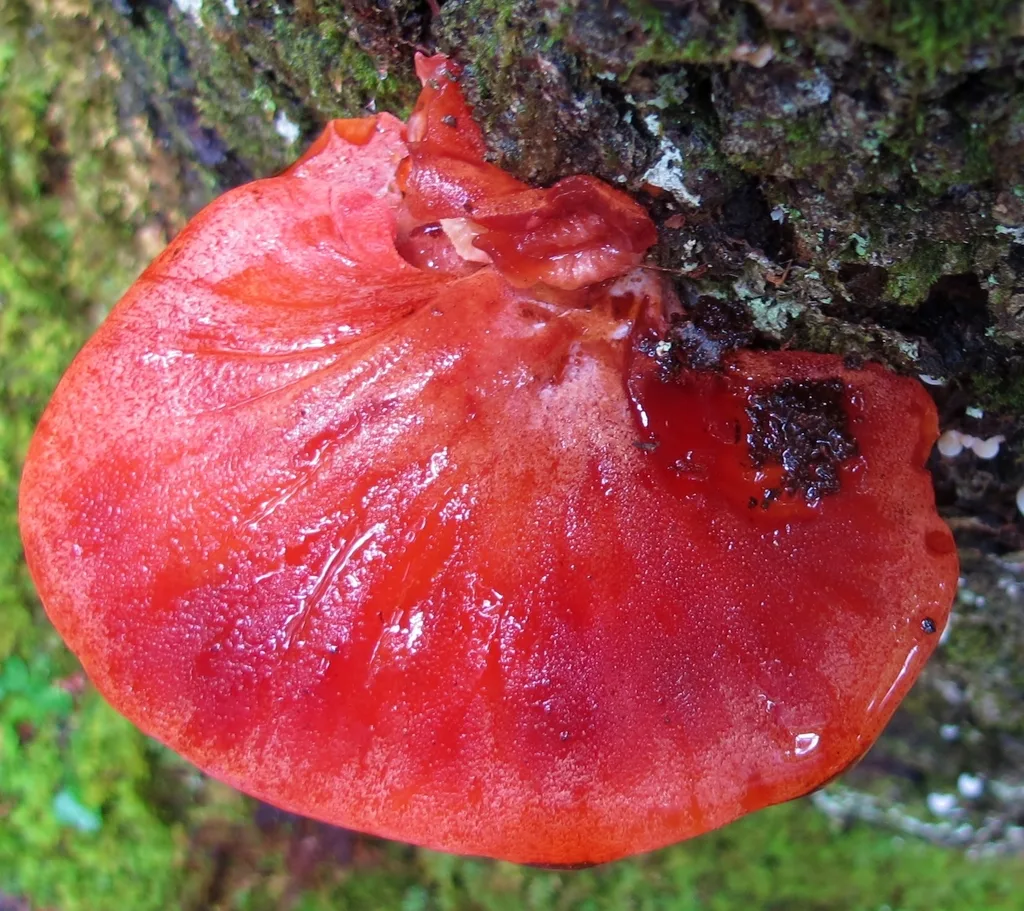
The beefsteak fungus is a thick, red to rusty bracket that looks like raw meat. Its cap is 3 to 20 inches wide, semicircular or spoon-shaped, and gelatinous on top. The flesh is dark pink with lighter veining, and the underside is pinkish yellow. It grows at the base of living oaks and on stumps from July to October, as the Missouri Department of Conservation describes. MDC rates it a good edible when young and fresh. Our oak tree fungus identification guide explains what it means for the tree.
Reishi (Ganoderma sessile)
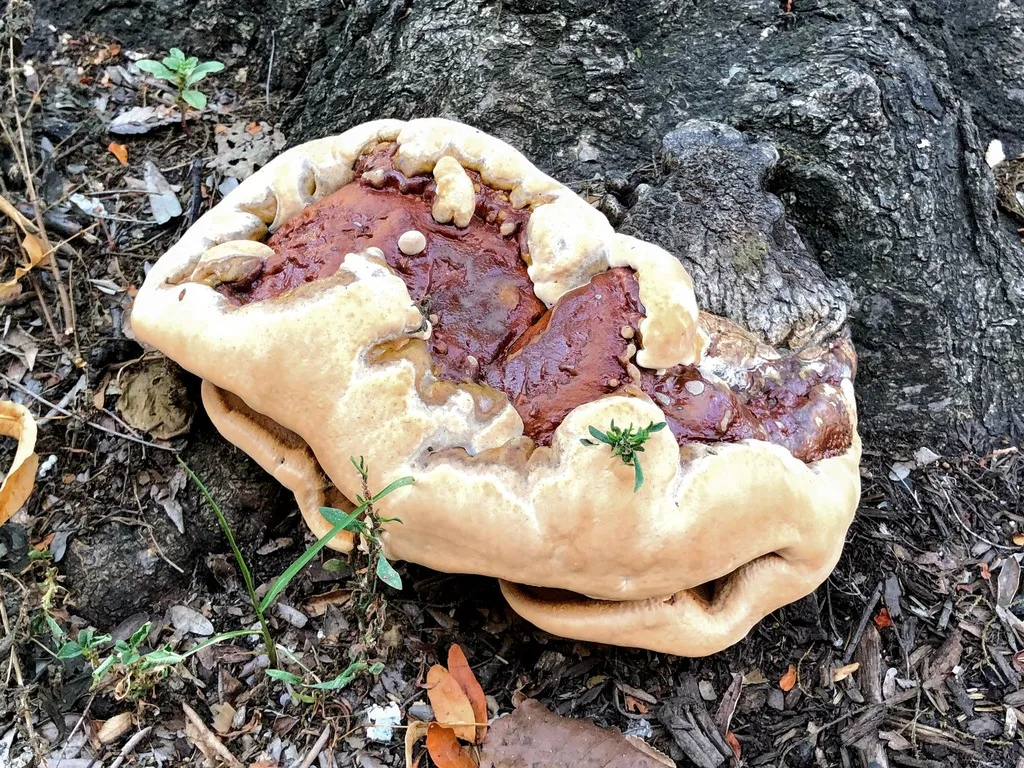
Reishi is a hard, shiny, dark red to dark brown shelf that looks varnished. Its cap is 1 to 14 inches wide, often zoned and lighter toward the edge, with whitish to brown pores. It grows at the base of living and dead hardwoods or around stumps from May to November. The Missouri Department of Conservation uses the name Ganoderma sessile, formerly G. lucidum, and calls it too tough to be a good edible. The Texas Plant Disease Diagnostic Lab says Ganoderma rot softens the anchoring wood at the base, has no known control, and calls for a professional inspection once a conk appears. See our Ganoderma lucidum group guide.
Lobster Mushroom (Hypomyces lactifluorum)
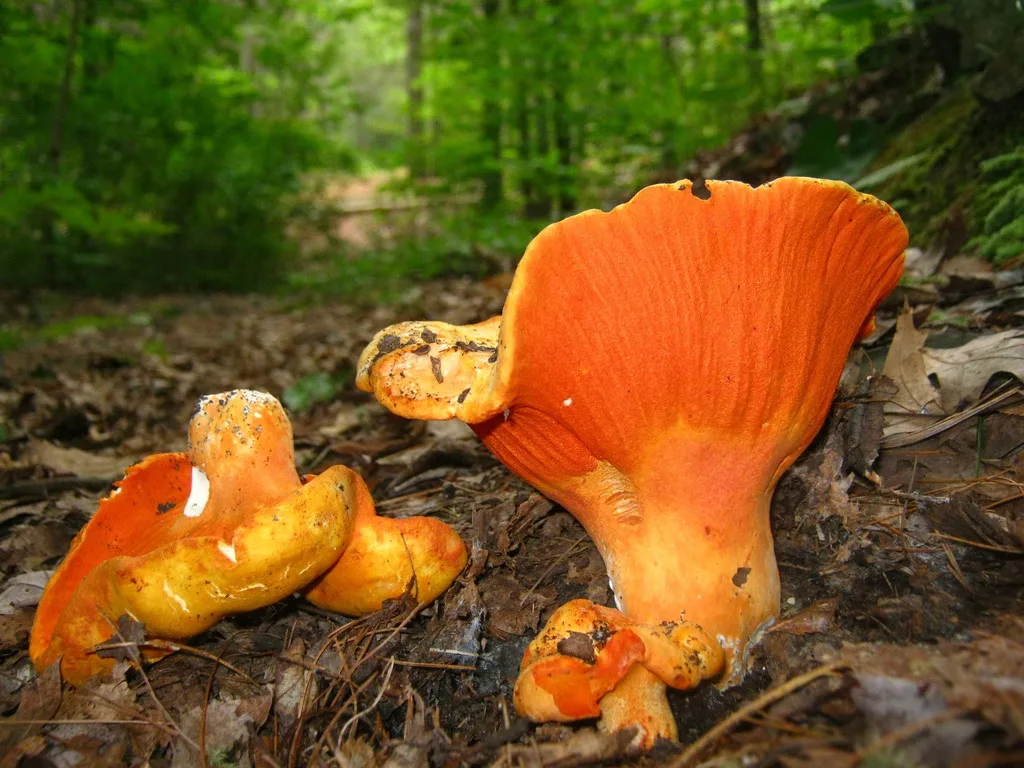
The lobster mushroom is an orange to orange-red mold that covers a white Lactarius or Russula. The surface is finely bumpy and hard, and the inside stays pure white. It grows in mixed woods from July to October, and MDC rates it a choice edible. The covered host can no longer be identified, so an expert check still matters.
Redlead Roundhead (Leratiomyces ceres)
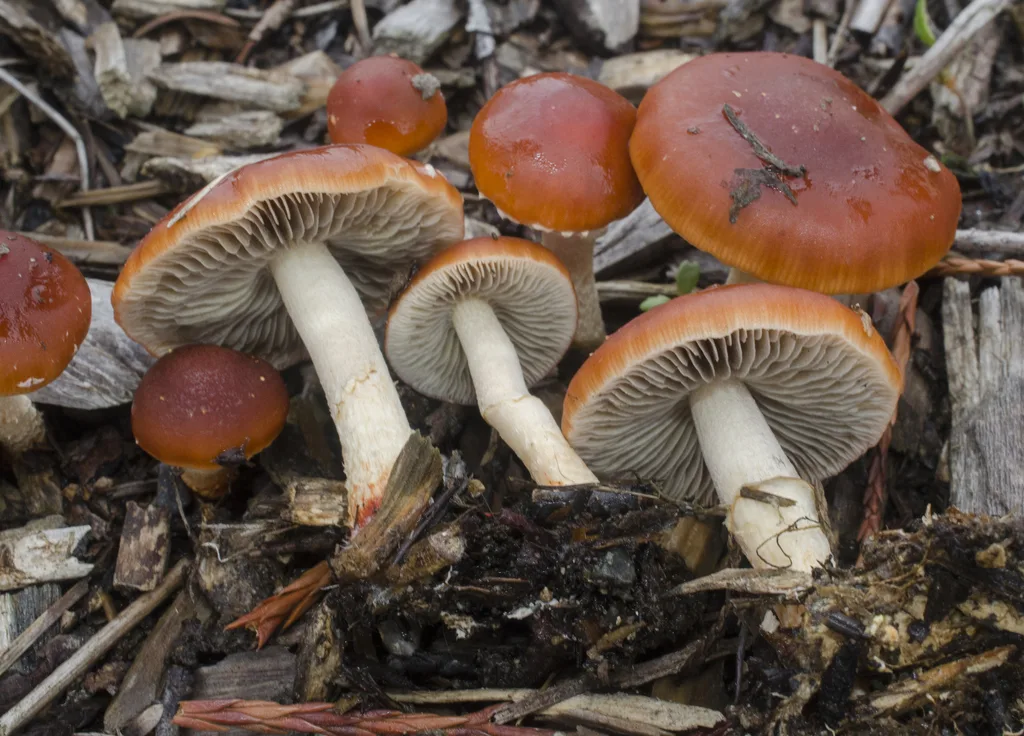
The redlead roundhead is the red-orange gilled mushroom of wood-chip beds. Its cap is 2.5 to 6 cm, reddish brown to orange-brown and slightly sticky when wet. Its gills turn from grayish brown to brownish purple, and it drops a purple-brown spore print. It grows in clusters on wood chips and occasionally in grass. MykoWeb calls it common in wood chips but rare in natural woodlands, and lists its edibility as unknown. Older books misapply the name Stropharia aurantiaca.
Scarlet Cup (Sarcoscypha dudleyi)
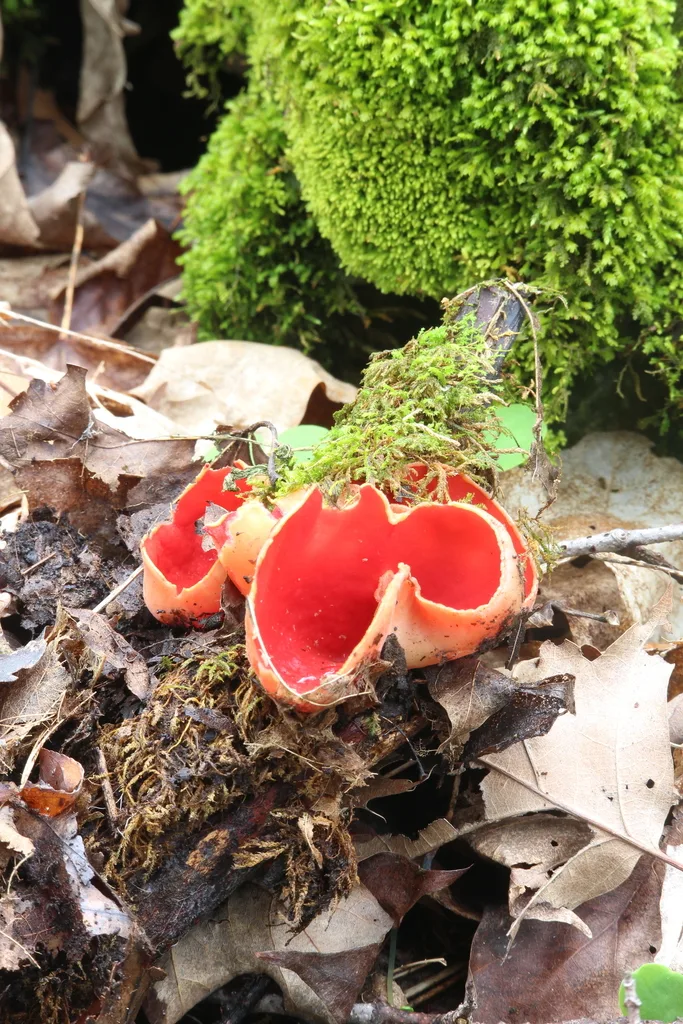
The scarlet cup is a bright red cup ¾ to 2 inches wide, white and finely hairy on the outside and usually stalkless. Many people call red cups like this scarlet elf cups. It grows on fallen wet sticks and branches in damp hardwood forests from March to May. The Missouri Department of Conservation calls it one of the earliest Missouri mushrooms of spring and lists it as not edible. The stalked scarlet cup, S. occidentalis, has a clear stem and a much tinier cup, and it appears later.
Bleeding Tooth (Hydnellum peckii)
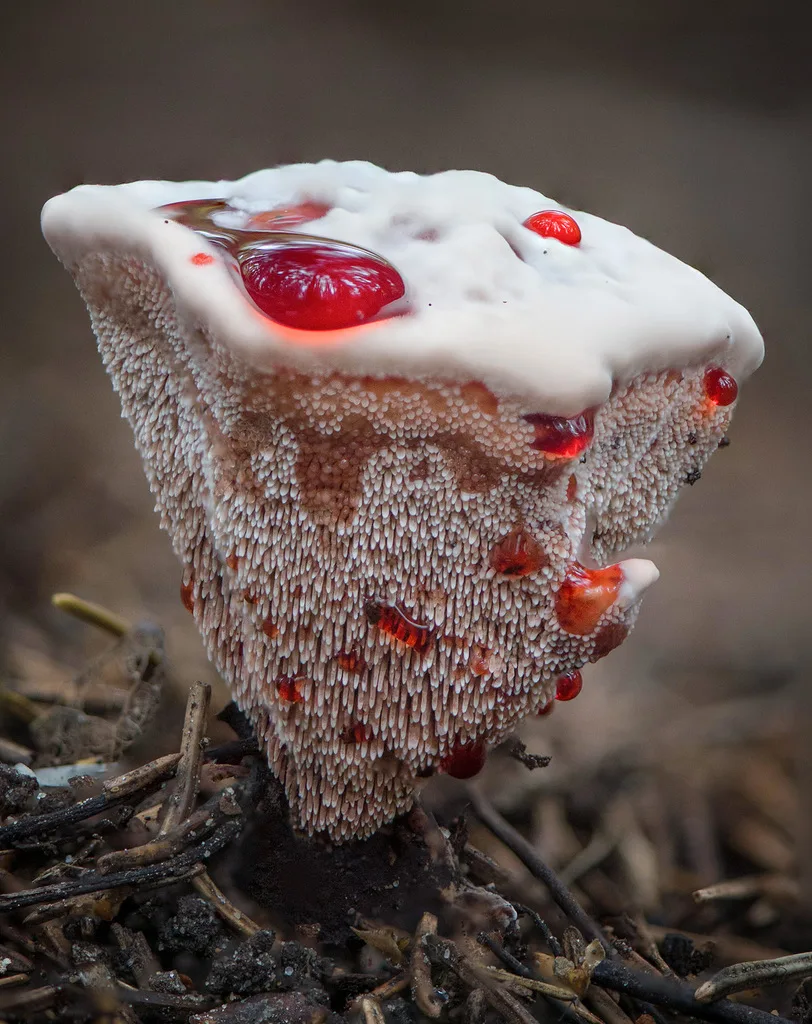
The bleeding tooth is a tough, pale fungus that beads bright red droplets on young caps. Its cap is 3 to 8 cm, white or pale pink at first and then buff, brown and blackening. Its underside carries crowded pinkish spines, not gills. First Nature lists names such as devil's tooth and strawberries and cream, and places it in conifer forest soil in late summer and autumn. MykoWeb records it under conifers in northern coastal California from fall to midwinter and lists it as inedible.
Red Mushroom Look-Alikes: Side-by-Side Comparison
Three pairings cause the most confusion: the fly agaric and the red Russulas, which both have red caps and white gills; the red Russulas and the red waxcaps; and Frost's bolete and the poisonous red-pored boletes. In each pair, the underside and the stem do the work.
| Mushroom | Underside | Stem | Risk |
|---|---|---|---|
| Fly agaric | White to cream gills | White, skirt-like ring, ringed bulb | Poisonous |
| Sickener | White gills | Off-white, snaps like chalk | Poisonous |
| Scarlet waxy cap | Thick, waxy, reddish-yellow gills | Orange-red, hollow | Listed as edible; look-alikes |
| Cinnabar chanterelle | Forked ridges, no true gills | Red-orange, smooth | Edible after expert check |
| Frost's bolete | Deep red pores, bruise blue | Red with raised webbing | Not recommended |
| Red-pored bolete (R. pulcherrimus) | Dull red pores, bruise blue | Red netting, thick base | Poisonous |
| Redlead roundhead | Gray-brown to purple-brown gills | Fragile ring | Edibility unknown |
A spore print adds a check that photos cannot. MDC lists a white print for the sickener and the scarlet waxy cap, and MykoWeb a purple-brown print for the redlead roundhead. Our spore print guide shows how to take one.
Are Any Red Mushrooms Edible?
A few red mushrooms are eaten in the US, including the cinnabar chanterelle, the beefsteak fungus and the lobster mushroom, but none is safe to eat without an in-person expert confirmation. The cinnabar chanterelle grows in the same woods as the sickener. Frost's bolete is edible but not recommended because of its poisonous relatives. MDC adds two cautions for confirmed edibles: be absolutely sure of the identification, and eat only a small amount the first time. Nobody should eat a mushroom based on this page.
Are Red Mushrooms Poisonous to Dogs?
Some red mushrooms are dangerous to dogs, and the fly agaric is the clearest risk. NAMA states that dogs, and especially cats, can die from the ibotenic acid and muscimol in Amanita muscaria and its relatives. Fly agarics grow under pines and other conifers, so a yard with conifers can have them. Follow our guide on what to do if your dog ate a mushroom and call your vet or a pet poison helpline.
Common Identification Mistakes
Treating Red as a Warning Label
Red does not mean poisonous, and a dull color does not mean safe. The cinnabar chanterelle is red and eaten, while the sickener is red and poisonous. Identify the species.
Assuming the White Spots Are Permanent
Rain can wash the warts off a fly agaric. A plain red cap with white gills, a ring and a bulb is still a fly agaric.
Mixing Up Red Russulas and Waxcaps
Both are red and grow from soil. A stem that snaps like chalk points to a Russula, and thick waxy gills point to a waxcap.
Ignoring Blue Bruising on a Red Bolete
Red pores that turn blue are the group MDC tells people to avoid. Frost's bolete does it too, which is why MDC does not recommend it.
Frequently Asked Questions
Are red mushrooms poisonous?
Many are, but not all. The fly agaric, the sickener and red-pored boletes are poisonous. The cinnabar chanterelle and the beefsteak fungus are red and eaten, but only after an expert confirms them.
Is a red mushroom with white spots poisonous?
Yes. A red cap with white warts, white gills and a ring is the fly agaric, Amanita muscaria. It contains ibotenic acid and muscimol, which cause confusion, visual distortion and drowsiness within 30 minutes to 2 hours.
What is the red mushroom growing in my yard?
Under pines or other conifers, it is often a fly agaric. On wood chips, it may be the redlead roundhead or a foul-smelling red stinkhorn. A hard, shiny red shelf at a tree base is reishi.
How do you identify a poisonous red mushroom?
Check the underside and the stem, not the color. White gills with a ring and bulb point to an Amanita, a chalky snapping stem points to a Russula, and red pores that bruise blue mean a bolete to avoid. Have an expert confirm any find.
Can you eat red mushrooms?
A few red mushrooms, such as the cinnabar chanterelle, the beefsteak fungus and the lobster mushroom, are eaten. Each has poisonous red look-alikes. Never eat one without an in-person expert check.
What is the small red cup fungus on sticks?
It is usually the scarlet cup, Sarcoscypha dudleyi, which grows on fallen wet sticks in damp hardwood forests from March to May. It is white and hairy on the outside. MDC lists it as not edible.
What mushroom bleeds red?
The bleeding tooth, Hydnellum peckii, beads bright red droplets on young caps. It has spines under the cap and grows in soil under conifers. It is tough and inedible.
What is the shiny red fungus on my tree?
A hard, shiny, dark red shelf at the base of a hardwood is usually reishi, Ganoderma sessile. It signals root and butt rot, which can weaken the tree's anchor. The Texas Plant Disease Diagnostic Lab advises a professional inspection once a conk appears.
Why does a red bolete turn blue?
Many boletes stain blue when their flesh or pores are damaged. MDC advises avoiding boletes with red or orange pores and those that bruise blue. Frost's bolete does both, so MDC does not recommend eating it.
Final Safety Reminder
Red mushrooms are easy to spot and easy to misjudge, and the poisonous ones often grow in yards where children and pets play. Never eat a wild mushroom based on a chart, a photo or an app. Photograph the top, the underside, the stem and the base, then check them with our free mushroom identifier and an experienced local identifier or mycological club. If someone may have eaten a red mushroom, call Poison Control at 1-800-222-1222.
Sign in to leave a comment and join the discussion.
 Guide
Most maple tree fungus is either a leaf spot that looks alarming but rarely hurts the tree, or a decay fungus fruiting from wood that is already rotting...
 Guide
Pine tree fungus identification starts with color and place: orange powder on a woody gall is a rust, brown dead shoot tips are a blight, a conk at the base...
 Guide
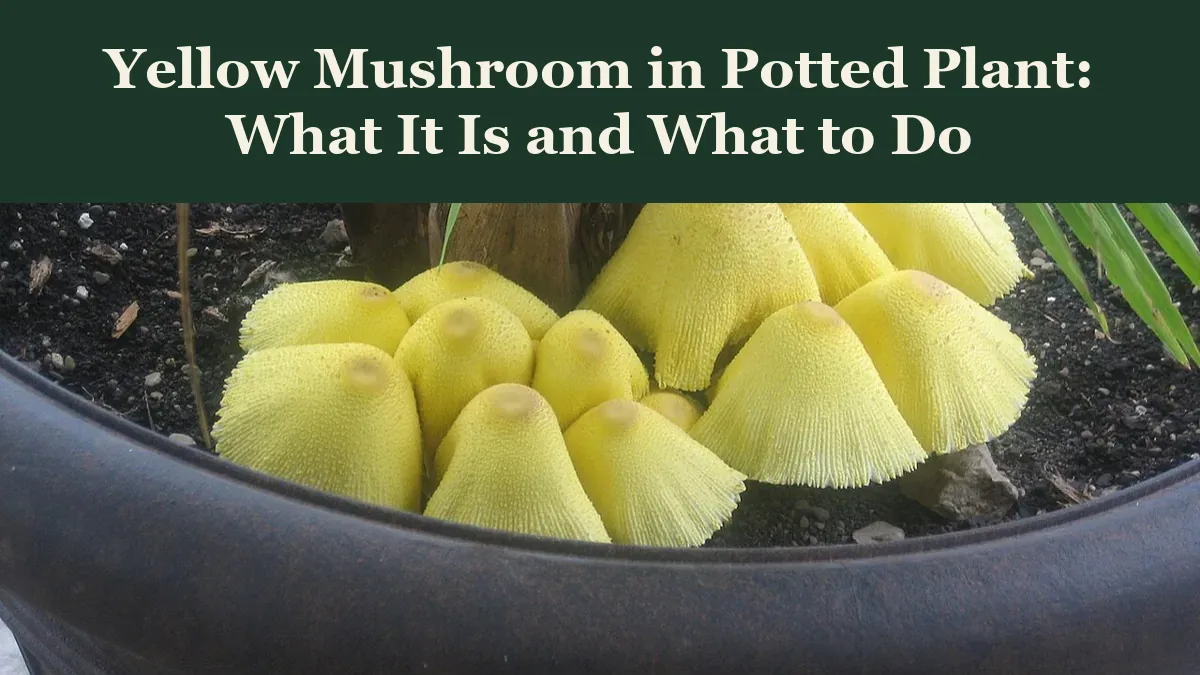
A yellow mushroom in a potted plant is almost always the flowerpot parasol, Leucocoprinus birnbaumii , a lemon-yellow mushroom that feeds on dead organic...