Orange Mushroom Identification Chart With Pictures
— views
An orange mushroom in the US is most often a chanterelle, a jack-o'-lantern, chicken of the woods, an orange fly agaric or a jelly fungus. The dangerous mix-up is the poisonous jack-o'-lantern, which grows in dense clusters on wood and has sharp true gills. Chanterelles grow from soil and have blunt, forked ridges. Never eat an orange mushroom until an experienced identifier has confirmed it in person.
This orange mushroom identification chart with pictures covers the orange species most people find in US yards and woods. It sorts them by where you found the mushroom, gives a three-step test for chanterelles and jack-o'-lanterns, and names the poisonous and deadly look-alikes plainly.
Key Takeaways
- Where it grows is the first clue. Orange clusters on a stump or at a tree base are jack-o'-lanterns until proven otherwise.
- Flip the cap. Chanterelles have blunt, forked ridges, while jack-o'-lanterns have sharp, knife-like true gills.
- Chicken of the woods has no gills at all. It forms orange shelves with a yellow pore surface on wood.
- Orange and yellow fly agarics are poisonous Amanitas, and some Amanitas are deadly.
- Rusty-orange webcaps (Cortinarius) can destroy the kidneys, and symptoms may take days to weeks to appear.
- Jack-o'-lantern poisoning usually starts 1 to 3 hours after a meal, and NAMA notes that victims often thought they had chanterelles.
- No chart replaces an in-person check. Keep children and pets away from orange mushrooms in the yard.
Orange Mushroom Identification Chart
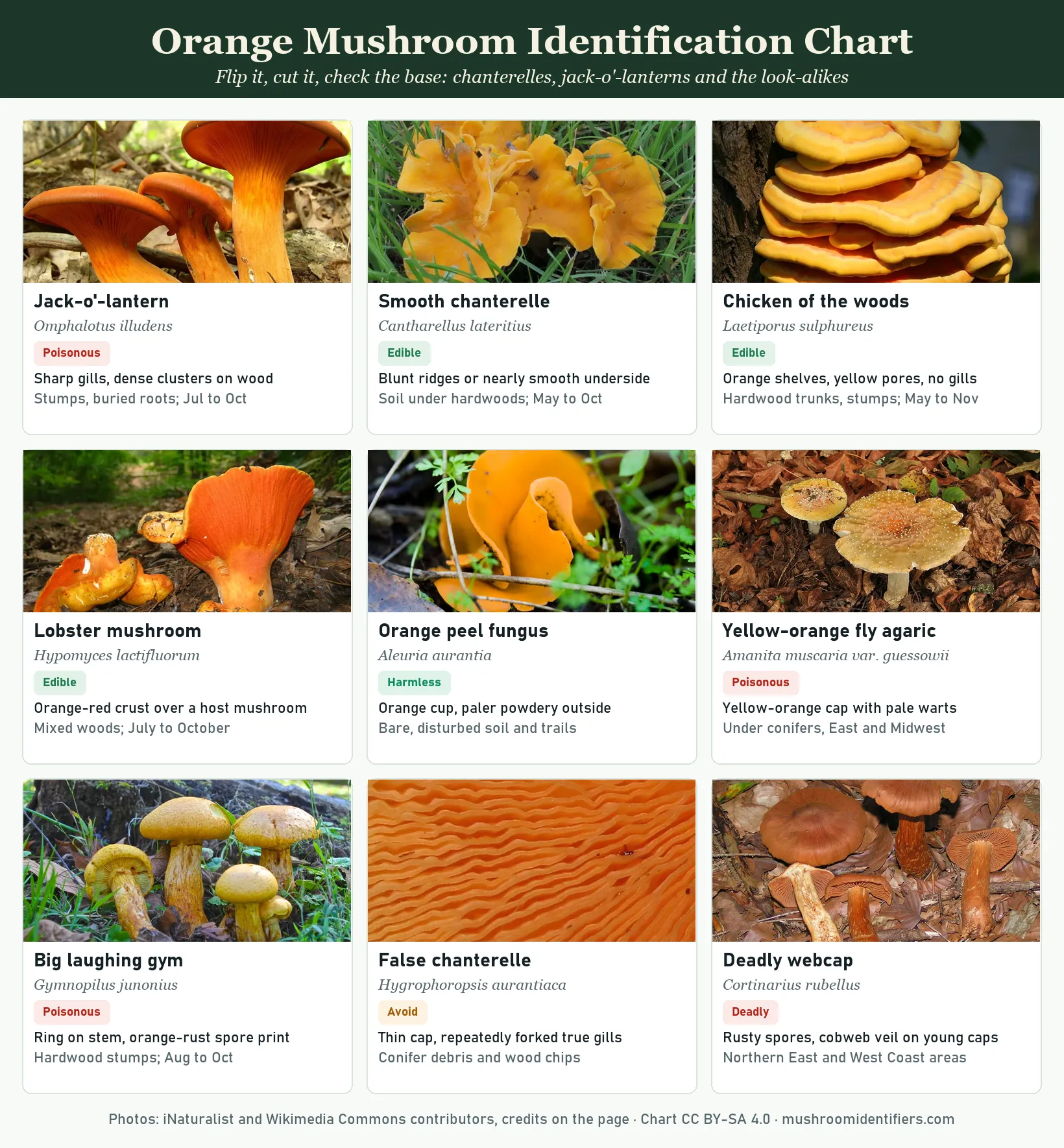
| Orange mushroom | Key features | Where and when | Edibility or risk |
|---|---|---|---|
| Jack-o'-lantern (Omphalotus illudens) | Orange cap 2 to 8 in, sharp crowded gills running down the stem, dense clusters | Stumps, tree bases, buried roots; July to October | Poisonous |
| Chanterelles (Cantharellus species) | Funnel shape, wavy edge, blunt forked ridges, fruity smell | Soil in hardwood forests, alone or scattered; May to October | Edible after expert confirmation |
| Chicken of the woods (Laetiporus sulphureus) | Overlapping orange shelves, sulfur-yellow pores, no gills | Dead or dying hardwoods, stumps; May to November | Edible after expert confirmation; some people react |
| Lobster mushroom (Hypomyces lactifluorum) | Orange-red bumpy crust over a host mushroom, white inside | Mixed woods, on the ground; July to October | Edible after expert confirmation |
| Orange peel fungus (Aleuria aurantia) | Orange cup 3 to 7 cm, paler and powdery outside | Bare, disturbed soil on trails and banks | Harmless |
| Witch's butter (Dacrymyces chrysospermus, Tremella aurantia) | Sticky orange jelly, lobed, up to 5 cm | Dead wood after rain, often in winter | Listed as edible by MykoWeb; confirm first |
| Yellow-orange fly agaric (Amanita muscaria var. guessowii) | Yellow to orange cap with pale warts | Soil under conifers, East and Midwest | Poisonous |
| American Caesar's mushroom (Amanita jacksonii) | Orange to red cap, lined edge, yellow gills, white sac at the base | Eastern woods, summer to fall | Avoid: an Amanita |
| Big laughing gym (Gymnopilus junonius) | Orange-yellow cap 3 to 7 in, ring, rusty spore print | Clusters on hardwood stumps and buried wood; August to October | Poisonous |
| False chanterelle (Hygrophoropsis aurantiaca) | Thin orange cap, repeatedly forked true gills | Conifer debris and wood chips; fall to late winter in California | Avoid |
| Orange mycena (Mycena leaiana) | Small bright orange caps, orange gill edges, tufted clusters | Decaying logs | Edibility unknown |
| Waxcaps (Hygrocybe species) | Small, bright, thick waxy gills | Ground in mixed woods; July to October | Avoid without expert ID |
| Deadly webcaps (Cortinarius rubellus and relatives) | Brownish to rusty orange, orange-rust gills, cobweb veil | Northern areas of both coasts, bogs; one Michigan case under oaks | Deadly: kidney failure |
Use the chart to narrow your find down, then check the underside, the inside and the base before you trust any match. Details come from the Missouri Department of Conservation, MykoWeb and the North American Mycological Association (NAMA). Seasons are for Missouri unless a region is named.
What Is the Orange Mushroom in My Yard?
Start with where the mushroom is growing, because orange species sort cleanly by what they grow on. A cluster on a stump or at the base of a tree points to wood-decay fungi such as the jack-o'-lantern. A single mushroom in leaf litter points to soil fungi such as chanterelles and Amanitas. A mushroom in grass can still be growing from a buried root, so dig gently around the base.
| Where you found it | Most likely orange mushrooms | First check |
|---|---|---|
| Lawn, near a stump or tree | Jack-o'-lantern from buried roots, big laughing gym | Dig to the base. A cluster joined at the bottom and rooted in wood is a warning sign. |
| Lawn or garden, under conifers | Yellow-orange fly agaric | Look for pale warts or patches on the cap, and dig up the whole base. |
| Wood chips or mulch | False chanterelle, big laughing gym | Check for forked true gills or a rusty spore print. |
| Bare dirt, path edge, bank | Orange peel fungus | A cup with no stem and no gills. |
| Tree trunk or stump, as shelves | Chicken of the woods | No gills, a yellow or white pore surface. |
| Fallen log or dead branch | Orange mycena, witch's butter | Tiny tufted caps, or a jelly that wobbles when pressed. |
| Forest floor, from soil | Chanterelles, lobster mushroom, waxcaps, Amanitas, webcaps | Flip it, cut it and check the base. See the test below. |
Our backyard mushroom identification guide covers the brown and white species that share lawns with these.
How Do You Tell a Chanterelle From a Jack-o'-Lantern?
Turn it over, slice it in half and look at how it grows: a chanterelle passes all three checks, and a jack-o'-lantern fails at least one. The Missouri Department of Conservation calls the underside the key difference. Chanterelle ridges are always blunt-edged, while jack-o'-lantern gills are sharp-edged and knife-like. NAMA notes that people poisoned by jack-o'-lanterns often thought they were picking chanterelles.
| Test | Chanterelle | Jack-o'-lantern |
|---|---|---|
| 1. Flip it | Blunt, shallow ridges with forks and cross-veins, or nearly smooth | Sharp, crowded, unforked true gills running down the stem |
| 2. Cut it | White to pale yellowish flesh inside | Orange flesh, the same color as the cap |
| 3. Check the base | Grows from soil, alone or scattered, never from wood | Dense clusters joined at the base, on stumps or buried roots |
| Spore print | Pinkish to yellow, by species | Cream to pale yellow |
The Bay Area Mycological Society describes the western jack-o'-lantern as orange inside and the chanterelle as white inside, and MykoWeb calls California chanterelle flesh yellowish. Fresh chanterelles smell fruity, but smell alone proves nothing. The cut test supports the gill test and never replaces it. Learn the underside terms in our guide to gills vs pores vs ridges.
Common Orange Mushroom Types in the US
These are the orange mushrooms Americans most often find, grouped from the most common mix-up to the rarer but deadlier ones. They range from sought-after edibles to a kidney-destroying webcap. Compare your find with several real photographs too.
Jack-o'-Lantern (Omphalotus illudens)
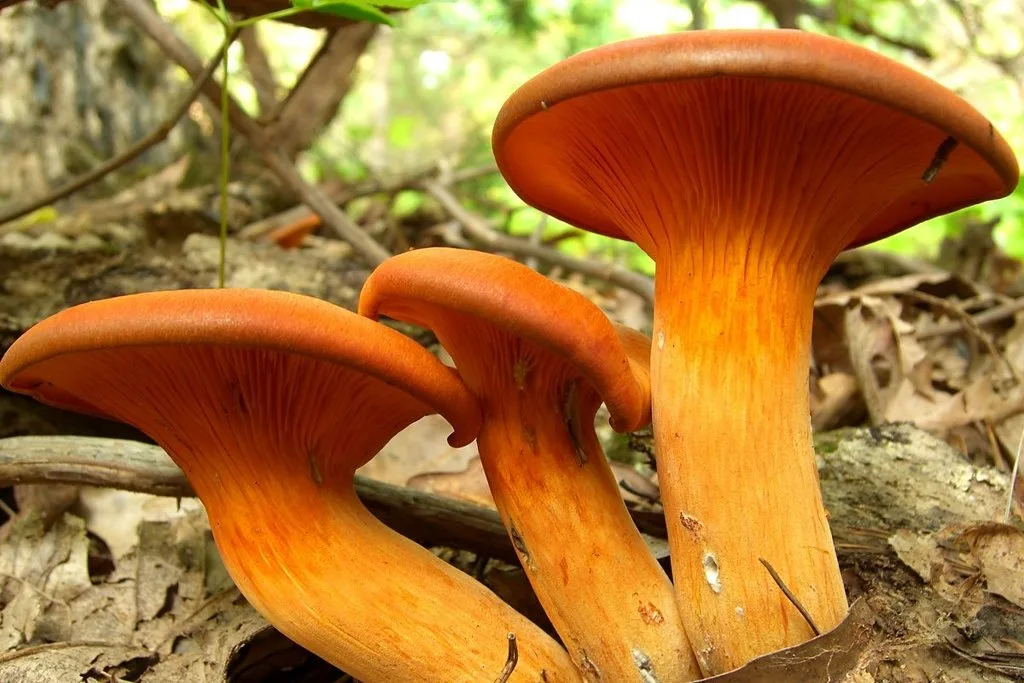
The jack-o'-lantern is the orange mushroom most important to recognize. Its cap is orange to yellowish orange and 2 to 8 inches wide. Its gills are sharp-edged, crowded and run down the stalk. It grows in large clusters on stumps, tree bases and buried roots from July to October, according to the Missouri Department of Conservation. Fresh gills can give off a faint greenish glow in the dark. On the West Coast, the related Omphalotus olivascens fruits from late fall through midwinter, most often with oaks and eucalyptus. Read the full profile in our jack-o'-lantern mushroom guide.
Chanterelles (Cantharellus lateritius and Relatives)
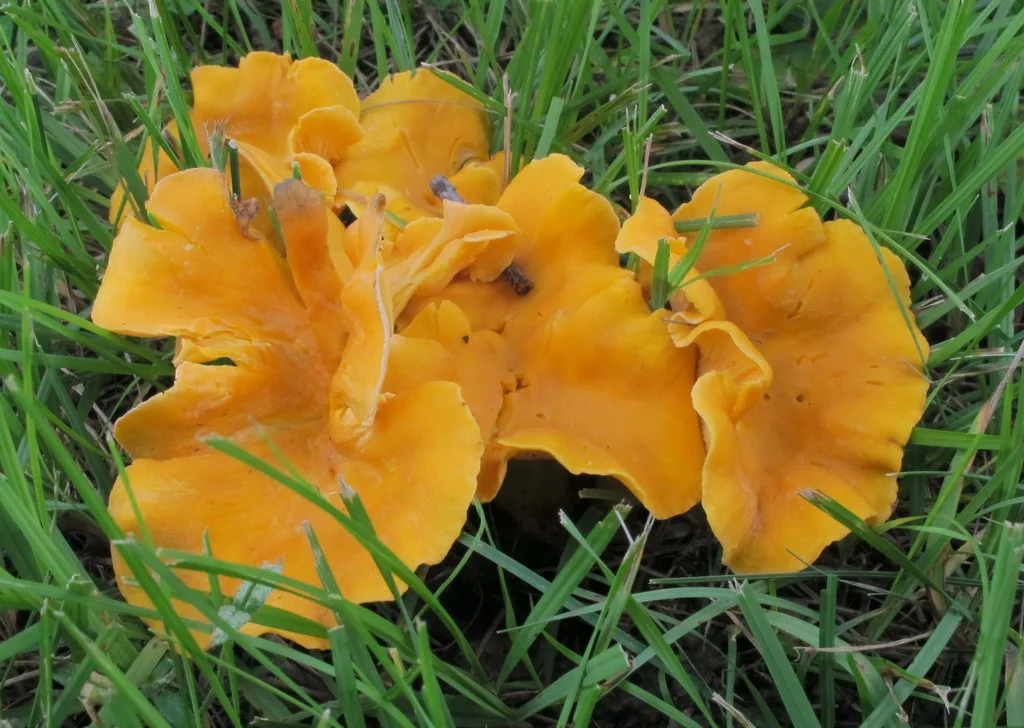
Chanterelles are funnel-shaped orange or yellow mushrooms with wavy cap edges. Their underside has blunt ridges, or is nearly smooth in the smooth chanterelle, Cantharellus lateritius. They always grow on the ground, in grass or leaf litter, and the Missouri Department of Conservation lists May to October. The names have changed. A 2013 study described three Midwestern species, C. phasmatis, C. flavus and C. spectaculus, that had been filed under the European name C. cibarius, according to the University of Michigan Herbarium. It says C. cibarius is no longer believed to occur in North America. California has its own oak chanterelle, C. californicus, which fruits from fall to early spring. See our golden chanterelle guide.
Chicken of the Woods (Laetiporus sulphureus)
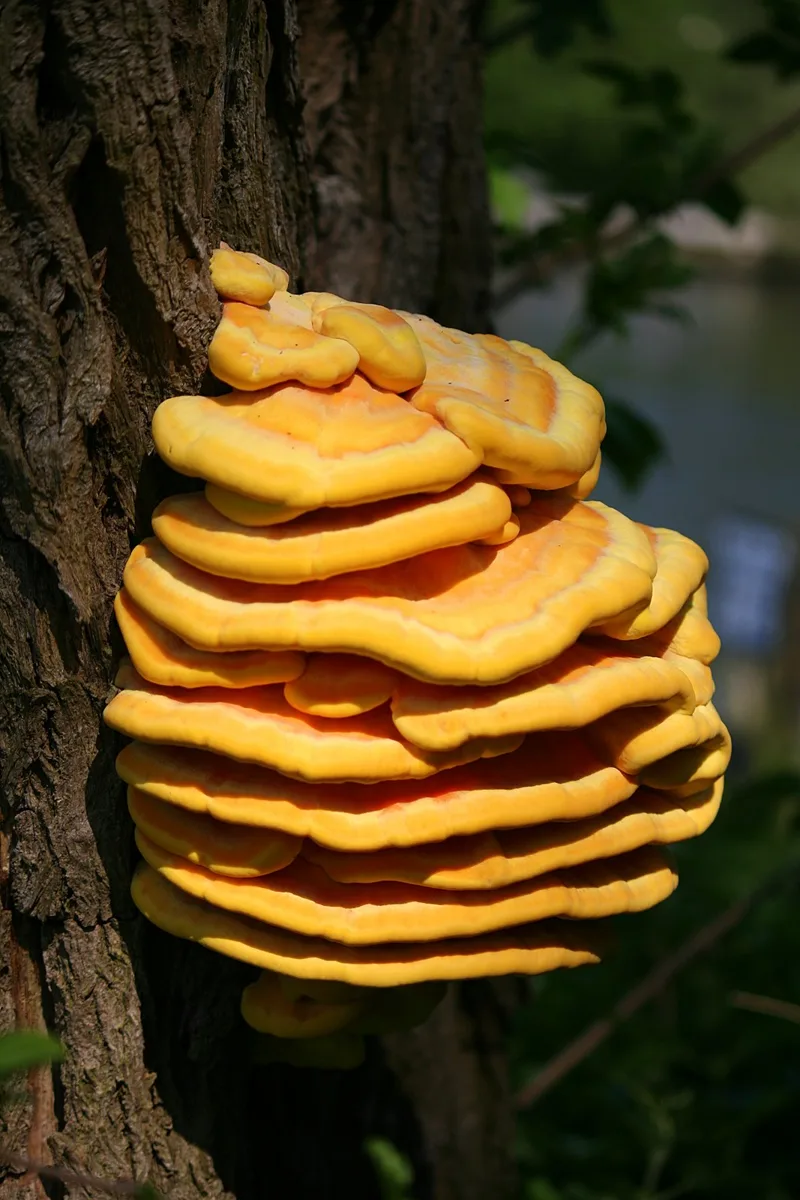
Chicken of the woods is a bright shelf fungus, not a gilled mushroom. Its caps are orange-red to orange-yellow and 2 to 12 inches wide, with a sulfur-yellow pore surface underneath. Up to 50 caps can overlap in one cluster. It grows on dead or dying hardwoods, stumps and buried roots from May to November, as the Missouri Department of Conservation describes. The pale chicken of the woods, L. cincinnatus, has a white pore surface. Some people get stomach upset or swollen lips from either one. See our chicken of the woods guide.
Lobster Mushroom (Hypomyces lactifluorum)
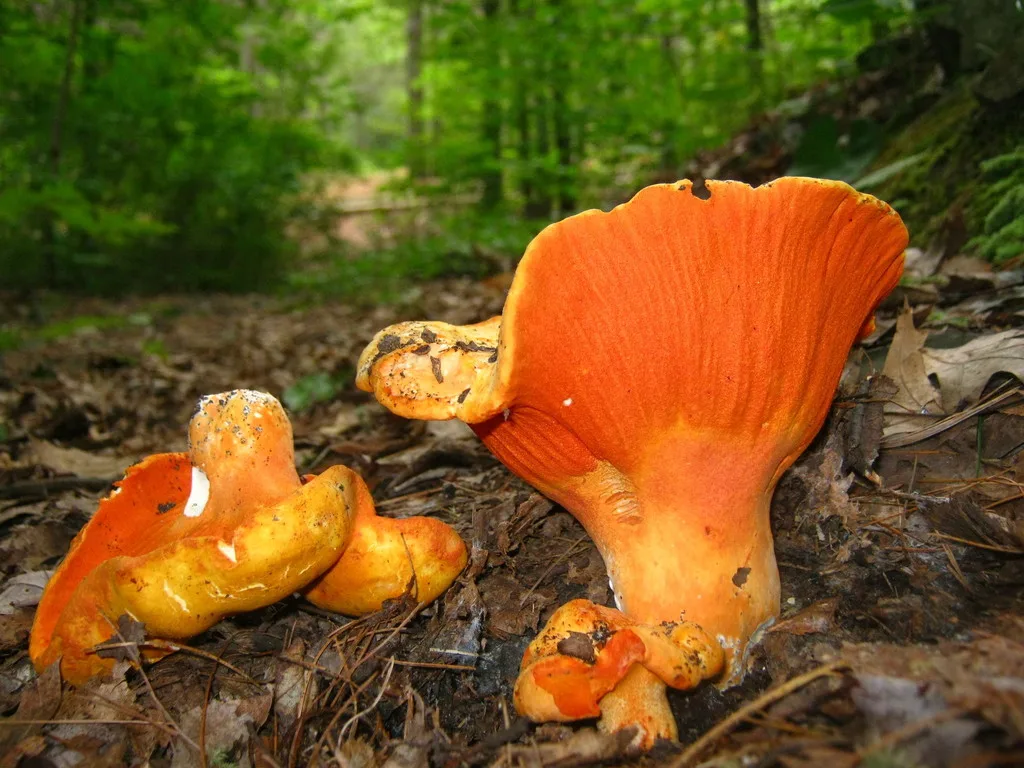
A lobster mushroom is a mold that grows over another mushroom. The parasite turns a white Lactarius or Russula bright orange to orange-red, with a finely bumpy, hard surface. The host's gills are usually covered completely, and the inside stays pure white. It grows in mixed woods from July to October, according to the Missouri Department of Conservation, which calls it a mushroom growing on a mushroom. The covered host can no longer be identified.
Orange Peel Fungus (Aleuria aurantia)
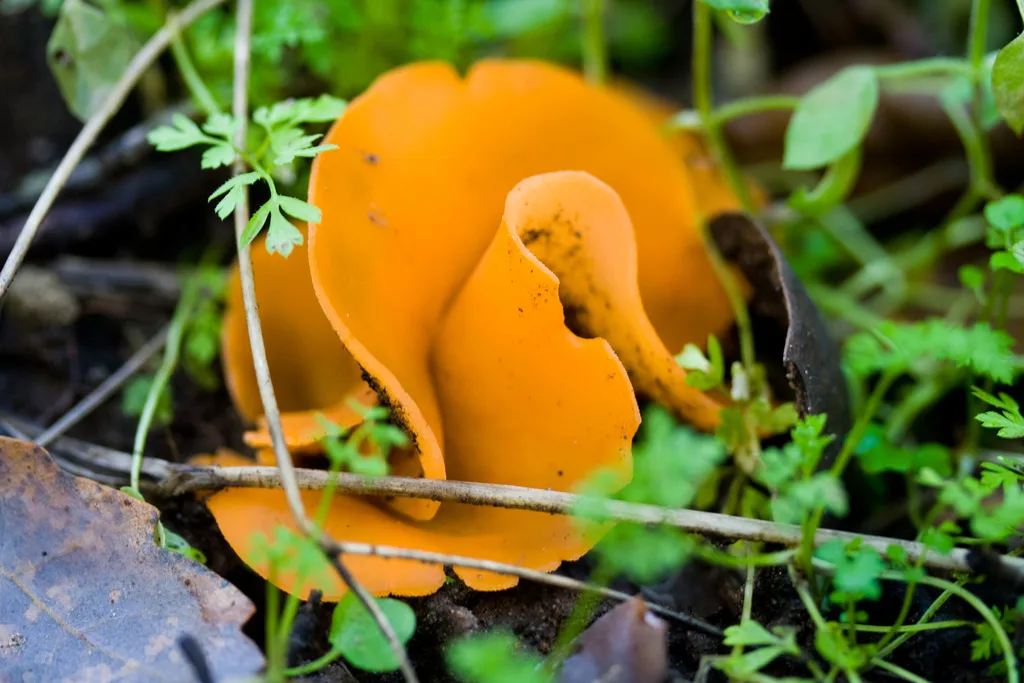
The orange peel fungus looks like a scrap of orange rind on the ground. It forms irregular cups 3 to 7 cm across, often split on one side. The inside is orange and the outside is paler and powdery. It grows on bare, disturbed soil along trails, banks and dirt roads. MykoWeb places its California season from late fall to early spring, with a peak from November to January.
Witch's Butter (Dacrymyces chrysospermus and Tremella aurantia)
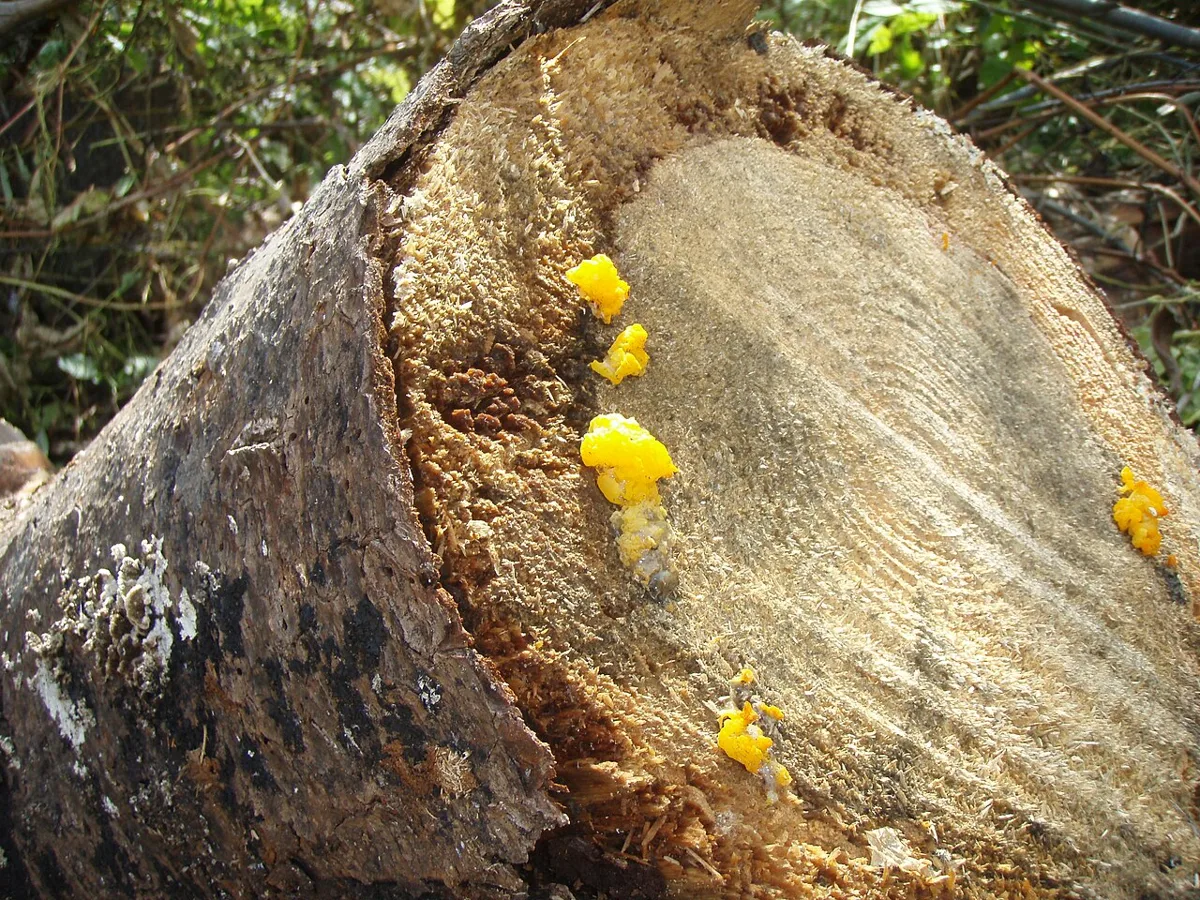
Witch's butter is a sticky orange jelly on dead wood. Two unrelated fungi share the name. Dacrymyces chrysospermus grows on stripped conifer wood or from bark cracks, reaches 5 cm wide and fruits in winter after rain. Tremella aurantia looks very similar but grows on hardwoods with intact bark, where it parasitizes crust fungi. MykoWeb says the wood they grow on is the best way to tell them apart.
Yellow-Orange Fly Agaric (Amanita muscaria var. guessowii)
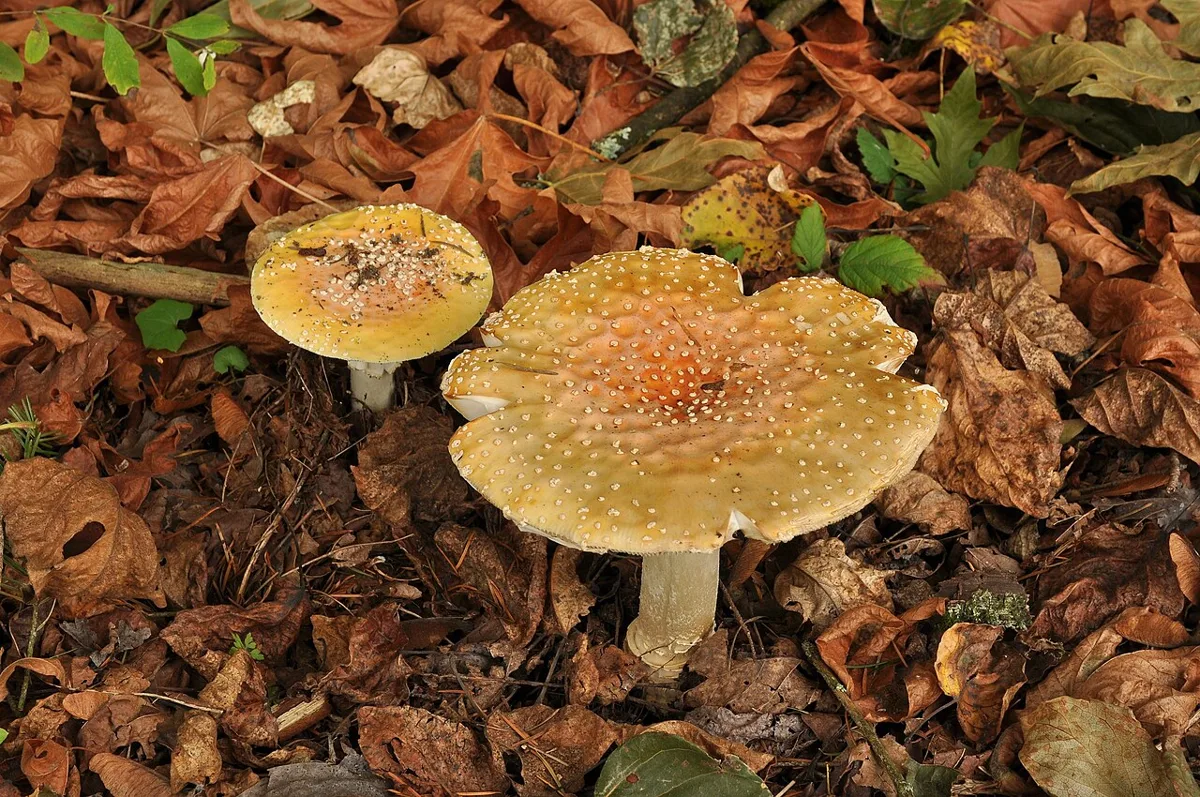
The eastern fly agaric is the classic toadstool shape in yellow to orange. Its cap usually carries pale warts or patches, the remains of the veil that wrapped the young mushroom. Tom Volk at the University of Wisconsin describes a red form mostly in the West and Deep South, an orange form in the Midwest and East, and a yellow form mostly in the East, all with conifers. Older sources call the yellow form var. formosa, and newer ones use var. guessowii. It contains ibotenic acid and muscimol and is poisonous. See our Amanita muscaria guide.
American Caesar's Mushroom (Amanita jacksonii)
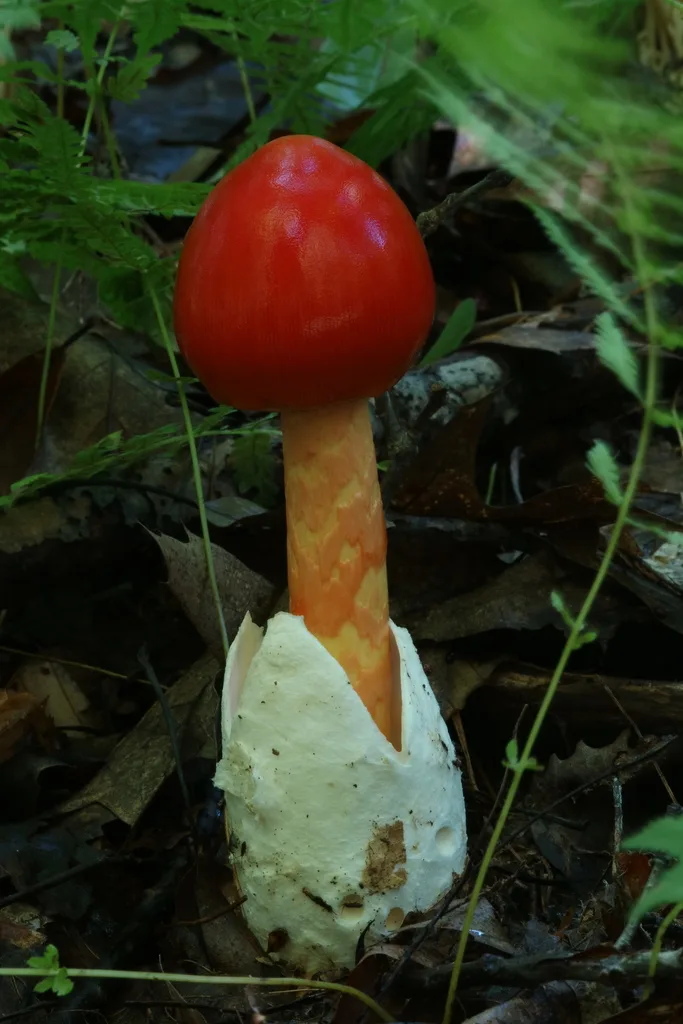
This eastern Amanita has an orange to orange-red cap with a lined edge, yellow gills and a large white sac at the base. Some sources call it edible. It is still an Amanita, the genus of the death cap, and it can be confused with the poisonous fly agarics. Leave every orange Amanita alone.
Big Laughing Gym (Gymnopilus junonius)
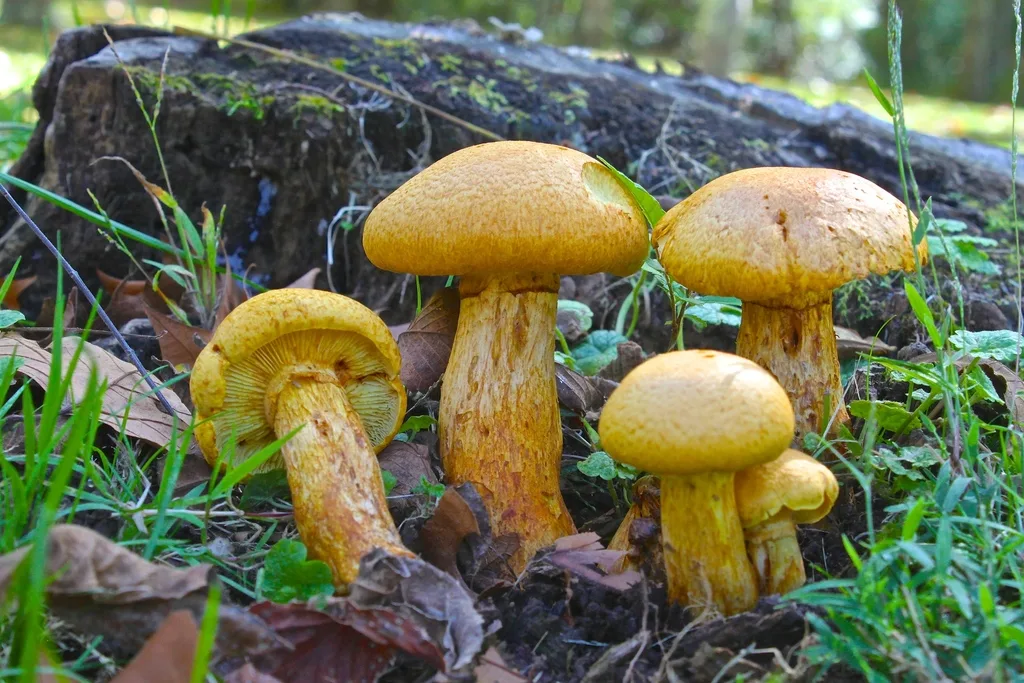
The big laughing gym is a large orange-yellow to tan mushroom that grows in clusters on wood. Its cap is 3 to 7 inches wide with tiny scales, and the stalk has a ring. The spore print is orange to rust, which separates it from the jack-o'-lantern. It grows on hardwood stumps, trunks and buried wood from August to October. The Missouri Department of Conservation lists it as poisonous and uses the newer name G. junonius in place of G. spectabilis. Sources differ on its hallucinogens: NAMA lists it among psilocybin mushrooms, while MDC says the amounts appear very low.
False Chanterelle (Hygrophoropsis aurantiaca)
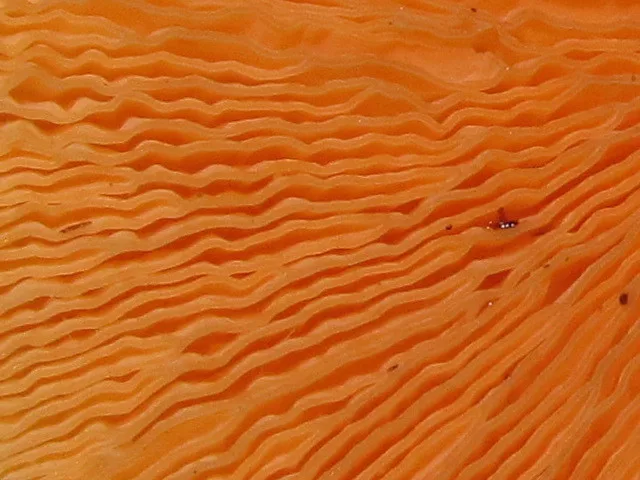
The false chanterelle is thinner and softer than a true chanterelle. Its cap is 2.5 to 7 cm and orange to orange-brown, darkest in the center. Its gills are true gills, crowded and repeatedly forked, and usually brighter than the cap. It grows on woody debris under conifers and is especially common on wood chips. MykoWeb notes that some authors list it as edible and others as poisonous, so treat it as one to avoid.
Orange Mycena (Mycena leaiana)
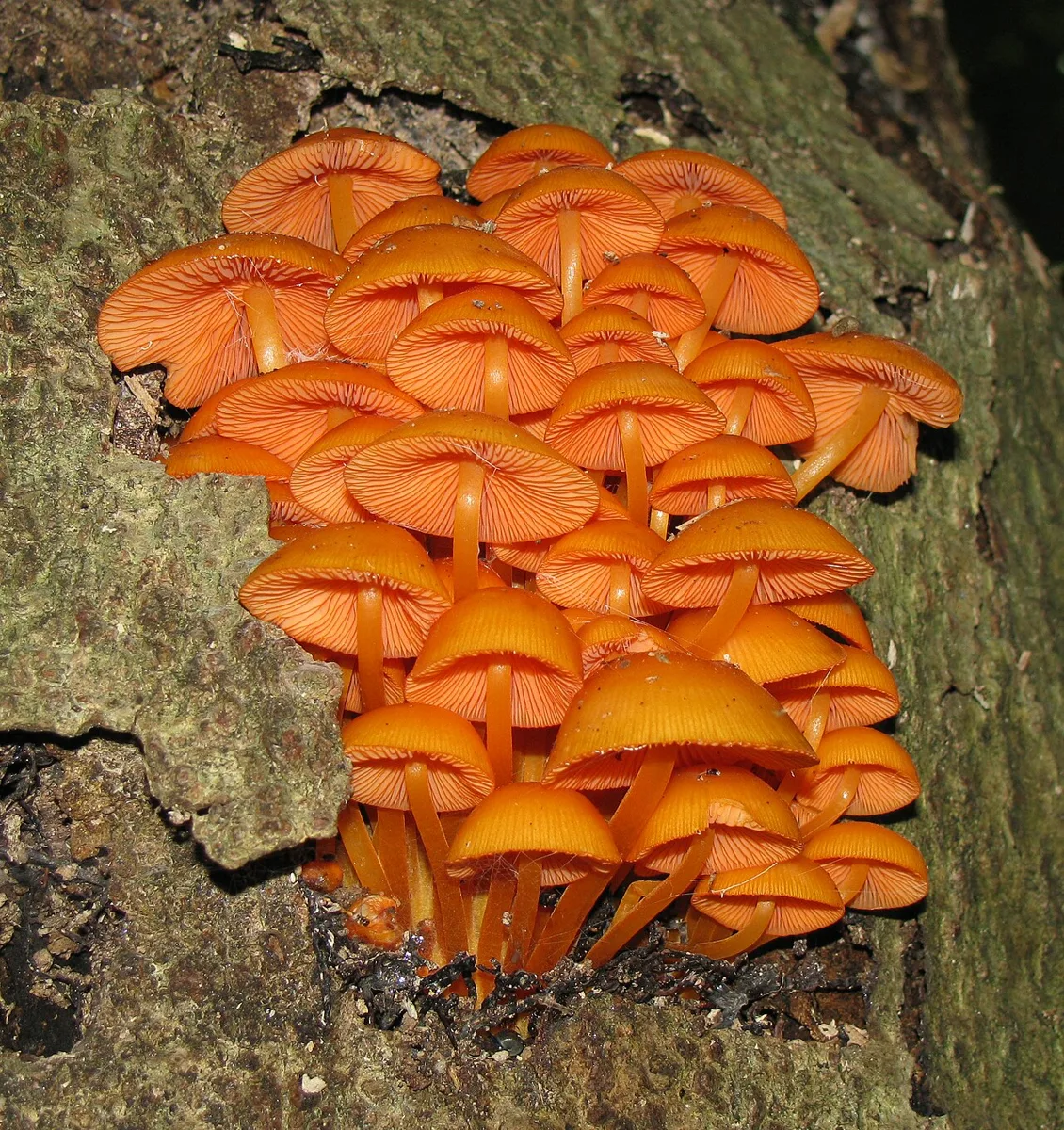
The orange mycena forms tufts of small, bright orange caps on decaying logs. Its gill edges are orange and keep their color even when rain fades the cap to a pale tan-orange. The orange pigment rubs off on your fingers. Tom Volk notes that its edibility is unknown.
Waxcaps (Hygrocybe)
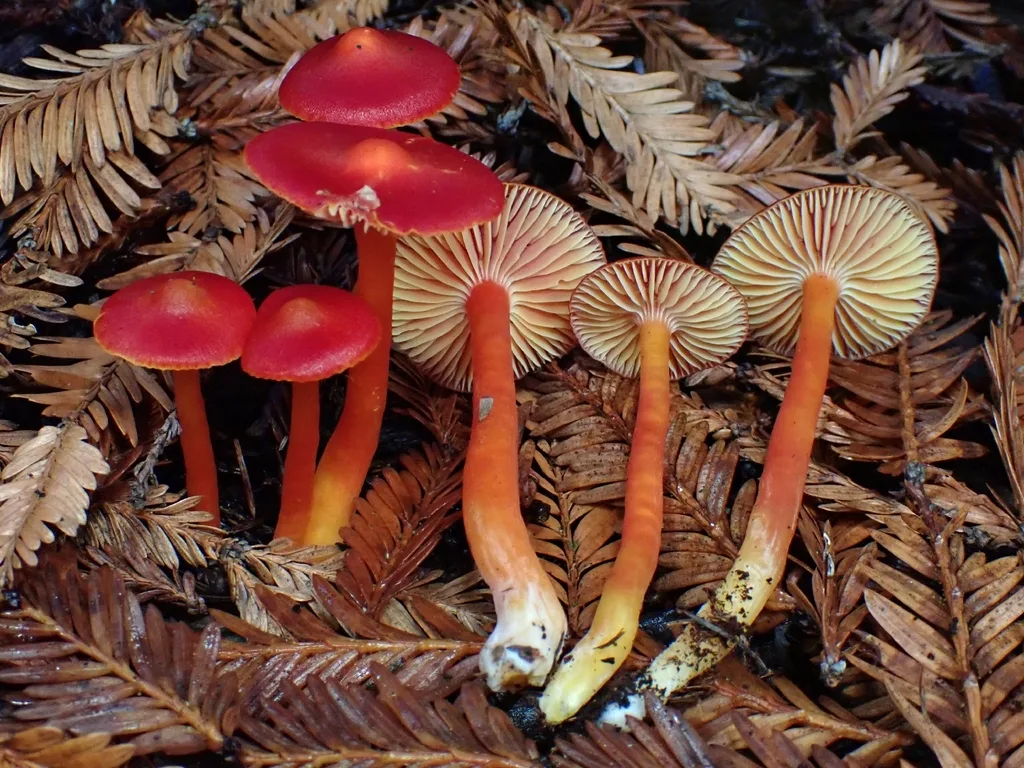
Waxcaps are small, bright mushrooms with thick, waxy gills. The scarlet waxy cap, Hygrocybe coccinea, has a scarlet cap, bright reddish-yellow gills and an orange-red stalk, so a faded one can read as orange. It grows on the ground in mixed woods from July to October. The Missouri Department of Conservation warns that other Hygrocybe species look alike, so color alone does not identify one.
Deadly Webcaps (Cortinarius rubellus and Relatives)
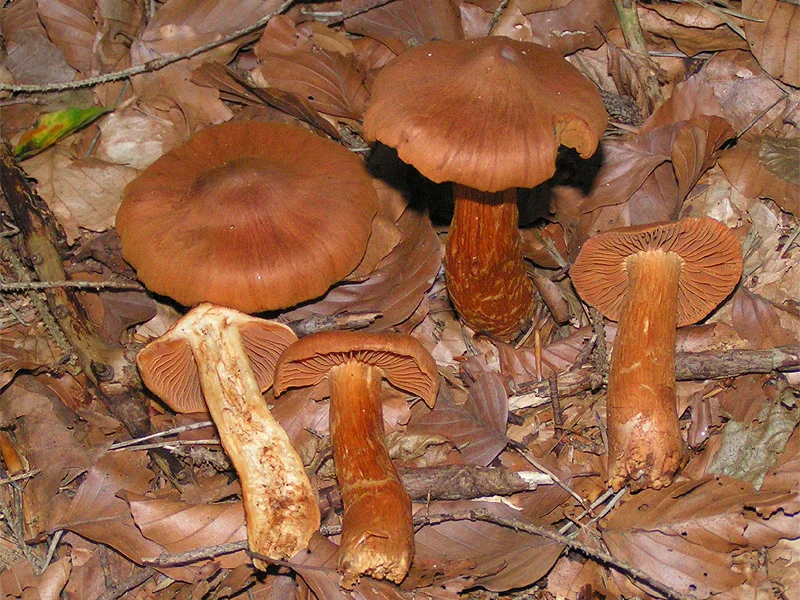
The deadly webcaps are brownish to rusty orange mushrooms with orange-rust gills and a rusty spore print. Young ones have a cobweb-like veil that leaves a faint band of fibers on the stem. They contain orellanine, which attacks the kidneys. The Merck Veterinary Manual places Cortinarius rubellus in northern areas of the East and West Coasts and reports C. orellanosus from Michigan. It also states that orellanine is not destroyed by cooking, freezing or drying. See our deadly webcap guide.
Orange Mushroom Look-Alikes: Side-by-Side Comparison
Four orange mushrooms must be ruled out before anything is called a chanterelle: the poisonous jack-o'-lantern, the poisonous big laughing gym, the false chanterelle and the deadly webcaps. The underside, the spore print and the growing site separate them. A chanterelle is the only one of the five with blunt ridges instead of true gills.
| Mushroom | Underside | Spore print | Grows on | Risk |
|---|---|---|---|---|
| Chanterelle | Blunt forked ridges | Pinkish to yellow | Soil, alone or scattered | Edible after expert check |
| Jack-o'-lantern | Sharp, unforked true gills | Cream | Wood or buried roots, clusters | Poisonous |
| Big laughing gym | Yellow to rusty gills, ring on stem | Orange to rust | Wood, clusters | Poisonous |
| False chanterelle | Crowded, repeatedly forked true gills | White | Conifer debris, wood chips | Avoid |
| Deadly webcaps | Orange-rust gills, cobweb veil | Rusty brown | Soil, northern areas and bogs | Deadly |
A spore print settles several of these at once. Our spore print guide shows how to make one. The second risky pairing is the orange Amanitas: the fly agaric has pale warts, and the American Caesar's mushroom has a lined cap edge and yellow gills. Neither is a beginner's mushroom.
Which Orange Mushrooms Are Poisonous?
The poisonous orange mushrooms in the US are the jack-o'-lanterns, the orange fly agarics, the big laughing gym and the deadly webcaps, and each one causes a different kind of illness. The slowest poison is the most dangerous, so a late onset is a reason to seek care fast.
| Mushroom | Toxin group | Onset | What happens |
|---|---|---|---|
| Jack-o'-lantern | Stomach irritant | About 1 to 3 hours | Nausea in about 90% of cases, vomiting in about 73%; most recover within 12 hours |
| Fly agarics | Ibotenic acid and muscimol | 30 minutes to 2 hours | Confusion, visual distortion, drowsiness, sometimes convulsions |
| Big laughing gym | Psilocybin group, per NAMA | Usually within an hour for this group | MDC reports serious illness |
| Deadly webcaps | Orellanine | 36 hours to 3 weeks, average about 8 days | Kidney failure, sometimes permanent |
The figures come from NAMA's mushroom poisoning syndromes page. NAMA describes two North American webcap cases: a Michigan woman in 2008 who ate a Cortinarius found under oaks, and a Quebec man in 2020 who ate C. rubellus from a sphagnum bog. The Merck Veterinary Manual estimates that 2 to 3 mushrooms can cause kidney disease that needs lifelong dialysis. If anyone may have eaten a wild orange mushroom, call Poison Control at 1-800-222-1222, even if they feel fine.
Are Any Orange Mushrooms Edible?
Several orange mushrooms are eaten in the US, including chanterelles, chicken of the woods and lobster mushrooms, but none is safe until an experienced identifier confirms the exact find. Chanterelles have two orange look-alikes, the jack-o'-lantern and the false chanterelle. Chicken of the woods causes reactions in some people. Nobody should eat a mushroom based on this page.
The Missouri Department of Conservation gives these cautions for confirmed edibles:
- Be absolutely sure of the identification.
- Eat only a small amount the first time.
- Cook chicken of the woods well.
Are Orange Mushrooms Dangerous to Dogs?
Some orange mushrooms are dangerous to dogs, and the fly agarics are the clearest risk. NAMA states that dogs, and especially cats, can die from the ibotenic acid and muscimol in Amanita muscaria and its relatives. The Merck Veterinary Manual has no confirmed North American webcap case in animals, but notes that missing tests may hide cases. Follow our guide on what to do if your dog ate a mushroom and call your vet or a pet poison helpline.
Common Identification Mistakes
Calling Every Orange Cluster a Chanterelle
Chanterelles grow alone or scattered from soil. A tight orange cluster on a stump or root is the jack-o'-lantern pattern. Check the base first.
Skipping the Underside
Color does not separate these mushrooms. Blunt forked ridges, sharp true gills and a pore surface each point to a different group. Turn every cap over.
Trusting a Mushroom That Seems to Grow From Soil
Jack-o'-lanterns fruit from buried roots and can look as if they grow from the ground. Dig around the base to see whether it is attached to wood.
Relying on an Old Field Guide Name
Older guides call US chanterelles Cantharellus cibarius and the big laughing gym Gymnopilus spectabilis. Search the current names too, because newer sources describe the species more precisely.
Frequently Asked Questions
Are orange mushrooms poisonous?
Some are and some are not. The jack-o'-lantern, the orange fly agarics, the big laughing gym and the deadly webcaps are poisonous. Chanterelles and chicken of the woods are eaten, but only after an expert confirms them.
What is the orange mushroom growing in my yard?
A cluster near a stump or tree is often a jack-o'-lantern growing from buried roots. A yellow-orange toadstool with pale warts under conifers is a fly agaric. An orange cup on bare dirt is the orange peel fungus, and orange gilled mushrooms on wood chips are often false chanterelles.
Is the orange mushroom at the base of my tree poisonous?
Treat it as poisonous until someone identifies it. Dense orange clusters with sharp gills at a tree base are the jack-o'-lantern pattern. Orange shelves with no gills are more likely chicken of the woods.
How can you tell a chanterelle from a jack-o'-lantern?
Flip it, cut it and check the base. Chanterelles have blunt forked ridges, pale flesh and grow alone from soil. Jack-o'-lanterns have sharp true gills, orange flesh and grow in clusters from wood.
What orange mushrooms are edible?
Chanterelles, chicken of the woods and lobster mushrooms are the best-known orange edibles in the US. Each has a poisonous look-alike or causes reactions in some people. Never eat one without an in-person expert check.
Do jack-o'-lantern mushrooms glow in the dark?
Yes, fresh jack-o'-lantern gills can give off a faint greenish glow in a dark room. MykoWeb notes that the western species glows only after several minutes in complete darkness. The glow does not change the fact that it is poisonous.
What is the orange jelly fungus on dead wood?
It is usually witch's butter. Dacrymyces chrysospermus grows on conifer wood, and Tremella aurantia grows on hardwood with the bark still on. MykoWeb says the wood type is the best way to tell them apart.
What is the orange cup fungus on the ground?
A bright orange cup on bare, disturbed soil is most likely the orange peel fungus, Aleuria aurantia. It has no stem or gills and is 3 to 7 cm across. It is harmless, though MykoWeb considers it of no value as food.
Are orange mushrooms poisonous to dogs?
Some are. NAMA reports that dogs and especially cats can die from fly agaric toxins. Call a vet or a pet poison helpline if your dog eats any wild mushroom.
Can orange mushrooms kill you?
The deadly webcaps can cause kidney failure, and symptoms may take 36 hours to 3 weeks to appear. Jack-o'-lanterns usually cause a few hours of severe vomiting rather than death. Call Poison Control at 1-800-222-1222 after any suspected poisoning.
Final Safety Reminder
Orange mushrooms include some of the best-known edibles in North America and some of the most common poisonings, often side by side in the same woods. Never eat a wild mushroom based on a chart, a photo or an app. Photograph the top, the underside, the cut flesh and the base, then check them with our free mushroom identifier and an experienced local identifier or mycological club. Keep children and pets away from unknown orange mushrooms in the yard. If someone may have eaten one, call Poison Control at 1-800-222-1222.
Sign in to leave a comment and join the discussion.
 Guide
Most maple tree fungus is either a leaf spot that looks alarming but rarely hurts the tree, or a decay fungus fruiting from wood that is already rotting...
 Guide
Pine tree fungus identification starts with color and place: orange powder on a woody gall is a rust, brown dead shoot tips are a blight, a conk at the base...
 Guide
A yellow mushroom in a potted plant is almost always the flowerpot parasol, Leucocoprinus birnbaumii , a lemon-yellow mushroom that feeds on dead organic...