Coral Fungus Identification Chart With Pictures
— views
A coral fungus is a mushroom shaped like branching sea coral or a tuft of upright clubs, with no cap and no gills. Most US corals grow from soil in the woods, but a few, such as the crown-tipped coral, grow on dead wood. Many corals are brittle and snap cleanly. Some Ramaria corals cause stomach upset, so no coral should be eaten without expert confirmation.
This coral fungus identification chart with pictures covers the corals most often found in the US, the jelly fungi and other false corals that look like them, a simple wood, snap and tip test, and what sources say about eating them. It is an identification guide, not permission to eat a wild mushroom.
Key Takeaways
- Check what the fungus grows from first. Crown-tipped coral, yellow stagshorn and dead man's fingers grow from wood, while most Ramaria and Clavulina corals grow from soil.
- Snap a branch. Many ground corals are brittle, while the jellied false coral and yellow stagshorn are tough or rubbery jelly fungi.
- Tiny crowns with 3 to 6 points on every tip, on dead hardwood, point to the crown-tipped coral, Artomyces pyxidatus.
- The yellow-tipped coral, Ramaria formosa, has been reported to cause stomach problems, and the name has been applied to several species.
- Ramaria corals fade to a dull tan with age, so a young specimen and the whole base are needed to identify one.
- Even corals listed as edible can upset stomachs. Every coral needs expert confirmation before anyone eats it.
Coral Fungus Identification Chart
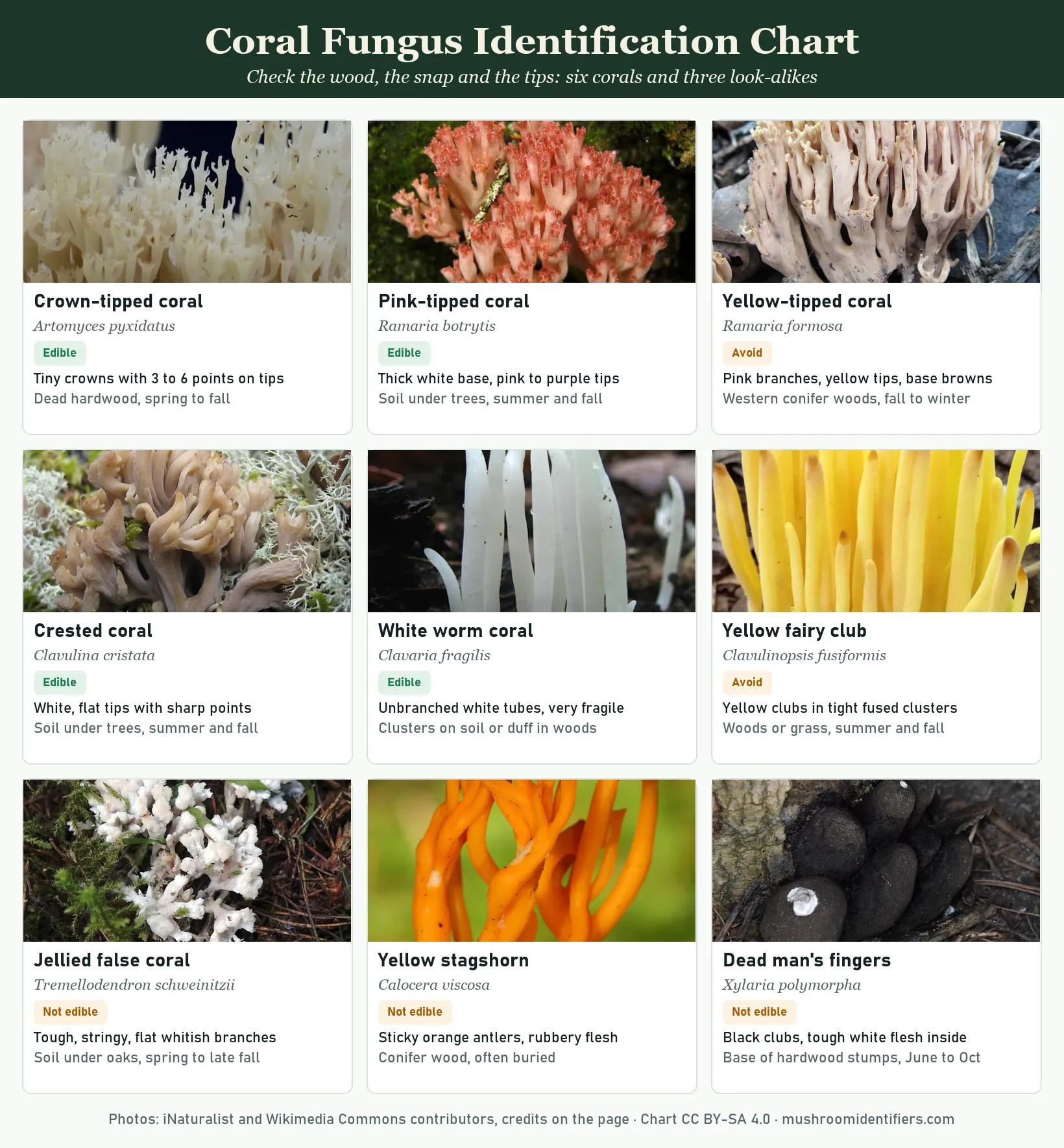
Start with what the fungus grows from and whether a branch snaps, then match the tips and colors in this table. Color alone is not enough, because the same Ramaria species can vary in color and all of them fade with age.
| Coral | Key features | Where and when | Edibility or risk |
|---|---|---|---|
| Crown-tipped coral (Artomyces pyxidatus) | Whitish to tan branches; every tip a small crown with 3 to 6 points | Dead hardwood such as aspen, willow and maple; spring to fall; East and Rockies | Edible with caution per Missouri Department of Conservation; may upset stomachs |
| Pink-tipped coral (Ramaria botrytis) | Stocky, thick white base; crowded pink to purplish tips like cauliflower | Soil under hardwoods or conifers; summer and fall, fall to midwinter in California | Rated edible for most people by MykoWeb; expert check needed |
| Yellow-tipped coral (Ramaria formosa) | Pink branches with yellowish tips; massive white base that stains brown | Western conifer forests; fall to midwinter | Avoid; reported to cause stomach problems |
| Red coral (Ramaria araiospora) | Bright red to magenta branches; red to pink, brittle flesh | Under tanoak and western hemlock on the West Coast; fall and winter | Described as edible in a Pacific Northwest mycological society article; expert check needed |
| Crested coral (Clavulina cristata) | White, sometimes pinkish; flattened tips with several sharp points | Soil under conifers and hardwoods; summer and fall, winter in California | Listed as edible but "lacking in texture" by MykoWeb |
| White worm coral (Clavaria fragilis) | Unbranched white tubes 3 to 9 cm tall; very fragile | Clusters on soil or duff in woods; late fall to midwinter in California | Listed as edible but insubstantial by MykoWeb |
| Yellow fairy club (Clavulinopsis fusiformis) | Unbranched yellow spindles in tight clusters with fused bases | Woods, sometimes grass; summer and fall; more common in the North | Bitter taste; avoid |
| Cauliflower mushroom (Sparassis spathulata) | One rosette of flat, wavy, cream lobes 10 to 20 cm across | Base of oaks or pines in the East; summer and fall | Not a true coral; expert check needed |
Sources for each row are linked in the sections below. For other fungi on logs and stumps, see our tree mushroom identification chart.
What Is a Coral Fungus?
"Coral fungus" describes a shape, not one family: the name covers any fungus that grows as branches or upright clubs instead of a cap on a stem. The best-known corals belong to the genus Ramaria, in the family Ramariaceae. The crown-tipped coral sits in a different family, the Auriscalpiaceae, according to the Missouri Department of Conservation.
Some look-alikes are even more distant. DNA studies place the crested coral near hedgehog mushrooms and chanterelles, far from most other corals. The jellied false coral and the yellow stagshorn are jelly fungi. Dead man's fingers is an ascomycete, in the same division as morels. Because the coral shape appears in unrelated groups, the shape alone tells you little about safety.
How Do You Identify a Coral Fungus?
Use five checks in order: what it grows from, whether a branch snaps, what the tips look like, the spore print color and the base. Each check removes a group of look-alikes. Together they narrow a find to a genus, and sometimes to a species. Coral mushrooms are not easy to tell apart, so the last step is always an expert.
| Check | How to do it | What it tells you |
|---|---|---|
| 1. Wood or soil | Lift the whole fungus and see what the base is attached to. Buried wood can make a wood fungus look like it grows from soil. | On wood: crown-tipped coral, yellow stagshorn, dead man's fingers, coral tooth. On soil: most Ramaria, crested coral, white worm coral, jellied false coral. |
| 2. Snap | Bend one branch until it breaks. | A clean, brittle break fits many true corals. Tough, stringy or rubbery flesh points to the jellied false coral or yellow stagshorn. |
| 3. Tips | Look closely at the branch ends, ideally with a hand lens. | Crowns with 3 to 6 points: crown-tipped coral. Flattened tips with sharp points: crested coral. Crowded pink cauliflower tips: pink-tipped coral. No branches: white worm coral or fairy clubs. |
| 4. Spore print | Lay a few branches on white and dark paper overnight. | The pink-tipped and red corals print yellowish. The crown-tipped coral, crested coral, white worm coral, fairy clubs and jellied false coral print white. |
| 5. Base | Cut the fungus from top to bottom and handle the base. | A white base that stains brown fits Ramaria formosa. A jelly-like core is a reason to avoid it. |
The snap test has an exception. The Missouri Department of Conservation says true coral fungi are brittle and break easily, while the jellied false coral is tough. A North American field guide, however, describes the crown-tipped coral's flesh as fairly tough and pliable. Treat the snap as one clue, not a verdict.
Age matters too. Michael Beug, quoted by the Cascade Mycological Society, advises collecting at least one young specimen because all Ramaria turn a cardboard color in age, and harvesting the entire base. Our spore print guide explains how to take a print.
Common Coral Fungus Types in the US
The corals people find most often in the US are the crown-tipped coral on wood, a handful of Ramaria species on soil, the white crested coral and the small unbranched fairy clubs. Each has one feature that sets it apart, and the sections below give that feature first.
Crown-Tipped Coral (Artomyces pyxidatus)
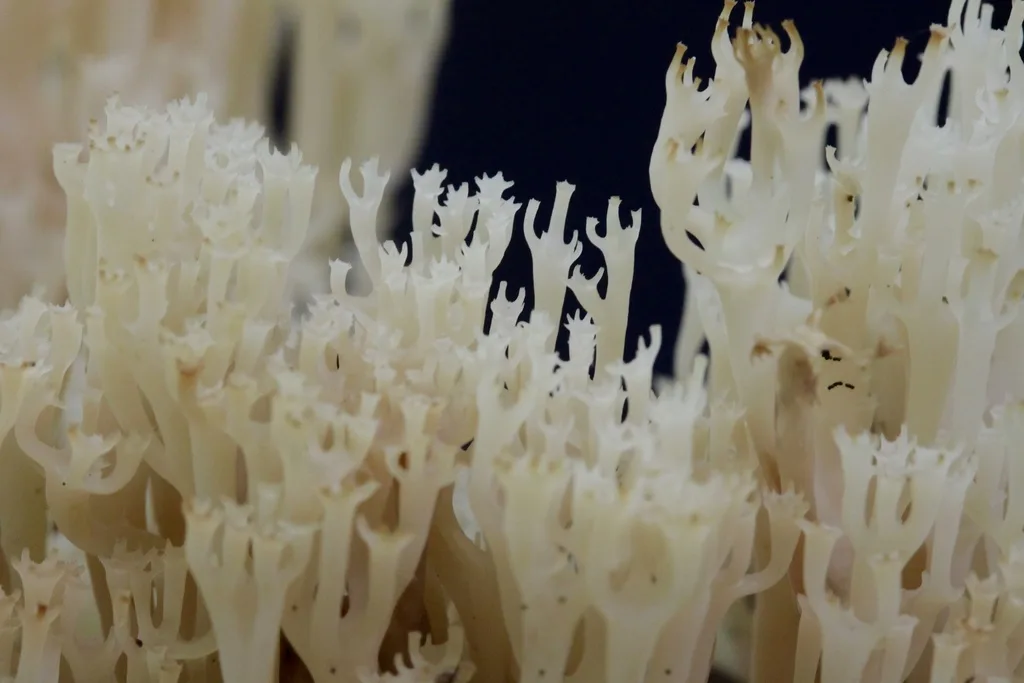
This is the coral on dead wood. One species account describes it as 4 to 13 cm high and whitish to pale yellow, with every branch tip "crowned" by a shallow depression and 3 to 6 points. It grows on dead hardwood, including aspens, tulip trees, willows and maples, in spring, summer and fall. It ranges across eastern North America and the Rocky Mountains, and it is absent or rare on the West Coast. The spore print is white. The Missouri Department of Conservation lists it as edible with caution. Older guides call it Clavicorona pyxidata.
Pink-Tipped Coral (Ramaria botrytis)
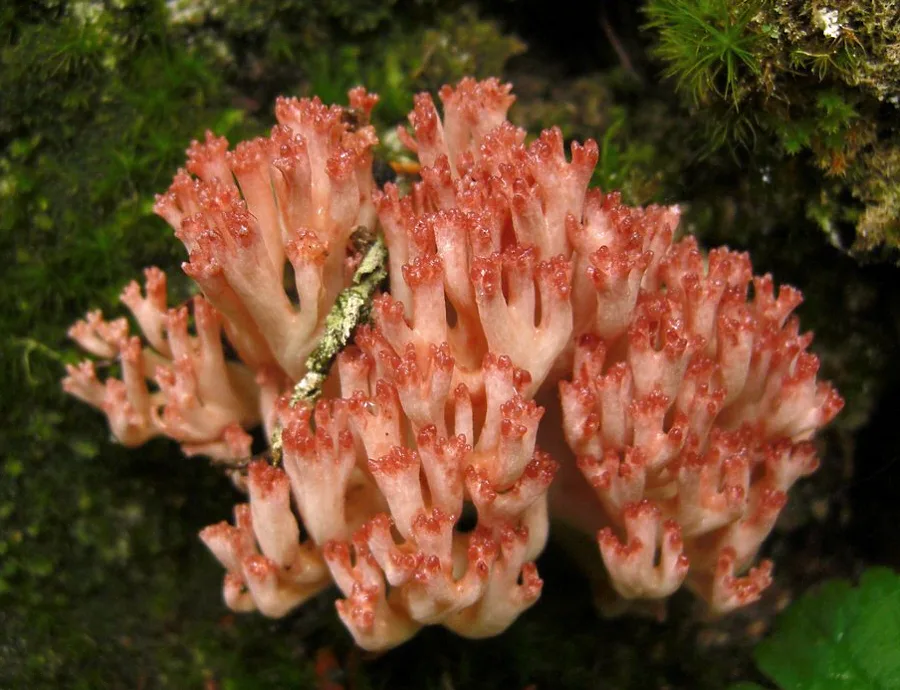
This stocky coral looks like a head of cauliflower with colored tips. A standard reference gives 7 to 20 cm high, a thick whitish base and crowded tips that are pink to purplish or red. It is mycorrhizal and grows on soil under hardwoods or conifers in summer and fall. The spore print is yellowish, and the site calls it one of the few relatively easily recognized Ramaria. MykoWeb notes that the tips fade to pale buff with age and rates it "edible and good, for most people."
Yellow-Tipped Coral (Ramaria formosa)
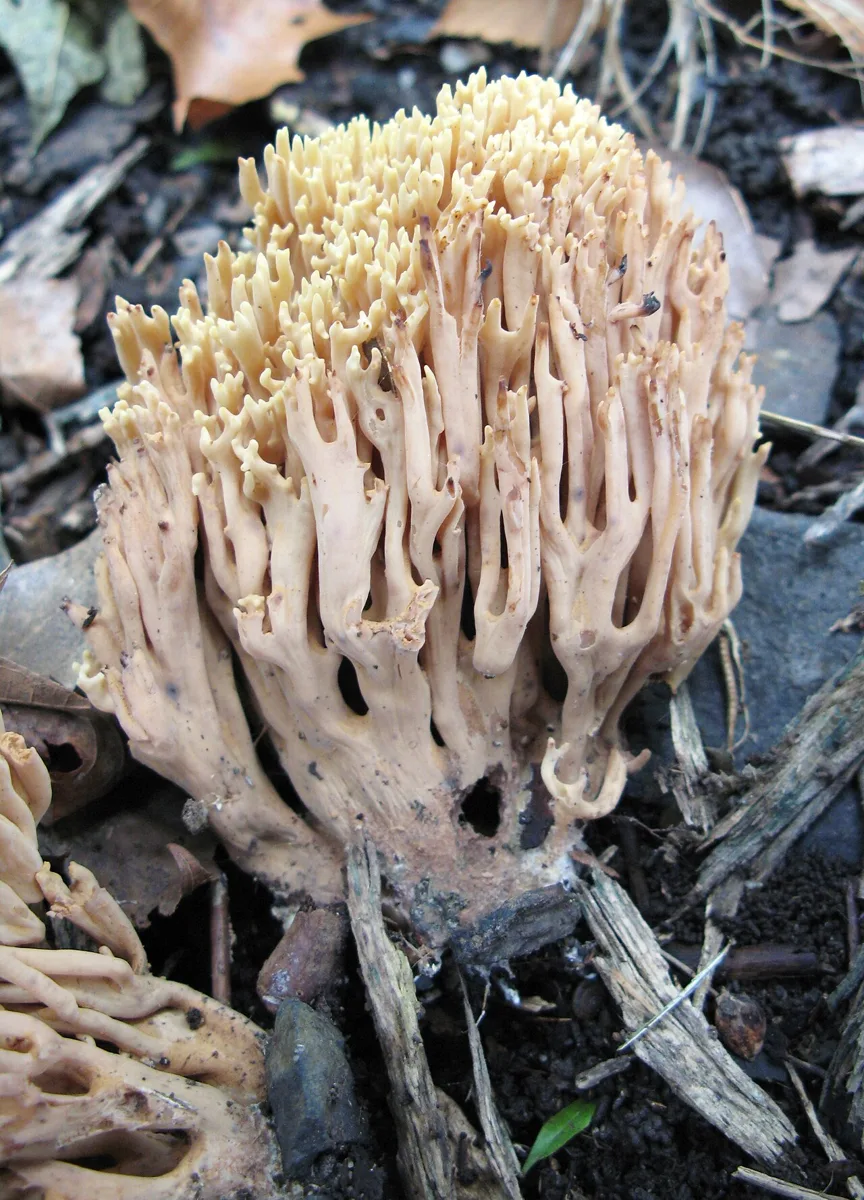
This is the coral that sources warn about by name. MykoWeb describes a massive white base that stains brown when handled, pink branches and yellowish tips. It grows in western mixed forests, especially with Douglas fir and western hemlock, from fall through midwinter. MykoWeb lists its edibility as unclear and notes reports of stomach problems in some people. It adds that the name has been applied to several distinct species.
Red Coral (Ramaria araiospora)
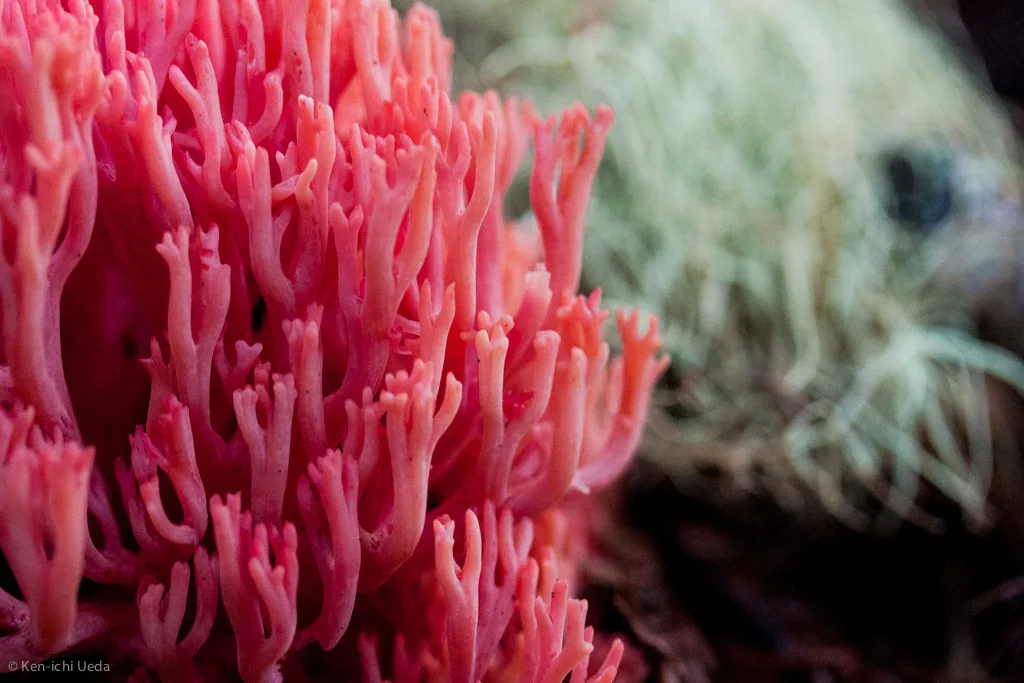
This is the bright red coral of the West Coast. One field guide describes red to magenta branches that fade with age, red to pink brittle flesh and a yellowish spore print. It grows under tanoak and western hemlock in coastal California and the Pacific Northwest in fall and winter. One variety keeps red tips, while the other develops orange to yellow tips.
Crested Coral (Clavulina cristata)
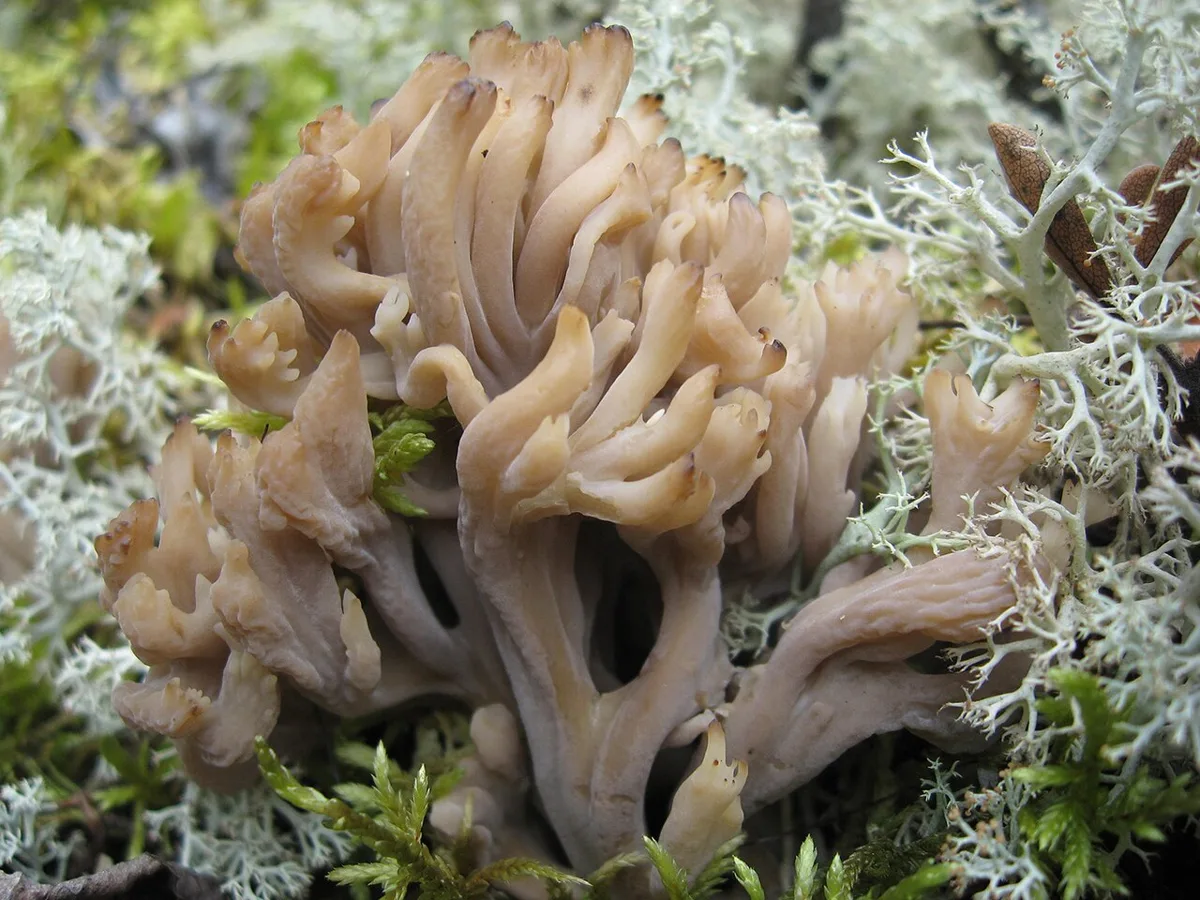
This small white coral has flattened tips that end in several sharp points. A North American field guide gives 2 to 10 cm high, white branches that can turn pinkish, fairly brittle flesh and a white spore print. A parasitic fungus, Helminthosphaeria clavariarum, can turn it gray to black from the base up. MykoWeb calls it especially common under pines in California in mid to late winter, and lists it as edible but lacking in texture.
White Worm Coral (Clavaria fragilis)
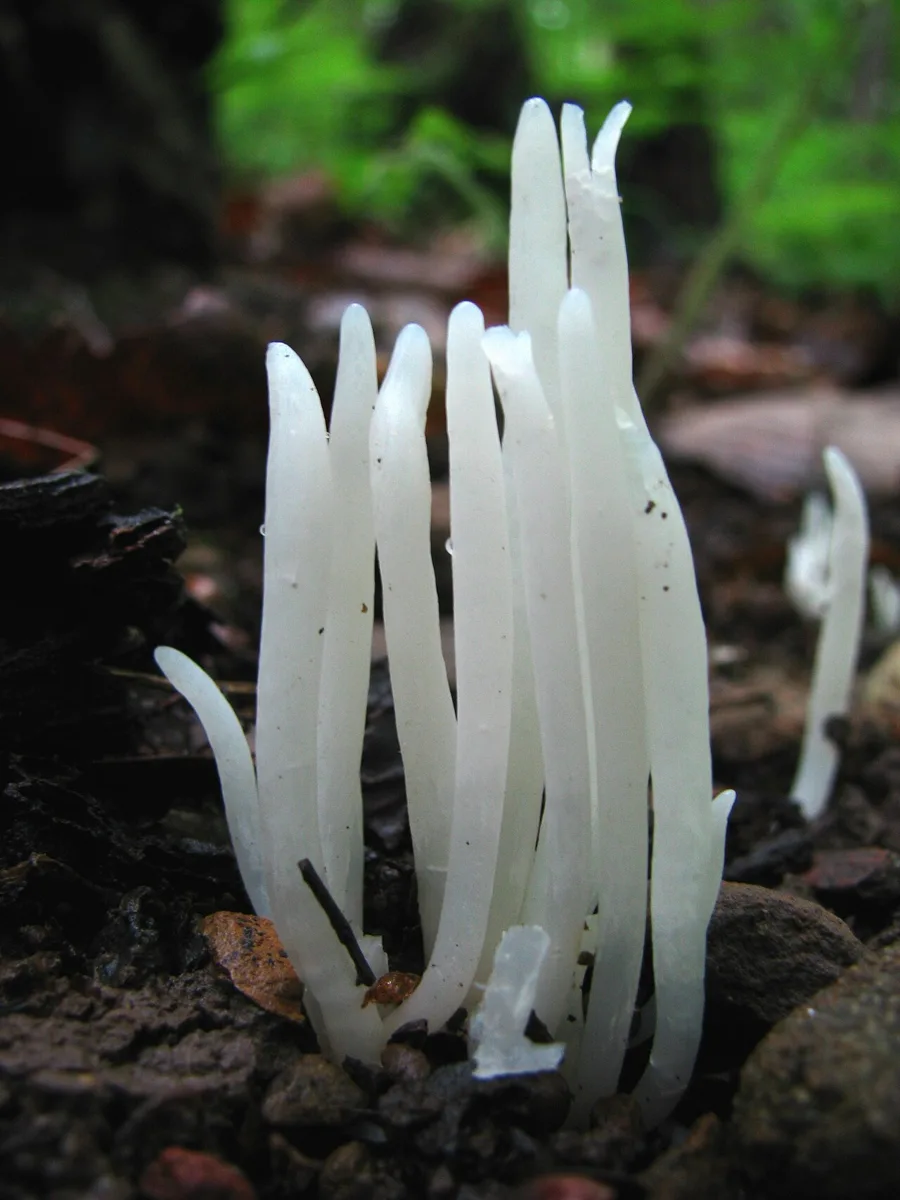
This coral has no branches at all. MykoWeb describes white tubes 3 to 9 cm tall and 2 to 4 mm thick that yellow with age, especially at the tips. The flesh is so fragile that collecting it is difficult. It grows alone or in clusters on soil or duff in mixed woods. MykoWeb calls it fairy fingers and lists it as edible but unsubstantial. Older books may use the name Clavaria vermicularis.
Yellow Fairy Club (Clavulinopsis fusiformis)
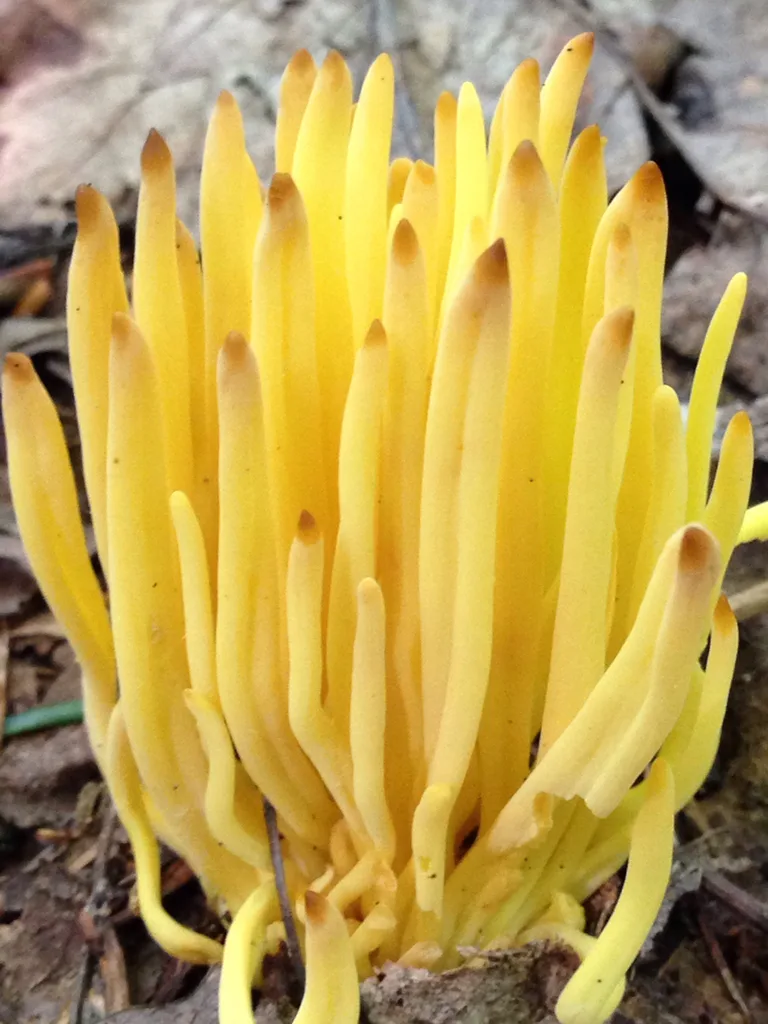
These bright yellow, unbranched spindles grow in tight clusters with fused bases. One species account gives 5 to 15 cm high, a pointed tip, a bitter taste and a white spore print. It grows in woods, and sometimes in grass, in summer and fall, and it is more common in northern North America. The smaller Clavulinopsis laeticolor does not grow in tight clusters.
Cauliflower Mushroom (Sparassis spathulata)
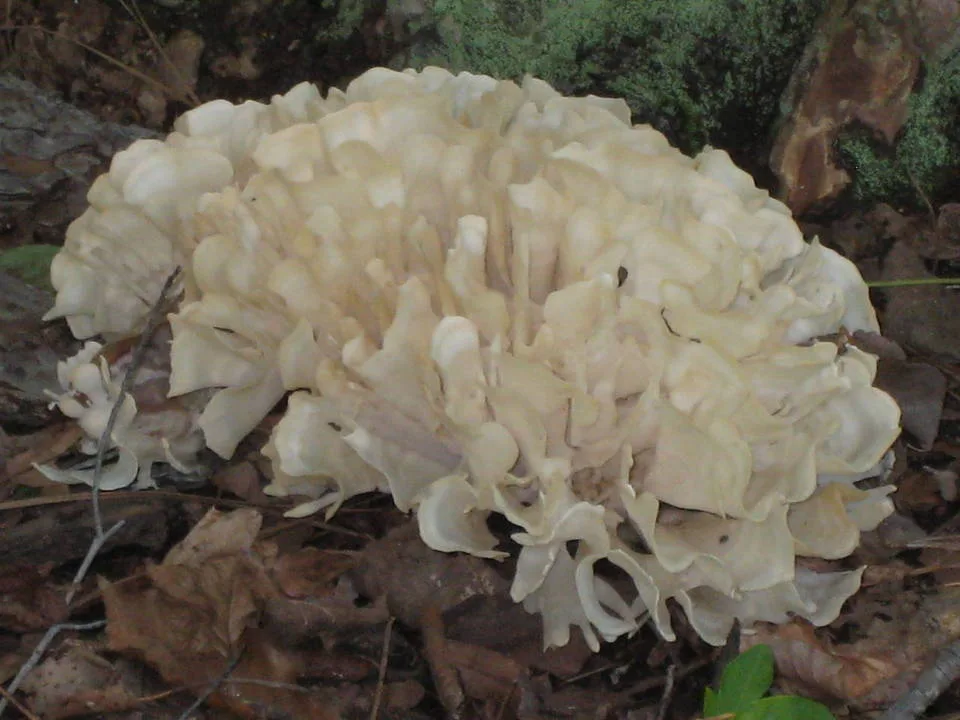
The cauliflower mushroom is not a true coral, but it is often called one. A standard reference describes a rosette 10 to 20 cm across made of flattened, creamy to yellowish lobes, usually zoned with bands of color. It grows from the roots or base of oaks or pines, causing brown rot or butt rot. It fruits in summer and fall east of the Great Plains and below the Great Lakes, and it often returns to the same spot.
Coral Fungus Look-Alikes: Side-by-Side Comparison
The fungi most often mistaken for corals are jelly fungi, dead man's fingers and coral tooth fungi, but the real safety question is which corals upset stomachs. No source we opened documents a deadly coral fungus. The ones named as risky are the yellow-tipped coral and Ramaria species with a jelly-like core.
| Fungus | How it differs from a true coral | Grows on | Risk |
|---|---|---|---|
| Yellow-tipped coral (Ramaria formosa) | A true coral: pink with yellow tips, base stains brown | Soil, western conifer forests | Stomach problems reported |
| Gelatinous Ramaria (several species) | A true coral with a jelly-like core when cut | Soil | Avoid, per Pacific Northwest advice |
| Jellied false coral (Tremellodendron schweinitzii) | Tough, stringy, flattened whitish branches | Soil under oaks | Not edible |
| Yellow stagshorn (Calocera viscosa) | Greasy, sticky, rubbery orange antlers | Conifer wood, often buried | Generally regarded as inedible |
| Dead man's fingers (Xylaria polymorpha) | Black clubs with tough white flesh, no branches | Base of hardwood stumps | Not edible |
| Coral tooth (Hericium coralloides) | White branches with spines hanging in rows | Dead hardwood logs | Expert check needed |
Jellied False Coral (Tremellodendron schweinitzii)
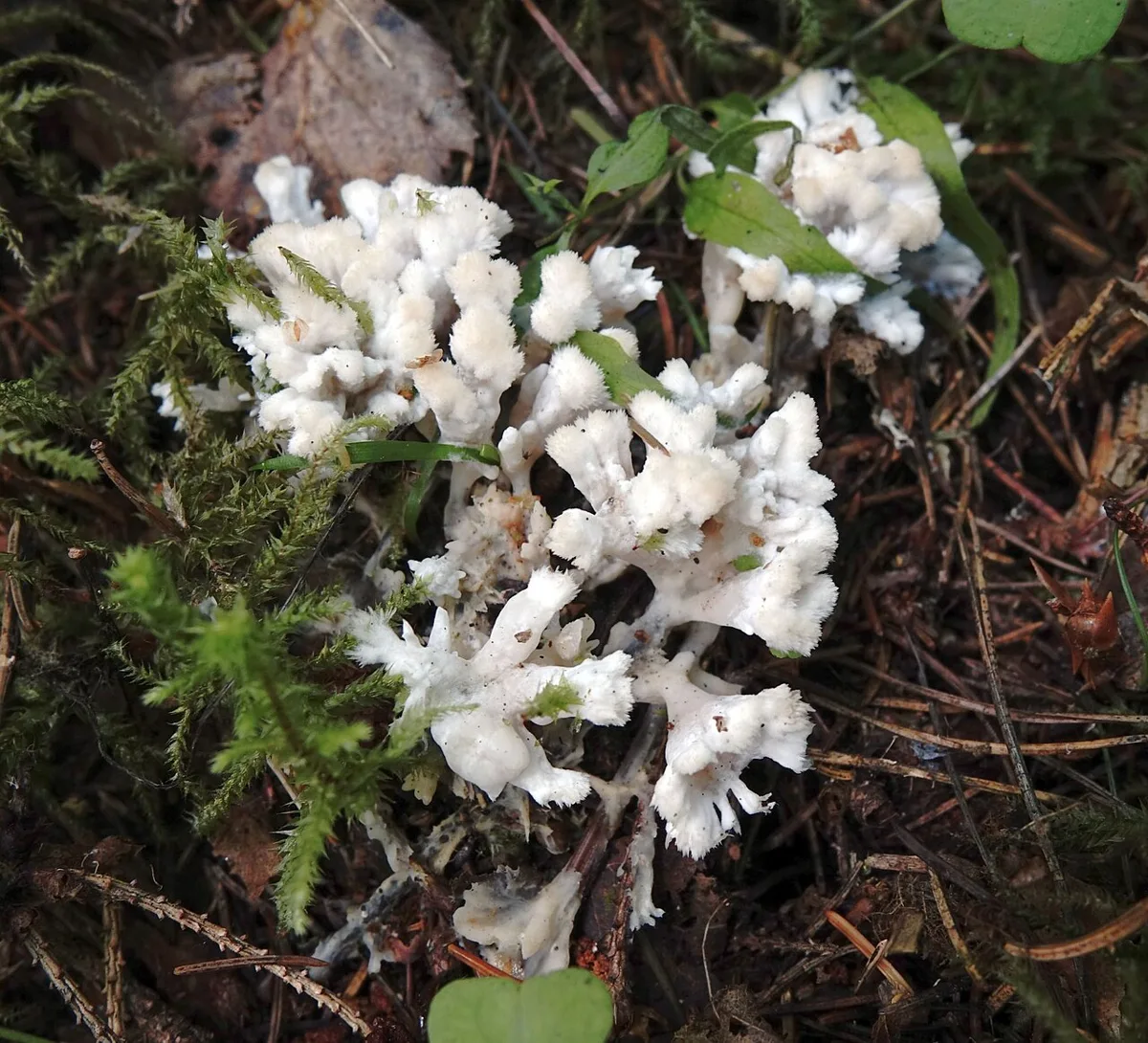
This is the "coral" that will not snap. One field guide describes flattened whitish to buff branches up to 10 cm high from fused bases, with very tough, stringy flesh. Mycologists group it with the jelly fungi because of its microscopic basidia. It is mycorrhizal with oaks and grows east of the Great Plains from spring to late fall. The Missouri Department of Conservation lists it as Tremellodendron pallidum and rates it not edible.
Yellow Stagshorn (Calocera viscosa)
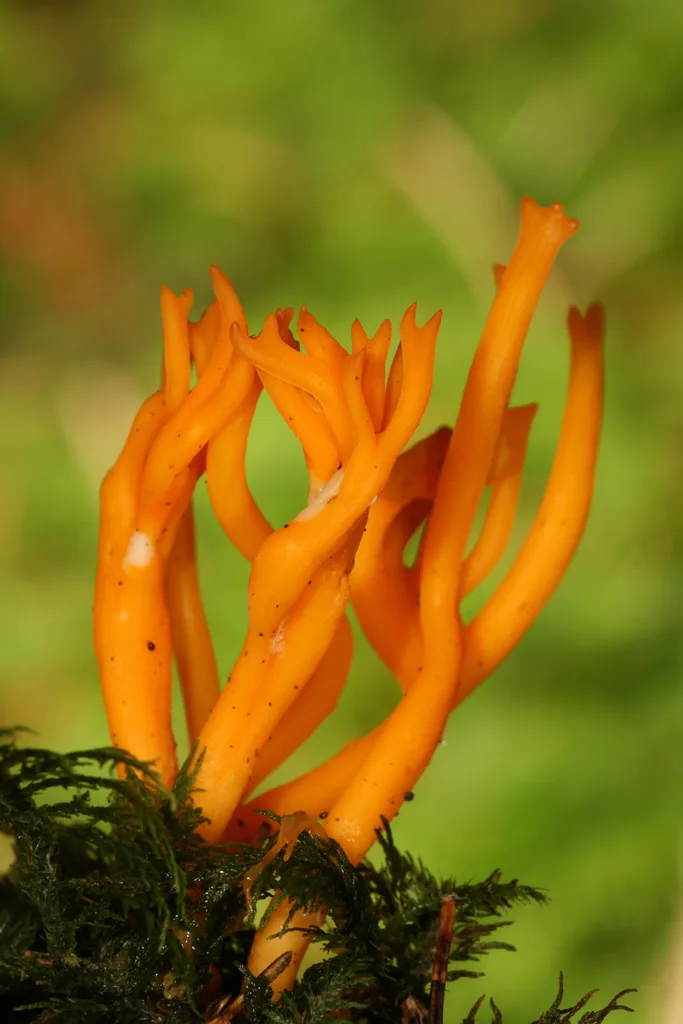
This orange jelly fungus looks like a small coral on conifer wood. A North American field guide describes orange to orange-yellow branches up to about 8 cm high, with tough, gelatinous flesh unlike the brittle flesh of club fungi. The wood is often buried, so it can look like it grows from soil. First Nature names its greasy, sticky surface as the clearest difference from Ramaria and states that it is generally regarded as inedible.
Dead Man's Fingers (Xylaria polymorpha)
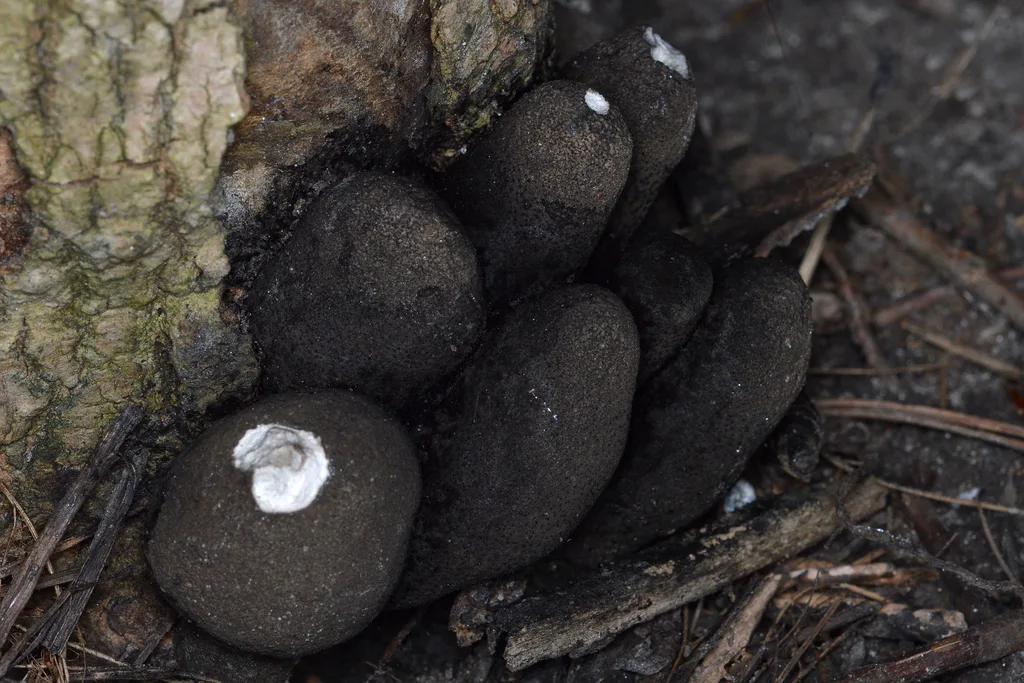
These black, finger-shaped clubs grow at the base of hardwood stumps. Young ones are pale, often bluish, with a whitish tip in early spring, and that they blacken by summer. Mature clubs stand 4 to 14 cm tall, with very tough white flesh inside. The Missouri Department of Conservation lists them as not edible.
Coral Tooth (Hericium coralloides)
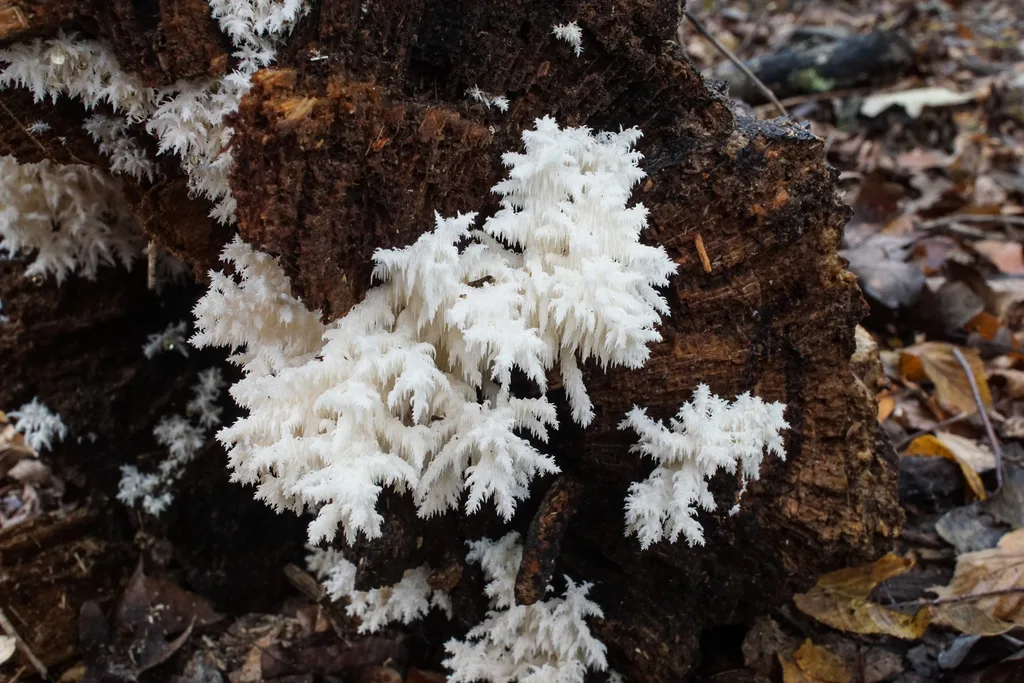
This white, branched fungus on dead hardwood logs looks like a coral at first glance. The difference is the spines. One species account describes spines 0.5 to 1 cm long that hang in rows along delicate branches, in late summer and fall. It belongs to the same genus as lion's mane.
Are Coral Fungi Poisonous?
Some coral fungi are listed as edible, but several Ramaria species are linked to stomach upset, and sources disagree on how risky the genus is. The Missouri Department of Conservation states that the crown-tipped coral "and other coral mushrooms may cause gastrointestinal upset." MykoWeb records stomach problems after the yellow-tipped coral. Nobody should eat a coral based on this page.
The Cascade Mycological Society article cited above says recent research and experience suggest no poisonous Ramaria occur in the Pacific Northwest. It still passes on Daniel Winkler's advice to avoid three groups:
- Corals with a gelatinous, jelly-like core.
- The yellow-tipped coral, Ramaria formosa.
- Yellow corals that fruit in fall. Winkler says spring-fruiting ones seem harmless.
The article also quotes David Arora's warning that poisoning records cannot show how many people eat a mushroom safely, so a short list of reports does not prove a genus is safe. For a coral that an expert has confirmed, the sources advise cooking it thoroughly, eating only a small amount the first time and keeping a sample in case someone needs to identify what was eaten.
Read our poisonous vs edible mushrooms guide to see why simple rules fail. If a dog eats a coral or any other wild mushroom, follow our steps on what to do if your dog ate a mushroom and call a vet.
When and Where Do Coral Fungi Grow in the US?
Coral fungi fruit mainly in summer and fall in the East and Midwest, and from fall into winter in California and along the Pacific coast. Most Ramaria are thought to be mycorrhizal, and the crested coral is presumed to be, so they grow from soil near living trees. The crown-tipped coral, yellow stagshorn and dead man's fingers feed on dead wood.
| Region or season | What sources record |
|---|---|
| Spring, East and Midwest | Young, pale bluish dead man's fingers. The first stage of the jellied false coral, which looks like bird droppings just after morel season. |
| Summer and fall, East and Midwest | Pink-tipped coral, crested coral, yellow fairy clubs and the cauliflower mushroom. In Missouri, the crown-tipped coral from June to September and the jellied false coral from May to November. |
| California | Pink-tipped, yellow-tipped and white worm corals from fall to midwinter. Crested coral in mid to late winter. |
| Coastal California and the Pacific Northwest | Red coral under tanoak and western hemlock in fall and winter. |
Our guide to mushroom habitat explains how mycorrhizal and wood-rotting fungi differ.
Why Do Coral Fungus Names Differ Between Guides?
Several corals have changed names, and some guides still disagree on which name is correct. If a field guide and a website give different Latin names for the same picture, one of them may be using an older name. These are the changes you are most likely to meet.
- Crown-tipped coral: once Clavicorona pyxidata, now Artomyces pyxidatus. A 2002 study by Lickey, Hughes and Petersen, cited by found three genetically distinct groups, one of them in the northeastern US.
- Crested coral: MykoWeb accepts Clavulina cristata, while one field guide suggests the older Clavulina coralloides may be the proper name.
- Jellied false coral: A standard reference calls T. pallidum the result of a 1915 error, while the Missouri Department of Conservation still uses it.
Common Identification Mistakes
Calling Every Branched Fungus a Coral
Jelly fungi, dead man's fingers, coral tooth and the cauliflower mushroom all get called corals. Check the snap, the tips and the substrate before you settle on a name.
Identifying a Ramaria by Color Alone
The same Ramaria species can vary in color, and cameras shift colors further. Old Ramaria fade to a cardboard color and lose the one clue they had.
Leaving the Base Behind
The base carries key features, such as the brown staining of Ramaria formosa. Dig out the whole fungus and cut it from top to bottom.
Missing Buried Wood
Yellow stagshorn and dead man's fingers can grow from buried wood and look like ground fungi. Feel under the base for wood before deciding it grows from soil.
Treating "Edible" Lists as a Green Light
Corals listed as edible can still upset stomachs. Our guide to identifying a mushroom you found covers the checks to make before trusting any list.
Frequently Asked Questions
What is a coral fungus?
A coral fungus is a mushroom that grows as branches or upright clubs instead of a cap and stem. The name covers several unrelated groups, including Ramaria, Clavulina, Clavaria and the crown-tipped coral. Some look-alikes, such as yellow stagshorn, are jelly fungi.
Are coral mushrooms poisonous?
Some coral mushrooms cause stomach upset, and the yellow-tipped coral, Ramaria formosa, is named in reports. The Missouri Department of Conservation warns that corals in general may cause gastrointestinal upset. Never eat a coral without expert confirmation.
Can you eat coral fungus?
Sources list a few corals as edible, such as the pink-tipped coral and the crown-tipped coral, but even those may upset stomachs. Ramaria species are hard to tell apart. An expert must confirm the species first.
What does a false coral mushroom look like?
The jellied false coral has flattened, whitish branches that feel tough and stringy instead of brittle. It grows on soil under oaks from spring to late fall. It is a jelly fungus, and the Missouri Department of Conservation lists it as not edible.
What is a crown-tipped coral fungus?
The crown-tipped coral, Artomyces pyxidatus, is a whitish to tan coral that grows on dead hardwood. Every branch tip ends in a tiny crown with 3 to 6 points. It is common in the East and the Rockies and rare on the West Coast.
How do you tell a coral fungus from a jelly fungus?
Bend a branch. Many true corals are brittle and snap, while jelly fungi like the jellied false coral and yellow stagshorn are tough or rubbery. Yellow stagshorn also feels greasy and sticky and always grows on wood.
Where do coral fungi grow?
Most coral fungi grow from soil in forests, often near living trees that they partner with. A few, such as the crown-tipped coral, grow on dead wood. Check the base to see which it is.
What is the black finger-like fungus on stumps?
Black, finger-shaped clubs at the base of hardwood stumps are usually dead man's fingers, Xylaria polymorpha. They are tough and white inside. The Missouri Department of Conservation lists them as not edible.
Why is my white coral fungus turning gray?
A parasitic fungus can turn the crested coral gray to black from the base upward. Some gray corals may simply be a different Clavulina species. A hand lens shows the parasite's tiny black dots.
Final Safety Reminder
Coral fungi are easy to notice and hard to name to species, and some cause stomach upset. Never eat a wild mushroom based on a chart, a photo or an app. Photograph the whole fungus, the base and a cut section using our guide on how to photograph mushrooms for identification, then check them with our free mushroom identifier and a local mycological club. If someone may have eaten a poisonous mushroom in the US, call Poison Control at 1-800-222-1222.
Sign in to leave a comment and join the discussion.
 Species Guide
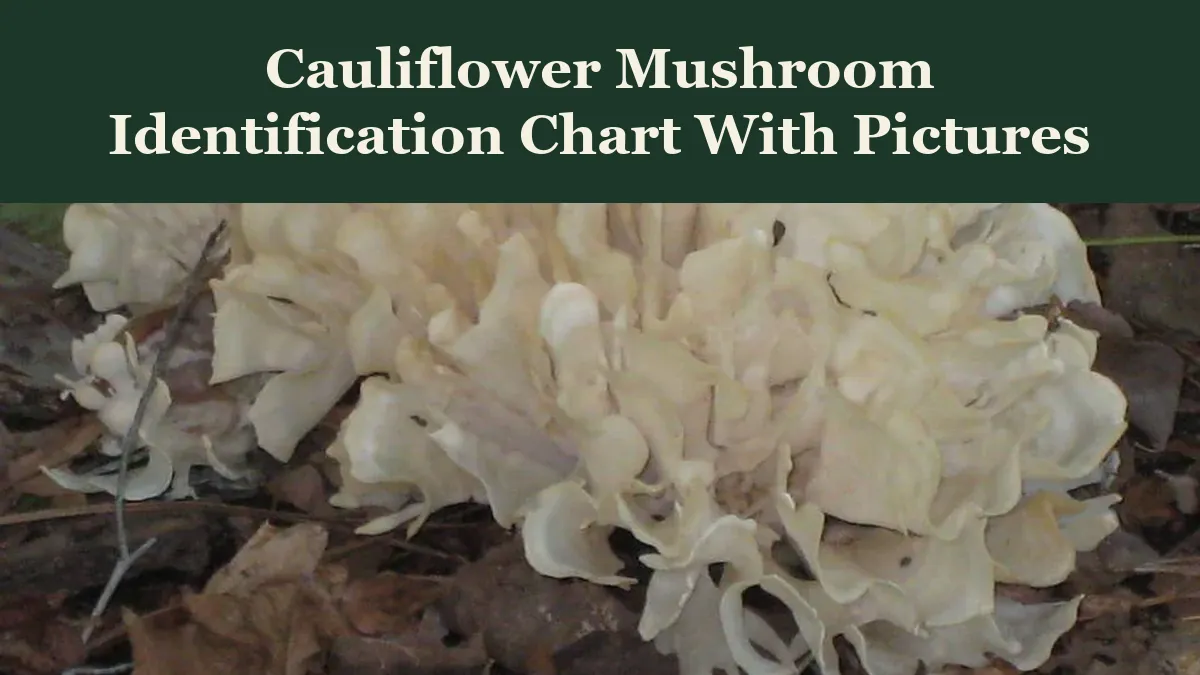
A cauliflower mushroom ( Sparassis ) is a large, cream-colored rosette of flat, wavy, ribbon-like lobes that grows at the base of a tree. It has no caps, no...
 Species Guide
The golden oyster mushroom ( Pleurotus citrinopileatus ) is a bright yellow oyster mushroom that grows in dense, bouquet-like clusters on dead hardwood,...
 Species Guide
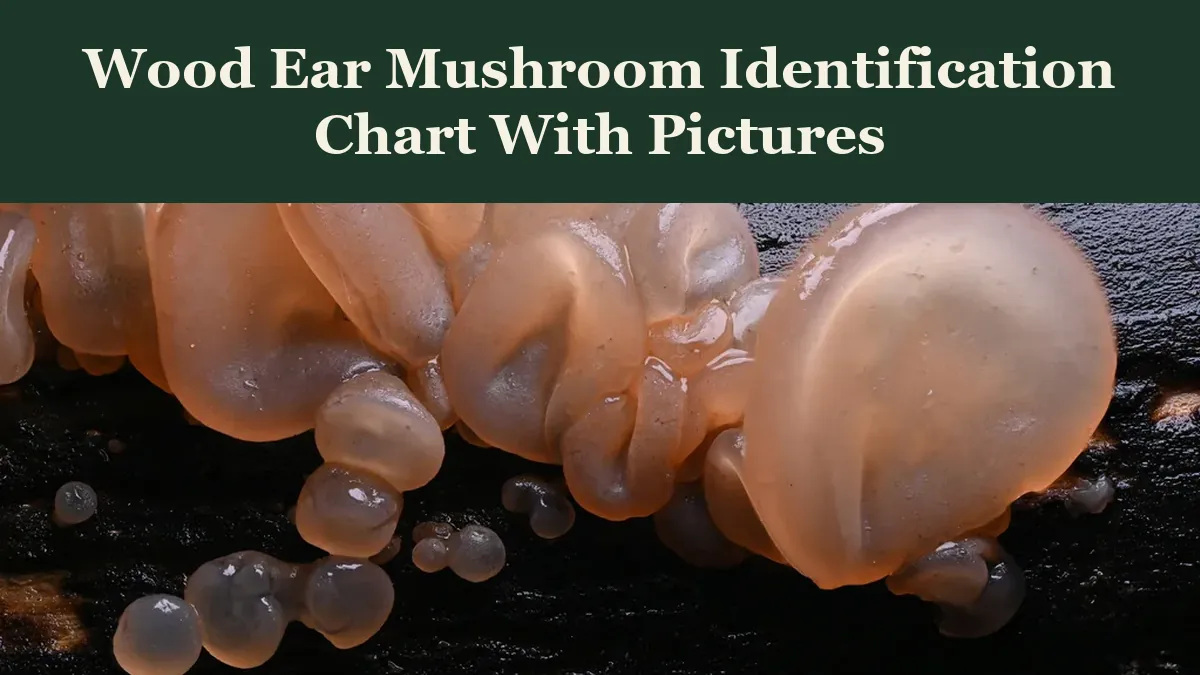
A wood ear mushroom is a brown, rubbery, ear-shaped jelly fungus in the genus Auricularia that grows on dead wood. In North America the hardwood species is...