Jelly Fungus Identification Chart With Pictures
— views
A jelly fungus is a fungus with a rubbery or gelatinous body that grows mostly on dead wood, shrinks to a hard crust in dry weather and swells again after rain. Witch's butter, wood ear, amber jelly roll and snow fungus are common US examples. None of the sources we checked lists a true jelly fungus as deadly. Still, slime molds and star jelly get mistaken for them, and no wild jelly fungus should be eaten without expert confirmation.
This jelly fungus identification chart with pictures covers nine US types, a three-question sort by wood, why jelly fungi revive after rain, and the look-alikes that are not fungi at all. It is an identification guide, not permission to eat a wild mushroom.
Key Takeaways
- "Jelly fungus" describes a texture, not one family. Several unrelated groups share it.
- Most jelly fungi grow on dead sticks and logs. The apricot jelly grows on soil under conifers instead.
- Check the wood first. Yellow jelly on hardwood is usually witch's butter or golden ear. Orange jelly with a pale base on bare conifer wood is usually Dacrymyces.
- Jelly fungi shrink to a crust in dry air and swell again in rain.
- Slime molds and star jelly (Nostoc) are not fungi, and extension services call both harmless.
- Dried black fungus and silver ear soaked for more than two days have caused bongkrekic acid poisoning in China, and this toxin can kill.
- Several jelly fungi are listed as edible but bland. Never eat a wild one without expert confirmation.
What Is a Jelly Fungus?
"Jelly fungus" is an informal name for fungi with rubbery, gelatinous fruiting bodies, and it does not describe a single natural group. A North American field guide calls jelly fungi a diverse and complicated set of species from several groups within the Basidiomycota.
Tom Volk of the University of Wisconsin sorts the classic jelly fungi into three orders by the shape of their spore-producing cells, the basidia:
- Tremellales: basidia split lengthwise. Witch's butter belongs here.
- Auriculariales: basidia divided crosswise. Wood ear belongs here.
- Dacrymycetales: basidia shaped like a tuning fork. Orange jelly belongs here.
Those cells need a microscope, which is why a North American field guide notes that some Dacrymyces look almost the same as yellow Tremella to the naked eye. A spore print rarely settles it, because the amber jelly roll, black witch's butter, apricot jelly and toothed jelly all print white or whitish. Our guide to the parts of a mushroom explains the terms.
Jelly Fungus Identification Chart
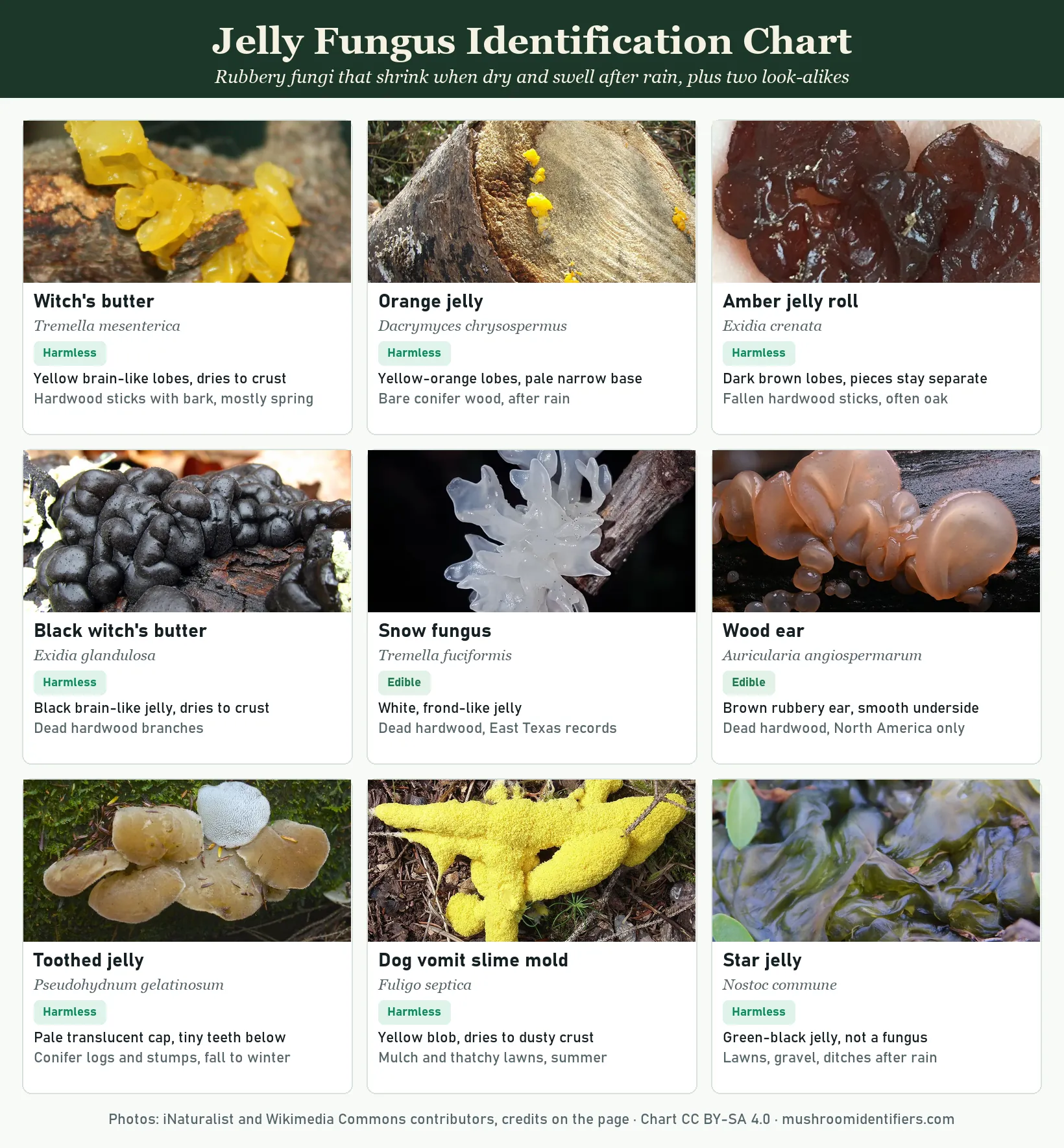
Chart photos not shown below. Dog vomit slime mold: Siga, Public domain, via Wikimedia Commons; Star jelly: iNaturalist user, CC0, via iNaturalist.
| Jelly fungus | What it looks like | Where it grows | When | Edibility or risk |
|---|---|---|---|---|
| Witch's butter (Tremella mesenterica) | Yellow, brain-like lobes, 2 to 5 cm | Hardwood sticks with bark, often oak | Mostly spring, any season | No rating in our sources |
| Golden ear (Naematelia aurantia) | Golden yellow folds, 2 to 10 cm | Dead hardwood, on hairy curtain crust | Most of the year | Edible but flavorless, per MykoWeb |
| Orange jelly (Dacrymyces chrysospermus) | Yellow-orange lobes, pale base, up to 5 cm | Bare conifer wood | After rain; winter in California | Listed as edible by MykoWeb |
| Amber jelly roll (Exidia crenata) | Dark brown lobes, 1 to 4 cm each | Fallen hardwood sticks, often oak | Spring to fall | No rating in our sources |
| Black witch's butter (Exidia glandulosa) | Black, brain-like masses | Hardwood branches | Fall to late winter in California | "Probably edible" but insignificant, per MykoWeb |
| Snow fungus (Tremella fuciformis) | White, frond-like jelly | Dead hardwood | Most months in East Texas records | Cultivated food; soaked dried product has poisoned people |
| Wood ear (Auricularia angiospermarum) | Brown rubbery ear, smooth underside | Dead hardwood | Wet weather | Cultivated relatives are major foods |
| Apricot jelly (Guepinia helvelloides) | Pink to salmon tongue, 4 to 6 cm wide | Soil and rotten wood under conifers | Late summer and fall | No rating in our sources |
| Toothed jelly (Pseudohydnum gelatinosum) | Pale translucent cap, tiny teeth below | Conifer logs and stumps | Late fall to midwinter in California | Listed as edible by MykoWeb |
Sources are linked in each species section below. California seasons are marked, because jelly fungi fruit in different months across the US.
How Do You Identify a Jelly Fungus? Three Questions
Ask three questions in order: is it growing on wood or on soil, is the wood a hardwood or a conifer, and what else is growing on the same stick. Color alone fails, because three different yellow jellies look nearly the same. The wood and its neighbors narrow the list fast, and a close-up photo often leaves them out.
| What you see | Most likely | Why |
|---|---|---|
| Yellow jelly on a thin hardwood stick with bark | Witch's butter | Favors hardwood sticks 0.5 to 1.5 inches thick |
| Yellow jelly growing from a hairy crust fungus | Golden ear | Parasitizes the hairy curtain crust, Stereum hirsutum |
| Orange jelly with a pale base on bare conifer wood | Orange jelly | Grows on conifer wood without bark |
| Brown ear-shaped jelly on dead hardwood | Wood ear | Its twin, Auricularia americana, takes conifer wood |
| Dark brown lobes on fallen oak twigs | Amber jelly roll | Favors recently fallen hardwood sticks |
| Black brain-like jelly on hardwood branches | Black witch's butter | Hardwood, rarely pine |
| Pink-orange tongue on soil under conifers | Apricot jelly | Grows in duff, soil and rotten wood |
| Pale jelly cap with teeth below, on a conifer log | Toothed jelly | Teeth like a tooth fungus, flesh like jelly |
| Green-black jelly on soil, gravel or a lawn | Star jelly, not a fungus | A cyanobacterium that swells in rain |
| Yellow to orange blob on mulch | Slime mold, not a fungus | Dries to a crust of dark spores |
Our mushroom habitat guide explains how growing site narrows an identification, and the tree mushroom identification chart covers the bracket fungi that share the same logs.
Why Do Jelly Fungi Shrivel and Come Back After Rain?
Jelly fungi lose water in dry air and shrink to a thin, hard crust, then take up water and swell back to full size when rain returns. The Utah State University Herbarium describes this cycle and suggests that the rubbery flesh may protect them from drying and freezing. That may explain why they show up in fall and early spring, when other mushrooms are scarce.
- Witch's butter shrinks to an orange-yellow crust.
- Golden ear dries to a hard crust that revives with moisture, according to MykoWeb. First Nature adds that it turns orange and shrivels to a small fraction of its wet size.
- Orange jelly dries reddish-orange to reddish-brown.
- Black witch's butter forms a black crust on the branch.
- Amber jelly roll blackens along its edges and ridges.
A dull crust on a stick in a dry week may be a jelly fungus waiting for rain, so look again after the next rain. Swelling does not prove a fungus, though, because star jelly does it too.
Common Jelly Fungus Types in the US
These nine jelly fungi show the main shapes and colors found in the US, from yellow brains and brown ears to black crusts, white fronds and pink tongues. Each entry gives size, wood, season and current name. Compare your find with several real photographs, because jelly fungi change shape as they dry.
Witch's Butter or Yellow Brain (Tremella mesenterica)
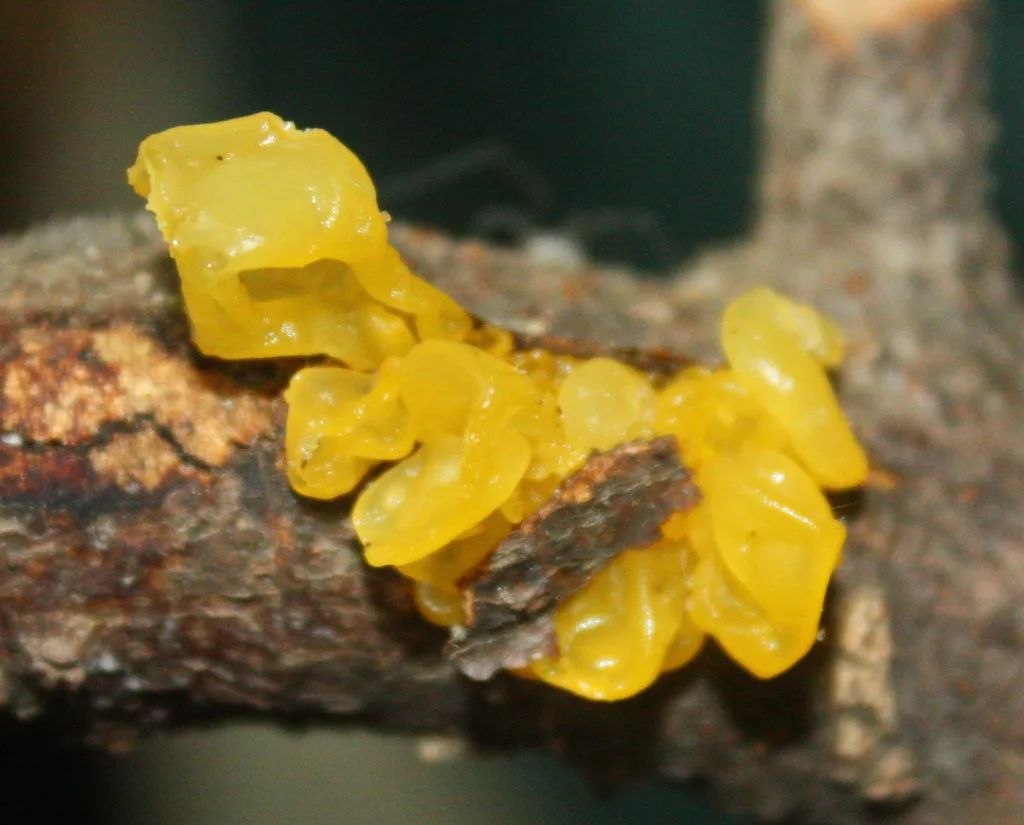
Witch's butter is the bright yellow, brain-like jelly that looks splattered across a dead stick. It measures 2 to 5 cm across. One species account records it on oak and other hardwood sticks, usually 0.5 to 1.5 inches thick with the bark still on. It is widespread in North America, possibly less common in the West, and fruits mostly in spring.
It does not rot the wood. A standard reference describes it as a parasite of Peniophora crust fungi hidden in the stick, while Tom Volk names Stereum and Aleurodiscus, so sources differ on the host. Volk also records an Eastern European legend in which pricking the fungus with pins breaks a witch's spell.
Golden Ear (Naematelia aurantia)
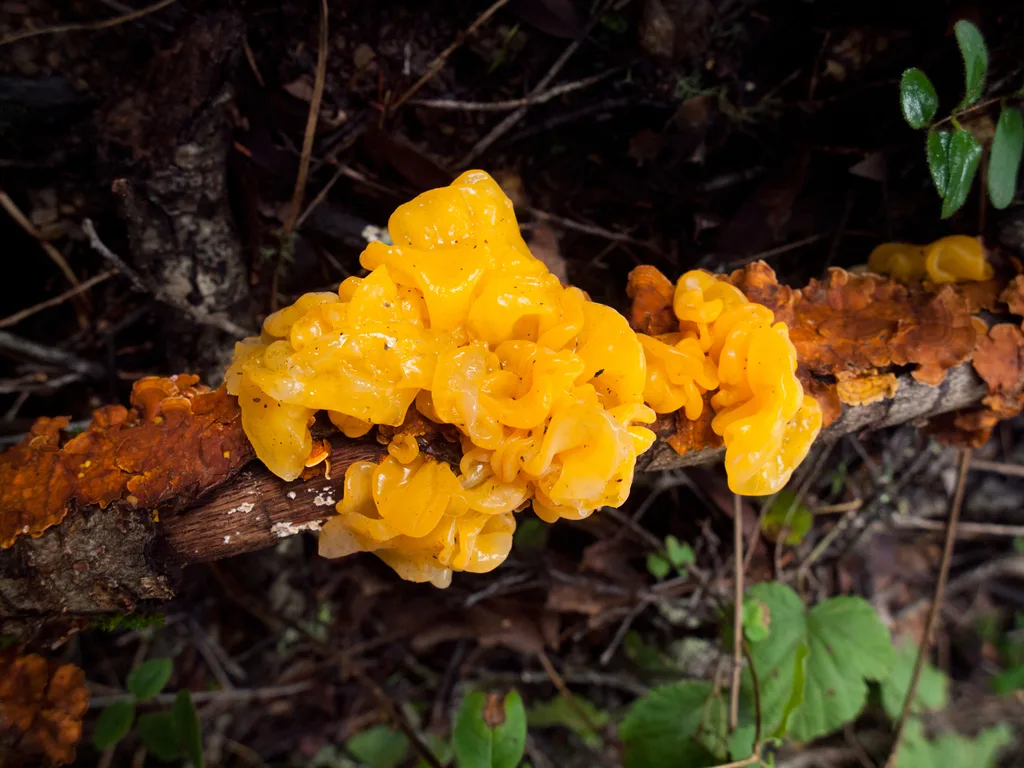
Golden ear looks almost identical to witch's butter. First Nature reports that it is called golden ear in North America, where it is widespread. It grows on and often engulfs the hairy curtain crust, Stereum hirsutum, a common wood-rotting fungus. MykoWeb gives 2 to 10 cm, a yellow color that is shiny when wet and a home on downed hardwoods. Older books call it Tremella aurantia.
If the yellow jelly grows out of a hairy crust fungus, golden ear is the better match. MykoWeb lists it as edible but without flavor.
Orange Jelly (Dacrymyces chrysospermus)
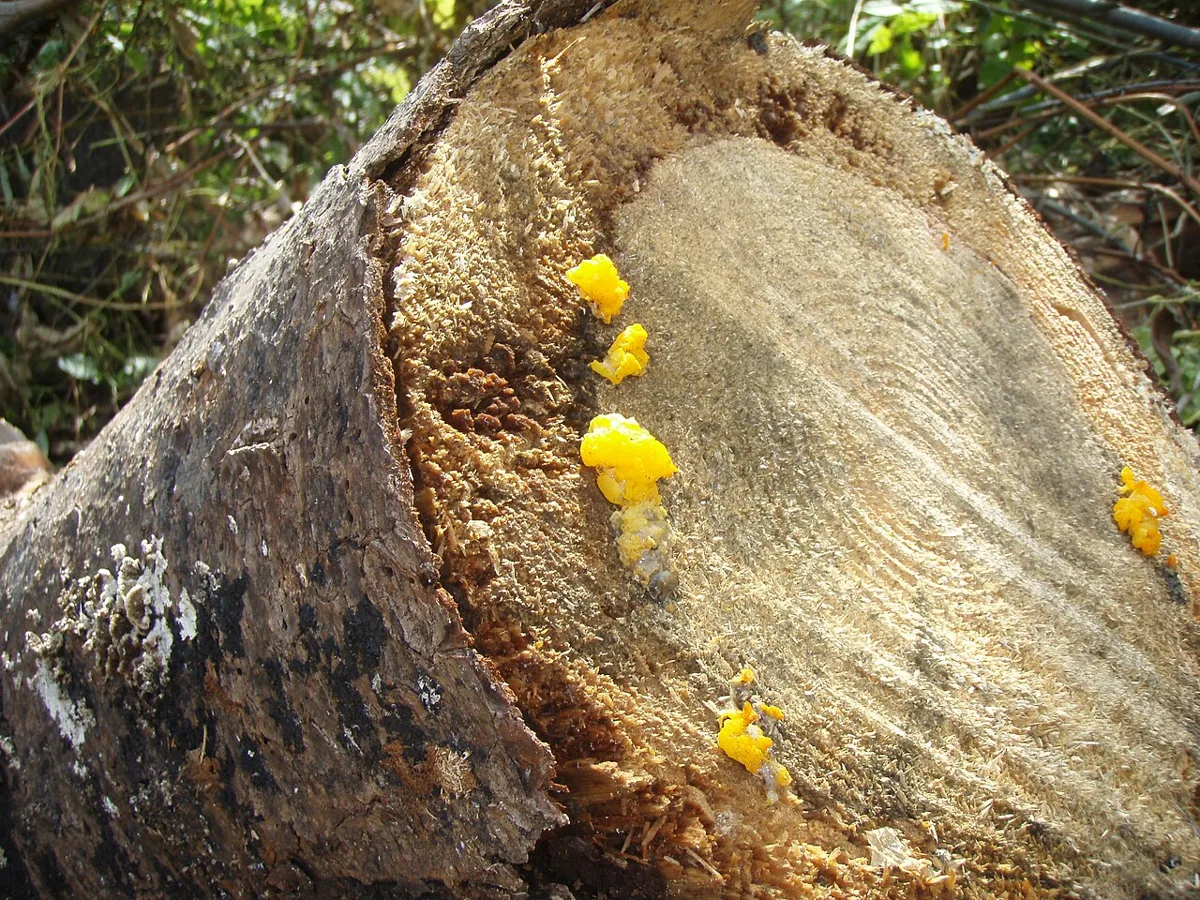
Orange jelly grows on bare conifer wood or from bark cracks. MykoWeb describes it as yellow-orange, up to 5 cm broad and 2 cm tall, with a base that narrows sharply and is pale where it attaches. It is common in California through the winter after rain. Older books call it Dacrymyces palmatus.
MykoWeb also calls this species "witch's butter," which shows why common names cause mix-ups. Under a microscope it has tuning-fork basidia, unlike the two yellow jellies above.
Amber Jelly Roll (Exidia crenata)
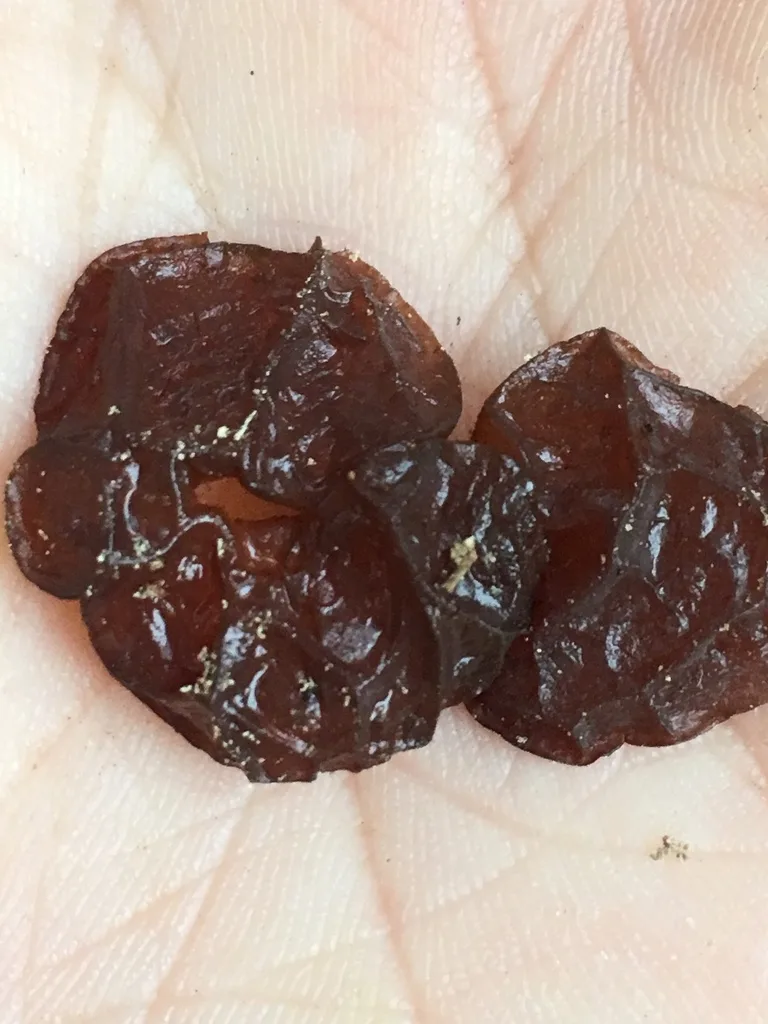
The amber jelly roll is a dark brown jelly, often with a purplish cast, clustered on recently fallen hardwood sticks, especially oak. One field guide gives 1 to 4 cm for each piece, attached at a central point, with wide hollows between ridges. It is much more common east of the Rocky Mountains and appears from spring through fall.
Its name has changed. Older guides use Exidia recisa, the name of a similar European species. DNA work showed that the American fungus is distinct, and current sources call it Exidia crenata. A 2026 revision of the genus in IMA Fungus accepts E. crenata as a distinct species.
Black Witch's Butter (Exidia glandulosa)
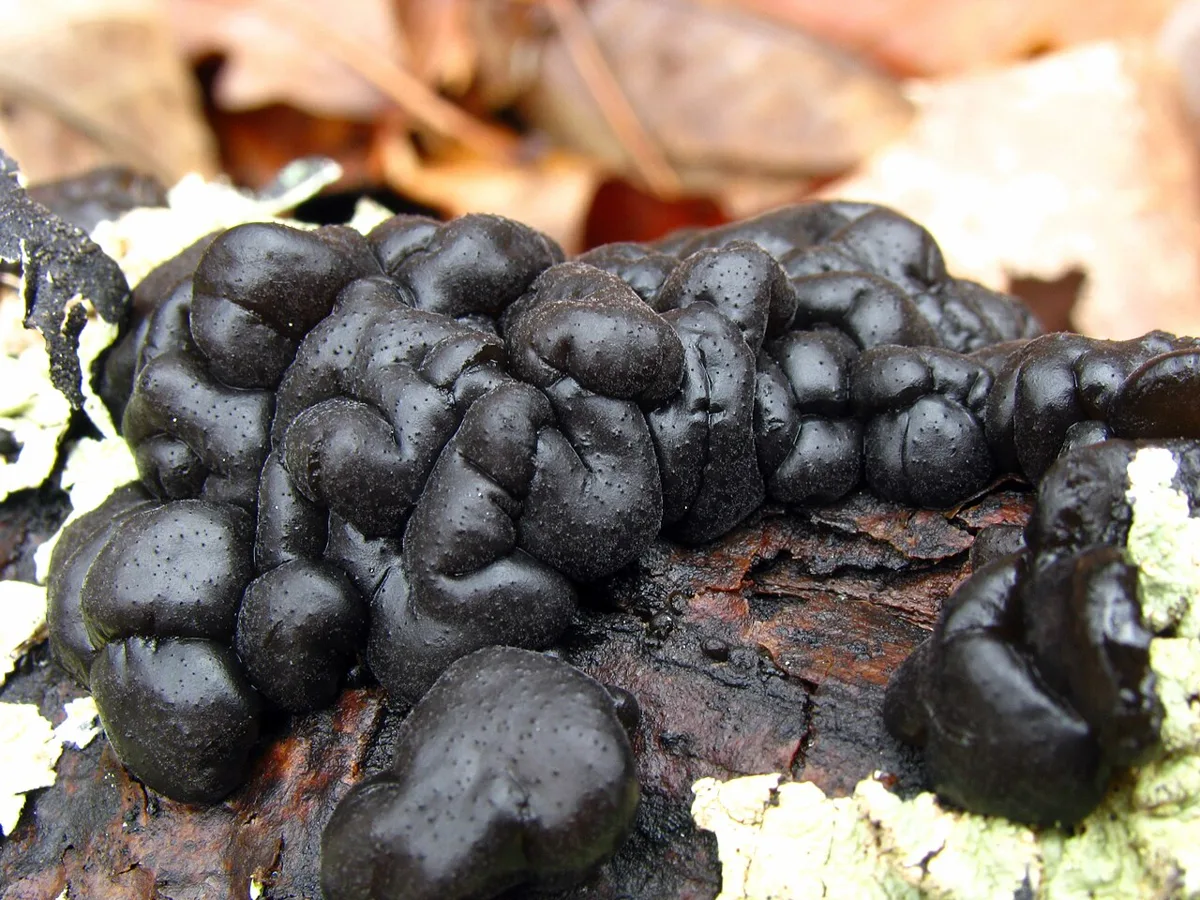
Black witch's butter is an olive-black to black, brain-like jelly on hardwood branches. MykoWeb describes units 1 to 2 cm across that merge into masses up to 10 to 20 cm long, with a smooth to warted surface. In California it appears from the fall rains to late winter. It is also called black jelly roll and warty jelly fungus.
The name is not settled. MykoWeb notes that Exidia nigricans is virtually impossible to separate from it in the field. The 2026 IMA Fungus revision clarified what E. glandulosa means and reported an unnamed species in the same group from the San Francisco area. North American black jellies may get new names as that work continues.
Snow Fungus or White Jelly Fungus (Tremella fuciformis)
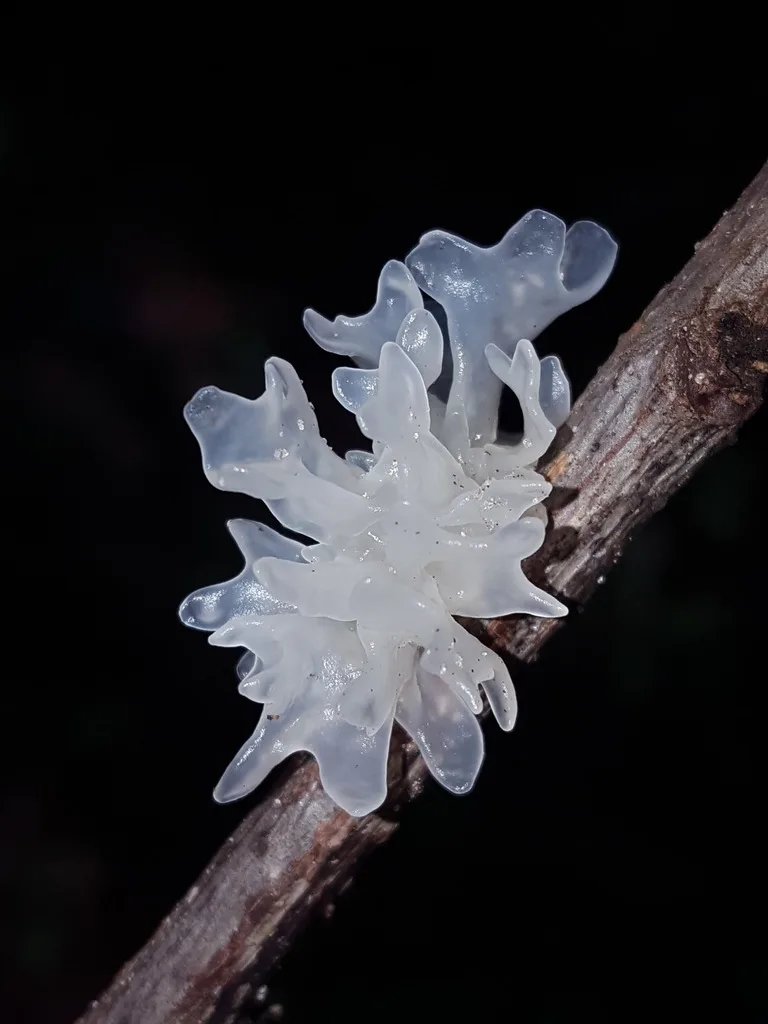
Snow fungus is the white, frond-like jelly behind most "white jelly fungus" searches. It is also called silver ear. It is cultivated in China, where Tom Volk notes it is served as a dessert. It depends on another fungus, so growers add the host fungus to the log first and the Tremella second.
It also grows wild in the US. Texas Mushrooms has dated photo records from Huntsville State Park, Sam Houston National Forest and College Station, on dead hardwood including an oak log, in most months between October and July.
Wood Ear (Auricularia angiospermarum)
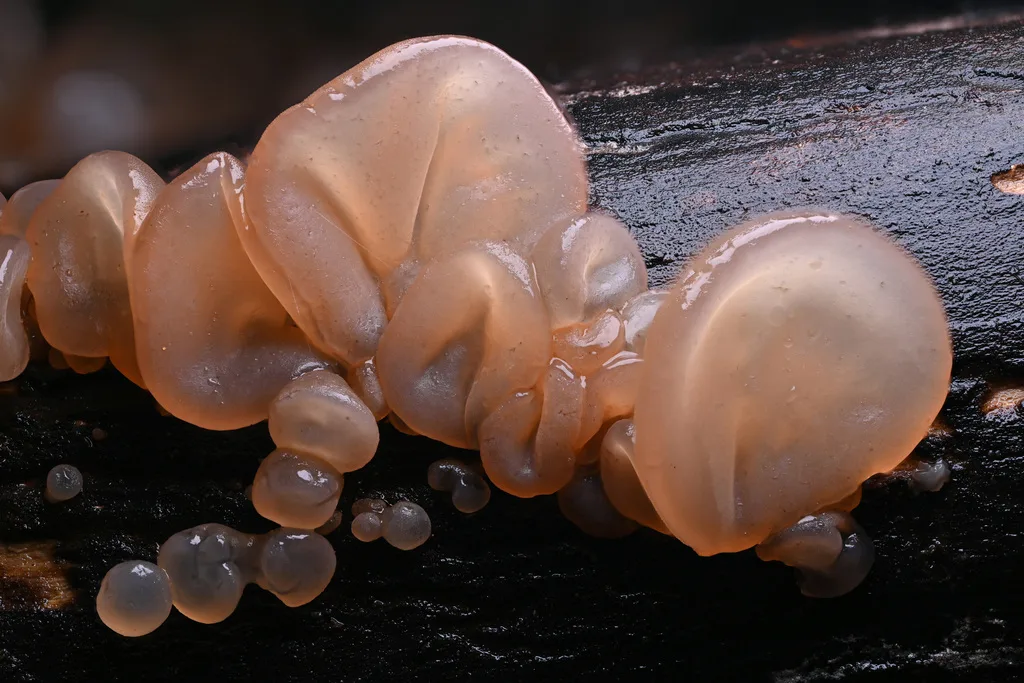
Wood ear is the brown, rubbery, ear-shaped jelly on dead hardwood. Many North American guides called it Auricularia auricula. A 2021 global study of the genus found that A. auricula-judae, the European jelly ear, is known only from Europe.
The same study names Auricularia angiospermarum as the hardwood species, reported so far only in North America, with collections on oak in Connecticut, walnut in Arizona and hickory in Wisconsin. Its twin, Auricularia americana, grows on conifer wood such as fir. Both have a smooth underside without folds. The black wood ear grown commercially in China is a different species, Auricularia heimuer.
Apricot Jelly (Guepinia helvelloides)
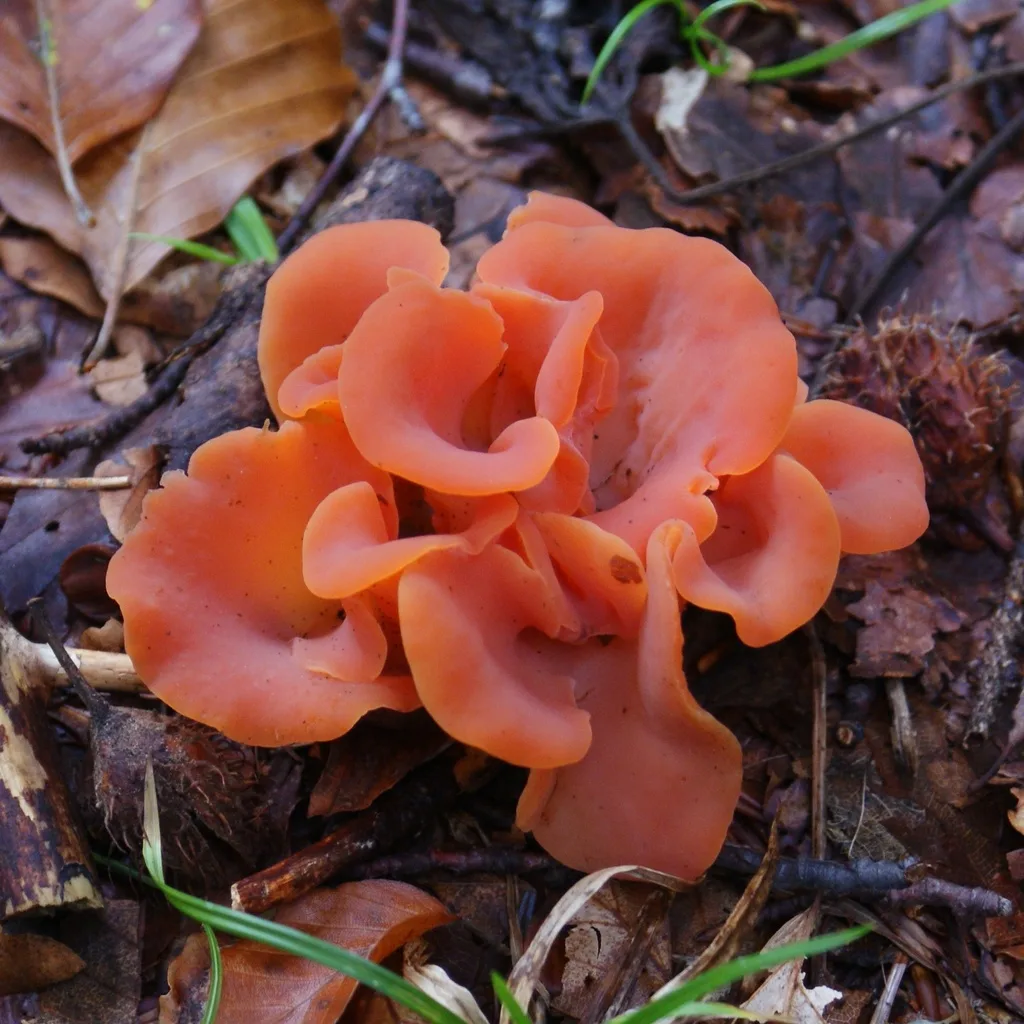
Apricot jelly is the pink to salmon jelly shaped like a tongue or funnel, with a stem at one side. A Pacific Northwest forest survey handbook gives 20 to 80 mm in height, a translucent rubbery texture and a smooth underside. It grows in duff, soil and rotten wood under conifers, in late summer and fall, rarely in spring.
The handbook lists records from California, Oregon and Washington and states that no other Pacific Northwest species looks like it. Older names include Tremiscus helvelloides and Phlogiotis helvelloides.
Toothed Jelly (Pseudohydnum gelatinosum)
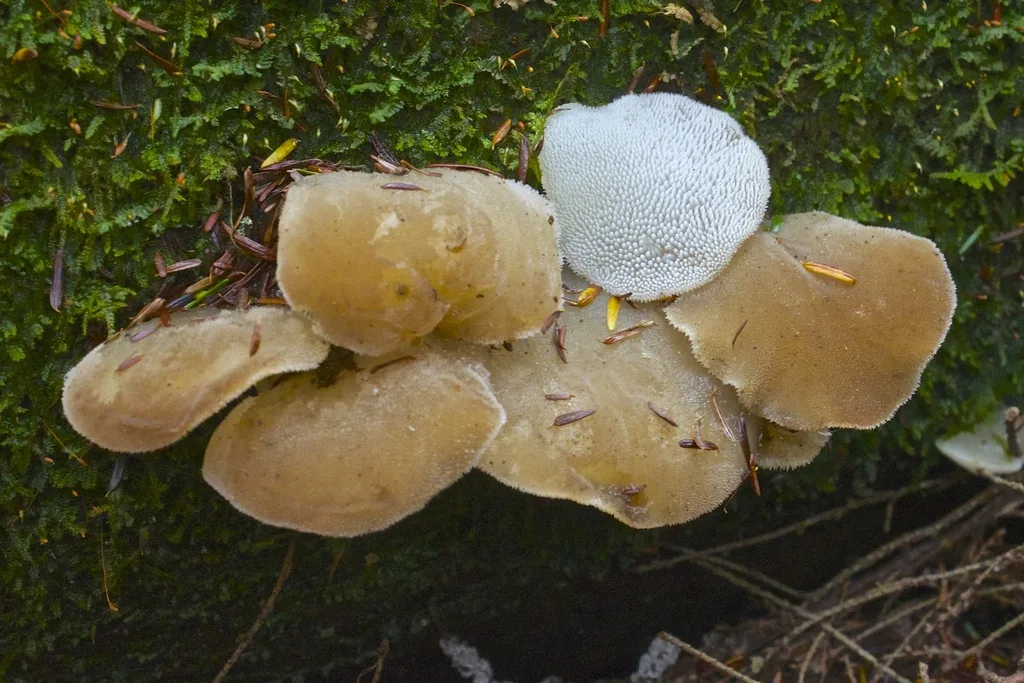
The toothed jelly is a pale, translucent jelly cap with tiny cone-shaped spines underneath. MykoWeb gives a cap of 2 to 5 cm, whitish to gray, on conifer logs and stumps from late fall to midwinter in California. It is also called jelly tooth. The spines resemble a tooth fungus, but tooth fungi are fleshy to leathery and never translucent.
Witch's Butter vs Golden Ear vs Orange Jelly
These three yellow-to-orange jellies are the hardest to separate, and the wood and host fungus tell them apart better than color does. Witch's butter and golden ear grow on hardwood, while orange jelly grows on bare conifer wood with a pale base. A microscope gives the final answer.
| Feature | Witch's butter | Golden ear | Orange jelly |
|---|---|---|---|
| Latin name | Tremella mesenterica | Naematelia aurantia | Dacrymyces chrysospermus |
| Size | 2 to 5 cm | 2 to 10 cm | Up to 5 cm |
| Wood | Hardwood sticks with bark | Dead hardwood | Bare conifer wood |
| Feeds on | Crust fungi in the wood | Hairy curtain crust | The wood itself |
| Field clue | Thin stick, bark on | Grows out of a hairy crust | Narrow, pale base |
| Basidia | Split lengthwise | Split lengthwise | Tuning fork |
Things Mistaken for Jelly Fungi
Slime molds, star jelly, stinkhorn eggs and jelly-like cup fungi are the usual mix-ups, but the most dangerous jelly-related mistake happens in the kitchen. Two of the field look-alikes are not fungi at all. Dried black fungus and silver ear soaked too long have caused bongkrekic acid poisoning, which can be fatal.
| Look-alike | What it is | How to tell | Risk |
|---|---|---|---|
| Dog vomit slime mold (Fuligo septica) | Slime mold | Yellow to orange blob on mulch; dries to a spore crust | Harmless; spores can bother allergies |
| Star jelly (Nostoc commune) | Cyanobacterium | Green to blue-black jelly on soil or gravel; black when dry | Not toxic; slippery |
| Stinkhorn egg | Young stinkhorn | Egg in mulch with a jelly layer inside | Treat as inedible |
| Black jelly drops (Bulgaria inquinans) | Jelly-like cup fungus | Black drops on dead hardwood logs, especially oak | Not covered in our sources |
| Soaked dried black fungus or silver ear | Food product | Outbreaks followed soaking for more than two days | Dangerous: bongkrekic acid, death rates up to 60 percent in past outbreaks |
Slime Molds
Dog vomit slime mold appears on mulch and thatchy lawns in summer, often after heavy rain. Illinois Extension explains that slime molds are no longer classed as fungi. It dries to a tan crust with a dark core of spores. It is harmless to plants, pets and people, although the spores can irritate allergies or asthma. Our backyard mushroom identification guide covers other things in mulch.
Star Jelly (Nostoc)
Star jelly is Nostoc commune, a cyanobacterium that swells into rubbery, yellow-green to blue-black jelly after rain. Ohio State University Extension finds it in turf openings, gravel lots and ditches, and it collapses into black flakes when dry. It is not toxic, but wet mats are slippery. Ohio State lists "witch's-butter" among its old names.
Stinkhorn Eggs and Jelly Drops
A stinkhorn egg sits in mulch like a small white ball, and cut open it shows a jelly layer around a developing stinkhorn. Compare them in our stinkhorn mushroom identification chart. Black jelly drops is one of the jelly-like cup fungi that one species account lists.
Are Jelly Fungi Edible?
Several jelly fungi are listed as edible, but most have little flavor, and no wild jelly fungus should be eaten without expert confirmation. Tom Volk writes that some are quite edible but none tastes particularly good. MykoWeb lists golden ear, orange jelly and toothed jelly as edible, and black witch's butter as probably edible but insignificant.
Two jelly fungi are major foods. The 2021 Auricularia study calls the black wood ear the second most important edible mushroom in China after shiitake. The risk comes from how the dried product is handled. The Hong Kong Centre for Food Safety reports that soaked black fungus and silver ear caused bongkrekic acid outbreaks in Guangdong and Zhejiang, usually after soaking for more than two days. A bacterium, Burkholderia gladioli pathovar cocovenenans, makes the toxin.
- The toxin is heat-stable, so cooking does not remove it.
- Symptoms start 30 minutes to 12 hours after eating and include dizziness, abdominal pain and vomiting.
- In severe cases, death can follow 1 to 20 hours after symptoms begin.
- The Centre advises soaking in the refrigerator if overnight soaking is needed, and discarding soaked mushrooms that smell or taste abnormal.
Read our poisonous vs edible mushrooms guide before trusting any rule of thumb about wild fungi.
Common Identification Mistakes
Naming a Yellow Jelly by Color Alone
Witch's butter, golden ear and orange jelly overlap in color. Check whether the wood is hardwood or conifer, and look for a hairy crust fungus on the same stick.
Judging a Dried Specimen
Jelly fungi change color and shape as they dry. A shriveled black or orange crust can look nothing like the wet fungus, so look again after rain.
Trusting the Name "Witch's Butter"
Sources apply "witch's butter" to Tremella mesenterica, golden ear, orange jelly, black witch's butter and even star jelly. Use the Latin name when you ask for help.
Calling Every Jelly on the Lawn a Fungus
Green-black jelly on soil or gravel is usually star jelly, and a yellow blob on mulch is usually a slime mold. Neither is a fungus.
Using Old Field Guide Names
Exidia recisa, Auricularia auricula, Tremella aurantia and Phlogiotis helvelloides all appear in older US books. Learn the current names before comparing photos online, and follow our guide to identifying a mushroom you found.
Frequently Asked Questions
What is a jelly fungus?
A jelly fungus is a fungus with a rubbery or gelatinous body, usually growing on dead wood. The name covers several unrelated groups, including Tremella, Exidia, Auricularia and Dacrymyces. Most shrink when dry and swell again after rain.
Is jelly fungus edible?
Some jelly fungi are listed as edible, but most have little flavor. Wood ear and snow fungus are cultivated foods, yet dried products soaked for more than two days have caused bongkrekic acid poisoning, which can be fatal. Never eat a wild jelly fungus without expert confirmation.
Is witch's butter poisonous?
None of the sources we checked lists witch's butter as poisonous, and its look-alike golden ear is listed as edible but flavorless. That is not a safety rating, because several different fungi share the name. Ask an expert before eating any wild find.
What is the white jelly fungus?
The white jelly fungus is usually snow fungus, Tremella fuciformis, also called silver ear. It grows wild on dead hardwood in parts of the US, including East Texas, and is cultivated in China. The pale toothed jelly on conifer logs is another candidate.
What is yellow brain fungus?
Yellow brain is the British name for Tremella mesenterica, known in the US as witch's butter. It is a yellow, brain-like jelly on hardwood sticks. Golden ear and orange jelly look similar, so check the wood.
Why does jelly fungus disappear when it is dry?
Jelly fungi lose water and shrink to a thin, hard crust in dry air. When rain returns, they take up water and swell back to full size. Golden ear, for example, dries to a crust that revives with moisture.
What is the black jelly fungus on wood?
Black jelly on hardwood branches is usually black witch's butter, Exidia glandulosa, or a close relative. Brown, ear-shaped jelly is more likely wood ear.
Is jelly fungus harmful to trees?
Most jelly fungi grow on sticks and logs that are already dead. Witch's butter and golden ear feed on crust fungi in the wood rather than on the wood itself. None of the sources we checked describes a jelly fungus as a tree disease.
What is the jelly stuff on my lawn after rain?
Green to blue-black jelly on a lawn or gravel after rain is usually star jelly, Nostoc commune. It is a cyanobacterium, not a fungus, and Ohio State University Extension describes it as not toxic.
Is jelly ear the same as wood ear?
Jelly ear is the European species, Auricularia auricula-judae. A 2021 study found it only in Europe. The North American hardwood wood ear is Auricularia angiospermarum, and the conifer species is Auricularia americana.
Final Safety Reminder
Jelly fungi have messy names, several unrelated look-alikes and, in their dried cultivated forms, a real food-safety risk. Never eat a wild mushroom based on a chart, a photo or an app. Photograph the fungus and the wood it grows on, using our guide on how to photograph mushrooms for identification, then check it with our free mushroom identifier and a local mycological club. If someone may have eaten a poisonous mushroom in the US, call Poison Control at 1-800-222-1222.
Sign in to leave a comment and join the discussion.
 Species Guide
A coral fungus is a mushroom shaped like branching sea coral or a tuft of upright clubs, with no cap and no gills. Most US corals grow from soil in the...
 Species Guide
A cauliflower mushroom ( Sparassis ) is a large, cream-colored rosette of flat, wavy, ribbon-like lobes that grows at the base of a tree. It has no caps, no...
 Species Guide
The golden oyster mushroom ( Pleurotus citrinopileatus ) is a bright yellow oyster mushroom that grows in dense, bouquet-like clusters on dead hardwood,...