Cauliflower Mushroom Identification Chart With Pictures
— views
A cauliflower mushroom (Sparassis) is a large, cream-colored rosette of flat, wavy, ribbon-like lobes that grows at the base of a tree. It has no caps, no gills and no pores. The eastern species grows at oaks from summer into fall, and the western species grows at conifers from fall into winter. We found no documented deadly look-alike, but coral fungi cause stomach upsets, so an expert must confirm any find.
This cauliflower mushroom identification chart with pictures covers the two main US species, the naming mix-up that puts different Latin names on the same mushroom, a month-by-month season comparison, what the fungus does to the tree, and the look-alikes that matter.
Key Takeaways
- A cauliflower mushroom is a rosette of flat, wavy ribbons rising from a rooting base at the foot of a tree.
- The eastern species, Sparassis spathulata, grows at the base of trees, often oak stumps. Most US records fall in July to September, peaking in August.
- The western species, Sparassis radicata, grows at conifers. Most records fall in October to January.
- Field guides use Sparassis crispa for different mushrooms, so a name alone does not tell you which species a guide means.
- The western species causes brown rot at the base of conifers, and the mushroom returns to the same tree year after year.
- Coral fungi (Ramaria) are the risky look-alike, with stomach upsets on record. They are brittle and branch like coral, not like ribbons.
Cauliflower Mushroom Identification Chart
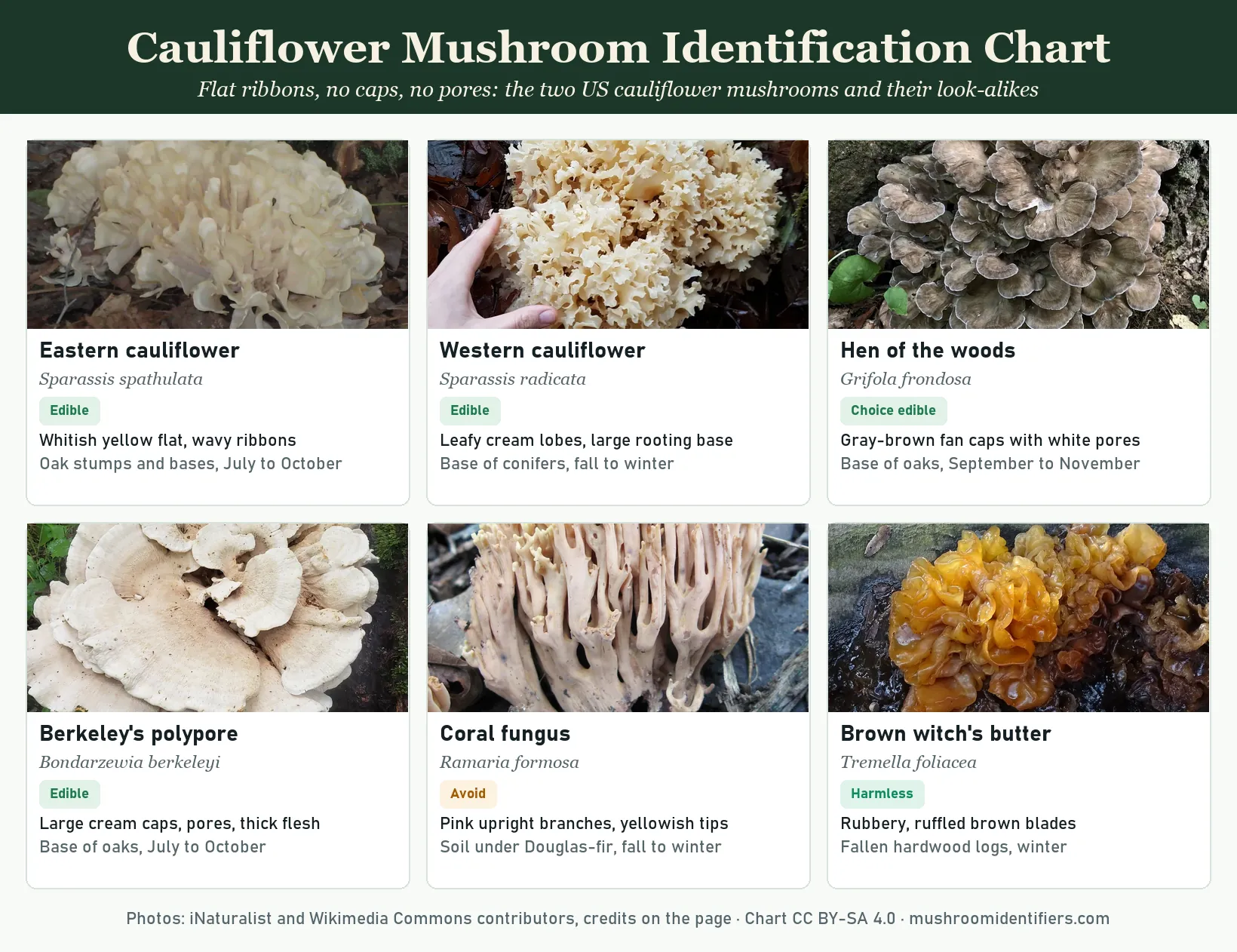
| Mushroom | Key features | Where and when | Edibility or risk |
|---|---|---|---|
| Eastern cauliflower mushroom (Sparassis spathulata) | Whitish yellow rosette of flat, wavy ribbons, cordlike root | Base of trees, often decayed oak stumps, July to October | Excellent edible when young per MDC |
| Western cauliflower mushroom (Sparassis radicata) | White to pale yellow leaf-like branches, large rooting base | Base of conifers in the West, late fall to midwinter in California | Edible and choice per MykoWeb |
| Hen of the woods (Grifola frondosa) | Many small gray-brown fan caps with white pores | Base of oaks, September to November | Choice edible per MDC; stomach upsets reported |
| Berkeley's polypore (Bondarzewia berkeleyi) | Large cream caps, thick white flesh, whitish pores | Base of oaks, July to October | Edible when young; tough and bitter with age |
| Coral fungus (Ramaria formosa) | Upright pink branches with yellowish tips, stem stains brown | Soil in mixed forests with Douglas-fir and hemlock, fall to midwinter | Avoid; stomach problems reported |
| Brown witch's butter (Tremella foliacea) | Rubbery, ruffled brown blades, sticky when wet | On fallen hardwood logs, winter in California | Edible but bland per MykoWeb |
Details come from the Missouri Department of Conservation (MDC) and MykoWeb. MDC dates are for Missouri, and MykoWeb dates are for California, so local seasons can differ.
What Is a Cauliflower Mushroom?
A cauliflower mushroom is any member of the genus Sparassis, a group of fungi that form a rounded mass of flattened, wavy branches at the base of trees. The National Park Service describes the western species as white to cream clusters that resemble cauliflower or egg noodles. The branches rise from a central base, and the mushroom forms a prominent rooting base.
The spores form on the surfaces of the flat branches. MykoWeb notes that the spore-bearing layer covers the flattened branch surfaces, so there are no gills or pores to look for. The spore print is white, according to both MDC and MykoWeb. Learn the method in our spore print guide.
Cauliflower mushrooms feed on trees. MDC describes the eastern species as parasitic in living trees and saprobic on dead ones. MykoWeb says the western species is believed to be parasitic on conifers, and that affected trees fruit every year.
How Do You Identify a Cauliflower Mushroom?
Look for four things together: flat ribbons instead of caps, a cream to pale yellow color, a single rooting base, and a spot at the foot of a tree or stump. No single feature is enough. Our guide to gills vs pores vs ridges explains why a lack of gills and pores narrows the options so much.
Shape
The mushroom is one rounded mass of many thin, flattened, wavy lobes. MDC gives the eastern species 6 to 12 inches wide and 6 to 10 inches tall. The PNW Plant Disease Management Handbook describes western clusters of thin, leaf-like branches up to about a foot across. MykoWeb notes that western trees sometimes produce masses the size of a bushel basket.
Color
The eastern species is whitish yellow, according to MDC. MykoWeb describes the western species as white to pale yellow when young, with branch edges darkening to brown with age.
Texture and Smell
MDC says the flesh is flexible when young and becomes tough with age. MykoWeb describes the western species as having white flesh and a fragrant, somewhat spicy odor.
Base
Dig carefully around the base. MDC notes a cordlike root on the eastern species. MykoWeb describes a large, root-like base on the western species that looks chambered above and solid below when cut. The PNW Handbook adds that a perennial stalk connects each fruiting body to a decayed root.
When Does the Cauliflower Mushroom Grow?
The eastern cauliflower mushroom peaks in August, while the western species peaks from October to January, and hen of the woods peaks in October. MDC lists July through October for the eastern species. MykoWeb gives late fall to midwinter for the western species in California. The timing alone can hint at which rosette you have found.
Research-grade iNaturalist records for the US, as of November 2026, show the full pattern. Each column shows the share of that species' records observed in each month.
| Month | S. spathulata (4,757 records) | S. americana (1,380) | S. radicata (1,728) | Hen of the woods (12,769) |
|---|---|---|---|---|
| February to May | Under 1% | 2% | 5% | Under 1% |
| June | 2% | 6% | Under 1% | Under 1% |
| July | 20% | 14% | Under 1% | Under 1% |
| August | 51% | 26% | 1% | 2% |
| September | 20% | 30% | 12% | 35% |
| October | 5% | 16% | 30% | 56% |
| November | Under 1% | 4% | 21% | 5% |
| December | Under 1% | 1% | 18% | Under 1% |
| January | Under 1% | Under 1% | 12% | Under 1% |
In August, US records of the eastern cauliflower mushroom outnumber hen of the woods records almost ten to one. In October, hen records outnumber it almost thirty to one. These figures show when people photographed the mushrooms, not exactly when they fruited, so treat them as a guide. MDC also notes that the eastern species is quite common after a wet summer and rare in a dry one.
Common Cauliflower Mushroom Types in the US
Two cauliflower mushrooms are widely recognized in the US: an eastern species at oaks and a western species at conifers. The region and the host tree are the quickest way to tell them apart. iNaturalist also lists a third name, Sparassis americana, explained in the naming section below.
Eastern Cauliflower Mushroom (Sparassis spathulata)
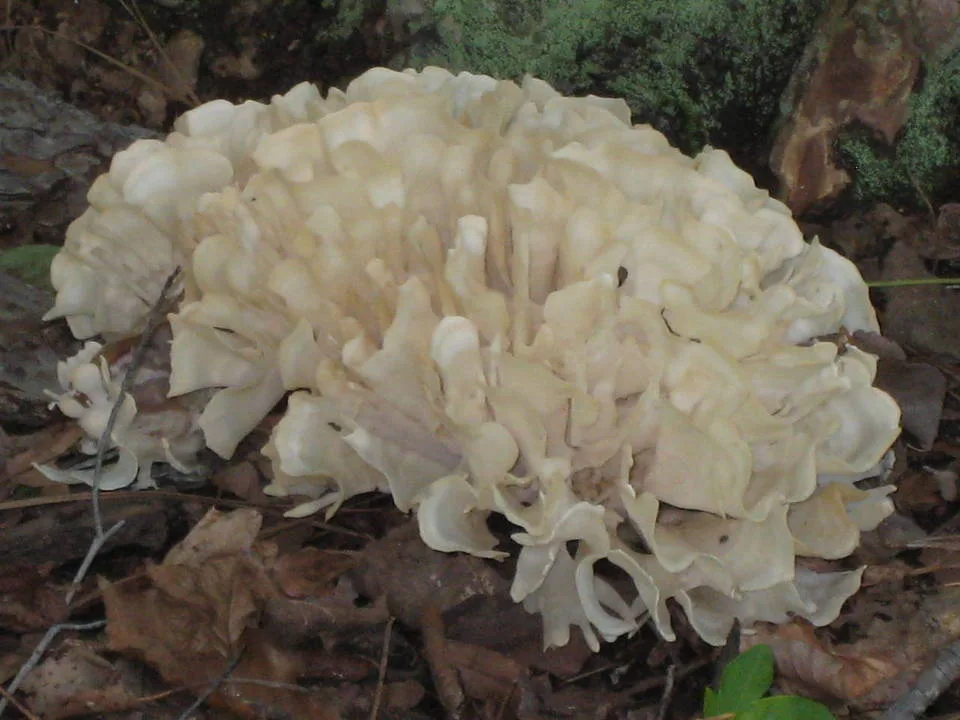
The Missouri Department of Conservation calls this species the eastern cauliflower mushroom and lists it statewide in Missouri. MDC describes a large, stalkless, whitish yellow rosette of flattened, wavy, ribbonlike folds with a cordlike root. It grows singly at the base of trees, often at decayed oak stumps, from July to October. It can reappear in the same spot every year.
MDC lists Sparassis herbstii as another name for it. A 2015 study led by Ronald Petersen at the University of Tennessee treats S. herbstii as a form of S. spathulata. MDC calls it an excellent edible when young and fresh.
Western Cauliflower Mushroom (Sparassis radicata)
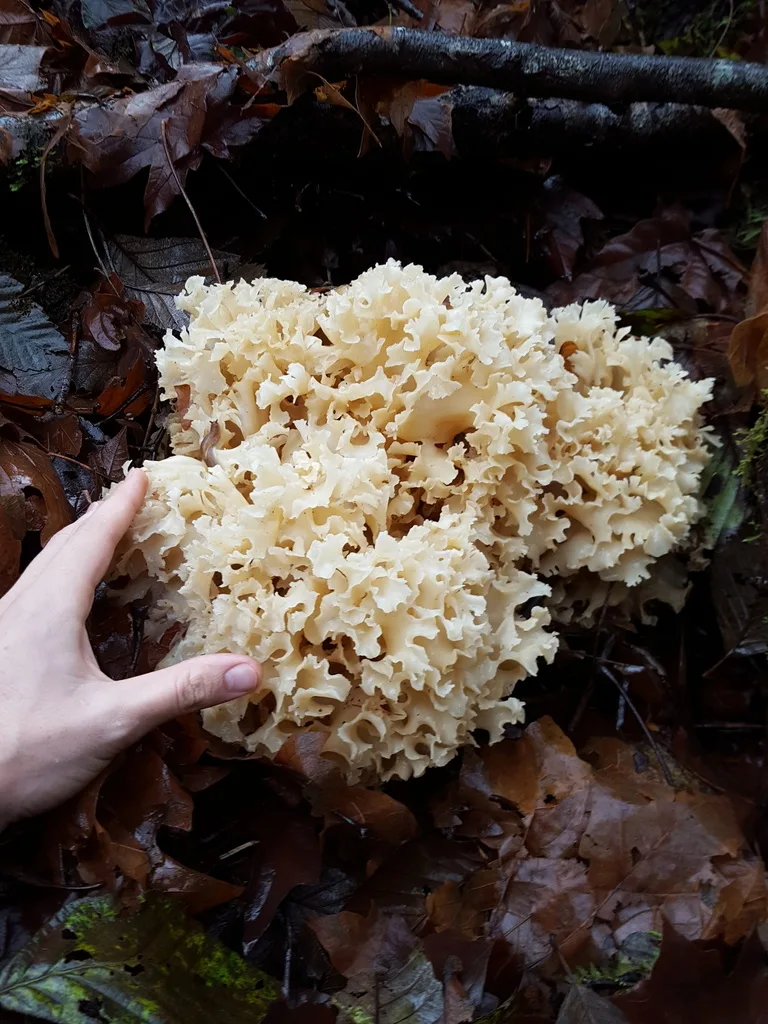
This is the cauliflower mushroom of western conifer forests. MykoWeb describes a rounded mass of flattened, wavy, leaf-like branches from a large, root-like base. In California, it grows usually alone at the base of conifers, especially Bishop and Monterey pine, from late fall to midwinter. The PNW Handbook, which calls it S. crispa, lists Engelmann spruce, Douglas-fir, ponderosa pine, white fir and southwestern white pine as hosts.
MykoWeb rates it edible and choice, and notes that cleaning debris out of the branches can be a deterrent. See our guide to edible mushrooms in the Pacific Northwest for other species of the region.
Why Are Cauliflower Mushroom Names So Confusing?
The name Sparassis crispa has been used for several different mushrooms, and US sources still disagree on how to use it. DNA studies have split what older guides called one species into several. Different reputable sources have not caught up in the same way, so the same western mushroom can appear under two names.
| Source | Name it uses | What it says |
|---|---|---|
| MykoWeb (California) | Sparassis radicata | S. crispa is a misapplied name for it. DNA separates western S. radicata from eastern S. americana and European S. crispa. |
| National Park Service (Mount Rainier) | Sparassis radicata | Western conifer species that causes brown rot |
| PNW Plant Disease Management Handbook | Sparassis crispa | Lists S. radicata as the former name |
| Missouri Department of Conservation | Sparassis spathulata | Synonym S. herbstii. Also lists a rare "wood cauliflower," S. crispa, in Missouri |
| Petersen and colleagues, 2015 | Sparassis spathulata | The American species differs from the European S. brevipes, so different names apply |
The practical reading is simple. If a US guide says Sparassis crispa, check the region and host tree. At western conifers, it usually refers to the mushroom MykoWeb calls S. radicata, as the PNW Handbook's own "formerly S. radicata" note shows. At eastern oaks, compare the find with S. spathulata, since MDC treats S. crispa as rare there. MykoWeb also names an eastern species, S. americana, and iNaturalist records for it peak in August and September.
The sources conflict on whether S. crispa itself grows in the US. MykoWeb treats it as European, while MDC lists it as rare in Missouri. We could not resolve this with the sources we checked.
Is the Cauliflower Mushroom Bad for the Tree?
The cauliflower mushroom is a sign of root and butt decay in the tree it grows from, and the western species causes brown rot. The National Park Service says it causes brown rot, especially at the base of trees, and that it lives on both living and dead trees.
The PNW Handbook gives the details for western conifers:
- Yellowish white fans of fungal threads form under the bark of roots on old trees.
- Decayed wood turns reddish at first, then yellowish brown.
- Diseased roots are covered with resin.
- Root decay affects heartwood and sapwood, while trunk decay stays in the heartwood.
- The fungus appears to spread between trees through root grafts or root contact. It does not enter through fire scars or wounds.
The handbook's only listed control is removing infected trees when thinning a stand. Picking the mushroom does not remove the fungus in the roots. A tree with base decay near a house, road or play area deserves an inspection by a certified arborist. Our oak tree fungus identification guide covers the other fungi that grow at the base of oaks, and our guide to mushrooms growing on trees explains how fruiting position relates to rot.
Cauliflower Mushroom Look-Alikes
Four kinds of fungi get mistaken for a cauliflower mushroom: hen of the woods, Berkeley's polypore, coral fungi and jelly fungi. MDC names the hen, Berkeley's polypore and the black-staining polypore as look-alikes. MykoWeb compares the cauliflower mushroom with brown witch's butter. Coral fungi are the group with stomach upsets on record.
Hen of the Woods (Grifola frondosa)
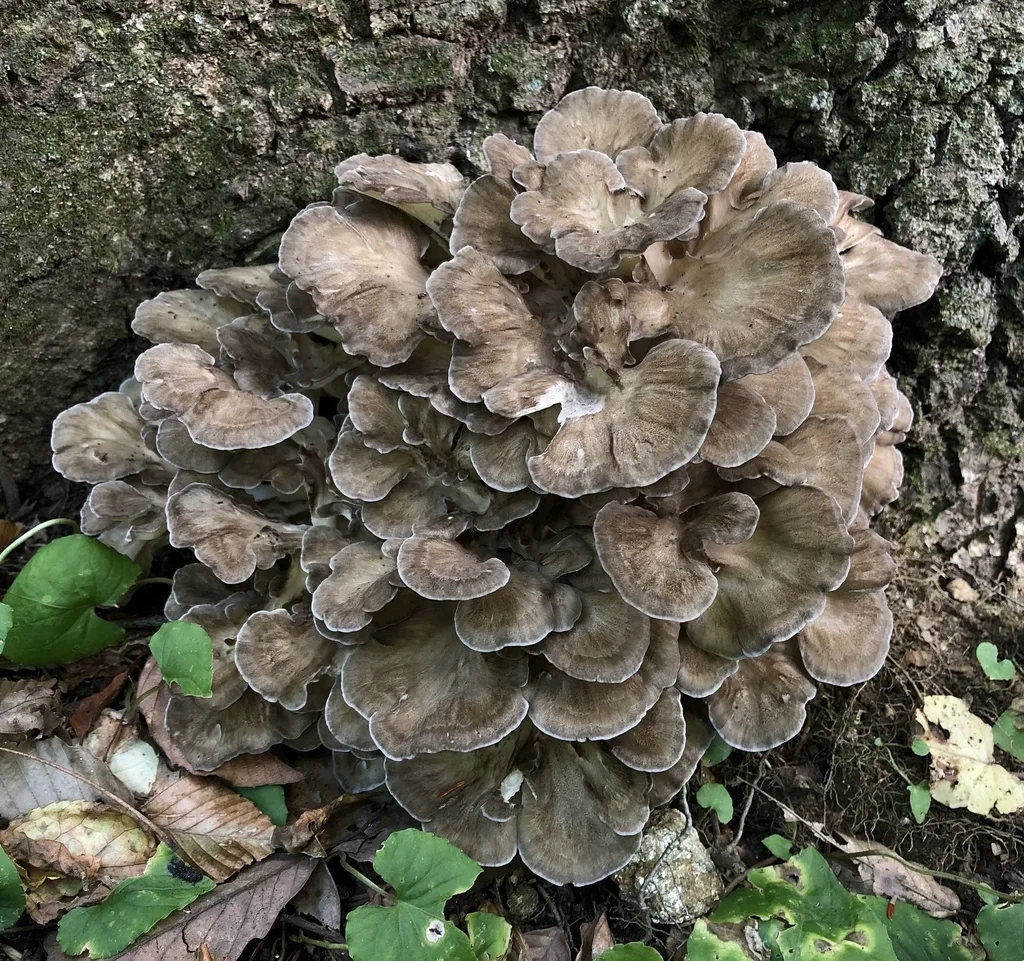
The hen grows at the same oaks, but it has many small gray-brown fan caps with a white pore surface underneath. A North American field guide gives caps of 3 to 14 cm. The Missouri Department of Conservation lists September through November, later than the cauliflower mushroom, and calls it a choice edible.
Berkeley's Polypore (Bondarzewia berkeleyi)
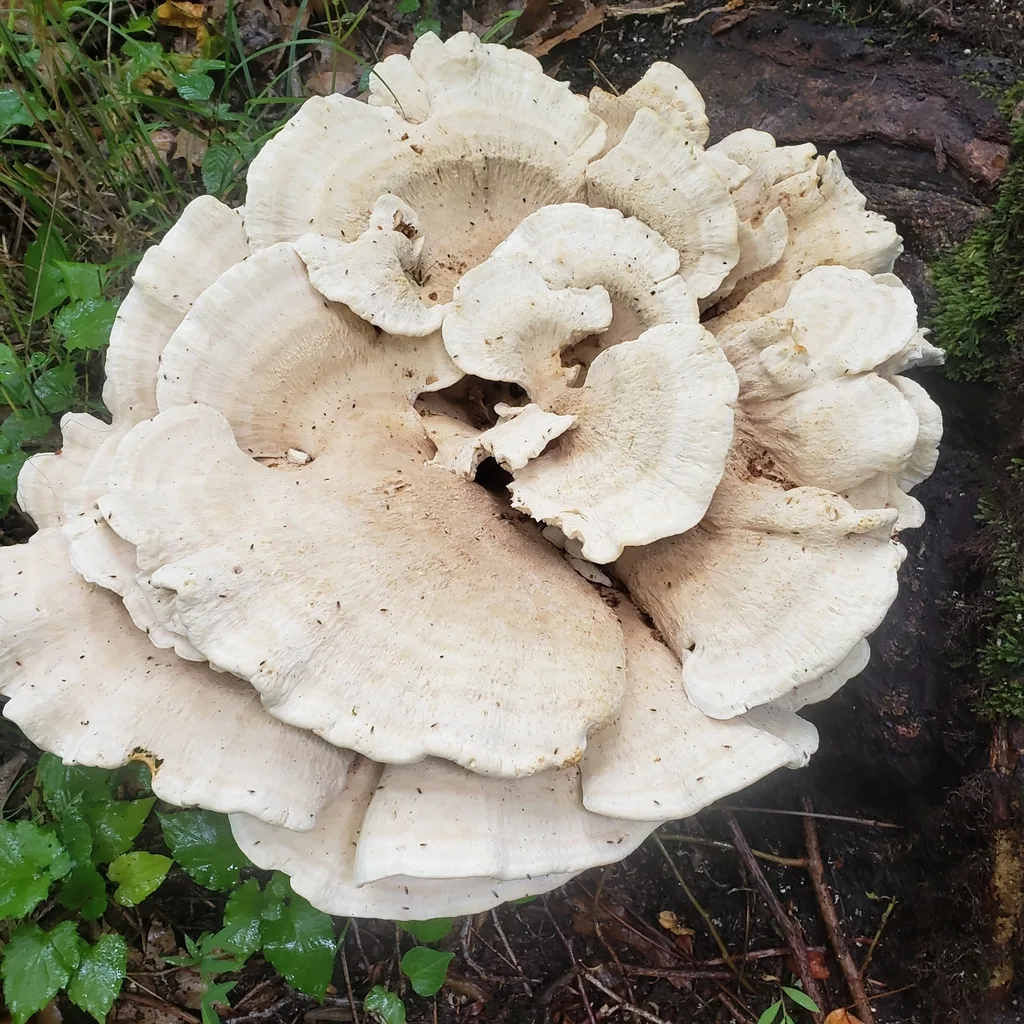
Berkeley's polypore is cream-colored like a cauliflower mushroom, but it forms true caps with whitish pores underneath. The Missouri Department of Conservation gives caps of 3 to 12 inches and whole masses up to 3 feet across at the base of oaks, from July to October. MDC lists it as edible when young and warns that it gets tough, woody and bitter with age.
The black-staining polypore is the third rosette at oak bases. The Missouri Department of Conservation notes that its flesh and pores bruise black when cut or touched, and that the cauliflower mushroom does not.
Coral Fungus (Ramaria formosa)
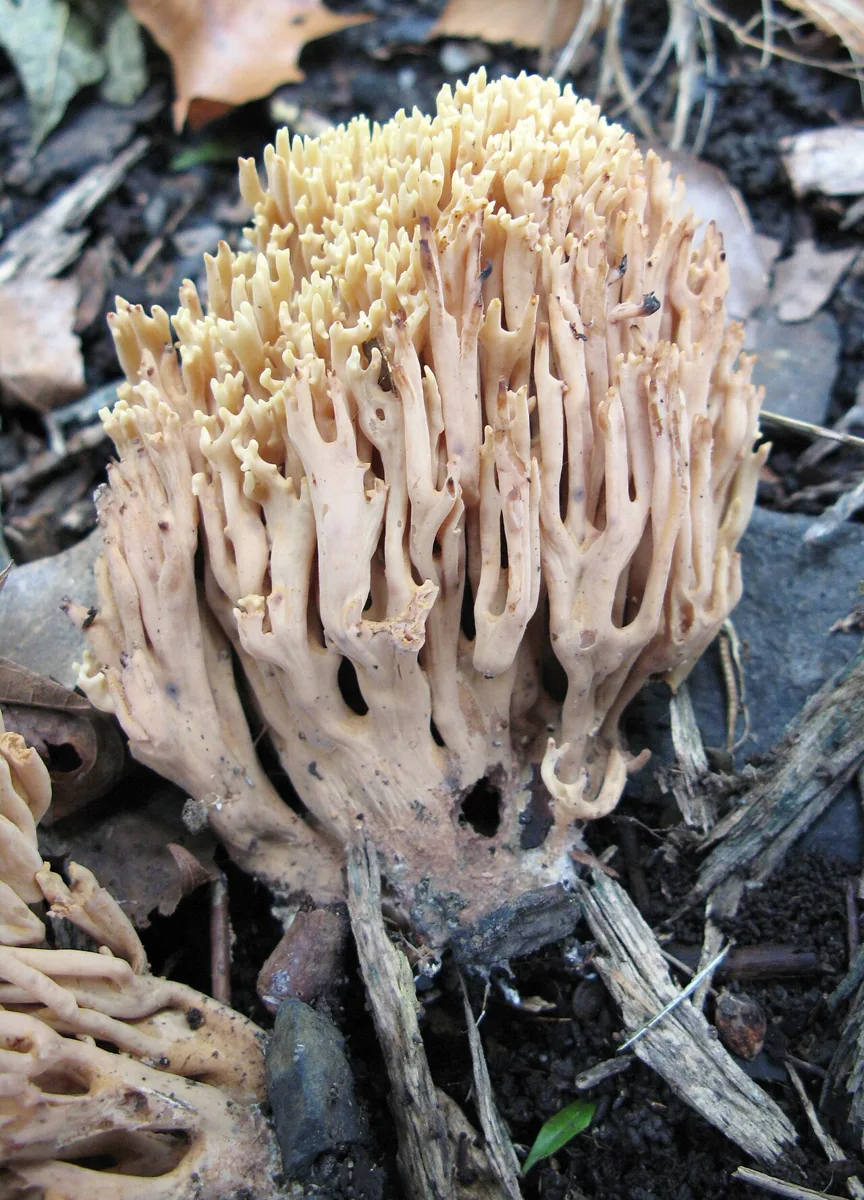
Coral fungi grow as upright branches from a base in the soil, not as flat ribbons. MykoWeb describes Ramaria formosa with pink branches, yellowish tips and a massive white stem that stains brown when handled. It grows in mixed forests with Douglas-fir and western hemlock from fall through midwinter. MykoWeb lists its edibility as unclear and says it has been reported to cause stomach problems in some people. The name has been applied to several distinct species.
Other corals carry the same warning. The NAMA poisoning registry summary lists stomach upsets after Ramaria meals in Colorado and Washington, with onset at 4.5 to 8 hours. It also lists a dog in Colorado with stomach upset, salivation and dry heaves after Ramaria pallida.
Brown Witch's Butter (Tremella foliacea)
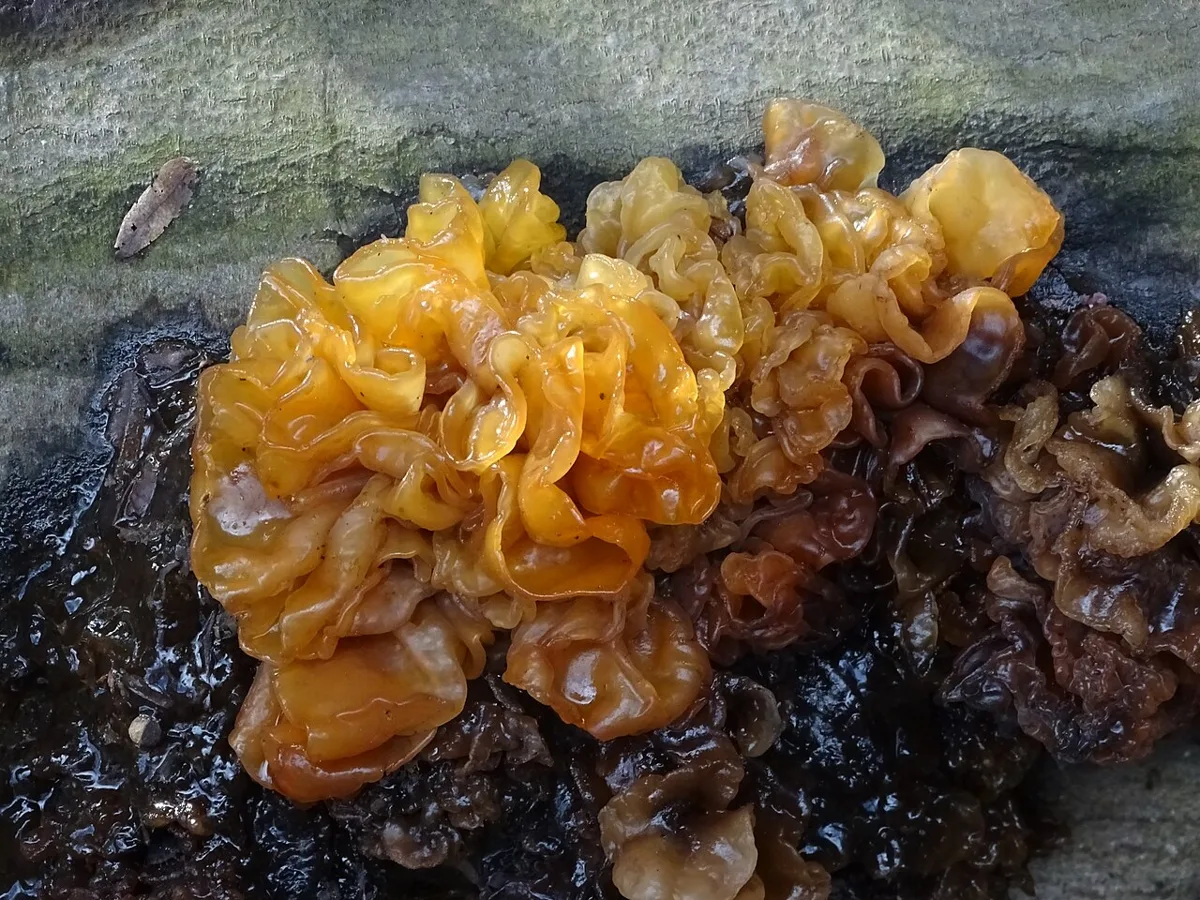
This jelly fungus forms a ruffled, rounded mass that can look like a small, dark cauliflower mushroom. MykoWeb describes it as 5 to 15 cm across, dull brownish purple to cinnamon brown, with thin, rubbery, somewhat translucent blades that are sticky when wet. It grows on fallen hardwood logs and branches, not from a rooting base at a tree. MykoWeb lists it as edible but with little flavor. Newer sources place it in Phaeotremella.
A whitish jelly fungus can also cause confusion. The Missouri Department of Conservation describes jellied false coral, Tremellodendron pallidum, as a whitish cluster of flattened or fused upright branches, 2 to 6 inches wide, on the ground in deciduous or mixed woods from May to November. It is tough and leathery, and MDC lists it as not edible.
Cauliflower Mushroom vs Look-Alikes: Side-by-Side Comparison
Shape, texture and the spot where it grows separate a cauliflower mushroom from every look-alike. Coral fungi are the dangerous mix-up because of reported stomach illness. We found no deadly look-alike documented in the sources we checked.
| Mushroom | Shape | Texture | Grows on | Risk |
|---|---|---|---|---|
| Cauliflower mushroom (Sparassis) | Flat, wavy ribbons, no caps or pores | Flexible when young, tough with age | Base of a tree or stump, rooting base | Edible after expert check |
| Hen of the woods | Many gray-brown fan caps, white pores | Firm | Base of oaks | Edible after expert check; stomach upsets reported |
| Berkeley's polypore | Large cream caps, whitish pores | Thick, firm flesh | Base of oaks | Edible when young; bitter when old |
| Black-staining polypore | Caps with white pores | Bruises black | Base of oaks | Edible when young per MDC |
| Coral fungi (Ramaria) | Upright branches from soil | Brittle, breaks easily, per MDC | Soil | Stomach upsets reported. Avoid. |
| Jellied false coral | Whitish flattened, fused branches | Tough, leathery, gelatinous | Soil in deciduous woods | Not edible per MDC |
| Brown witch's butter | Ruffled brown blades | Rubbery, sticky when wet | Fallen hardwood logs | Edible but bland per MykoWeb |
A Quick Field Test: Flip, Feel, Dig
Three checks separate a cauliflower mushroom from its look-alikes: look for caps and pores, test the texture, and trace the base. Do them in place and photograph each step. They narrow the options, but they do not replace an expert's confirmation.
- Flip. Look under the lobes. Caps with a pore surface point to a hen, Berkeley's polypore or the black-staining polypore. Flat ribbons with no pores fit a cauliflower mushroom.
- Feel. Bend a branch gently. A coral that snaps is a coral fungus. A rubbery, translucent, sticky blade is a jelly fungus. A cauliflower mushroom is flexible when young.
- Dig. Follow the base down. A cauliflower mushroom roots into the ground beside a tree or stump. A jelly fungus sits on a fallen log. A coral rises from soil.
Can You Eat a Cauliflower Mushroom?
Cauliflower mushrooms are rated as edible by MDC and MykoWeb, but only an experienced identifier should confirm a find before anyone eats it. Nobody should eat a wild mushroom based on this page. MDC calls the eastern species an excellent edible when young and fresh, and MykoWeb rates the western species edible and choice.
- MDC's rating applies to young, fresh specimens only.
- Eat a small amount the first time, as MDC advises for edible species.
- Rule out coral fungi with the feel test, because some cause stomach upsets.
We found no Sparassis case in NAMA's summary of about 2,000 poisoning reports, which does not prove any single mushroom safe. Read our poisonous vs edible mushrooms guide before trusting any rule of thumb. If a dog eats a coral fungus or any other wild mushroom, follow our guide on what to do if your dog ate a mushroom.
Common Identification Mistakes
Calling Any Cream Rosette a Cauliflower
Berkeley's polypore is cream too. Turn it over, because pores mean it is not a cauliflower mushroom.
Confusing Coral Fungi With Cauliflower Mushrooms
Corals have upright branches that snap. Cauliflower mushrooms have flat, wavy ribbons. Coral fungi have caused stomach upsets in NAMA reports.
Trusting the Latin Name in an Old Guide
Older and even current guides use Sparassis crispa for different mushrooms. Go by region, host tree and features.
Ignoring the Host Tree
The eastern species is often found at oak stumps, and the western species grows at conifers. A ruffled brown mass on a fallen hardwood log is a jelly fungus.
Photographing Only the Top
The base and the underside matter most. Photograph the whole mass, the underside, a bent branch and the base, using our guide on how to photograph mushrooms for identification.
Frequently Asked Questions
What does a cauliflower mushroom look like?
It looks like a head of cauliflower or a pile of egg noodles: a cream to pale yellow mass of flat, wavy ribbons. It has no caps, gills or pores. It grows from a rooting base at the foot of a tree.
Where do cauliflower mushrooms grow?
They grow at the base of trees and stumps. The eastern species is often found at decayed oak stumps, and the western species grows at conifers such as pines, Douglas-fir and spruce. They often return to the same tree each year.
When is cauliflower mushroom season?
In the East, MDC lists July to October, and iNaturalist records peak in August. In the West, MykoWeb gives late fall to midwinter for California, and records peak from October to January.
Is there a poisonous cauliflower mushroom look-alike?
We found no deadly look-alike documented. Hen of the woods and two other polypores grow at the same oaks but have pores, and coral fungi such as Ramaria formosa have caused stomach problems in some people. Corals are brittle with upright branches, while cauliflower mushrooms have flat, flexible ribbons.
Can you eat cauliflower mushrooms?
MDC calls the eastern species an excellent edible when young, and MykoWeb rates the western species choice. An experienced identifier must confirm the find first. Eat a small amount the first time, as MDC advises.
Is Sparassis crispa the same as the cauliflower mushroom?
Sparassis crispa is a name that sources apply differently. MykoWeb treats it as European and uses Sparassis radicata for the western US species, while the PNW Handbook still uses S. crispa for it. The eastern species is Sparassis spathulata.
Does a cauliflower mushroom hurt the tree?
It is a sign of root and butt decay. The National Park Service says the western species causes brown rot at the base of trees, and the PNW Handbook says it appears to spread through root contact. A tree with base decay near a house or road should be checked by an arborist.
What is the difference between a cauliflower mushroom and hen of the woods?
A cauliflower mushroom is cream colored with flat ribbons and no pores. Hen of the woods is gray-brown with many fan caps and a white pore surface. In the East, the cauliflower mushroom also peaks earlier, in August, while the hen peaks in October.
Final Safety Reminder
A cauliflower mushroom is distinctive, but coral fungi, jelly fungi and three oak polypores can sit close enough to fool a quick look. Never eat a wild mushroom based on a chart, a photo or an app. Do the flip, feel and dig checks, photograph each step, and check your find with our free mushroom identifier and a local mycological club. For other species at the base of trees, see our tree mushroom identification chart. If someone may have eaten a poisonous mushroom in the US, call Poison Control at 1-800-222-1222.
Sign in to leave a comment and join the discussion.
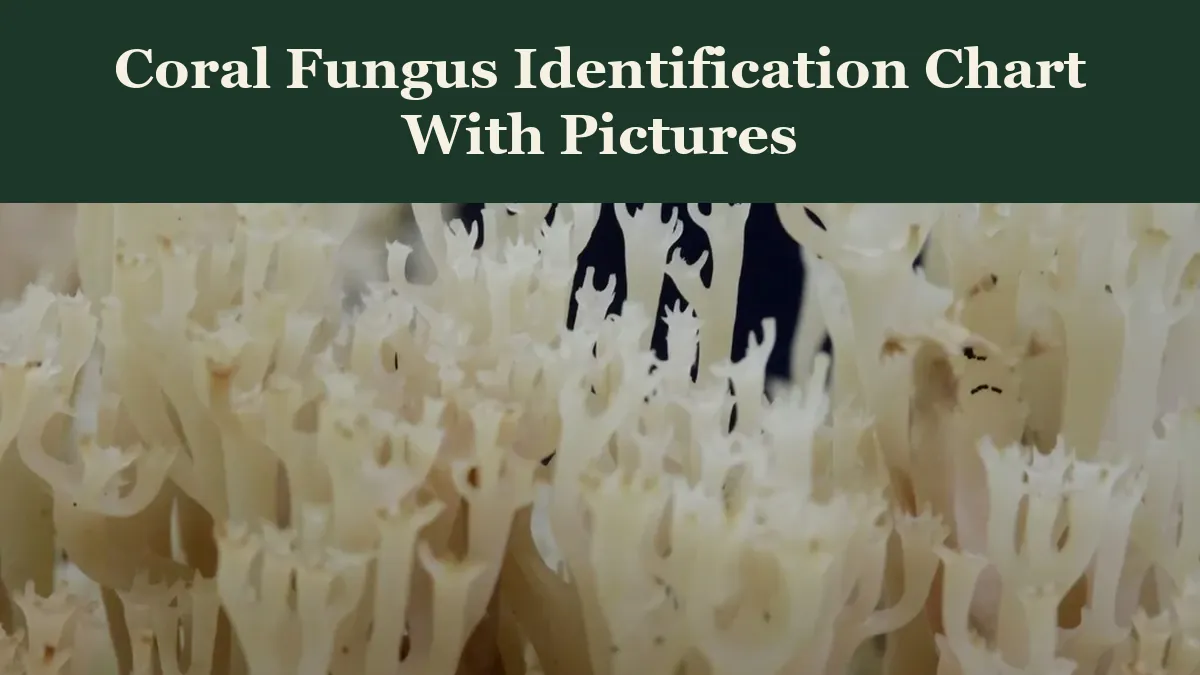 Species Guide
A coral fungus is a mushroom shaped like branching sea coral or a tuft of upright clubs, with no cap and no gills. Most US corals grow from soil in the...
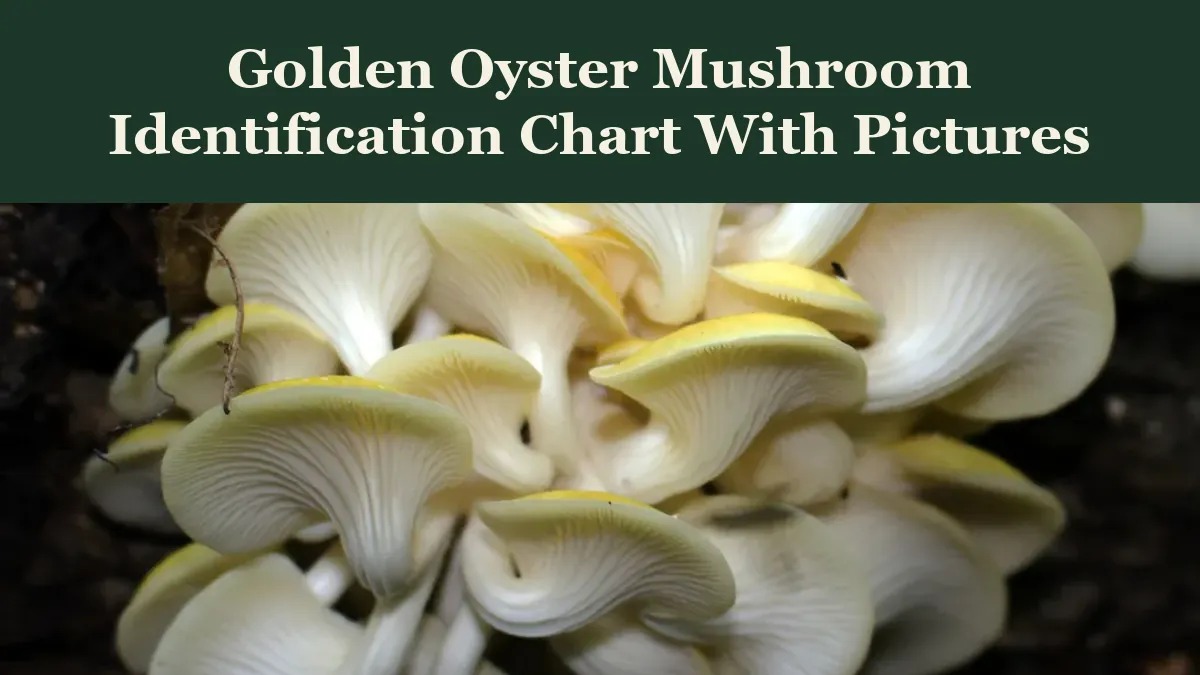 Species Guide
The golden oyster mushroom ( Pleurotus citrinopileatus ) is a bright yellow oyster mushroom that grows in dense, bouquet-like clusters on dead hardwood,...
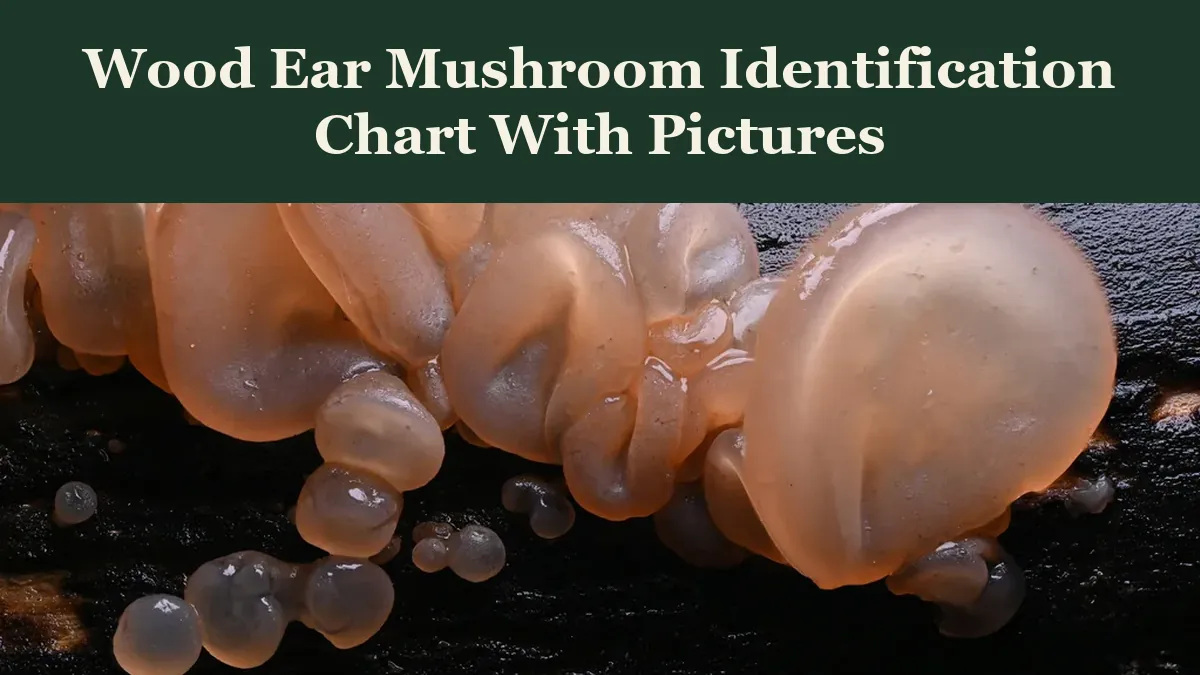 Species Guide
A wood ear mushroom is a brown, rubbery, ear-shaped jelly fungus in the genus Auricularia that grows on dead wood. In North America the hardwood species is...