Hen of the Woods Identification Chart With Pictures
— views
Hen of the woods mushroom (Grifola frondosa, also sold as maitake) is a large gray-brown rosette of overlapping fan-shaped caps that grows at the base of oaks in fall. Its underside is covered in white pores, not gills, and it often returns to the same tree for years. We found no documented deadly look-alike with its shape, but stomach upsets are on record, so an expert must confirm every find before anyone eats it.
This hen of the woods identification chart with pictures covers the hen itself and the five rosettes most often mistaken for it, with a quick press-and-count field test, a month-by-month season window by region, and a plain answer on poisonous look-alikes.
Key Takeaways
- Hen of the woods grows on the ground at the base of oaks and other hardwoods, mostly in September and October.
- It has many small gray-brown fan caps on a branched white base, and a white pore surface underneath.
- The hen does not bruise. A rosette whose pores turn black when pressed is the black-staining polypore.
- The three main look-alikes named by the Missouri Department of Conservation are all rated edible when young, and none is documented as deadly.
- Hen of the woods itself has caused stomach upsets in a small number of reported cases, so try only a small amount of a confirmed find.
- An orange cluster with gills at an oak base is not a hen. It may be the poisonous jack-o'-lantern.
Hen of the Woods Identification Chart
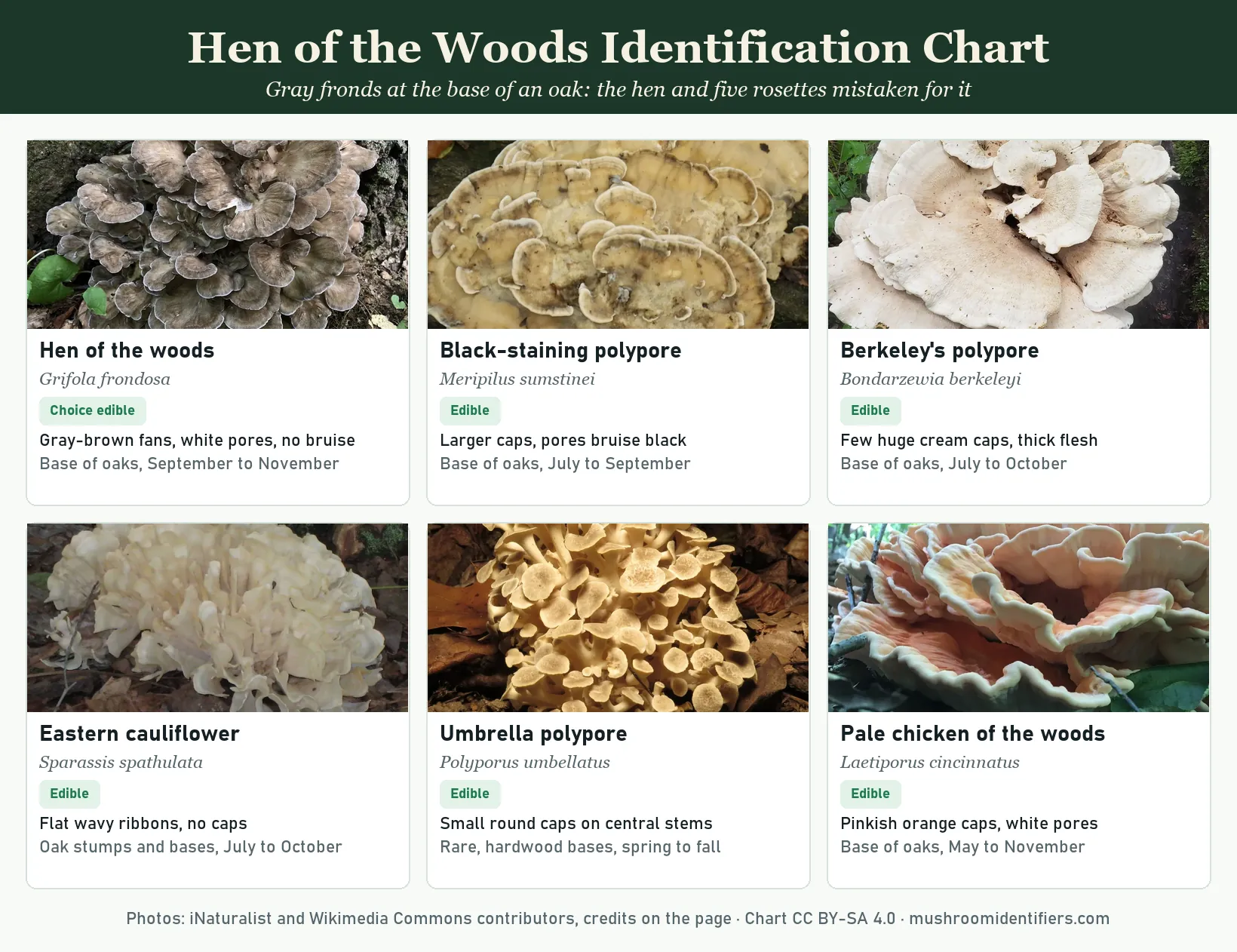
| Mushroom | Key features | Where and when | Edibility or risk |
|---|---|---|---|
| Hen of the woods (Grifola frondosa) | Many small gray-brown fan caps, white pores, flesh does not bruise | Base of oaks and other hardwoods, September to November | Choice edible per MDC; stomach upsets reported |
| Black-staining polypore (Meripilus sumstinei) | Larger whitish to brownish caps, pores and flesh bruise black | Base of oaks and hardwoods, July to September | Edible when young per MDC |
| Berkeley's polypore (Bondarzewia berkeleyi) | Few large cream caps, thick white flesh, rooting stalk | Base of oaks, July to October | Edible when young; turns tough and bitter |
| Eastern cauliflower mushroom (Sparassis spathulata) | Whitish yellow rosette of flat, wavy ribbons, no caps | Base of trees and decayed oak stumps, July to October | Edible when young per MDC |
| Umbrella polypore (Polyporus umbellatus) | Many small round caps, each on its own central stem | Rare, at hardwood bases, spring to fall | Edible, but too rare to collect |
| Pale chicken of the woods (Laetiporus cincinnatus) | Pinkish to pale orange caps, white pores | Base of oaks and buried roots, May to November | Edible per MDC; some people get stomach upset or swollen lips |
Details come from the Missouri Department of Conservation (MDC). Season months are MDC's Missouri dates, so they shift by a few weeks in other states.
What Is Hen of the Woods?
Hen of the woods is a polypore, a fungus that releases its spores through tiny pores instead of gills. Its scientific name is Grifola frondosa, and it belongs to the family Grifolaceae. "Maitake" is its Japanese name. MDC notes that in Japan it is called the "dancing mushroom," because people dance with joy when they find one. In the US, it is widely distributed east of the Rocky Mountains and rare in the West.
The fungus lives in the roots and lower trunk of its host. One field guide describes it as weakly parasitic on living oaks and other hardwoods, and saprobic on decaying wood. It causes a white butt rot. The mushroom often reappears in the same place in later years.
Size varies a lot between sources. A North American field guide gives clusters of 15 to 40 cm (about 6 to 16 inches) across. MDC reports clusters up to about 3 feet wide that typically weigh 5 to 10 pounds, and occasionally up to 50 pounds.
The American hen may not be the same species as Asian maitake. A 2002 DNA study in Mycologia by Shen, Geiser and Royse at Penn State compared 51 isolates. Eastern North American and Asian isolates fell into separate groups, with strong support for a species split. Earlier studies had found no visible difference between them. The major US commercial strain grouped with the Asian isolates, which suggests Asian ancestry. One species account and MDC both still use Grifola frondosa for the American mushroom.
How Do You Identify Hen of the Woods?
Check five features together: the overall shape, the cap color, the pore surface, the flesh and the base. No single feature confirms it. Hen of the woods has no gills at all, so first confirm you are looking at pores. Our guide to gills vs pores vs ridges shows the difference.
Overall Shape
The hen is a rosette of many caps that share one branched stem structure. A standard reference gives a height of 10 to 30 cm.
Caps
Each cap is fan-shaped or spoon-shaped. One field guide gives 3 to 14 cm across, while MDC gives 3/4 to 3 inches. The color runs from dark to pale gray-brown, often with faint concentric zones. Caps yellow with age, and their edges are wavy.
Pore Surface
The underside is a pore surface that runs down the stem, often nearly to the base. It is lavender gray when young, then white, then stained yellowish with age. The pores are large, at 1 to 3 per mm, and they can look angular or slot-like. They do not bruise.
Flesh
Slice through a cap and the base. The flesh is firm and white, and it does not change color when cut. The smell is mild and pleasant.
Base and Spore Print
The branched base is whitish, tough and often off-center. The spore print is white, according to both a standard reference and MDC.
When and Where Does Hen of the Woods Grow?
Hen of the woods grows on the ground at the base of oak trees and oak stumps, and most finds in the US fall in September and October. MDC lists September through November and notes that it favors moist hardwood forests and river bottoms with mature or aging trees. A North American field guide describes the season as summer and fall. Our oak tree fungus identification guide shows what else grows at the base of an oak.
Research-grade iNaturalist records give a clearer regional picture. The table below uses US observations as of November 2026, grouped by the month they were observed. The southern window runs later than the northern one.
| Month | Whole US (12,769 records) | New York and Minnesota (2,245) | Georgia and North Carolina (441) |
|---|---|---|---|
| August | 2% | 4% | 2% |
| September | 35% | 42% | 20% |
| October | 56% | 49% | 62% |
| November | 5% | 4% | 14% |
| All other months | 1% | 1% | 2% |
In the North, September and October are almost equal. In the Southeast, October holds most finds, and November still accounts for about one in seven. These numbers show when people photographed hens, not exactly when they fruited, so treat them as a guide.
A tree that produced a hen once is the best place to look the next fall. Our guide to mushrooms growing on trees explains what fruiting position says about the type of rot.
Hen of the Woods and Its Look-Alikes in the US
Six large rosettes can turn up at the base of hardwoods in the eastern US, and the hen is only one of them. MDC names the black-staining polypore, Berkeley's polypore and the eastern cauliflower mushroom as its main look-alikes. The umbrella polypore.
Hen of the Woods (Grifola frondosa)
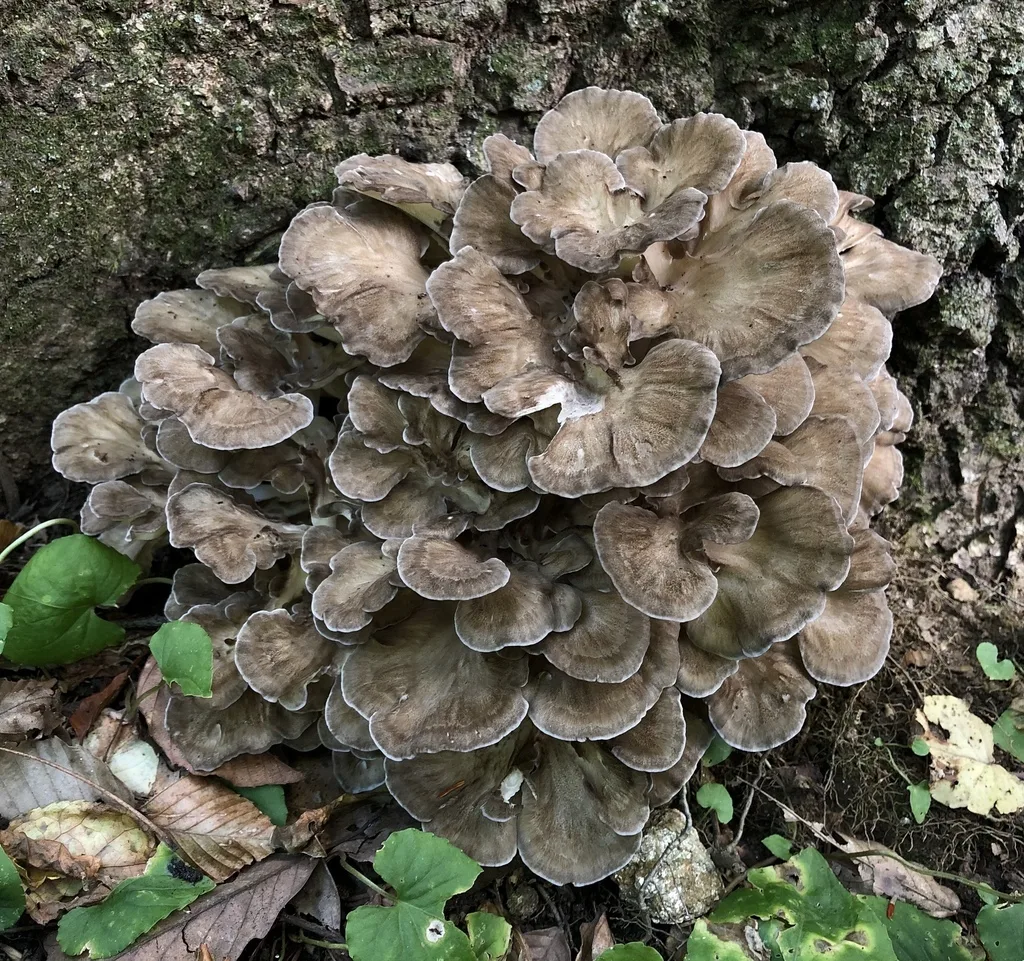
This is the gray-brown rosette of small fan caps described above. Its pores and flesh do not bruise.
Black-Staining Polypore (Meripilus sumstinei)
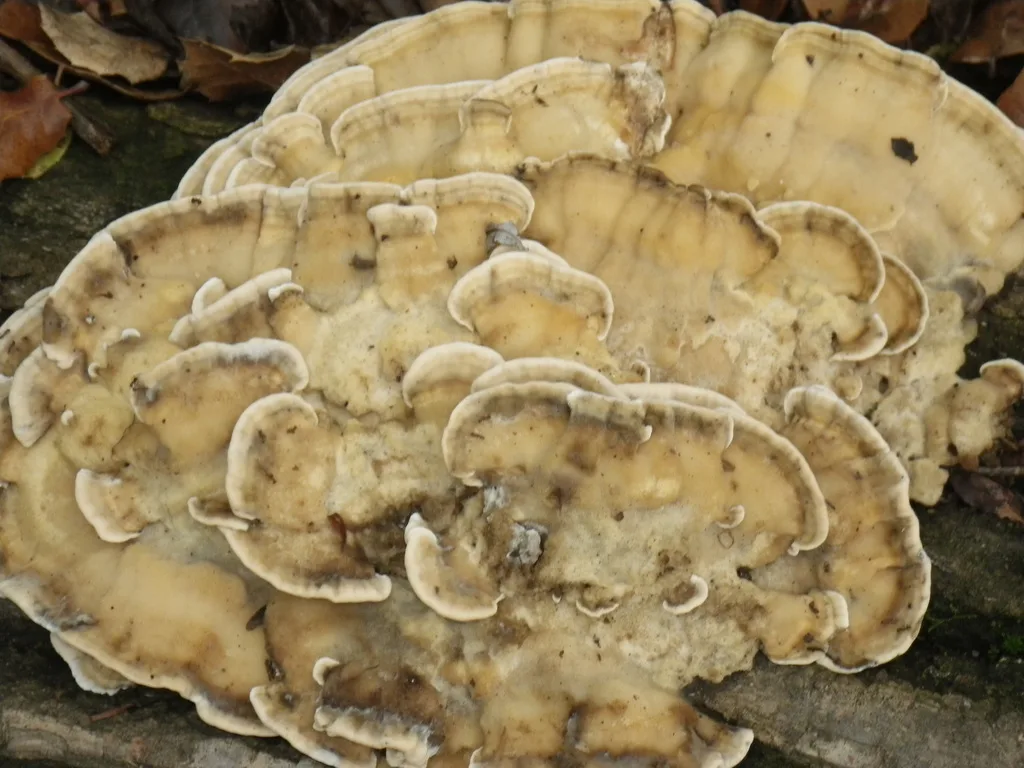
This is the look-alike that both MDC compare with the hen. One species account gives caps of 5 to 20 cm, much larger than a hen's. The caps are whitish, becoming brownish, and the thin margin ages black. The pore surface is pure white when young and bruises dark brown to black when fresh. Its pores are tiny, at 6 to 8 per mm, compared with 1 to 3 per mm on a hen.
Many North American field guides call it Meripilus giganteus. This name belongs to a strictly European species. The Missouri Department of Conservation calls it a good edible when young and fresh, and advises using only the softer outer edges of the caps. MDC gives its season as July through September, which overlaps with the start of hen season. See our guide to mushroom color changes and bruising for how to read a stain.
Berkeley's Polypore (Bondarzewia berkeleyi)
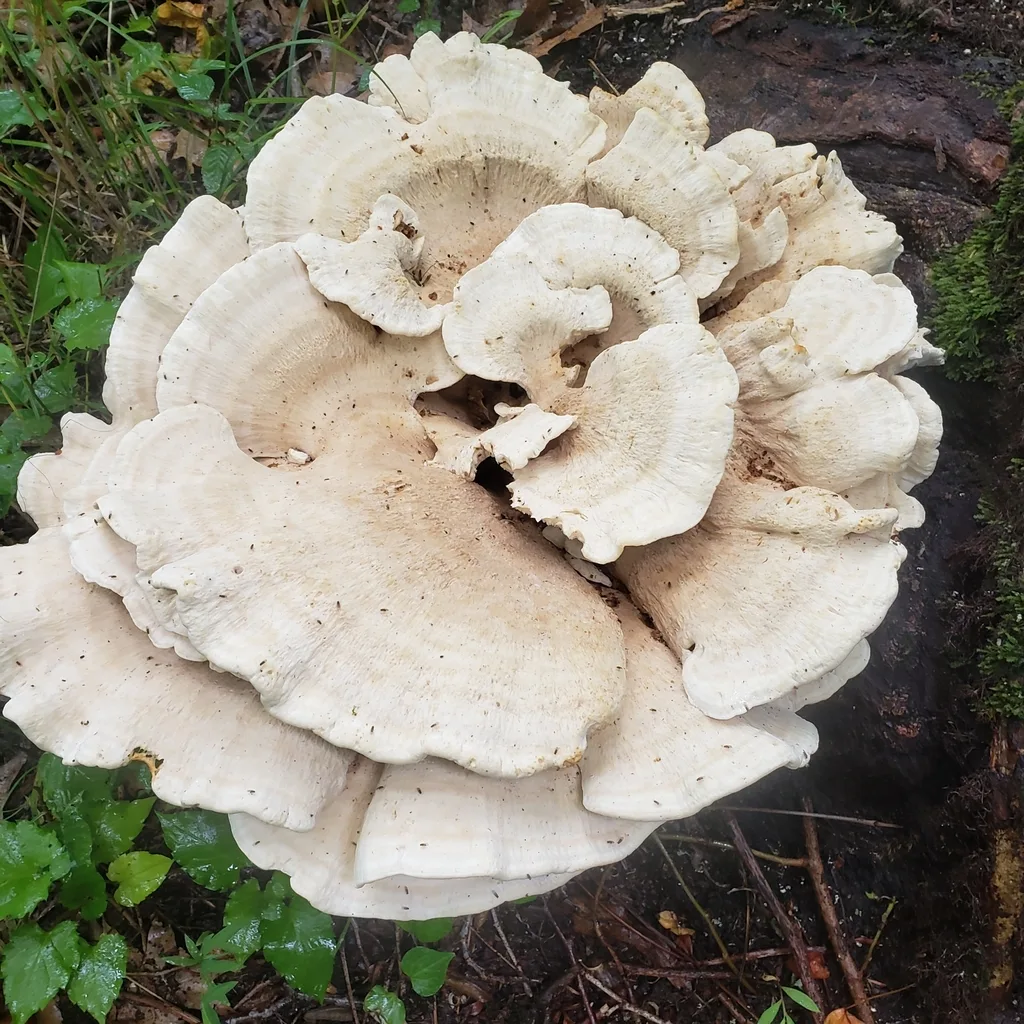
Berkeley's polypore has fewer, much larger caps. A standard reference gives individual caps of 6 to 25 cm and whole fruiting bodies of 20 to 50 cm or more. The caps are white when young and become cream to dull yellowish. The flesh is thick and white and does not bruise. One field guide also notes that DNA studies place Bondarzewia in the Russulaceae, closer to russulas and milk caps than to other polypores.
The Missouri Department of Conservation lists it as edible when young, and warns that it "gets tough, woody and bitter with age." Its stalk roots into the ground, and it can return to the same spot for years.
Eastern Cauliflower Mushroom (Sparassis spathulata)
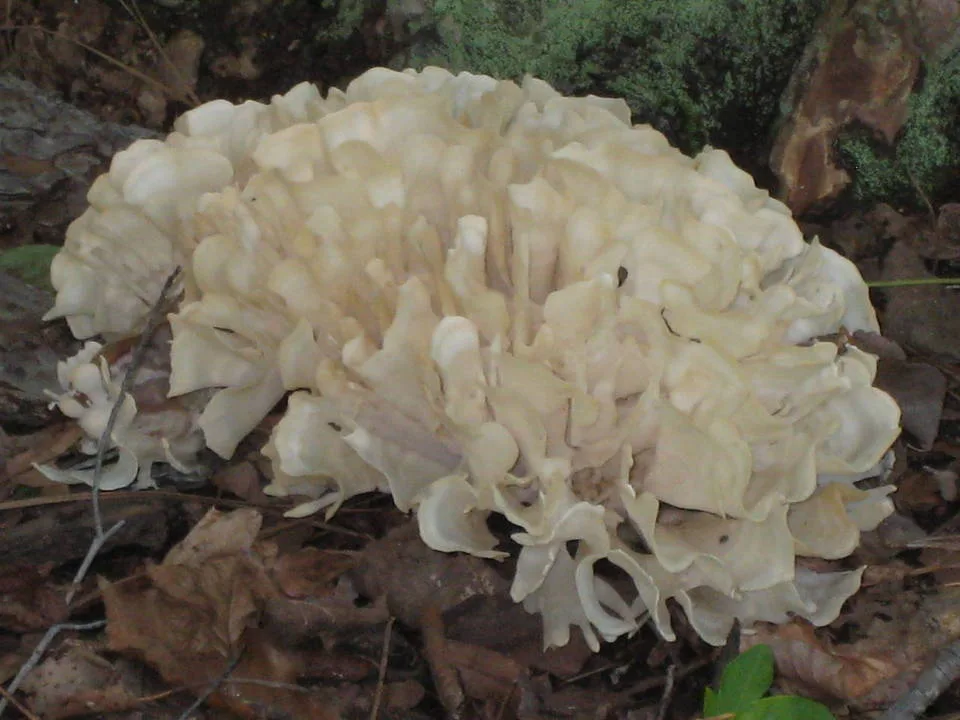
The cauliflower mushroom is a whitish yellow rosette of flat, wavy ribbons, with no separate caps. The Missouri Department of Conservation gives a size of 6 to 12 inches wide and 6 to 10 inches tall. It grows singly at the base of trees, often at decayed oak stumps, from July to October. MDC calls it an excellent edible when young and fresh, and notes that it is common after a wet summer and rare in a dry one.
Umbrella Polypore (Polyporus umbellatus)
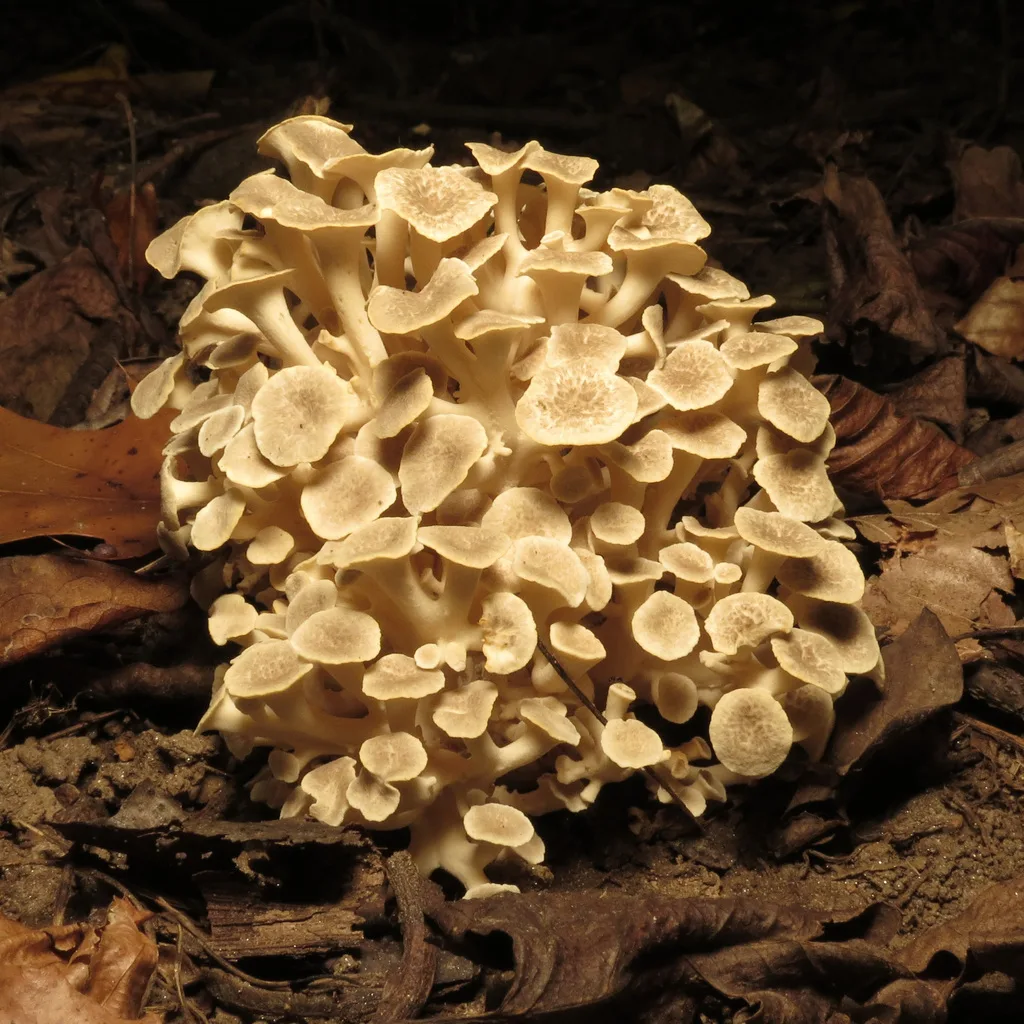
The umbrella polypore looks like a hen built from tiny parasols. A North American field guide gives caps of only 2 to 4 cm, each roughly circular with a central stem. The stems fuse below into one large structure that rises from an underground knot of tissue. The pore surface is white. One species account calls it rare but widespread in northern North America, south to Tennessee and Kansas, and much less common than the hen.
Older guides call it Grifola umbellata. First Nature lists it as edible but so rare that it should not be collected for eating.
Pale Chicken of the Woods (Laetiporus cincinnatus)
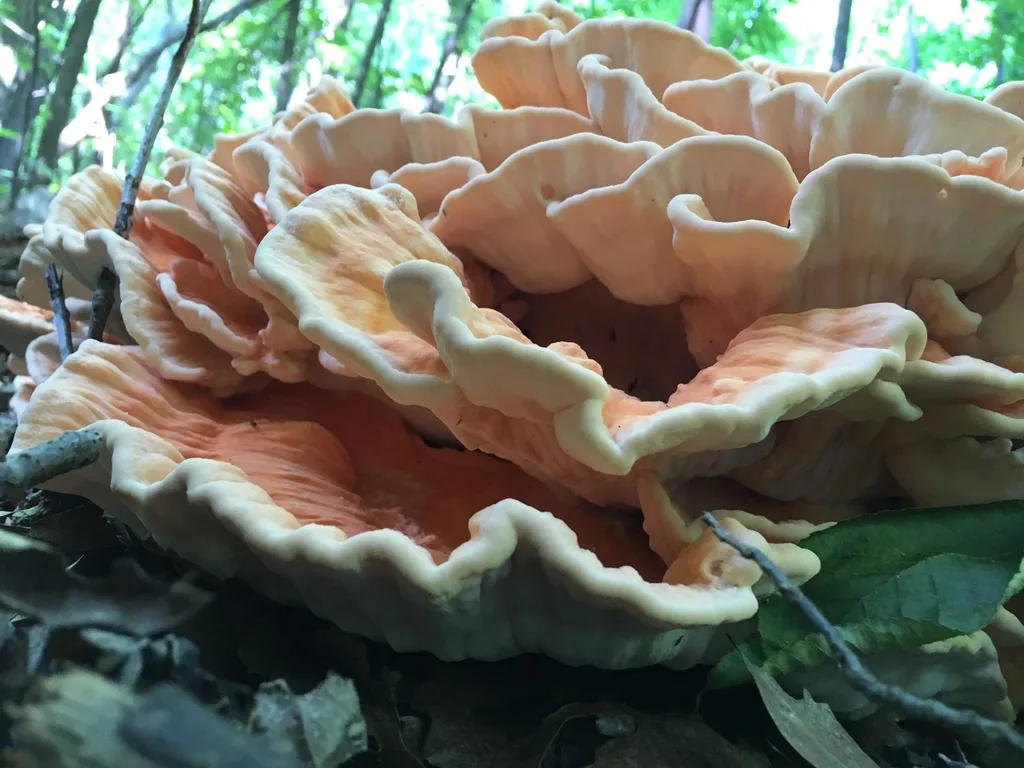
This chicken of the woods can form a rosette at the base of an oak. It grows on stumps, logs and buried roots, often at the foot of the tree. The Missouri Department of Conservation describes pinkish to pale orange caps of 2 to 12 inches with a white or off-white pore surface. Its warm color separates it from the gray-brown hen. MDC lists it as a choice edible, but warns that some people get stomach upset or swollen lips after eating it. It is the white-pored relative of the bright yellow chicken of the woods.
A Quick Field Test: Press, Flip, Count
Three checks separate the hen from every rosette above: press the pores, flip a cap, and count the caps. Do them on the mushroom where it grows, and photograph each step. The checks narrow the options, but they do not replace an expert's confirmation.
- Press. Push a thumb firmly into the white pore surface and the cap edge, then look again after a short wait. Black or dark brown marks point to the black-staining polypore. The hen does not bruise.
- Flip. Look under a cap. Gills mean it is not a polypore at all. Flat ribbons with no caps or pores mean the cauliflower mushroom. White pores running down a branched stem fit the hen.
- Count and measure. Many small gray-brown fans fit the hen. A few cream caps up to 10 inches across fit Berkeley's polypore. Many small round caps with central stems fit the umbrella polypore. Pink or orange tops fit pale chicken of the woods.
Finish by cutting the base. Hen flesh is firm and stays white. MDC notes that the black-staining polypore's flesh bruises black when cut. A clean result on all three checks is consistent with a hen, and it still needs an expert check.
Hen of the Woods Look-Alikes: Side-by-Side Comparison
The look-alikes that share the hen's shape are not documented as deadly, but the jack-o'-lantern, which shares its habitat, is poisonous. The table puts the main differences side by side. Cap size, cap color, pore size and bruising separate the rosettes. Gills separate the jack-o'-lantern.
| Mushroom | Caps | Underside | Bruising | Risk |
|---|---|---|---|---|
| Hen of the woods | Many small gray-brown fans | White pores, 1 to 3 per mm | None | Edible after expert check; stomach upsets reported |
| Black-staining polypore | Fewer, larger, whitish to brown | White pores, 6 to 8 per mm | Black | Edible when young per MDC |
| Berkeley's polypore | Few, very large, cream | Whitish pores, 1 to 2 per mm | None or faint yellow at the edge | Edible when young; tough and bitter when old |
| Eastern cauliflower mushroom | No caps, flat ribbons | No pore surface | Not described | Edible when young per MDC |
| Umbrella polypore | Many small round caps, central stems | White pores, 1 to 2 per mm | Not described | Edible but rare; leave it |
| Pale chicken of the woods | Pinkish to pale orange | White pores | Not described | Stomach upset or swollen lips in some people |
| Jack-o'-lantern (Omphalotus illudens) | Bright orange, flat to funnel-shaped | Sharp, crowded gills | None | Poisonous; very sick for a few days |
Pore counts come from one field guide. The jack-o'-lantern row comes from the Missouri Department of Conservation.
Is There a Poisonous Hen of the Woods Look-Alike?
No deadly look-alike with the hen's shape is documented in the sources we checked, but some of these mushrooms do cause stomach upsets. MDC rates the black-staining polypore, Berkeley's polypore, the eastern cauliflower mushroom and pale chicken of the woods as edible. The risks come from three places instead.
The Hen Itself
Hen of the woods itself appears in poisoning reports. A 2006 summary of the North American Mycological Association (NAMA) poisoning registry covers more than 30 years of voluntary reports. Its gastrointestinal table lists about two dozen people, including three children, who reported illness after eating Grifola frondosa. Most had stomach upset that began within minutes to several hours. One adult lost consciousness after the stomach upset, and one case may have involved alcohol. The authors note that spoiled mushrooms cause symptoms very similar to mushroom poisoning, so some reports may reflect old specimens.
Chicken of the Woods
MDC warns that pale chicken of the woods causes stomach upset or swollen lips in some people. The NAMA summary also records one woman who died after eating what was probably chicken of the woods, while no one else in her group got sick. The authors list that case among unusual deaths not directly due to mushroom toxins.
The Jack-o'-Lantern
The jack-o'-lantern is a poisonous mushroom that can grow in the same spot as a hen. MDC describes large clusters of bright orange caps with sharp, crowded gills at the base of trees, on stumps and on buried wood, feeding on dead hardwoods such as oaks, from July to October. It causes mild to severe stomach upset, and MDC says it makes people very sick for a few days. It has gills and a bright orange color, so it fails the flip test at once.
If a dog eats any mushroom from the base of a tree, follow our guide on what to do if your dog ate a mushroom and call a vet.
Can You Eat Hen of the Woods?
Hen of the woods is widely eaten, and MDC calls it a choice edible, but only after an experienced identifier has confirmed the find. Nobody should eat a wild mushroom based on this page. A small number of people have reported stomach upset after eating hens. The precautions that sources give are simple:
- Use only fresh, tender portions, as MDC advises.
- Cook it thoroughly.
- Eat a small amount the first time. NAMA reports show that a few people react to hens.
- Take only what you need, so the cluster can keep growing, as MDC suggests.
This page makes no health claims. There is no legitimate scientific support for medicinal claims about this mushroom. Our poisonous vs edible mushrooms guide explains why simple rules for edibility fail.
Common Identification Mistakes
Skipping the Press Test
The black-staining polypore also fruits at the base of oaks. Press the pores and wait before you decide.
Calling Any Rosette at an Oak a Hen
Six different rosettes can grow in that spot in the eastern US. Count the caps, check their shape and note their color every time.
Not Looking Under the Cap
The jack-o'-lantern also grows in clusters at the base of trees, including oaks. Gills rule out the hen immediately.
Picking an Old Specimen
Old specimens may be spoiled. NAMA's authors note that spoiled mushrooms cause symptoms much like poisoning, and MDC advises using only fresh, tender portions.
Trusting a Photo Alone
Bruising, flesh color and smell do not show in a single picture. Photograph the top, the underside, a pressed spot and a cut base, using our guide on how to photograph mushrooms for identification.
Frequently Asked Questions
What does hen of the woods look like?
Hen of the woods is a gray-brown rosette of many small, overlapping fan-shaped caps on a branched white base. Its underside is a white pore surface with no gills. It usually sits on the ground at the base of an oak.
Is there a poisonous hen of the woods look-alike?
No deadly look-alike with the same shape is documented in the sources we checked. The poisonous jack-o'-lantern grows at oak bases too, but it is bright orange and has gills. Some look-alikes, and the hen itself, have caused stomach upsets.
What is the difference between hen of the woods and maitake?
They are names for the same species, Grifola frondosa, and maitake is its Japanese name. A 2002 DNA study found that eastern North American and Asian populations form separate groups. The main US commercial strain grouped with the Asian ones.
How do you tell hen of the woods from the black-staining polypore?
Press the pore surface. The black-staining polypore bruises dark brown to black, while the hen does not bruise. The black-staining polypore also has larger caps and much smaller pores.
When is hen of the woods season?
Most US finds are in September and October. In New York and Minnesota, iNaturalist records split almost evenly between the two months. In Georgia and North Carolina, October dominates and about one in seven records falls in November.
Where does hen of the woods grow?
It grows on the ground at the base of oaks and other hardwoods, and on oak stumps. It is widely distributed east of the Rocky Mountains and rare in the West. It often returns to the same tree in later years.
Can you eat hen of the woods?
The Missouri Department of Conservation calls it a choice edible, but an experienced identifier must confirm every find first. Cook it thoroughly and try a small amount the first time. A small number of people have reported stomach upset after eating it.
Is hen of the woods the same as chicken of the woods?
No. Chicken of the woods belongs to the genus Laetiporus and is yellow, orange or pinkish, while hen of the woods is gray-brown. The pale chicken of the woods can form a rosette at an oak base, but its caps are pinkish to orange.
Does hen of the woods hurt the tree?
It is a sign of white butt rot in the roots and lower trunk calls the fungus weakly parasitic on living oaks. Picking the mushroom does not remove the fungus. A tree with base decay near a house or road should be checked by an arborist.
Final Safety Reminder
Hen of the woods is distinctive, but five other rosettes and a poisonous gilled cluster grow at the same trees. Never eat a wild mushroom based on a chart, a photo or an app. Do the press, flip and count checks, photograph each step, and check your find with our free mushroom identifier and a local mycological club. If someone may have eaten a poisonous mushroom in the US, call Poison Control at 1-800-222-1222.
Sign in to leave a comment and join the discussion.
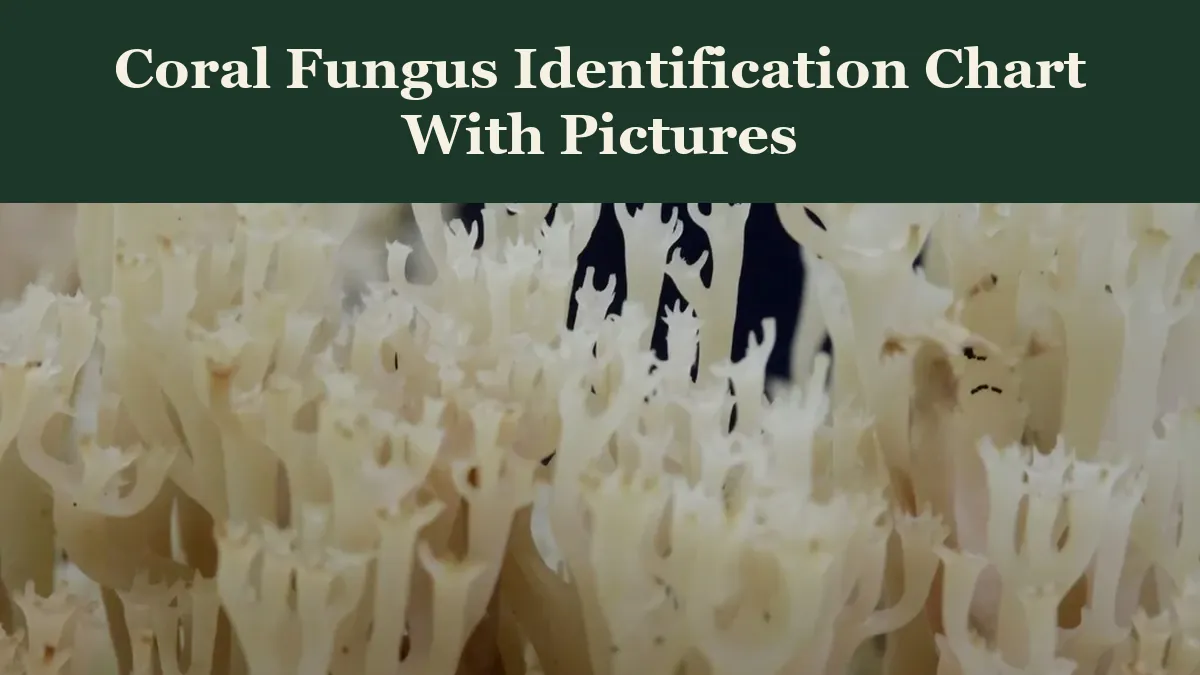 Species Guide
A coral fungus is a mushroom shaped like branching sea coral or a tuft of upright clubs, with no cap and no gills. Most US corals grow from soil in the...
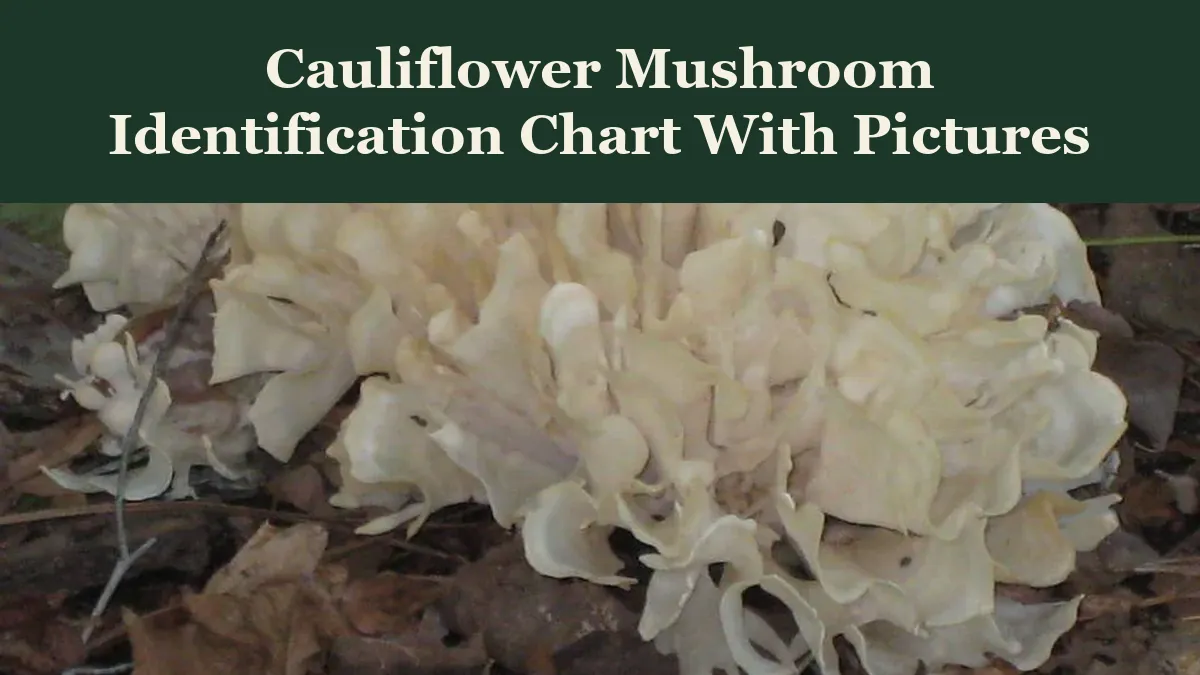 Species Guide
A cauliflower mushroom ( Sparassis ) is a large, cream-colored rosette of flat, wavy, ribbon-like lobes that grows at the base of a tree. It has no caps, no...
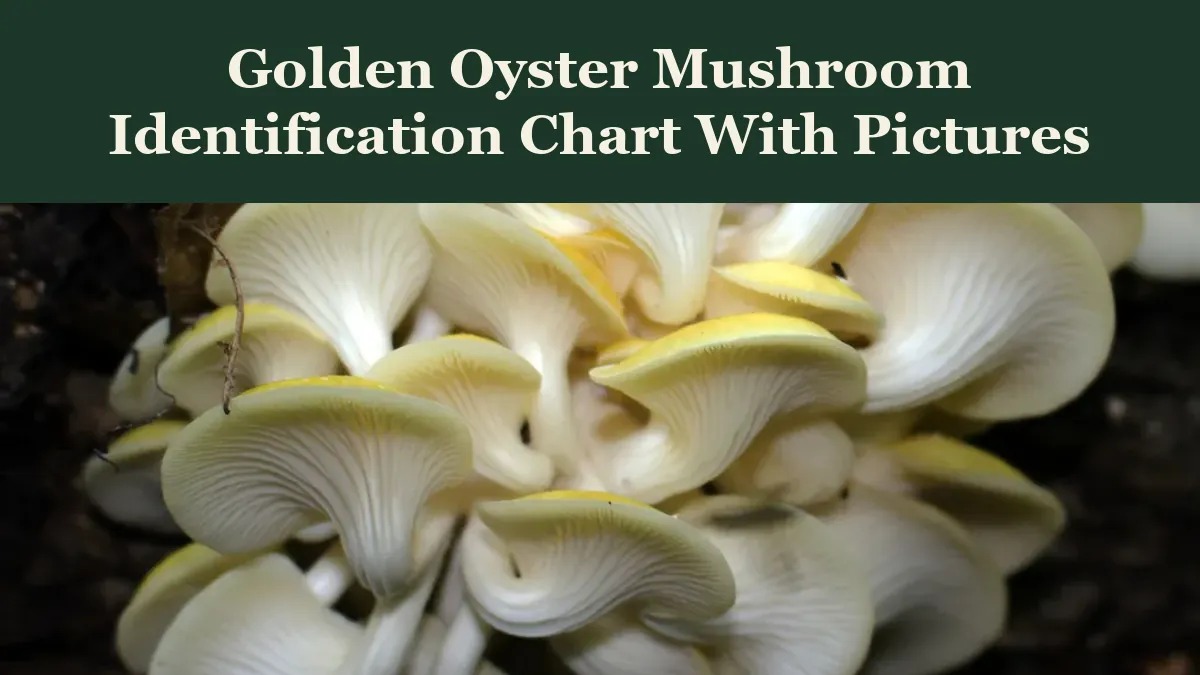 Species Guide
The golden oyster mushroom ( Pleurotus citrinopileatus ) is a bright yellow oyster mushroom that grows in dense, bouquet-like clusters on dead hardwood,...