Hedgehog Mushroom Identification Chart With Pictures
— views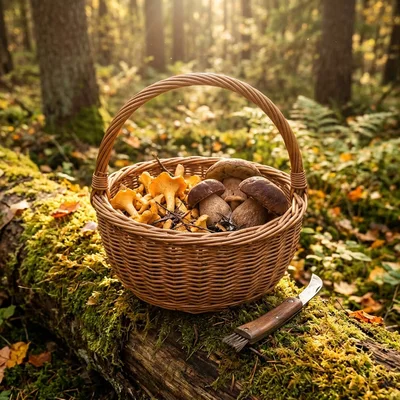
A hedgehog mushroom is a pale orange to buff mushroom with soft spines, or teeth, under the cap instead of gills. It grows on soil under trees, not on wood, and it leaves a white spore print. The name covers several Hydnum species. DNA work published in 2018 shows that the European Hydnum repandum does not grow in North America. Any hedgehog meant for eating needs expert confirmation first.
This hedgehog mushroom identification chart with pictures covers the US hedgehogs, the new species names, the season by region, a flip, pinch and print test, and the toothed look-alikes. It is an identification guide, not permission to eat a wild mushroom.
Key Takeaways
- Flip the mushroom first. A hedgehog has crowded soft teeth under the cap. Chanterelles have ridges, and most other cap mushrooms have gills or pores.
- Hedgehogs grow from soil and leave a white spore print. A brown print points to the scaly hedgehog and its relatives.
- Tough, cork-like flesh means a different tooth fungus, such as Phellodon. Hedgehog flesh is soft and brittle.
- The name Hydnum repandum now belongs to a European species. US hedgehogs carry newer names such as H. subolympicum, H. washingtonianum and H. oregonense.
- Season depends on region: July to November in Missouri, and mid-winter to early spring in California.
- None of the sources used here lists a deadly mushroom with teeth. An orange cap seen only from above can still be a gilled mushroom, including the poisonous jack-o'-lantern.
- Field guides rate hedgehogs as good edibles, but nobody should eat one without expert confirmation. Sources say to cook them thoroughly.
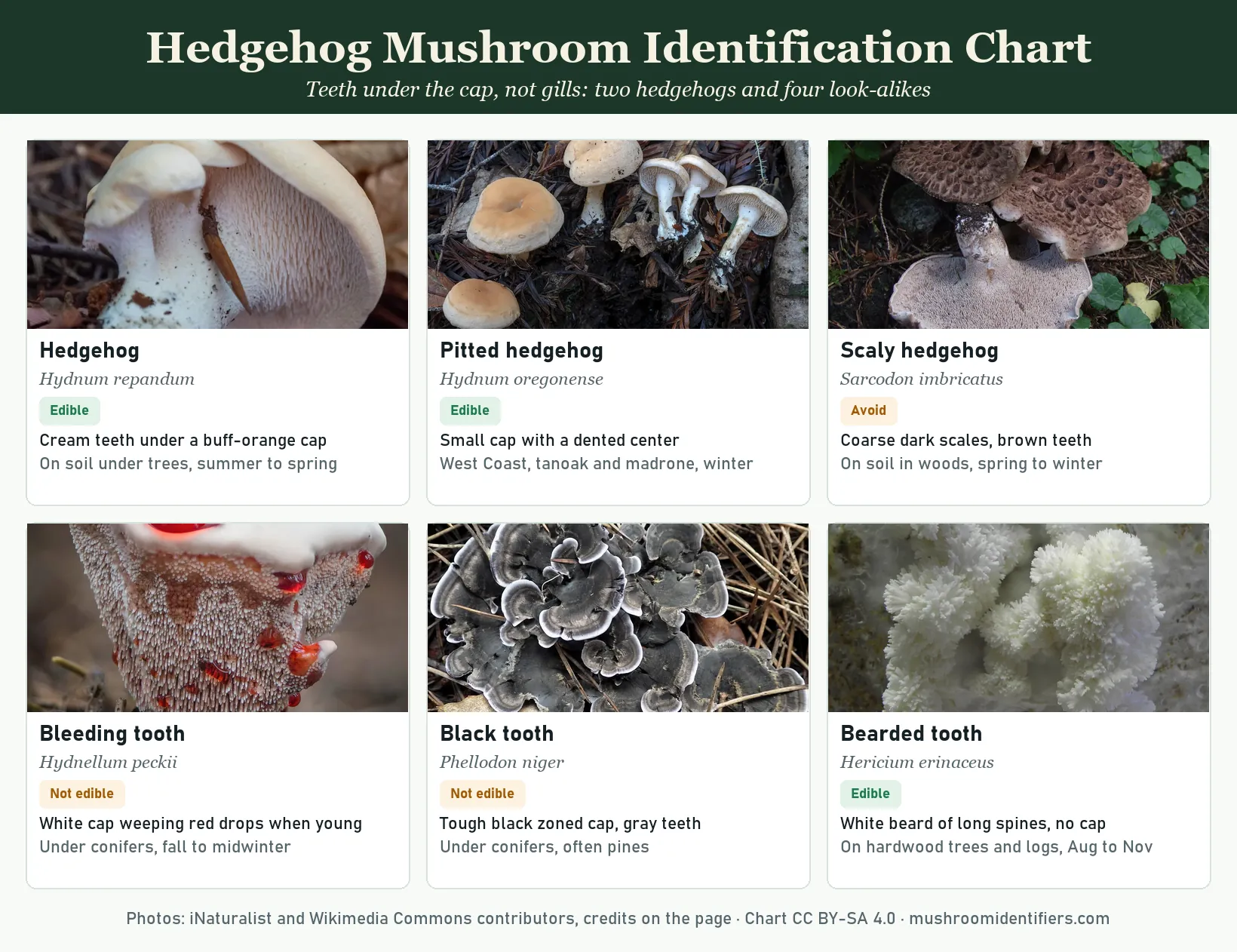
Hedgehog Mushroom Identification Chart
| Mushroom | Key features | Where and when | Spore print | Edibility or risk |
|---|---|---|---|---|
| Hedgehog (Hydnum repandum group) | Buff to orange-tan cap, cream teeth, soft brittle flesh | On soil in mixed woods; July to November in Missouri, mid-winter to spring in California | White | Rated choice by sources; expert confirmation needed |
| Pitted hedgehog (Hydnum oregonense) | Small cap, 2.5 to 5 cm, with a dented center | West Coast, under tanoak and madrone; mid-winter to early spring | White | Rated edible by MykoWeb; expert confirmation needed |
| Eastern pitted hedgehog (Hydnum umbilicatum) | Smaller than the hedgehog, with a small central pit | Eastern North America; not in the West | Not stated in the sources used | Not rated by the sources used here |
| Scaly hedgehog (Sarcodon imbricatus) | Large cap with coarse dark raised scales, brown teeth | On soil in woods; late spring through winter | Brown | Taste mild to bitter; avoid |
| Bleeding tooth (Hydnellum peckii) | Young white cap weeping deep red drops | Under conifers; fall through mid-winter | Not stated in the source used | Inedible |
| Black tooth (Phellodon niger) | Tough black zoned cap, gray teeth, fused caps | Under conifers, often pines | White | Inedible, too tough |
| Bearded tooth (Hericium erinaceus) | White beard of long spines, no cap or stem | On living and fallen hardwoods; August to November | White | Rated choice by MDC; a different fungus |
Chart details come from the Missouri Department of Conservation, MykoWeb. Compare your find with several real photographs, not one picture.
What Is a Hedgehog Mushroom?
A hedgehog mushroom is a ground-growing Hydnum with a cap, a stem and soft teeth on the underside where most mushrooms have gills. The Missouri Department of Conservation (MDC) calls the spines the easiest way to identify it. MDC also lists the name "sweet tooth." The teeth do the same job as gills. They carry the spore-making surface.
Hedgehogs are mycorrhizal. Their mycelium partners with tree roots and trades nutrients with the tree. MDC notes that this mycelium can live for decades. Hydnum sits in the order Cantharellales, the same order as the chanterelles.
One naming trap matters. MDC lists "hedgehog mushroom" as a common name for the bearded tooth, Hericium erinaceus, as well. That fungus is better known as lion's mane, and it grows on wood. A search for "hedgehog mushroom" can return both.
The Flip, Pinch and Print Test
Three checks separate a hedgehog from most look-alikes: flip it over, pinch the flesh, and make a spore print. Each step rules out a different group. Do all three on every mushroom you collect, and add a look at the base. These checks narrow the choices. They do not prove that a mushroom is safe to eat.
| Step | What a hedgehog shows | What points to something else |
|---|---|---|
| Flip it | Crowded cream to pale orange teeth hanging down | Ridges: a chanterelle. Gills: a gilled mushroom. Pores: a bolete or polypore. |
| Pinch it | Soft flesh and teeth that break cleanly; MykoWeb calls both brittle | Tough, cork-like flesh that resists tearing: Phellodon or another tooth fungus |
| Print it | White spore print | Brown print: the scaly hedgehog, Sarcodon |
| Press it | US hedgehogs slowly bruise ocher to orange-brown | Bruising alone decides nothing; use it with the other steps |
| Check the base | A cap and stem rising from soil | A white mass of spines on a log or trunk: the bearded tooth |
The flip is the step people skip, because hedgehogs and chanterelles look alike from above. Our guide to gills vs pores vs ridges shows each underside type. For the spore print step, follow our spore print guide and use a sheet of dark paper, because a white print is hard to see on white paper.
Core Identification Features
Check the cap, the teeth, the stem and flesh, the bruising, the spore print and the habitat together. One clue never decides it. The sources below describe slightly different species, so their numbers do not always match. Where they disagree, this section says so. Our guide to the parts of a mushroom explains each term.
Cap
MDC describes the cap as irregular and dull orangish tan. It starts convex and flattens, often with a central dip. The edge curls inward at first and turns wavy later. Sources disagree on size. MDC gives ½ to 7 inches, MykoWeb gives 2 to 12 cm for California gives 6 to 15 cm for the European species. Expect a wide range.
Teeth
The teeth are pale yellowish white to cream. MykoWeb gives them as 0.4 to 0.6 cm long in California hedgehogs. A standard reference describes the teeth as round in cross-section and densely packed. They often run a short way down the stem.
Stem and Flesh
The stem is pale, smooth and often off-center. MDC gives a length of 1 to 4 inches. The flesh is white to pale buff and thick. MykoWeb describes it as brittle. MDC adds that older specimens can taste somewhat bitter.
Bruising
US sources describe slow color change where the mushroom is handled. MDC says the flesh and underside bruise ocher. MykoWeb says the cap, teeth and stem bruise orange-brown. One field guide describes the European H. repandum as not bruising.
Spore Print
Both MDC and MykoWeb give a white spore print. MDC describes the spores as round, smooth and colorless. A brown print rules out a hedgehog.
Habitat
Hedgehogs grow on the ground, scattered or in groups. They never grow from wood. MDC places them in mixed woods. MykoWeb finds them mostly under conifers in California, sometimes with hardwoods.
When and Where Do Hedgehog Mushrooms Grow?
Hedgehogs fruit from summer into fall in Missouri, and from mid-winter into early spring in California. MDC lists July to November in Missouri, where the species is found statewide. MykoWeb says California hedgehogs fruit late, often not until after New Year's. The table below sticks to the regions and trees named in the sources.
| Region | Season in sources | Trees named | Source |
|---|---|---|---|
| Missouri | July to November | Mixed woods | MDC |
| California | Mid-winter to early spring, often after New Year's | Bishop pine, Douglas fir | MykoWeb |
| California and the West Coast (H. oregonense) | Mid-winter to early spring | Tanoak, madrone, sometimes Douglas fir | MykoWeb |
| Eastern hardwood forests (H. subolympicum) | Not stated in the source used | Hardwoods | A North American field guide |
| Conifer forests (H. washingtonianum) | Not stated in the source used | Conifers; known from Newfoundland and Labrador, Washington and California | One species account |
MykoWeb notes that the winter chanterelle (Cantharellus tubaeformis) and the black trumpet (listed there as Craterellus cornucopioides, a name MykoWeb now treats as misapplied in California) often fruit at the same time and place as the pitted hedgehog in California. Read more about soil, trees and moisture in our mushroom habitat guide.
Common Hedgehog Mushroom Types in the US
Most US hedgehogs fall into two forms: the larger, classic hedgehog and the smaller pitted hedgehog with a dented cap. Each form now contains more than one species, as the next section explains. In the field, the form is what you can see. The sources separate the newer species partly by spore size and DNA, which a cap and stem cannot show.
Hedgehog (Hydnum repandum Group)
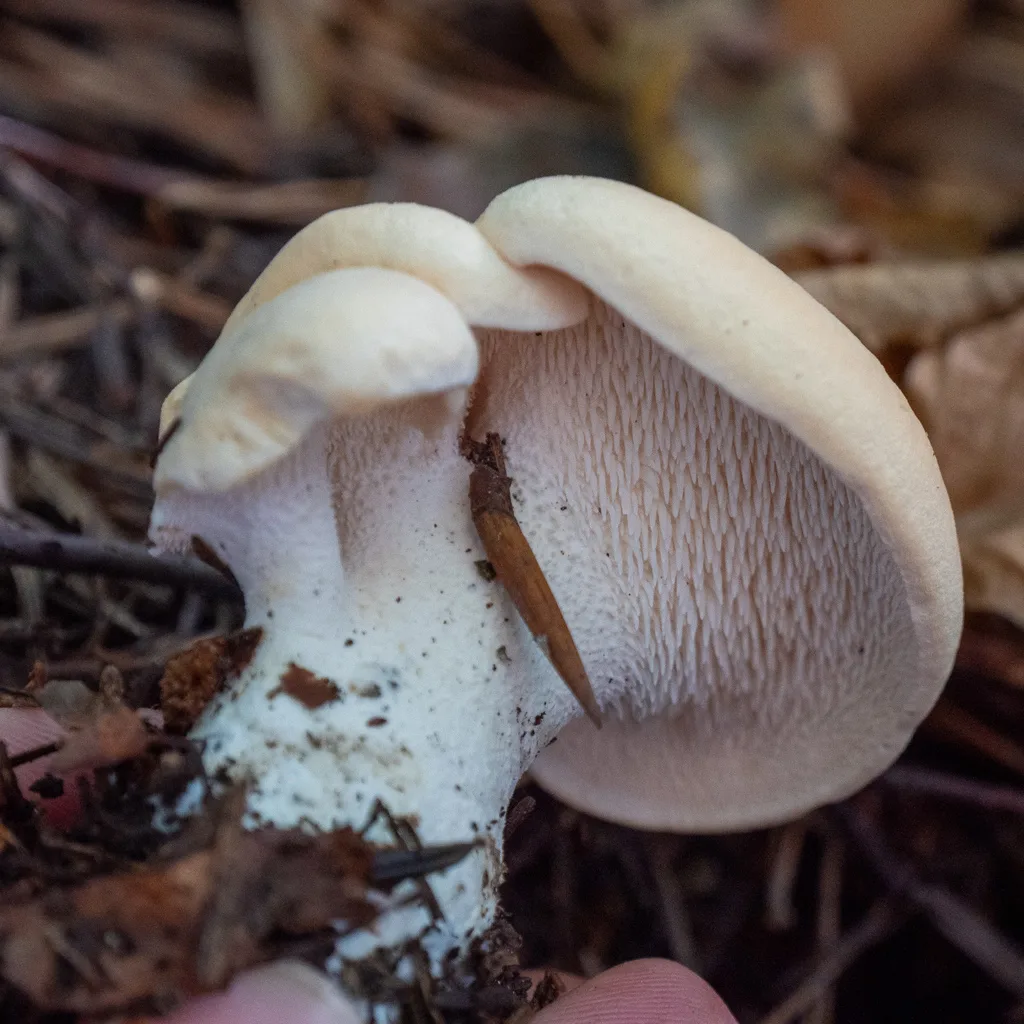
This is the hedgehog most field guides picture. It has a dull orange-tan to buff cap, cream teeth and a pale, often off-center stem. It grows on soil in mixed woods, under conifers and hardwoods. MykoWeb states that the true Hydnum repandum is not known in California and that 2 to 3 species hide under the name there. MykoWeb reports it as common under Bishop pine and Douglas fir in the part of California it covers. The older name Dentinum repandum also appears in older books.
Pitted Hedgehog (Hydnum oregonense)
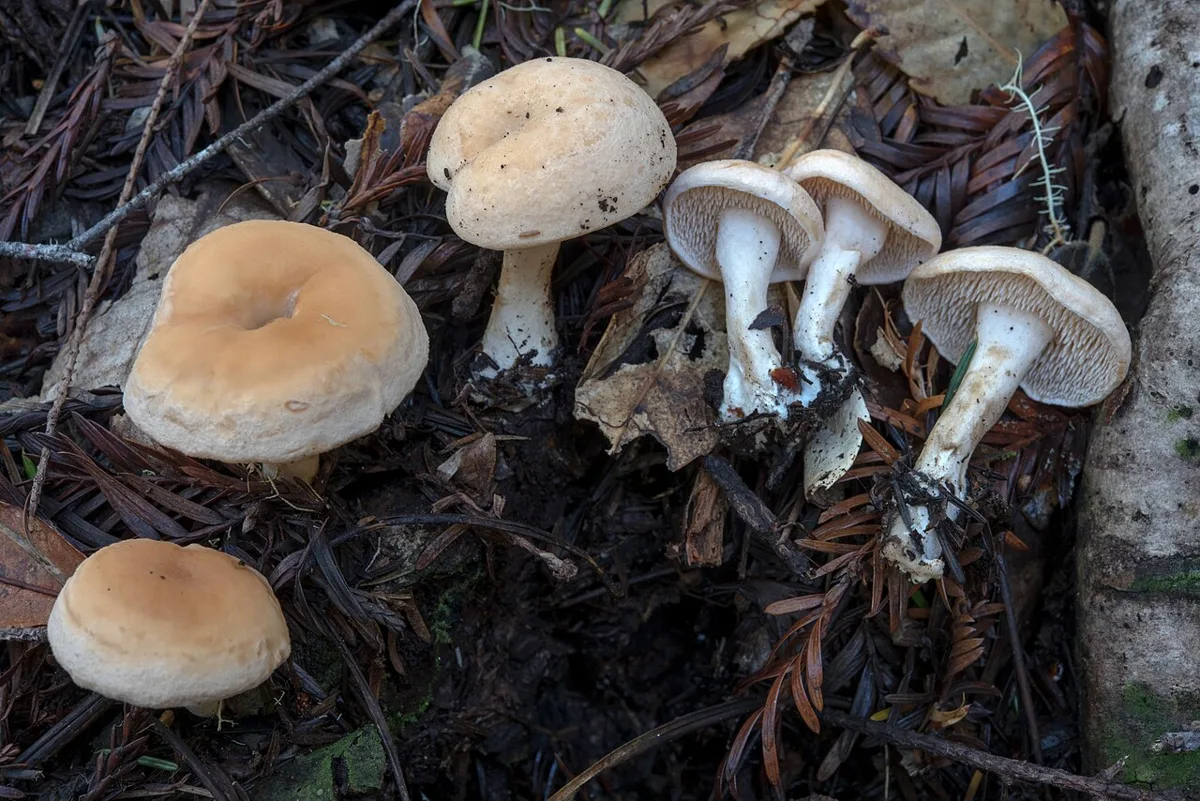
This West Coast hedgehog is smaller and more slender, with a cap of 2.5 to 5 cm and a clearly dented center. MykoWeb records it in mixed hardwood and conifer woods, often under tanoak and madrone. Its spores are larger than those of the classic hedgehog. Californians long called it Hydnum umbilicatum. MykoWeb now states that H. umbilicatum does not occur in western North America. In the East, a small hedgehog with a central pit is still called H. umbilicatum, the species described by Charles Peck.
Why Did Hedgehog Mushroom Names Change?
DNA studies published in 2018 showed that the name Hydnum repandum had covered several different species, and that the true H. repandum is European. That, under current DNA-based definitions, H. repandum does not occur in North America. North American field guides still use the name, so expect to see it for years.
Two papers drove the change. Niskanen and colleagues named the known diversity of Hydnum in Europe and North America in Mycologia in 2018. Swenie, Baroni and Matheny described six new species from eastern North America in MycoKeys the same year, with a key to the eastern species.
| Name in older US guides | Where | Name used now |
|---|---|---|
| Hydnum repandum with hardwoods | Eastern North America | Hydnum subolympicum, among others |
| Hydnum repandum with conifers | Newfoundland and Labrador, Washington, California | Hydnum washingtonianum |
| Hydnum repandum in California | California | Not settled; MykoWeb names H. olympicum or H. washingtonianum as probable |
| Smaller, paler eastern hedgehogs | Eastern North America | Hydnum subtilior, among others |
| Larger, darker orange hedgehogs | North America | Hydnum aerostatisporum, among others |
| Hydnum umbilicatum in California | West Coast | Hydnum oregonense |
| Hydnum umbilicatum in the East | Eastern North America | Hydnum umbilicatum, unchanged |
The rows come from MykoWeb. Some of them, such as H. washingtonianum, look very similar to the European H. repandum. For a forager, the practical point is simple: "Hydnum repandum" on a label or app result means "a hedgehog of some kind," not one exact species.
Hedgehog Mushroom Look-Alikes: Side-by-Side Comparison
The look-alikes that matter are other tooth fungi, the bearded tooth on wood, and chanterelles or orange gilled mushrooms seen only from above. None of the sources used for this page lists a deadly mushroom with teeth. The danger comes from skipping the flip and taking a gilled orange mushroom home as a hedgehog.
| Look-alike | How to tell it apart | Spore print | Risk |
|---|---|---|---|
| Scaly hedgehog (Sarcodon imbricatus) | Coarse, raised, dark brown to black scales on a brown cap; teeth turn dark brown | Brown | Taste mild to bitter; avoid |
| Bleeding tooth (Hydnellum peckii) | White young cap that weeps deep red drops, later dark brown and knobby | Not stated in the source used | Very acrid; inedible |
| Black tooth (Phellodon niger) | Blue-black zoned cap with a white rim, cork-like flesh, fused caps | White | Inedible |
| Bearded tooth (Hericium erinaceus) | White mass of long spines on wood, no cap or stem | White | A different edible fungus; still confirm |
| Chanterelles (Cantharellus) | Blunt ridges under the cap, no teeth | The underside decides it | Edible species exist; confirm each one |
| Jack-o'-lantern (Omphalotus illudens) | True gills, orange color | The underside decides it | Poisonous |
Scaly Hedgehog (Sarcodon imbricatus)
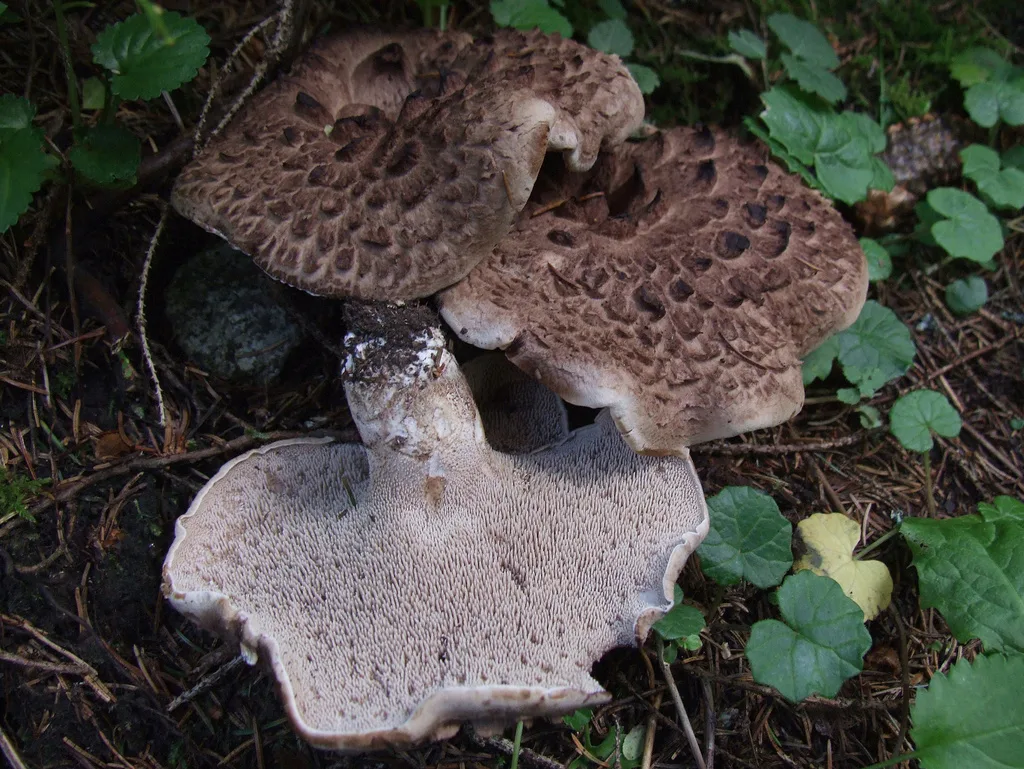
The scaly hedgehog is bigger and darker than a true hedgehog. A species description hosted by MykoWeb gives a cap of 50 to 200 mm, tan to dull red-brown, covered with coarse, raised, shingle-like scales that are dark brown to nearly black. The teeth start pale brown or gray and darken. The stem is often hollow near the top. The spore print is brown, and the taste is described as mild to bitter. It fruits on soil in woods from late spring through winter.
Bleeding Tooth (Hydnellum peckii)
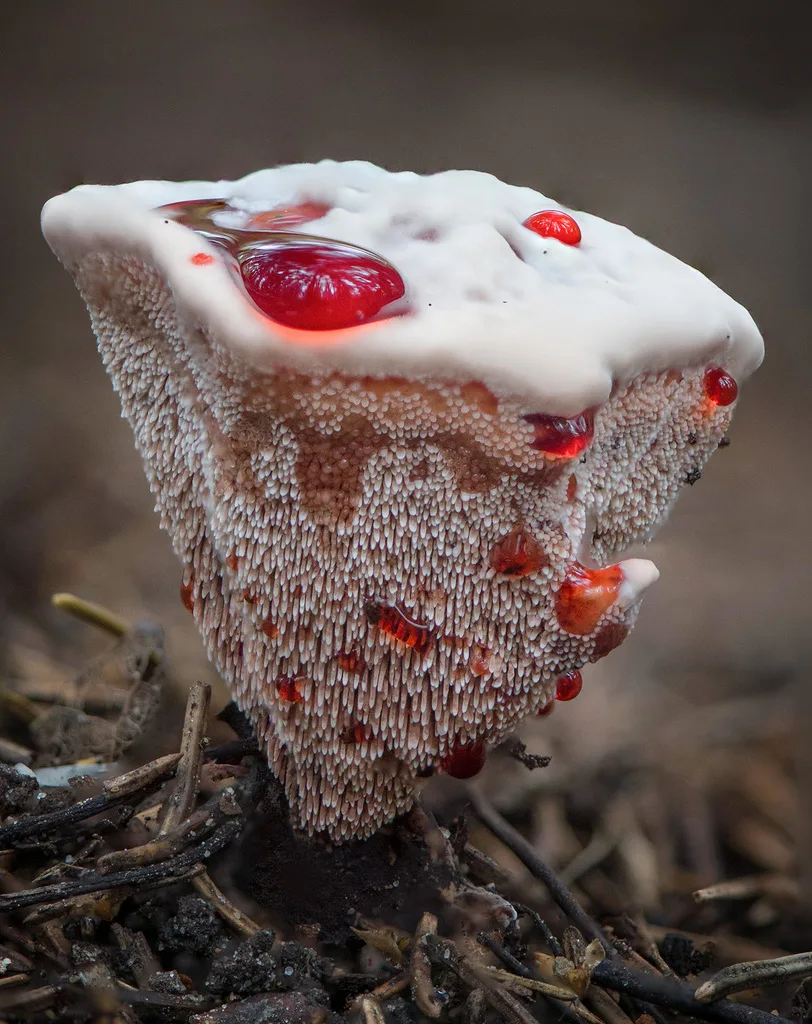
Young bleeding tooth caps are white and weep deep red droplets. Older caps turn dark brown to reddish brown and lose the drops. MykoWeb lists it as inedible, with a very acrid taste. It grows in duff under conifers such as Sitka spruce, Douglas fir, western hemlock and pine, from fall through mid-winter. Older caps lose the drops, which makes them harder to recognize.
Black Tooth and Other Phellodon Species
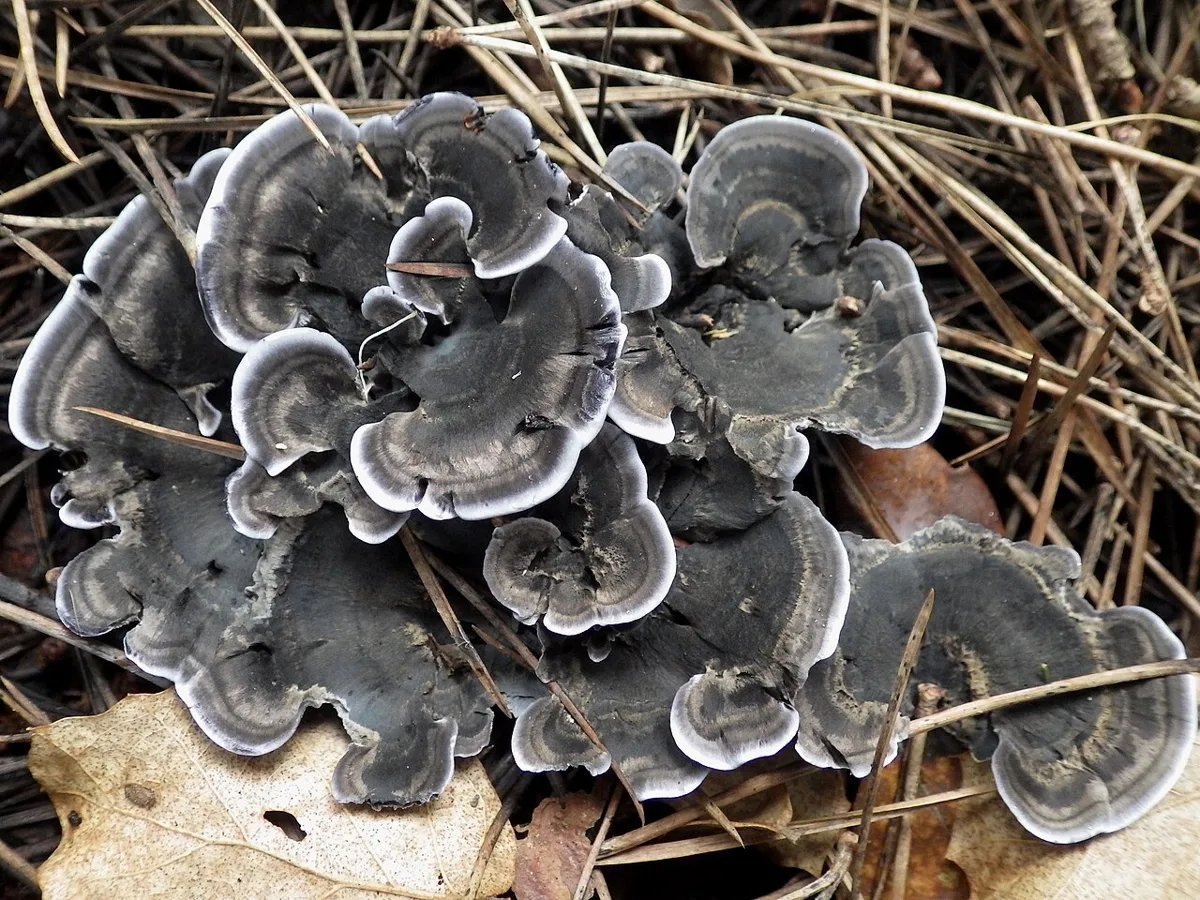
Phellodon species are tough tooth fungi. First Nature describes the black tooth as blue-black to black with a white rim and concentric zones. Its flesh is tough and cork-like. Several caps often fuse together, with twigs and conifer needles grown into them. The spore print is white, so the print does not separate it from a hedgehog. The pinch test does. First Nature lists it as inedible and records it in North America. A brown relative, Phellodon tomentosus, has white teeth and grows with pine and spruce, according to MykoWeb.
Bearded Tooth or Lion's Mane (Hericium erinaceus)
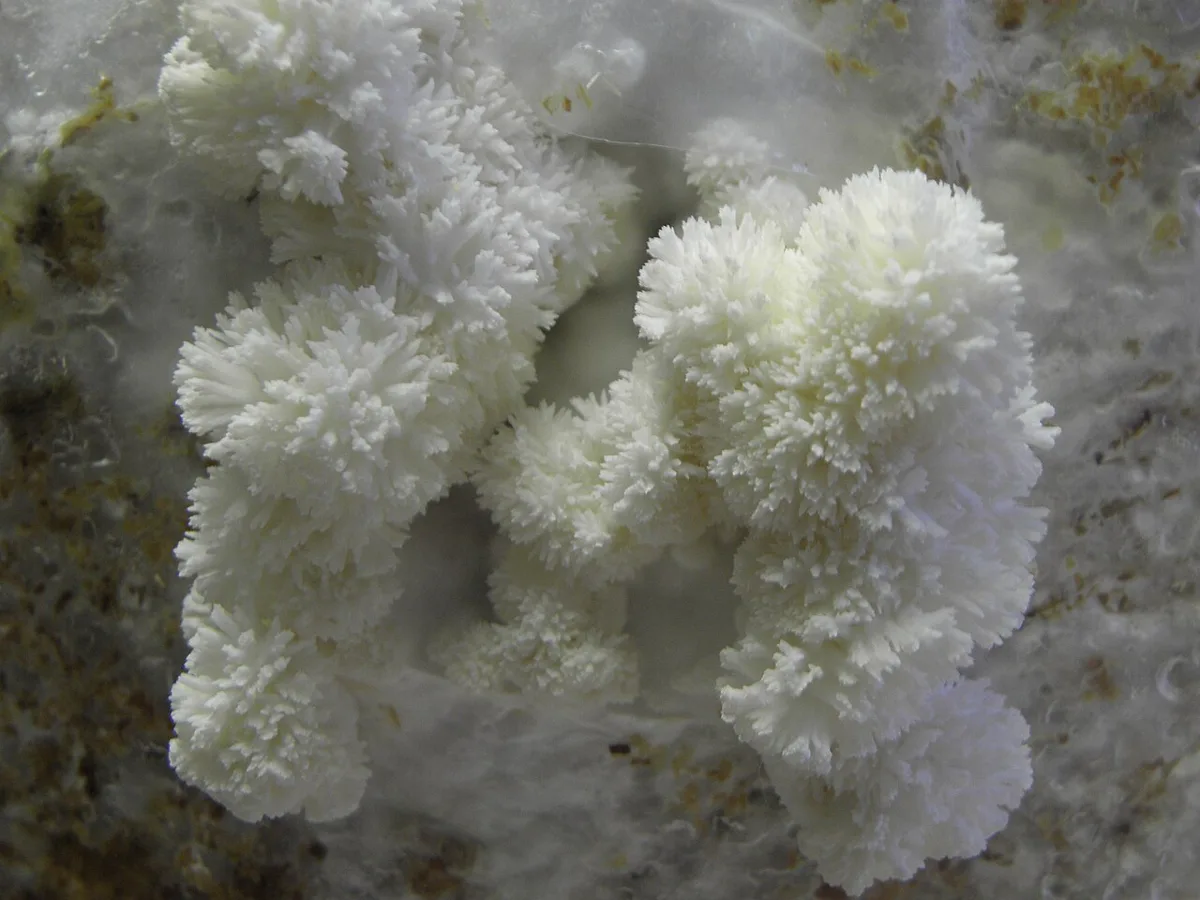
The bearded tooth shares the name "hedgehog mushroom" in some sources, but it looks nothing like a Hydnum once you see it whole. The Missouri Department of Conservation describes a white, beard-like mass of spines ½ to 2 inches long, with no stalk. It grows on living hardwoods and on fallen logs from August to November. See our lion's mane mushroom guide for the full profile.
Chanterelles and Orange Gilled Mushrooms Seen From Above
From above, a hedgehog cap can pass for a chanterelle. MykoWeb notes that California chanterelles share the same pale buff to buff-orange color. MDC states the difference plainly: chanterelles lack spines. Compare the undersides with our chanterelle identification guide. Any orange mushroom with true gills is neither. The jack-o'-lantern mushroom is the poisonous orange species to rule out first.
Are Hedgehog Mushrooms Edible?
The sources used here rate hedgehogs as good edibles, but only after a correct identification by someone experienced. MDC calls the hedgehog a choice edible. MykoWeb rates the California hedgehog edible and excellent, and the pitted hedgehog edible and good. Nobody should eat one based on this page.
Precautions for an expert-confirmed hedgehog:
- Cook it thoroughly. MDC advises cooking all specimens.
- Expect bitterness in old specimens. MykoWeb says hedgehogs can be bitter unless well cooked.
- Try a small amount first. MDC notes that some people react to chemicals in certain fungi.
- Check every mushroom in the basket, not just the first one.
We found no edibility notes for the newer eastern species names, such as H. subolympicum and H. subtilior, in the sources used for this page. Our poisonous vs edible mushrooms guide explains why simple rules fail.
Common Identification Mistakes
Judging From the Top Only
A buff-orange cap looks the same on a hedgehog, a chanterelle and some gilled mushrooms. Flip every mushroom before it goes in the basket.
Calling Every Toothed Mushroom a Hedgehog
Teeth also appear on the scaly hedgehog, the bleeding tooth, Phellodon and the bearded tooth. Teeth alone confirm only the group, not the species.
Skipping the Spore Print
A brown print rules out a hedgehog and points to Sarcodon. A white print still needs the pinch test, because Phellodon prints white too.
Ignoring a Tough Texture
Hedgehog flesh tears easily. A cap that bends like cork, or several caps fused around twigs, is a different tooth fungus.
Trusting One Name or One Source
Older guides use Hydnum repandum for several US species, and sources differ on size and bruising. Read more than one regional source before deciding.
Frequently Asked Questions
What is a hedgehog mushroom?
A hedgehog mushroom is a Hydnum species with soft teeth under the cap instead of gills. It has a pale orange to buff cap and grows on soil under trees. Its spore print is white.
Are hedgehog mushrooms edible?
The Missouri Department of Conservation calls the hedgehog a choice edible, and MykoWeb rates it excellent. Sources say to cook it thoroughly and try a small amount first. Never eat one without expert confirmation.
Is there a poisonous hedgehog mushroom look-alike?
None of the sources used here lists a deadly toothed look-alike. The scaly hedgehog can taste bitter, and the bleeding tooth and black tooth are inedible. The real risk is a gilled orange mushroom, such as the poisonous jack-o'-lantern, taken without checking the underside.
How do you tell a hedgehog mushroom from a chanterelle?
Turn it over. A hedgehog has soft teeth hanging under the cap, while a chanterelle has blunt ridges. The two can look alike from above and can grow in the same woods.
When is hedgehog mushroom season?
The Missouri Department of Conservation lists July to November in Missouri. MykoWeb says California hedgehogs fruit from mid-winter to early spring, often after New Year's. Season depends on region.
Where do hedgehog mushrooms grow?
Hedgehogs grow on the ground in mixed woods, scattered or in groups. They partner with tree roots, so they never grow on wood. Sources name conifers such as Douglas fir and Bishop pine, and hardwoods such as tanoak and madrone.
What color is a hedgehog mushroom spore print?
White. Both the Missouri Department of Conservation and MykoWeb give a white print. A brown print points to the scaly hedgehog instead.
Is Hydnum repandum found in North America?
Not under current DNA-based definitions. The true Hydnum repandum is European. US hedgehogs belong to related species such as Hydnum subolympicum, Hydnum washingtonianum and Hydnum oregonense.
Is lion's mane a hedgehog mushroom?
The Missouri Department of Conservation lists "hedgehog mushroom" as one common name for lion's mane, Hericium erinaceus. It is a different fungus. It grows on wood as a white mass of spines with no cap or stem.
What is the scaly hedgehog mushroom?
The scaly hedgehog, Sarcodon imbricatus, is a larger tooth fungus with coarse dark scales on a brown cap. Its teeth turn dark brown and its spore print is brown. Its taste is described as mild to bitter.
Final Safety Reminder
The hedgehog is one of the easier wild mushrooms to recognize, but every specimen still needs checking. Flip it, pinch it and print it every time, and never eat a wild mushroom based on a chart, a photo or an app. Photograph the cap, the teeth and the base using our guide on how to photograph mushrooms for identification, then check your pictures with our free mushroom identifier and a local mycological club. If someone may have eaten a poisonous mushroom in the US, call Poison Control at 1-800-222-1222.
Sign in to leave a comment and join the discussion.
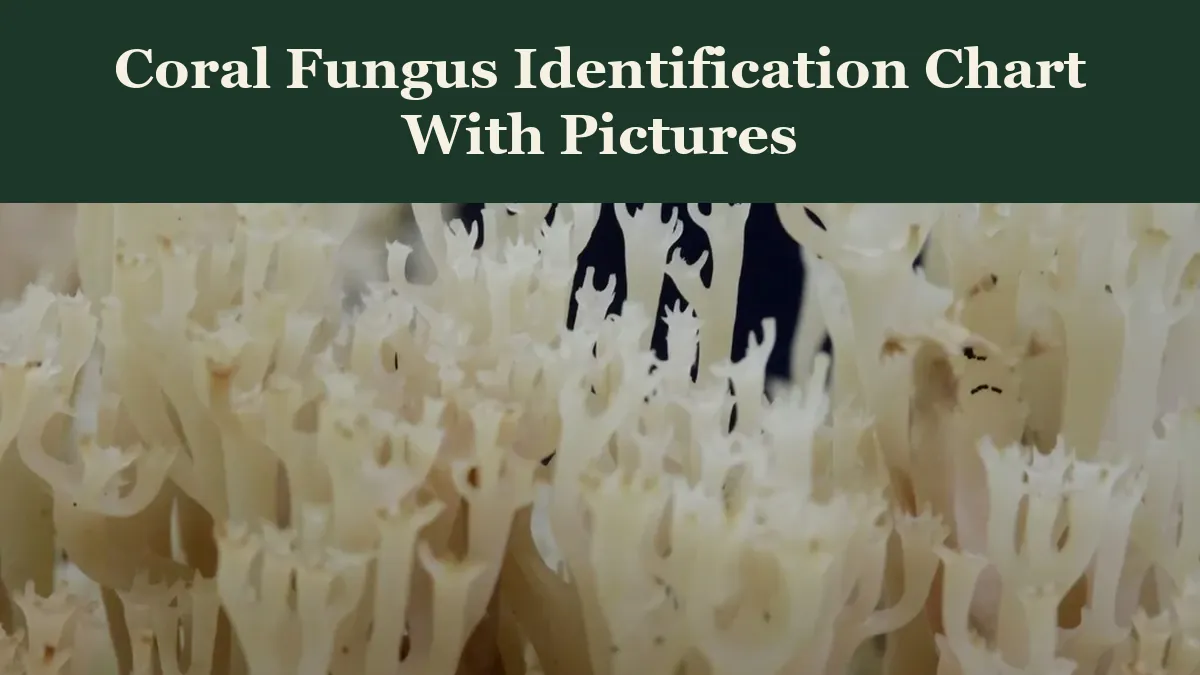 Species Guide
A coral fungus is a mushroom shaped like branching sea coral or a tuft of upright clubs, with no cap and no gills. Most US corals grow from soil in the...
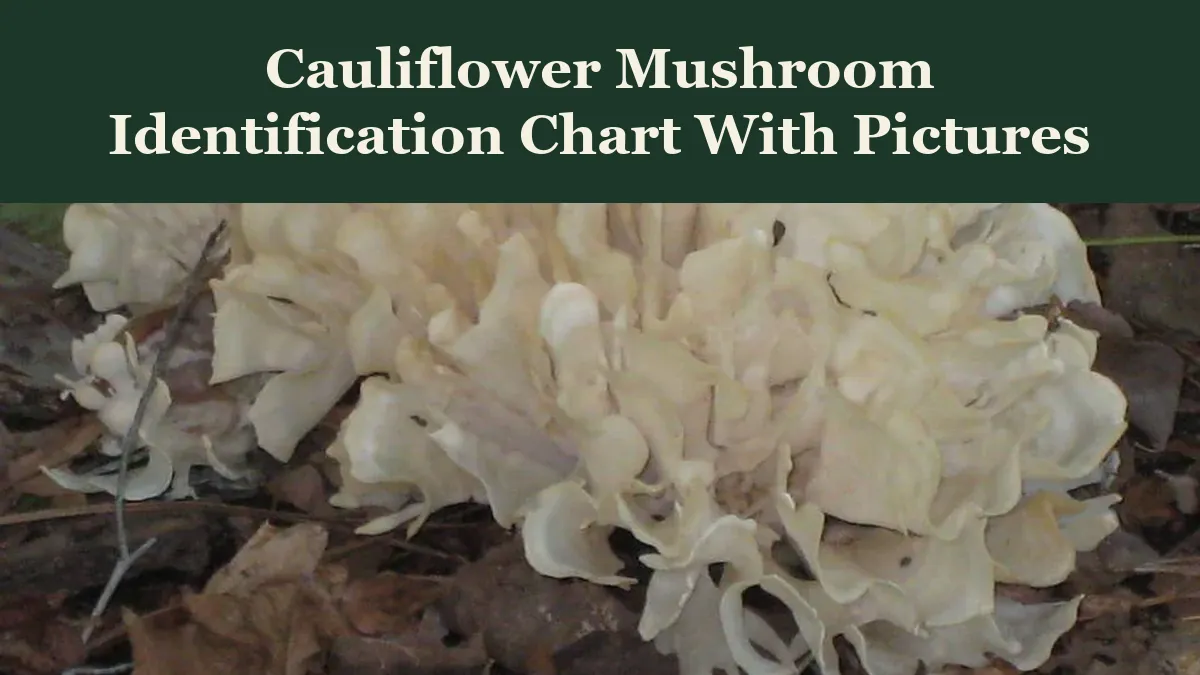 Species Guide
A cauliflower mushroom ( Sparassis ) is a large, cream-colored rosette of flat, wavy, ribbon-like lobes that grows at the base of a tree. It has no caps, no...
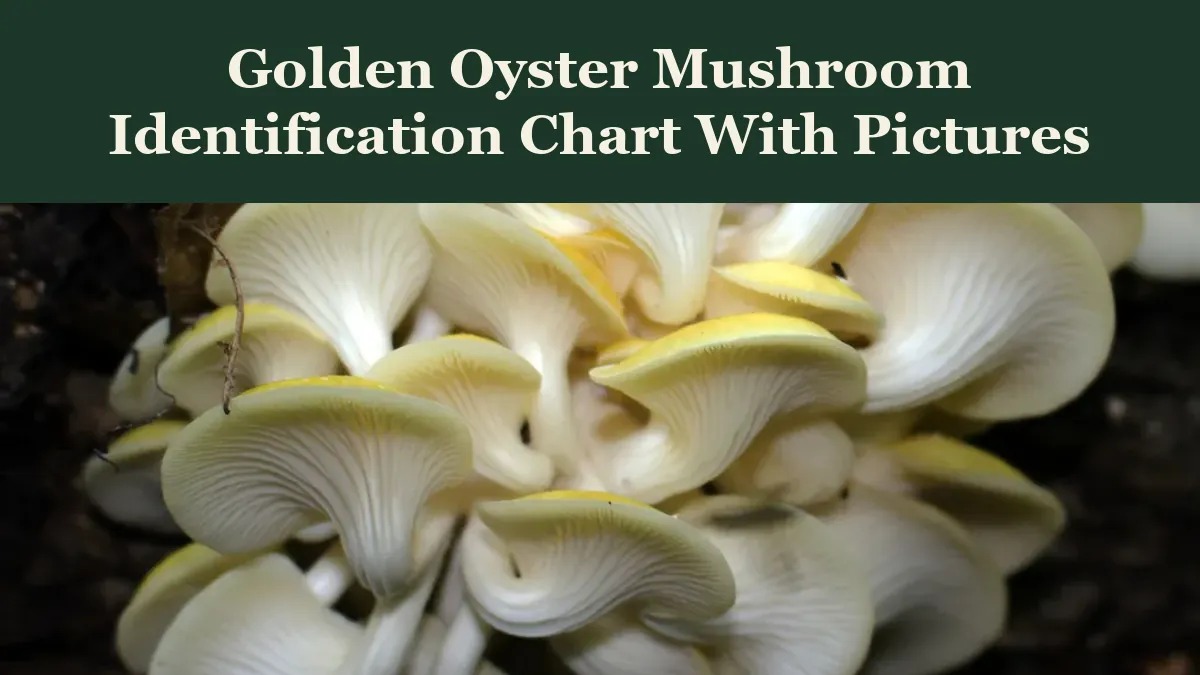 Species Guide
The golden oyster mushroom ( Pleurotus citrinopileatus ) is a bright yellow oyster mushroom that grows in dense, bouquet-like clusters on dead hardwood,...