Black Trumpet Mushroom Identification Chart With Pictures
— views
A black trumpet mushroom is a hollow, dark gray to black funnel with a smooth or slightly wrinkled underside and no gills. In the eastern US it is Craterellus fallax, which fruits in summer on mossy ground in hardwood forests. California has its own species, Craterellus calicornucopioides, which fruits from mid-winter into spring. Black trumpets are rated choice edibles, but every find still needs expert confirmation.
This black trumpet mushroom identification chart with pictures covers the US species, how to spot them on a dark forest floor, the season by region, the spore print colors and the black look-alikes that share their woods. It is an identification guide, not permission to eat a wild mushroom.
Key Takeaways
- A black trumpet is hollow all the way down, like a funnel or a small horn. It has no gills, and the underside is smooth to faintly veined.
- The eastern black trumpet, Craterellus fallax, grows with oaks and beech east of the Rocky Mountains. Missouri lists June to September.
- The California black trumpet, Craterellus calicornucopioides, grows under tanoak, madrone and live oak from mid-winter into spring.
- Spore print color differs by species: salmon to ocher-orange in the East, pale buff in California, and white for the European C. cornucopioides.
- Black trumpets are hard to see. Hunters look for small black holes in the litter, then search closely, because one trumpet usually means more nearby.
- Look-alikes include the devil's urn, black elfin saddles, black cup fungi and black earth tongues. None of them combines a thin hollow funnel, a smooth to veined underside and growth from soil.
- Sources rate black trumpets as choice edibles. Be completely sure of the identification, confirm it with an expert, and try only a small amount the first time.
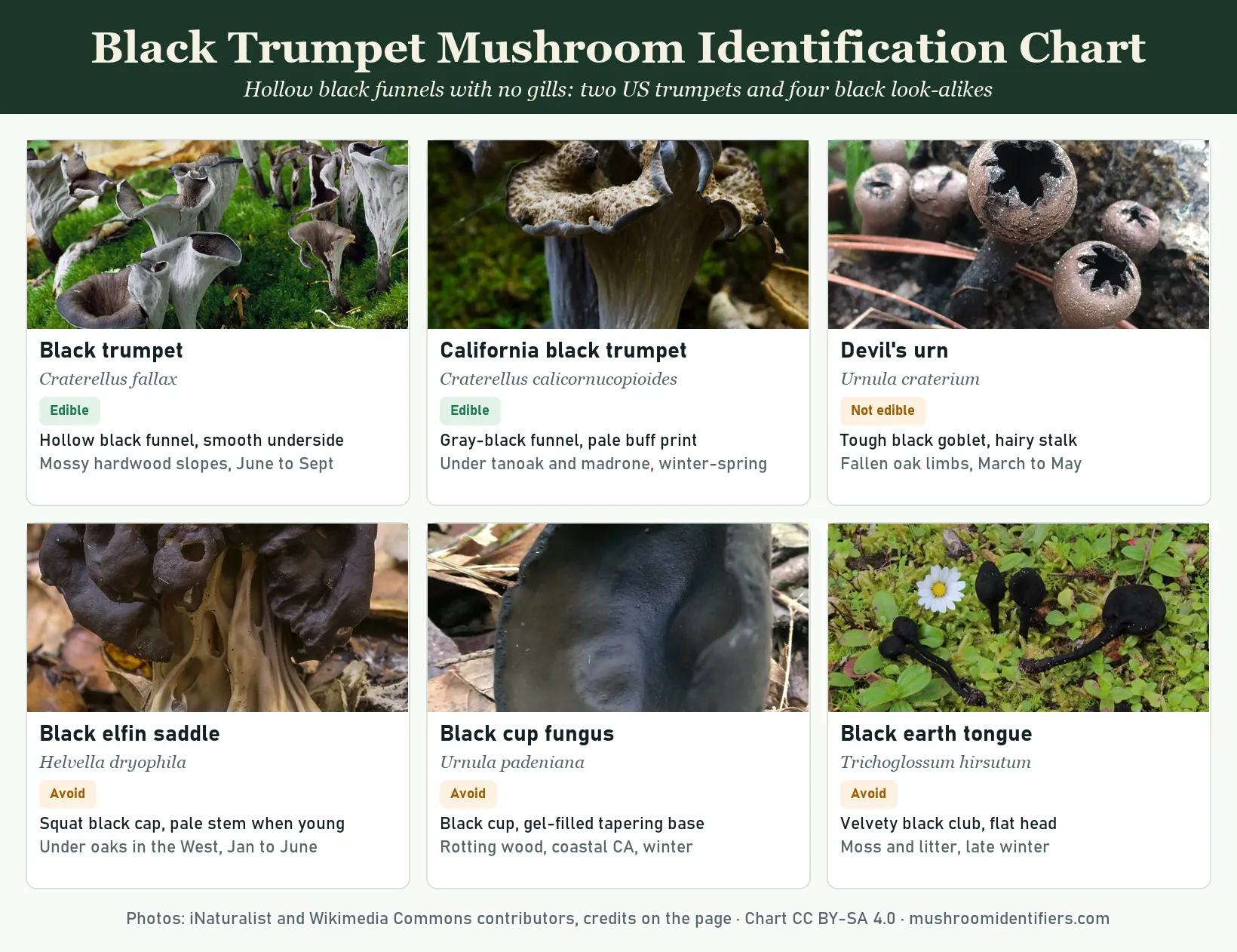
Black Trumpet Mushroom Identification Chart
| Mushroom | Key features | Where and when | Spore print | Edibility or risk |
|---|---|---|---|---|
| Eastern black trumpet (Craterellus fallax) | Hollow dark brown to black funnel; underside turns salmon with age | Mossy, rocky slopes in hardwood forests; June to September in Missouri | Salmon to ocher-orange | Rated choice; expert confirmation needed |
| California black trumpet (Craterellus calicornucopioides) | Gray-black funnel, 2 to 7 cm wide; pale gray underside | Under tanoak, madrone and live oak; mid-winter to spring | Pale buff | Rated edible and choice by MykoWeb; expert confirmation needed |
| Horn of plenty (Craterellus cornucopioides) | Very similar funnel; smaller spores | Common in Europe, rare in North America | White | The European species; most US trumpets are not this one |
| Devil's urn (Urnula craterium) | Tough black goblet on a short, hairy stalk | Fallen oak limbs, often at soil level; March to May in Missouri | Not stated | Not edible |
| Black elfin saddle (Helvella dryophila) | Squat, nearly black cap on a stem that is pale when young | Under oaks in the West; January to June | Not stated | Not a trumpet; keep it out of the basket |
| Black cup fungus (Urnula padeniana) | Black cup with a tapering base filled with dark gel | Rotting or buried wood in coastal California forests; mid-winter to spring | Not stated | Edibility unknown |
| Black earth tongue (Trichoglossum hirsutum) | Small velvety black club with a flattened head | Moss, rotting wood or leaf litter; late winter to early spring in California | Not stated | Edibility unknown |
Chart details come from the Missouri Department of Conservation, MykoWeb and Tom Volk's Fungus of the Month. Compare your find with several real photographs, not one picture.
What Is a Black Trumpet Mushroom?
A black trumpet is a dark, hollow, funnel-shaped member of the chanterelle family, Cantharellaceae, in the genus Craterellus. The Missouri Department of Conservation (MDC) lists three other common names: horn of plenty, black chanterelle and trumpet of the dead. Tom Volk notes that the French call a similar species "trompette des morts," or trumpet of death.
Black trumpets are relatives of the golden chanterelle, but they sit in a different genus. Tom Volk explains that members of this family have blunt ridges instead of gills. In black trumpets the underside is smoother still, smooth to slightly veined according to MDC. Volk adds that Cantharellus species usually have clamp connections in their cells, while Craterellus species usually do not. Compare the golden species in our chanterelle identification guide.
Sources disagree on how black trumpets feed. MDC calls the black trumpet probably a saprobe, a fungus that breaks down dead material. Volk says it is most often found with oak or beech, probably as a mycorrhizal partner of the tree roots. The habitat advice is the same either way: look under oaks and beech.
How to Spot Black Trumpets
Black trumpets are hard to find because they are small and dark and blend into the leaf litter, so the trick is to scan for holes rather than mushrooms. MDC says their color makes them hard to see. MykoWeb notes that hunters search for "small black holes in the ground." From above, a trumpet shows only its dark, hollow inside, which reads as a hole.
- Pick the right ground. MDC places eastern trumpets on rocky, mossy hillsides in hardwood forests. Volk names oak and beech. In California, MykoWeb names tanoak, madrone and live oak. Our mushroom habitat guide explains how trees and moisture shape where fungi fruit.
- Go in the right window. Look from June to September in Missouri. Look from mid-winter into spring in California.
- Scan for black gaps. Move slowly and look for dark holes, slits and shadows in the litter and moss. Check the edges of moss patches and the dark ground between leaves.
- Stop at the first one. MDC says more are usually nearby. Volk reports finding sometimes several hundred in a small area. Search the ground around your feet before moving on.
- Remember the spot. MDC notes that black trumpets can return to the same spot for years.
- Check each one. Pick each trumpet whole, look down into it, and turn it over. Look for a hollow funnel, a smooth or faintly veined underside, no gills and no separate stem.
Core Identification Features
Check the shape, the outer surface, the underside, the spore print, the flesh and the way the mushrooms grow. A black trumpet has a short list of features, and every one should match. Our guide to the parts of a mushroom explains each term.
Shape
The fruiting body is a funnel, vase or trumpet with a wavy edge, hollow down to the base. MDC gives a width of ⅛ to 3½ inches and a height of 1 to 5½ inches. MykoWeb gives 2 to 7 cm wide and 3 to 9 cm tall for the California species. The edge is sometimes torn.
Outer Surface
The inside of the funnel is the upper surface. MDC describes it as dark brown to black, dry, and more often rough and scaly than smooth. MykoWeb describes the California species as dark gray to blackish when wet, turning lighter as it dries.
Underside
The outside of the funnel carries the spores. MDC describes it as smooth to slightly veined, brown to gray when young and salmon-colored when mature. MykoWeb describes the California underside as smooth to slightly wrinkled and pale gray. Real gills rule out a black trumpet. Our guide to gills vs pores vs ridges shows the difference.
Spore Print
Spore print color helps sort the species. Volk gives a salmon print for C. fallax and a white print for the European C. cornucopioides. MDC gives ocher-buff to ocher-orange. MykoWeb gives pale buff for the California species. A spore print on white and dark paper makes the color easier to judge. See our spore print guide.
Flesh and Smell
The flesh is thin. MykoWeb calls it leathery. MDC calls the black trumpet highly fragrant. Volk describes the smell as very sweet, like apricots, and stronger than a golden chanterelle, while noting that some people compare it to used sweat socks.
Growth Pattern
Black trumpets grow on the ground in groups of a few to many, according to MDC. MykoWeb says the California species tends to fruit in clusters. A single black cup on a stick is a warning sign, not a trumpet.
When and Where Do Black Trumpets Grow?
Black trumpets fruit in summer in the East and Midwest, and from mid-winter into spring in California. MDC lists June to September in Missouri, where the species is found statewide. MykoWeb lists mid-winter to spring for the California species. Volk calls C. fallax fairly common east of the Rocky Mountains. The second table shows which black look-alikes fruit in the same window.
| Region | Black trumpet season | Trees named | Source |
|---|---|---|---|
| Missouri | June to September | Hardwood forests, on mossy rocky slopes | MDC |
| East of the Rocky Mountains | Summer | Oak and beech | Tom Volk |
| California | Mid-winter to spring | Tanoak, madrone, live oak | MykoWeb |
| Black look-alike | Fruiting window in sources | Overlap with trumpets |
|---|---|---|
| Devil's urn (Urnula craterium) | March to May in Missouri | Before the eastern trumpet season in Missouri |
| Hairy rubber cup (Galiella rufa) | July to September in Missouri | Same window as eastern trumpets |
| Black elfin saddle (Helvella dryophila) | January to June, under oaks | Same window and some of the same trees as California trumpets |
| Conifer elfin saddle (Helvella vespertina) | October to January, under conifers | Overlaps the start of the California season |
| Black cup (Urnula padeniana) | Mid-winter to spring in California | Same window as California trumpets |
| Black earth tongue (Trichoglossum hirsutum) | Late winter to early spring in California | Same window as California trumpets |
The windows come from MDC, MykoWeb and the 2013 Mycologia study that named the western elfin saddles. For other fungi under oaks, see our oak tree fungus identification guide.
Common Black Trumpet Types in the US
Two black trumpets cover most US finds: Craterellus fallax in the East and Midwest, and Craterellus calicornucopioides in California. They look almost the same in the field. The region, the season and the spore print color separate them. The European horn of plenty is rare in North America, according to Volk.
Eastern Black Trumpet (Craterellus fallax)
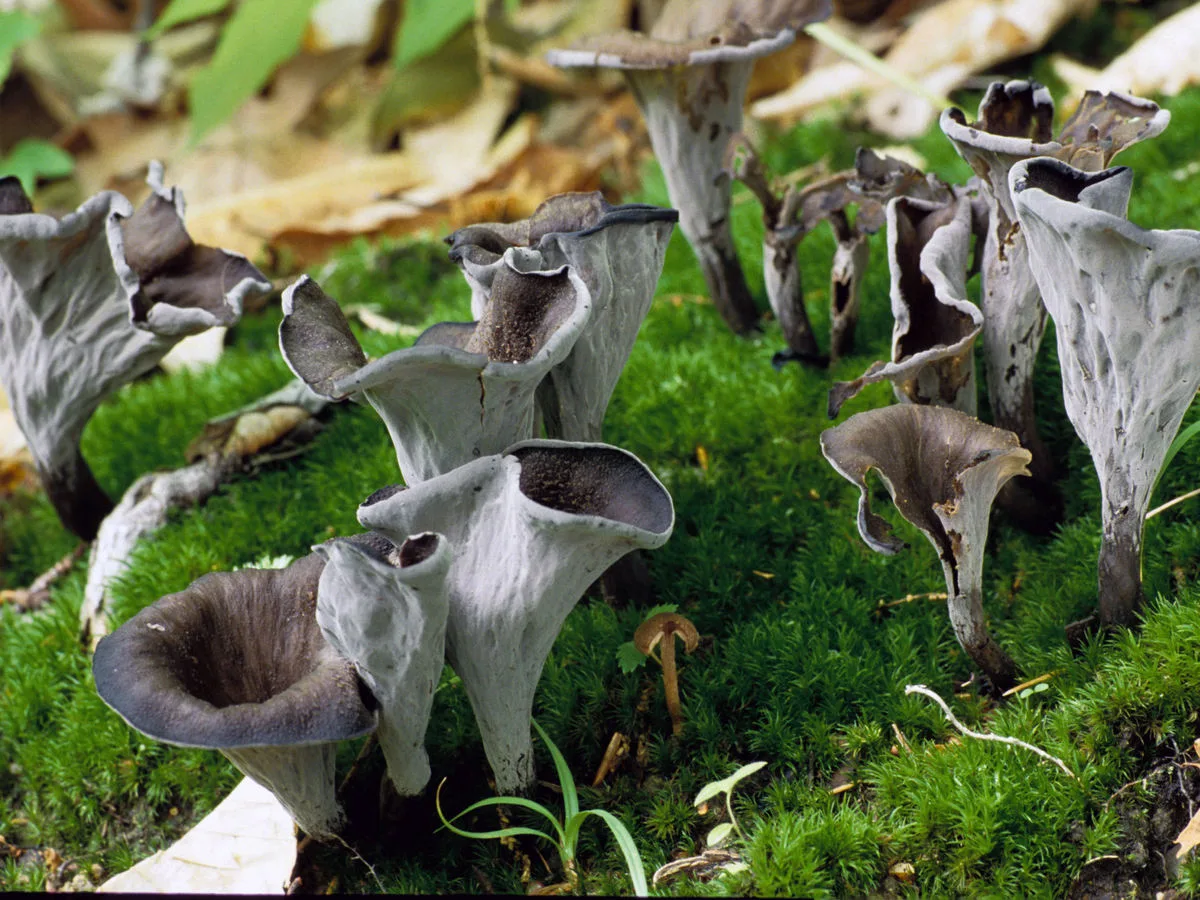
This is the black trumpet of eastern and midwestern forests. It is a hollow, dark brown to black funnel up to about 3½ inches across. Its underside turns salmon as it matures, and its spore print is salmon to ocher-orange. Volk gives its spores as about 11 to 15 µm long, larger than those of the European species. It grows on the ground with oak or beech, often on mossy, rocky slopes, from June to September in Missouri. MDC lists it under the name Craterellus cornucopioides with C. fallax in parentheses, so you will see both names for the same mushroom.
California Black Trumpet (Craterellus calicornucopioides)
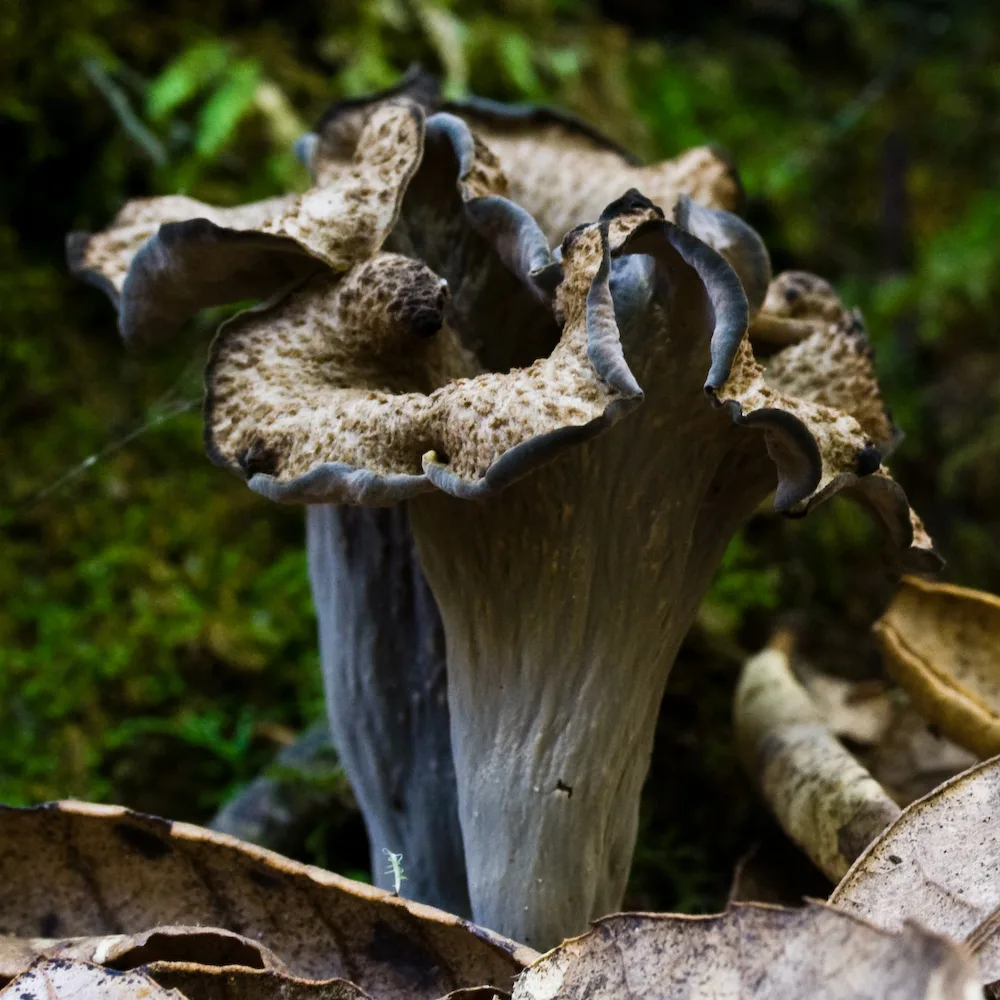
California's black trumpet was named Craterellus calicornucopioides by D. Arora and J.L. Frank in 2015, according to MykoWeb. Before that, it went by the European name C. cornucopioides, which MykoWeb now lists as misapplied. It is a dark gray to blackish funnel, 2 to 7 cm wide and 3 to 9 cm tall, with a pale gray underside and a pale buff spore print. It is especially common under tanoak and madrone, and also grows with live oak. It fruits from mid-winter into spring, often in clusters.
Why Are Black Trumpet Names So Confusing?
Many US sources still use the European name Craterellus cornucopioides for black trumpets, but North America has its own species. Volk describes C. fallax and C. cornucopioides as very similar. He separates them by spore print color, salmon versus white, and by spore size. He calls C. cornucopioides rare in North America and common in Europe.
| Name you may see | What it refers to | Spore print |
|---|---|---|
| Craterellus fallax | The eastern and midwestern black trumpet | Salmon to ocher-orange |
| Craterellus calicornucopioides | The California black trumpet, named in 2015 | Pale buff |
| Craterellus cornucopioides | The European horn of plenty; also used loosely in older US guides | White |
The rows come from Volk, MDC and MykoWeb. A market or app label that says "Craterellus cornucopioides" usually means "a black trumpet of some kind," not a confirmed species.
Black Trumpet Look-Alikes: Side-by-Side Comparison
MDC says the black trumpet has no lookalikes in Missouri, and a clean, whole trumpet is distinctive. The mix-ups involve other black fungi in the same litter and season. None of the sources used here names a dangerous look-alike for a whole trumpet. None of these fungi combines a thin hollow funnel, a smooth to veined underside and growth from soil, so each fails a careful look inside, underneath and at the base.
| Look-alike | How to tell it apart | Grows on | Risk |
|---|---|---|---|
| Devil's urn (Urnula craterium) | Tough, rubbery goblet with a hairy black stalk; spring | Fallen hardwood limbs and buried roots | Not edible |
| Black elfin saddles (Helvella dryophila, H. vespertina) | A cap on a separate stem, not a funnel | Soil under oaks or conifers | Not a trumpet; keep separate |
| Black cups (Urnula padeniana, Plectania) | Open cups or urns on wood; gel-filled base in U. padeniana | Rotting or buried wood | Edibility unknown |
| Black earth tongues (Trichoglossum, Geoglossum) | Flattened clubs, not funnels | Moss, rotting wood, litter | Edibility unknown |
| Ridged black chanterelle (Craterellus cinereus var. multiplex) | A network of ridges under the cap; stronger odor | Not stated in the source used | Much rarer; confirm with an expert |
Devil's Urn (Urnula craterium)
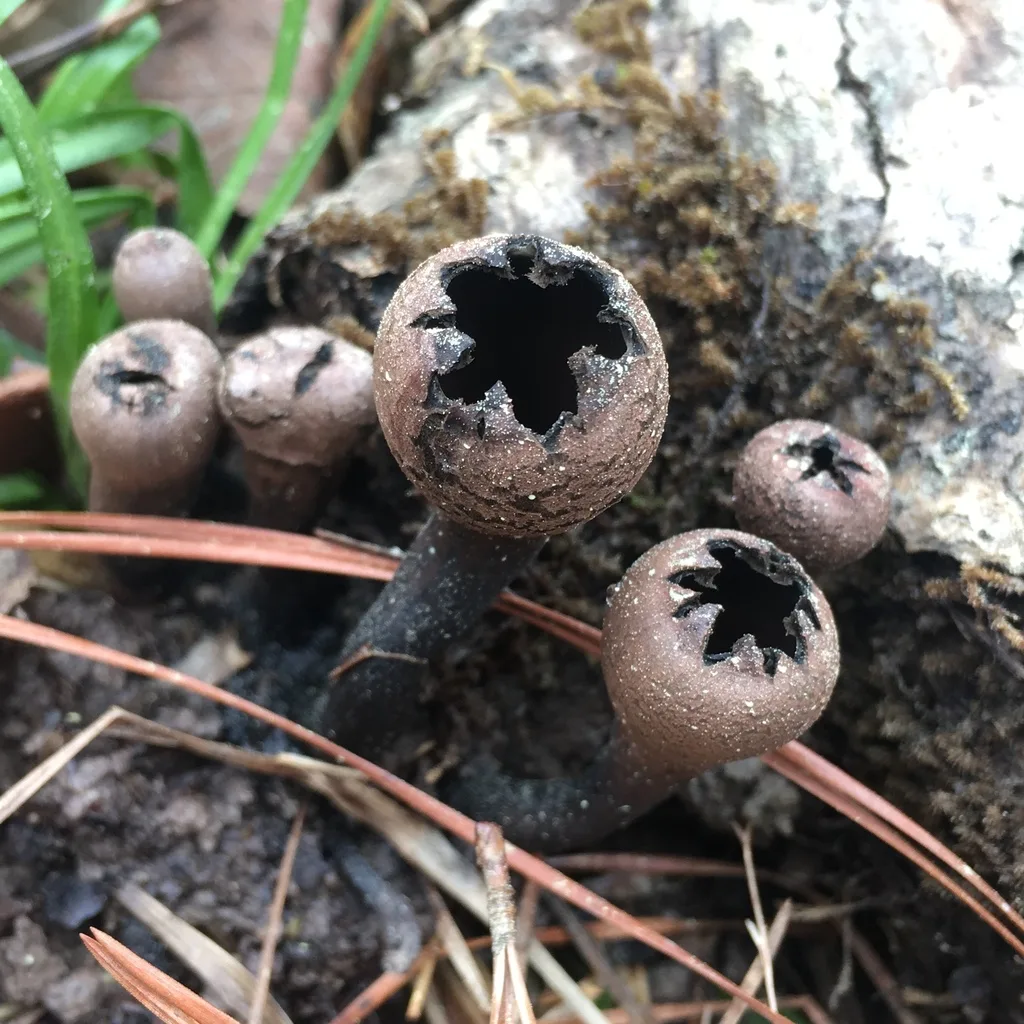
The devil's urn is a black goblet, not a funnel. The Missouri Department of Conservation describes a cup 1¾ to 3¼ inches wide on a short, thick, densely hairy black stalk. Both surfaces are dark brownish black, and the texture is tough, rubbery and leathery. Young urns look like clusters of dark brown grapes before they tear open. It grows on decaying hardwood branches, especially fallen oak limbs where they touch the soil, and on buried roots, so it can look as if it grows from the ground. MDC lists it as not edible and gives March to May for its season.
Black Elfin Saddles (Helvella dryophila)
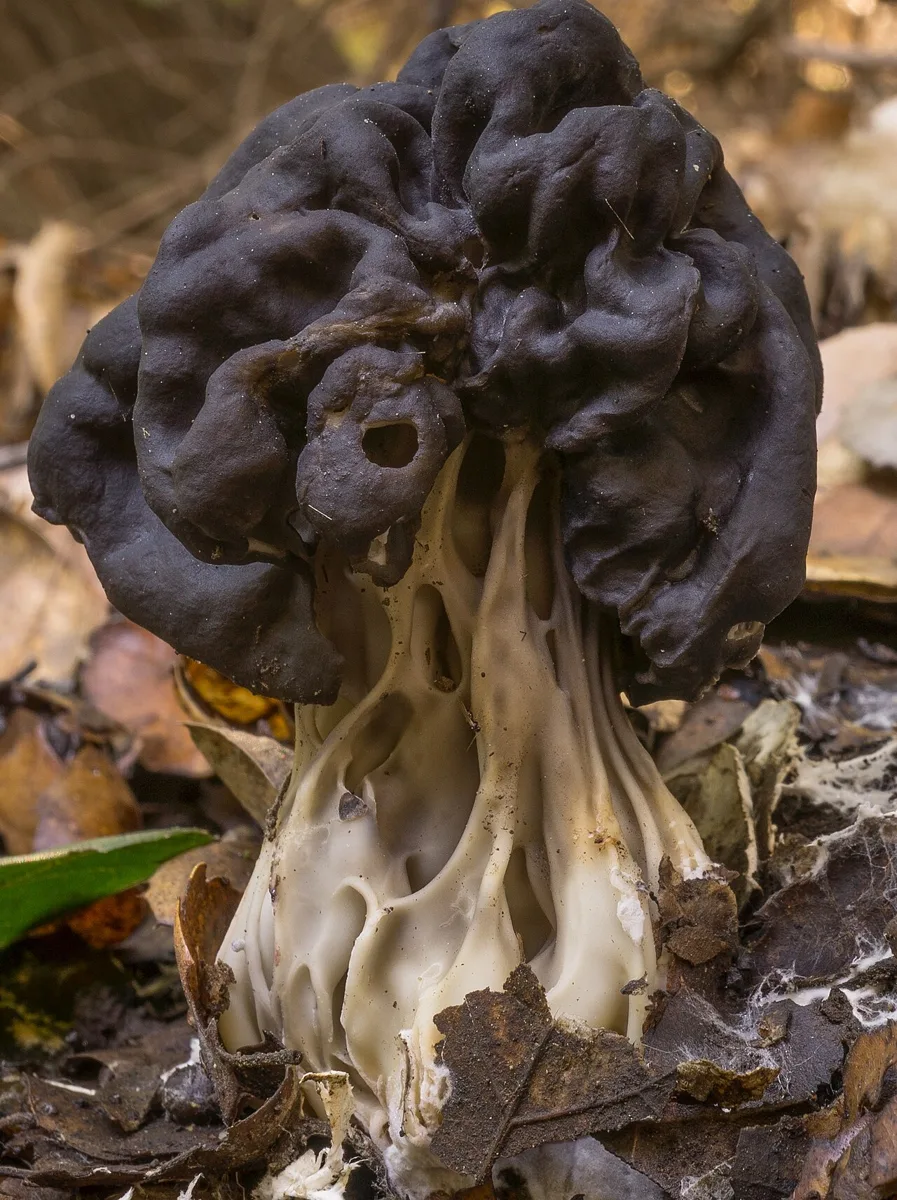
Black elfin saddles have a cap on a stem, not a hollow funnel. A 2013 study in Mycologia split the western "Helvella lacunosa" into several species. It described H. dryophila as having a dark, almost black, squat cap and a stem that is pale when young. It grows with oaks and fruits from January to June, the same months and some of the same trees as the California black trumpet. MykoWeb gives a slightly different window, late fall to early spring, and notes that the European H. lacunosa is not known from North America. Its conifer counterpart, H. vespertina, grows under pine and Douglas fir. MykoWeb lists both as edible when cooked. They are not black trumpets, and this page does not recommend them as food.
Black Cup Fungi (Urnula padeniana)
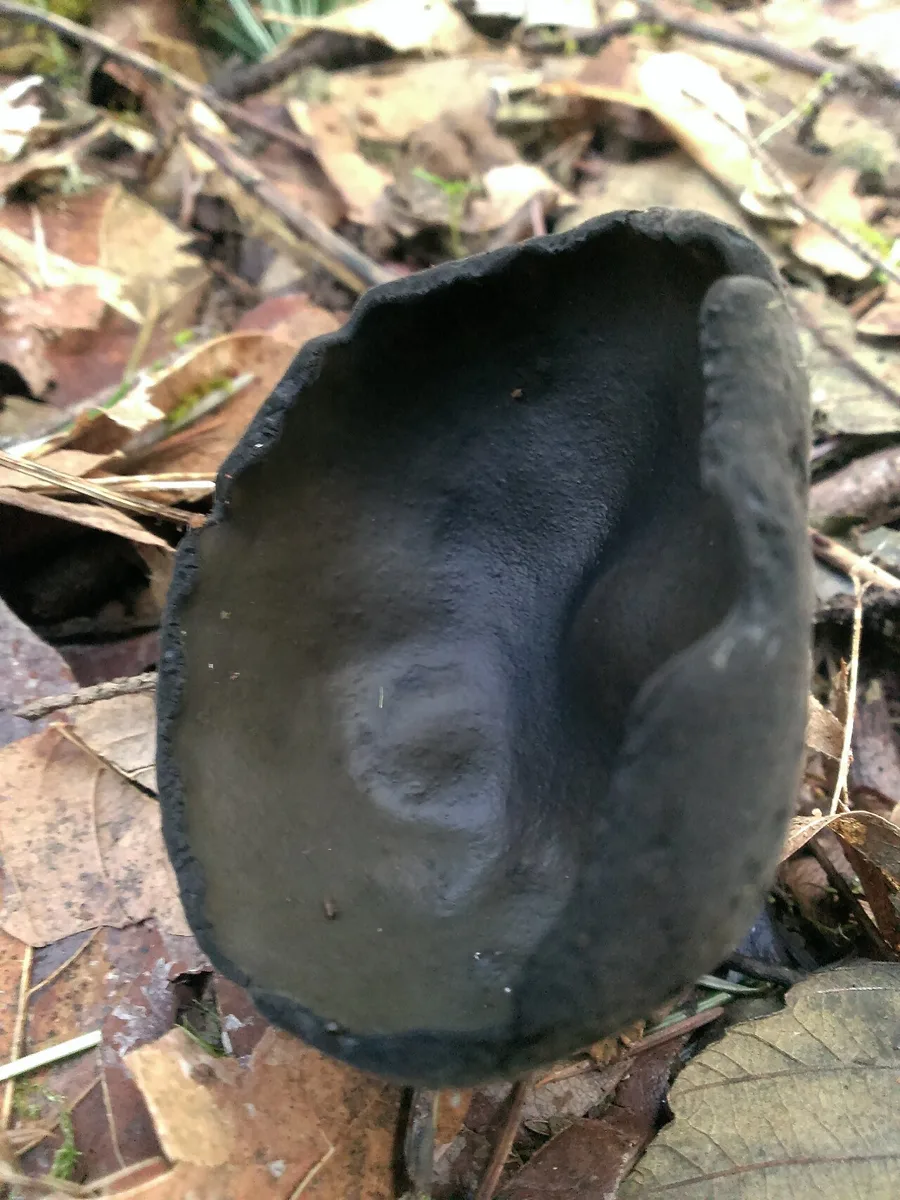
At least one black cup fungus grows on wood in coastal California during trumpet season. MykoWeb describes Urnula padeniana as a top-shaped black cup, 3 to 6 cm tall, with a tapering base filled with blackish gel. Its gray outer surface blackens where handled. It grows on rotting or buried wood in coastal forests from mid-winter to spring. MykoWeb lists its edibility as unknown. A cup attached to wood, even buried wood, is not a black trumpet.
Black Earth Tongues (Trichoglossum hirsutum)
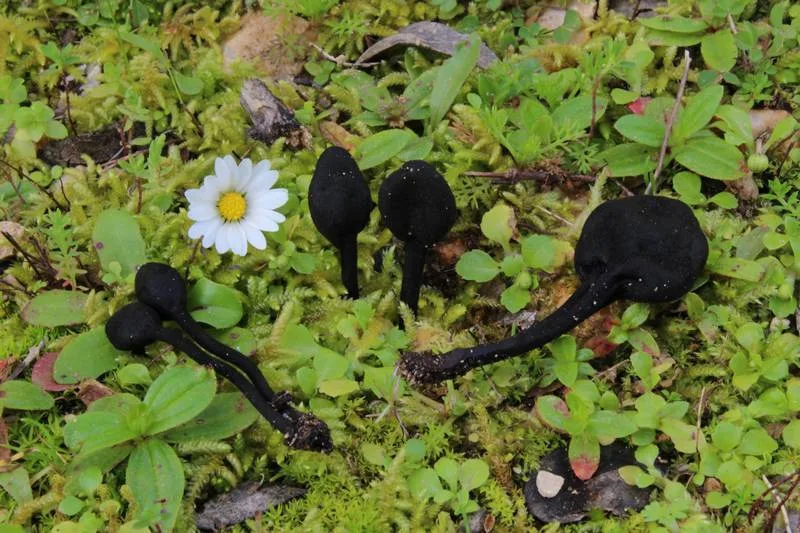
Earth tongues are small black clubs that rise from moss and litter. MykoWeb describes the black earth tongue as 1.5 to 7 cm tall, with a flattened, spade-shaped head and a thin round stem. Velvety hairs on the head and stem separate it from Geoglossum, which is smoother. It fruits in moss, rotting wood or leaf litter from late winter to early spring in California. MykoWeb lists its edibility as unknown. An earth tongue is a club, not a funnel, so a look at the top rules out a trumpet.
Are Black Trumpets Edible?
The sources used here rate black trumpets as choice edibles, but only after a correct identification by someone experienced. MDC calls the black trumpet a choice edible. Volk calls C. fallax a delicious edible prized for its odor. MykoWeb rates the California black trumpet edible and choice. Nobody should eat one based on this page.
Precautions for an expert-confirmed trumpet:
- Be completely sure of the identification, as MDC advises for all edible mushrooms.
- Eat only a small amount the first time and watch for a reaction, as MDC advises.
- Check every piece in the basket. Black cups and earth tongues can be picked by accident in dark litter.
MDC notes that the flavor intensifies when dried. Our poisonous vs edible mushrooms guide explains why simple rules fail, and our guide to edible mushrooms in Missouri covers the state where much of the eastern data comes from.
Common Identification Mistakes
Picking Every Black Shape in the Litter
Devil's urns, black cups and earth tongues are also dark and grow in the same litter. Look inside and underneath each piece before it goes in the basket.
Ignoring What It Grows From
Black trumpets grow from the ground. A black cup or urn attached to a stick, a limb or buried wood is a different fungus.
Expecting the Same Spore Print Everywhere
Eastern trumpets print salmon to ocher-orange, California trumpets print pale buff, and the European species prints white. Compare your print with the right region.
Using the Wrong Season for Your Region
A black funnel in a California January fits the local trumpet. A black cup on an oak limb in a Missouri April fits the devil's urn far better than a trumpet.
Frequently Asked Questions
What is a black trumpet mushroom?
A black trumpet is a hollow, dark gray to black funnel-shaped mushroom in the chanterelle family. It has no gills, and its underside is smooth to faintly veined. In the eastern US it is Craterellus fallax.
Are black trumpet mushrooms edible?
The Missouri Department of Conservation and MykoWeb rate black trumpets as choice edibles. Be completely sure of the identification and try only a small amount the first time. Never eat one without expert confirmation.
What looks like a black trumpet mushroom?
The devil's urn, black elfin saddles, black cup fungi and black earth tongues can share the same woods. None of them combines a thin hollow funnel, a smooth to veined underside and growth from soil. Look inside, underneath and at the base of every piece.
Is there a poisonous black trumpet look-alike?
The Missouri Department of Conservation says there are no lookalikes in Missouri, and none of the sources used here names a dangerous one for a whole trumpet. The devil's urn is not edible, and other black cups have unknown edibility. Confirm every find with an expert.
When is black trumpet season?
The Missouri Department of Conservation lists June to September in Missouri. MykoWeb gives mid-winter to spring for the California black trumpet. Season depends on region.
Where do black trumpets grow?
Eastern black trumpets grow on the ground in hardwood forests, often on mossy, rocky slopes near oak or beech. California black trumpets grow under tanoak, madrone and live oak. They tend to fruit in groups.
Why are black trumpets so hard to find?
They are small and dark, so they blend into the forest floor. MykoWeb notes that hunters look for small black holes in the ground. Once you find one, search closely, because more are usually nearby.
What color is the black trumpet spore print?
It depends on the species. Tom Volk gives salmon for the eastern Craterellus fallax, and MykoWeb gives pale buff for the California species. The European Craterellus cornucopioides prints white.
What is the difference between Craterellus fallax and Craterellus cornucopioides?
Tom Volk describes them as very similar. Craterellus fallax has a salmon spore print and larger spores, while Craterellus cornucopioides has a white print. He calls C. cornucopioides rare in North America and common in Europe.
Final Safety Reminder
A black trumpet is distinctive once you hold it whole, but a fast hand in dark litter can pick up a black cup or an earth tongue with it. Look inside and underneath every piece, and never eat a wild mushroom based on a chart, a photo or an app. Photograph the inside, the underside and the base using our guide on how to photograph mushrooms for identification, then check your pictures with our free mushroom identifier and a local mycological club. If someone may have eaten a poisonous mushroom in the US, call Poison Control at 1-800-222-1222.
Sign in to leave a comment and join the discussion.
 Species Guide
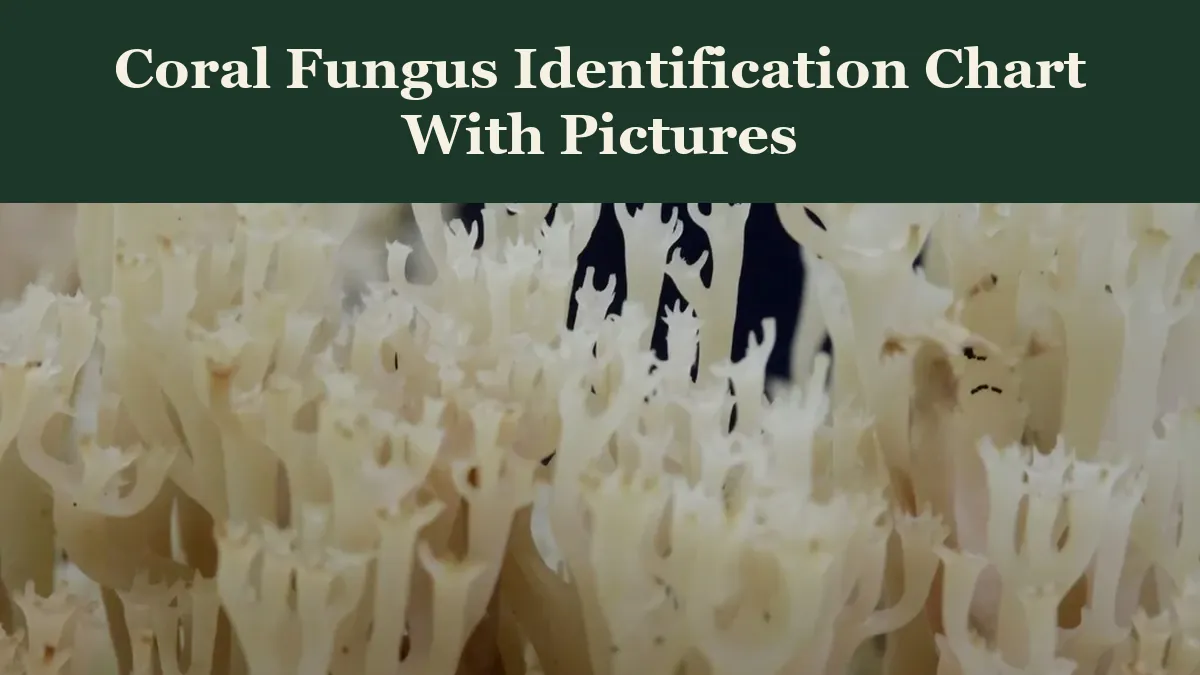
A coral fungus is a mushroom shaped like branching sea coral or a tuft of upright clubs, with no cap and no gills. Most US corals grow from soil in the...
 Species Guide
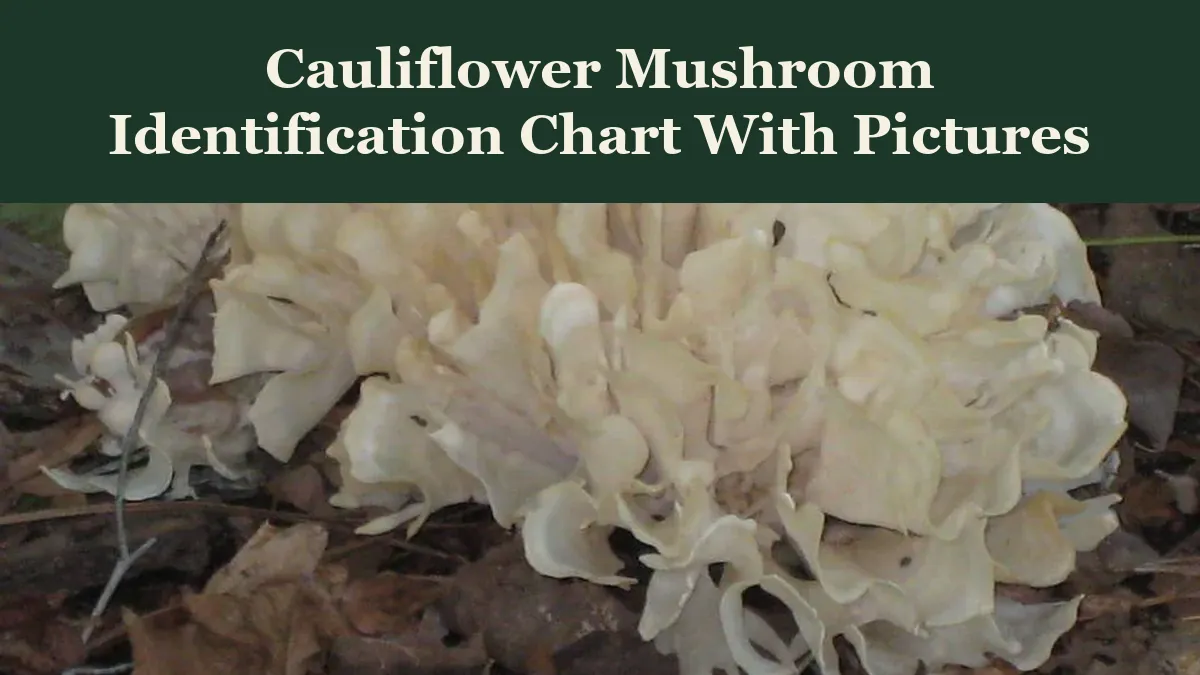
A cauliflower mushroom ( Sparassis ) is a large, cream-colored rosette of flat, wavy, ribbon-like lobes that grows at the base of a tree. It has no caps, no...
 Species Guide
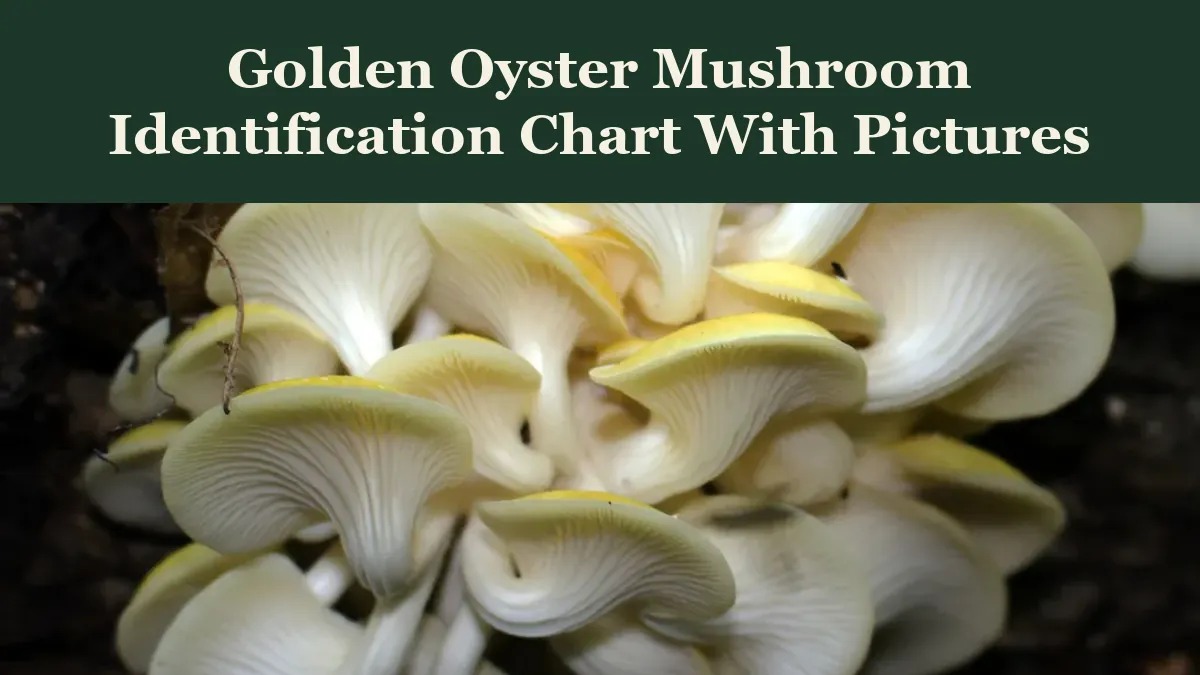
The golden oyster mushroom ( Pleurotus citrinopileatus ) is a bright yellow oyster mushroom that grows in dense, bouquet-like clusters on dead hardwood,...