Wood Ear Mushroom Identification Chart With Pictures
— views
A wood ear mushroom is a brown, rubbery, ear-shaped jelly fungus in the genus Auricularia that grows on dead wood. In North America the hardwood species is Auricularia angiospermarum and the conifer species is A. americana. The old name A. auricula-judae belongs to a European fungus. None of the field look-alikes in our sources is deadly, but dried wood ear soaked for days has killed people through bongkrekic acid.
This wood ear mushroom identification chart with pictures covers the wild US species, the dried kinds sold in stores, a flip-bend-check test, the season by region, the rubbery look-alikes and the documented soaking poisonings. It is an identification guide, not permission to eat a wild mushroom.
Key Takeaways
- A wood ear is thin, rubbery and ear-shaped, with a finely hairy back and a smooth or slightly veined spore side. It has no gills or pores and little or no stem.
- The wood decides the name: A. angiospermarum on hardwood, A. americana on conifers, with two more species on the Gulf Coast.
- Black witch's butter, amber jelly roll, brown witch's butter and dark cup fungi are the common look-alikes. None in our sources is deadly, and devil's urn and hairy rubber cup are listed as not edible.
- Wood ear fruits from May to November in Missouri and from late fall through spring in California.
- In China, wood ear caused 3 bongkrekic acid outbreaks from 2018 to 2020, with 3 deaths among 5 cases. Black fungus in these outbreaks had typically been soaked for more than two days.
- Bongkrekic acid is heat-stable and is not removed by washing or cooking.
- Wood ear is listed as edible, but a wild one still needs expert confirmation before anyone eats it.
What Is a Wood Ear Mushroom?
"Wood ear" is the common name for jelly fungi in the genus Auricularia, which form thin, rubbery, ear-shaped fruiting bodies on dead wood. A 2021 global study of the genus accepted 37 species worldwide, including 10 new ones. The same study found that A. auricula-judae, the European jelly ear, is known only from Europe. The study reassigns earlier US reports under that name to A. americana.
Field guides lag behind. The Missouri Department of Conservation still lists wood ear as Auricularia auricula and calls it very common statewide. Older books use the same name. When you compare photos online, expect to see three or four Latin names for the same brown ear.
Wood ears grow from a network of fungal threads that digest rotting wood, and the "ears" are the spore-producing part. Our guide to the parts of a mushroom explains these terms.
Wood Ear Mushroom Identification Chart
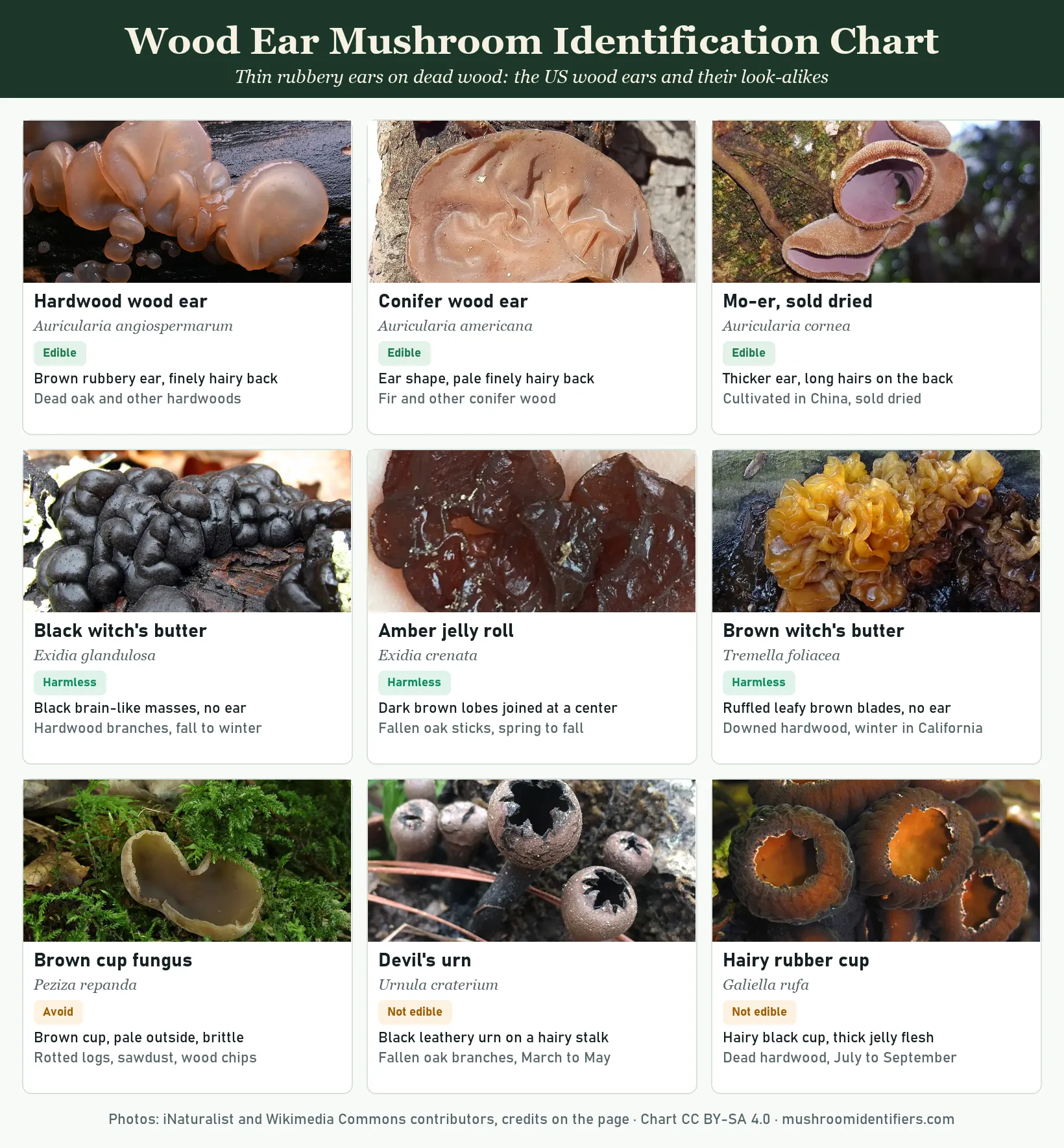
Chart photos not shown below. Black witch's butter: This image was created by user Dan Molter (shroomydan) at Mu, CC BY-SA 3.0, via Wikimedia Commons; Amber jelly roll: iNaturalist user, CC0, via iNaturalist; Brown witch's butter: Andrawaag, CC0, via Wikimedia Commons; Brown cup fungus: Holger Krisp, CC BY 3.0, via Wikimedia Commons; Devil's urn: Matt Berger, CC BY, via iNaturalist; Hairy rubber cup: This image was created by user Dan Molter (shroomydan) at Mu, CC BY-SA 3.0, via Wikimedia Commons.
| Wood ear | Key features | Where and when | Edibility or risk |
|---|---|---|---|
| Hardwood wood ear (Auricularia angiospermarum) | Brown, rubbery ear; finely hairy back; smooth spore side | Dead hardwood such as oak, walnut and hickory; North America only | Listed as edible; expert confirmation needed |
| Conifer wood ear (Auricularia americana) | Ear-shaped; pale, finely hairy back; brown spore side | Fir and other conifers; late fall to spring in California | Listed as edible by MykoWeb |
| Gulf Coast species (Auricularia fuscosuccinea) | Fawn to cinnamon-brown, up to 6.5 cm | Dead hardwood; Florida and Louisiana | No rating in our sources |
| Gulf Coast species (Auricularia nigricans) | Reddish brown, densely hairy back, up to 6 cm | Fallen hardwood trunks; Louisiana | No rating in our sources |
| Mo-er, sold dried (Auricularia cornea) | Thicker ear with long hairs on the back | Cultivated in southern China; also reported in North America | Cultivated food; soaked product can carry bongkrekic acid |
| Heimuer, sold dried (Auricularia heimuer) | Thin ear up to 12 cm, shorter hairs | Cultivated in China; wild on oak in temperate Asia | Cultivated food; soaked product can carry bongkrekic acid |
Species details come from the 2021 Auricularia study, MykoWeb and the Missouri Department of Conservation. Separating the wild species with certainty takes a microscope, because the study relies on hair length and inner tissue layers.
How to Identify a Wood Ear: Flip It, Bend It, Check the Wood
Three quick checks separate a wood ear from most look-alikes: flip it to see the two sides, bend it to test the texture, and check what wood it grows on. None of these checks proves an identification on its own. Together they rule out the brittle cup fungi and the brain-shaped jellies that resemble wood ear.
| Check | Wood ear | What a mismatch suggests |
|---|---|---|
| Flip it | Back finely hairy and paler; spore side smooth to slightly veined; no gills or pores | Gills or pores mean a different mushroom entirely |
| Look at the shape | Separate ears or shallow cups | Brain-like or leafy masses point to Exidia or Tremella |
| Bend it | Rubbery with thin flesh | Brittle flesh points to a cup fungus such as Peziza |
| Check thickness | Thin | Thick, gelatinous flesh in a hairy cup points to hairy rubber cup |
| Check the wood | Hardwood: A. angiospermarum. Conifer: A. americana | A stalked cup on buried sticks points to devil's urn |
The Missouri Department of Conservation uses the bend test: wood ear is rubbery, while many cup fungi are brittle. Our guide to gills, pores and ridges shows what to look for on the underside, and the tree mushroom identification chart covers the bracket fungi that share the same logs.
Sources differ on the spore side. The 2021 study describes it as smooth without folds in both North American species. The Missouri Department of Conservation describes irregular veins. A few wrinkles do not rule out a wood ear.
When Is Wood Ear Season in the US?
Wood ear has no single season in the US: it fruits from May to November in Missouri and from late fall through spring in California. Like other jelly fungi, it shrinks when the air is dry and swells again after rain, according to the Utah State University Herbarium. A dry, shriveled ear on a log can return to full size after the next storm.
| Region | What sources record | Look-alikes out at the same time |
|---|---|---|
| Missouri | Wood ear May to November, statewide | Devil's urn March to May; hairy rubber cup July to September; amber jelly roll spring to fall |
| California | Conifer wood ear late fall through spring, more common in the mountains than on the coast | Black witch's butter fall rains to late winter; brown witch's butter mid to late winter |
| Gulf Coast | A. fuscosuccinea in Florida and Louisiana; A. nigricans on fallen oak in Louisiana | Not covered in our sources |
| Northeast and Upper Midwest | Hardwood wood ear first described from oak in Connecticut; conifer wood ear on fir in Minnesota and Wisconsin | Amber jelly roll, which is most common east of the Rockies |
Seasons come from the Missouri Department of Conservation, MykoWeb and the 2021 study. Missouri readers can compare other local species in our guide to edible mushrooms in Missouri, and our mushroom habitat guide explains how wood type narrows an identification.
Common Wood Ear Types in the US
Four wild wood ears have US records in the 2021 study, and two species cultivated in China are the main dried products. The wild ones differ mainly by wood type and region. The dried ones differ by thickness and hairiness.
Hardwood Wood Ear (Auricularia angiospermarum)
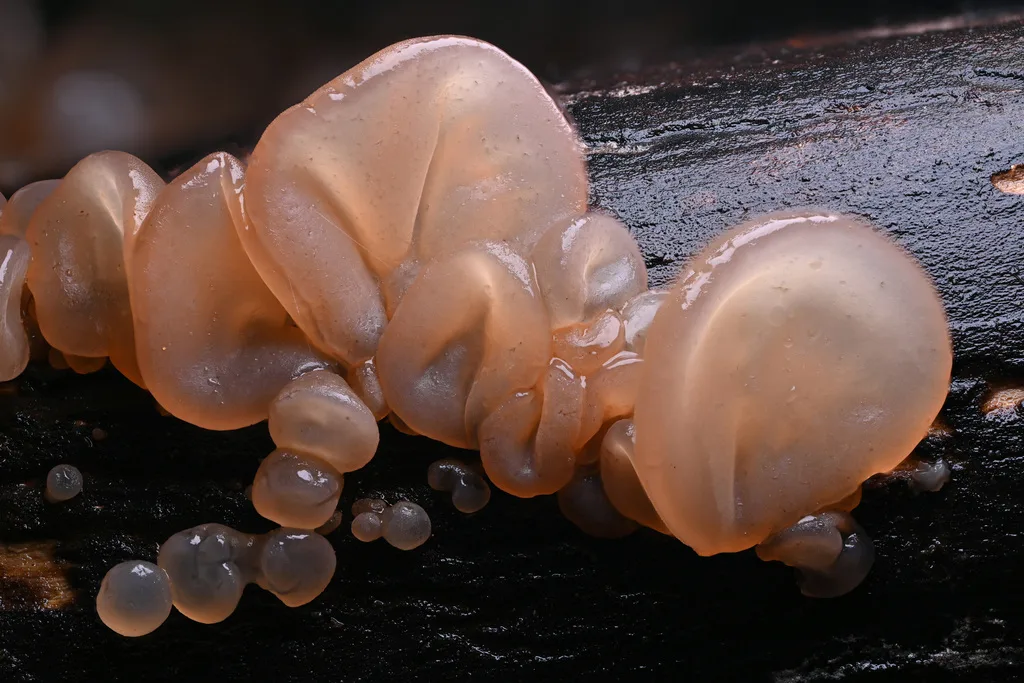
This is the North American wood ear of dead oak and other broadleaf wood. The 2021 study validated the name and reports the species only from North America. Its type specimen grew on a fallen oak trunk in Connecticut, and other US collections came from walnut in Arizona and hickory in Wisconsin. The Missouri Department of Conservation describes the wood ear as 1 to 6 inches wide, reddish brown to grayish black, rubbery and thin-fleshed, usually in groups on rotting wood. It leaves a white spore print.
Conifer Wood Ear (Auricularia americana)
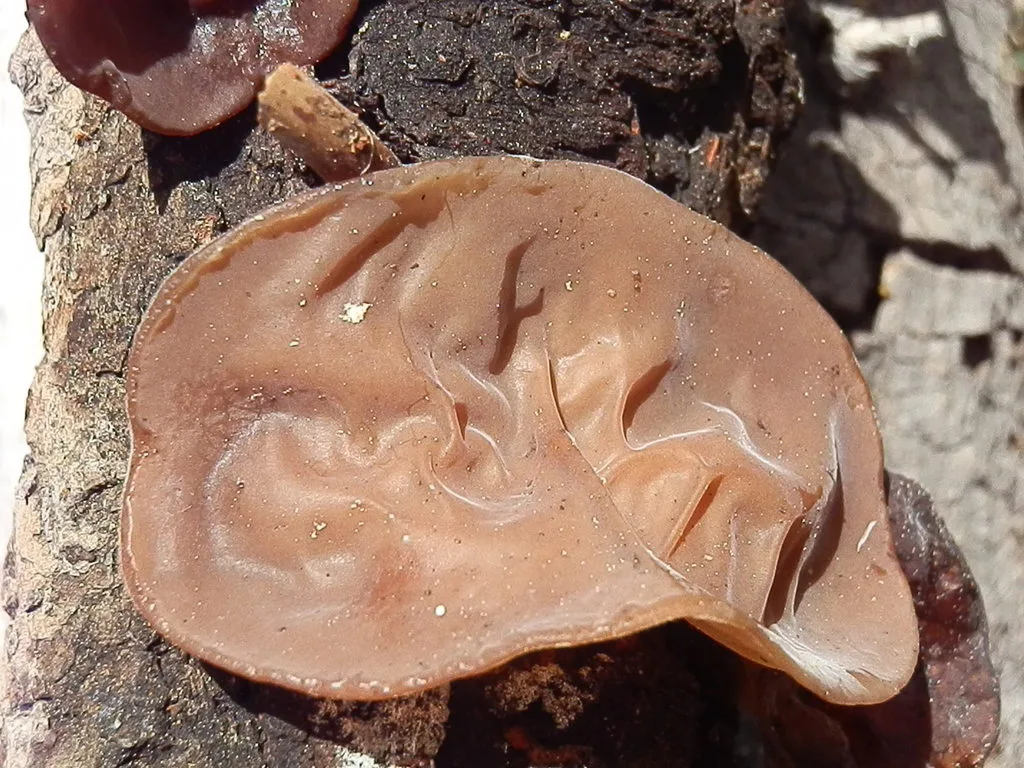
The conifer wood ear grows on gymnosperm wood, according to the 2021 study, with US collections on fir in Minnesota and Wisconsin. It also occurs in north Asia. MykoWeb describes a pale, finely hairy back and a reddish-brown to brown spore side. In California it is not uncommon in the mountains, much less common on the coast, and fruits from late fall through spring. MykoWeb records it on both conifers and hardwoods in California, so the sources do not fully agree on wood type.
Gulf Coast Wood Ear (Auricularia fuscosuccinea)
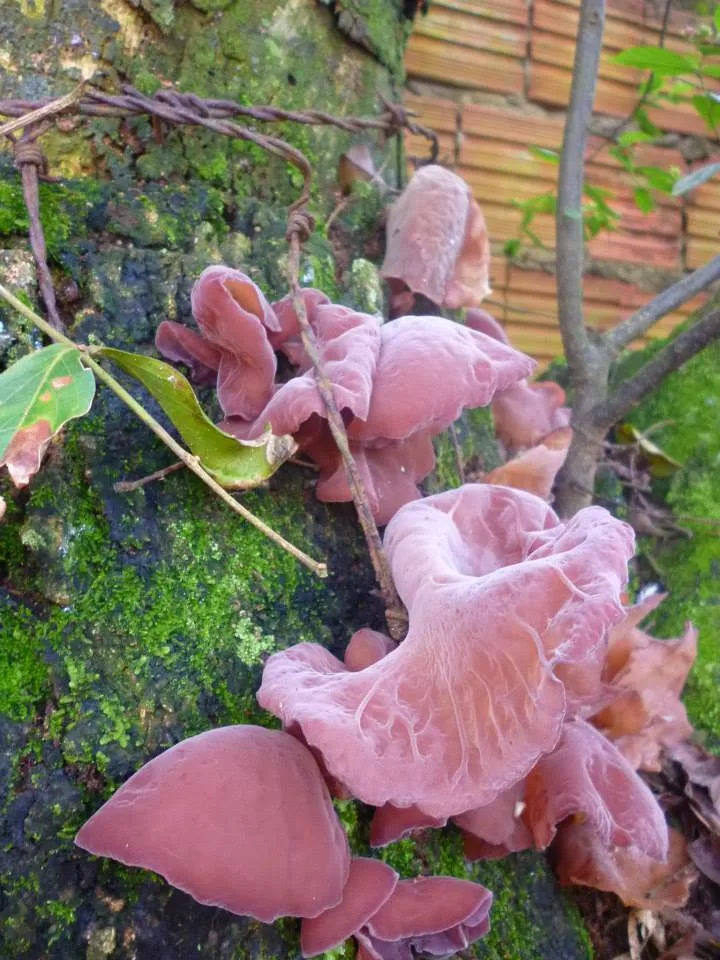
This species belongs to tropical and subtropical America. The 2021 study lists US records from Florida and Louisiana. Fresh ears reach 6.5 cm and are fawn to cinnamon brown, drying cinnamon to wine-brown. It grows on dead broadleaf trees and fallen trunks.
Auricularia nigricans
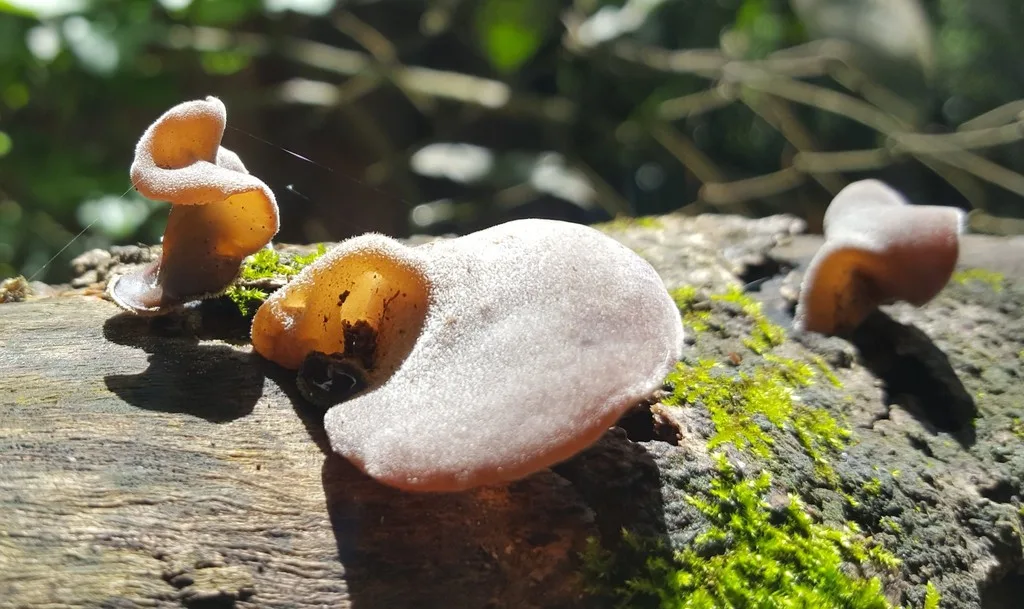
This Gulf Coast wood ear is reddish brown to orange-brown when fresh and reaches 6 cm. Its back is densely hairy. The hairs are 300 to 600 micrometers long, much longer than those of the northern species. The 2021 study records it on a fallen oak trunk in Louisiana and describes it as distributed throughout America. The old name Auricularia polytricha, first described from Jamaica, is now treated as a synonym of A. nigricans.
Mo-er, the Thick Dried Wood Ear (Auricularia cornea)
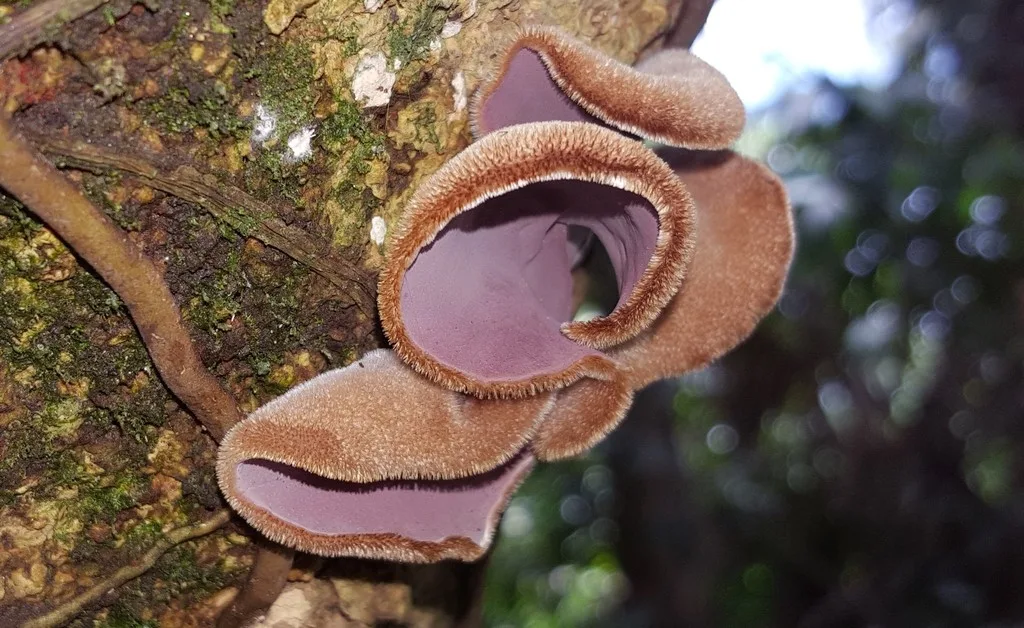
The thick, hairy wood ear cultivated in southern China is called maomuer. For more than a century it was called A. polytricha. The 2021 study identifies it as Auricularia cornea, a species with a wide range that includes North America. A white form is also cultivated.
Heimuer, the Thin Dried Wood Ear (Auricularia heimuer)
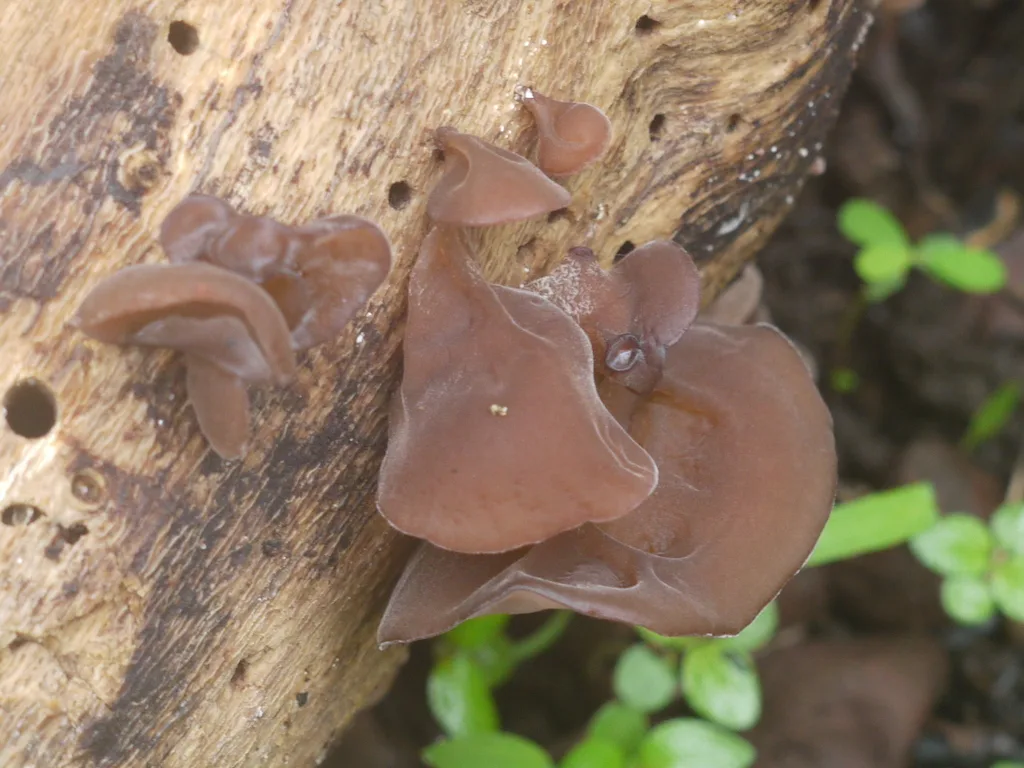
Heimuer is the most important cultivated Auricularia in China and the second most important edible mushroom there after shiitake, according to the 2021 study. It was long misnamed A. auricula-judae. Its fruiting bodies reach 12 cm, and in the wild it grows mostly on oak in temperate Asia. The Missouri Department of Conservation notes that a closely related species is cultivated in Asia and sold in some US Asian markets.
Wood Ear Look-Alikes: Side-by-Side Comparison
Six rubbery or cup-shaped fungi can be mistaken for wood ear, and none of them is reported as deadly in the sources we checked. Two of them, devil's urn and hairy rubber cup, are listed as not edible by the Missouri Department of Conservation. One, a brown cup fungus, has unknown edibility. The safest rule is to treat every look-alike as inedible.
| Look-alike | Shape and texture | Wood and season | Risk |
|---|---|---|---|
| Wood ear (Auricularia) | Thin, rubbery ear; hairy back | Dead hardwood or conifer | Listed as edible |
| Black witch's butter (Exidia glandulosa) | Black, brain-like masses | Hardwood branches; fall to late winter in California | "Probably edible" but insignificant, per MykoWeb |
| Amber jelly roll (Exidia crenata) | Dark brown lobes attached at a center | Fallen hardwood sticks, often oak; spring to fall | No rating in our sources |
| Brown witch's butter (Tremella foliacea) | Ruffled, leaf-like brown blades, 5 to 15 cm | Downed hardwood; mid to late winter in California | Edible but flavorless, per MykoWeb |
| Brown cup fungus (Peziza repanda) | Brown cup, pale outside, thin brittle flesh | Rotted logs, sawdust, wood chips | Edibility unknown |
| Devil's urn (Urnula craterium) | Black, leathery urn on a hairy stalk | Fallen oak branches; March to May | Not edible, per MDC |
| Hairy rubber cup (Galiella rufa) | Hairy black cup, thick jelly-like flesh | Dead hardwood and buried roots; July to September | Not edible, per MDC |
Black Witch's Butter and Amber Jelly Roll
These two Exidia jellies share dead hardwood with wood ear. MykoWeb describes black witch's butter as olive-black to black, brain-like units 1 to 2 cm across that merge into masses up to 20 cm long. The amber jelly roll is dark brown, often purplish, with pieces 1 to 4 cm across attached at a central point, which lists it under its older name Exidia recisa. Neither forms separate ears with a finely hairy back.
Brown Witch's Butter
MykoWeb describes Tremella foliacea as a cushion of ruffled, leaf-like blades fused to a common base, dull brownish to cinnamon-brown, on downed hardwood. MykoWeb's wood ear page notes that it has a similar color but lacks the ear shape and the hairy back.
Brown Cup Fungi
MykoWeb describes Peziza repanda as a cup 5 to 10 cm broad, light to chestnut-brown inside and white to ash-gray outside, with thin, brittle flesh. It grows on well-rotted logs, sawdust and wood chips, and its edibility is unknown. A wood ear bends instead of snapping.
Devil's Urn and Hairy Rubber Cup
The devil's urn is a dark brownish-black goblet 1.75 to 3.25 inches wide on a hairy stalk, growing on fallen hardwood branches, especially oak, from March to May. Mature urns are considered a sign that morel mushrooms are about to appear. The hairy rubber cup is smaller, at 0.75 to 1.25 inches, with a hairy blackish-brown outside, a reddish to chocolate-brown inside and thick gelatinous flesh. It fruits from July to September. The Missouri Department of Conservation lists both as not edible.
Is Wood Ear Mushroom Safe to Eat?
Wood ear is listed as edible by the Missouri Department of Conservation and MykoWeb, but a wild wood ear still needs expert confirmation, and two documented risks apply to the dried product. The Missouri Department of Conservation advises being absolutely sure of the identification and eating only a small amount the first time to check for a reaction.
The first risk is bongkrekic acid in dried wood ear that was soaked too long, covered in the next section. The second is an effect on blood clotting. Toxic Fungi of Western North America reports that the thick wood ear sold as A. polytricha, or mo-er, has an aspirin-like effect on blood platelets.
- A 1980 report in the New England Journal of Medicine described the effect after a researcher ate the mushroom.
- The effect lasted 3 to 24 days in that researcher and other volunteers.
- The page advises people about to have surgery and people with poor blood clotting to avoid it.
Our poisonous vs edible mushrooms guide explains why no simple rule makes a wild mushroom safe.
Wood Ear Food Safety: Bongkrekic Acid From Long Soaking
Dried wood ear left soaking for days can let a bacterium grow and produce bongkrekic acid, a heat-stable toxin that has killed people in China. A 2023 study in PLoS One counted 19 bongkrekic acid outbreaks in China from 2010 to 2020, with 146 illnesses and 43 deaths, a case fatality rate of 29.5 percent.
| Food | Outbreaks | Cases | Deaths |
|---|---|---|---|
| Wood ear (Auricularia) | 3 | 5 | 3 |
| Silver ear (Tremella) | 1 | 52 | 0 |
| Fermented corn flour products | 9 | 65 | 33 |
| Wet rice noodles | 5 | 21 | 7 |
The wood ear outbreaks were reported from 2018 to 2020 in Zhejiang and Guangdong. The silver ear outbreak happened in Shandong in 2012. About 95 percent of all outbreaks happened from May to October, peaking in July, and vomiting was the most common symptom.
The Hong Kong Centre for Food Safety adds these points:
- The toxin comes from Burkholderia gladioli pathovar cocovenenans, a soil and plant bacterium.
- The black fungus in the mainland outbreaks had typically been soaked for more than two days.
- Symptoms start 30 minutes to 12 hours after eating. In severe cases, death can follow 1 to 20 hours after symptoms begin.
- Toxin formation is considered unlikely after short soaking under normal conditions.
- If overnight soaking is needed, the Centre advises doing it in the refrigerator, and discarding soaked mushrooms that smell or taste abnormal.
An earlier Centre bulletin from 2019 states that the toxin is heat-stable and cannot be removed by washing. For scale, MykoWeb's cookbook page notes that dried wood ear swells to two to five times its size within 15 to 20 minutes in hot water. Anyone who feels unwell after eating soaked wood ear should seek medical care at once.
Wood Ear vs Cloud Ear vs Jelly Ear
These are market and regional names, not species, and sources apply them inconsistently. MykoWeb's cookbook page calls A. polytricha "wood ear," "tree ear" or "black fungus," and the smaller A. auricula "cloud ear." Under current names, the cultivated maomuer once called A. polytricha is A. cornea, and the cultivated heimuer once called A. auricula-judae is A. heimuer. "Jelly ear" usually means the European A. auricula-judae, which the 2021 study found only in Europe. Check the Latin name on a package, and expect it to be outdated.
Common Identification Mistakes
Trusting an Old Latin Name
Many US sources still say Auricularia auricula or A. auricula-judae. Neither name fits a wild American wood ear under current research.
Ignoring the Wood
Hardwood and conifer wood ears are different species. Note the wood before you pick or photograph the fungus.
Calling Every Brown Jelly a Wood Ear
Brain-like or leafy brown jelly is more likely an Exidia or Tremella. A wood ear forms separate ears with a hairy back.
Skipping the Bend Test
A brittle cup that snaps is a cup fungus, not a wood ear. A thick, gelatinous hairy cup is a hairy rubber cup.
Treating Long Soaking as Harmless
Wood ear deaths in China followed multi-day soaking. Cooking does not destroy bongkrekic acid. Follow our steps for identifying a mushroom you found before any wild find goes near a kitchen.
Frequently Asked Questions
What does a wood ear mushroom look like?
A wood ear is a thin, rubbery, ear-shaped fungus, 1 to 6 inches wide, reddish brown to grayish black. One side is finely hairy and paler, and the other is smooth to slightly veined. It has no gills or pores and little or no stem.
Where do wood ear mushrooms grow?
Wood ears grow on dead wood. In North America, Auricularia angiospermarum grows on hardwoods such as oak, walnut and hickory, and Auricularia americana grows on conifers such as fir. Two more species occur on the Gulf Coast.
Is wood ear mushroom edible?
Wood ear is listed as edible by the Missouri Department of Conservation and MykoWeb. A wild one still needs expert confirmation, and the Missouri agency advises eating only a small amount the first time. Dried wood ear soaked for days has caused fatal bongkrekic acid poisoning.
Can wood ear mushrooms be poisonous?
The fungus itself is not listed as poisonous in our sources, but soaked dried wood ear can carry bongkrekic acid made by bacteria. A 2023 study counted 3 wood ear outbreaks in China with 3 deaths among 5 cases. Toxic Fungi of Western North America also reports an aspirin-like effect on blood platelets.
What looks like a wood ear mushroom?
Black witch's butter, amber jelly roll, brown witch's butter, brown cup fungi, devil's urn and hairy rubber cup can all look similar. None is reported as deadly in our sources. Devil's urn and hairy rubber cup are listed as not edible.
When is wood ear mushroom season?
The Missouri Department of Conservation lists May through November. MykoWeb lists late fall through spring for California. Wood ears shrink in dry weather and swell again after rain.
Can wood ear grow on pine trees?
The conifer wood ear, Auricularia americana, grows on conifer wood, and the 2021 study's US records are on fir. We found no source that names pine specifically. MykoWeb records the species on both conifers and hardwoods in California.
What is the difference between wood ear and cloud ear?
Both are market names for Auricularia species, and sources use them inconsistently. MykoWeb's cookbook calls A. polytricha wood ear and the smaller A. auricula cloud ear. Under current names, the main cultivated kinds are Auricularia cornea and Auricularia heimuer.
How long is it safe to soak wood ear mushrooms?
The Hong Kong Centre for Food Safety reports that outbreak mushrooms were usually soaked for more than two days. It advises refrigerating wood ear if overnight soaking is needed and discarding any that smell or taste abnormal. The toxin is not removed by washing or cooking.
Is jelly ear the same as wood ear?
Jelly ear is the European species, Auricularia auricula-judae, and a 2021 study found it only in Europe. US reports under that name belong to Auricularia americana. The common hardwood wood ear in North America is Auricularia angiospermarum.
Final Safety Reminder
Wood ear is one of the easier jelly fungi to recognize, but its names are tangled, several rubbery look-alikes share its logs, and the dried product has a documented poisoning risk. Never eat a wild mushroom based on a chart, a photo or an app. Photograph both sides and the wood it grows on, using our guide on how to photograph mushrooms for identification, then check it with our free mushroom identifier and a local mycological club. If someone may have eaten a poisonous mushroom in the US, call Poison Control at 1-800-222-1222.
Sign in to leave a comment and join the discussion.
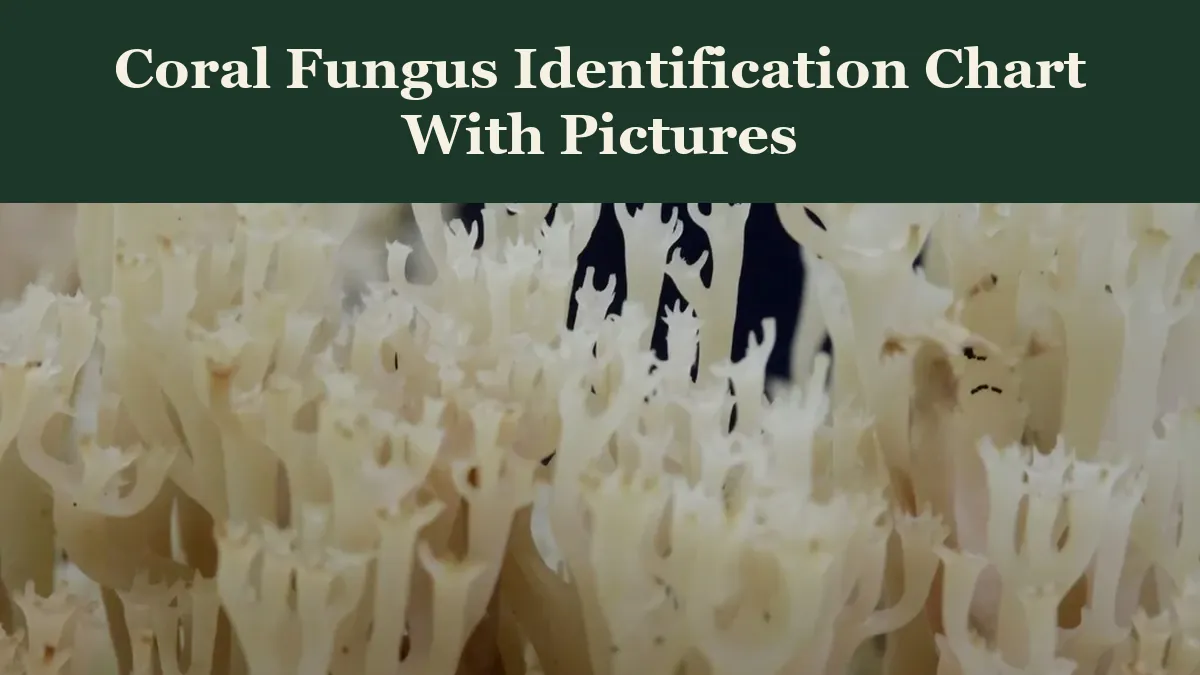 Species Guide
A coral fungus is a mushroom shaped like branching sea coral or a tuft of upright clubs, with no cap and no gills. Most US corals grow from soil in the...
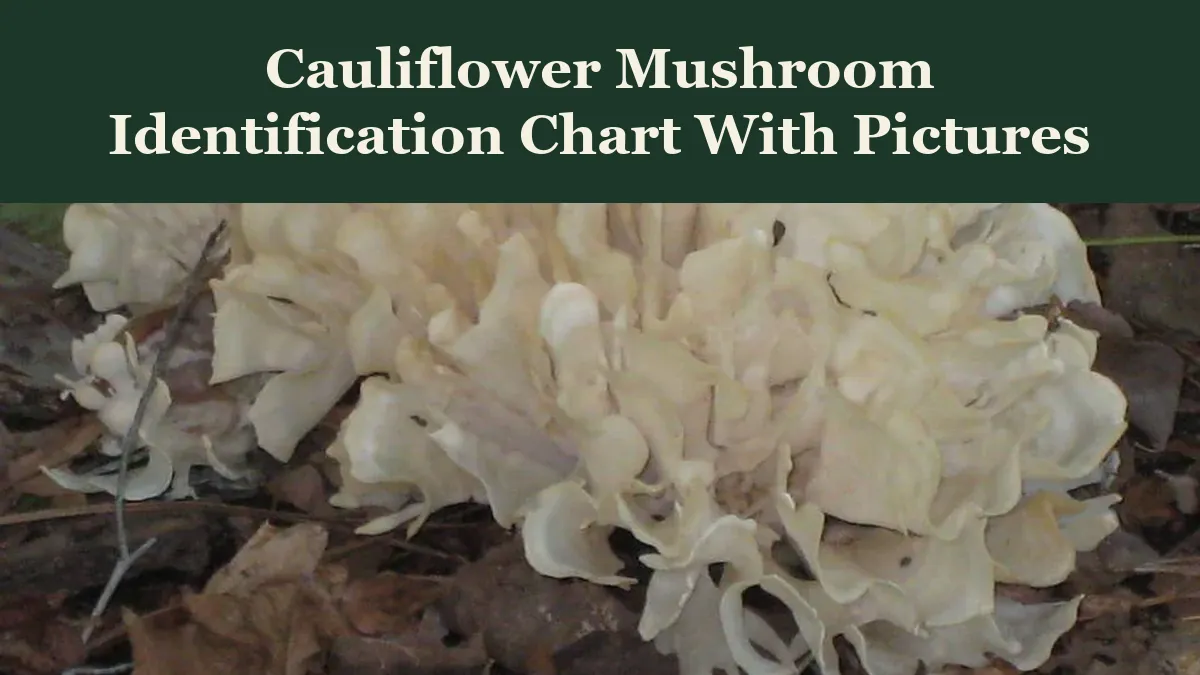 Species Guide
A cauliflower mushroom ( Sparassis ) is a large, cream-colored rosette of flat, wavy, ribbon-like lobes that grows at the base of a tree. It has no caps, no...
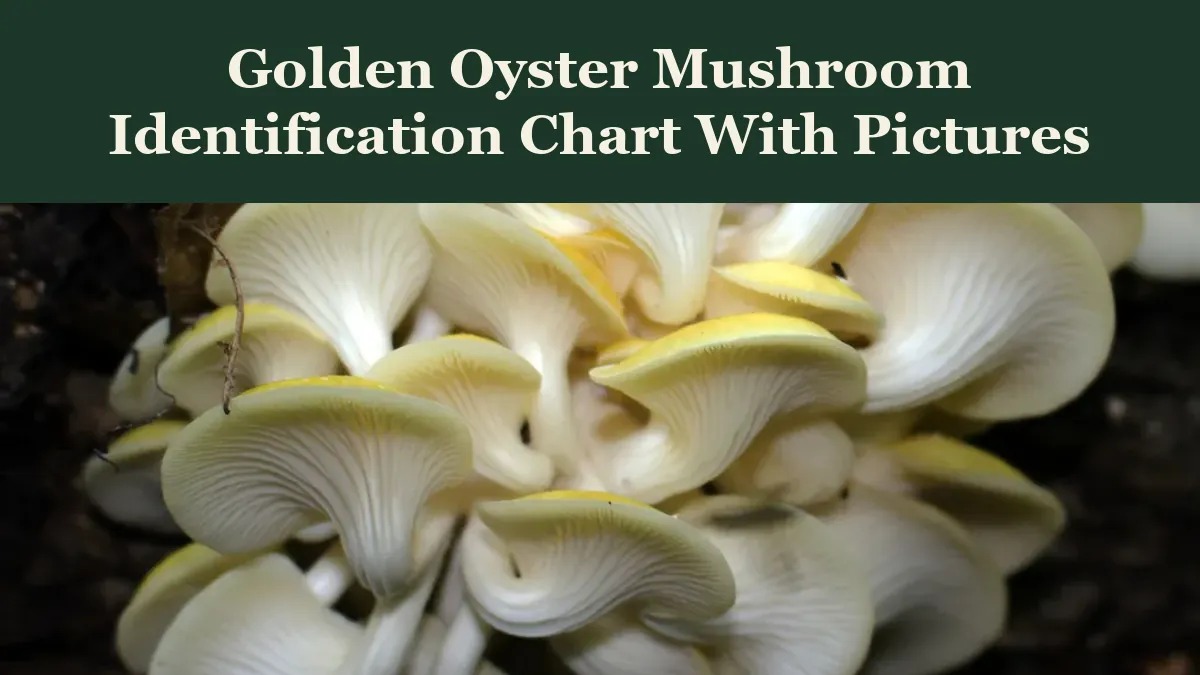 Species Guide
The golden oyster mushroom ( Pleurotus citrinopileatus ) is a bright yellow oyster mushroom that grows in dense, bouquet-like clusters on dead hardwood,...