Palm Tree Fungus Identification: Ganoderma and More
— views
The fungus people notice most on a palm tree is Ganoderma butt rot, a lethal trunk decay with no cure, or a leaf problem that is cosmetic or not caused by a fungus at all. A hard shelf on the lower trunk means the palm is rotting inside and should come down, especially near a house. One-sided frond death, pink spore masses or black specks point to other diseases.
This palm tree fungus identification guide sorts what you can see by where it appears on the palm, says what each problem means for the tree and for safety, and covers the mushrooms that come up under palms. It draws on University of Florida (UF/IFAS), University of California and Texas A&M sources for readers in Florida, Texas, Arizona and California.
Key Takeaways
- A hard, half-moon shelf on the lower 4 to 5 feet of a palm trunk is Ganoderma butt rot. UF/IFAS says there is no cure and the palm should be removed, mainly for safety.
- A soft, flat white patch on the lower trunk is the first stage of the same conk.
- Fronds dying on one side, with a brown stripe along the leaf stem, point to Fusarium wilt. UC IPM calls it nearly 100 percent fatal.
- Dropped fruit, bronze lower fronds and a dead spear leaf point to lethal bronzing, which a bacterium causes, not a fungus.
- Tiny black specks with yellow threads on old fronds are false smut, which UF/IFAS calls primarily cosmetic.
- White mushrooms with green gills in the lawn are the green-spored parasol, which UF/IFAS cites as the most common cause of mushroom poisoning in the US. Keep children and pets away.
Palm Tree Fungus Identification Chart
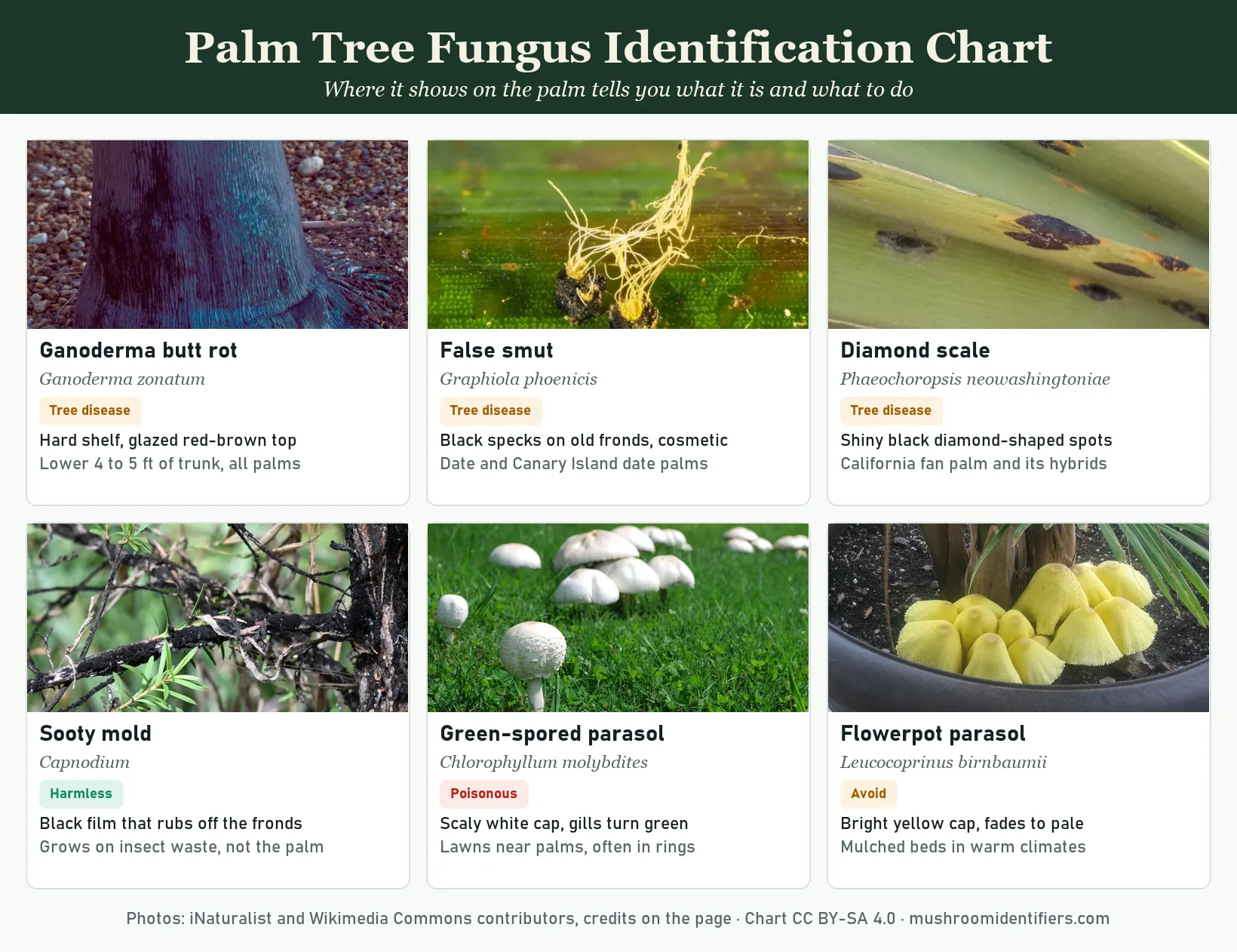
Chart photos not shown below. Sooty mold: Jerry Cooper, CC BY, via iNaturalist.
Find the row that matches where the problem appears on your palm, then read the section for the species named in it. Position on the palm is the best first clue, because each disease starts in a different place.
| Where you see it | What it looks like | Most likely | What it means for the palm | What to do |
|---|---|---|---|---|
| Lower 4 to 5 feet of trunk | Hard shelf, glazed reddish brown top, white underside; soft white patch when young | Ganoderma butt rot (Ganoderma zonatum) | Lower trunk already decayed; no cure | Remove the palm; grind the stump |
| Upper trunk | Dark "bleeding" stain, soft tissue at a wound | Thielaviopsis trunk rot (Thielaviopsis paradoxa) | Trunk or crown can collapse without warning | Arborist check now |
| Oldest fronds, one side | Leaflets brown on one side, brown stripe on the leaf stem | Fusarium wilt (Fusarium oxysporum) | Fatal; spreads to other palms | Lab test; disinfect pruning tools |
| Newest leaves | Stunted leaves, pink spore masses at leaf bases | Pink rot (Nalanthamala vermoeseni) | Attacks stressed palms; can kill the bud | Fix planting depth, drainage, watering |
| Oldest fronds, surface | Raised black specks with yellow threads | False smut (Graphiola phoenicis) | Mostly cosmetic | Check nutrition first |
| Fan palm leaves | Shiny black diamond-shaped spots | Diamond scale (Phaeochoropsis neowashingtoniae) | Thins California fan palm canopies | Keep the palm vigorous |
| Whole canopy | Fruit drop, bronze old fronds, then a dead spear leaf | Lethal bronzing (a phytoplasma) | Fatal within months | Extension test; remove if positive |
| Leaf surface | Black film that wipes off | Sooty mold | Grows on insect honeydew | Control the insects |
| Lawn near the palm | White to tan scaly cap, gills turning green | Green-spored parasol (Chlorophyllum molybdites) | No harm to the palm; poisonous | Remove; keep children and pets away |
| Mulch bed | Bright yellow cap fading to pale yellow | Flowerpot parasol (Leucocoprinus birnbaumii) | Not known to harm plants | Remove if children or pets use the bed |
For fungi on other host trees, see our tree mushroom identification chart.
Is Fungus on a Palm Tree a Sign the Palm Is Dying?
A conk on a living palm trunk does mean the palm is dying, because the only Ganoderma that attacks living palms rots the trunk from the inside and nothing stops it. Leaf diseases are different, and several are cosmetic or slow. Mushrooms in the lawn usually have nothing to do with the tree.
UF/IFAS states that Florida has many Ganoderma species, but only Ganoderma zonatum is a pathogen of palms, and it attacks no other plant family. The Ganoderma species on hardwoods such as oak are rarely seen on living palms, though they may decay dead palm stumps. Those varnished conks are covered in our Ganoderma lucidum group guide and our oak tree fungus identification guide.
Palm Tree Fungus on the Trunk
Two fungi cause most trunk failures in landscape palms: Ganoderma butt rot at the base and Thielaviopsis trunk rot higher up. Both are lethal, neither has a cure, and both can bring a palm down on a roof or car. Height on the trunk, and whether the rot starts in the center or on one side, tells them apart.
Ganoderma Butt Rot (Ganoderma zonatum)
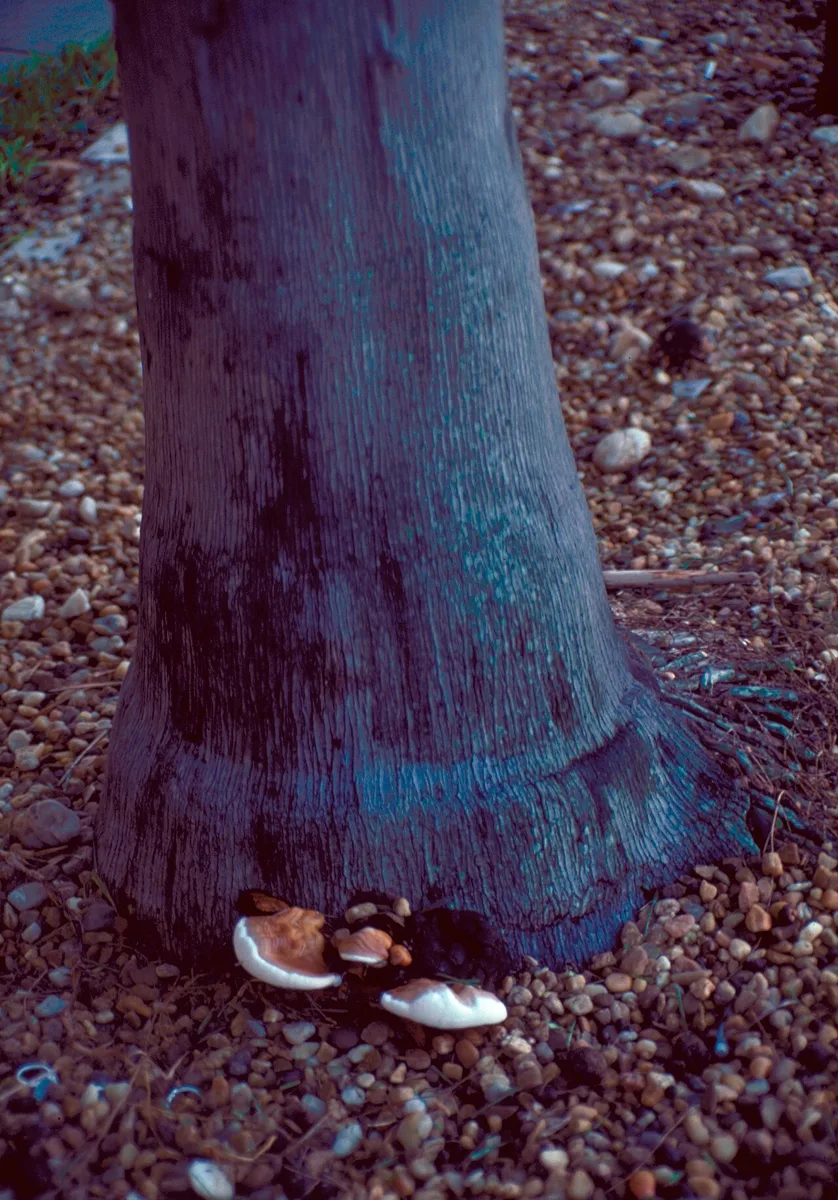
UF/IFAS reports the fungus throughout Florida, from Key West to Pensacola, and also in Georgia and South Carolina. At least 65 palm species have been documented with the disease in Florida, and all palms are assumed to be susceptible. In California, Hodel and Santos of UC Cooperative Extension describe it as rare on palms.
The conk starts as a soft, solid white mass, flat on the trunk. It then grows into a hard, half-moon shelf with a glazed reddish brown top, a white underside and distinct zones, attached directly to the trunk with no stalk. It can reach 8 inches wide and 2 inches thick. Spores fall as a reddish brown dust, and UF/IFAS says one conk can produce 3 cups of them.
The rot is hidden. It fills the lower 4 to 5 feet of the trunk in a cone shape, widest at the soil line, while the trunk still feels hard. Fronds may wilt, except the spear leaf, or the palm may simply decline. Many infected palms never produce a conk before they die.
Thielaviopsis Trunk Rot (Thielaviopsis paradoxa)
Thielaviopsis trunk rot makes a trunk collapse on itself, or makes the whole canopy fall off, often without warning. UF/IFAS notes that the canopy often looks healthy until the collapse. The fungus enters only through fresh wounds, so the rot is usually in the upper third of the trunk.
The one visible sign is stem bleeding, a reddish brown to black stain running down from the wound, most common on coconut palms. Tissue around an infected wound is soft enough to push a finger into and often smells like fermented fruit. The rot sits on one side and moves inward, the opposite of Ganoderma.
Sources frame this problem differently. UC IPM calls it sudden crown drop, mainly in Canary Island date palms, and says Thielaviopsis paradoxa has been isolated from failed palms but is unconfirmed as the primary cause.
What a Conk on a Palm Trunk Means Near a House
A conk on a living palm means much of the trunk has already rotted, and UF/IFAS recommends removing the palm primarily for safety. UF/IFAS warns that these palms are likely to be the first blown down in heavy winds, which matters most in hurricane season. Its fact sheet shows a royal palm that fell on a house after Ganoderma weakened the trunk.
- Remove the stump and roots, or grind the stump so it breaks down faster and grows fewer new conks.
- Do not chip the lower trunk for mulch. Send it to a landfill or incinerator, and bag conks for the trash.
- Check your other palms every six months, and at least monthly once a palm on the property has had a conk. The spores blow on the wind, so neighbors should check too.
- Do not replant a palm in the same spot. The fungus probably survives in soil almost indefinitely, so plant anything except a palm.
UC IPM advises sounding the upper trunk with a mallet: healthy tissue gives a sharp, ringing tone, and decayed tissue gives a dull thud. On a tall palm, leave this to a certified arborist.
Palm Tree Fungus on the Fronds
Frond diseases range from fatal wilts to spots that only spoil the look of old leaves, and the pattern of dying leaves separates them. Fusarium wilt kills from the oldest fronds upward, one side of the leaf first. Pink rot attacks the newest leaves first. False smut and diamond scale mark the leaf surface.
Fusarium Wilt of Canary Island Date Palm (Fusarium oxysporum f. sp. canariensis)
This wilt attacks Canary Island date palms almost exclusively. UF/IFAS says it was first documented in California in the 1970s and in Florida in 1994. Leaflets on one side of an old frond turn brown while the other side stays green, and a reddish brown stripe runs along the leaf stem on the same side. The dying climbs the canopy. The palm may die within months but usually lingers up to a year.
The fungus moves mainly on pruning tools, and an infected palm can look healthy for what UF/IFAS estimates could be 6 to 18 months. Fungicides have not worked. UF/IFAS advises a new or disinfected tool for every palm, such as a 25 percent bleach soak for at least 5 minutes. UC IPM notes the fungus survives in soil for at least 25 years, so do not replant a Canary Island date palm where one died.
Fusarium Wilt of Queen and Mexican Fan Palms (Fusarium oxysporum f. sp. palmarum)
A newer Fusarium wilt kills queen palms and Mexican fan palms. A 2020 UC paper by Hodel and Santos reports it as widespread in Florida and the Houston-Galveston area of Texas, and confirmed on queen palms in Gilbert, Arizona. In California it was found on queen palms in Fallbrook, and state plant pathologists confirmed it on Mexican fan palms in Los Angeles in September 2020.
Symptoms match the Canary Island date palm disease, but death comes faster, within three months of the first symptoms. There is no cure. Florida observations suggest airborne spores may be the main way it spreads, so clean tools alone may not stop it. Replace a dead palm with a species not known to be susceptible.
Pink Rot (Nalanthamala vermoeseni)
Pink rot is a weak but opportunistic fungus that attacks stressed palms. UC IPM lists nearly all palms as hosts, especially queen and California fan palms. New leaves may be stunted, distorted or die as they emerge, and pinkish spore masses form behind overlapping leaf bases with a brownish, syrupy ooze. Hodel and Santos call it common in coastal Southern California. UC IPM links it to deep planting, overwatering, poor drainage, poor nutrition, freeze damage and bad pruning. Fungicides help only temporarily.
False Smut (Graphiola phoenicis)
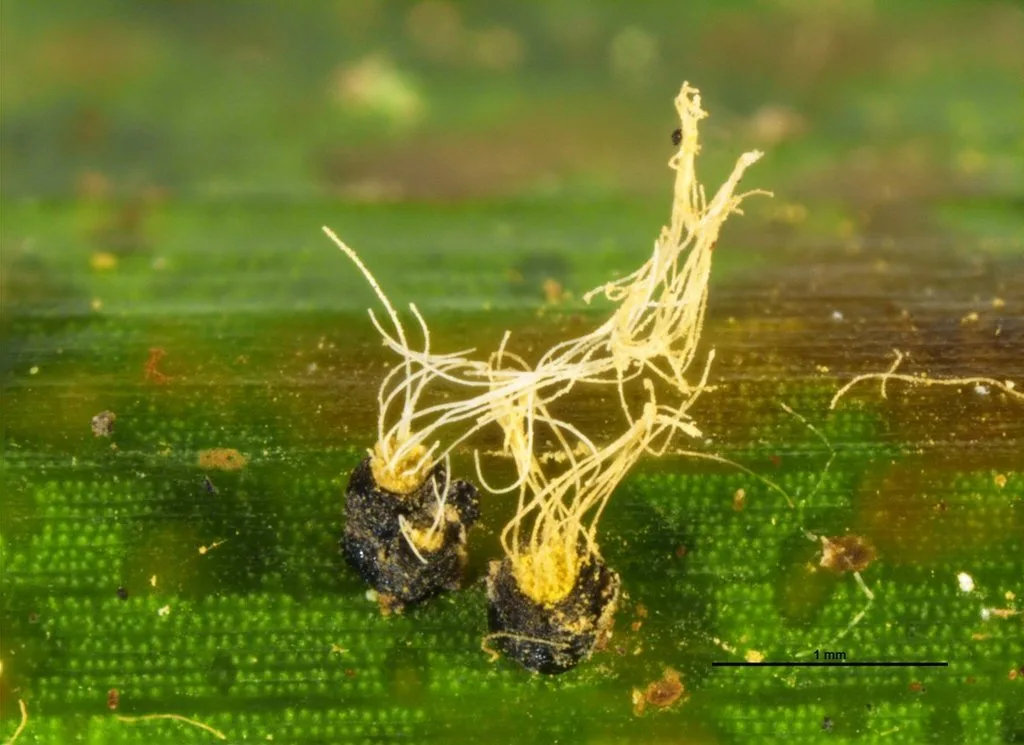
False smut, or Graphiola leaf spot, shows as raised black specks under 1/16 inch on the oldest fronds. UF/IFAS explains that mature specks push out light threads and yellow spores, then deflate into tiny black craters you can feel. The main hosts are Canary Island date palm and date palm, and the Texas Plant Disease Handbook lists it for Texas palms. UF/IFAS calls it primarily cosmetic. Date palms in dry California stay free of it, but the same palm moved to humid Florida gets it.
Diamond Scale (Phaeochoropsis neowashingtoniae)
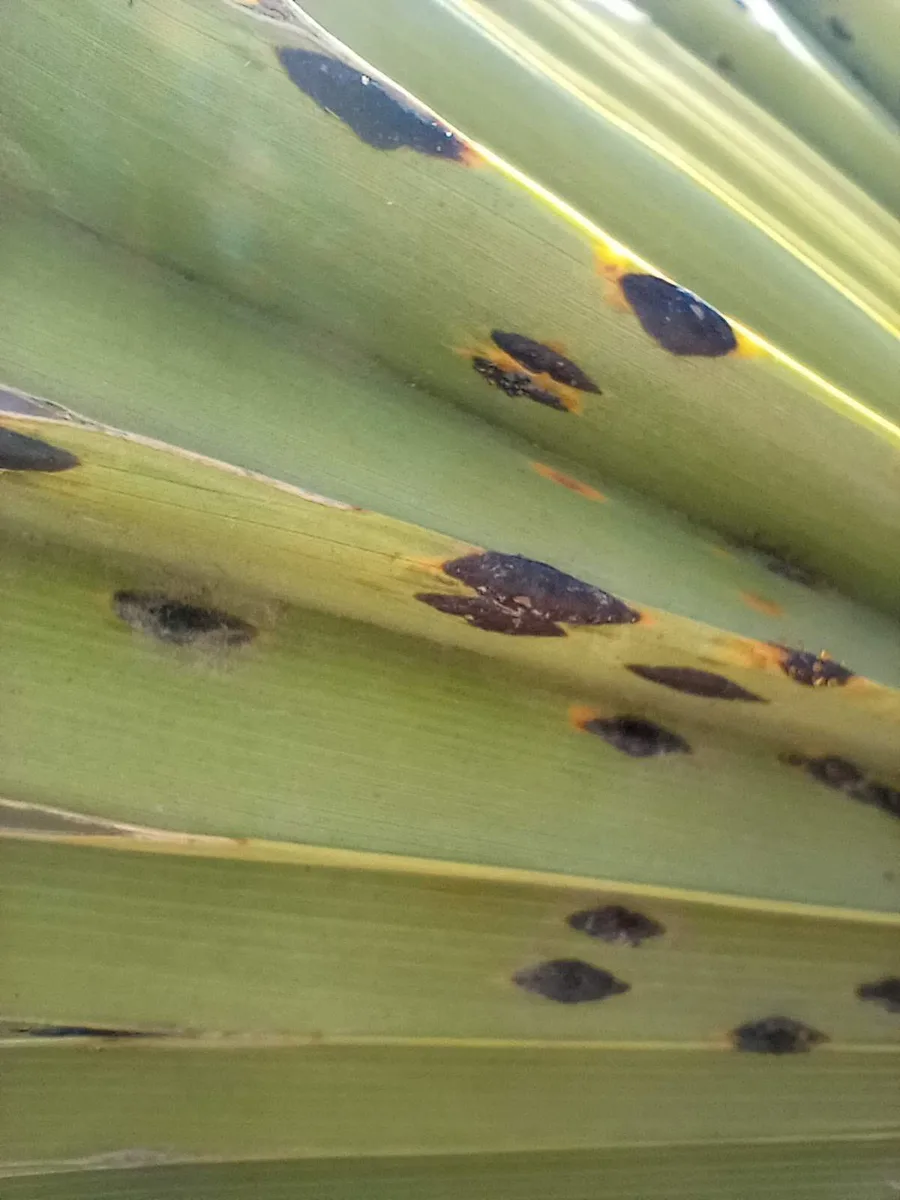
Diamond scale is a fungus, not an insect. UC IPM says it mainly attacks California fan palm and its hybrids, and it has not been seen on pure Mexican fan palm. Shiny black, diamond-shaped fruiting bodies form on blades and leaf stems, older leaves die first, and the canopy thins. Regular watering and fertilizing keep palms vigorous, and resistant species are the long-term answer.
Palm Problems That Look Like Fungus but Are Not Fungal Infections
Two common palm problems get blamed on a fungal disease: lethal bronzing, which a bacterium causes, and sooty mold, a fungus that lives on insect waste rather than on the palm. A third, potassium deficiency, is a nutrient problem that UF/IFAS says is often mistaken for false smut. Each one needs a different response from a true fungal infection.
Lethal Bronzing
Lethal bronzing is caused by a phytoplasma, a bacterium without a cell wall. UF/IFAS Gardening Solutions says a sap-feeding planthopper, Haplaxius crudus, spreads it. It was first found in Phoenix palms in Texas, hence its old name, Texas Phoenix palm decline. In Florida it appeared in 2006 and has reached more than 30 of 67 counties. Hosts include date, Canary Island date, queen, cabbage, pindo and coconut palms.
Fruit drops or flowers blacken first, then the oldest fronds bronze from the bottom up, then the spear leaf dies. Death usually follows two to three months after the first symptoms, and there is no cure. A palm that tests positive should be removed right away, and neighbors that test negative can receive repeated preventive doses of an antibiotic. Hodel and Santos reported in 2020 that it was not yet in California.
Sooty Mold
A black film that rubs off the fronds is sooty mold. Illinois Extension says these fungi grow mostly on honeydew, the sticky waste of scale insects and aphids. Control the insects, and the mold has nothing to feed on.
Palm Tree Fungus Look-Alikes: Side-by-Side Comparison
The four lethal palm problems can be separated by where they start, which leaves die first and what the trunk shows. Ganoderma butt rot and Thielaviopsis trunk rot are the dangerous ones for people, because both can drop a palm or its crown without warning.
| Feature | Ganoderma butt rot | Thielaviopsis trunk rot | Fusarium wilt | Lethal bronzing |
|---|---|---|---|---|
| Cause | Fungus | Fungus | Fungus | Phytoplasma, a bacterium |
| Where it starts | Lower trunk, center outward | Upper trunk, one side, outside inward | Oldest fronds, one side of the leaf | Fruit and flowers, then old fronds |
| What you see | Hard conk, or nothing | Bleeding stain, soft spot, collapse | Brown stripe on the leaf stem | Bronze fronds, dead spear leaf |
| How it spreads | Spores into soil, along roots | Spores into fresh wounds | Pruning tools; possibly air | A planthopper |
| Main danger | Trunk fails in wind | Crown drops suddenly | Spreads to nearby palms | Death within months |
Petiole and rachis blight copies the one-sided dying of Fusarium wilt, but UF/IFAS says it usually does not kill the palm. Ganoderma also kills fronds from the bottom up, but Hodel and Santos note that it is slower and not one-sided.
Mushrooms Growing Under Palm Trees
Mushrooms in the lawn or mulch under a palm are feeding on organic matter, not attacking the palm, but the most common lawn species is poisonous. Two to know in warm states are the green-spored parasol in grass and the yellow flowerpot parasol in mulch.
Green-Spored Parasol (Chlorophyllum molybdites)
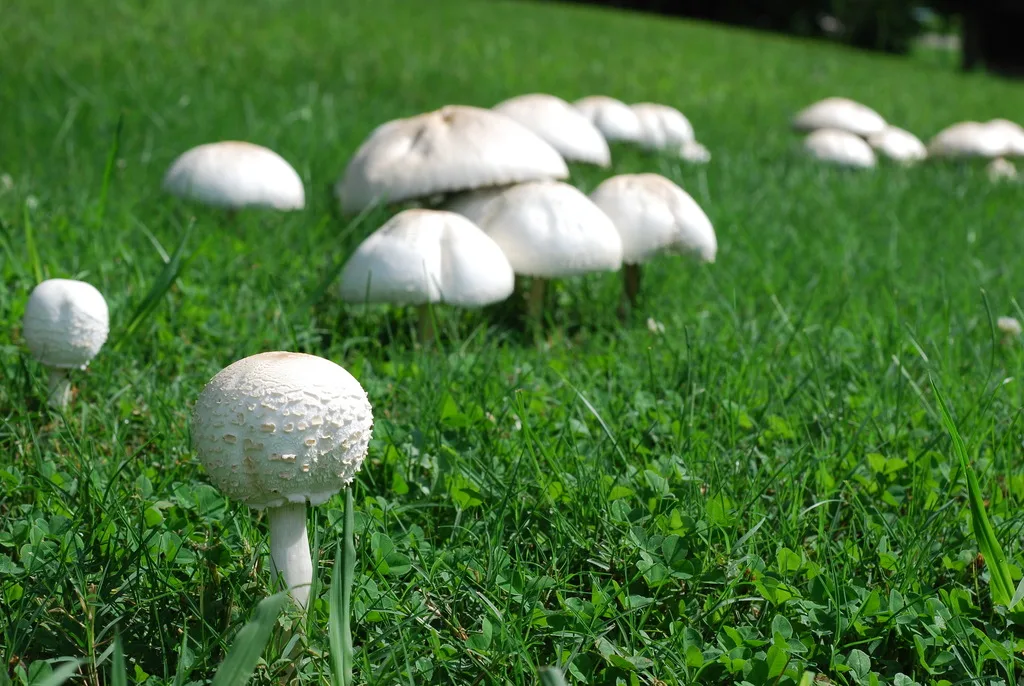
UF/IFAS calls it one of the largest and most common lawn mushrooms of the Southeast, particularly in Florida. The cap is white to brown, 1.8 to 11.8 inches across, with beige to pinkish brown scales. The free gills turn from white to gray to green, and the stem has a thick ring. The spore print is green, a rare color among mushrooms. It often forms fairy rings in lawns and grassy areas, from about April to November in Florida.
UF/IFAS cites it as the most common cause of mushroom poisoning in the United States. Vomiting and diarrhea start 1 to 2 hours after eating and can last from 4 hours to 7 days. There is no antidote. It is easily confused with edible parasols, and children and dogs face higher risk. Our Chlorophyllum molybdites guide covers it in full.
Flowerpot Parasol (Leucocoprinus birnbaumii)
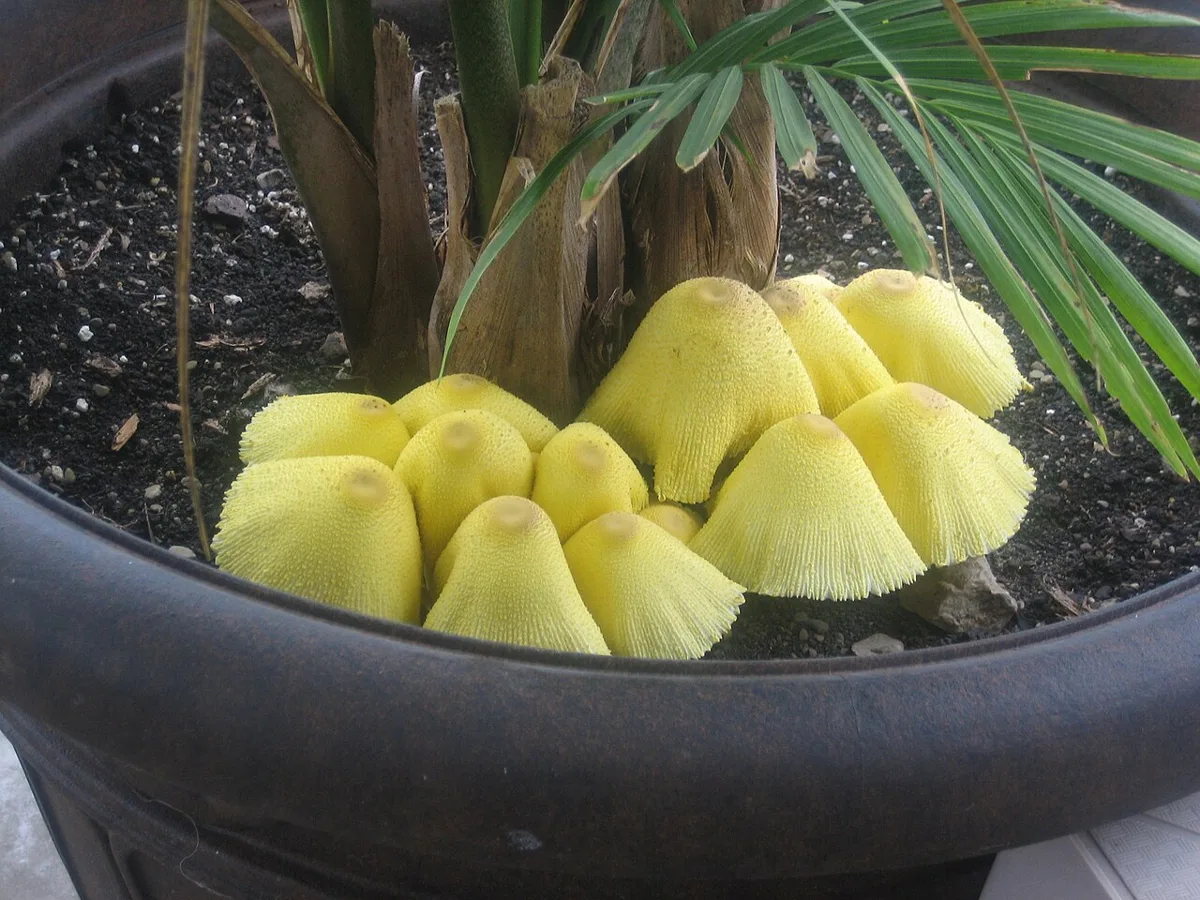
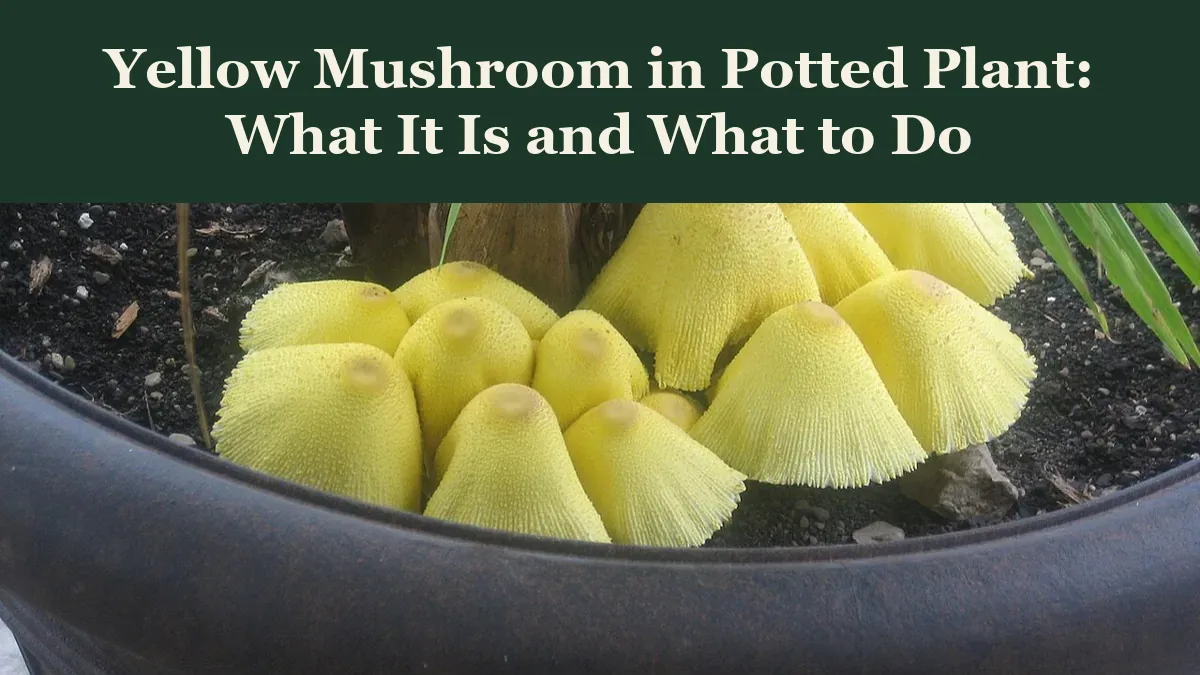
The flowerpot parasol is a bright yellow mushroom best known from houseplant pots. Tom Volk's Fungus of the Month page notes that it grows outdoors in warm southern climates, especially in mulched flower beds. The caps fade to a very pale yellow, almost white, as they open. It is not known to harm plants. Reports on its toxicity conflict, so do not eat it.
| Feature | Green-spored parasol (Chlorophyllum molybdites) | Flowerpot parasol (Leucocoprinus birnbaumii) |
|---|---|---|
| Cap | 1.8 to 11.8 inches, white to brown, scaly | Bright yellow, fading to pale yellow |
| Spore print | Green | White |
| Where | Lawns, often in fairy rings | Mulched beds in warm climates; pots |
| Risk | Poisonous | Toxicity reports conflict; not for eating |
The palm needs no treatment for either mushroom. Pick and bag them where children and pets play. See how to get rid of mushrooms in grass or our backyard mushroom identification guide for other yard species. If a dog eats one, follow our steps for what to do if your dog ate a mushroom.
Can You Treat Palm Tree Fungus?
No treatment cures Ganoderma butt rot, Thielaviopsis trunk rot or either Fusarium wilt, and extension services say so plainly. UF/IFAS states there are no cultural or chemical controls for Ganoderma, no way to prevent or cure Thielaviopsis trunk rot, and no effective fungicide for Fusarium wilt of Canary Island date palm. Lethal bronzing has no cure either. Prevention mostly comes down to pruning:
- Cut only dead fronds. A frond with green on its stem is alive, and cutting it leaves a fresh wound.
- Skip "hurricane cuts" and "pineapple" sculpting, which UF/IFAS says weaken palms and raise the risk of spreading disease.
- Use a new or disinfected tool on every palm, and keep climbing spikes and nails out of the trunk.
- Inspect a Canary Island date palm before purchase, before its old fronds are trimmed for shipping.
Common Identification Mistakes
Waiting for a Conk Before Worrying
Many palms with Ganoderma butt rot die without producing a conk. Only cross-sections of the lower trunk after felling confirm it.
Knocking Off the Conk and Keeping the Palm
Removing a conk reduces spores, but the rot stays inside. A conk on a living palm means the palm needs to come down.
Calling Potassium Deficiency a Fungus
Yellow and dead spotting on old fronds is often potassium deficiency, not false smut. UF/IFAS warns that removing those fronds makes the deficiency worse.
Treating a Lawn Parasol as a Safe Mushroom
The green-spored parasol looks like edible parasols. Green-tinged gills and a green spore print mean it is the poisonous one.
Frequently Asked Questions
What is the fungus growing on my palm tree trunk?
A hard shelf with a glazed reddish brown top and white underside on the lower 4 to 5 feet of the trunk is almost certainly Ganoderma zonatum. UF/IFAS says it is the only Ganoderma that attacks living palms. The disease is lethal and has no cure.
Can a palm tree survive Ganoderma butt rot?
No. UF/IFAS describes Ganoderma butt rot as lethal, with no cultural or chemical control. A palm with a conk should be removed, mainly because its rotted trunk is likely to fail in strong wind.
What is the white fungus on my palm tree?
A soft, flat white patch on the lower trunk is usually a young Ganoderma conk that will harden into a brown shelf. White mushrooms with green-tinged gills in the lawn nearby are the poisonous green-spored parasol.
Is palm tree fungus contagious to other palms?
Several palm fungi spread. Ganoderma spores blow on the wind and reach palms through the soil, and Fusarium wilt moves on pruning tools and possibly through the air. Ganoderma attacks only palms, so it is no threat to other plants.
Can I plant a new palm where one died of Ganoderma?
UF/IFAS advises against it, because replacement palms in the same spot have also died. The fungus probably survives in soil almost indefinitely, so any plant other than a palm is a safer choice.
Why are the fronds on my palm dying on one side?
Leaflets dying on one side of the frond, with a brown stripe on the leaf stem, are the classic sign of Fusarium wilt. Petiole and rachis blight looks the same but is usually not fatal. A lab test tells them apart.
What are the black spots on my palm leaves?
Tiny raised black specks with yellow threads on the oldest fronds are false smut, which is primarily cosmetic. Shiny black diamond shapes on a California fan palm are diamond scale. A black film that wipes off is sooty mold.
Are mushrooms under palm trees poisonous to dogs?
Some are. UF/IFAS says the green-spored parasol's toxin affects dogs as well as people, and dogs face higher risk because they eat lawn mushrooms. Call a vet or a pet poison helpline if your dog eats any wild mushroom.
Final Safety Reminder
A conk on a palm trunk is a safety problem first. Have any palm with a conk or a soft, bleeding upper trunk checked by a certified arborist, especially if it could reach a house, and act before storm season. Never eat a mushroom from under a palm, keep children and pets away from lawn mushrooms, and call Poison Control at 1-800-222-1222 if someone eats one. For a first opinion on a mushroom, photograph the cap, gills and base and check them with our free mushroom identifier, then with a local expert.
Sign in to leave a comment and join the discussion.
 Guide
Most maple tree fungus is either a leaf spot that looks alarming but rarely hurts the tree, or a decay fungus fruiting from wood that is already rotting...
 Guide
Pine tree fungus identification starts with color and place: orange powder on a woody gall is a rust, brown dead shoot tips are a blight, a conk at the base...
 Guide
A yellow mushroom in a potted plant is almost always the flowerpot parasol, Leucocoprinus birnbaumii , a lemon-yellow mushroom that feeds on dead organic...