Pheasant Back Mushroom Identification Chart With Pictures
— views
A pheasant back mushroom is a large, fan-shaped polypore with brown scales on a cream to tan cap, big angular pores underneath and a short stem that is black at the base. It is also called dryad's saddle, and its scientific name is Cerioporus squamosus, formerly Polyporus squamosus. It grows on living and dead hardwoods, mostly in spring. Sources call young ones edible, but a wild find still needs expert confirmation.
This pheasant back mushroom identification chart with pictures shows the features that confirm it, the spring polypores that look like it, a season guide by US region, what it means for the tree, and what the poisoning records say.
Key Takeaways
- Flip it first. A pheasant back has pores, not gills, and the pores are large and angular.
- Check the base. The short stem sits off-center and turns black and velvety at the bottom.
- Cut it and smell it. Sources describe the smell as watermelon rind or strongly mealy.
- The smaller spring polypore, winter polypore and hexagonal-pored polypore share its season and wood, so check the stem position and the pore shape.
- None of the sources we checked names a deadly look-alike, but NAMA has a report of an adult who vomited after eating a cooked pheasant back.
- On a living tree it causes white heart rot. Ohio State University Extension says infected trees become hazardous over time and there is no cure.
Pheasant Back Mushroom Identification Chart
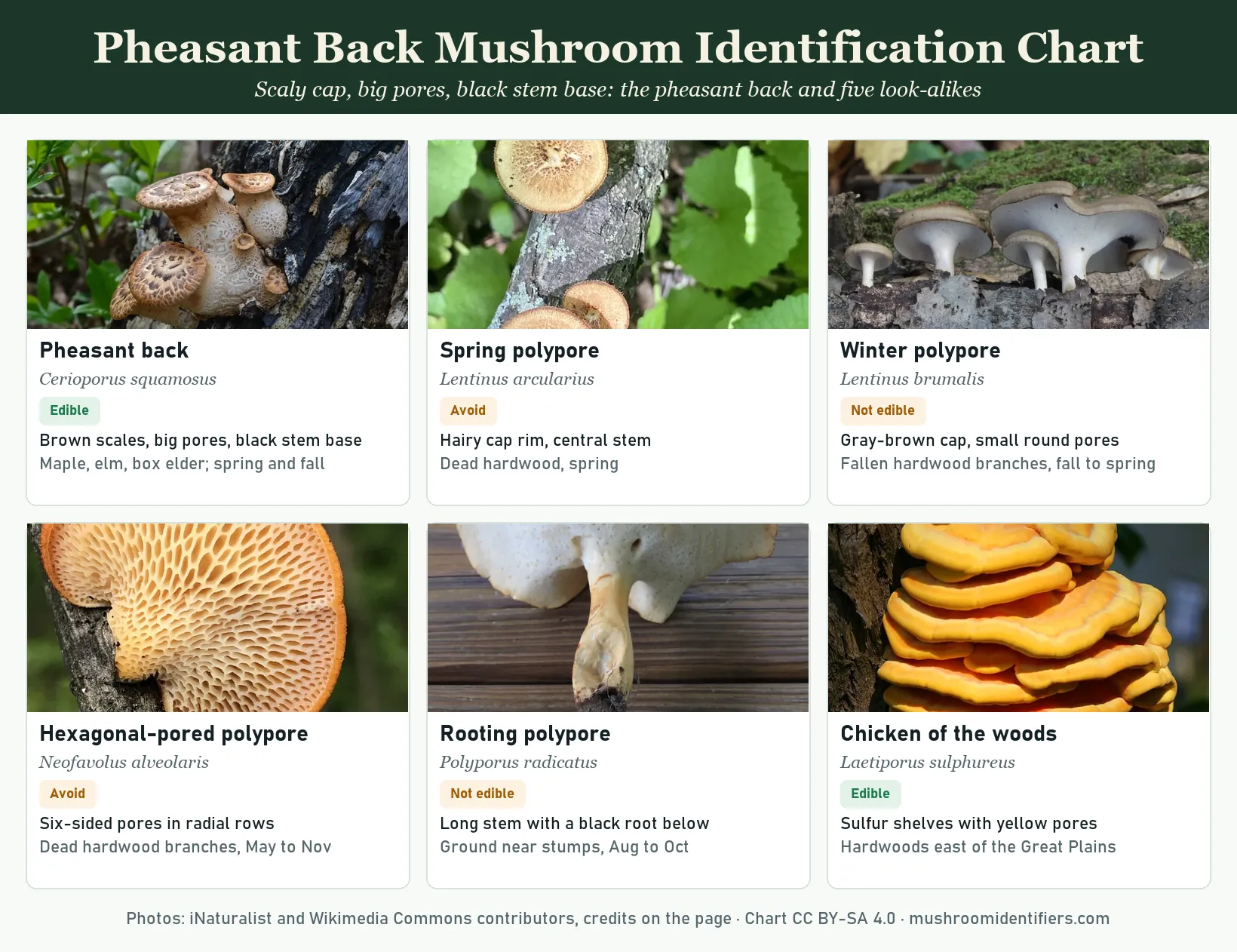
Start with the underside and the stem, then compare the cap. The five look-alikes below all grow on or near hardwood, and most of them appear in the same months as the pheasant back. Each row gives the feature that separates that species from a pheasant back.
| Mushroom | Key features | Where and when | Edibility or risk |
|---|---|---|---|
| Pheasant back (Cerioporus squamosus) | Cream to tan fan with flat brown scales; large angular pores; short off-center stem, black at the base | Living and dead hardwoods, especially silver maple, box elder and elm; mostly spring, some in fall | Called edible when young; one NAMA stomach-upset report; expert check needed |
| Spring polypore (Lentinus arcularius) | Brown to golden-brown cap, 1/2 to 3 in, with a finely hairy rim; angular pores; central brown stem | Dead hardwood, especially cottonwood in Nebraska; spring | No source we opened rates it as food; avoid |
| Winter polypore (Lentinus brumalis) | Gray-brown cap, 2 to 8 cm; small round pores, 2 to 3 per mm; central stem | Fallen hardwood branches; late fall to spring | Tough and inedible |
| Hexagonal-pored polypore (Neofavolus alveolaris) | Orange to tan fan, 3/8 to 4 in; six-sided pores in radial rows; stub stem or none | Dead hardwood branches; May to November in Missouri | Called edible but tough and woody |
| Rooting polypore (Polyporus radicatus) | Scruffy yellow-brown cap; tiny angular pores; long central stem with a black root below ground | On the ground near stumps, from buried roots; August to October | Not edible |
| Chicken of the woods (Laetiporus sulphureus) | Overlapping sulfur-colored shelves; yellow pores | Hardwoods east of the Great Plains | Edible only when well cooked; NAMA has stomach-upset reports |
Details come from the Missouri Department of Conservation, First Nature and the other sources linked below. Compare your find with real photographs as well.
What Is a Pheasant Back Mushroom?
The pheasant back is a wood-decay polypore that grows on hardwoods and is a common find in spring. Polypores make their spores inside tubes that open as pores on the underside. The pheasant back is a white-rot fungus. It decays wood in living trees as a parasite and in dead logs and stumps as a saprobe.
Both common names come from its looks. Tom Volk of the University of Wisconsin-La Crosse writes that hunters have mistaken it for a pheasant seen from behind. A dryad is a tree nymph in Greek mythology, and the cap can look like a saddle for one, as his Fungus of the Month page explains. The species name squamosus refers to the scales.
Cerioporus or Polyporus?
The scientific name is not settled. In 2016, Zmitrovich and Kovalenko moved the pheasant back and its relatives into the genus Cerioporus. The Missouri Department of Conservation and Ohio State University Extension now use Cerioporus squamosus. A 2022 DNA study in Mycosphere by Ji and colleagues disagreed. It found that the group is not a single natural lineage and suggested keeping these species in Polyporus until more evidence is found. Both names refer to the same mushroom, so older field guides are still useful.
How Do You Identify a Pheasant Back?
A pheasant back is confirmed by four features together: pores instead of gills, flat brown scales on a pale cap, a short off-center stem with a black base, and a fresh smell when cut. No single feature is enough. Small spring polypores share the pores and the season, so work through these steps in order.
| Step | What to do | Pheasant back result |
|---|---|---|
| 1. Flip it | Look at the underside | White to cream pores, large and angular, running down the stem |
| 2. Check the base | Look at where it joins the wood | Short, thick, off-center stem covered in dark brown to black velvet at the bottom |
| 3. Cut it | Slice the flesh | White flesh that does not change color; soft when young, corky when old |
| 4. Smell it | Smell the cut surface | Watermelon rind, or strongly mealy |
| 5. Print it | Make a spore print | White |
Learn the method in our guide to how to make a spore print, and see our parts of a mushroom guide for the terms.
Cap and Scales
The cap is semicircular, kidney-shaped or fan-shaped. It is pale tan to creamy yellow, with large, flattened brown to blackish scales arranged loosely outward from the stem. Old caps can fade to whitish, and the scales can almost disappear on fall specimens. The National Park Service notes that the cap is sometimes sunken in the middle and rises toward the edge, which gives the saddle shape.
Pores
The pore surface is whitish to cream and turns yellowish with age. A standard reference describes the pores as large at maturity, angular and often irregular. The tube layer is up to 1.5 cm deep. Ohio State University Extension notes that fresh specimens can release water droplets from the pore surface.
Stem and Black Base
The stem is 2 to 8 cm long and 1 to 4 cm thick. It is usually off-center or to one side. It is whitish above, and from the base upward it becomes covered with a velvety dark brown to black coat. Ohio State Extension adds that a specimen occasionally has a central stem and a nearly round cap.
Smell
Sources describe the smell in two ways. The Missouri Department of Conservation and Ohio State Extension say it smells like watermelon rind, and Ohio State specifies when cut. One field guide describes the odor and taste as strongly mealy. Cut a fresh piece before you judge the smell.
Size
Caps usually measure about 2 to 12 inches across. A North American field guide gives 5 to 30 cm, and Missouri gives 2.5 to 12 inches. Ohio State Extension reports shelves up to 18 inches, and Tom Volk notes that some reach about 2 feet. Size alone settles nothing.
When and Where Do Pheasant Backs Grow?
Pheasant backs fruit mainly in spring, often during morel season, and some areas see a second flush in fall. One species account records it as widespread in North America and much more common east of the Rocky Mountains. It also turns up in summer, fall and during winter warm spells. It can return to the same spot for years and often fruits more than once a year, according to the Missouri Department of Conservation.
Season by US Region
| Region | When sources report it | Source |
|---|---|---|
| Wisconsin | Commonly April and May; occasionally fall | Tom Volk, University of Wisconsin |
| Michigan | Spring, often with morels, and again in fall; rarely summer | Midwest American Mycological Information |
| Missouri | May to October | Missouri Department of Conservation |
| Ohio | Early spring to late fall; old shelves can last into the next year | Ohio State University Extension |
| Washington, DC, area parks | Spring, one of the few large fungi of the season there | National Park Service |
| Western US | Much less common; mainly on quaking aspen | A standard reference |
A pheasant back is a common find on a spring morel walk. Tom Volk notes that in some areas it is more common than morels and easier to spot. For the morel itself, see our Morchella esculenta guide.
Host Trees
In the Midwest and the East, a North American field guide lists many hardwoods, especially silver maple and box elder. Ohio State Extension says it is often on dead American elm in woodlots. The National Park Service names elms and maples as the most frequent hosts in the eastern US. It also lists buckeye, alder, hackberry, tulip poplar, cottonwood, willow and basswood. It grows alone or, more often, in clusters of two or three. For other fungi on trunks and logs, see our tree mushroom identification guide.
Pheasant Back and Its Common Look-Alikes in the US
The mushrooms most often confused with a pheasant back are other stemmed polypores that share its hardwood habitat, and most of them also share its spring season. All of them have pores. The differences are in the cap edge, the pore size and shape, and where the stem attaches.
Pheasant Back (Cerioporus squamosus)
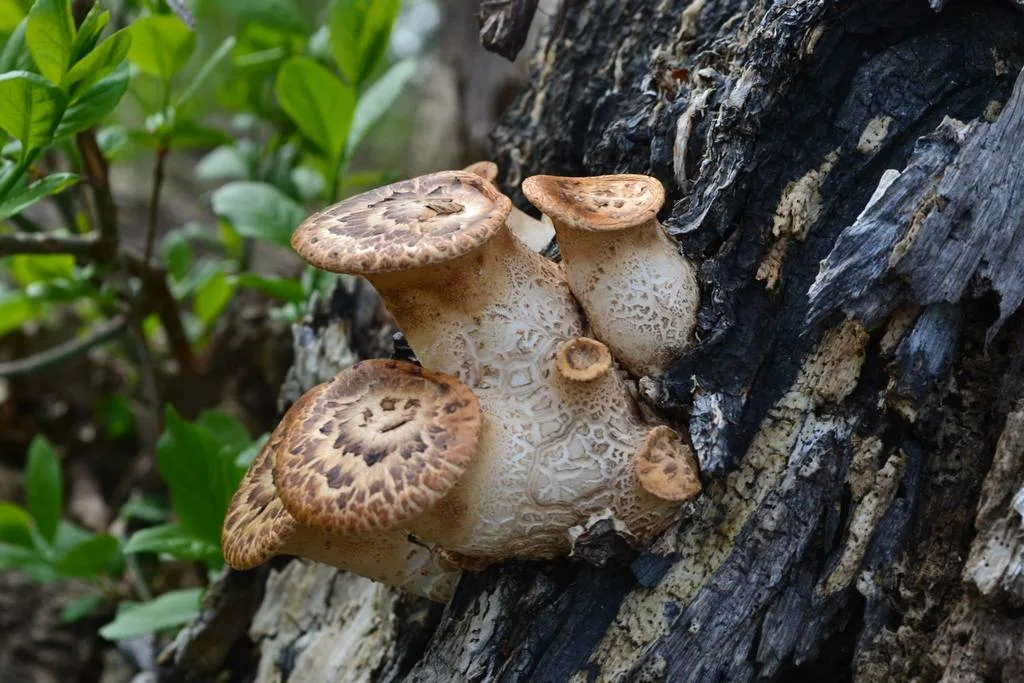
This is the large one: a pale fan with flat brown scales, big angular pores and a black stem base. Tom Volk describes shelves sticking out from the lower part of dead trunks adds logs and stumps. On a fallen log it can look more like a stemmed mushroom, per the National Park Service.
Spring Polypore (Lentinus arcularius)
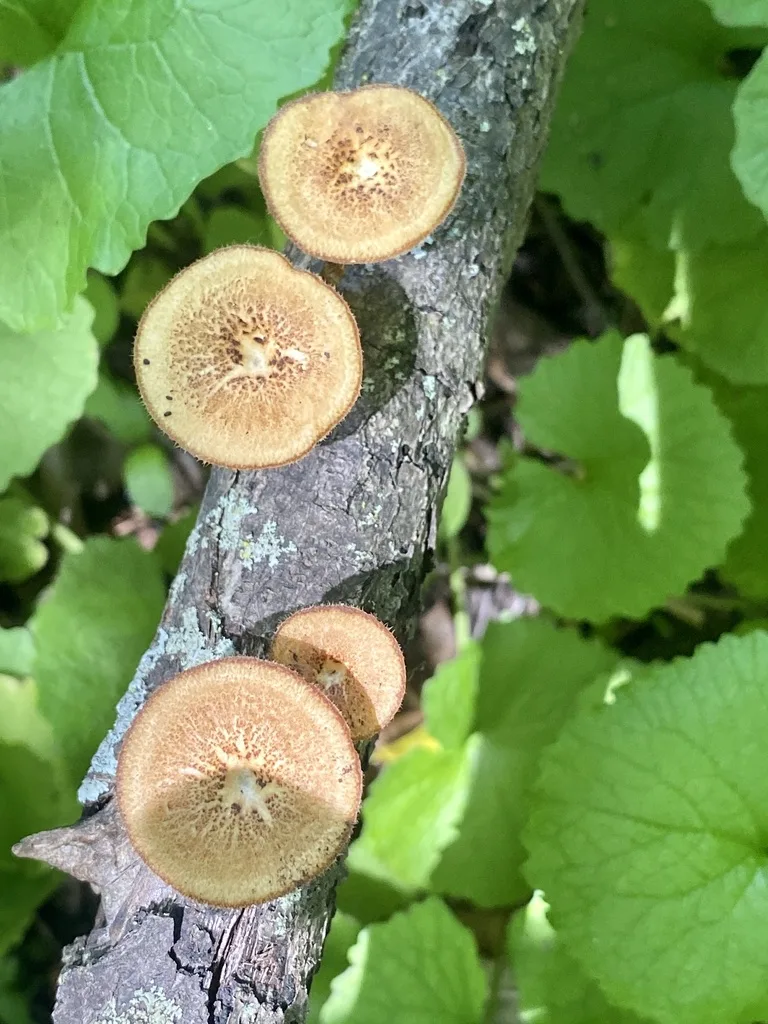
The spring polypore is a small stemmed mushroom with a fringe of fine hairs on the cap rim. Fontenelle Forest Nature Search in Nebraska describes a brown to golden-brown cap about 1/2 to 3 inches wide, a white pore surface and a brown stem 1 to 2.5 inches long. It grows in spring on dead hardwood, especially cottonwood there. Its older name is Polyporus arcularius. The 2022 Mycosphere study places it in Lentinus and reports angular pores.
Winter Polypore (Lentinus brumalis)
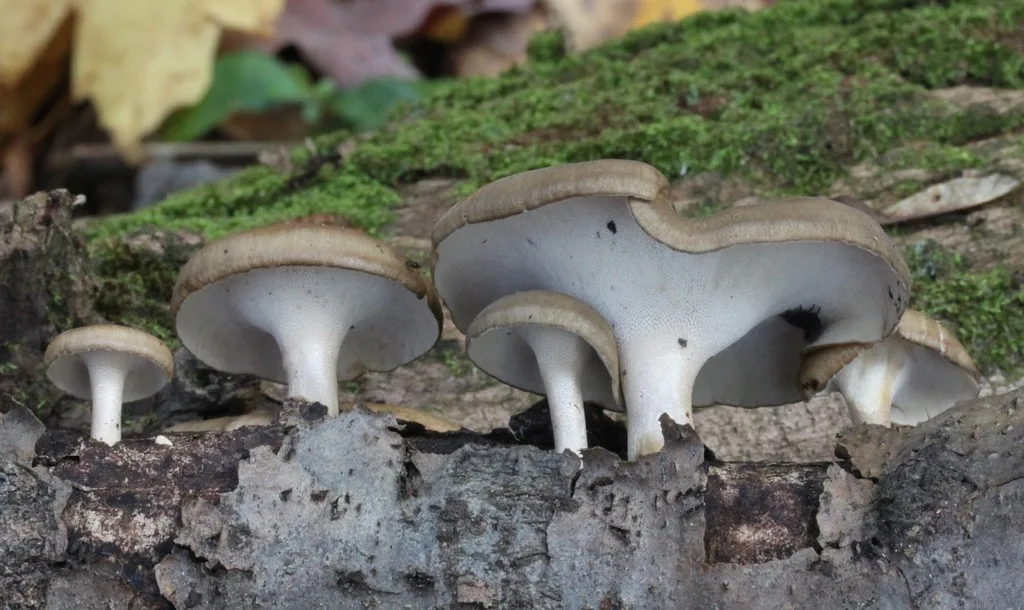
The winter polypore has a gray-brown cap 2 to 8 cm across that darkens with age. Its pores are small, at 2 to 3 per mm, and the 2022 Mycosphere study describes them as circular. First Nature places it on fallen hardwood branches from late autumn to the end of spring and calls it tough and inedible. Its older name is Polyporus brumalis.
Hexagonal-Pored Polypore (Neofavolus alveolaris)
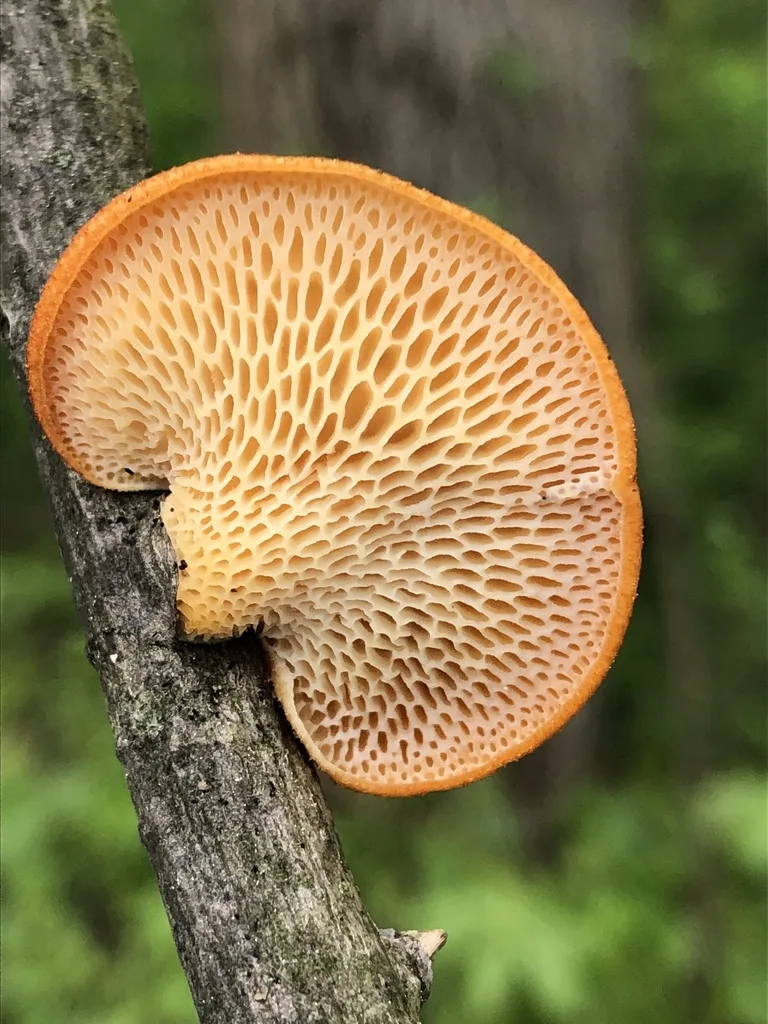
This small orange to tan fan has six-sided, honeycomb pores in radial rows. Its cap is 3/8 to 4 inches wide and scaly, becoming smooth with age. The stem is a short white stub, or it is missing. The Missouri Department of Conservation lists it under Polyporus alveolaris and records it from May through November on dead hardwood branches.
Rooting Polypore (Polyporus radicatus)
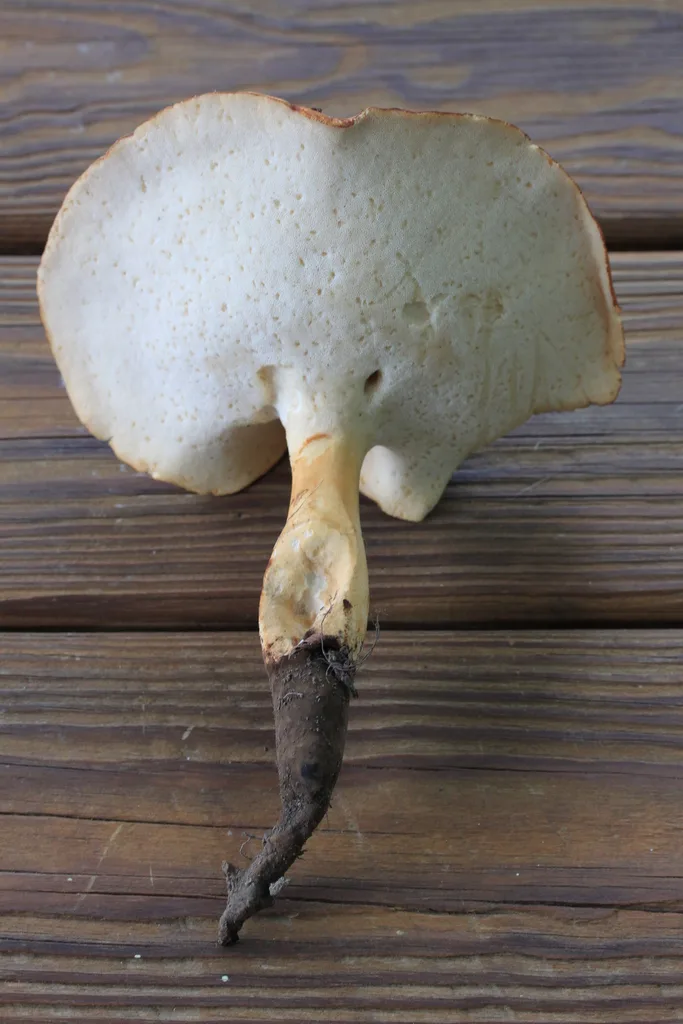
The rooting polypore seems to grow from the ground, but it is attached to buried roots near stumps. The Missouri Department of Conservation gives a cap of 1.5 to 10 inches, a central stem 2.5 to 6 inches long, and a long, black, rootlike part underground. It fruits from August to October and is not edible. The 2022 Mycosphere study found it closer to the pheasant back's group than to the core Polyporus species.
Chicken of the Woods (Laetiporus sulphureus)
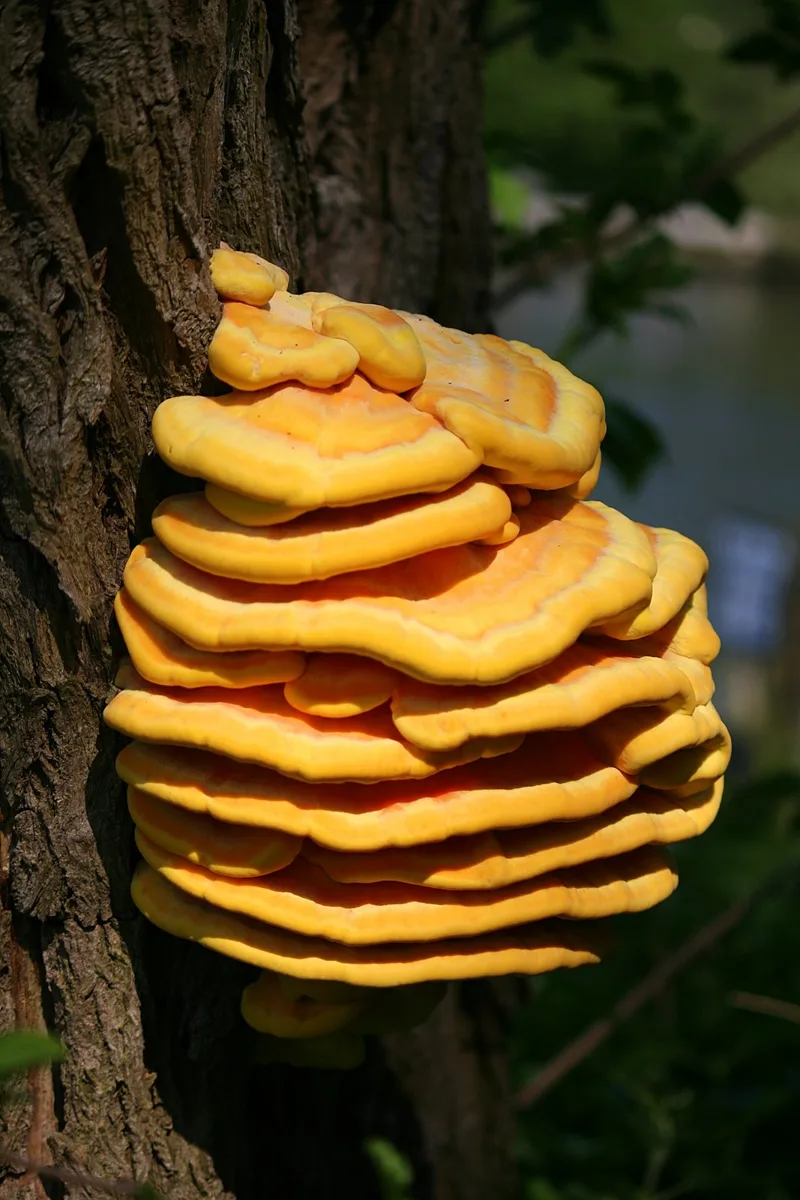
Chicken of the woods also forms overlapping shelves on hardwoods, and Missouri lists it among the pheasant back's similar species. Its pores are yellow, not white. It also causes a brown rot rather than a white rot, as Tom Volk's Laetiporus page explains. See our full chicken of the woods guide.
Pheasant Back vs Look-Alikes: Side-by-Side Comparison
The fastest separation is the stem: the pheasant back has a short off-center stem with a black base, while the spring, winter and rooting polypores have central stems. None of the sources we checked names a deadly mushroom that is mistaken for a pheasant back. The risks are stomach upset and eating a tough, old specimen.
| Mushroom | Cap | Pores | Stem | Risk |
|---|---|---|---|---|
| Pheasant back | Large, pale, flat brown scales | Large, angular, white to cream | Short, off-center, black velvet base | One NAMA stomach-upset report |
| Spring polypore | 1/2 to 3 in, brown, hairy fringe on the rim | Angular | Central | Not rated as food in sources we opened |
| Winter polypore | 2 to 8 cm, gray-brown, darkens with age | Small and round, 2 to 3 per mm | Central | Tough, inedible |
| Hexagonal-pored polypore | Small, orange to tan | Six-sided honeycomb in rows | Stub or none | Tough and woody |
| Rooting polypore | Yellow-brown, scruffy | Tiny, angular | Long, central, black root | Not edible |
| Chicken of the woods | Sulfur-colored shelves | Yellow | Usually overlapping shelves | Stomach upset in NAMA reports |
Why Gills vs Pores Matters
Pores mark the pheasant back as a polypore, so a mushroom with blade-like gills underneath is not a pheasant back, however scaly the cap. This is the single quickest check in the field. It takes a few seconds and rules out every gilled mushroom growing on the same log.
DNA does not follow this split neatly, though. The 2022 Mycosphere study placed the spring polypore and winter polypore in Lentinus, a genus whose gilled members are almost all tropical. The fringed sawgill is a gilled Lentinus found in the US Gulf South, and our Lentinus crinitus guide covers it. For field identification, the underside still sorts a mushroom into the right group. Our guide to gills vs pores vs ridges shows each type side by side.
Is Pheasant Back Mushroom Edible?
Sources that rate the pheasant back call it edible when young, but opinions on its quality vary and one poisoning report exists. Nobody should eat one based on this page. A wild mushroom needs a confident identification by an experienced person first.
- The Missouri Department of Conservation considers it a good edible, especially when young.
- Ohio State Extension calls it presumably edible when young.
- Tom Volk calls it reported to be edible but found the texture very rubbery.
- The National Park Service calls it technically edible, poor-tasting and tender only when very young.
- The flesh becomes corky and tough with age, especially in the stem.
The poisoning records add a caution. The NAMA 2006 to 2017 poisoning summary lists one adult in Michigan with nausea and vomiting 7 hours after eating cooked Polyporus squamosus. NAMA notes that some identifications in its registry are educated guesses, so one report does not prove the species is toxic.
Sources give general precautions for any wild mushroom. Missouri advises cooking all wild mushrooms and trying only a small amount the first time, because some people are allergic to certain fungal chemicals. Midwest American Mycological Information advises cooking thoroughly and not eating more than one new species at a time. Our poisonous vs edible mushrooms guide explains why simple rules fail.
Are Pheasant Back Mushrooms Poisonous to Dogs?
Evidence is limited, but NAMA records one dog in Michigan that became seriously ill after a pheasant back. The same NAMA summary lists profuse vomiting and diarrhea, then two seizures at the vet, constricted pupils and other signs. It is a single report, and the mushroom identification behind it cannot be checked.
Treat any wild mushroom a dog eats as an emergency. Follow our guide on what to do if your dog ate a mushroom and call your vet or a pet poison helpline.
Is a Pheasant Back Bad for the Tree?
Yes, on a living tree it is a sign of white heart rot that weakens the trunk and branches over time. Ohio State University Extension states that trees hosting it will become hazardous over time and that there is no cure once a tree is infected. On a dead tree or log, the same fungus is a normal decomposer that recycles nutrients.
The fungus enters through wounds from storm damage and pruning cuts, according to Ohio State. Topping a tree and leaving branch stubs raise the risk. The National Park Service notes that heart rot makes a tree more likely to fall in storms, so a pheasant back on a living tree near a building or road is a warning sign. Have a certified arborist inspect a yard tree that shows one. Ohio State describes the shelf as an annual reproductive structure, so knocking it off does not cure the tree.
Common Identification Mistakes
Calling Every Scaly Spring Shelf a Pheasant Back
The hexagonal-pored polypore is also scaly when young, and it fruits in the same months. Its pores form a neat honeycomb in rows, and the whole mushroom stays small.
Skipping the Flip
A scaly cap seen from above is not enough. Turn the mushroom over every time. Gills rule out a pheasant back at once.
Ignoring Where the Stem Attaches
A central stem points to the spring polypore, the winter polypore or the rooting polypore. A pheasant back usually has a short stem to one side with a black base.
Judging by Size Alone
A young pheasant back can be only 2 inches across. A size match with a picture proves nothing, so check the pores and the base as well.
Assuming "No Deadly Look-Alike" Means Safe
NAMA has a report of an adult who vomited after a cooked pheasant back, and old specimens are tough. A clean identification is the start of the safety check, not the end of it.
Frequently Asked Questions
What is a pheasant back mushroom?
A pheasant back is a large polypore with brown scales on a pale cap, big angular pores and a short stem that is black at the base. It grows on hardwoods, mostly in spring. Its scientific name is Cerioporus squamosus, formerly Polyporus squamosus.
Is pheasant back mushroom edible?
Sources that rate it call it edible when young, and the Missouri Department of Conservation calls it a good edible. Opinions on taste vary, and NAMA records one adult who vomited after eating it cooked. Never eat a wild mushroom without expert confirmation.
Is dryad's saddle the same as pheasant back?
Yes. Dryad's saddle and pheasant back are two common names for the same species. Both names come from the cap, which can look like a saddle or like a pheasant's back feathers.
What does a pheasant back mushroom smell like?
The Missouri Department of Conservation and Ohio State University Extension say it smells like watermelon rind. One field guide describes the smell as strongly mealy. Cut a fresh piece to check it.
When do pheasant back mushrooms grow?
They fruit mainly in spring, often during morel season in April and May. Some areas see a second flush in fall. Missouri records them from May to October.
What trees do pheasant backs grow on?
They grow on many hardwoods, especially silver maple, box elder and elm. The National Park Service also lists buckeye, cottonwood, willow, basswood and others. In the western US they grow mainly on quaking aspen.
Is there a poisonous pheasant back look-alike?
None of the sources we checked names a deadly look-alike. The common look-alikes are small spring polypores that are tough rather than toxic. A gilled mushroom on the same log is not a pheasant back and needs its own identification.
How do you tell a pheasant back from a spring polypore?
A spring polypore is about 1/2 to 3 inches wide, with a central stem and a hairy fringe on the cap rim. A pheasant back is usually much larger, with flat brown scales and a short stem to one side. Its stem base is black and velvety.
Does a pheasant back mushroom hurt the tree?
On a living tree it causes white heart rot, which weakens the wood. Ohio State University Extension says infected trees become hazardous over time and there is no cure. Have an arborist check a yard tree near a house or road.
Final Safety Reminder
A pheasant back is one of the easier spring mushrooms to recognize, but easy is not the same as safe. Never eat a wild mushroom based on a chart, a photo or an app. Photograph the cap, the underside, the stem base and the wood it grows on, then check your find with our free mushroom identifier and a local mycological club. If someone may have eaten a poisonous mushroom in the US, call Poison Control at 1-800-222-1222.
Sign in to leave a comment and join the discussion.
 Species Guide
A coral fungus is a mushroom shaped like branching sea coral or a tuft of upright clubs, with no cap and no gills. Most US corals grow from soil in the...
 Species Guide
A cauliflower mushroom ( Sparassis ) is a large, cream-colored rosette of flat, wavy, ribbon-like lobes that grows at the base of a tree. It has no caps, no...
 Species Guide
The golden oyster mushroom ( Pleurotus citrinopileatus ) is a bright yellow oyster mushroom that grows in dense, bouquet-like clusters on dead hardwood,...