Edible Mushrooms in Minnesota: Complete Identification Guide (2026)

Nathan Cole
Mycologist · Author · Fungi Expert
Updated
Aug 22, 2026
Minnesota is one of the best states in the Midwest for mushroom foraging, offering a rich diversity of edible fungi across hardwood forests, boreal woodlands, and lake regions.
From prized Morels (Morchella spp.) in spring to Golden Chanterelles (Cantharellus spp.), King Boletes (Boletus edulis), Hen of the Woods (Grifola frondosa), and Lion's Mane (Hericium erinaceus) in late summer and fall, the state provides outstanding opportunities for both beginner and experienced foragers.
Safe identification remains essential because several edible mushrooms have poisonous lookalikes.
What Are the Best Edible Mushrooms in Minnesota?
Minnesota's most popular edible wild mushrooms include:
| Mushroom | Peak Season | Common Habitat |
|---|---|---|
| Morel | Spring | Aspen forests, burn areas |
| Golden Chanterelle | Summer–Fall | Oak and mixed hardwood forests |
| King Bolete | Summer–Fall | Pine and spruce forests |
| Lobster Mushroom | Summer–Fall | Mixed woodlands |
| Chicken of the Woods | Summer–Fall | Dead hardwood trees |
| Hen of the Woods | Fall | Mature oak forests |
These mushrooms are prized for their flavor, culinary versatility, and abundance in Minnesota's forests.
Why Minnesota Is One of the Best States for Mushroom Foraging?
Minnesota's combination of northern forests, abundant rainfall, wetlands, and diverse tree species creates excellent conditions for fungal biodiversity.
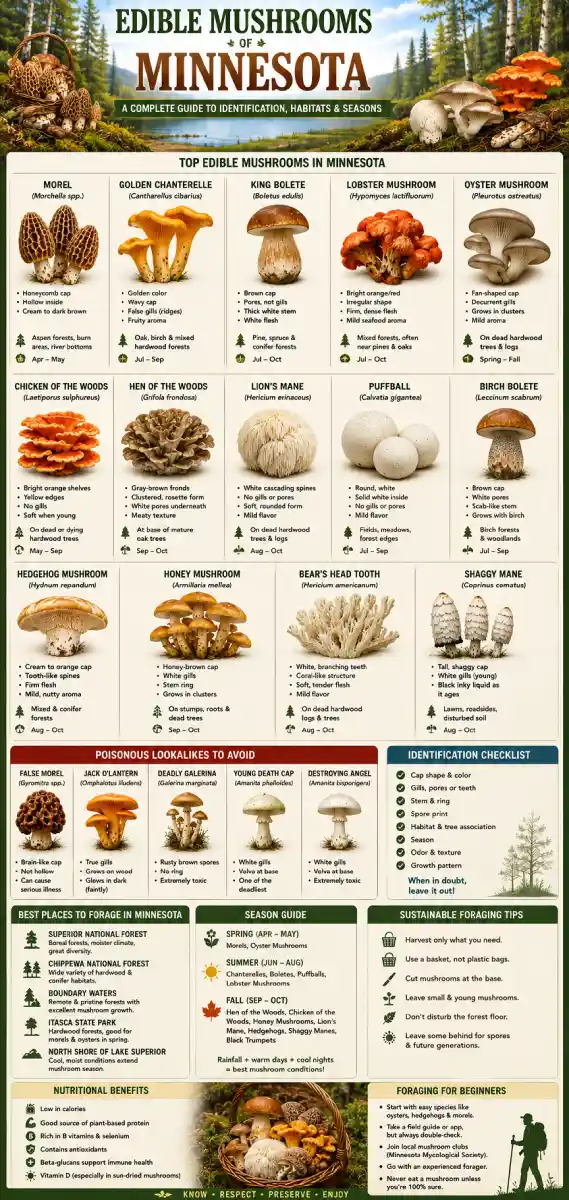
The state's ecosystems support both mycorrhizal mushrooms, which grow in partnership with trees, and saprobic mushrooms that decompose fallen wood and organic matter.
Climate and Seasonal Rainfall
Several environmental factors contribute to mushroom abundance:
- Regular spring rainfall
- Warm summer temperatures
- Moist forest floors
- Rich organic soils
- Cool autumn weather
Heavy rainfall followed by mild temperatures often triggers large mushroom flushes.
Hardwood and Boreal Forest Ecosystems
Minnesota contains a wide variety of productive habitats, including:
- Aspen forests
- Birch forests
- Oak woodlands
- Maple forests
- Pine forests
- Spruce forests
- Mixed hardwood forests
Each forest type supports different edible mushroom species.
Tree Associations Matter
Many edible mushrooms grow in association with specific trees.
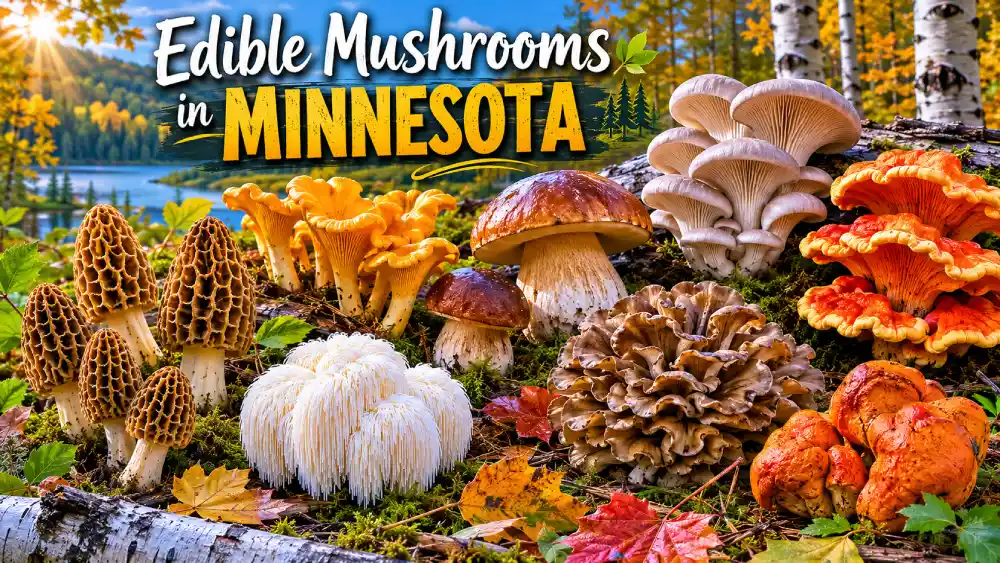
Examples include:
- Morels near aspen and elm
- Chanterelles near oak and birch
- King Boletes near pine and spruce
- Hen of the Woods around mature oaks
Learning tree identification often improves mushroom hunting success.
Morel Mushrooms (Morchella Species)
Morels are Minnesota's most anticipated spring mushroom and attract thousands of foragers every year.
Their distinctive appearance and outstanding flavor make them one of the state's most valuable wild edible mushrooms.
Identification Features
True morels have:
- Honeycomb-like cap
- Deep pits and ridges
- Hollow interior
- Cream to dark brown coloration
- Cone-shaped profile
A true morel should be completely hollow when sliced from top to bottom.
Habitat in Minnesota
Morels commonly grow:
- In burn areas
- Near dying elm trees
- Under aspen
- Along river bottoms
- At woodland edges
Old orchards and recently disturbed soils can also be productive.
Season
Typical fruiting period:
- Mid-April through May
- Early June in northern Minnesota
Timing depends on soil temperature and spring weather.
Culinary Uses
Morels are famous for their:
- Nutty flavor
- Meaty texture
- Rich aroma
They are excellent in:
- Butter sautés
- Cream sauces
- Pasta
- Risotto
- Mushroom soups
Poisonous Lookalike
False Morels (Gyromitra species) resemble true morels but may contain toxic compounds.
True morels are hollow inside, while false morels have folded, chambered interiors.
Golden Chanterelle (Cantharellus Species)
Golden Chanterelles are among Minnesota's finest summer mushrooms and are highly prized by chefs and mushroom enthusiasts.
Their bright golden color and fruity aroma make them relatively easy to recognize.
Identification Features
Golden Chanterelles display:
- Yellow to golden-orange cap
- Wavy margins
- Thick flesh
- Forked false gills
- Fruity apricot-like aroma
Unlike true gills, the ridges extend smoothly down the stem.
Habitat
They grow:
- In oak forests
- Under birch trees
- In mixed hardwood woodlands
- On mossy forest floors
They emerge directly from soil rather than wood.
Season
Most common:
- July through September
- Following periods of consistent rainfall
Culinary Value
Chanterelles are prized for:
- Delicate flavor
- Firm texture
- Excellent versatility
They pair well with:
- Eggs
- Cream sauces
- Poultry
- Pasta
- Fresh herbs
Dangerous Lookalike
The Jack O'Lantern Mushroom resembles chanterelles but grows on wood and has true gills instead of blunt ridges.
King Bolete (Boletus edulis)
The King Bolete, also known as Porcini, is one of the world's premier edible mushrooms and is found in suitable habitats throughout Minnesota.
Its thick stem and sponge-like pores make it a favorite among beginner and experienced foragers alike.
Identification Features
King Boletes typically possess:
- Large brown cap
- Thick white stem
- White flesh
- Pore surface instead of gills
- Mild earthy aroma
Young specimens are especially prized for culinary use.
Habitat in Minnesota
King Boletes commonly grow:
- Under white pine
- Under spruce
- In mixed conifer forests
- Along woodland trails
They form mycorrhizal relationships with tree roots and often return to the same locations each year.
Season
Peak production occurs:
- July through October
- After warm rains
Culinary Uses
King Boletes are valued for their:
- Dense texture
- Rich umami flavor
- Excellent drying qualities
Popular preparations include:
- Grilling
- Roasting
- Soups
- Risotto
- Mushroom powders
Identification Tip
Unlike many poisonous mushrooms, King Boletes have pores rather than gills, making them easier to distinguish when properly identified.
Lobster Mushroom (Hypomyces lactifluorum)
The Lobster Mushroom is one of the most visually striking edible fungi found in Minnesota. Its bright orange-red color and dense texture make it easy to spot on the forest floor during late summer and fall.
Interestingly, a Lobster Mushroom is not a true mushroom species. It is created when a parasitic fungus colonizes certain Russula or Lactarius mushrooms, transforming them into a delicious edible delicacy.
Identification Features
Lobster Mushrooms typically have:
- Bright orange to reddish-orange exterior
- Irregular shape
- Thick, firm flesh
- Dense texture
- Mild seafood-like aroma
Their appearance often resembles the shell of a cooked lobster.
Habitat in Minnesota
They commonly grow:
- In mixed hardwood forests
- Under pine trees
- In birch woodlands
- Along mossy forest floors
- Near mature oak forests
They often emerge partially buried beneath leaves and pine needles.
Season
Peak season usually occurs:
- July through October
- After periods of steady rainfall
Culinary Uses
Lobster Mushrooms are highly prized for:
- Firm texture
- Rich flavor
- Excellent cooking versatility
Popular dishes include:
- Mushroom bisque
- Pasta
- Risotto
- Cream sauces
- Roasted vegetable recipes
Identification Advantage
Their brilliant orange coloration makes them less likely to be confused with many poisonous mushrooms, making them a favorite among experienced foragers.
Oyster Mushroom (Pleurotus ostreatus)
Oyster Mushrooms are among the easiest edible mushrooms to identify and are an excellent choice for beginner foragers.
They grow in shelf-like clusters on hardwood trees and often appear throughout much of the growing season.
Identification Features
Oyster Mushrooms generally display:
- Fan-shaped caps
- White to gray coloration
- Decurrent gills
- Short or absent stem
- Smooth surface
- Clustered growth
Fresh specimens have a pleasant, mild aroma.
Habitat in Minnesota
They commonly grow on:
- Dead elm trees
- Aspen logs
- Cottonwood
- Maple
- Fallen hardwood trunks
Because they are saprobic fungi, they feed on decaying wood rather than living roots.
Season
Depending on weather conditions, Oyster Mushrooms may appear:
- Spring
- Summer
- Fall
- Occasionally during mild winters
Culinary Value
Their mild taste and tender texture make them ideal for:
- Stir-fries
- Soups
- Pasta
- Grilled dishes
- Vegetarian recipes
Why Beginners Love Oyster Mushrooms?
Oyster Mushrooms have relatively few dangerous lookalikes and a distinctive growth habit, making them one of the safest edible mushrooms for those learning mushroom identification.
Chicken of the Woods (Laetiporus sulphureus)
Chicken of the Woods is one of Minnesota's most colorful edible mushrooms.
Its vibrant orange shelves growing from tree trunks can often be spotted from a considerable distance.
Identification Features
Key characteristics include:
- Bright orange upper surface
- Yellow edges
- Shelf-like clusters
- No gills
- Soft texture when young
Large specimens may weigh several pounds.
Habitat
Chicken of the Woods commonly grows:
- On oak trees
- On dead hardwood logs
- On stumps
- On dying trees
Young growth is generally considered the best for eating.
Season
Typically fruits:
- Late spring
- Summer
- Early fall
Culinary Uses
Its texture resembles cooked chicken, making it popular in:
- Tacos
- Stir-fries
- Sandwiches
- Vegetarian entrées
Harvest Tip
Choose soft, tender edges and avoid older, woody portions for the best eating quality.
Hen of the Woods (Grifola frondosa)
Hen of the Woods, also called Maitake, is one of the most prized edible mushrooms found in Minnesota's mature hardwood forests.
Its large, overlapping fronds resemble the feathers of a nesting hen.
Identification Features
Hen of the Woods typically has:
- Gray-brown fronds
- Rosette-like clusters
- White pore surface
- Firm flesh
- Thick branching base
Large specimens can weigh more than 20 pounds.
Habitat in Minnesota
Most commonly found:
- At the base of mature oak trees
- Around old stumps
- In hardwood forests
- Along woodland edges
Many patches return to the same tree year after year.
Season
Peak season:
- September
- October
Culinary Value
Hen of the Woods is highly regarded because of its:
- Rich umami flavor
- Meaty texture
- Excellent storage qualities
It is delicious roasted, sautéed, grilled, or added to soups and stews.
Nutritional Interest
This mushroom contains beta-glucans and antioxidants and is widely studied for its potential health-supporting properties.
Lion's Mane (Hericium erinaceus)
Lion's Mane is one of the most unusual edible mushrooms growing in Minnesota.
Instead of a traditional cap and stem, it produces cascading white spines that resemble a lion's mane or waterfall of icicles.
Identification Features
Lion's Mane displays:
- Pure white color
- Long hanging spines
- Rounded growth form
- Soft texture
- No gills or pores
Its appearance is unlike almost any other edible mushroom.
Habitat in Minnesota
Lion's Mane grows on:
- Dead hardwood trees
- Standing dead trunks
- Fallen logs
- Wounded oak and maple trees
It prefers mature deciduous forests with abundant woody debris.
Season
Most commonly appears:
- Late summer
- Fall
Culinary Uses
Lion's Mane is prized for:
- Seafood-like texture
- Mild flavor
- Versatility in cooking
It is commonly prepared as:
- Crab-style cakes
- Pan-seared steaks
- Soups
- Stir-fries
- Pasta dishes
Research and Health Interest
Lion's Mane contains naturally occurring compounds that are being studied for their potential role in supporting nerve function and cognitive health. Although research is ongoing, it remains one of the most sought-after gourmet and functional mushrooms among foragers and chefs alike.
Bear's Head Tooth (Hericium americanum)
Bear's Head Tooth is one of Minnesota's most fascinating edible mushrooms. Closely related to Lion's Mane, it produces cascading clusters of white branches covered with delicate hanging spines.
Its unique appearance makes it one of the easiest mushrooms to recognize in mature hardwood forests.
Identification Features
Bear's Head Tooth typically has:
- White to cream coloration
- Branching coral-like structure
- Hanging tooth-like spines
- Soft, tender flesh
- Dense cluster formation
Unlike traditional mushrooms, it has no cap or gills.
Habitat in Minnesota
It commonly grows:
- On fallen hardwood logs
- On dead maple trees
- On beech and oak
- In mature deciduous forests
Because it grows directly from wood, careful inspection of fallen logs often leads to successful discoveries.
Season
Most productive during:
- August
- September
- October
Culinary Uses
Bear's Head Tooth is highly regarded for its:
- Delicate seafood-like texture
- Mild flavor
- Excellent sautéing qualities
It is often prepared with butter, garlic, herbs, or incorporated into creamy pasta dishes.
Identification Advantage
Its branching structure and hanging teeth make it difficult to confuse with dangerous mushrooms, making it a rewarding species for experienced foragers.
Puffball Mushroom (Calvatia gigantea)
Puffballs are among the most unusual edible fungi in Minnesota because they develop without visible caps or gills.
When harvested at the proper stage, they provide excellent culinary value.
Identification Features
Young edible puffballs should be:
- Round or slightly pear-shaped
- Bright white inside
- Firm throughout
- Smooth on the exterior
- Completely solid
The interior must remain uniformly white.
Habitat in Minnesota
Puffballs commonly appear:
- In open meadows
- Along woodland edges
- In grasslands
- Near trails
- In old fields
Some giant puffballs can exceed 12 inches in diameter.
Season
Peak season occurs:
- July
- August
- September
Especially after warm summer rains.
Culinary Uses
Puffballs have a mild flavor and absorb seasonings well.
Popular cooking methods include:
- Breaded slices
- Grilling
- Pan frying
- Soups
- Vegetarian entrées
Important Safety Rule
Always slice every puffball in half before eating.
If any developing stem, cap, or gills are visible inside, discard the mushroom immediately because young poisonous Amanitas may resemble puffballs.
Birch Bolete (Leccinum scabrum)
The Birch Bolete is one of Minnesota's characteristic woodland mushrooms, closely associated with birch forests.
Its distinctive stem markings make it relatively easy to identify.
Identification Features
Typical characteristics include:
- Brown cap
- White pore surface
- Thick stem
- Dark scab-like dots on the stem
- Firm white flesh
The stem scales become more noticeable as the mushroom matures.
Habitat
Birch Boletes grow almost exclusively near:
- White birch
- Paper birch
- Mixed birch forests
- Woodland edges
Their strong relationship with birch trees makes habitat an important identification clue.
Season
Most commonly found:
- July through September
Following periods of rainfall.
Culinary Value
Birch Boletes offer:
- Mild earthy flavor
- Dense texture
- Excellent roasting qualities
Many foragers dry them for use in soups and sauces during winter.
Identification Tip
Always examine:
- Tree association
- Stem scales
- Pore surface
- Flesh color after cutting
to distinguish them from similar bolete species.
Hedgehog Mushroom (Hydnum repandum)
The Hedgehog Mushroom is considered one of the safest edible mushrooms for beginners because of its unmistakable underside.
Instead of gills or pores, it produces soft tooth-like spines.
Identification Features
Hedgehog Mushrooms possess:
- Cream to orange cap
- Thick flesh
- White teeth beneath the cap
- Firm stem
- Mild aroma
The downward-pointing spines are the defining feature.
Habitat in Minnesota
Common habitats include:
- Mixed hardwood forests
- Pine forests
- Moss-covered woodland floors
- Oak forests
They often grow in scattered groups.
Season
Peak fruiting:
- August
- September
- October
Culinary Uses
Hedgehog Mushrooms are appreciated for their:
- Nutty flavor
- Firm texture
- Excellent shelf life
They work well in sautés, soups, risottos, and roasted dishes.
Beginner-Friendly Species
Very few poisonous mushrooms have tooth-like undersides, making Hedgehogs one of the easiest mushrooms for beginners to recognize.
Honey Mushroom (Armillaria mellea)
Honey Mushrooms are among Minnesota's most abundant fall mushrooms and frequently appear in dense clusters around tree bases and stumps.
A single patch can produce dozens of edible mushrooms.
Identification Features
Honey Mushrooms typically display:
- Honey-colored cap
- White gills
- White spore print
- Stem ring
- Clustered growth
Young specimens usually have the best texture.
Habitat
They commonly grow:
- On buried roots
- Around dead trees
- On hardwood stumps
- Along woodland trails
- In mature forests
Although edible, they are also known plant pathogens that cause root rot.
Season
Most productive during:
- September
- October
Following cool autumn rains.
Culinary Uses
Honey Mushrooms are valued for:
- Mild earthy flavor
- Firm texture
- Excellent cooking qualities
They are frequently added to soups, stews, pasta dishes, and mixed mushroom recipes.
Safety Consideration
Always cook Honey Mushrooms thoroughly.
Some individuals may experience digestive upset when consuming raw or undercooked specimens, so first-time consumers should try only a small portion.
Shaggy Mane (Coprinus comatus)
The Shaggy Mane is one of Minnesota's most recognizable edible mushrooms thanks to its tall white cap covered with shaggy scales. It is often found outside traditional forests, making it a pleasant surprise for hikers and homeowners alike.
Because it deteriorates quickly after harvest, it should be cooked as soon as possible.
Identification Features
Shaggy Manes typically have:
- Tall cylindrical cap
- White shaggy scales
- Hollow stem
- White gills when young
- Black liquid as they mature
As the mushroom ages, the cap dissolves into an inky black fluid through a process known as deliquescence.
Habitat
Commonly found:
- Lawns
- Parks
- Roadsides
- Woodland trails
- Disturbed soils
- Open grassy areas
Season
Peak fruiting occurs:
- August
- September
- October
especially after periods of rain.
Culinary Uses
Young specimens with white gills are prized for:
- Mild flavor
- Tender texture
- Quick cooking time
Older mushrooms should be avoided because they rapidly decompose.
Best Places to Find Edible Mushrooms in Minnesota
Minnesota's forests and protected natural areas offer outstanding mushroom-foraging opportunities.
Superior National Forest
One of the state's premier mushroom destinations.
Common edible species include:
- Morels
- Chanterelles
- King Boletes
- Lobster Mushrooms
- Hedgehog Mushrooms
The combination of boreal forests and abundant moisture creates ideal conditions for fungal diversity.
Chippewa National Forest
This expansive forest supports:
- Oyster Mushrooms
- Honey Mushrooms
- Puffballs
- Lion's Mane
- Chicken of the Woods
Mixed hardwood and conifer habitats provide excellent foraging opportunities.
Boundary Waters Canoe Area Wilderness
Remote forests and minimal disturbance make this region an exceptional habitat for wild mushrooms.
Experienced foragers often discover:
- Chanterelles
- Black Trumpets
- Lobster Mushrooms
- Boletes
during productive years.
Itasca State Park Region
Northern hardwood forests surrounding Itasca support:
- Morels
- Puffballs
- Oyster Mushrooms
- Chicken of the Woods
particularly after wet springs.
North Shore of Lake Superior
The cool, humid climate near Lake Superior supports extended mushroom seasons.
Common finds include:
- Chanterelles
- Hedgehog Mushrooms
- Oyster Mushrooms
- Lion's Mane
Mushroom Season in Minnesota
Understanding seasonal patterns greatly improves foraging success.
Spring (April–May)
Spring mushrooms include:
- Morels
- Oyster Mushrooms
Warm soil temperatures combined with rainfall trigger emergence.
Summer (June–August)
Common summer species include:
- Chanterelles
- King Boletes
- Birch Boletes
- Puffballs
- Lobster Mushrooms
Frequent thunderstorms often lead to productive flushes.
Fall (September–October)
Fall is widely considered Minnesota's best mushroom season.
Popular species include:
- Hen of the Woods
- Chicken of the Woods
- Honey Mushrooms
- Lion's Mane
- Hedgehog Mushrooms
- Shaggy Manes
- Black Trumpets
Cool temperatures and moist conditions create ideal growing environments.
How to Identify Edible Mushrooms Safely?
Safe mushroom identification depends on observing multiple characteristics.
Never rely on color alone.
Instead examine:
- Cap shape
- Gills, pores, or teeth
- Stem features
- Habitat
- Tree associations
- Growth pattern
- Spore print
- Odor
Using multiple identification criteria greatly reduces the risk of mistakes.
Make a Spore Print
A spore print provides valuable identification information.
Simple process:
- Remove the stem.
- Place the cap on white and dark paper.
- Cover with a bowl.
- Leave overnight.
The resulting spore color can help distinguish similar species.
Poisonous Lookalikes to Avoid
Several edible mushrooms have toxic counterparts.
| Edible Species | Dangerous Lookalike |
|---|---|
| Morel | False Morel |
| Chanterelle | Jack O'Lantern |
| Honey Mushroom | Deadly Galerina |
| Puffball | Young Death Cap |
| White Mushrooms | Destroying Angel |
Learning these comparisons is one of the most important mushroom safety skills.
Sustainable Mushroom Foraging Tips
Responsible harvesting helps preserve Minnesota's fungal biodiversity.
Best Practices
- Harvest mature mushrooms only.
- Leave young specimens to grow.
- Use baskets or mesh bags.
- Minimize disturbance to soil and vegetation.
- Leave part of each patch for spore dispersal.
Ethical harvesting supports healthy mushroom populations for future generations.
Nutritional Benefits of Wild Edible Mushrooms
Many edible mushrooms are rich in essential nutrients while remaining low in calories.
Common nutritional benefits include:
- Protein
- Dietary fiber
- Potassium
- Selenium
- Copper
- B vitamins
- Vitamin D
- Antioxidants
- Beta-glucans
Species such as Lion's Mane and Hen of the Woods are also being studied for their potential functional health benefits.
Conclusion
Minnesota offers some of the finest mushroom foraging opportunities in the Midwest. From spring morels to autumn hen of the woods, its forests provide an impressive diversity of edible fungi for those willing to learn proper identification.
Success depends on understanding habitat, tree associations, seasonality, and poisonous lookalikes. By following safe identification practices and sustainable harvesting methods, foragers can responsibly enjoy one of nature's most rewarding seasonal foods.
Frequently Asked Questions
What edible mushrooms grow in Minnesota?
Common edible mushrooms include Morels, Golden Chanterelles, King Boletes, Lobster Mushrooms, Oyster Mushrooms, Chicken of the Woods, Hen of the Woods, Lion's Mane, Puffballs, Honey Mushrooms, Hedgehog Mushrooms, Birch Boletes, Bear's Head Tooth, and Shaggy Manes.
When is mushroom season in Minnesota?
Mushroom season typically runs from April through October, with the highest diversity occurring during late summer and fall.
Are morels common in Minnesota?
Yes. Morels are among the most sought-after spring mushrooms and are commonly found near aspen, elm, burn areas, and river bottoms.
Where can I forage mushrooms in Minnesota?
Popular locations include Superior National Forest, Chippewa National Forest, the Boundary Waters Canoe Area Wilderness, Itasca State Park, and the North Shore of Lake Superior.
Are chanterelles found in Minnesota?
Yes. Golden Chanterelles grow in hardwood forests, especially near oak and birch trees, during summer and early fall.
Which edible mushrooms have poisonous lookalikes?
Morels, Chanterelles, Honey Mushrooms, Puffballs, and several white mushrooms have dangerous toxic lookalikes that require careful identification.
Can you forage mushrooms in Minnesota?
Mushroom foraging is permitted in many public lands, although specific regulations may vary depending on the location and management agency.
What is the safest edible mushroom for beginners?
Oyster Mushrooms, Hedgehog Mushrooms, and King Boletes are often recommended because of their distinctive identification features.
How do I identify edible mushrooms safely?
Study multiple characteristics including habitat, cap shape, gills or pores, stem features, spore prints, season, and tree associations. Never depend on a single identifying feature.
What is the most important mushroom-foraging rule?
Never eat a wild mushroom unless you are completely certain of its identification.
Sign in to leave a comment and join the discussion.
 Species Guide
Alaska has many edible mushrooms, including morels, king boletes, golden chanterelles, hedgehogs, oyster mushrooms and bear’s head mushrooms. Most appear...
 Species Guide
Wisconsin is home to edible mushrooms such as morels, chanterelles, oyster mushrooms, hen of the woods, chicken of the woods and giant puffballs. Different...
 Species Guide
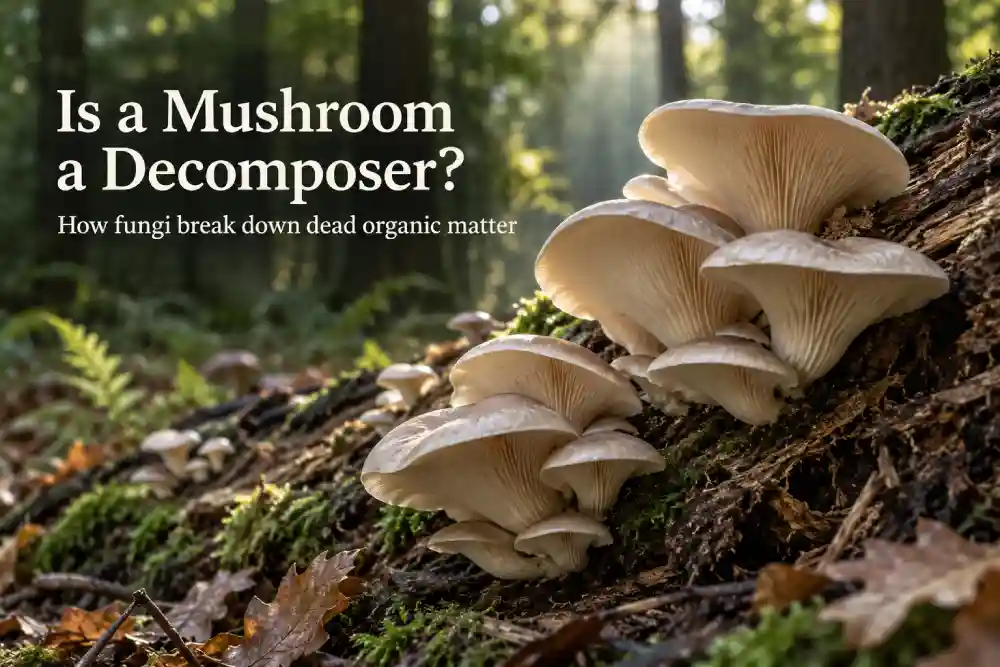
Is a Mushroom a Decomposer? Yes, many mushroom-forming fungi are decomposers. They break down dead wood, fallen leaves and other organic material, helping...