Mushroom Farms in Kennett Square, PA: Complete Guide to the Mushroom Capital of the World

Nathan Cole
Mycologist · Author · Fungi Expert
Updated
Aug 22, 2026
Kennett Square, Pennsylvania, is known worldwide as the Mushroom Capital of the World, producing a significant share of the fresh mushrooms consumed in the United States.
Located in Chester County, this historic farming community is home to some of the country's largest mushroom growers, including Phillips Mushroom Farms, South Mill Champs, To-Jo Mushrooms, and Basciani Foods.
Beyond its agricultural importance, Kennett Square has become a destination for food lovers, mushroom enthusiasts, and visitors interested in learning about commercial mushroom cultivation.
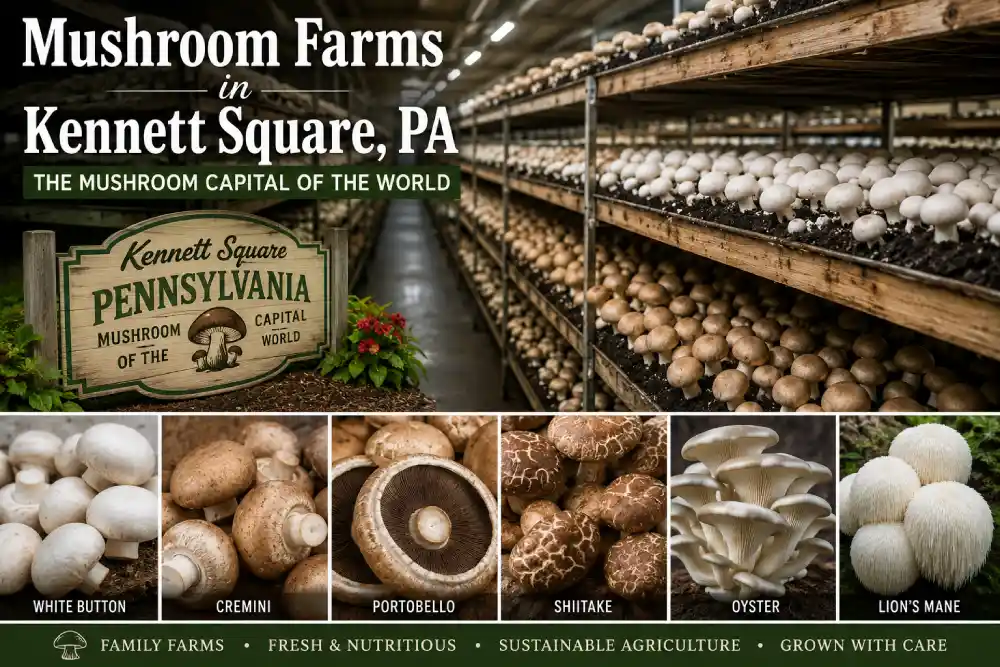
Why Is Kennett Square Famous for Mushroom Farms?
Kennett Square earned its reputation because of its ideal growing conditions, experienced growers, and more than a century of mushroom farming tradition.
Today, the region produces millions of pounds of mushrooms each year, including:
| Mushroom Type | Common Uses |
|---|---|
| White Button | Salads, pizzas, sandwiches |
| Cremini | Pasta, soups, roasting |
| Portobello | Burgers, grilling |
| Shiitake | Asian cuisine, stir-fries |
| Oyster | Gourmet cooking |
| Lion's Mane | Specialty cuisine |
| Maitake | Fine dining |
Its thriving mushroom industry has made Chester County one of the most important agricultural regions in Pennsylvania.
Check also our Mushroom Identification Quiz
Why Kennett Square Is Called the Mushroom Capital of the World?
Few communities are as closely associated with a single crop as Kennett Square is with mushrooms.
For generations, local farms have refined cultivation techniques and built an industry that supplies grocery stores, restaurants, wholesalers, and food manufacturers across the country.
A Rich Agricultural History
Commercial mushroom production began in the late 1800s when local farmers adapted unused greenhouse space for mushroom cultivation.
Over time, these small operations evolved into large-scale indoor farming facilities.
Ideal Growing Conditions
Several factors contributed to Kennett Square's success:
- Moderate climate
- Strong agricultural tradition
- Access to quality compost materials
- Skilled workforce
- Established distribution networks
These advantages helped transform the region into the center of American mushroom production.
Modern Industry Leadership
Today, Kennett Square remains a leader in:
- Mushroom research
- Sustainable farming
- Specialty mushroom production
- Food safety
- Controlled-environment agriculture
Its influence extends well beyond Pennsylvania.
History of Mushroom Farming in Kennett Square
The mushroom industry has shaped the economy and identity of Kennett Square for more than a century.
Early Commercial Cultivation
In the late nineteenth century, growers discovered that abandoned greenhouse structures created favorable conditions for mushroom production.
This innovation sparked rapid industry growth.
Expansion Through the 20th Century
As consumer demand increased, mushroom farms expanded significantly.
Advances in:
- Compost preparation
- Spawn technology
- Climate control
- Harvesting methods
allowed farms to improve yields and product quality.
Today's Industry
Modern mushroom farms combine decades of agricultural experience with advanced technology.
Many facilities use computerized environmental controls to maintain ideal conditions for mycelium growth and mushroom development.
The result is consistent, year-round production of fresh mushrooms.
Top Mushroom Farms in Kennett Square
Kennett Square is home to several well-known mushroom producers that supply fresh mushrooms to markets throughout North America.
Phillips Mushroom Farms
One of the region's best-known growers, Phillips Mushroom Farms has built a reputation for producing high-quality fresh and specialty mushrooms.
The company is also recognized for its educational outreach and mushroom-based products.
Products
- White Button Mushrooms
- Cremini Mushrooms
- Portobello Mushrooms
- Specialty mushrooms
- Dried mushroom products
South Mill Champs
South Mill Champs is one of the largest integrated mushroom growers and distributors in North America.
Its operations include cultivation, packaging, processing, and distribution for retail and foodservice markets.
Product Range
- White mushrooms
- Brown mushrooms
- Portobellos
- Specialty mushrooms
- Value-added mushroom products
To-Jo Mushrooms
To-Jo Mushrooms is known for innovation and premium-quality fresh mushrooms.
The company supplies retailers, restaurants, and distributors across the United States.
Focus Areas
- Fresh mushrooms
- Organic options
- Sustainable production
- Food safety programs
Basciani Foods
Basciani Foods has been a significant contributor to Pennsylvania's mushroom industry for decades.
Its operations emphasize efficient production and reliable distribution while maintaining high quality standards.
Read also about Mushroom Identifier Book
What Types of Mushrooms Are Grown in Kennett Square?
Although white button mushrooms dominate production, local farms cultivate a growing variety of specialty mushrooms to meet changing consumer demand.
White Button Mushrooms
The most widely produced mushroom in America.
Popular because of their:
- Mild flavor
- Versatility
- Long shelf life
- Affordable price
Cremini Mushrooms
Often described as a more mature version of the white button mushroom.
Known for:
- Richer flavor
- Firmer texture
- Excellent roasting qualities
Portobello Mushrooms
Portobellos are fully mature cremini mushrooms.
Their large caps make them ideal for:
- Grilling
- Sandwiches
- Burgers
- Stuffed recipes
Specialty Mushrooms
Many Kennett Square farms now produce gourmet varieties including:
- Shiitake
- Oyster Mushrooms
- Lion's Mane
- Maitake
- Beech Mushrooms
Growing interest in specialty mushrooms continues to expand the region's agricultural diversity and culinary appeal.
How Mushrooms Are Grown Commercially?
Modern mushroom farming is very different from traditional field agriculture. Instead of growing in open soil, mushrooms are cultivated in carefully controlled indoor environments where temperature, humidity, airflow, and carbon dioxide levels are managed throughout the growing cycle.
This controlled approach allows Kennett Square farms to produce fresh mushrooms year-round with consistent quality.
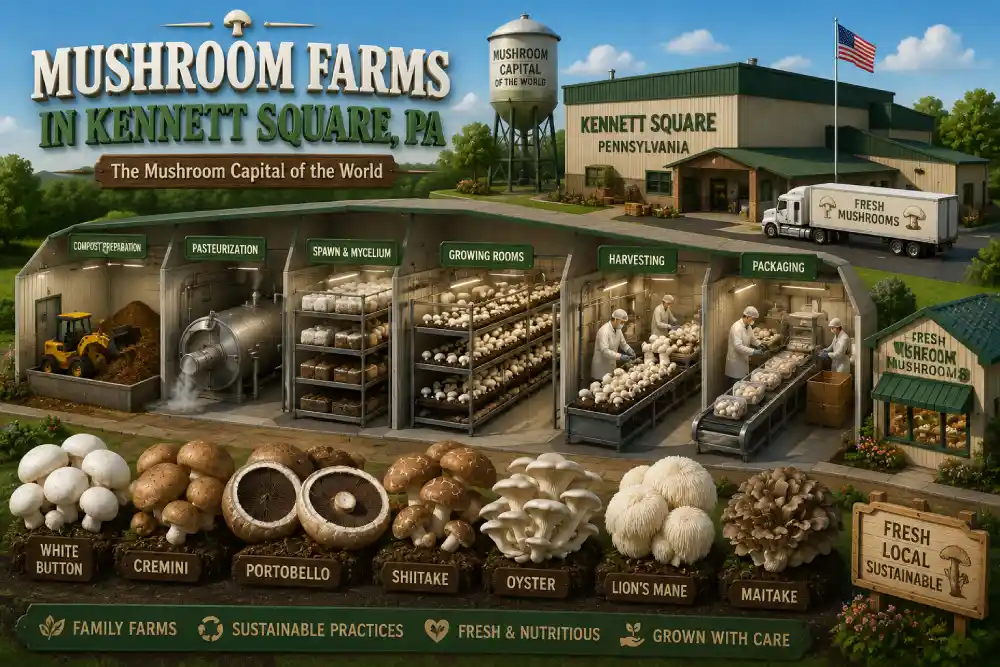
The Commercial Growing Process
The basic production cycle includes:
- Compost preparation
- Pasteurization
- Spawn inoculation
- Mycelium colonization
- Casing application
- Mushroom development
- Harvesting
- Packaging and distribution
Every stage is monitored to maximize quality and food safety.
Compost, Spawn, and Mycelium: The Foundation of Mushroom Farming
Successful mushroom cultivation begins long before mushrooms appear.
Understanding compost, spawn, and mycelium helps explain why Kennett Square has become a global leader in mushroom production.
Mushroom Compost
Unlike green plants, mushrooms do not perform photosynthesis.
Instead, they obtain nutrients from specially prepared compost made from agricultural materials such as:
- Straw
- Hay
- Corn cobs
- Poultry litter
- Gypsum
- Organic matter
The compost is carefully blended and conditioned to create an ideal growing medium.
Pasteurization
Before planting, compost undergoes pasteurization to reduce harmful organisms while preserving beneficial microbes.
This step helps create a healthy environment for mushroom growth.
Spawn
Spawn functions much like seed in traditional farming.
It consists of grain colonized by mushroom mycelium and serves as the starting point for commercial cultivation.
After mixing spawn into compost, the fungal network begins spreading throughout the growing bed.
Mycelium
Mycelium is the underground network of microscopic fungal threads that eventually produces mushrooms.
During colonization, mycelium:
- Breaks down organic matter
- Absorbs nutrients
- Expands through the compost
- Stores energy for fruiting
Healthy mycelium is essential for producing large, consistent mushroom harvests.
Climate-Controlled Growing Rooms
One reason Kennett Square farms are so productive is their use of highly controlled indoor growing environments.
Environmental conditions are adjusted throughout each growth stage to encourage healthy mushroom development.
Temperature Management
Different stages require different temperatures.
Modern facilities use computerized systems to maintain ideal conditions for:
- Spawn run
- Mycelium growth
- Pin formation
- Mushroom expansion
Stable temperatures improve both yield and quality.
Humidity Control
High humidity is essential because mushrooms contain a large percentage of water.
Growing rooms typically maintain elevated humidity levels to prevent drying and encourage proper development.
Humidity management also helps maintain:
- Cap quality
- Stem firmness
- Overall appearance
Air Circulation
Fresh air exchange plays an important role in mushroom production.
Ventilation systems help regulate:
- Carbon dioxide levels
- Oxygen availability
- Moisture distribution
- Air quality
Proper airflow supports uniform growth throughout the cultivation room.
Lighting
Unlike plants, cultivated mushrooms do not require sunlight for photosynthesis.
Commercial farms rely primarily on environmental controls rather than intense lighting, allowing production in enclosed indoor facilities.
Harvesting and Packaging
Although technology supports many aspects of production, mushroom harvesting remains a skilled process that often relies on experienced workers.
Careful handling preserves freshness and extends shelf life.
Hand Harvesting
Many mushrooms are still harvested by hand to prevent damage.
Harvesters carefully select mushrooms based on:
- Size
- Maturity
- Shape
- Quality
Multiple harvests, known as "flushes," can occur from a single growing bed.
Sorting and Grading
After harvest, mushrooms are sorted according to:
- Size
- Appearance
- Variety
- Intended market
This ensures retailers and foodservice customers receive consistent products.
Packaging
Fresh mushrooms are packaged quickly to preserve quality.
Common packaging formats include:
- Retail trays
- Bulk cartons
- Foodservice containers
- Specialty packaging
Modern facilities use efficient packaging systems while maintaining strict hygiene standards.
Cold Chain Distribution
After packaging, mushrooms are refrigerated and transported through a controlled cold chain.
Maintaining low temperatures helps preserve:
- Freshness
- Texture
- Flavor
- Shelf life
Efficient logistics allow mushrooms grown in Kennett Square to reach supermarkets and restaurants across North America within a short period of time.
Food Safety and Quality Control
Food safety is a top priority throughout the mushroom industry.
Commercial farms follow rigorous standards designed to protect consumers and maintain product quality.
Quality Assurance Measures
Modern mushroom operations emphasize:
- Sanitary growing environments
- Employee hygiene
- Equipment cleaning
- Product traceability
- Routine inspections
These practices help ensure consistent, high-quality production.
Sustainability and Resource Efficiency
Many Kennett Square mushroom farms also focus on environmental stewardship by:
- Recycling spent mushroom compost
- Reusing agricultural by-products
- Conserving water
- Improving energy efficiency
- Supporting circular agriculture
Spent mushroom substrate is frequently repurposed as a soil amendment for landscaping and farming, reducing waste while creating additional value.
The combination of advanced cultivation technology and sustainable practices has helped establish Kennett Square as a global leader in commercial mushroom production.
Sustainability Practices at Mushroom Farms
Modern mushroom farms in Kennett Square are increasingly focused on sustainability and efficient resource management. Because mushrooms are grown indoors using agricultural by-products, the industry has become a model for circular agriculture.
Many farms continuously improve their environmental practices while maintaining high production standards.
Recycling Agricultural Materials
Mushroom compost is produced using renewable organic materials such as:
- Straw
- Hay
- Corn cobs
- Poultry manure
- Gypsum
Instead of becoming waste, these materials are transformed into nutrient-rich growing media.
Reusing Spent Mushroom Compost
After harvesting is complete, the compost still contains valuable organic matter.
Spent mushroom substrate is commonly reused for:
- Landscaping
- Garden soil improvement
- Crop production
- Erosion control
- Greenhouse growing media
This recycling process reduces waste while supporting sustainable agriculture.
Water and Energy Conservation
Many mushroom farms invest in technologies that improve resource efficiency, including:
- Water recycling systems
- High-efficiency ventilation
- Climate automation
- Energy-saving equipment
- Precision environmental controls
These innovations help reduce operating costs while minimizing environmental impact.
Visiting Mushroom Farms in Kennett Square
Kennett Square attracts thousands of visitors every year who want to learn about mushroom cultivation and experience the region's agricultural heritage.
While many commercial facilities are not open for routine public access due to food safety requirements, visitors can still enjoy mushroom-related attractions throughout the area.
Educational Experiences
Depending on the season, visitors may find:
- Agricultural education programs
- Farmers markets
- Culinary demonstrations
- Mushroom cooking classes
- Local food events
These experiences showcase the importance of mushrooms in the region's culture and economy.
Local Restaurants and Specialty Markets
Many restaurants and specialty food shops in Kennett Square feature locally grown mushrooms in their menus.
Popular dishes include:
- Stuffed portobellos
- Wild mushroom risotto
- Creamy mushroom soup
- Mushroom pizza
- Gourmet burgers
- Pasta with mixed mushrooms
Sampling fresh local mushrooms is one of the highlights of visiting the area.
The Kennett Square Mushroom Festival
One of the region's most celebrated annual events is the Kennett Square Mushroom Festival.
The festival celebrates the area's rich agricultural history while bringing together mushroom growers, chefs, artisans, and visitors from across the country.
Festival Highlights
Visitors can enjoy:
- Cooking demonstrations
- Mushroom-growing exhibits
- Culinary competitions
- Family activities
- Live entertainment
- Local vendors
- Specialty food products
The event has become one of Pennsylvania's best-known agricultural festivals.
Economic Impact of the Mushroom Industry
Mushroom farming is one of the most important agricultural industries in Chester County and plays a significant role in Pennsylvania's economy.
The industry supports thousands of jobs across:
- Farming
- Processing
- Packaging
- Transportation
- Equipment manufacturing
- Food distribution
- Retail
Its economic influence extends well beyond mushroom production itself.
Innovation and Research
Kennett Square continues to lead advancements in:
- Controlled environment agriculture
- Sustainable growing methods
- Specialty mushroom cultivation
- Food safety systems
- Compost technology
Ongoing innovation helps local farms remain competitive while meeting changing consumer demand.
Why Consumer Demand Continues to Grow?
Interest in mushrooms has expanded significantly due to their culinary versatility and nutritional profile.
Consumers increasingly seek:
- Gourmet mushroom varieties
- Plant-based foods
- Functional ingredients
- Sustainable products
- Locally grown produce
As a result, farms in Kennett Square continue to diversify beyond traditional white button mushrooms into premium specialty varieties.
Conclusion
Kennett Square has earned its title as the Mushroom Capital of the World through more than a century of innovation, hard work, and agricultural expertise. Its mushroom farms supply millions of fresh mushrooms each year while advancing sustainable farming practices and supporting the regional economy.
Whether you're interested in commercial agriculture, specialty mushrooms, or local food culture, Kennett Square offers a fascinating look into one of America's most successful farming industries. From compost preparation and climate-controlled growing rooms to harvesting, packaging, and culinary traditions, the region continues to set the standard for mushroom production.
- Poisonous Mushrooms in Iowa
- Edible Mushrooms in Michigan
- Poisonous Mushrooms in Minnesota
- Edible Mushrooms in PA
- Edible Mushrooms in Illinois
Frequently Asked Questions
Why is Kennett Square called the Mushroom Capital of the World?
Kennett Square produces a significant share of the fresh mushrooms grown in the United States and has been a center of commercial mushroom cultivation for more than a century.
What types of mushrooms are grown in Kennett Square?
The region grows White Button, Cremini, Portobello, Shiitake, Oyster, Lion's Mane, Maitake, Beech, and other specialty mushrooms.
How are mushrooms grown commercially?
Commercial mushrooms are cultivated indoors using compost, mushroom spawn, climate-controlled growing rooms, and carefully managed humidity, temperature, and airflow.
What is mushroom spawn?
Spawn is grain that has been colonized by mushroom mycelium and is used to introduce fungal growth into prepared compost.
What is mycelium?
Mycelium is the underground network of fungal threads that absorbs nutrients and eventually produces mushrooms.
Are mushrooms grown in soil?
No. Commercial mushrooms are typically grown in specially prepared compost made from agricultural by-products rather than ordinary garden soil.
What happens to spent mushroom compost?
Spent mushroom compost is commonly recycled for landscaping, gardening, farming, and soil improvement projects.
Can you visit mushroom farms in Kennett Square?
Some educational events and seasonal activities are available, but many commercial growing facilities have limited public access due to food safety and biosecurity requirements.
When is the Kennett Square Mushroom Festival held?
The festival is traditionally held each fall and celebrates the region's mushroom heritage with food, exhibits, cooking demonstrations, and entertainment.
Why are mushrooms important to Pennsylvania's economy?
The mushroom industry supports thousands of jobs and contributes significantly to agriculture, food production, transportation, retail, and tourism throughout the region.
Sign in to leave a comment and join the discussion.
 Species Guide
Alaska has many edible mushrooms, including morels, king boletes, golden chanterelles, hedgehogs, oyster mushrooms and bear’s head mushrooms. Most appear...
 Species Guide
Wisconsin is home to edible mushrooms such as morels, chanterelles, oyster mushrooms, hen of the woods, chicken of the woods and giant puffballs. Different...
 Species Guide
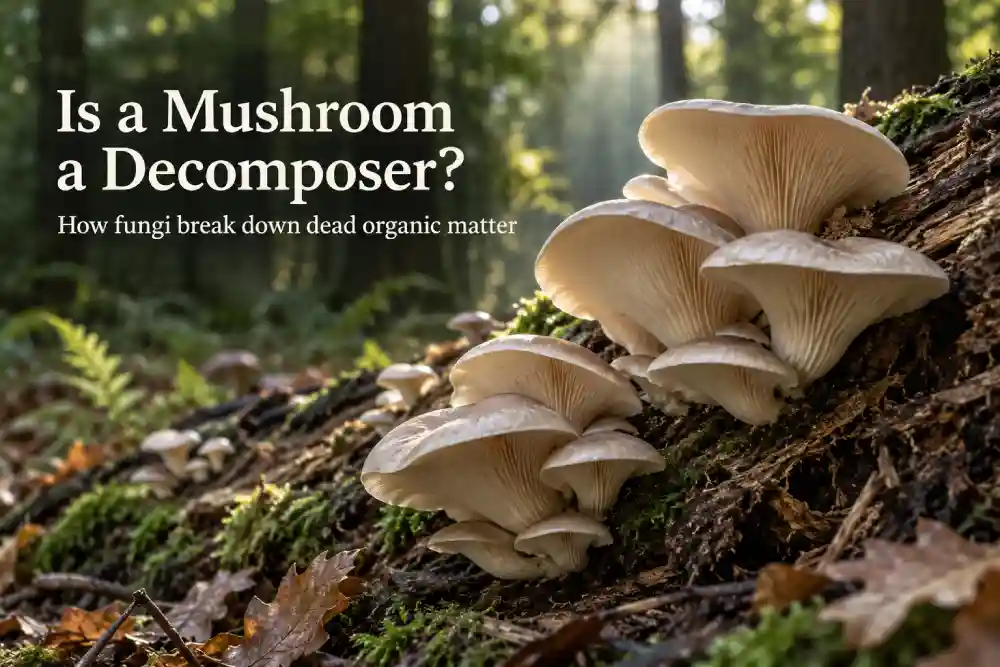
Is a Mushroom a Decomposer? Yes, many mushroom-forming fungi are decomposers. They break down dead wood, fallen leaves and other organic material, helping...