Poisonous Mushrooms in Minnesota: Identification, Safety, and Toxic Species Guide

Nathan Cole
Mycologist · Author · Fungi Expert
Updated
Jun 1, 2026
Minnesota is home to hundreds of wild mushroom species, including several highly poisonous fungi that grow in forests, parks, lawns, and woodland ecosystems throughout the state. Dangerous mushrooms such as Amanita phalloides, Amanita bisporigera, and Galerina marginata can closely resemble edible mushrooms, making accurate identification extremely important. Learning how to identify toxic mushrooms by cap shape, gill structure, spore print color, habitat, stem features, and seasonal growth patterns can help reduce dangerous misidentification risks while exploring Minnesota forests.
In Mycology, Minnesota is considered a highly active fungal region because its humid summers, hardwood forests, wetlands, and northern woodland ecosystems create ideal environments for diverse fungi to thrive. While many mushrooms are harmless or edible, others contain toxins capable of causing severe illness, liver failure, kidney damage, or death if consumed.
Why Minnesota Has So Many Wild Mushrooms?
Minnesota’s climate and forest ecosystems support one of the richest fungal environments in the Midwest. Moisture, seasonal rainfall, organic matter, and dense forests all contribute to rapid mushroom growth throughout spring, summer, and fall.
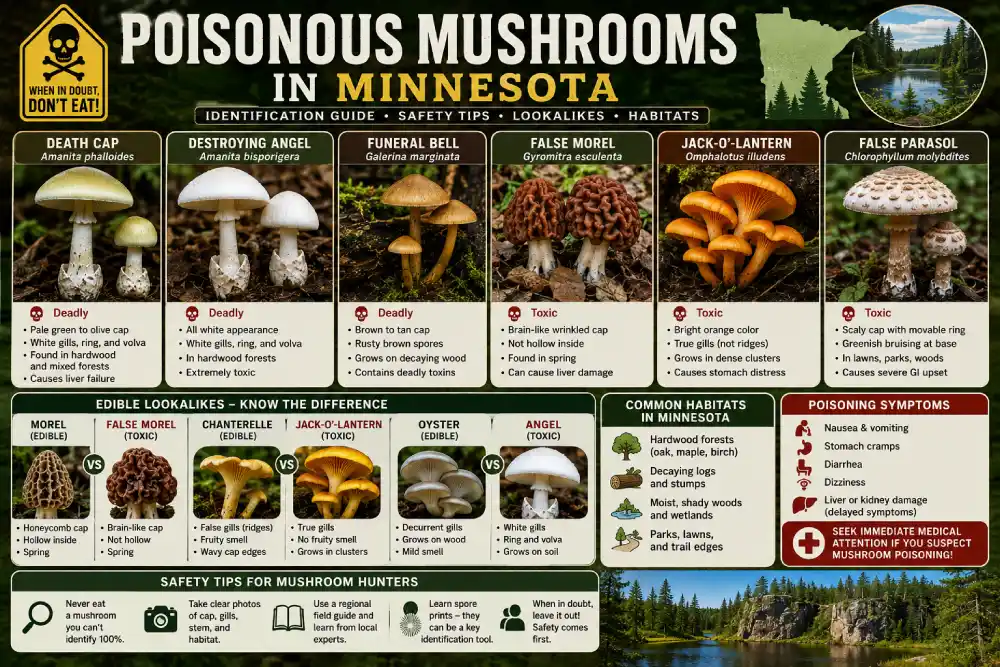
The state’s woodland diversity creates ideal conditions for both edible and poisonous fungi.
Minnesota Forest Ecosystems
Large portions of Minnesota contain:
- Hardwood forests
- Conifer woodlands
- Wetlands
- Moss-covered forest floors
- Decaying organic matter
These habitats provide nutrients and moisture that fungi need to grow and reproduce.
Moisture and Seasonal Conditions
Mushrooms depend heavily on environmental moisture.
Minnesota commonly experiences:
- Humid summers
- Rainfall-rich growing seasons
- Damp woodland soil
- Cool shaded forests
After heavy rain, mushrooms may emerge rapidly across trails, lawns, tree roots, and decaying logs.
Forest Biodiversity Supports Fungal Growth
Regions such as Superior National Forest and Chippewa National Forest contain extensive fungal biodiversity due to:
- Mature tree populations
- Dense leaf litter
- Rotting wood
- Stable moisture conditions
These ecosystems support thousands of fungal organisms beneath the soil surface.
Why Some Mushrooms Become Toxic?
Many poisonous mushrooms evolved chemical defenses that discourage animals from consuming them.
Some fungal toxins:
- Attack the liver
- Damage kidneys
- Affect the nervous system
- Trigger severe digestive illness
Toxicity levels vary dramatically between species, which is why visual identification alone can sometimes be misleading.
Most Dangerous Poisonous Mushrooms in Minnesota
Several deadly mushroom species grow naturally throughout Minnesota forests and grassy areas. Some toxic fungi closely resemble edible mushrooms, making careful identification essential for anyone exploring wild mushrooms.
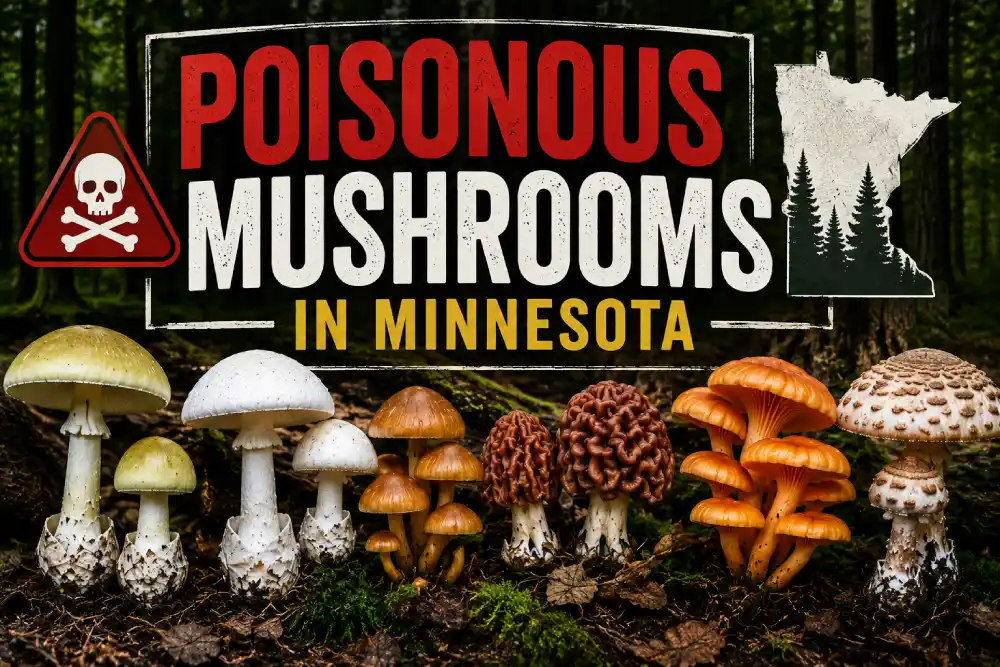
Amanita phalloides
The death cap is considered one of the deadliest mushrooms in the world.
Identification Features
- Pale greenish or olive cap
- White gills
- White spore print
- Ring around the stem
- Cup-like volva at the base
Why It Is Dangerous?
Death cap mushrooms contain amatoxins that can cause:
- Liver failure
- Organ damage
- Delayed poisoning symptoms
- Fatal outcomes without treatment
Even small amounts may be deadly.
Amanita bisporigera
Destroying angels are highly toxic white mushrooms commonly found in woodland environments.
Identification Features
- Completely white appearance
- Smooth cap
- White gills
- Thin stem with ring
- Bulbous base with volva
Because they appear clean and harmless, beginners sometimes mistake them for edible species.
Galerina marginata
Galerina species often grow on rotting wood and are frequently confused with edible woodland mushrooms.
Identification Features
- Brown cap
- Rusty brown spores
- Small clustered growth
- Wood-growing habitat
Important Warning
This mushroom also contains dangerous amatoxins similar to death caps.
Gyromitra esculenta
False morels are commonly confused with edible morels during spring mushroom season.
Key Differences
| True Morels | False Morels |
|---|---|
| Hollow inside | Cotton-like interior |
| Honeycomb cap | Brain-like folds |
| Uniform structure | Irregular wrinkled cap |
False morels may contain toxic compounds that affect the nervous system and liver.
How to Identify Poisonous Mushrooms?
Correct mushroom identification requires studying multiple characteristics together rather than depending on one visual clue. In mushroom identification, no single feature guarantees whether a mushroom is edible or toxic.
Examine the Cap Shape and Texture
Poisonous mushrooms may develop:
- Smooth caps
- Sticky surfaces
- Scaly textures
- Bell-shaped forms
- Convex or flat caps
Rainfall and age often change the cap appearance significantly.
Look at the Gills Carefully
Gill color and attachment patterns provide important clues.
Warning signs may include:
- Bright white gills
- Crowded blade-like structures
- Dark staining
- Fragile thin gills
Many deadly Amanita species have white gills beneath the cap.
Check for Stem Rings and Volvas
Some poisonous mushrooms possess:
- Stem rings
- Bulbous bases
- Cup-like volvas
These features are especially important when identifying Amanita mushrooms.
Use Spore Print Testing
Spore prints help separate visually similar species.
Common spore colors include:
- White
- Brown
- Black
- Pink
- Rusty brown
Spore color remains one of the most reliable identification tools in Mycology.
Study Habitat and Tree Associations
Certain poisonous mushrooms strongly associate with:
- Hardwood forests
- Conifer roots
- Dead logs
- Mossy woodland floors
Habitat helps narrow possibilities but should never be used alone for identification.
Edible Mushrooms vs Poisonous Lookalikes
Many dangerous mushrooms resemble edible species closely enough to confuse beginner foragers. Learning these lookalikes is one of the most important safety skills in mushroom identification.
Morels vs False Morels
Gyromitra esculenta often appears during the same season as edible morels.
Edible Morels
- Hollow from top to bottom
- Honeycomb pit structure
- Uniform interior
False Morels
- Folded wrinkled cap
- Cotton-like tissue inside
- Irregular distorted appearance
Chanterelles vs Jack-o’-Lantern Mushrooms
Omphalotus illudens is commonly mistaken for chanterelles because of its orange coloration.
Chanterelles
- Thick false gills
- Fruity smell
- Wavy cap edges
Jack-o’-Lantern Mushrooms
- Sharp true gills
- Dense clustered growth
- Bright orange coloration
Jack-o’-lantern mushrooms can cause severe gastrointestinal illness.
Oyster Mushrooms vs Toxic Woodland Species
Certain toxic wood-growing fungi may resemble Pleurotus ostreatus from a distance.
Important identification features include:
- Gill attachment
- Spore color
- Growth pattern
- Wood type
- Odor and texture
Why Misidentification Happens?
Common causes include:
- Mushrooms changing appearance with age
- Rain altering colors
- Similar habitats
- Beginners relying on one feature
- Poor-quality identification photos
Accurate identification requires patience, experience, and examining multiple fungal characteristics together.
Mushroom Poisoning Symptoms and Warning Signs
Symptoms of Mushroom Poisoning vary depending on the species involved and the type of toxin present. Some reactions appear quickly, while others may take several hours before symptoms begin.
Delayed symptoms are especially dangerous because serious organ damage may already be occurring internally before a person realizes they have consumed a toxic mushroom.
Early Symptoms of Mushroom Poisoning
Common early warning signs may include:
- Nausea
- Vomiting
- Stomach cramps
- Diarrhea
- Dizziness
- Sweating
These symptoms can develop within a few hours after ingestion depending on the toxin type.
Delayed Toxic Reactions
Some deadly mushrooms, especially Amanita species, may not cause symptoms immediately.
Delayed poisoning may involve:
- Liver damage
- Kidney failure
- Confusion
- Severe dehydration
- Organ failure
Because symptoms can temporarily improve before worsening again, delayed toxic reactions are particularly dangerous.
When to Seek Emergency Help?
Immediate medical attention is important if someone:
- Eats an unidentified mushroom
- Develops severe digestive symptoms
- Experiences confusion or weakness
- Shows signs of dehydration
- Has persistent vomiting or diarrhea
Keeping mushroom samples or photographs may help medical professionals identify the species involved.
Where Poisonous Mushrooms Grow in Minnesota?
Poisonous mushrooms can grow throughout Minnesota in forests, parks, lawns, wetlands, and decaying woodland environments. Some toxic species prefer hardwood forests, while others thrive near rotting wood, grassy areas, or tree roots.
Understanding habitat patterns is an important part of mushroom identification because many fungi strongly associate with specific ecosystems.
Hardwood Forests
Many dangerous mushrooms grow in hardwood woodland environments containing:
- Oak trees
- Maple trees
- Birch forests
- Aspen groves
- Beech woodlands
Species such as Amanita phalloides and Amanita bisporigera often form underground relationships with tree roots through Mycorrhiza.
Decaying Logs and Stumps
Wood-decaying toxic mushrooms commonly appear on:
- Rotting logs
- Dead stumps
- Fallen branches
- Damp bark
- Moss-covered wood
Galerina marginata is especially associated with decaying wood habitats.
Wet Woodland Areas
Minnesota’s humid forests and wetlands support high fungal diversity.
Poisonous mushrooms often appear:
- Near streams
- In swampy forests
- Along shaded trails
- In mossy soil
- After heavy rain
Moisture-rich environments dramatically increase mushroom fruiting activity.
Parks and Wilderness Regions
Toxic fungi can also grow in:
- Campgrounds
- Urban parks
- Residential lawns
- Hiking trails
- Wilderness regions like Boundary Waters Canoe Area Wilderness
Because dangerous mushrooms may grow close to edible species, careful identification remains essential in all environments.
Mushroom Hunting Safety Tips
Safe mushroom foraging requires patience, education, and caution. Even experienced foragers avoid eating mushrooms unless they are completely confident in the identification.
In Mycology, responsible identification always involves examining multiple characteristics together.
Never Eat an Unidentified Mushroom
The most important safety rule is simple:
- Never taste unknown mushrooms
- Never rely on internet photos alone
- Never assume mushrooms are safe because animals eat them
Some deadly species closely resemble edible fungi.
Learn Spore Print Techniques
Spore Print analysis helps distinguish toxic species from harmless lookalikes.
Spore prints can reveal:
- White spores
- Rust-brown spores
- Black spores
- Pink spores
- Purple-brown spores
Spore color often remains more reliable than surface appearance alone.
Photograph Mushrooms Carefully
Good identification photos should include:
- Top of the cap
- Gills or pores underneath
- Stem base
- Nearby trees
- Habitat surroundings
The stem base is especially important because deadly Amanita mushrooms often have a hidden volva underground.
Use Regional Minnesota Field Guides
Regional guides help identify:
- Local species
- Seasonal growth patterns
- Toxic lookalikes
- Forest habitats
- Spore print colors
Minnesota-specific resources are more accurate than general global mushroom guides.
Join Local Mycology Groups
Local mushroom communities can help beginners:
- Learn fungal anatomy
- Compare species safely
- Understand seasonal growth
- Practice field identification
Experienced foragers often learn identification skills gradually over many years.
Seasonal Poisonous Mushrooms in Minnesota
Different toxic mushrooms appear during different seasons depending on rainfall, temperature, and humidity. Seasonal awareness helps foragers recognize which dangerous species are most active at certain times of the year.
Spring Poisonous Mushrooms
Spring conditions support:
- Gyromitra esculenta
- Early Amanita species
- Woodland cup fungi
False morels are especially dangerous during spring because they resemble edible morels.
Summer Toxic Mushrooms
Warm humid weather creates ideal fungal conditions.
Common summer toxic mushrooms include:
- Chlorophyllum molybdites
- Jack-o’-lantern mushrooms
- Poisonous lawn fungi
Heavy rainfall often triggers rapid mushroom growth across forests and grassy areas.
Fall Mushroom Risks
Autumn is one of the busiest mushroom seasons in Minnesota forests.
Dangerous fall mushrooms include:
- Amanita phalloides
- Cortinarius rubellus
- Galerina species
Cool temperatures and leaf litter create ideal fruiting conditions.
Year-Round Toxic Fungi
Some wood-decaying fungi remain visible throughout much of the year on:
- Dead trees
- Stumps
- Fallen logs
- Moist bark
Even during colder months, toxic mushrooms may still persist in woodland environments.
Frequently Asked Questions About Poisonous Mushrooms in Minnesota
What is the deadliest mushroom in Minnesota?
Amanita phalloides is widely considered the deadliest mushroom found in Minnesota because it contains powerful amatoxins capable of causing fatal liver failure.
Are white mushrooms poisonous?
Some white mushrooms are edible, but others are highly toxic. Dangerous white mushrooms include Amanita bisporigera, which can be deadly if consumed.
Color alone cannot determine whether a mushroom is safe.
How can you tell if a mushroom is toxic?
There is no simple visual rule for identifying poisonous mushrooms.
Experts examine:
- Spore print color
- Gill structure
- Stem features
- Volvas and rings
- Habitat
- Bruising reactions
- Overall morphology
Safe identification requires studying multiple characteristics together.
What poisonous mushrooms look edible?
Several toxic mushrooms resemble edible species.
Examples include:
| Poisonous Mushroom | Common Edible Lookalike |
|---|---|
| False morel | True morel |
| Jack-o’-lantern | Chanterelle |
| Destroying angel | Young edible white mushrooms |
| Galerina | Honey mushrooms |
This is why accurate identification is critical before consuming any wild fungi.
What should you do after eating a wild mushroom?
If someone consumes an unidentified mushroom:
- Seek medical attention immediately
- Save mushroom samples if possible
- Photograph the mushroom
- Do not wait for symptoms to worsen
Rapid medical evaluation can be lifesaving in severe poisoning cases.
Final Thoughts
Minnesota contains an incredible diversity of fungi ranging from harmless woodland mushrooms to highly toxic species capable of causing severe illness or death. Forest ecosystems across the state provide ideal conditions for poisonous mushrooms to thrive during spring, summer, and fall.
Understanding mushroom identification involves much more than color alone. Features such as spore prints, gill structure, stem anatomy, habitat, and seasonal growth patterns all help distinguish dangerous fungi from edible species. In Mycology, responsible identification always relies on observing multiple characteristics together rather than assumptions based on appearance.
Whether exploring hiking trails, studying woodland fungi, or learning beginner mushroom identification, careful observation and safety awareness remain essential when encountering wild mushrooms in Minnesota forests.
Sign in to leave a comment and join the discussion.
 Species Guide
Alaska has many edible mushrooms, including morels, king boletes, golden chanterelles, hedgehogs, oyster mushrooms and bear’s head mushrooms. Most appear...
 Species Guide
Wisconsin is home to edible mushrooms such as morels, chanterelles, oyster mushrooms, hen of the woods, chicken of the woods and giant puffballs. Different...
 Species Guide
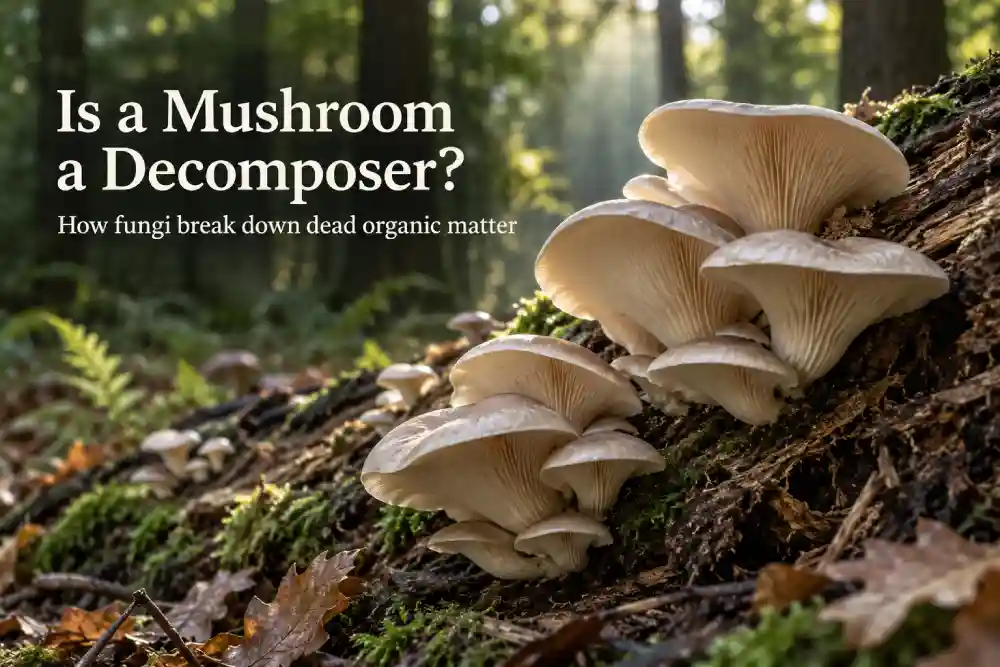
Is a Mushroom a Decomposer? Yes, many mushroom-forming fungi are decomposers. They break down dead wood, fallen leaves and other organic material, helping...