Edible Mushrooms in Michigan: Complete Identification and Foraging Guide

Nathan Cole
Mycologist · Author · Fungi Expert
Updated
May 29, 2026
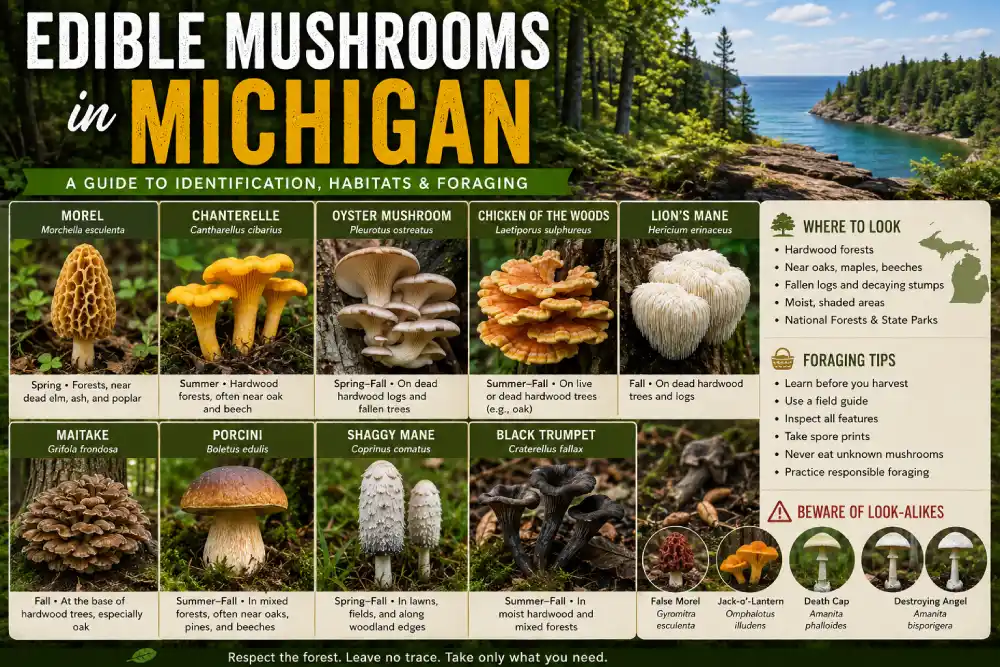
If you're wondering what edible mushrooms grow in Michigan, the state is home to some of North America's most sought-after wild fungi. Popular edible species include the Morchella esculenta, Cantharellus cibarius, Pleurotus ostreatus, and Grifola frondosa. Thanks to its hardwood forests, Great Lakes climate, and diverse ecosystems, Michigan offers excellent mushroom foraging opportunities throughout spring, summer, and fall.
However, accurate identification is essential because several poisonous mushrooms closely resemble edible species.
Wild mushroom hunting has become increasingly popular across Michigan, especially in forested regions where rich soil, moisture, and mature trees support diverse fungal growth. Understanding identification features, seasonal patterns, and habitat preferences can help beginners and experienced foragers safely enjoy Michigan's mushroom diversity.
Why Michigan Is a Mushroom Hunter's Paradise?
Few states offer the variety of mushroom habitats found in Michigan. Surrounded by the Great Lakes and covered by millions of acres of forest, Michigan provides ideal growing conditions for hundreds of fungal species.
Great Lakes Climate Supports Mushroom Growth
The Great Lakes influence local weather patterns by providing:
- Consistent moisture
- Moderate temperatures
- Seasonal rainfall
- Humid woodland environments
These conditions encourage mushrooms to fruit throughout much of the year.
Diverse Forest Ecosystems
Michigan contains extensive:
- Oak forests
- Maple woodlands
- Beech forests
- Birch groves
- Mixed hardwood ecosystems
Many edible mushrooms develop close relationships with tree roots through Mycorrhiza, helping both trees and fungi thrive.
Upper Peninsula Mushroom Habitats
The Upper Peninsula is especially known for its rich fungal diversity due to:
- Dense forests
- Cooler temperatures
- Abundant rainfall
- Less urban development
Many experienced foragers consider it one of the best mushroom-hunting regions in the Midwest.
Top Edible Mushrooms in Michigan
| Mushroom | Best Season | Common Habitat |
|---|---|---|
| Morel | Spring | Hardwood forests |
| Chanterelle | Summer | Oak and beech forests |
| Oyster Mushroom | Spring & Fall | Dead hardwood logs |
| Chicken of the Woods | Summer & Fall | Hardwood trees |
| Lion's Mane | Fall | Dead hardwood trees |
| Maitake | Fall | Oak tree bases |
| Porcini | Summer & Fall | Mixed forests |
| Shaggy Mane | Fall | Lawns and grasslands |
| Black Trumpet | Summer & Fall | Mossy hardwood forests |
Top Edible Mushrooms in Michigan
Michigan forests support numerous edible fungi that are prized for their flavor, texture, and culinary versatility.
Morchella esculenta (Morel Mushroom)
Morels are often considered the most sought-after wild mushrooms in Michigan.
Identification Features
- Honeycomb-like cap
- Hollow interior
- Cream to yellow coloration
- Distinctive ridged surface
Typical Habitat
Morels commonly grow near:
- Dead elm trees
- Ash trees
- Tulip poplars
- Disturbed woodland soil
Spring is the peak season for morel hunting throughout Michigan.
Cantharellus cibarius (Chanterelle Mushroom)
Chanterelles are highly valued for their fruity aroma and rich flavor.
Identification Features
- Golden-yellow coloration
- Wavy cap margins
- False gills instead of true gills
- Firm flesh
Common Habitat
Chanterelles often grow beneath:
- Oak trees
- Beech trees
- Mixed hardwood forests
Summer rainfall frequently triggers large flushes.
Pleurotus ostreatus (Oyster Mushroom)
Oyster mushrooms are among the easiest edible mushrooms for beginners to recognize.
Identification Features
- Fan-shaped caps
- White decurrent gills
- Clustered growth pattern
- Soft texture
Habitat
Typically found on:
- Dead hardwood logs
- Fallen trees
- Decaying stumps
They commonly appear during spring and fall.
Michigan Mushroom Identification Guide
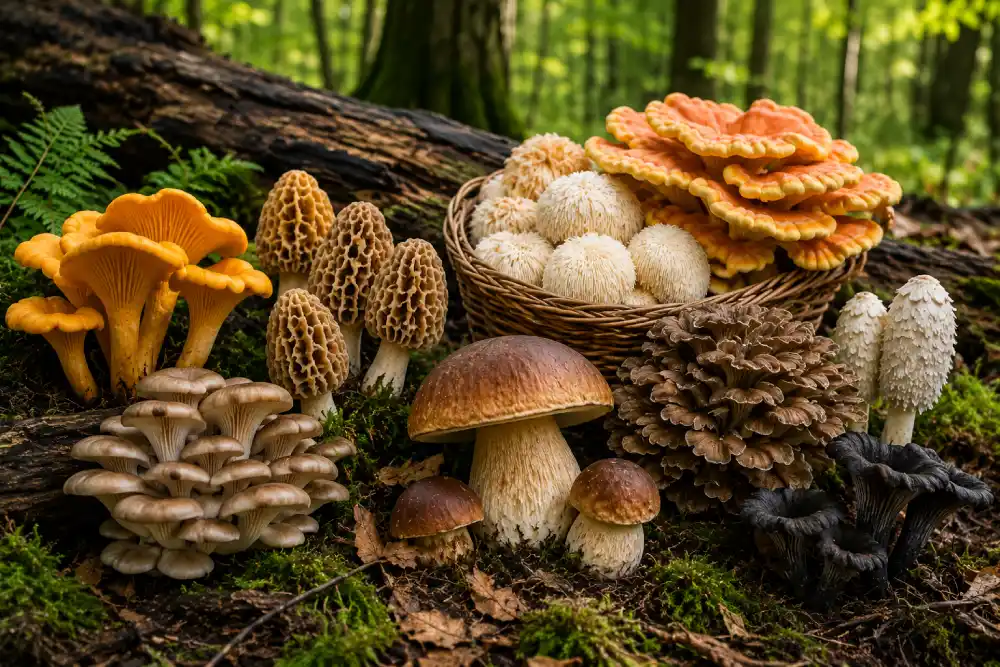
Successful mushroom foraging depends on accurate identification. In Mycology, experts use a combination of structural features rather than relying on color alone.
Cap Shapes and Colors
Caps vary dramatically between species.
Common shapes include:
- Convex
- Flat
- Funnel-shaped
- Bell-shaped
- Wavy
Cap color may change depending on age, weather, and moisture levels.
Gills, Pores, and Teeth
Different mushrooms release spores using different structures.
| Structure Type | Description |
|---|---|
| Gills | Thin blade-like structures beneath the cap |
| Pores | Sponge-like surfaces with tiny openings |
| Teeth | Hanging spines or icicle-like projections |
For example, Hericium erinaceus uses tooth-like structures instead of gills.
Stem Characteristics
Stem observations may include:
- Thickness
- Color
- Texture
- Presence of rings
- Bulbous bases
These details often help separate edible species from toxic lookalikes.
Why Spore Prints Matter?
A Spore Print can reveal important identification clues.
Spore colors may be:
- White
- Brown
- Black
- Pink
- Purple-brown
Spore prints are among the most reliable identification tools available.
Edible vs Poisonous Mushrooms in Michigan
One of the most important aspects of mushroom foraging is learning how edible species differ from their dangerous lookalikes.
Morels vs False Morels
The edible Morchella esculenta is frequently confused with Gyromitra esculenta.
Key Differences
| True Morel | False Morel |
| Hollow inside | Cotton-like interior |
| Honeycomb cap | Brain-like folds |
| Uniform structure | Irregular shape |
Chanterelles vs Jack-o'-Lantern Mushrooms
Omphalotus illudens can resemble chanterelles from a distance.
Chanterelles
- False gills
- Fruity aroma
- Wavy cap edges
Jack-o'-Lantern Mushrooms
- Sharp true gills
- Bright orange coloration
- Dense clustered growth
Jack-o'-lantern mushrooms are poisonous and should never be consumed.
Death Cap Mushrooms
Amanita phalloides is among the most dangerous mushrooms that may occur in Michigan.
Important warning signs include:
- White gills
- Stem ring
- Bulbous base
- White spore print
Even small amounts can cause severe poisoning.
Understanding these differences is critical for safe mushroom identification and responsible foraging.
Sign in to leave a comment and join the discussion.
 Species Guide
Alaska has many edible mushrooms, including morels, king boletes, golden chanterelles, hedgehogs, oyster mushrooms and bear’s head mushrooms. Most appear...
 Species Guide
Wisconsin is home to edible mushrooms such as morels, chanterelles, oyster mushrooms, hen of the woods, chicken of the woods and giant puffballs. Different...
 Species Guide
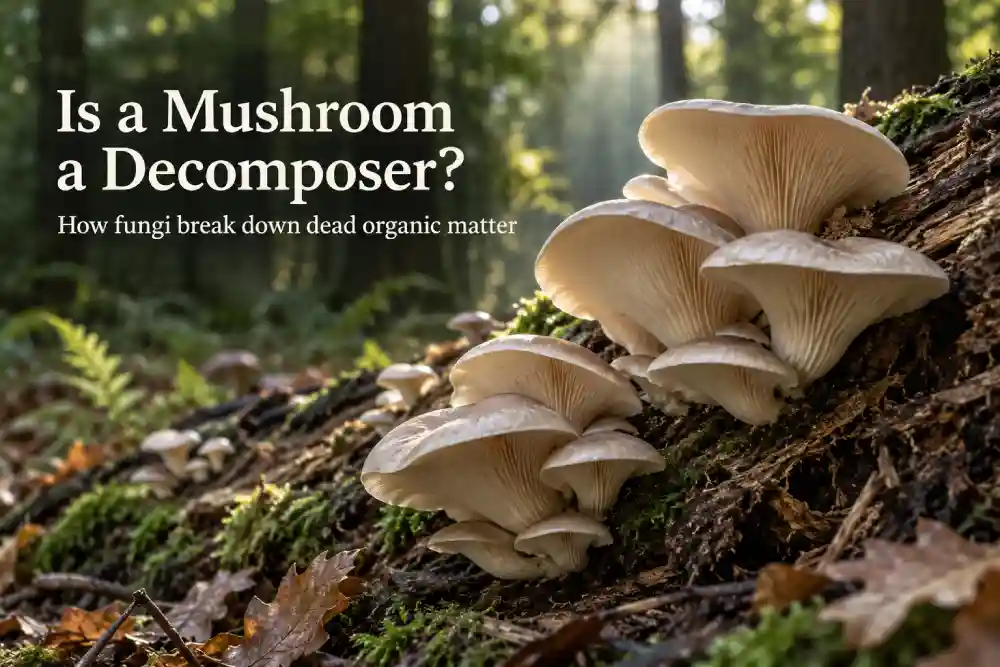
Is a Mushroom a Decomposer? Yes, many mushroom-forming fungi are decomposers. They break down dead wood, fallen leaves and other organic material, helping...