5 Best Lion's Mane Mushroom Grow Kits (November 2026)
— views
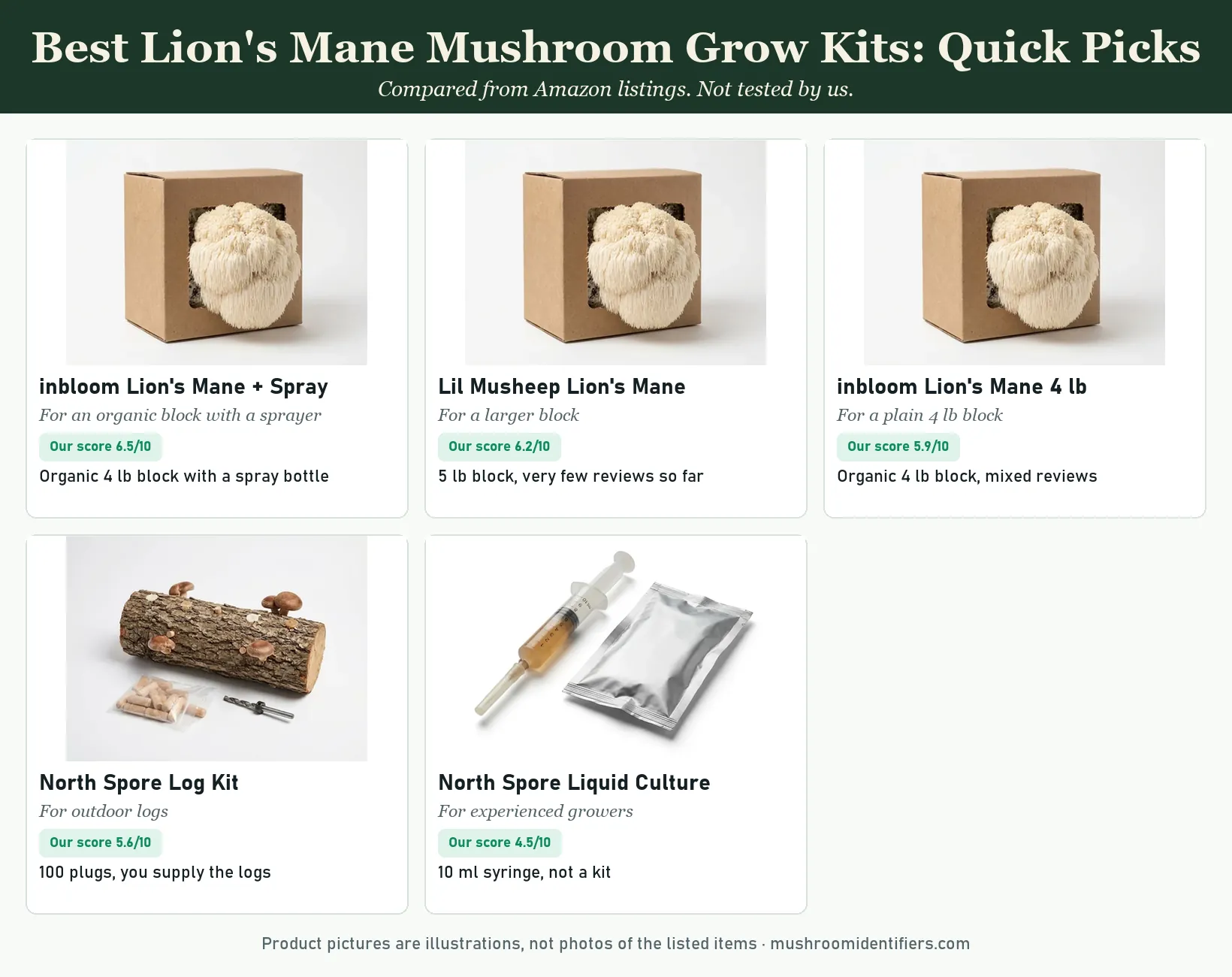
The best lion's mane mushroom grow kits include the inbloom Organic Lion's Mane Mushroom Growing Kit with Spray, 4 lb for an organic block with a sprayer, the Lil Musheep Lion's Mane Mushroom Grow Kit, 5 lb for a larger block, and the inbloom Organic 4 lb Lion's Mane Mushroom Growing Kit for a plain 4 lb block.
The best lion's mane mushroom grow kit for most people is the inbloom Organic Lion's Mane Mushroom Growing Kit with Spray, 4 lb, which is organic, weighs 4 lb and includes a spray bottle, according to the listing title. The title also says it is made in the USA. The listing facts used here give no timing or yield figure for any of the five products.
Choose by format first. A block suits an indoor grower who wants mushrooms within weeks. A log suits a patient gardener, and liquid culture suits someone who already works with sterile substrate. Our mushroom grow kit comparison covers other species if you are still deciding.
Lion's mane may take longer than an oyster block. UF/IFAS Gardening Solutions says an oyster kit can be ready in about a week to 10 days, and our oyster mushroom grow kit guide covers that route.
How We Chose Lion's Mane Mushroom Grow Kits
We compared current Amazon listings against university extension guidance and did not test these products. Each product then received a score out of 10, based on three weighted factors.
- Beginner ease, 40%: how forgiving the format is, per extension guidance.
- Review depth, 30%: how many buyers have reviewed the listing.
- Listing clarity, 30%: whether the listing states what you get and what to expect.
A score compares listings. It is not a lab result or a yield guarantee. Facts about a product come from its listing, so treat them as the seller's claims. Growing facts come from the university and peer-reviewed sources linked through this page.
| Product | Best for | Type | Our score |
|---|---|---|---|
| inbloom Organic Lion's Mane Mushroom Growing Kit with Spray, 4 lb | An organic block with a sprayer | Indoor block | 6.5/10 |
| Lil Musheep Lion's Mane Mushroom Grow Kit, 5 lb | A larger block | Indoor block | 6.2/10 |
| inbloom Organic 4 lb Lion's Mane Mushroom Growing Kit | A plain 4 lb block | Indoor block | 5.9/10 |
| North Spore Organic Lion's Mane Outdoor Mushroom Grow Kit, 100 plugs | Outdoor logs | Log plug kit | 5.6/10 |
| North Spore Organic Lion's Mane Liquid Culture Syringe, 10 ml | Experienced growers | Liquid culture | 4.5/10 |
The Best Lion's Mane Mushroom Grow Kits for Different Needs
inbloom Organic Lion's Mane Mushroom Growing Kit with Spray, 4 lb: Best for an organic block with a sprayer
Our score: 6.5/10
- Organic, according to the listing title.
- A 4 lb kit.
- A spray bottle is included, according to the listing title.
- Made in the USA, according to the listing title.
This kit suits a home cook who wants to try lion's mane and does not own a spray bottle. Utah State University Extension lists lion's mane among five mushroom species that are easy to grow at home.
Pros
- The spray bottle comes with the kit, according to the listing title.
- It has the highest score of these five listings.
- Utah State names lion's mane as an easy species for home growers.
Cons
- The listing facts used here give no timing or yield figure.
- The University of Kentucky says lion's mane is extremely fragile and bruises very easily.
Follow the card that comes with the kit. If your bag needs cuts, Cornell Small Farms describes small V or X cuts, typically two on the broad side and one on the compact side.
Cornell says lion's mane should fruit from the side, because top fruiting can gather water and encourage disease. Mushrooms can reach fist size from these small holes, so leave space between cuts.
Lil Musheep Lion's Mane Mushroom Grow Kit, 5 lb: Best for a larger block
Our score: 6.2/10
- A 5 lb block.
- "No experience or special equipment needed," according to the listing.
- Very few reviews so far.
This kit suits a grower who wants the largest block in this comparison. It also suits a buyer who is comfortable with very little buyer feedback.
Pros
- At 5 lb, it is the largest block here.
- The listing says no experience or special equipment is needed.
Cons
- Very few reviews so far, so there is little feedback to read.
- The listing facts used here give no timing or yield figure.
- The listing facts used here do not mention a sprayer, so you may need your own.
The 5 lb is the size of the block, not the size of the harvest. We found no extension figure that links block weight to lion's mane yield. Do not assume this block will give more mushrooms than a 4 lb block.
inbloom Organic 4 lb Lion's Mane Mushroom Growing Kit: Best for a plain 4 lb block
Our score: 5.9/10
- Organic, according to the listing title.
- A 4 lb kit.
- Reviews are more mixed than the kit above.
This kit suits a grower who already owns a spray bottle and wants a plain 4 lb block. Read the recent reviews before you buy, because they are more mixed.
Pros
- It is organic, according to the listing title.
- It comes from the same brand as the top pick, at the same 4 lb size.
Cons
- Reviews are more mixed than the kit above.
- The listing facts used here give no timing or yield figure.
- The listing facts used here do not mention a sprayer.
Light is easy to check. Cornell says that if a book can be read comfortably in the room, the light should be sufficient. Utah State gives 6 to 8 hours of light a day to signal fruiting.
Fresh air matters too. Cornell and Utah State both keep carbon dioxide below 1,000 ppm, so do not seal the block in a closed box.
North Spore Organic Lion's Mane Outdoor Mushroom Grow Kit, 100 plugs: Best for outdoor logs
Our score: 5.6/10
- An outdoor log starter kit.
- 100 plugs.
- The plug spawn is made in Maine, according to the listing.
- You supply the logs.
This kit suits a gardener with shade, fresh hardwood and real patience. It does not suit anyone who wants mushrooms this year.
Pros
- The University of Kentucky says well-maintained logs can produce for at least three to five years.
- Lion's mane can be grown on logs in the same manner as shiitake, according to Kentucky.
Cons
- You must supply your own hardwood logs.
- The wait is long. Kentucky says about 18 months, and a Cornell trial says two years.
- The listing facts used here do not say how many logs 100 plugs cover.
Kentucky uses logs about 3 to 8 inches across and 3 to 4 feet long, cut from decay-free live trees with intact bark. It says oaks seem to be preferred, although beech or maple can be used. Cornell's outdoor guide pairs lion's mane with beech and sugar maple instead, so the sources differ on wood. If you use oak, our oak tree fungus identification guide shows what else can grow on it.
Kentucky inoculates fresh logs with dowel or sawdust spawn, for example through drill holes, then seals the sites with hot cheese wax. It keeps logs in a moist, shady spot, and it says lion's mane logs are often buried upright to one third of their length. Cornell's totem method uses a saw and a bag of spawn, so it is a different route from this plug kit.
Not every log succeeds. In Cornell's lion's mane trial, about 60% of stacks of the commercial strain fruited, while shiitake logs typically fruit at about 95%. Other fungi can also move in. Kentucky says logs with blue-green Trichoderma must be removed and destroyed. Check anything unexpected with our guide on how to identify a mushroom you found.
North Spore Organic Lion's Mane Liquid Culture Syringe, 10 ml: Best for experienced growers
Our score: 4.5/10
- About 10 ml of liquid culture.
- Ready to inoculate, according to the listing.
- Not a kit.
- Needs sterile substrate and technique.
This product suits a grower who already sterilizes substrate and wants to run lion's mane from the start. It is the wrong purchase for a first attempt.
Pros
- You choose your own substrate.
- The listing says it is ready to inoculate.
Cons
- It is not a kit, so nothing will grow without more materials.
- It needs sterile substrate and technique.
- It has the lowest score of these five listings.
Utah State's method shows the work involved. It uses liquid culture to inoculate grain spawn. It pressure-cooks the grain at about 250°F and 15 psi for 120 minutes, wipes surfaces with 90% isopropyl alcohol and heats the needle until red hot. Utah State says off-color growth in the grain means the bag was not sterilized completely.
What Temperature Does Lion's Mane Need?
Lion's mane fruits in a cool room, and most sources fall between about 57 and 75°F. No single figure applies, because strains and setups differ. The table converts each source to Fahrenheit.
| Source | Setup | Fruiting temperature | Humidity |
|---|---|---|---|
| Utah State Extension | Home tub, general method | Drop to 68 to 71°F to trigger fruiting | Under 80% |
| Cornell Small Farms | Farm rooms, most species | 60s°F | Above 85% at pinning, then lower |
| Scientific Reports, 2023 | Commercial bottle trial | 61°F in the trial. The paper's introduction gives 64 to 75°F | 65 to 75% |
| Frontiers in Plant Science, 2024 | Research bags | 59 to 64°F | 90 to 95% |
| Journal of Fungi, 2026 | Review of methods across China | Mostly 57 to 72°F | Mostly 80 to 95% |
Humidity is where the sources conflict most. Utah State's home method says under 80%, while Cornell and most of the research setups go higher. Those are different setups, so follow the card that comes with your kit.
Strain matters too. A 2021 study in Scientia Horticulturae found that some Hericium isolates fruited at 77°F, while others needed 59 or 68°F. It warned that temperatures above 68°F may limit cultivation.
Mycelium likes more warmth than the mushroom does. A 2008 study in Mycobiology found the best mycelial growth at 77°F. A fully colonized block only needs the cool stage.
In practice, aim for a room in the 60s°F. That range sits inside most of the figures above. If your home stays above the mid-70s°F, check the listing before you buy a block.
Block, Log or Liquid Culture?
Most home growers should choose a block, because it needs no outdoor wood and no sterile work. A log suits a long project, and liquid culture suits someone who already has the equipment.
| Format | Where it grows | First mushrooms | Your work | Who it suits |
|---|---|---|---|---|
| Block | Indoors | Five to six weeks under controlled conditions (Kentucky). No figure for a home kit | Mist, give fresh air, harvest with care | Home cooks and apartments |
| Log | Outdoors, in shade | About 18 months (Kentucky). Two years (Cornell trial) | Cut, drill, plug, wax and water | Patient gardeners |
| Liquid culture | Indoors, on your own substrate | About 47 to 60 days from inoculation in two research setups. No figure for a home syringe | Sterilize, inoculate, then fruit | Experienced growers |
The three formats also differ after the first crop. Kentucky says a single bag may give a second, smaller flush in some cases. Logs last longer, but Cornell says lion's mane typically fruits only once a year, in the fall.
The Cornell trial reported low production for two years, then real fruiting in the third and fourth. For more on what grows on wood, see our tree mushroom identification guide.
Why Lion's Mane Kits Fail
Lion's mane kits fail for four main reasons: the surface dries out, the mushroom gets bruised, the harvest comes too late, or the block is contaminated. We found no extension guide to lion's mane kit faults, so the table combines general growing sources with what they say about this species.
| Problem | Sign | What to do |
|---|---|---|
| Too dry | The surface looks dry or starts to crack | Mist more often. The 2026 review keeps humidity high at the mushroom surface to prevent drying and cracking |
| Too wet | Water sits on the block or the mushroom | Spray less. Utah State mists a tub lid only to the point before water runs down. Fruit from the side |
| Browning | Brown or bruised patches on the mushroom | Handle it less. Kentucky says even slight injuries can become sites for bacterial invasion |
| Yellowing | White spines or top turn yellow | Harvest soon. Yellowing is a sign of age |
| Contamination | Growth on the block turns black, green, pink or orange | Discard the substrate, as Utah State advises |
| Wrong temperature | Little or no growth | Compare the room with the chart above |
Color change on the mushroom is normal with age. A 2020 study in Foods says the fruiting body is normally white and becomes yellow or brown over time, and it ties the dark pigment to polyphenol oxidase enzymes. MushroomExpert.com also describes spines discoloring brownish to yellowish in age. We found no study that ties yellowing on a home kit to one growing fault.
Pink needs a second look. Kentucky says the top of an aging lion's mane can turn yellow or pink. Utah State treats pink growth on substrate as contamination. So check where the color sits. Color on an aging mushroom means you waited too long, while colored growth on the block means the block goes in the trash.
When to Harvest Lion's Mane
Harvest lion's mane when the spines have lengthened, before the top softens and turns noticeably yellow or pink. That is the University of Kentucky's rule. Lion's mane has spines instead of gills, which our guide to the parts of a mushroom puts in context.
MushroomExpert.com gives 1 to 4 cm, or about 0.4 to 1.6 inches, for spines on wild lion's mane, and young spines can be shorter. Use that as a rough guide, not a target. Our lion's mane identification guide covers the wild mushroom.
Handling and Storage
Kentucky says specialty mushrooms are cut with a sharp knife or twisted off at the base, depending on the species. It does not name a method for lion's mane, so follow your card and touch the spines as little as possible.
Kentucky refrigerates fresh mushrooms immediately in vented cardboard containers. Cornell gives 34 to 37°F and about 7 days for mushrooms in general. Cornell adds that shiitake tends to keep better than oyster or lion's mane, so plan to cook it early.
Kentucky says drying is not commonly done with lion's mane. Our guide on how to dry mushrooms explains the general method if you try it.
Taste and Cooking
Timing affects flavor. Kentucky says cooked lion's mane reportedly has the flavor of lobster, and Cornell says the taste is said to resemble lobster and seafood. A UF/IFAS Extension post reports that older mushrooms have been described as sour and bitter.
Illinois Extension does not recommend eating specialty or gourmet mushrooms raw. It says they should be thoroughly cooked, and that an internal temperature of 145°F should be sufficient. It also advises washing mushrooms only just before serving.
Which Lion's Mane Mushroom Grow Kit Should You Choose?
Choose the kit that matches what you want, using the list below.
- If you want an organic block with the sprayer included, choose the inbloom Organic Lion's Mane Mushroom Growing Kit with Spray, 4 lb.
- If you want the largest block, choose the Lil Musheep Lion's Mane Mushroom Grow Kit, 5 lb.
- If you own a spray bottle and want a plain block, choose the inbloom Organic 4 lb Lion's Mane Mushroom Growing Kit.
- If you have shade, fresh hardwood logs and patience, choose the North Spore Organic Lion's Mane Outdoor Mushroom Grow Kit, 100 plugs.
- If you already work with sterile substrate, choose the North Spore Organic Lion's Mane Liquid Culture Syringe, 10 ml.
Our Top 3 Picks at a Glance
Frequently Asked Questions
Is a lion's mane mushroom grow kit good for beginners?
Utah State Extension lists lion's mane among five species that are easy to grow at home. It can take longer than an oyster block, and it is fragile. A first-time grower who wants the quickest result should consider an oyster kit first.
How do you grow lion's mane from a kit?
Follow the card that comes with the kit. Keep the block in a cool room, mist it, give it fresh air and light, and let the mushroom form from the side. Harvest when the spines have lengthened and before the top turns yellow.
What if my lion's mane grow kit instructions differ from this page?
Follow your kit's instructions first. The figures on this page come from general guidance, farm methods and research setups. None of them was written for a specific home kit.
How long does a lion's mane grow kit take?
The University of Kentucky says five to six weeks under controlled conditions. We found no extension figure for a home kit, and the listing facts used here give none. Treat the Kentucky figure as a rough guide.
What does lion's mane taste like?
The University of Kentucky says cooked lion's mane reportedly has the flavor of lobster. Cornell says the taste is said to resemble lobster and seafood. Older mushrooms have been described as sour and bitter, so harvest on time.
Why is my lion's mane turning yellow?
The mushroom is normally white and becomes yellow or brown over time. Kentucky says to harvest before the top becomes noticeably yellow or pink. Yellowing means it is time to pick.
Why is there pink on my lion's mane kit?
Kentucky says the top of an aging lion's mane can turn pink. Pink growth on the block itself is different, and Utah State says to discard substrate that turns pink. Put a contaminated block in the trash.
Can you grow lion's mane outdoors?
Yes, on hardwood logs or stumps. Kentucky says about 18 months to harvestable mushrooms, and a Cornell trial says two years. Cornell says lion's mane typically fruits once a year, in the fall.
Can you eat lion's mane raw?
Illinois Extension does not recommend eating specialty or gourmet mushrooms raw. It says they should be thoroughly cooked. An internal temperature of 145°F should be sufficient.
Final Safety Reminder
A kit block grows the labeled species, but a log, stump or wild tree can grow anything. Never eat a wild mushroom based on a chart, a photo or an app. A wild lion's mane needs expert confirmation like any other wild mushroom, and our guide to poisonous vs edible mushrooms covers the basics. Check anything unexpected with our free mushroom identifier and a local expert. Cook everything you grow, and put contaminated blocks in the trash.
About this guide: we compared current Amazon listings with university extension guidance and did not test these products. As an Amazon Associate, Mushroom Identifiers earns from qualifying purchases at no extra cost to you. Prices and availability are shown on Amazon.
Sign in to leave a comment and join the discussion.
 Guide
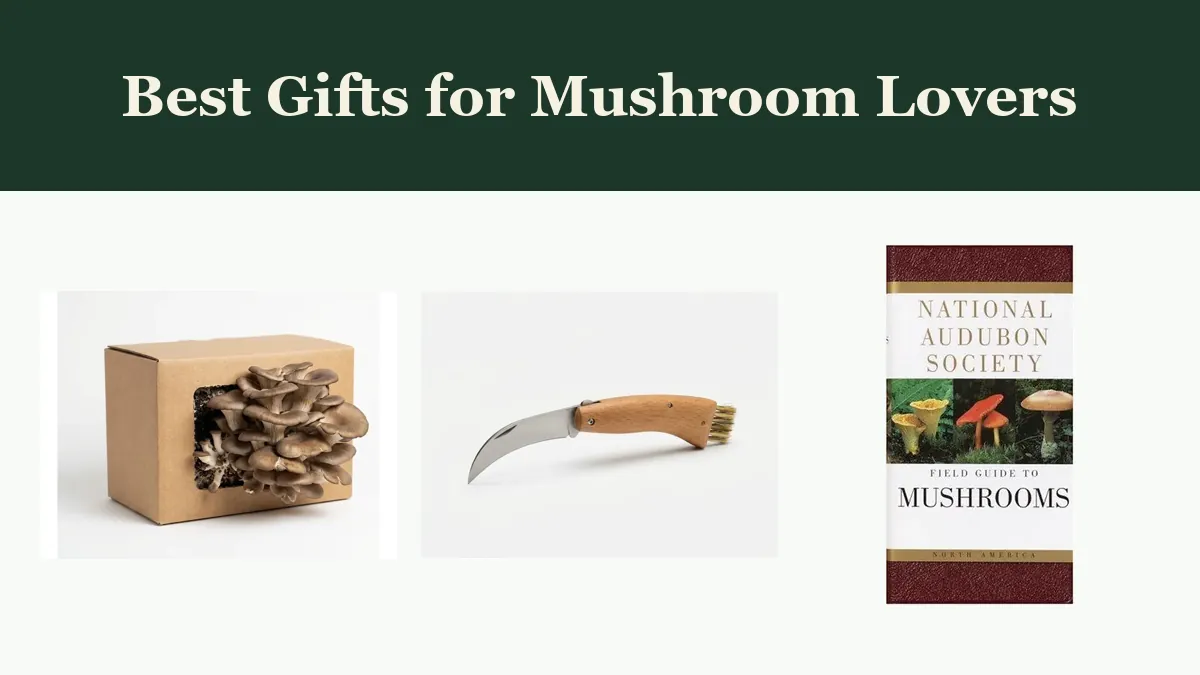
The best gifts for mushroom lovers include the Back to the Roots Organic Oyster Mushroom Grow Kit for a home cook, the Opinel No. 08 Mushroom Knife for a...
 Guide
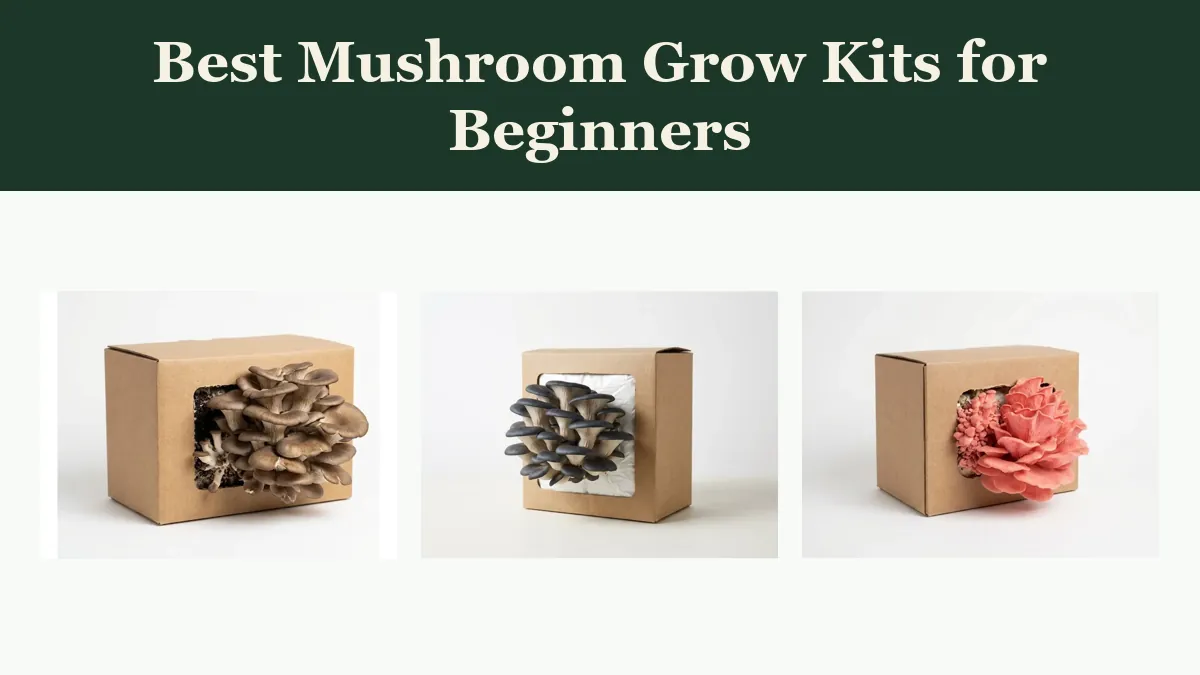
The best mushroom grow kits for beginners include the Back to the Roots Organic Oyster Mushroom Grow Kit for a first kit, the North Spore Blue Oyster...
 Guide
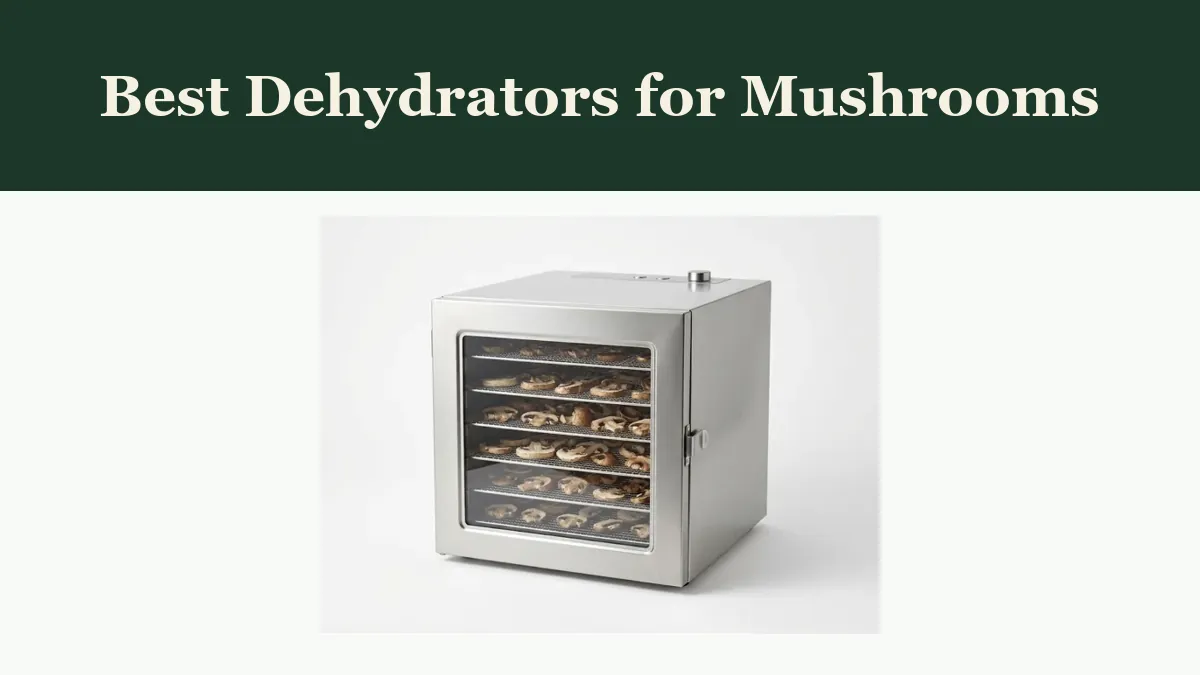
The best dehydrators for mushrooms include the Cosori Food Dehydrator, 5 Stainless Steel Trays for most home foragers, the Cosori Food Dehydrator, 6...