6 Best Dehydrators for Mushrooms (November 2026)
— views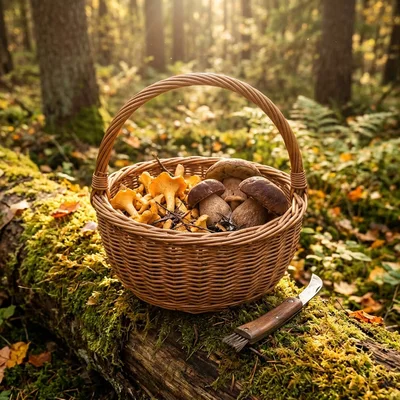
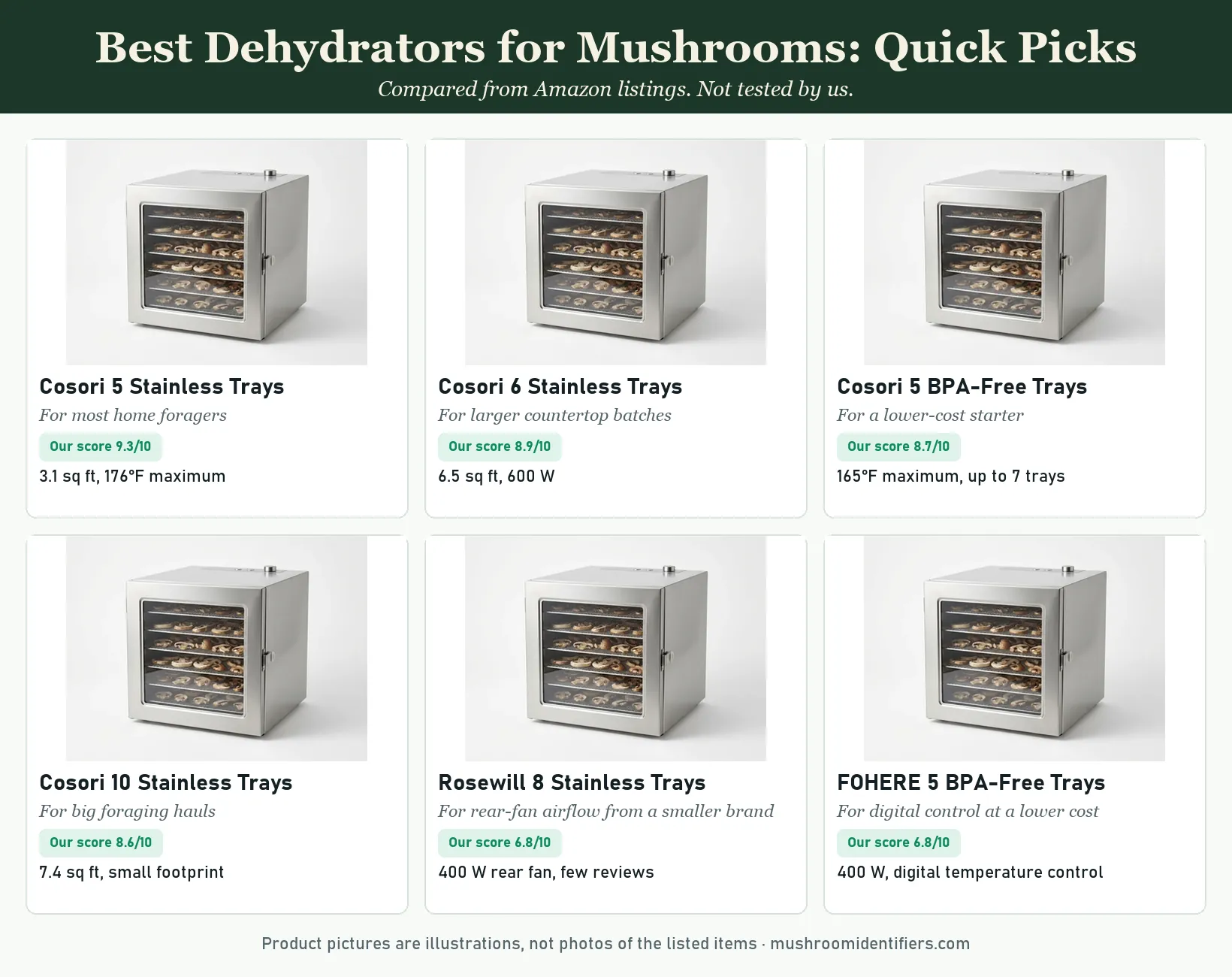
The best dehydrators for mushrooms include the Cosori Food Dehydrator, 5 Stainless Steel Trays for most home foragers, the Cosori Food Dehydrator, 6 Stainless Steel Trays for larger countertop batches, and the Cosori Food Dehydrator, 5 BPA-Free Trays for a lower-cost starter.
The best dehydrator for mushrooms for most people is the Cosori Food Dehydrator, 5 Stainless Steel Trays, which lists 3.1 square feet of drying space and a 176°F maximum temperature. It includes 5 trays, a recipe cookbook and mesh screens, according to the listing. It is one of the most-reviewed dehydrators on Amazon.
Choose a food dehydrator for mushrooms by three things: temperature control that covers 120°F to 140°F, enough tray area for your usual batch, and steady airflow. A small machine may be enough for store-bought mushrooms or a flush from one of the mushroom grow kits we compared. A forager who brings home a full basket needs more tray area.
A dehydrator preserves mushrooms. It does not make them safe. NDSU Extension says drying or cooking does not destroy the toxins in poisonous mushrooms, so read our guide to poisonous vs edible mushrooms before you load a tray with anything wild.
How We Chose Dehydrators for Mushrooms
We compared current Amazon listings against university extension guidance and did not test these products. Each dehydrator then received a score out of 10, based on three weighted factors.
- Fit for mushrooms, 40%: temperature control low enough for mushrooms, tray area and airflow, as far as the listing shows them.
- Review depth, 30%: how many buyers have reviewed the listing.
- Listing clarity, 30%: whether the listing states what you get and what the machine does.
A score compares listings. It is not a lab result or a performance guarantee. Product facts come from the listings, so treat them as the seller's claims.
| Product | Best for | Type | Our score |
|---|---|---|---|
| Cosori Food Dehydrator, 5 Stainless Steel Trays | Most home foragers | 5 stainless steel trays | 9.3/10 |
| Cosori Food Dehydrator, 6 Stainless Steel Trays | Larger countertop batches | 6 stainless steel trays | 8.9/10 |
| Cosori Food Dehydrator, 5 BPA-Free Trays | A lower-cost starter | 5 BPA-free trays | 8.7/10 |
| Cosori Food Dehydrator, 10 Stainless Steel Trays | Big foraging hauls | 10 stainless steel trays | 8.6/10 |
| Rosewill Food Dehydrator, 8 Stainless Steel Trays | Rear-fan airflow from a smaller brand | 8 stainless steel trays | 6.8/10 |
| FOHERE Food Dehydrator, 5 BPA-Free Trays | Digital control at a lower cost | 5 BPA-free trays | 6.8/10 |
The Best Dehydrators for Mushrooms for Different Needs
The 5-tray stainless Cosori is the best all-round fit, and the other five suit a bigger batch, a smaller budget or one specific feature. Where a detail is missing below, the listing facts used here do not state it, so check the listing before you buy.
Cosori Food Dehydrator, 5 Stainless Steel Trays: Best for most home foragers
Our score: 9.3/10
- 3.1 square feet of drying space, according to the listing.
- 176°F maximum temperature, according to the listing.
- Includes 5 trays, a recipe cookbook and mesh screens, according to the listing.
- One of the most-reviewed dehydrators on Amazon.
This model suits a forager who dries a modest batch at a time and prefers metal trays. Its stated maximum sits well above the 140°F that Colorado State gives for mushrooms.
Pros
- The stated maximum clears both the 120°F and 140°F settings in the sources.
- Mesh screens come with it, according to the listing.
- Many buyer reviews are available to read before you decide.
Cons
- It has the smallest drying space of the three models with a stated area here.
- The listing facts used here give no lowest setting, so confirm it goes down to 120°F.
- A large review count shows popularity, not drying performance.
Screens matter for mushrooms because slices shrink as they dry. NDSU Extension says small slices of high-moisture foods can nearly disappear once the moisture is gone. It also says the higher the water content, the larger the slice should be. A fine screen helps keep small pieces on the tray.
Cosori Food Dehydrator, 6 Stainless Steel Trays: Best for larger countertop batches
Our score: 8.9/10
- 6 stainless steel trays.
- 6.5 square feet of drying space, according to the listing.
- 600 W, according to the listing.
- Among the most-reviewed dehydrators on Amazon.
This model suits someone who keeps filling a smaller machine. Its listed drying space is about twice that of the 5-tray stainless model, with only one more tray.
Pros
- It offers far more listed drying space per tray than the 5-tray stainless model.
- The trays are stainless steel.
- Many buyer reviews are available to read.
Cons
- The listing facts used here give no temperature range, so confirm that it covers 120°F to 140°F.
- At 600 W, it has the highest stated wattage of the six.
- The listing facts used here give no dimensions, so measure your counter.
A larger batch means more pieces to watch. Colorado State University Extension says vegetables can scorch easily near the end of drying, so check more closely at that stage.
If your harvest comes from a block, our oyster mushroom grow kit guide covers the growing side.
Cosori Food Dehydrator, 5 BPA-Free Trays: Best for a lower-cost starter
Our score: 8.7/10
- 5 BPA-free trays.
- 165°F maximum temperature, according to the listing.
- 350 W, according to the listing.
- Expandable to 7 trays, according to the listing.
This model suits a first-time buyer who is not sure how often they will dry mushrooms. It has many reviews, and it can grow with your harvest. Choose a stainless model if you prefer metal trays.
Pros
- The 165°F maximum still sits above the 140°F setting.
- It has the lowest stated wattage of the six.
- The listing says it expands to 7 trays.
Cons
- The listing facts used here give no drying area in square feet.
- The listing facts used here do not say whether the extra trays are included.
- The trays are not stainless steel.
Clemson Cooperative Extension says some models are expandable and that additional trays can be purchased later. Check the listing for extra trays before you count on that route.
Cosori Food Dehydrator, 10 Stainless Steel Trays: Best for big foraging hauls
Our score: 8.6/10
- 10 stainless steel trays.
- 7.4 square feet of drying area, according to the listing.
- Small footprint for its capacity, according to the listing.
This model suits a forager who regularly brings home more than a smaller machine can hold.
Pros
- It has the largest stated drying area here.
- Ten trays let you spread out a large batch in single layers.
- The listing describes a small footprint for the capacity.
Cons
- It lists only 0.9 square feet more than the 6-tray model, despite 4 more trays.
- The listing facts used here give no temperature range.
- Small for its capacity does not mean small, so measure your counter.
Oregon State University Extension lists oyster mushrooms and morels among good varieties for drying. Our oyster mushroom identification guide and morel guide describe those two groups.
A big haul is the time to slow down. Oregon State says to dry only mushrooms that are safe to eat. Start with how to identify a mushroom you found, then get an expert to confirm the result before you slice anything.
Rosewill Food Dehydrator, 8 Stainless Steel Trays: Best for rear-fan airflow from a smaller brand
Our score: 6.8/10
- 400 W rear fan, according to the listing.
- 8 adjustable stainless steel trays, according to the listing.
- Fruit-roll trays, according to the listing.
- Few reviews so far.
This model suits a buyer who wants a rear fan named on the listing and accepts a smaller brand with little buyer feedback.
Pros
- It is the only one of the six whose listing facts here name a rear fan.
- Adjustable trays may leave room for small whole mushrooms.
- The trays are stainless steel.
Cons
- Few reviews so far means little evidence from buyers.
- The listing facts used here give no drying area or temperature range.
- Fruit-roll trays add little if you only dry mushrooms.
UC Master Food Preservers of El Dorado County says a horizontal dehydrator, with the heat source and fan at the back, gives equal heat treatment to all trays. That is the case for a rear fan in general. It is not evidence about this model.
FOHERE Food Dehydrator, 5 BPA-Free Trays: Best for digital control at a lower cost
Our score: 6.8/10
- 5 BPA-free trays.
- 400 W, according to the listing.
- Digital temperature control, according to the listing.
- Fewer reviews than Cosori.
This model suits a buyer who wants to set a number on a digital control and keep the cost down. It offers less buyer feedback than the Cosori machines above.
Pros
- Digital control makes a 120°F or 140°F target simple to set, if the range covers it.
- It is a lower-cost option.
Cons
- It has fewer reviews than Cosori.
- The listing facts used here give no drying area or temperature range.
- A digital readout shows a setting, not a verified tray temperature.
The National Center for Home Food Preservation (NCHFP) recommends an enclosed thermostat from 85°F to 160°F and a dial for regulating temperature. A digital control can do the same job only if its range fits. Check the range on the listing before you buy.
What Temperature Should You Dehydrate Mushrooms At?
Sources conflict: Colorado State says 140°F for mushrooms, while Oregon State says 120°F. A dehydrator for drying mushrooms should simply cover both settings.
| Source | Setting | Time given | Dryness test |
|---|---|---|---|
| Colorado State | 140°F, mushrooms | 8 to 10 hours | Dry and leathery |
| NCHFP | 140°F, dehydrators in general | None on that page | None on that page |
| Oregon State | 120°F, mushrooms | None | Crisp or brittle |
| UC Master Food Preservers | 120°F, mushrooms | 8 to 10 hours | Crisp and brittle in its chart, leathery in its text |
| NC State Extension, Guilford County | 86°F to 104°F, herbs, spices and mushrooms | None | None |
The pages we opened do not explain why their figures differ. The NC State figure is the outlier. Our drying guide starts from about 140°F.
A higher number is not better. UC Master Food Preservers says too much heat cooks the food and can form a hard crust that traps moisture. It also says drying too slowly can allow mold or spoilage. Clemson says drying should never be hurried by raising the temperature.
When you read a listing, check these points:
- Top setting: it should reach 140°F. The two stated maximums here, 176°F and 165°F, both do.
- Bottom setting: it should reach 120°F. The listing facts used here give no model's lowest setting.
- Fan: NCHFP and UC Master Food Preservers both call for a fan.
- Timer: NCHFP lists one among the features to look for, because food that finishes overnight can scorch.
This page covers the machine only. For slicing, loading and dryness testing, follow our full guide on how to dry mushrooms.
Stainless or BPA-Free Trays?
Either tray type can dry mushrooms, so choose by preference, cleaning and budget. We found no extension source that says one material dries mushrooms better than the other.
| Point | Stainless steel trays | BPA-free trays |
|---|---|---|
| What sources say | NCHFP lists stainless steel among the best drying screens | NCHFP describes open mesh trays of sturdy, lightweight plastic as a feature to look for |
| Models here | Cosori 5, 6 and 10 tray, Rosewill | Cosori 5 tray, FOHERE |
| Who it suits | A buyer who prefers metal | A buyer who wants a lower-cost start |
The screen advice comes from NCHFP's sun drying page. It warns against galvanized hardware cloth, copper and aluminum screens.
The FDA describes BPA as an industrial chemical used to make polycarbonate, a hard, clear plastic. Its stated position is that BPA is safe at the current levels occurring in foods. A BPA-free label is therefore a buyer's preference here, not a drying feature.
A guest writer on a Cornell Cooperative Extension blog chose stainless trays for sturdiness. That is one Master Food Preserver volunteer's preference, not a test.
Stacked or Box-Style Dehydrators?
A box-style machine with a rear fan gives more even heat on paper, while a stacked machine may cost less and can need tray rotation.
| Point | Stacked (vertical airflow) | Box-style (horizontal airflow) |
|---|---|---|
| Fan and heater | At the base or top | At the back or side |
| Heat across trays | Risk of uneven heat | Equal heat to all trays |
| Tray rotation | Can help ensure even drying | Not needed on the Cornell writer's rear-fan unit |
| Flavors and drips | Flavors can mix, and liquids can drip into the heater | Less flavor mixing, and no drips onto the heater |
| Cost and limits | May cost less | Has a limit on food height |
The table draws on NCHFP, UC Master Food Preservers, the Cornell blog and NC State Extension. Thin mushroom slices should clear the height limit. Small whole mushrooms may need a wider tray gap.
The Rosewill is the only machine here whose listing facts name a rear fan. The facts used here do not state the airflow of the other five. Look for the fan position in the listing photos. Rotate the trays if you buy a stacked machine.
How Much Tray Space Do You Need?
Compare square feet, not tray count, and buy for the batch you dry most often. NCHFP calls limited capacity the major disadvantage of a dehydrator. It says 12 square feet of drying space dries about a half-bushel of produce.
| Listing | Trays | Listed area | Rough produce capacity at the NCHFP ratio |
|---|---|---|---|
| Cosori, 5 stainless | 5 | 3.1 sq ft | About 1/8 bushel |
| Cosori, 6 stainless | 6 | 6.5 sq ft | About 1/4 bushel |
| Cosori, 10 stainless | 10 | 7.4 sq ft | About 3/10 bushel |
The last column is our own arithmetic from a general produce figure. We found no extension source that gives pounds of sliced mushrooms per square foot.
Area limits you because mushrooms need room. Colorado State says to arrange pieces in single layers. UC Master Food Preservers says the pieces should not touch or overlap. The listing facts used here give no area for the other three models, so compare their tray sizes before you buy.
Tray count can mislead. The 6-tray listing states more than twice the area of the 5-tray listing. The 10-tray listing adds only 0.9 square feet to that.
Do You Need a Dehydrator at All?
No. An oven is enough for occasional use if it holds about 140°F to 145°F with the door propped open. NDSU Extension gives that test, and the Missouri Department of Conservation suggests 135°F to 150°F. Test the oven with a thermometer first.
An oven has real costs:
- Time: Clemson says twice as long as a dehydrator. Colorado State says up to twice as long. UC Master Food Preservers says 2 to 3 times longer.
- Energy: Clemson and UC Master Food Preservers both say an oven uses more.
- Quality: UC Master Food Preservers says oven-dried food is generally darker, more brittle and less flavorful.
- Safety: NDSU Extension says oven drying is not a safe procedure if young children are present.
A dehydrator earns its counter space if you dry mushrooms often or have young children at home. If you dry them a few times a year, start with the oven.
Which Dehydrator for Mushrooms Should You Choose?
Choose the machine that matches your usual batch.
- If you want the best all-round fit, choose the Cosori with 5 stainless steel trays.
- If you often fill a small machine, choose the Cosori with 6 stainless steel trays.
- If you want a lower-cost start, choose the Cosori with 5 BPA-free trays.
- If you want the largest stated drying area, choose the Cosori with 10 stainless steel trays.
- If a rear fan matters most, choose the Rosewill with 8 stainless steel trays.
- If you want digital control at a lower cost, choose the FOHERE with 5 BPA-free trays.
- If you dry mushrooms only a few times a year, use your oven.
Our Top 3 Picks at a Glance
Frequently Asked Questions
What is the best dehydrator for mushrooms?
The Cosori Food Dehydrator with 5 stainless steel trays scores highest here, at 9.3 out of 10. Our score compares listings, and we did not test any of these machines.
What temperature should you dehydrate mushrooms at?
Sources conflict. Colorado State says 140°F, while Oregon State and UC Master Food Preservers say 120°F. Buy a machine that covers both settings.
How long do mushrooms take in a dehydrator?
Colorado State gives 8 to 10 hours at 140°F. UC Master Food Preservers gives the same range at 120°F. NDSU Extension says drying time varies with the equipment, the food and the humidity.
Does a dehydrator need a high maximum temperature for mushrooms?
No. The dehydrator figures on this page stop at 140°F, so a higher maximum adds nothing for mushrooms. UC Master Food Preservers warns that too much heat can cook food and form a hard crust.
Are stainless steel trays better than BPA-free trays?
We found no extension source that says so. NCHFP names both stainless steel and plastic among suitable drying materials. Choose by preference, cleaning and budget.
Is a rear-fan dehydrator better for mushrooms?
UC Master Food Preservers says a fan at the back gives all trays equal heat. A stacked machine can still work, and rotating its trays can help it dry evenly.
How much tray space do you need to dry mushrooms?
You need enough to hold your usual batch in a single layer. NCHFP says 12 square feet dries about a half-bushel of produce. We found no extension figure for sliced mushrooms in pounds.
Can you dry mushrooms without a dehydrator?
Yes, if your oven holds about 140°F to 145°F with the door propped open. Clemson says it takes twice as long and uses more energy. NDSU Extension says oven drying is not safe when young children are present.
Does a dehydrator make wild mushrooms safe to eat?
No. NDSU Extension and Oregon State both say drying and cooking do not destroy the toxins in poisonous mushrooms. Both also say only an expert can tell poisonous and edible kinds apart.
Final Safety Reminder
A dehydrator removes water, not danger. Drying does not make an unidentified mushroom safe. Never dry or eat a wild mushroom based on a chart, a photo or an app. Confirm every find with a local expert before you slice it, and use a regional field guide to prepare. Keep children and pets away from unknown mushrooms. For a starting point, take clear photos of the whole mushroom, then check them with our free mushroom identifier.
About this guide: we compared current Amazon listings with university extension guidance and did not test these products. As an Amazon Associate, Mushroom Identifiers earns from qualifying purchases at no extra cost to you. Prices and availability are shown on Amazon.
Sign in to leave a comment and join the discussion.
 Guide
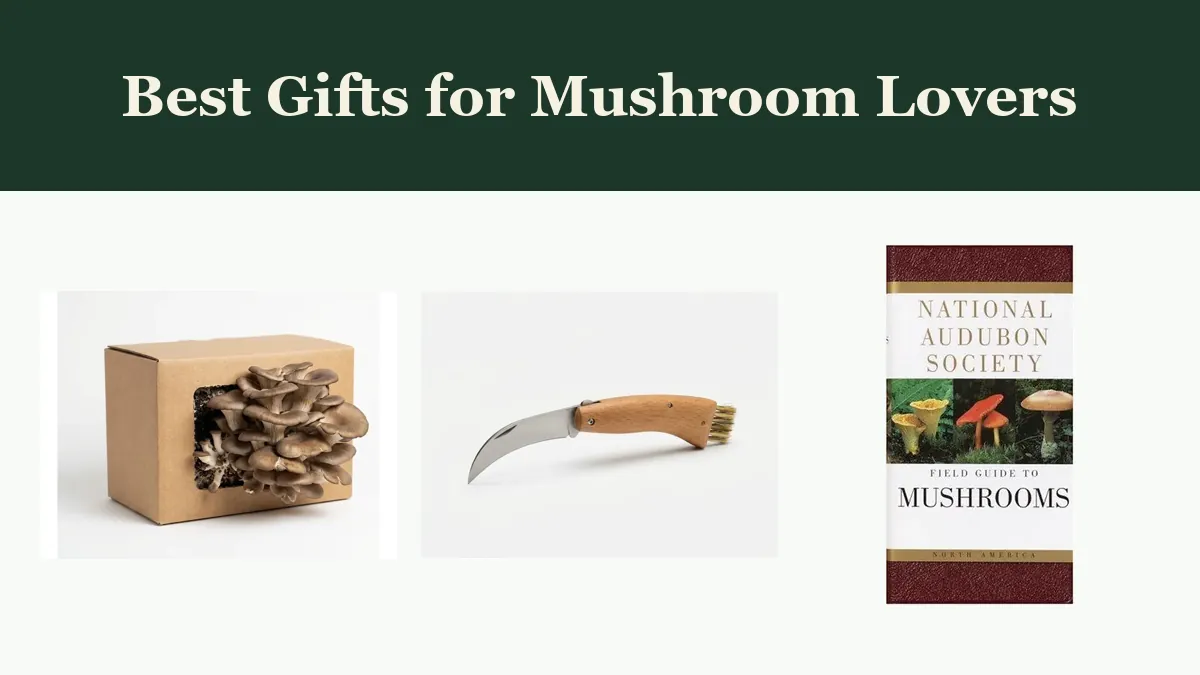
The best gifts for mushroom lovers include the Back to the Roots Organic Oyster Mushroom Grow Kit for a home cook, the Opinel No. 08 Mushroom Knife for a...
 Guide
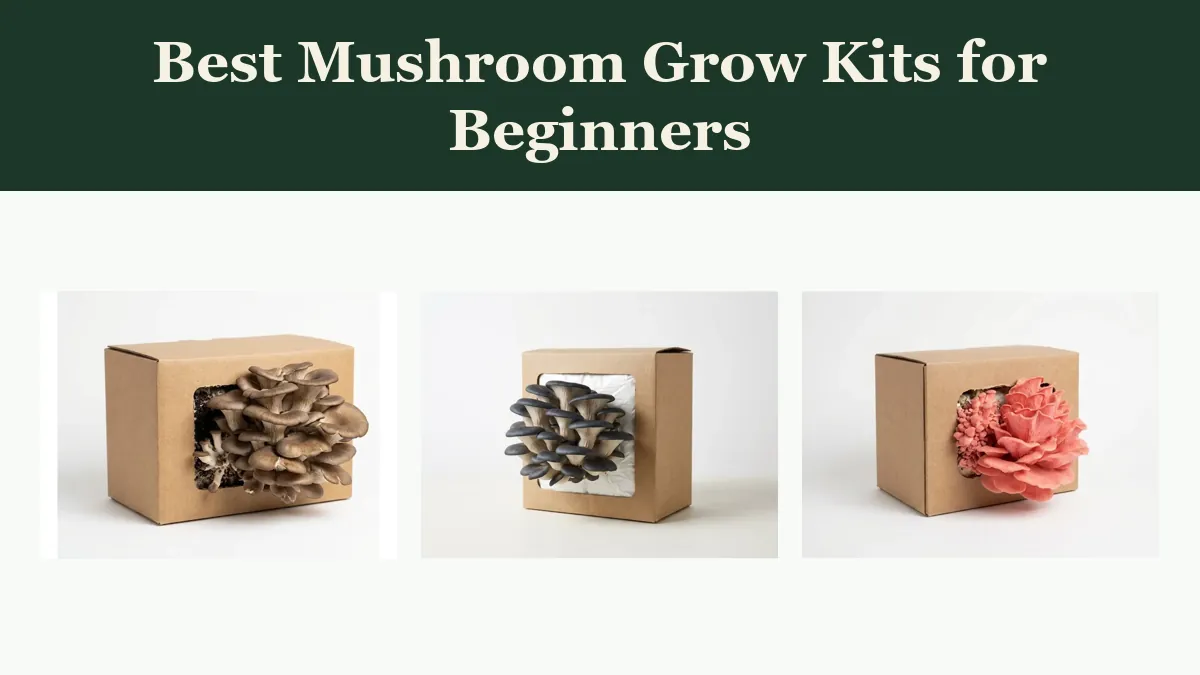
The best mushroom grow kits for beginners include the Back to the Roots Organic Oyster Mushroom Grow Kit for a first kit, the North Spore Blue Oyster...
 Guide
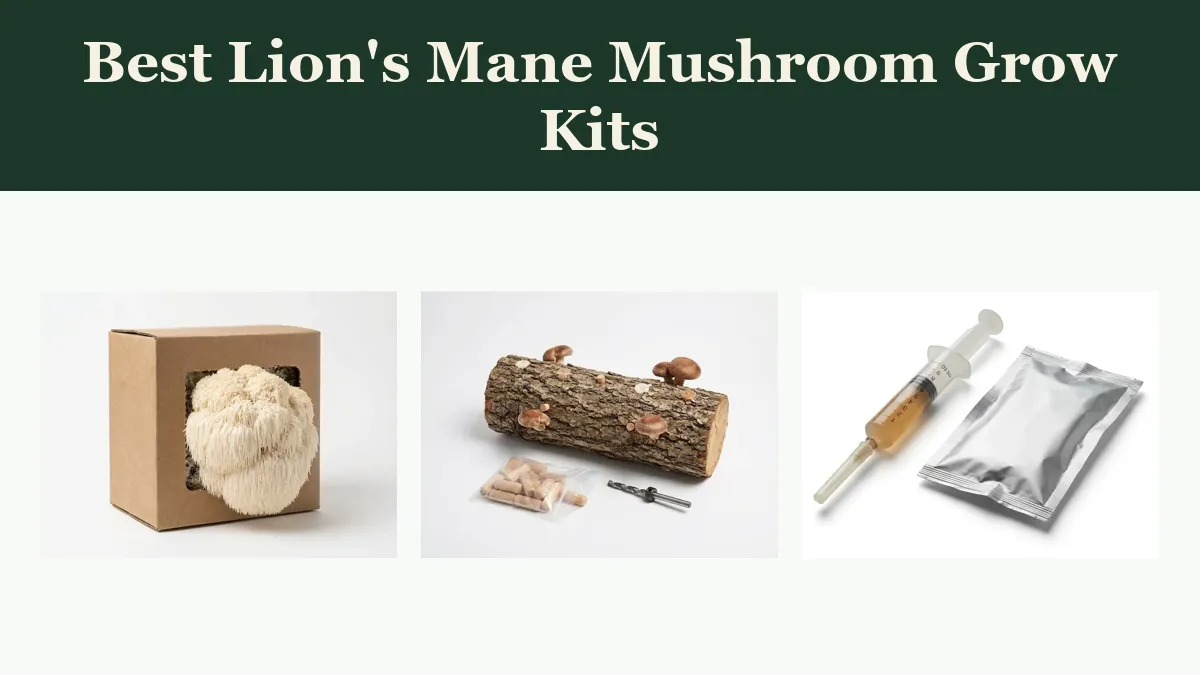
The best lion's mane mushroom grow kits include the inbloom Organic Lion's Mane Mushroom Growing Kit with Spray, 4 lb for an organic block with a sprayer,...