Mushroom Gills Function: How Mushroom Gills Help Fungi Survive and Reproduce?

Nathan Cole
Mycologist · Author · Fungi Expert
Updated
May 20, 2026
Mushroom gills are thin, blade-like structures found underneath the cap of many fungi. Their main function is to produce and release microscopic spores that allow mushrooms to reproduce and spread through forests, soil, and organic matter. These gills increase surface area for spore production, making fungal reproduction highly efficient. In the field of Mycology, mushroom gills are also one of the most important features used to identify edible, medicinal, and poisonous mushroom species.
Mushrooms may appear simple on the surface, but the underside of the cap contains an advanced reproductive system developed over millions of years. Species such as Agaricus bisporus, Pleurotus ostreatus, and Amanita muscaria all rely on gills to disperse spores into the environment. Understanding how these structures work can help mushroom enthusiasts, foragers, students, and nature photographers better recognize fungal species and appreciate their ecological role.
Beyond reproduction, gills also help scientists classify fungi through characteristics such as spacing, attachment, thickness, and color. Some mushrooms have crowded white gills, while others develop dark brown or black gills as spores mature. These details are often critical during wild mushroom identification, especially when distinguishing edible species from toxic lookalikes.
What Are Mushroom Gills?
Mushroom gills are thin rib-like structures located underneath the mushroom cap. In fungal anatomy, they are commonly known as lamellae. Their primary purpose is to create as much surface area as possible for producing spores, which are the reproductive cells of fungi.
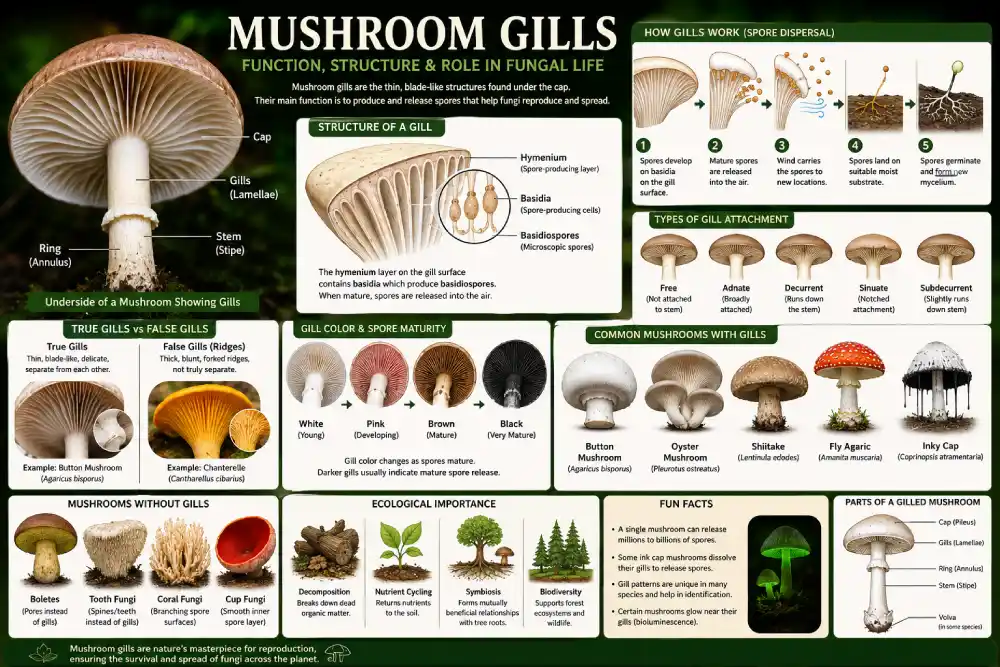
If you flip over a typical grocery-store mushroom, you will notice rows of delicate lines radiating outward from the stem toward the cap edge. These are the gills. Inside these structures lies the spore-producing tissue called the hymenium, where specialized cells known as basidia generate spores.
Why Do Mushrooms Have Gills?
The design of mushroom gills is highly efficient. Instead of having a flat underside, the mushroom develops hundreds of thin folds that dramatically increase the area available for spore production.
This structure helps fungi:
- Produce millions of spores quickly
- Improve airflow beneath the cap
- Increase reproductive success
- Spread spores across large distances through wind currents
Without gills, many mushroom species would struggle to reproduce effectively in natural ecosystems.
Are Gills Found in All Mushrooms?
Not all mushrooms have gills. While many familiar fungi are gilled mushrooms, others use pores, spines, or smooth surfaces for spore release.
Here is a simple comparison:
| Mushroom Structure | Function | Example |
|---|---|---|
| Gills | Spore production and release | Button mushrooms |
| Pores | Spore release through tiny tubes | Boletes |
| Teeth/Spines | Hanging spore surfaces | Tooth fungi |
| Smooth surfaces | Direct spore-bearing layer | Some cup fungi |
Species like Cantharellus cibarius technically have false gills, which appear more like blunt ridges than thin blades.
Main Function of Mushroom Gills
The main function of mushroom gills is reproduction. Gills allow fungi to produce, store, and release microscopic spores into the environment. These spores act similarly to seeds in plants, although fungi reproduce in a completely different biological way.
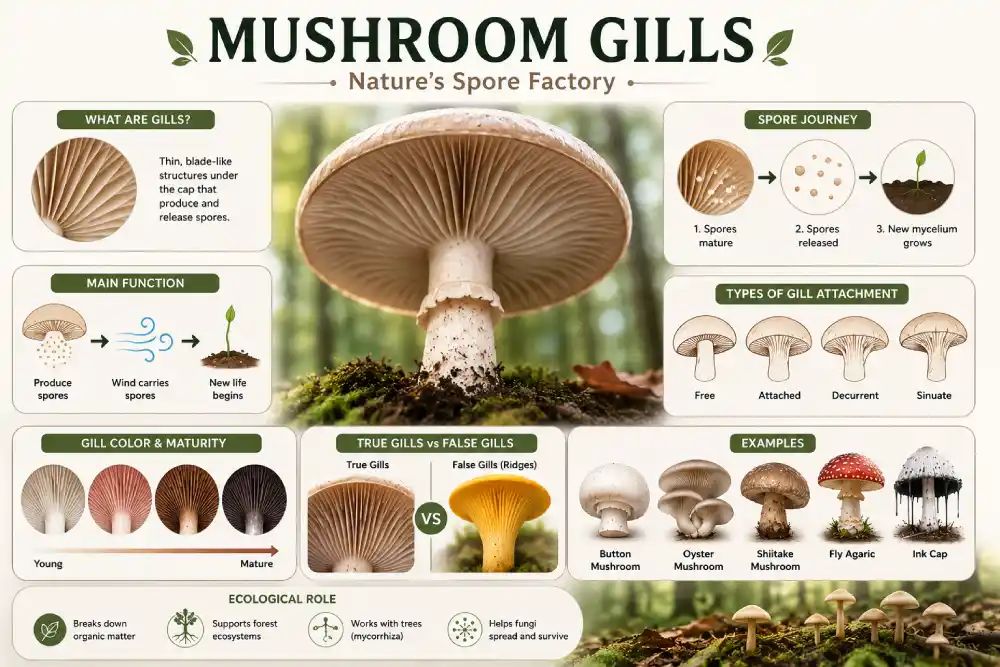
Inside the gills, billions of spores develop on tiny reproductive structures called basidia. Once mature, the spores are released into the air and carried by wind, moisture, or animal movement to new locations where future fungal colonies may grow.
How Gills Increase Spore Production?
One of the most remarkable aspects of mushroom gills is how efficiently they use space. A mushroom cap may appear small from above, but the folded gill system underneath creates an enormous reproductive surface.
This design allows mushrooms to:
- Maximize spore-producing area
- Release spores continuously
- Improve air circulation
- Prevent spores from clumping together
Scientists studying Spore Dispersal often describe gills as a natural engineering solution for maximizing reproduction with minimal energy use.
Why Airflow Matters Beneath the Cap?
The spacing between mushroom gills is not random. Air must move freely beneath the cap to carry spores away efficiently. If the gills were packed too tightly, spores could become trapped.
Many woodland fungi evolved cap shapes and stem heights that improve airflow near the forest floor. This adaptation helps spores travel farther into surrounding environments rich in moisture and organic matter.
How Mushroom Gills Produce Spores?
Spores are produced within a fertile tissue layer called the hymenium, which covers the surface of the gills. Under a microscope, this area contains tiny club-shaped structures called basidia that generate spores externally.
The spores formed here are known as Basidiospores, and they are a defining feature of many gilled fungi classified within the Basidiomycota group.
Step-by-Step Spore Production Process
1. Basidia Develop on the Gill Surface
Tiny reproductive cells form across the hymenium layer.
2. Spores Grow on the Basidia
Each basidium produces microscopic spores ready for dispersal.
3. Mature Spores Are Released
When humidity and airflow conditions are favorable, spores detach from the gills.
4. Wind Carries the Spores
Air currents transport spores into soil, wood, moss, or decaying organic matter.
5. New Fungal Networks Form
If conditions are suitable, spores germinate and grow into underground fungal threads called mycelium.
This entire process is a critical part of the fungal life cycle and helps maintain biodiversity in forests and ecosystems worldwide.
Structure of Mushroom Gills
Mushroom gills may look fragile, but they are highly specialized biological structures designed for reproduction and survival. Their arrangement, thickness, color, and attachment style often vary between species and can reveal important identification clues.
In Mycology, gill structure is one of the first features examined when identifying wild mushrooms.
Key Parts of Mushroom Gills
| Gill Feature | Description |
|---|---|
| Gill spacing | Distance between individual gills |
| Gill attachment | How the gills connect to the stem |
| Gill color | Often linked to spore maturity |
| Gill thickness | Can help distinguish species |
| Gill edges | Smooth, serrated, or uneven margins |
Some mushrooms develop very crowded gills to maximize spore production, while others have widely spaced gills adapted to different environmental conditions.
Why Gill Color Changes Over Time?
Young mushrooms often display pale gills that darken as spores mature. For example:
- White gills may indicate immature spores
- Pink gills can appear during development
- Dark brown or black gills often signal mature spore release
This color transition is common in species like Agaricus bisporus and can help identify the growth stage of a mushroom.
Types of Mushroom Gill Attachments
Gill attachment refers to the way the gills connect to the mushroom stem. This characteristic is extremely important in fungal identification because certain mushroom groups consistently share similar attachment patterns.
Professional mushroom foragers and mycologists often examine this feature before making any identification decisions.
Common Types of Gill Attachments
Free Gills
Free gills do not touch the stem directly. A small gap remains between the gills and stalk.
Example: Many species in the Agaricus group.
Adnate Gills
These gills connect broadly to the stem in a clean, attached manner.
Decurrent Gills
Decurrent gills extend downward along the stem rather than stopping at the cap edge.
Species like Pleurotus ostreatus commonly display this feature.
Sinuate Gills
These gills curve slightly upward before meeting the stem, creating a notched appearance.
Why Gill Attachment Matters?
Gill attachment can help distinguish mushrooms that otherwise look nearly identical. This is especially important when separating edible species from dangerous toxic lookalikes.
For example:
- Some poisonous mushrooms have white free gills
- Certain edible mushrooms have decurrent gills
- Attachment patterns may indicate fungal family classification
Because of this, gill attachment remains one of the most trusted visual tools in mushroom identification.
True Gills vs False Gills
Not every mushroom with lines beneath its cap has true gills. In the fungal world, there is an important distinction between true gills and false gills, especially when identifying edible and poisonous species in the wild.
True gills are thin, blade-like structures that can usually be separated individually with a fingernail or knife. False gills, on the other hand, are blunt ridges or folds that appear wrinkled and are often fused directly into the mushroom cap tissue.
Understanding this difference is essential for both beginner foragers and experienced mushroom enthusiasts because several edible mushrooms are commonly confused with toxic lookalikes.
What Are True Gills?
True gills are delicate vertical plates located beneath the mushroom cap. These structures contain the spore-producing layer called the hymenium, where spores develop and disperse into the air.
Characteristics of true gills include:
- Thin and blade-like appearance
- Distinct separation between each gill
- Fragile texture
- High surface area for spore production
- Clearly visible spacing patterns
Many common gilled fungi, including Agaricus bisporus and Amanita muscaria, have true gills.
What Are False Gills?
False gills are not separate blades. Instead, they appear as thick folds, wrinkles, or shallow ridges running beneath the mushroom cap. These ridges are often smoother and less delicate than true gills.
False gills typically:
- Look rounded or blunt
- Merge gradually into the cap
- Feel rubbery or thick
- Branch irregularly
- Resist breaking apart individually
The well-known Cantharellus cibarius is one of the most recognized mushrooms with false gills.
True Gills vs False Gills Comparison
| Feature | True Gills | False Gills |
|---|---|---|
| Shape | Thin blades | Rounded ridges |
| Texture | Fragile | Thick and firm |
| Separation | Individually distinct | Blended into cap |
| Spore surface | Large exposed area | Smaller folded surface |
| Example | Button mushroom | Chanterelle |
Why This Difference Matters in Identification?
One of the biggest reasons people learn about false gills is to safely distinguish chanterelles from toxic lookalikes such as jack-o’-lantern mushrooms.
While chanterelles have thick forked ridges, toxic lookalikes often possess sharp true gills. This small anatomical difference can prevent dangerous identification mistakes.
However, no mushroom should ever be identified using a single feature alone. Experts in Mycology recommend examining:
- Gill structure
- Smell
- Spore print color
- Habitat
- Stem texture
- Bruising reactions
before consuming any wild mushroom.
Mushroom Gills and Spore Dispersal
Mushroom gills are highly specialized for efficient spore dispersal. Their arrangement beneath the cap creates ideal airflow conditions that help microscopic spores travel into the surrounding environment.
This process is a key part of Spore Dispersal and allows fungi to colonize forests, grasslands, dead wood, and soil-rich habitats around the world.
How Spores Leave the Gills?
When spores mature on the gill surface, they are released from the basidia and fall into tiny pockets of moving air beneath the mushroom cap.
From there:
- Air currents carry spores outward
- Wind transports them across surrounding environments
- Moisture helps spores settle into suitable habitats
- Spores germinate into fungal networks called mycelium
A single mature mushroom may release millions or even billions of spores during its lifespan.
Why Gill Shape Helps Spore Movement?
The spacing and orientation of gills create natural ventilation channels. These channels allow air to move upward and outward beneath the cap, helping spores escape efficiently.
Scientists studying fungal morphology have found that:
- Taller stems improve airflow
- Wider caps create protected dispersal zones
- Evenly spaced gills reduce spore congestion
- Humid conditions improve spore survival
This natural engineering allows mushrooms to reproduce successfully even in dense forest environments.
Environmental Factors That Affect Spore Dispersal
Several environmental conditions influence how effectively spores spread from mushroom gills.
Humidity
Moist air helps prevent spores from drying out too quickly.
Wind
Gentle airflow carries spores away from the mushroom colony.
Rainfall
Rain can both help and hinder dispersal depending on intensity.
Forest Structure
Trees, moss, and decaying logs create favorable fungal habitats.
Many woodland mushrooms time their spore release during humid periods after rainfall, when survival chances are highest.
Colors of Mushroom Gills and What They Mean
Gill color is one of the most noticeable features of a mushroom and often changes throughout the mushroom’s life cycle. These color shifts usually occur because spores mature over time.
For mushroom identification, gill color is considered one of the most valuable visual clues.
Common Mushroom Gill Colors
| Gill Color | Possible Meaning |
|---|---|
| White | Young or immature spores |
| Pink | Developing spores |
| Brown | Mature spore production |
| Black | Aging or dense spore deposits |
| Yellow | Species-specific pigmentation |
Different species naturally develop different gill colors, textures, and staining reactions.
Why Mushroom Gills Change Color?
As spores mature, they often darken the surface of the gills. This is especially common in species such as Coprinopsis atramentaria, where the gills eventually become black and begin dissolving.
This process is part of fungal reproduction and helps maximize spore release into the environment.
Can Gill Color Identify Poisonous Mushrooms?
Gill color alone cannot confirm whether a mushroom is edible or toxic. However, certain dangerous mushrooms are known for specific gill characteristics.
For example:
- Some toxic Amanita species have white gills
- Certain edible Agaricus mushrooms develop chocolate-brown gills
- False chanterelles display sharper orange true gills
Because many mushrooms share similar colors, experts always recommend combining multiple identification features before drawing conclusions.
How Mushroom Gills Help With Identification?
Mushroom gills provide some of the most reliable visual information used in fungal identification. Mycologists carefully study gill characteristics to classify mushrooms into families, genera, and species.
Even small details beneath the cap can reveal whether a mushroom is edible, medicinal, toxic, or completely unrelated to another visually similar species.
Important Gill Features Used in Identification
Gill Attachment
How the gills connect to the stem is often species-specific.
Gill Spacing
Some mushrooms have crowded gills, while others have wide spacing.
Gill Thickness
Thin delicate gills may indicate different fungal groups than thick waxy gills.
Gill Color
Spore maturity frequently changes the appearance of the gills.
Gill Edge Shape
Edges may appear smooth, jagged, serrated, or forked.
Together, these features form part of fungal taxonomy and classification systems used in modern Mycology.
The Importance of Spore Prints
A spore print is created by placing a mushroom cap on paper so falling spores leave behind a visible color pattern.
Spore print colors include:
- White
- Brown
- Pink
- Black
- Purple-brown
Because spores are produced directly from the gills, spore prints are closely connected to gill structure and coloration.
Why Beginners Should Study Gills Carefully?
Many dangerous mushrooms resemble edible species from above. The underside of the cap often reveals critical differences invisible at first glance.
For example:
- Decurrent gills may suggest oyster mushrooms
- White free gills may indicate toxic Amanita species
- Forked false gills are common in chanterelles
Learning to observe these details can dramatically improve mushroom identification accuracy and safety.
Edible vs Poisonous Mushroom Gills
Mushroom gills can provide important clues about whether a species may be edible or dangerous, but they should never be used as the only identification factor. Some deadly poisonous mushrooms closely resemble edible varieties, especially when viewed quickly in natural environments.
Foragers and mushroom experts rely on a combination of characteristics, including gill structure, habitat, odor, bruising reactions, and spore print color before making any identification decisions.
Why Gill Features Matter for Safety
Gill anatomy often reveals important taxonomic relationships between mushrooms. Certain fungal groups consistently share similar gill traits, which helps narrow down identification possibilities.
Important warning signs may include:
- Bright white gills in some toxic species
- Crowded delicate gills
- Unusual discoloration
- Slimy or decaying gill surfaces
- Strong chemical odors
However, no single trait guarantees edibility or toxicity.
Examples of Edible and Toxic Gilled Mushrooms
| Mushroom | Gill Type | Edibility |
|---|---|---|
| Pleurotus ostreatus | Decurrent gills | Edible |
| Lentinula edodes | Attached gills | Edible |
| Amanita muscaria | Free white gills | Toxic |
| Coprinopsis atramentaria | Dark dissolving gills | Conditionally edible |
Safe Mushroom Identification Tips
Before consuming any wild mushroom:
- Never rely on gill color alone
- Examine the stem and cap carefully
- Check for rings or volvas
- Create a spore print
- Research habitat and season
- Consult experienced mycologists when uncertain
Wild mushroom identification requires patience and caution because many toxic species can cause severe illness or death if misidentified.
FAQs About Mushroom Gills
What is the main function of mushroom gills?
The main function of mushroom gills is to produce and release microscopic spores for reproduction. The gills increase surface area beneath the cap, helping fungi spread efficiently through the environment.
What is the main function of the gills?
Gills help mushrooms reproduce by creating and dispersing spores into the air. They also improve airflow under the mushroom cap for better spore release.
What are the gills in a mushroom?
Mushroom gills are thin blade-like structures found underneath the cap. They contain spore-producing cells and are an important part of fungal anatomy and identification.
Are mushroom gills good for you?
In edible mushrooms, the gills can provide nutrients like fiber, antioxidants, B vitamins, and minerals. Their nutritional value depends on the mushroom species.
Are mushroom gills safe to eat?
Yes, mushroom gills are generally safe to eat in properly identified edible mushrooms. However, toxic mushrooms may also have gills, so wild mushrooms should never be eaten without accurate identification.
Sign in to leave a comment and join the discussion.
 Species Guide
Alaska has many edible mushrooms, including morels, king boletes, golden chanterelles, hedgehogs, oyster mushrooms and bear’s head mushrooms. Most appear...
 Species Guide
Wisconsin is home to edible mushrooms such as morels, chanterelles, oyster mushrooms, hen of the woods, chicken of the woods and giant puffballs. Different...
 Species Guide
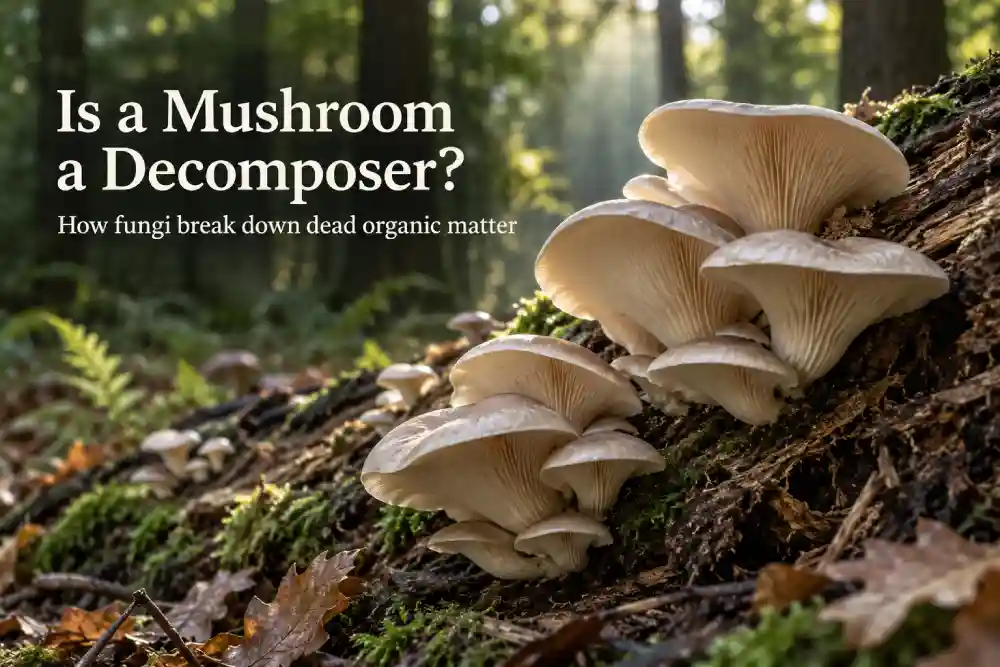
Is a Mushroom a Decomposer? Yes, many mushroom-forming fungi are decomposers. They break down dead wood, fallen leaves and other organic material, helping...