20 Edible Mushrooms in Wisconsin: Seasons & Habitats

Nathan Cole
Mycologist · Author · Fungi Expert
Updated
Oct 4, 2026
Wisconsin is home to edible mushrooms such as morels, chanterelles, oyster mushrooms, hen of the woods, chicken of the woods and giant puffballs. Different species grow in hardwood forests, grassy areas, decaying logs and wood-chip beds. Their seasons stretch from spring through fall, with temperature, rainfall and habitat influencing when they appear.
Finding a mushroom in the right place at the right time does not confirm that it is edible. This guide explains 20 species or mushroom groups worth learning about, including their ecological relationships and important identification concerns.
Never eat a wild mushroom based only on this article, photographs or an identification app. Have collected specimens checked by a qualified local mushroom expert. Cooking does not reliably destroy mushroom toxins.
What Are Edible Mushrooms?
Edible mushrooms are the fruiting bodies of fungi that can be eaten when correctly identified, collected in suitable condition and prepared appropriately. Some require thorough cooking, and even recognized edible species can cause adverse reactions in certain people.
The visible mushroom is only part of the organism. Beneath the surface, mycelium—a network of fine fungal threads—grows through wood, soil or other material.
Understanding how a fungus obtains nutrients helps explain where its mushrooms appear:
- Decomposers break down dead wood, leaves and organic debris. Oyster mushrooms and wine caps are examples.
- Mycorrhizal fungi exchange resources with living tree roots. Chanterelles and king boletes belong to this group.
- Parasitic fungi obtain resources from living hosts. Lobster mushrooms involve a fungus parasitizing another mushroom.
For Wisconsin mushroom hunters, learning trees, substrates and seasonal conditions is therefore part of learning the mushrooms themselves.
1. Morel Mushrooms
Morels are among Wisconsin’s most familiar spring mushrooms. Their caps have deep pits separated by raised ridges, producing a honeycomb-like surface. Several Morchella species occur in the state, so color and shape vary.
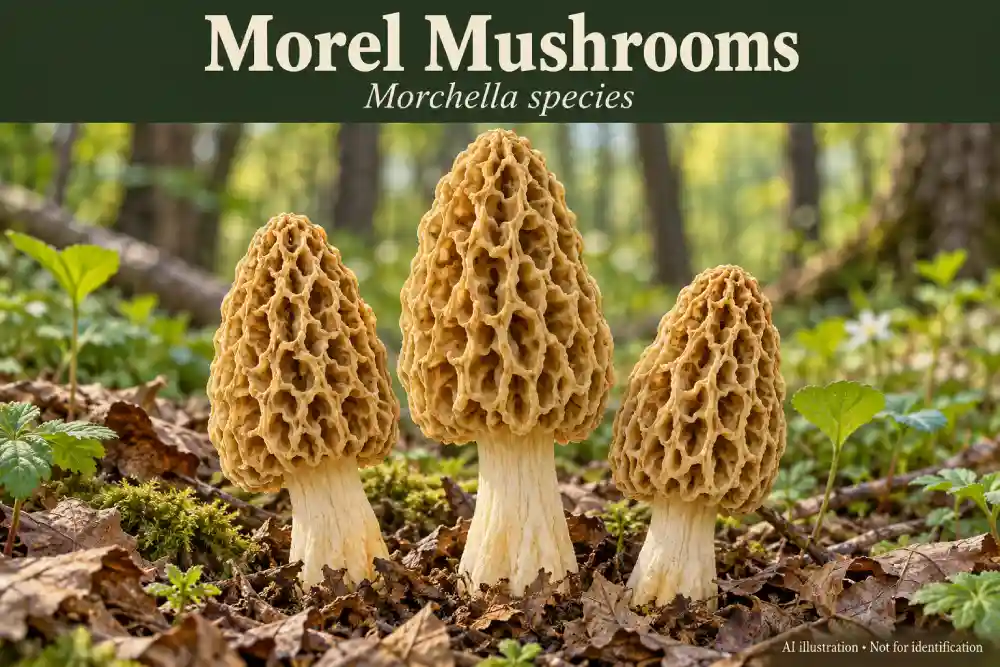
May is an important morel month in Wisconsin, although warmer locations may produce earlier mushrooms and cooler areas may continue into early June. Woodland near dead or dying elms is a useful habitat association to study. Moisture and warming temperatures influence fruiting, but a suitable tree does not guarantee a successful search.
- Scientific group: Morchella species.
- Typical season: Spring.
- Common habitat: Woodland soil, including areas near dying elms.
- Features to study: Cap pits, internal structure and cap attachment.
- Important caution: False morels require careful comparison. A hollow interior alone does not establish identity, and true morels must be thoroughly cooked.
2. Chanterelle Mushrooms
Chanterelles grow from forest soil in association with living trees. Many have yellow or orange caps with uneven, wavy edges. Their undersides may have blunt, branching ridges rather than true gills, although some species have a relatively smooth underside.
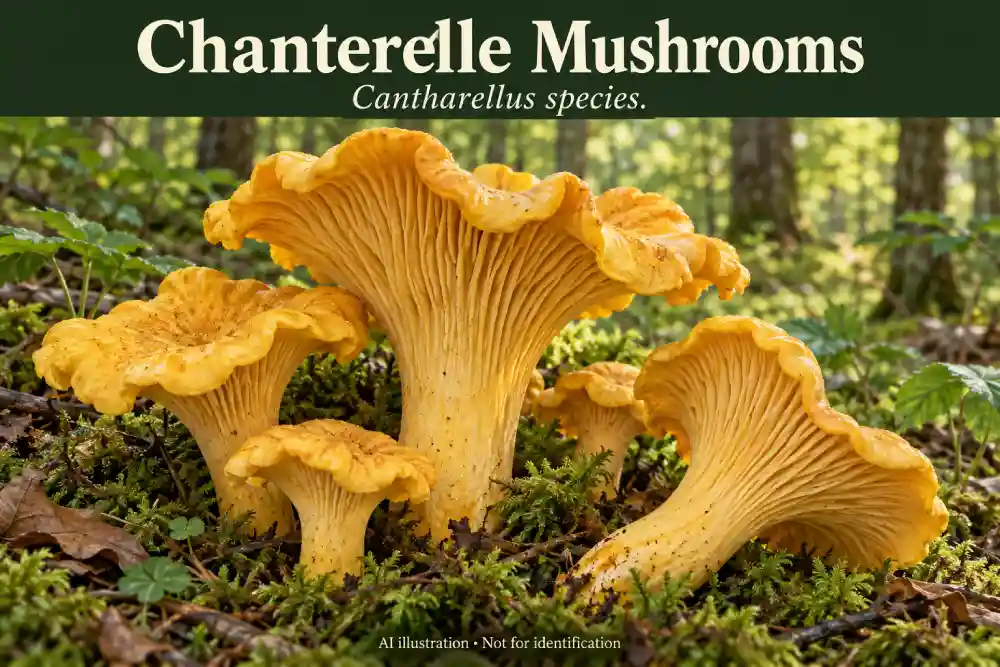
They are summer mushrooms in Wisconsin, sometimes continuing into early fall when conditions remain suitable. The poisonous jack-o’-lantern is an important lookalike because it can share similar orange coloring. Its true gills and connection to wood require careful examination, especially when that wood is buried.
- Scientific group: Cantharellus species.
- Typical season: Summer into early fall.
- Common habitat: Woodland ground near associated living trees.
- Features to study: Underside ridges, flesh, substrate and growth pattern.
- Important caution: Orange color and a fruity smell are not enough to identify an edible chanterelle.
3. Oyster Mushrooms
Oyster mushrooms commonly form overlapping clusters on hardwood trunks and fallen logs. Their fan-shaped caps may be whitish, gray or brownish, depending on the species. Gills extend toward a short, often off-center stem or attachment point.
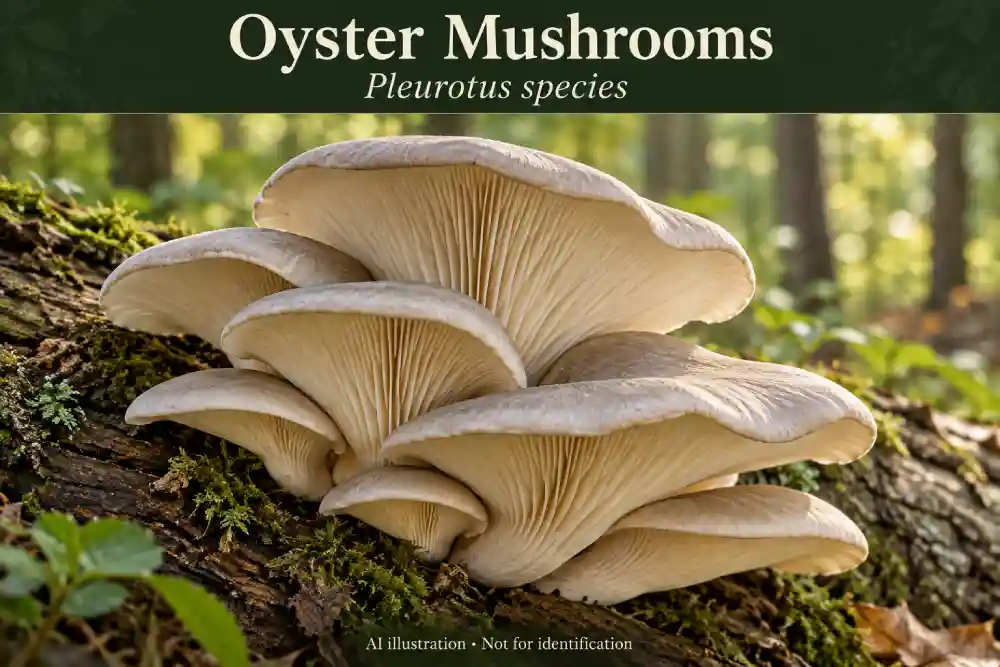
These fungi decompose wood. A log may produce multiple flushes over time while enough suitable material remains, although moisture and temperature determine when fruiting occurs. Several unrelated fungi also produce pale shelves on trees, making the underside essential to examine.
- Scientific group: Pleurotus species.
- Typical season: Different species fruit from spring through fall.
- Common habitat: Dead or declining hardwood trees and logs.
- Features to study: Cap shape, descending gills and stem attachment.
- Important caution: A fan-shaped cap growing on wood does not automatically identify an oyster mushroom.
4. Hen of the Woods
Hen of the woods, also known as maitake, forms a branching cluster of smaller, overlapping gray-brown caps. The layered appearance resembles feathers, while the underside contains tiny pores rather than gills.
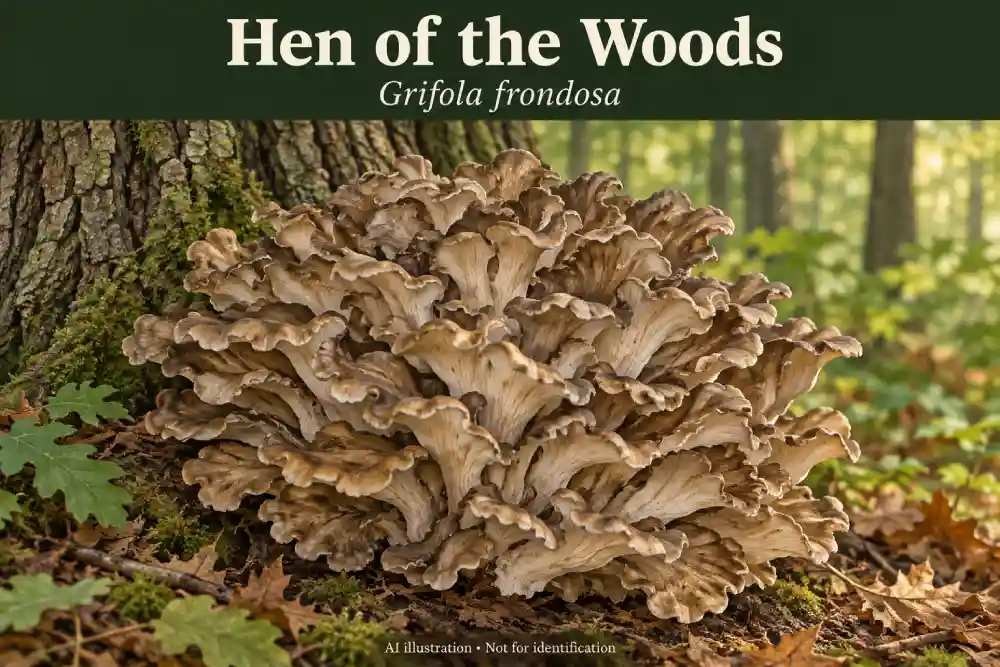
In Wisconsin, this mushroom is strongly associated with oak bases during fall. Its many caps connect through a shared branching structure. Studying that structure helps distinguish it from unrelated mushrooms growing close together around the same tree.
- Scientific name: Grifola frondosa.
- Typical season: Late summer and fall, especially autumn.
- Common habitat: Oak bases and associated roots.
- Features to study: Overlapping caps, branching base and pore surface.
- Important caution: Other polypores form rosettes; proximity to an oak is not a complete identification.
5. Chicken of the Woods
Chicken of the woods produces orange to yellow shelves on trees, stumps or decaying roots. Young growth is softer and more flexible, while mature shelves often become tough, dry or crumbly. The underside has pores whose color varies among species.
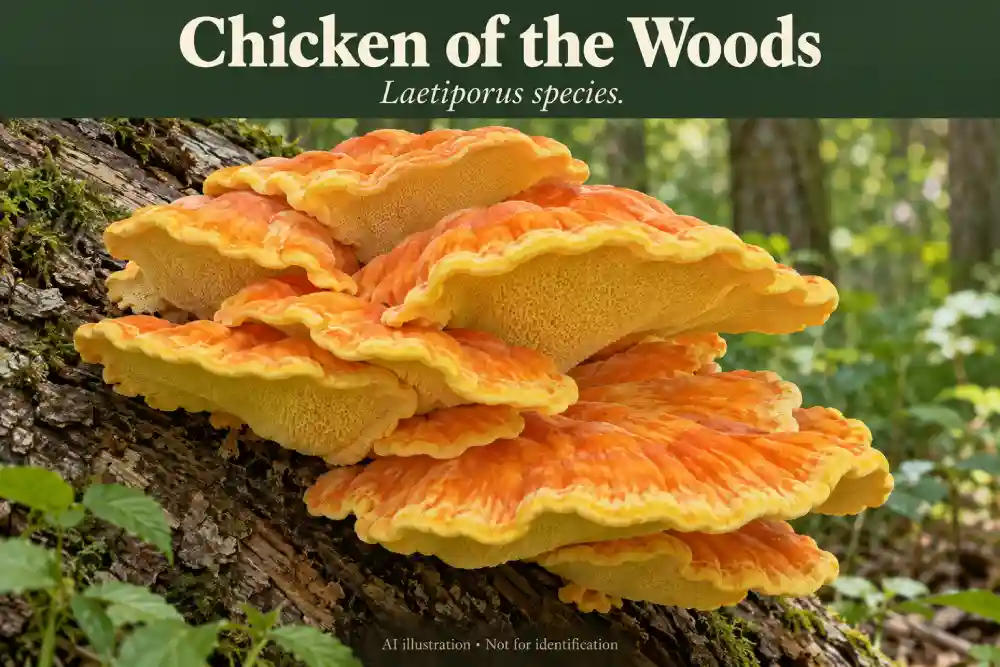
The common name covers several Laetiporus species. Host-tree identification matters, particularly because conifer-associated collections have raised greater concern about adverse reactions. Some people also react to correctly identified hardwood-associated specimens.
- Scientific group: Laetiporus species, including L. sulphureus and L. cincinnatus.
- Typical season: Summer and fall.
- Common habitat: Tree trunks, stumps and decaying roots.
- Features to study: Shelf arrangement, pore color, texture and host tree.
- Important caution: Obtain species-level guidance and cook thoroughly. Not every orange bracket fungus is edible.
6. Giant Puffball
Giant puffballs produce rounded fruiting bodies that can become conspicuously large. They occur in grassy areas, open woodland and edges, without the exposed cap-and-stem structure seen in many familiar mushrooms.
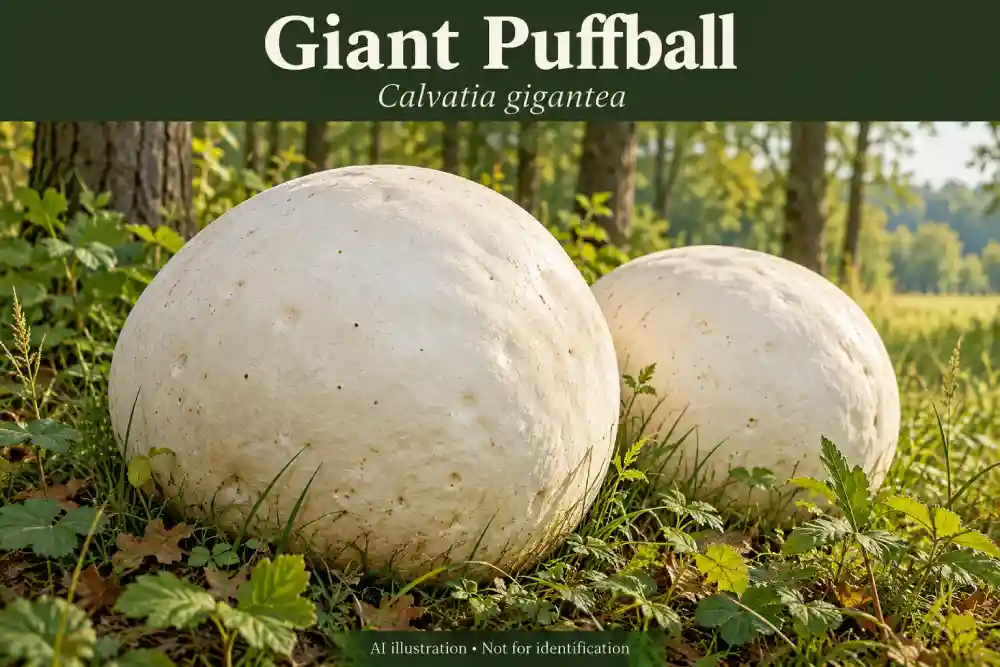
A correctly identified giant puffball considered for food must have a uniformly white, firm interior. Yellowing, darkening or powdery tissue indicates that it is no longer at the appropriate stage. A full cross-section also helps reveal internal structures that would rule out a puffball.
- Scientific name: Calvatia gigantea.
- Typical season: Summer and fall.
- Common habitat: Grassy ground and woodland edges.
- Features to study: Outer surface and complete interior.
- Important caution: Developing cap, stem or gill structures rule out a true puffball. White flesh alone does not prove safety.
7. Black Trumpet Mushrooms
Black trumpets are thin, hollow mushrooms with dark gray, brown or nearly black coloring. Their funnel-shaped bodies blend into leaf litter, making them easy to overlook even when several grow nearby.
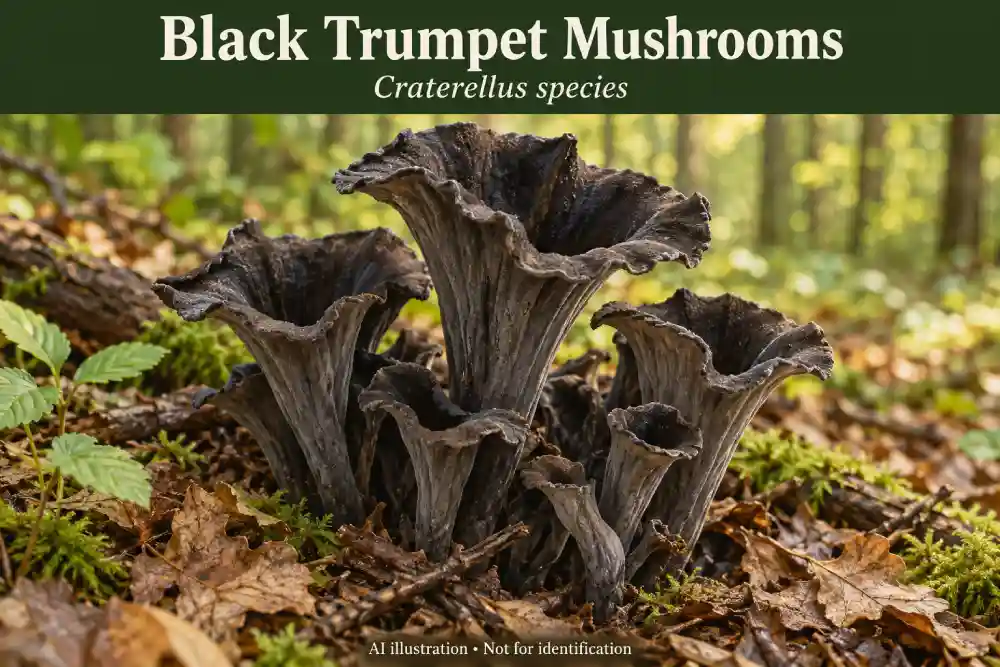
Their outer spore-bearing surface lacks the obvious blade-like gills of many other mushrooms. Examining their full shape, texture and outer surface is more informative than recognizing a dark silhouette among the leaves.
- Scientific group: Craterellus species, including C. fallax.
- Typical season: Summer into fall.
- Common habitat: Woodland ground among leaves and moss.
- Features to study: Hollow form, thin flesh and outer surface.
- Important caution: Dark color and trumpet shape are supporting clues, not a complete identification.
8. Hedgehog Mushrooms
Hedgehog mushrooms have a cap and stem, but small, downward-pointing teeth replace the gills underneath. Depending on the species, the caps may be cream, buff or orange-toned.
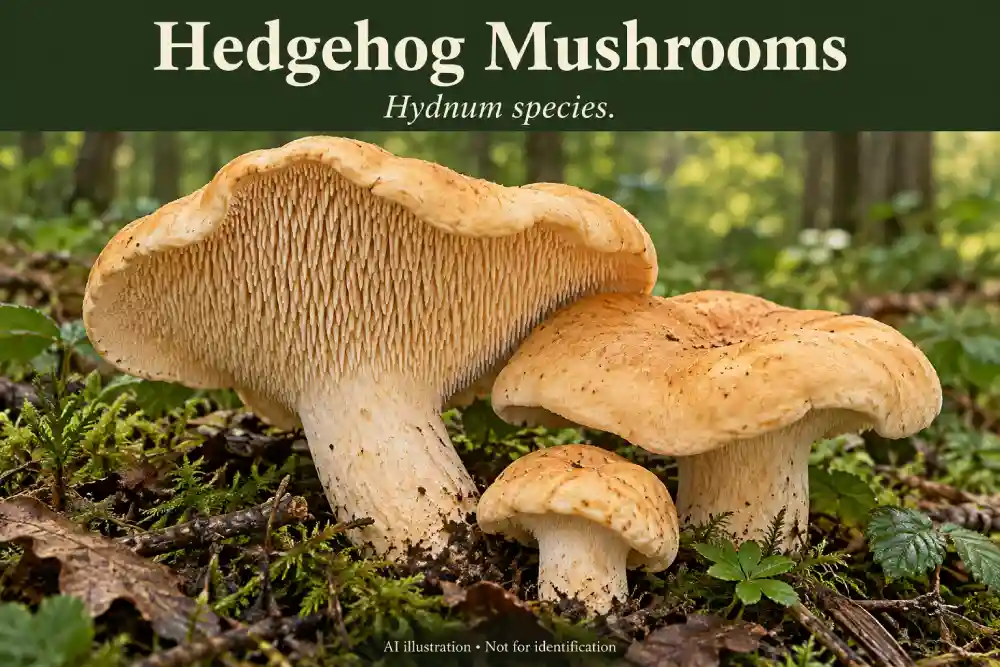
Wisconsin hedgehogs include multiple Hydnum species. Older field guides sometimes apply European names broadly to North American mushrooms, so recognizing the group does not always establish the exact species.
- Scientific group: Hydnum species.
- Typical season: Summer and fall.
- Common habitat: Forest soil around associated trees.
- Features to study: Underside teeth, cap, stem and flesh.
- Important caution: Not every tooth-bearing fungus is an edible Hydnum.
9. Lion’s Mane
Lion’s mane produces a compact mass of hanging spines rather than a conventional cap with gills. It grows on hardwood, sometimes emerging from wounds in standing trees or from recently dead wood.
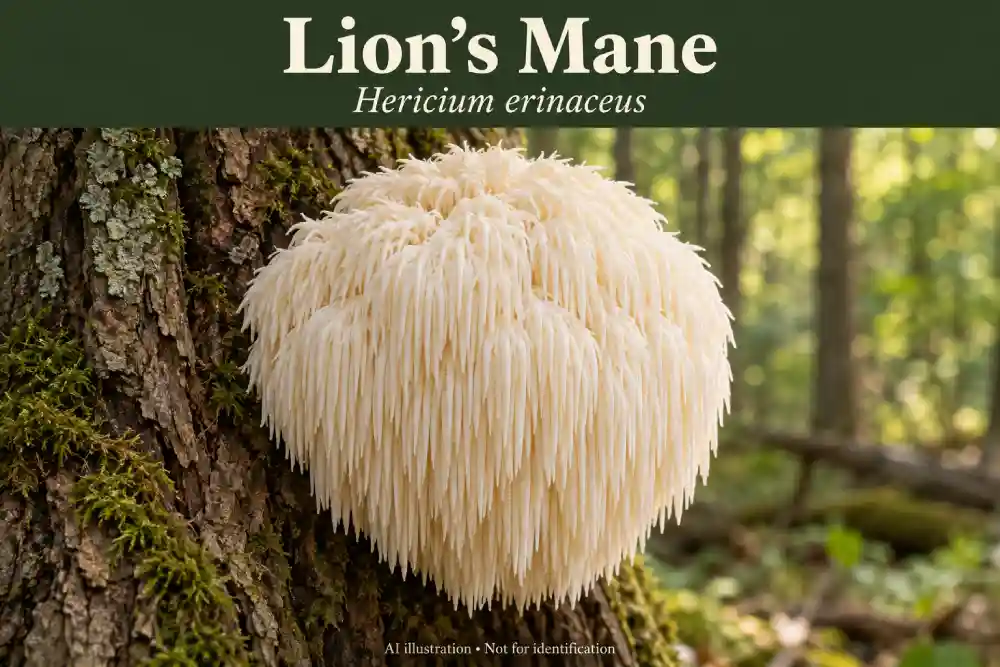
Mature lion’s mane usually has a less-branched structure than its close relatives. Young Hericium specimens can be difficult to separate because their branching patterns and spine lengths are not yet fully developed.
- Scientific name: Hericium erinaceus.
- Typical season: Late summer and fall.
- Common habitat: Hardwood trunks and recently dead hardwood.
- Features to study: Compact structure, hanging spines and wood attachment.
- Important caution: A white, shaggy appearance alone does not confirm lion’s mane.
10. Comb Tooth Mushroom
Comb tooth is a branching relative of lion’s mane. Its pale branches carry hanging teeth, creating a delicate structure that can resemble an elaborate piece of coral.
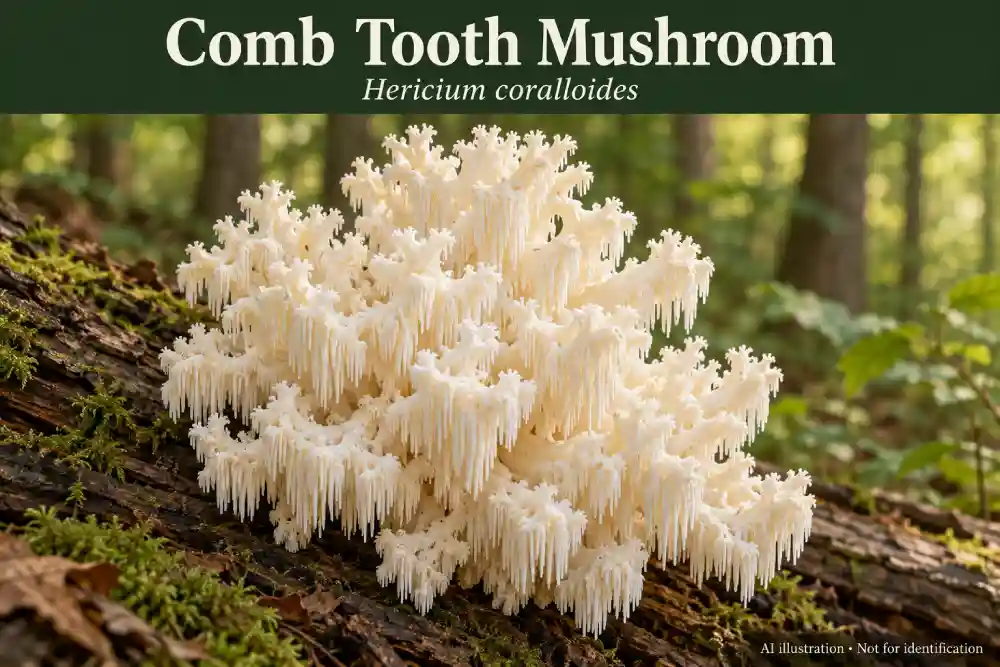
It grows on decaying hardwood and contributes to decomposition. Although related to lion’s mane, it is a distinct species. Learning its branching structure helps prevent the common mistake of labeling every white Hericium mushroom as lion’s mane.
- Scientific name: Hericium coralloides.
- Typical season: Summer and fall.
- Common habitat: Dead hardwood logs and other woody material.
- Features to study: Branch arrangement and hanging teeth.
- Important caution: Do not confuse it with unrelated upright coral fungi simply because both have branches.
11. Shaggy Mane
Shaggy manes have elongated pale caps covered with shaggy scales. As they mature, the gills darken and the cap begins dissolving into an inky liquid. This process is called deliquescence.
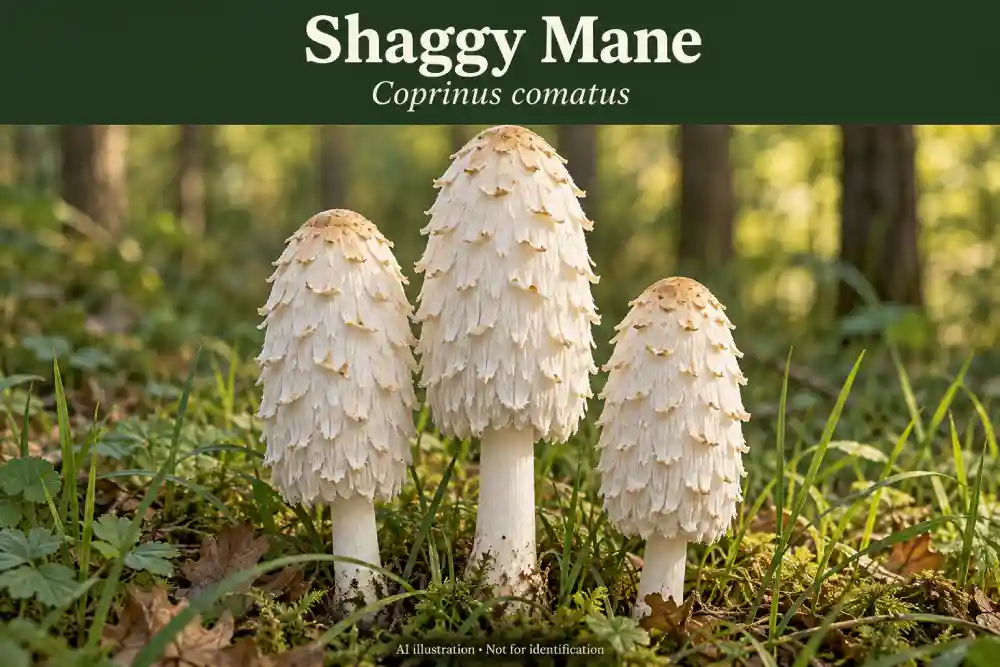
They occur in grassy and disturbed ground, sometimes appearing after suitable rain. Their rapid deterioration makes condition particularly important. Specimens already liquefying should not be collected as food.
- Scientific name: Coprinus comatus.
- Typical season: Spring through fall.
- Common habitat: Lawns, grassy areas and disturbed soil.
- Features to study: Elongated cap, scales and age-related changes.
- Important caution: “Ink cap” refers to several different mushrooms, not one interchangeable edible group.
12. Pheasant Back Mushroom
Pheasant back, also called dryad’s saddle, develops broad caps patterned with darker scales. These markings resemble feathers. Its underside has pores rather than gills.
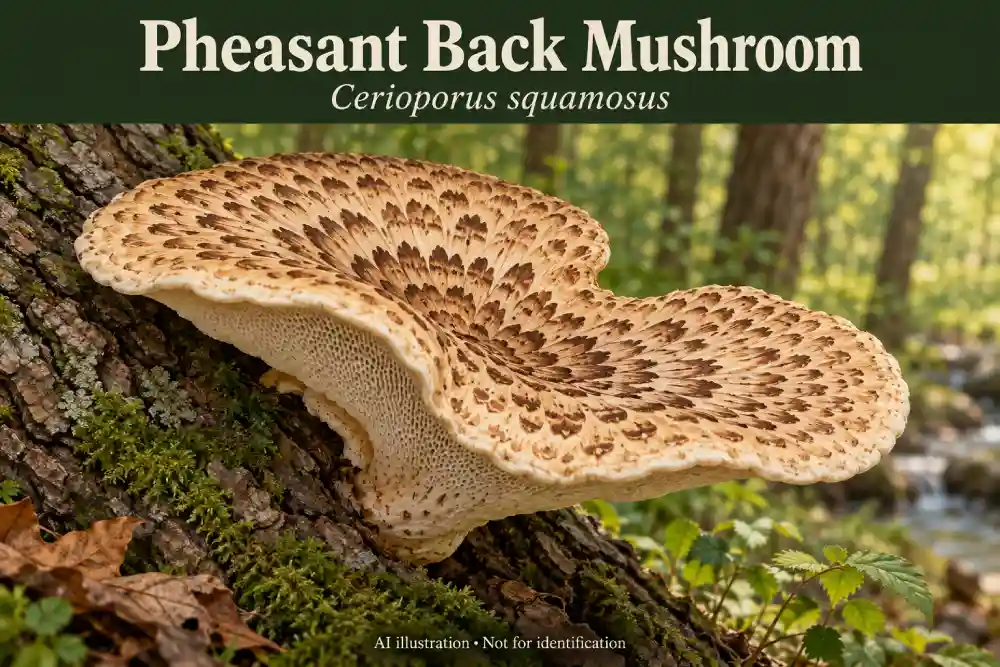
This hardwood-growing mushroom is frequently noticed during spring outings. Young, tender growth is more useful in cooking than large mature specimens, which become leathery. A cucumber- or watermelon-rind-like smell may be present, but should not be used alone for identification.
- Scientific name: Cerioporus squamosus, formerly Polyporus squamosus.
- Typical season: Spring through fall.
- Common habitat: Hardwood trunks, logs and stumps.
- Features to study: Cap scales, pores and stem attachment.
- Important caution: Large size does not indicate good eating quality; mature tissue can be very tough.
13. Lobster Mushroom
A lobster mushroom results from one fungus parasitizing another. Hypomyces lactifluorum infects certain host mushrooms, typically members of Russula or Lactifluus, changing their surface and shape.
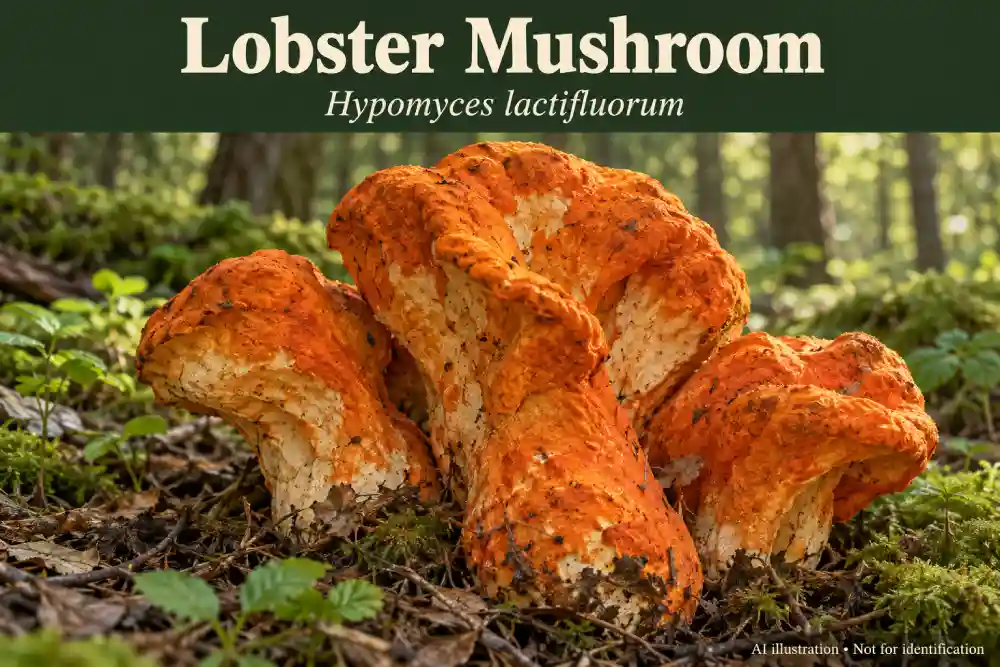
The resulting mushroom often has a firm orange exterior and an irregular form. Identification must establish the correct parasite-host product, rather than simply recognizing an orange or distorted mushroom on the forest floor.
- Scientific association: Hypomyces lactifluorum on an appropriate host.
- Typical season: Summer and fall.
- Common habitat: Woodland ground where host mushrooms grow.
- Features to study: Surface coating, overall structure and condition.
- Important caution: Orange color or deformation alone does not establish a lobster mushroom identification.
14. King Bolete or Porcini
King boletes belong to the Boletus edulis group. They generally have substantial stems and a sponge-like pore surface beneath the cap. Many have brown caps and fine netlike markings on part of the stem.
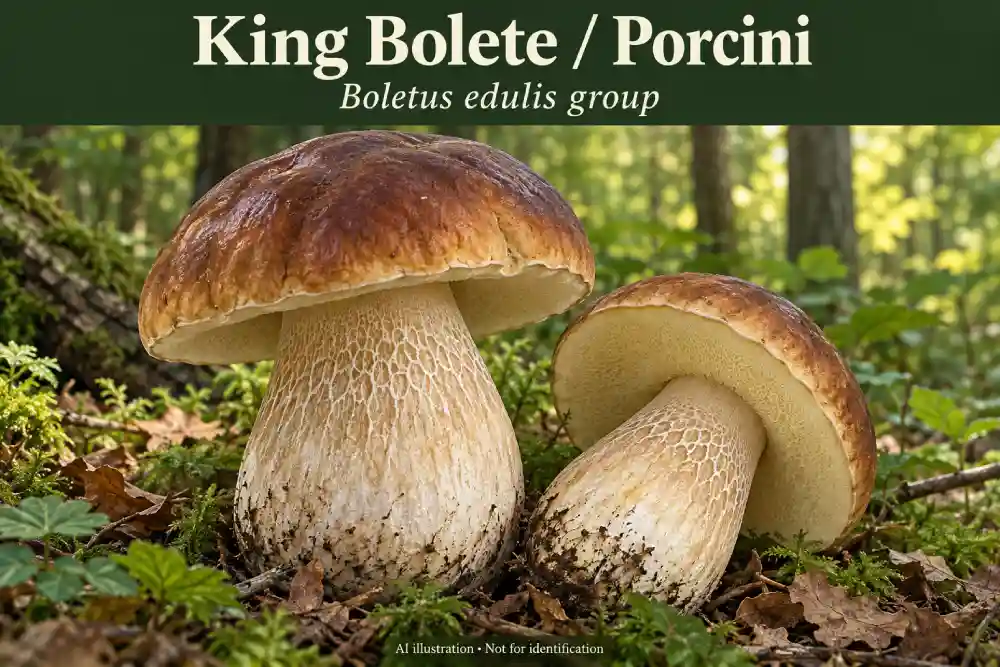
North American porcini include several related species. Tree associations, pore development and stem characteristics all matter, and European descriptions should not be applied uncritically to Wisconsin collections.
- Scientific group: Boletus edulis group.
- Typical season: Summer and fall.
- Common habitat: Soil around associated hardwoods or conifers.
- Features to study: Pores, stem markings, flesh and nearby trees.
- Important caution: Not all boletes are edible. No single bruising-color rule reliably separates every edible and poisonous species.
15. Elm Oyster Mushroom
The elm oyster belongs to Hypsizygus, rather than the true oyster genus Pleurotus. It often develops a substantial stem supporting a pale cap, giving it a different overall structure from many familiar oysters.
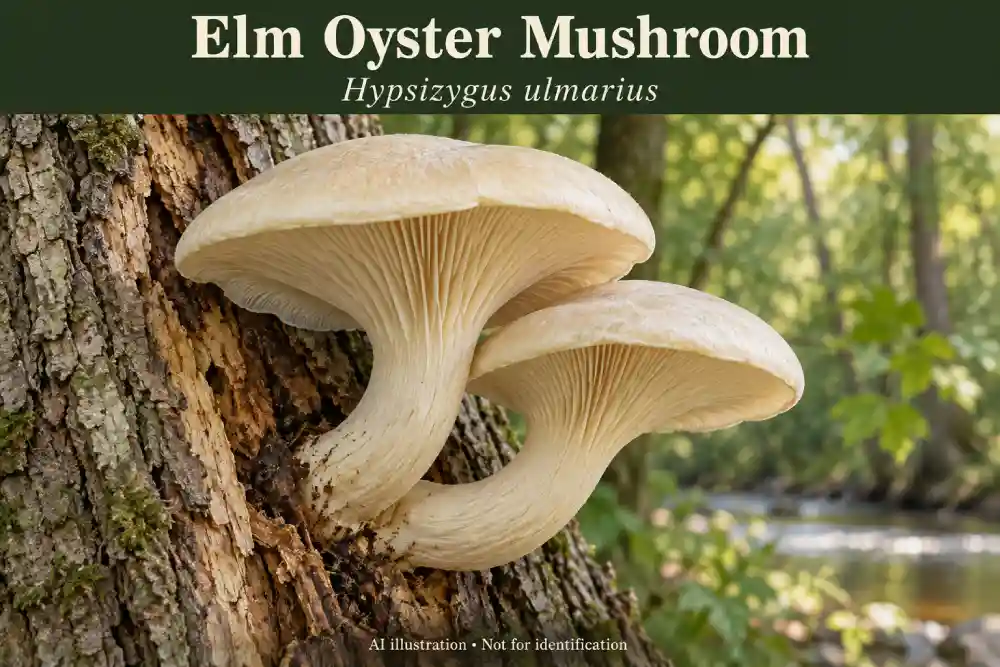
It can emerge from wounds and old branch scars on hardwoods, including elm and box elder. Its gill attachment differs from the strongly descending gills typical of true oysters.
- Scientific name: Hypsizygus ulmarius.
- Typical season: Most often late summer and fall.
- Common habitat: Hardwood wounds and branch scars.
- Features to study: Stem structure, gill attachment and host tree.
- Important caution: A pale mushroom on an elm is not automatically an elm oyster.
16. Wine Cap Mushroom
Wine caps, also called king stropharia, grow in wood chips, mulch and other organic material. Fresh caps can be wine-red or reddish-brown, but may fade considerably as they age.
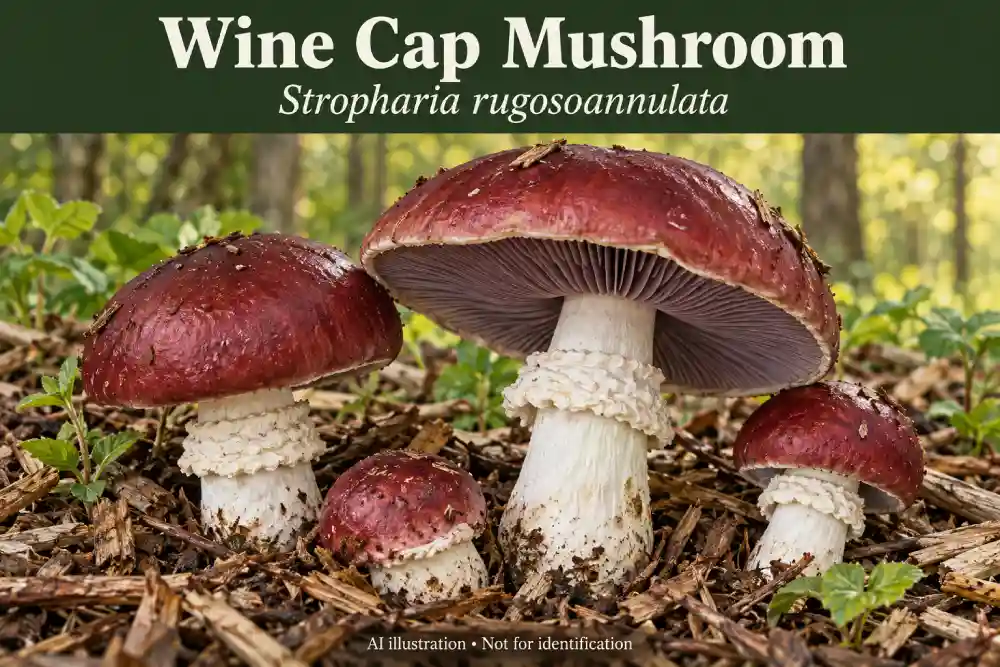
These decomposer fungi are also cultivated in outdoor beds, making them relevant to Wisconsin gardeners. However, an inoculated bed can support other fungi alongside the intended crop, so every collection still needs identification.
- Scientific name: Stropharia rugosoannulata.
- Typical season: Spring through fall when conditions are suitable.
- Common habitat: Wood-chip beds, gardens and organic debris.
- Features to study: Gill color, substantial stem ring and changing cap color.
- Important caution: Growing in a wine-cap bed does not prove that every mushroom there is a wine cap.
17. Wood Blewit
Wood blewits may have lilac or purple tones when fresh, but these colors can fade toward tan or brown. They grow in organic debris, including woodland litter and compost-rich settings.
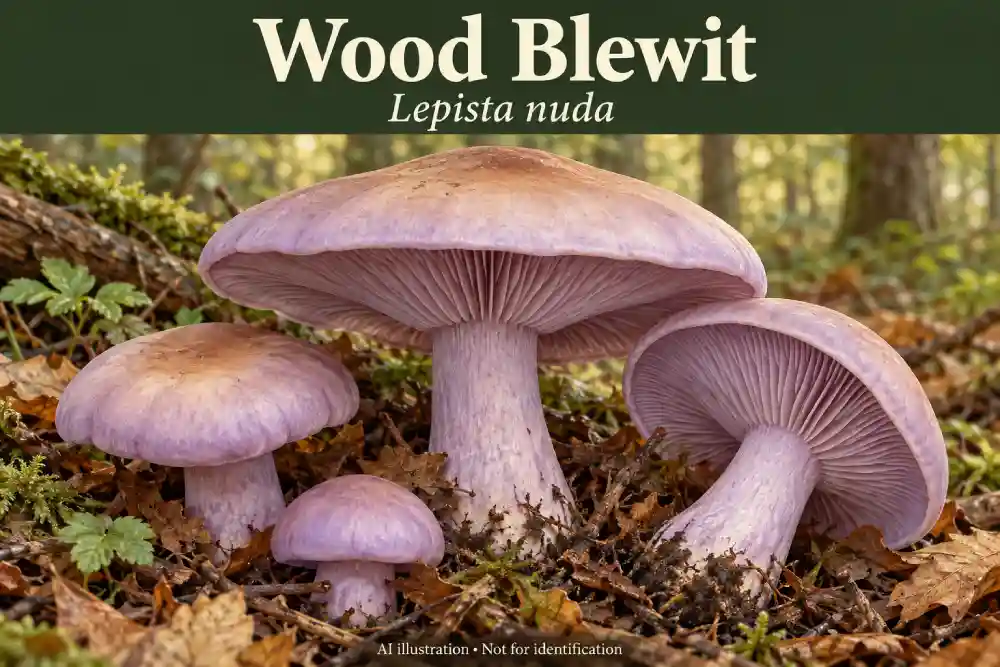
Blewits require more advanced identification skills. Purple Cortinarius species can resemble them, and some members of that genus are dangerously poisonous. The complete specimen, spore characteristics and evidence of a veil need careful assessment.
- Scientific names used in guides: Lepista nuda and Clitocybe nuda.
- Typical season: Late summer and fall.
- Common habitat: Leaf litter and accumulated organic matter.
- Features to study: Gills, spore print, veil features and color changes.
- Important caution: Purple color is not a sign of edibility.
18. Crown-Tipped Coral Mushroom
Crown-tipped coral produces branching, pale fruiting bodies on decaying hardwood. Its branch tips have small cup-like depressions surrounded by points, creating the crown-shaped appearance behind its common name.
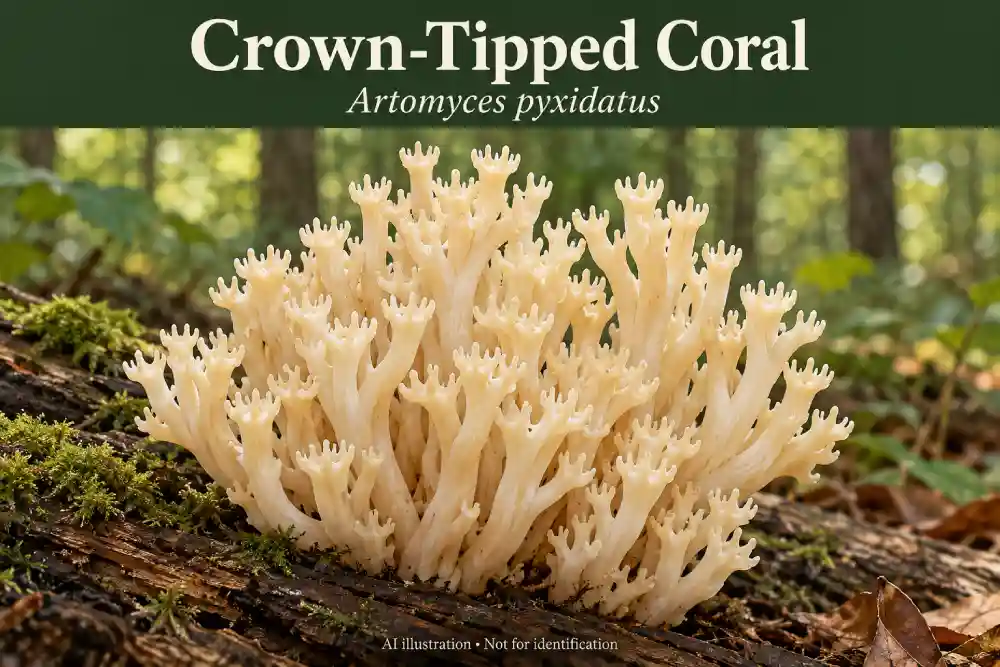
The substrate is useful to record because many other coral-like fungi grow from soil. Nevertheless, pale color and branching growth alone do not establish this species.
- Scientific name: Artomyces pyxidatus.
- Typical season: Spring through fall.
- Common habitat: Decaying hardwood.
- Features to study: Crown-shaped tips, branching pattern and wood attachment.
- Important caution: Do not generalize its edibility to other coral mushrooms.
19. Shrimp of the Woods
Shrimp of the woods refers to irregular pale masses associated with Entoloma abortivum parasitizing Armillaria mushrooms. Older accounts sometimes described this relationship in reverse, but research supports Entoloma as the parasite.
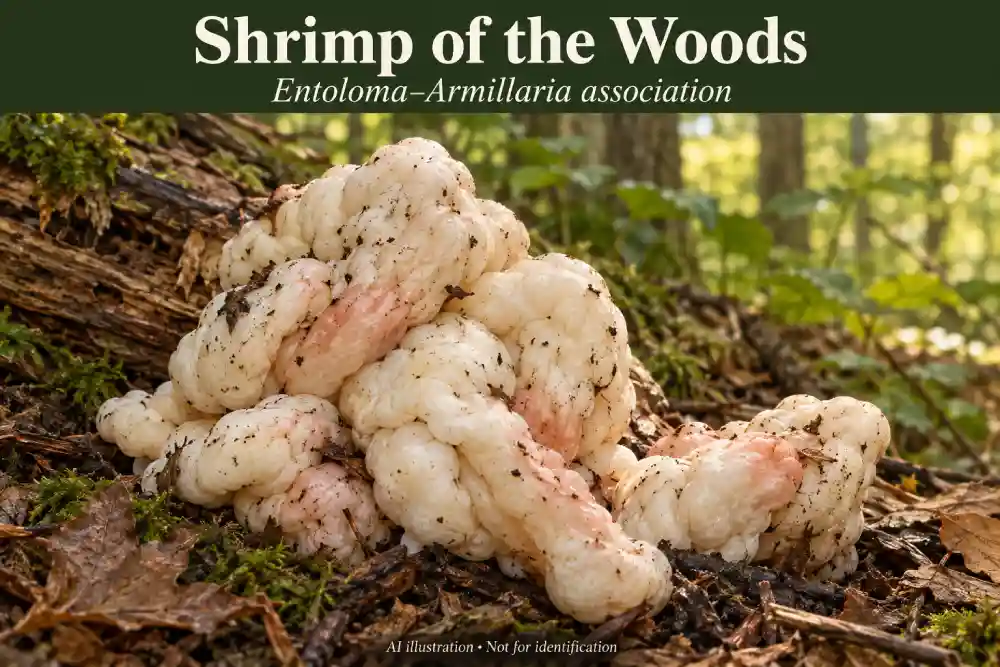
These malformed structures can occur near decaying wood alongside normally formed mushrooms. They require careful identification because neither a pale lump nor a nearby gray mushroom establishes that a collection is suitable for food.
- Scientific association: Entoloma abortivum interacting with Armillaria.
- Typical season: Late summer and fall.
- Common habitat: Hardwood forest near decaying wood.
- Features to study: Structure of the malformed masses and surrounding fungi.
- Important caution: This is an advanced identification subject. Many other Entoloma species are poisonous.
20. Resinous Polypore
Resinous polypore produces brown bracket-like fruiting bodies on dead hardwood. Young growth can be soft and fleshy, while older specimens become tough and leathery.
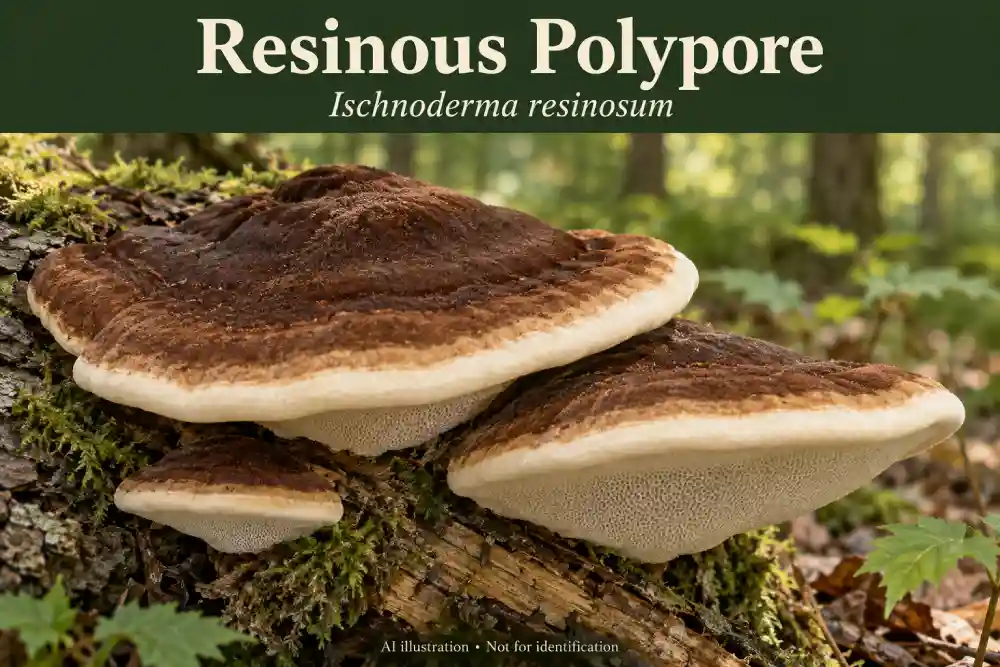
Its pale young pore surface bruises brown. Although recognized among Wisconsin’s food mushrooms, its culinary usefulness depends heavily on finding correctly identified, tender growth rather than mature woody brackets.
- Scientific name: Ischnoderma resinosum.
- Typical season: Fall.
- Common habitat: Dead hardwood logs and trunks.
- Features to study: Cap zones, growing margin, pore surface and host wood.
- Important caution: Similar-looking brackets should not be treated as interchangeable edible mushrooms.
When Is Mushroom Season in Wisconsin?
Wisconsin does not have one universal mushroom season. Morels are associated with spring, while hen of the woods is primarily an autumn mushroom. Many other species appear during summer and fall when moisture and temperature are suitable.
Use this table as a broad planning guide rather than a fixed harvest calendar.
| Season | Mushrooms to study | Habitat focus |
|---|---|---|
| Spring | Morels, pheasant back and some oysters | Woodland soil and hardwood logs |
| Early to midsummer | Chanterelles, oysters and chicken of the woods | Moist forest and decaying wood |
| Late summer | Black trumpets, lobsters, king boletes and hedgehogs | Forest floor and tree associations |
| Fall | Hen of the woods, blewits, resinous polypore and Hericium species | Oak bases, leaf litter and hardwood |
| Suitable periods throughout the growing season | Wine caps and shaggy manes | Mulch, organic debris and grassy ground |
Southern Wisconsin and the northern part of the state may fruit at different times. Prolonged dryness can also reduce visible mushrooms even when the habitat is otherwise suitable.
Where to Look for Edible Mushrooms in Wisconsin?
Matching a mushroom to its ecological setting is more useful than searching randomly. Start by observing the trees, ground cover and available dead wood.
| Habitat | Associated mushrooms | Useful observations |
|---|---|---|
| Hardwood logs and trunks | Oysters, pheasant back, comb tooth and resinous polypore | Tree type, decay stage and attachment |
| Oak bases and roots | Hen of the woods | Connection to roots or wood |
| Forest floor near living trees | Chanterelles, hedgehogs and king boletes | Nearby tree species and soil conditions |
| Leaf litter and organic debris | Blewits | Substrate and complete specimen |
| Wood-chip beds | Wine caps | Mulch type and individual mushroom features |
| Grassy areas and woodland edges | Giant puffballs and shaggy manes | Land treatment history and specimen condition |
A habitat association narrows the possibilities. It never replaces identification.
How to Study a Mushroom Before Considering It for Food?
Photograph the mushroom in place before collecting it, where collection is permitted. Record whether it grew from soil, exposed wood or buried material, and photograph the underside as well as the cap.
A useful observation record includes:
- Cap: Shape, texture, color and changes with age.
- Underside: Gills, pores, ridges or teeth.
- Stem: Position, surface markings, ring and complete base.
- Flesh: Internal structure and any color changes.
- Growth pattern: Solitary, scattered, clustered or joined.
- Substrate: Soil, leaf litter, wood chips or a particular tree.
- Spore print: A supporting feature interpreted alongside the others.
An identification app can help organize questions, but should not authorize consumption. Missing stem bases, hidden structures and poor photographs can lead to confident but incorrect answers.
Important Poisonous Lookalike Concerns
| Edible mushroom being studied | Potential confusion | Why a shortcut is unsafe |
|---|---|---|
| Morels | False morels and other spring fungi | Wrinkles and a hollow stem are insufficient |
| Chanterelles | Jack-o’-lantern mushrooms | Both may appear orange |
| Puffballs | Immature enclosed gilled mushrooms | The outside can conceal developing structures |
| Blewits | Purple Cortinarius species | Similar colors occur in unrelated fungi |
| Oyster mushrooms | Other pale wood-growing fungi | Fan shape is shared by multiple groups |
| Crown-tipped coral | Other coral-like fungi | Branching form does not establish species |
These comparisons show what requires investigation. They are not a checklist for approving a mushroom as food.
Can You Pick Mushrooms in Wisconsin State Parks?
Wisconsin DNR’s gathering guidance allows wild mushrooms to be picked by hand for personal consumption in the state parks and forests covered by that guidance.
This does not establish permission for every municipal park, county property, nature preserve or federal site. Check the rules for the specific location and obtain permission before entering private land. Commercial collecting and selling involve separate requirements.
When collecting is allowed:
- Avoid damaging trees, logs and surrounding plants.
- Take only what you can reasonably use or study.
- Keep different species separate.
- Record the habitat before removing a specimen.
- Respect property boundaries and restricted areas.
How to Handle and Prepare Correctly Identified Mushrooms?
After expert identification, condition and preparation still matter. Reject rotten, slimy or badly deteriorated specimens. Avoid collecting from contaminated ground or areas with an uncertain chemical-treatment history.
Use breathable containers, keep the collection cool and refrigerate promptly. Do not leave damp mushrooms sealed in warm plastic.
- Remove debris and inspect for deterioration.
- Follow preparation guidance appropriate to the species.
- Cook wild edible mushrooms thoroughly.
- Introduce a confirmed edible species in a small cooked portion.
- Stop eating it if an adverse reaction occurs.
A small portion is not a test for poison. It is only a precaution against individual intolerance after the mushroom has been positively identified.
How to Learn Mushroom Identification Locally?
Guided forays and identification workshops let you examine real specimens in their habitats. The Wisconsin Mycological Society and Madison Mycological Society offer regional learning resources and activities.
Bring clear photographs, habitat notes and complete specimens when collection is permitted. Ask which characteristics support the identification and which lookalikes must be excluded. Learning a few species thoroughly is more useful than memorizing a long list of edible names.
Frequently Asked Questions
What are the best-known edible mushrooms in Wisconsin?
Morels, chanterelles, oyster mushrooms, hen of the woods and chicken of the woods are among the most familiar. Their popularity does not mean every similar-looking mushroom is safe.
Are hen of the woods and chicken of the woods the same?
No. Hen of the woods is Grifola frondosa, with many smaller gray-brown caps. Chicken of the woods belongs to Laetiporus and forms larger orange or yellow shelves.
Are lion’s mane and comb tooth the same mushroom?
No. They are related Hericium species. Lion’s mane generally forms a compact mass of hanging spines, while comb tooth has a branching structure.
Are all mushrooms growing on wood edible?
No. Edible, inedible and poisonous fungi grow on wood. The substrate is one identification clue, not an edibility rule.
Can edible mushrooms grow in a Wisconsin yard?
Yes, but their location does not establish safety. Identification, chemical treatments, contamination and specimen condition all need consideration.
What is the best time to look for morels in Wisconsin?
May is an important month, but timing varies with location and weather. Some warmer areas produce earlier morels, while cooler locations may continue into early June.
Does drying or cooking destroy mushroom toxins?
Not reliably. Processing an unidentified mushroom does not make it safe.
Can you rely on an AI tool to identify edible mushrooms?
No. AI tools may help explain terminology or compare observations, but they should not determine whether a wild mushroom can be eaten. Use qualified local expertise.
What should you do after eating a suspected poisonous mushroom?
Call U.S. Poison Control at 1-800-222-1222 immediately. Do not wait for symptoms, because some serious poisonings have delayed effects. Call 911 for a life-threatening emergency.
Sign in to leave a comment and join the discussion.
 Species Guide
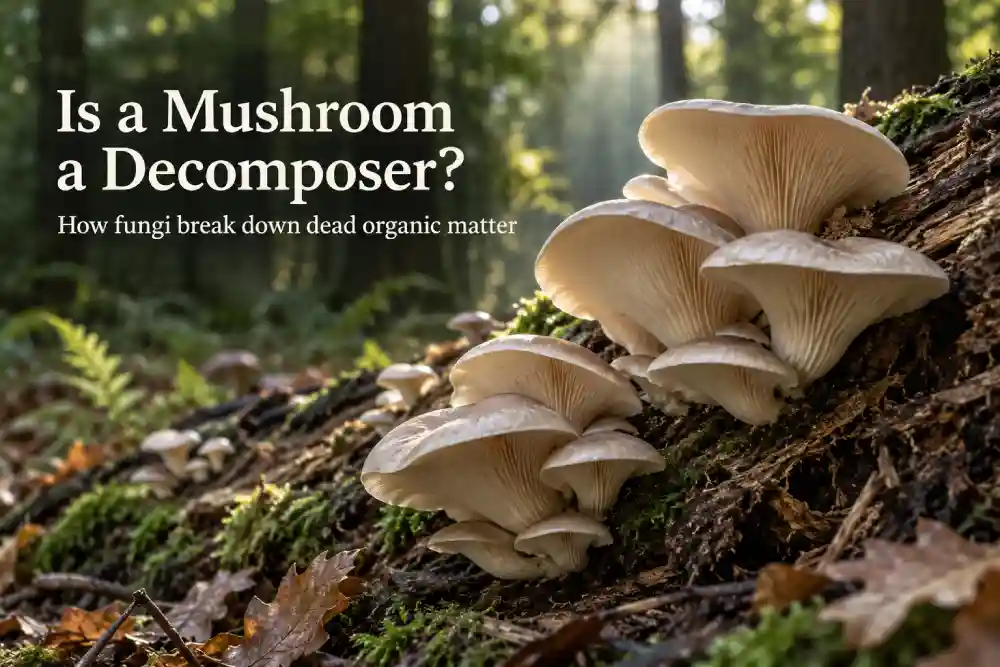
Is a Mushroom a Decomposer? Yes, many mushroom-forming fungi are decomposers. They break down dead wood, fallen leaves and other organic material, helping...
 Species Guide
If you're looking for edible mushrooms in Iowa, you'll find a surprising variety of delicious wild fungi growing in forests, river valleys, woodlands, and...
 Species Guide
Washington State is home to some of North America's most dangerous wild mushrooms, including the Death Cap ( Amanita phalloides ), Destroying Angel (...