Edible Wild Mushrooms in New Mexico: Identification, Habitat, and Foraging Guide

Nathan Cole
Mycologist · Author · Fungi Expert
Updated
Aug 22, 2026
New Mexico is home to a surprising variety of edible wild mushrooms, especially during the summer monsoon season when mountain forests come alive with fungal growth. Popular edible species include Morels (Morchella spp.), King Boletes (Boletus edulis), Chanterelles (Cantharellus spp.), Oyster Mushrooms (Pleurotus ostreatus), Puffballs (Calvatia spp.), and Lobster Mushrooms (Hypomyces lactifluorum).
These mushrooms grow throughout New Mexico's national forests, mountain ranges, and riparian woodlands, making the state a rewarding destination for mushroom foragers.
What Are the Best Edible Wild Mushrooms in New Mexico?
The most sought-after edible mushrooms in New Mexico include:
| Mushroom | Scientific Name | Season | Difficulty |
|---|---|---|---|
| Morel | Morchella spp. | Spring | Intermediate |
| King Bolete | Boletus edulis | Summer-Fall | Beginner |
| Chanterelle | Cantharellus spp. | Summer-Fall | Intermediate |
| Oyster Mushroom | Pleurotus ostreatus | Spring-Fall | Beginner |
| Puffball | Calvatia spp. | Summer-Fall | Beginner |
| Lobster Mushroom | Hypomyces lactifluorum | Summer-Fall | Intermediate |
These species are prized for their flavor, culinary versatility, and abundance in suitable habitats throughout New Mexico.
Why New Mexico Is a Hidden Gem for Mushroom Foraging?
When people think of mushroom hunting, states like Oregon, Washington, or Colorado often come to mind. However, New Mexico offers exceptional mushroom diversity thanks to its unique combination of elevation, climate, and forest ecosystems.
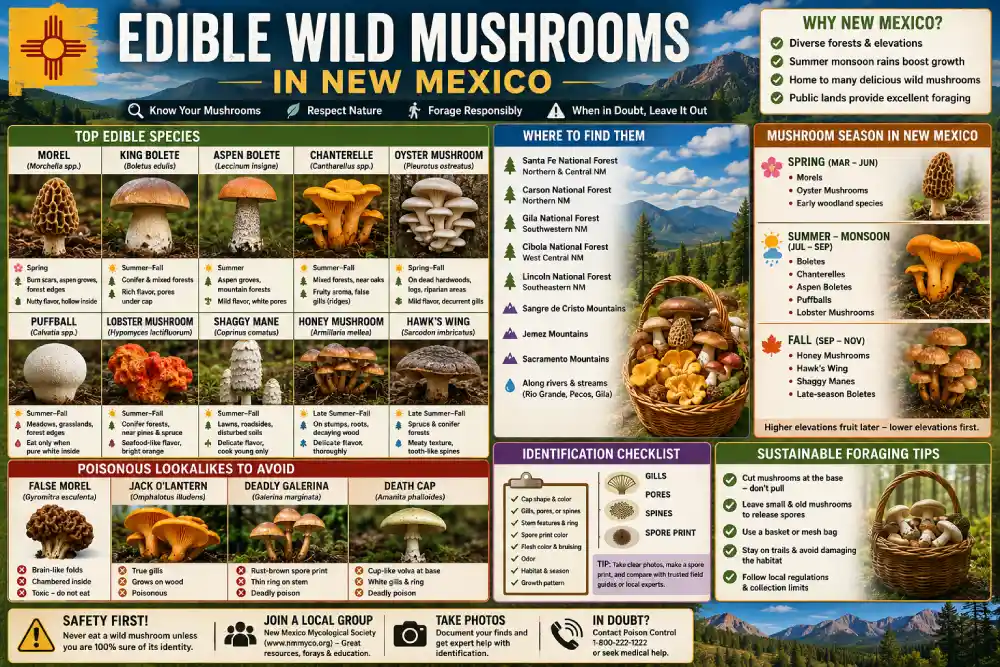
The state's varied landscape includes:
- Ponderosa pine forests
- Aspen groves
- Spruce-fir forests
- Mixed conifer woodlands
- Mountain meadows
- Riparian corridors
These habitats support dozens of edible mushroom species throughout the year.
The Importance of Summer Monsoons
The annual monsoon season is one of the biggest factors influencing mushroom growth in New Mexico.
Typically occurring from July through September, monsoon rains:
- Increase soil moisture
- Trigger mushroom fruiting
- Extend growing seasons
- Support diverse fungal communities
Many experienced foragers schedule trips specifically around monsoon weather patterns because productive mushroom flushes often occur shortly after significant rainfall.
Elevation Creates Diverse Habitats
New Mexico's dramatic elevation changes create multiple mushroom-growing environments.
For example:
- Lower elevations support oak woodlands and grasslands.
- Mid-elevations contain ponderosa pine forests.
- Higher elevations support spruce, fir, and aspen habitats.
Each ecosystem hosts different edible mushroom species, allowing foraging opportunities throughout much of the year.
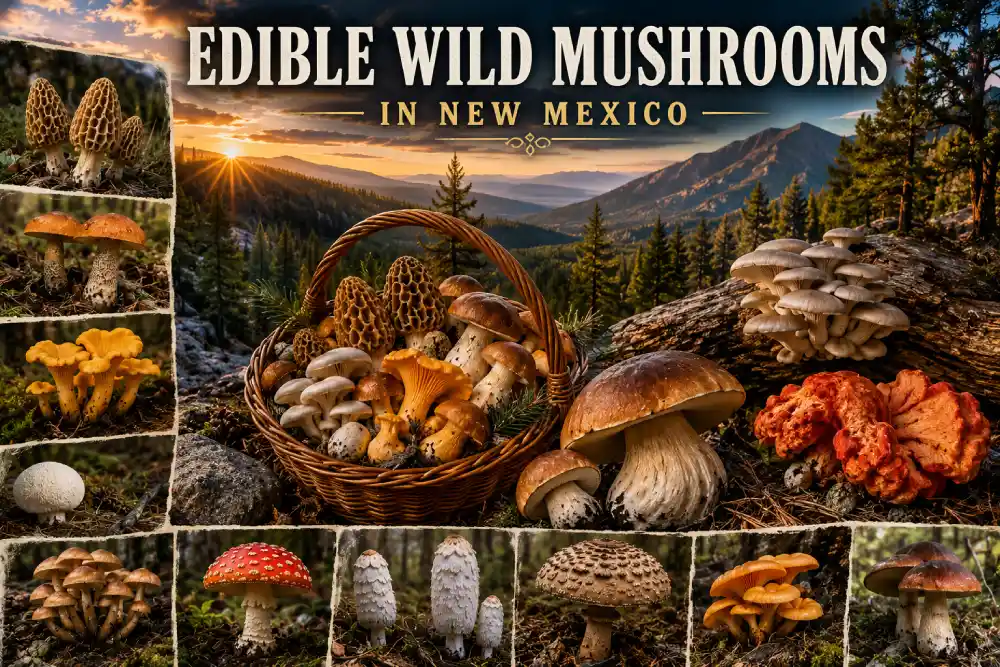
Morel Mushrooms (Morchella)
Few wild mushrooms are as highly prized as morels. Their rich flavor, distinctive appearance, and limited season make them one of the most sought-after mushrooms in North America.
Several morel species occur in New Mexico, particularly in mountainous regions.
Identification Features
Morels are relatively easy to recognize when mature.
Key characteristics include:
- Honeycomb-like cap
- Deep pits and ridges
- Hollow interior
- Cream, tan, gray, or brown coloration
- Cone-shaped or rounded cap
One of the most important identification features is that a true morel is completely hollow from top to bottom when sliced lengthwise.
Habitat in New Mexico
Morels are commonly found:
- In burn scars
- Near aspen groves
- Along forest edges
- In moist mountain forests
- Near creek corridors
Burned forests often produce especially productive morel harvests during the years following wildfires.
Season
Morels generally appear:
- March to June
- Earlier at lower elevations
- Later at higher elevations
Snowmelt and spring moisture play a major role in determining annual production.
Culinary Uses
Morels are valued for their:
- Nutty flavor
- Meaty texture
- Versatility in cooking
Popular preparations include:
- Sautéing in butter
- Cream sauces
- Pasta dishes
- Risottos
- Wild mushroom soups
Dangerous Lookalikes
The primary lookalike is the False Morel (Gyromitra esculenta).
Unlike true morels:
- False morels have brain-like folds.
- The interior is chambered rather than hollow.
- Some species contain dangerous toxins.
Every morel should be cut open before cooking to verify identification.
King Bolete (Boletus edulis
The King Bolete, often called Porcini, is one of the most famous edible mushrooms in the world.
Known for its large size and exceptional flavor, it is a favorite among both chefs and foragers.
Identification Features
King Boletes typically display:
- Large brown cap
- Thick white stem
- Sponge-like pores instead of gills
- White flesh
- Mild mushroom aroma
Unlike many poisonous mushrooms, boletes have pores rather than true gills underneath the cap.
Habitat in New Mexico
King Boletes commonly grow:
- In mixed conifer forests
- Near ponderosa pines
- Under spruce trees
- In mountain woodlands
They form mycorrhizal relationships with tree roots and are often found in the same areas year after year.
Season
King Boletes typically fruit during:
- Summer monsoon season
- Late summer
- Early fall
Productive flushes often occur after consistent rainfall.
Culinary Value
King Boletes are prized because of their:
- Dense texture
- Rich flavor
- Excellent drying qualities
Common uses include:
- Grilling
- Roasting
- Pasta dishes
- Soups
- Mushroom powders
Beginner-Friendly Species
Because of their distinctive pore surface and robust appearance, King Boletes are often considered one of the safer edible mushrooms for beginner foragers to learn.
Aspen Bolete (Leccinum insigne
The Aspen Bolete is another excellent edible mushroom commonly found in New Mexico's mountain forests.
It is particularly associated with aspen trees and can appear in large numbers during favorable weather conditions.
Identification Features
Aspen Boletes generally have:
- Orange cap
- Thick stem
- Dark scab-like scales on the stem
- White pores
- Firm flesh
As the mushroom ages, pore surfaces may darken slightly.
Habitat
Aspen Boletes grow almost exclusively near:
- Aspen groves
- Mountain forests
- Moist woodland habitats
- Mixed conifer-aspen ecosystems
Because of this strong association, locating healthy aspen stands often increases the chances of finding these mushrooms.
Season
Typical fruiting period:
- July through September
- Peak production during monsoon rains
Edibility
Aspen Boletes are considered edible when properly cooked.
Foragers appreciate them for:
- Mild flavor
- Firm texture
- Consistent production
Some people experience digestive sensitivity to certain Leccinum species, so consuming small amounts initially is often recommended.
Similar Species
Several other orange-capped boletes occur throughout North America.
Accurate identification should include:
- Habitat verification
- Stem scale examination
- Pore inspection
- Flesh reaction testing
Chanterelles (Cantharellus Species)
Chanterelles are among the most desirable edible wild mushrooms found in New Mexico. Their fruity aroma, golden color, and excellent culinary qualities make them a favorite of both recreational foragers and professional chefs.
Although not as common as in the Pacific Northwest, chanterelles can be found in suitable mountain habitats throughout New Mexico.
Identification Features
True chanterelles typically have:
- Golden yellow to orange-yellow caps
- Wavy cap margins
- Thick, blunt ridges instead of true gills
- Firm flesh
- Fruity aroma often compared to apricots
One of the most important identification characteristics is the presence of false gills. These blunt ridges run down the stem and cannot be easily separated from the cap.
Habitat in New Mexico
Chanterelles often grow:
- In mixed conifer forests
- Near oak trees
- In moist mountain woodlands
- Along shaded forest floors
- In areas with consistent summer moisture
Unlike many wood-decaying mushrooms, chanterelles grow directly from soil.
Season
The best season is:
- July through September
- Following monsoon rains
- Occasionally into early October
Culinary Uses
Chanterelles are highly valued because of their:
- Delicate flavor
- Meaty texture
- Pleasant aroma
Popular cooking methods include:
- Sautéing with butter
- Cream sauces
- Pasta dishes
- Risotto
- Egg dishes
Poisonous Lookalikes
The most common lookalike is the Jack O'Lantern Mushroom (Omphalotus species).
Differences include:
| Feature | Chanterelle | Jack O'Lantern |
|---|---|---|
| Gills | False ridges | True gills |
| Growth | On soil | On wood |
| Edibility | Edible | Poisonous |
| Aroma | Fruity | Mild or absent |
Oyster Mushrooms (Pleurotus ostreatus
Oyster mushrooms are one of the easiest edible mushrooms for beginners to identify. Their distinctive shelf-like growth pattern and preference for dead wood make them relatively straightforward to recognize.
Identification Features
Oyster mushrooms typically possess:
- Fan-shaped caps
- White, gray, or tan coloration
- Decurrent gills running down the stem
- Smooth cap surface
- Mild aroma
- Dense clusters
Many specimens have little or no visible stem.
Habitat in New Mexico
Oyster mushrooms grow on:
- Dead hardwood trees
- Fallen logs
- Cottonwood trees
- Decaying branches
- Riparian woodlands
They are especially common near waterways where moisture levels remain higher.
Season
Oyster mushrooms may appear:
- Spring
- Summer
- Fall
- Occasionally after periods of rain
Because they are less dependent on a specific season, they may be found during much of the year.
Culinary Value
Oyster mushrooms are prized for:
- Tender texture
- Mild flavor
- Versatility
Common preparations include:
- Stir-fries
- Soups
- Pasta dishes
- Grilled mushroom recipes
Beginner-Friendly Species
Many experts recommend oyster mushrooms as a starter species because:
- Identification is relatively straightforward.
- Dangerous lookalikes are uncommon.
- The mushrooms are widely distributed.
Puffball Mushrooms (Calvatia Species)
Puffballs are unique among edible mushrooms because they lack traditional caps, stems, and gills.
When harvested young and correctly identified, they can be excellent edible mushrooms.
Identification Features
Young edible puffballs are:
- Round or pear-shaped
- White inside
- Firm throughout
- Smooth or slightly textured externally
The interior should be completely solid white.
Habitat in New Mexico
Puffballs frequently occur:
- In grasslands
- Along forest edges
- In meadows
- Near trails
- In open woodland habitats
Some species can grow surprisingly large, reaching the size of a soccer ball or larger.
Season
Most puffballs appear:
- During summer monsoon season
- Through early fall
Moist conditions significantly increase production.
Culinary Uses
Young puffballs are valued for:
- Mild flavor
- Soft texture
- Ability to absorb seasonings
They are commonly:
- Sliced and fried
- Grilled
- Added to soups
- Used as a meat substitute
Critical Safety Warning
Never eat a puffball unless the interior is pure white.
Cut every specimen in half before consumption.
Young Death Caps and Destroying Angels may resemble puffballs at early stages.
True puffballs:
- Have no developing gills inside.
- Contain uniform white flesh throughout.
Lobster Mushrooms (Hypomyces lactifluorum)
The Lobster Mushroom is one of the most unusual edible mushrooms found in North America.
Interestingly, it is not a mushroom species itself but a parasitic fungus that infects certain Russula and Lactarius mushrooms, transforming them into a bright orange edible form.
Identification Features
Lobster mushrooms are known for:
- Bright orange to reddish-orange color
- Irregular shape
- Dense flesh
- Seafood-like aroma
- Distinctive crusty exterior
Their appearance is often compared to cooked lobster shells.
Habitat in New Mexico
Lobster mushrooms grow:
- In conifer forests
- In mixed woodlands
- Near pine trees
- Near spruce forests
- In mountainous regions
They often emerge partially buried beneath leaf litter.
Season
The primary fruiting period is:
- Mid-summer
- Monsoon season
- Early fall
Culinary Value
Many foragers consider lobster mushrooms among the finest wild edible fungi.
Popular uses include:
- Mushroom bisque
- Pasta
- Sautéed dishes
- Stuffings
- Gourmet recipes
Why They Are Popular
Lobster mushrooms offer:
- Distinct appearance
- Minimal confusion with toxic species
- Excellent flavor
- Firm texture
Their bright coloration makes them easier to spot than many woodland mushrooms.
Shaggy Mane (Coprinus comatus)
The Shaggy Mane is one of the most distinctive edible mushrooms in New Mexico.
Known for its unusual appearance and rapid deterioration after harvest, it is a favorite among experienced foragers.
Identification Features
Shaggy Manes typically display:
- Tall cylindrical cap
- White shaggy scales
- White gills when young
- Hollow stem
- Rapid blackening with age
As the mushroom matures, it begins to dissolve into a black liquid in a process known as deliquescence.
Habitat
Shaggy Manes often grow:
- Along roadsides
- In lawns
- In parks
- Along trails
- In disturbed soils
Unlike many forest mushrooms, they frequently occur in urban environments.
Season
Most commonly found:
- Summer
- Fall
- Following rain events
Culinary Uses
Young specimens are highly regarded for:
- Delicate flavor
- Tender texture
- Quick cooking time
Because they deteriorate rapidly, they should be cooked soon after harvesting.
Harvesting Tips
Only collect specimens that:
- Have white gills
- Show minimal blackening
- Remain firm and fresh
Once the cap begins turning black, culinary quality declines quickly.
Honey Mushrooms (Armillaria mellea)
Honey Mushrooms are among the most widespread edible mushrooms found in New Mexico. They often appear in large clusters and can produce substantial harvests when conditions are favorable.
Because they grow in dense groups, a single discovery can provide enough mushrooms for several meals.
Identification Features
Honey Mushrooms typically have:
- Honey-brown caps
- White to cream-colored gills
- White spore print
- Fibrous stem
- Distinct ring on the stem
- Clustered growth habit
Cap color may vary depending on age and environmental conditions.
Habitat in New Mexico
Honey Mushrooms commonly grow:
- On tree roots
- Around stumps
- Near dead hardwoods
- In conifer forests
- On buried wood
They are both decomposers and plant pathogens, often associated with root rot in trees.
Season
Typical fruiting period:
- Late summer
- Fall
- Following periods of rainfall
Culinary Uses
Honey Mushrooms are appreciated for:
- Mild earthy flavor
- Firm texture
- Excellent cooking qualities
Popular preparations include:
- Soups
- Stir-fries
- Pasta dishes
- Mixed mushroom recipes
Important Safety Note
Honey Mushrooms should always be cooked thoroughly.
Some individuals may experience digestive upset if they consume undercooked specimens.
Dangerous Lookalike
The most significant lookalike is the Deadly Galerina (Galerina marginata).
Key differences include:
| Feature | Honey Mushroom | Deadly Galerina |
|---|---|---|
| Spore Print | White | Rust Brown |
| Toxicity | Edible | Deadly |
| Stem Ring | Usually Present | Fragile |
| Habitat | Wood | Wood |
A spore print is highly recommended before consumption.
Hawk's Wing Mushroom (Sarcodon imbricatus)
The Hawk's Wing Mushroom is a unique edible species known for its distinctive scaly cap.
Although less famous than morels or chanterelles, it is a rewarding mushroom for experienced foragers in New Mexico's higher-elevation forests.
Identification Features
Characteristics include:
- Brown cap covered with dark scales
- Thick flesh
- White to gray underside with tooth-like structures
- Robust stem
- Firm texture
Unlike gilled mushrooms, Hawk's Wing belongs to a group commonly called tooth fungi.
Habitat
Often found:
- In conifer forests
- Under spruce trees
- Near pine forests
- In mountainous woodlands
The species forms mycorrhizal relationships with tree roots.
Season
Most commonly fruits:
- Late summer
- Fall
- During and after monsoon rains
Culinary Value
Young specimens are generally preferred because:
- Texture is more tender
- Flavor is milder
- Older mushrooms can become bitter
Many foragers enjoy them:
- Sautéed
- Grilled
- Dried for later use
Identification Advantage
The tooth-like structures underneath the cap make Hawk's Wing easier to distinguish from many potentially dangerous mushrooms.
Where to Find Edible Mushrooms in New Mexico?
New Mexico's mountain ranges and national forests provide some of the best mushroom-foraging opportunities in the Southwest.
Santa Fe National Forest
One of the state's premier mushroom destinations.
Common edible species include:
- King Boletes
- Chanterelles
- Aspen Boletes
- Morels
The combination of elevation and summer rainfall creates ideal fungal habitat.
Carson National Forest
Located in northern New Mexico, Carson National Forest supports:
- Morels
- Boletes
- Oyster Mushrooms
- Puffballs
Aspen groves can be especially productive during favorable years.
Gila National Forest
The vast wilderness areas of Gila National Forest contain:
- Boletes
- Chanterelles
- Lobster Mushrooms
- Honey Mushrooms
Monsoon moisture plays a major role in seasonal productivity.
Cibola National Forest
Foragers often search for:
- Puffballs
- Boletes
- Shaggy Manes
- Honey Mushrooms
Mixed conifer forests provide excellent habitat diversity.
Lincoln National Forest
Southern New Mexico's higher elevations support:
- Aspen Boletes
- King Boletes
- Oyster Mushrooms
- Various edible woodland fungi
Summer rainfall is essential for successful mushroom hunting.
Mountain Ranges Worth Exploring
Some of New Mexico's best mushroom habitats occur in:
- Sangre de Cristo Mountains
- Jemez Mountains
- Sacramento Mountains
These regions combine favorable elevations with diverse forest ecosystems.
Mushroom Season in New Mexico
Timing is one of the most important factors in successful mushroom foraging.
Spring Season (March–June)
Spring mushrooms include:
- Morels
- Oyster Mushrooms
- Early woodland species
Snowmelt and spring moisture drive production.
Summer Monsoon Season (July–September)
This is the most productive mushroom season in New Mexico.
Common species include:
- King Boletes
- Chanterelles
- Aspen Boletes
- Puffballs
- Lobster Mushrooms
- Hawk's Wing Mushrooms
Many experienced foragers consider the monsoon season the best time for mushroom hunting.
Fall Season (September–November)
As temperatures cool, additional species appear:
- Honey Mushrooms
- Shaggy Manes
- Late-season Boletes
Moisture availability remains the primary factor influencing production.
Elevation Matters
A useful rule for New Mexico foragers:
- Lower elevations fruit first.
- Higher elevations fruit later.
Following elevation gradients can extend the foraging season by several weeks.
How to Identify Edible Wild Mushrooms Safely?
Correct identification is the foundation of safe mushroom foraging.
Never rely on a single characteristic.
Examine Multiple Features
Study:
- Cap shape
- Cap color
- Gills or pores
- Stem structure
- Spore print
- Habitat
- Season
Professional mycologists use a combination of traits rather than one identifying feature.
Make a Spore Print
Spore prints help distinguish similar species.
Steps:
- Remove the stem.
- Place the cap on paper.
- Cover with a bowl.
- Wait several hours.
Spore color often eliminates dangerous lookalikes.
Learn Common Poisonous Species
Every New Mexico forager should recognize:
- Death Cap
- Destroying Angel
- False Morel
- Deadly Galerina
- Jack O'Lantern Mushroom
Understanding dangerous species is just as important as learning edible ones.
Join a Mycological Society
Organizations such as the New Mexico Mycological Society can provide:
- Field identification help
- Foraging workshops
- Mushroom walks
- Educational resources
Learning from experienced mushroom hunters significantly improves safety.
Follow the Golden Rule
If there is any uncertainty about identification, do not eat the mushroom.
This simple rule prevents nearly all serious mushroom poisonings.
Poisonous Lookalikes to Avoid
One of the biggest risks in mushroom foraging is confusing edible mushrooms with toxic species. Many dangerous mushrooms closely resemble popular edible varieties, which is why accurate identification is essential.
False Morel vs True Morel
This is one of the most common and potentially dangerous mistakes made by spring foragers.
| Feature | True Morel | False Morel |
|---|---|---|
| Interior | Completely hollow | Chambered or folded |
| Cap | Honeycomb pits | Brain-like folds |
| Edibility | Edible when cooked | Toxic |
| Shape | Symmetrical | Irregular |
Always cut morels lengthwise before consuming them.
Jack O'Lantern vs Chanterelle
These orange mushrooms are frequently confused by beginners.
| Feature | Chanterelle | Jack O'Lantern |
| Gills | False ridges | True gills |
| Growth | On soil | On wood |
| Edibility | Edible | Poisonous |
| Aroma | Fruity | Mild |
Checking whether the mushroom grows from wood or soil can prevent many mistakes.
Honey Mushroom vs Deadly Galerina?
Both species often grow on decaying wood.
| Feature | Honey Mushroom | Deadly Galerina |
| Spore Print | White | Rust Brown |
| Toxicity | Edible | Deadly |
| Growth | Clusters | Clusters |
| Risk Level | Low | Extremely High |
When identifying wood-growing mushrooms, spore prints are strongly recommended.
Puffball vs Young Amanita
Young Death Caps and Destroying Angels can resemble puffballs.
Safe puffballs should have:
- Pure white interior
- No developing gills
- No internal stem structures
Any sign of a developing mushroom inside means the specimen should not be eaten.
Sustainable Mushroom Foraging Tips
Responsible foraging protects both mushroom populations and forest ecosystems.
Harvest Carefully
Best practices include:
- Cut mushrooms at the base.
- Avoid excessive disturbance.
- Leave small specimens to mature.
- Avoid damaging surrounding habitat.
Sustainable harvesting helps ensure future mushroom production.
Leave Some Behind
Even in productive patches:
- Do not harvest every mushroom.
- Allow mature mushrooms to release spores.
- Leave older specimens when possible.
This supports natural reproduction.
Use Breathable Containers
Experienced foragers typically use:
- Mesh bags
- Woven baskets
These containers allow spores to disperse while walking through the forest.
Plastic bags can accelerate spoilage and reduce mushroom quality.
Respect Public Land Regulations
Before foraging:
- Check local regulations.
- Understand collection limits.
- Follow National Forest rules.
- Respect protected areas.
Rules may vary between forests and public lands.
Protect Sensitive Habitats
Avoid:
- Trampling vegetation
- Damaging tree roots
- Disturbing wildlife
- Creating unnecessary trails
Healthy ecosystems support healthy mushroom populations.
Conclusion
New Mexico offers exceptional opportunities for mushroom foraging thanks to its diverse mountain ecosystems, monsoon-driven growing seasons, and extensive public forests. From prized Morels and King Boletes to Chanterelles, Oyster Mushrooms, Puffballs, Lobster Mushrooms, Honey Mushrooms, and Hawk's Wing Mushrooms, the state provides a remarkable variety of edible fungi.
Successful mushroom hunting depends on understanding identification features, habitat preferences, seasonal timing, and potential lookalikes. While many edible species occur throughout New Mexico, dangerous mushrooms such as False Morels, Deadly Galerinas, Death Caps, and Jack O'Lantern Mushrooms make careful identification essential.
For beginners and experienced foragers alike, the safest approach is to learn a few species thoroughly, verify every collection, and never consume a mushroom unless identification is absolutely certain.
- Poisonous Mushrooms in Iowa
- Edible Mushrooms in Michigan
- Poisonous Mushrooms in Minnesota
- Edible Mushrooms in PA
- Edible Mushrooms in Illinois
Frequently Asked Questions
What edible wild mushrooms grow in New Mexico?
Common edible wild mushrooms in New Mexico include Morels, King Boletes, Aspen Boletes, Chanterelles, Oyster Mushrooms, Puffballs, Lobster Mushrooms, Honey Mushrooms, Hawk's Wing Mushrooms, and Shaggy Manes.
When is mushroom season in New Mexico?
The primary mushroom season runs from July through September during the summer monsoon season, although some species appear in spring and fall.
Are morels found in New Mexico?
Yes. Morels grow in mountain forests, burn scars, aspen groves, and moist woodland habitats throughout New Mexico.
Where can you forage mushrooms in New Mexico?
Popular locations include Santa Fe National Forest, Carson National Forest, Gila National Forest, Cibola National Forest, Lincoln National Forest, the Jemez Mountains, and the Sangre de Cristo Mountains.
What mushrooms grow after monsoon rains in New Mexico?
King Boletes, Chanterelles, Aspen Boletes, Puffballs, Lobster Mushrooms, Honey Mushrooms, and Hawk's Wing Mushrooms commonly appear after monsoon rainfall.
Are chanterelles found in New Mexico?
Yes. Chanterelles occur in suitable mountain forests and moist woodland habitats, especially during the summer monsoon season.
What are the safest edible mushrooms for beginners?
Oyster Mushrooms, Puffballs, and King Boletes are often considered beginner-friendly because they have distinctive characteristics and relatively few dangerous lookalikes.
How do you identify edible mushrooms in New Mexico?
Identification should be based on multiple characteristics including cap features, gills or pores, stem structure, habitat, season, and spore print color.
Which New Mexico mushrooms have poisonous lookalikes?
Morels, Chanterelles, Puffballs, and Honey Mushrooms all have potentially dangerous lookalikes that require careful identification.
Can you forage mushrooms in New Mexico national forests?
Yes. Mushroom foraging is generally allowed in many New Mexico national forests, although regulations and collection limits may vary by location.
Sign in to leave a comment and join the discussion.
 Species Guide
Alaska has many edible mushrooms, including morels, king boletes, golden chanterelles, hedgehogs, oyster mushrooms and bear’s head mushrooms. Most appear...
 Species Guide
Wisconsin is home to edible mushrooms such as morels, chanterelles, oyster mushrooms, hen of the woods, chicken of the woods and giant puffballs. Different...
 Species Guide
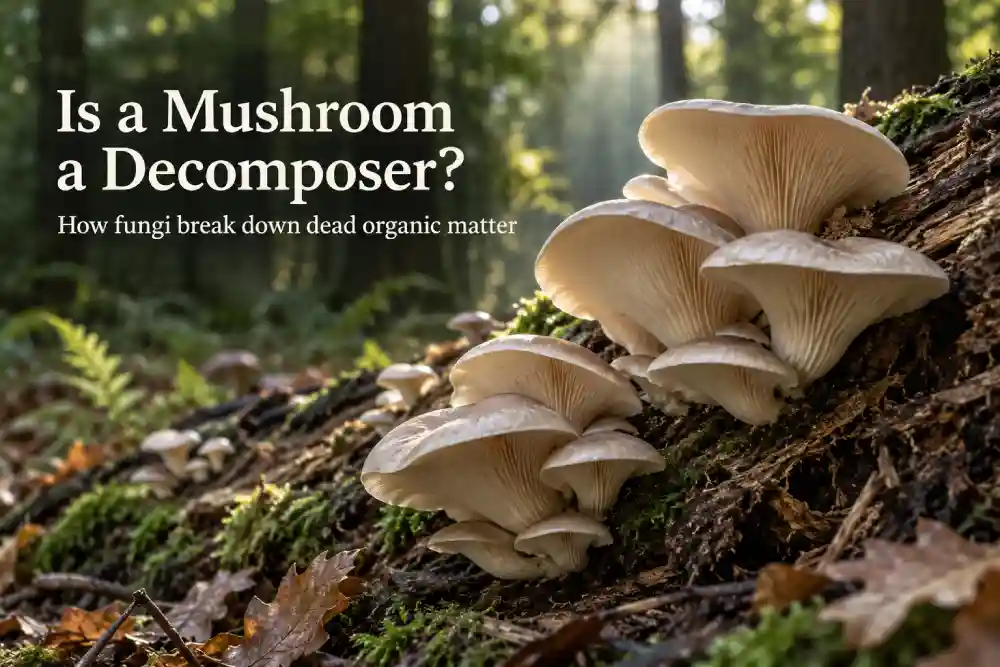
Is a Mushroom a Decomposer? Yes, many mushroom-forming fungi are decomposers. They break down dead wood, fallen leaves and other organic material, helping...