6 Best Mushroom Foraging Kits and Tools (November 2026)
— views
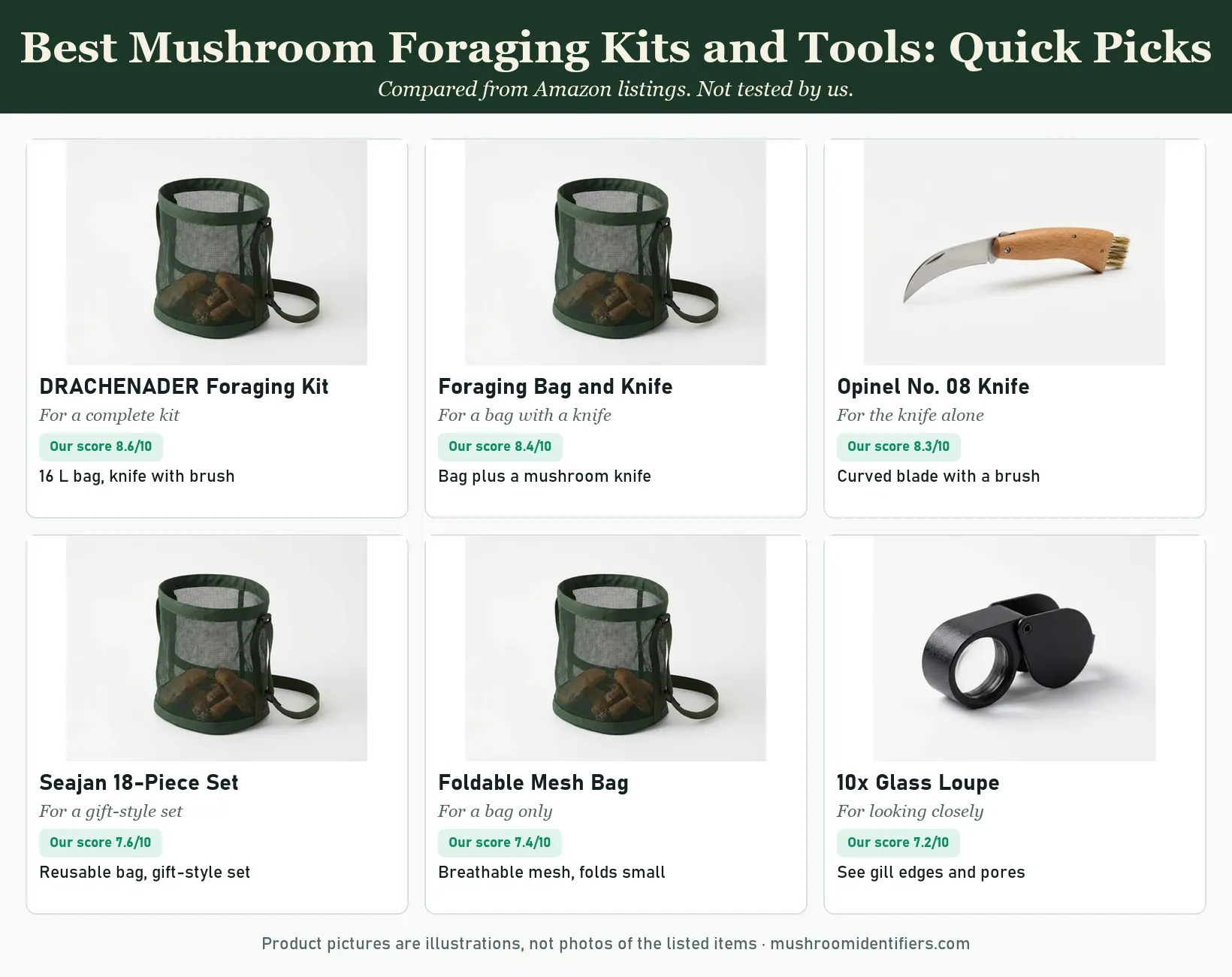
The best mushroom foraging kits include the DRACHENADER Mushroom Foraging Kit for a complete kit, the Foraging Bag and Knife Kit for a bag with a knife, and the Opinel No. 08 Mushroom Knife for the knife alone.
The best mushroom foraging kit for most people is the DRACHENADER Mushroom Foraging Kit, which pairs a mesh bag with a mushroom knife and brush. The bag holds 16 L and has a phone pocket, according to the listing.
Choose by what you are missing. A beginner with nothing needs a bag and a knife. Someone who owns a knife may only need a mesh bag or a lens.
A kit does not make anyone able to identify a mushroom. It only helps you carry and look at what you find. Start with our guide on how to identify a mushroom you found, and have an expert confirm anything you plan to eat.
How We Chose Mushroom Foraging Kits
We compared current Amazon listings against university extension guidance and did not test these products. We also used state agency and mycological society pages for foraging practice. Each product then received a score out of 10, based on three weighted factors.
- Beginner ease, 40%: how easy the item is to use on a first foray.
- Review depth, 30%: how many buyers have reviewed the listing.
- Listing clarity, 30%: whether the listing states what you get and what to expect.
A score compares listings. It is not a lab result or a guarantee of quality. Product facts come from each listing, so treat them as the seller's claims.
| Product | Best for | Type | Our score |
|---|---|---|---|
| DRACHENADER Mushroom Foraging Kit | A complete kit | Bag, knife and brush | 8.6/10 |
| Foraging Bag and Knife Kit | A bag with a knife | Bag and knife | 8.4/10 |
| Opinel No. 08 Mushroom Knife | The knife alone | Knife with brush | 8.3/10 |
| Seajan 18-Piece Mushroom Foraging Bag Kit | A gift-style set | Bag set | 7.6/10 |
| Foldable Mesh Foraging Bag | A bag only | Mesh bag | 7.4/10 |
| 10x Glass Jeweler's Loupe | Looking closely | Hand lens | 7.2/10 |
The Best Mushroom Foraging Kits and Tools for Different Needs
The items below carry, cut, clean or magnify, but none of them tells you what a mushroom is. Pick the ones that fill a gap in what you already own.
DRACHENADER Mushroom Foraging Kit: Best for a complete kit
Our score: 8.6/10
- A mesh foraging bag.
- A mushroom knife with a brush.
- A 16 L bag, according to the listing.
- A phone pocket on the bag, according to the listing.
This kit suits a first-time forager who owns none of the basics. One purchase covers carrying, digging and brushing. It leaves out the items that help with identification, so plan to add those.
Pros
- One purchase covers the bag, knife and brush.
- The bag is mesh, which the Colorado Mycological Society names as a good container.
- The phone pocket keeps a camera and map within reach.
Cons
- The listing facts used here mention no wax paper, digging tool, lens or field guide.
- A 16 L bag holds about 4 gallons, which is more than some daily limits allow.
- A soft bag gives less protection against crushing than a flat-bottomed basket.
Add a roll of wax paper. The Missouri Department of Conservation guide wraps finds so that different species stay separate.
Use the phone before you pick. Our guide on how to photograph mushrooms for identification shows which angles matter.
Foraging Bag and Knife Kit: Best for a bag with a knife
Our score: 8.4/10
- A mushroom foraging bag.
- A knife.
- Hundreds of reviews.
This kit suits a beginner who wants the two main items in one purchase and does not mind adding a brush. Its review count gives you buyer feedback to read before you decide.
Pros
- Hundreds of buyer reviews are available to read.
- One purchase covers the bag and the knife.
Cons
- The listing facts used here give no bag size.
- The listing facts used here do not state the bag material, so confirm that it breathes.
- The listing facts used here mention no brush.
Tie the knife to something. The Colorado Mycological Society recommends a sturdy knife on a lanyard or string so that it stays on you. It also suggests a soft brush, and a small paint brush will do.
Opinel No. 08 Mushroom Knife: Best for the knife alone
Our score: 8.3/10
- The Opinel No. 08 size.
- A curved stainless blade.
- A brush.
This knife suits a forager who already has a basket or bag. It puts the blade and the brush in one tool. It does nothing for carrying.
Pros
- The blade and brush come as one tool.
- The blade is stainless.
- It works with any basket or bag you already own.
Cons
- You still need a bag or basket.
- The listing facts used here give no handle or lock details.
- A cut at ground level can leave the base behind, so dig out anything you need to identify.
A knife is also a digging tool. Montana State University's Schutter Diagnostic Lab says to dig a mushroom out with a pocket knife and take care not to damage the base.
Seajan 18-Piece Mushroom Foraging Bag Kit: Best for a gift-style set
Our score: 7.6/10
- An 18-piece set.
- A reusable bag.
- A bag measuring 17.3 by 15.4 inches, according to the listing.
This set suits a gift for someone curious about foraging. The listing facts used here do not name the 18 pieces, so read the listing before you buy.
Pros
- A set makes an easy gift.
- The listing states the bag size.
- The bag is reusable.
Cons
- The listing facts used here do not list the pieces.
- A high piece count says nothing about how useful each piece is.
- The listing facts used here do not say whether the bag is mesh.
Compare the pieces with the carry list further down this page. If you give it as a gift, add a field guide and a note that a set does not teach identification.
Foldable Mesh Foraging Bag: Best for a bag only
Our score: 7.4/10
- A mesh bag.
- Breathable, according to the listing.
- Folds up.
This bag suits someone who already owns a knife and brush. It also suits someone who wants a bag that packs away between stops.
Pros
- Mesh avoids the spoilage that plastic causes.
- It folds, according to the listing.
- It works with a knife you already own.
Cons
- It includes no knife or brush.
- The listing facts used here give no size.
- Soft sides do not protect delicate mushrooms.
Put firm mushrooms at the bottom and fragile ones on top. Wrap each kind in wax paper so that different mushrooms stay apart.
10x Glass Jeweler's Loupe: Best for looking closely
Our score: 7.2/10
- 10x magnification.
- A glass lens.
- A jeweler's-style loupe.
This lens suits a forager who has the basics and wants to study gills, stems and surfaces. It is a learning tool. It adds nothing to carrying or cutting.
Pros
- 10x is the power that UNH Extension sets as the upper limit for easy use.
- UNH Extension says glass lenses are less easily scratched than plastic.
Cons
- The listing facts used here do not say whether it is a triplet lens.
- A lens shows features but cannot name a mushroom.
- The listing facts used here mention no cord, and a small lens is easy to lose.
Hold it close to your eye. UNH Extension says to hold a hand lens about an inch from the eye, rest that hand on your cheekbone and bring the subject toward the lens. That advice comes from a fact sheet on insects, but the optics are the same.
What to Carry on a First Foray
Carry a breathable container, wax paper, a knife, a brush, a digging tool, a lens and a field guide, plus basic safety gear. The list follows the Colorado Mycological Society and the Missouri guide. The last column shows whether the products here cover each item.
| Item | Job | Covered here? |
|---|---|---|
| Basket or mesh bag | Carries finds and lets air reach them | Yes, a bag in four products |
| Wax paper | Keeps each kind separate | Not in the listing facts |
| Knife | Digs and cuts | Yes, in three products |
| Soft brush | Removes dirt and insects | Yes, in two products |
| Trowel or digging tool | Lifts the whole base | Not in the listing facts |
| Magnifying lens | Shows gills and small features | Yes, the loupe |
| Field guide or key | Lets you check features | Sold separately |
| Whistle and compass | Keeps you in contact and on course | Not in the listing facts |
| Boots, water, first-aid supplies | Basic safety | Not in the listing facts |
Bring a notebook or use your phone. The Missouri guide says to record where each mushroom grew, whether it was single or in a cluster, its colors and any staining or bruising.
The best addition is not a product. A first foray with a club can teach you more than a tool can. The North American Mycological Association keeps a directory of affiliated clubs by state.
Why Mesh Instead of Plastic
Plastic makes mushrooms spoil, so carry them in mesh, a basket or paper. Three sources agree on this point.
- The Colorado Mycological Society says plastic bags do not work and make mushrooms spoil quickly.
- Montana State's lab says not to store or send mushrooms in plastic bags, for the same reason.
- The Missouri guide says plastic wrap hastens decay.
The spoilage point matters for identification too, because a decayed specimen is harder to examine. Montana State's lab wraps each specimen in wax paper or newspaper.
Do Mesh Bags Spread Spores?
Sources make the claim, but we found no study that tests it. The Missouri guide says a flat-bottomed basket helps spread spores as you hunt. The same idea is often repeated for mesh bags. Treat it as a pleasant idea and not as proven.
A long-term Swiss study points to something else. Egli and colleagues followed plots for 27 years and found that picking or cutting did not significantly reduce later mushroom numbers or species richness. In a second study, trampling cut fruiting by an estimated 30%. How you walk may matter more than your bag. The study was done in Swiss forests, so it may not apply everywhere.
Knife and Brush
Use the knife to dig out the whole mushroom when it needs identifying, not to slice the stem at ground level. The base often carries the feature that matters most.
Amanitas show why. The Missouri guide says they have a saclike cup around the base of the stem, called a volva. It says the cup is often buried just under the soil and may not be obvious. A knife cut above the soil leaves it behind. Our death cap identification guide shows what to look for.
Keep the base whole. Montana State's lab says to include the cap, gills, stem and base, and not to break off the base. The Missouri guide also says to collect entire specimens, base included.
Cut or Pull?
The Swiss study found no significant difference in later crops between picking and cutting. So the choice is about identification, not the harvest. Dig whenever a mushroom's identity is not already confirmed.
The Brush
A brush keeps your finds clean. The Colorado Mycological Society says a soft brush removes dirt and insects. Brush mushrooms in the field and less grit ends up in the bag. Avoid brushing away features such as scales or fine hairs on a mushroom you still need to identify.
A Lens and a Field Guide
A 10x lens shows small features, and a field guide tells you what they mean, but neither one confirms a mushroom is edible. Think of them as tools for learning.
A 10x lens is the standard choice. The Cornell Mushroom Blog recommends a basic 10x triplet lens for naturalists. UNH Extension says not to go above 10x, because higher power shortens the focal distance and narrows the view. Our guide to the parts of a mushroom explains what you are looking at.
A field guide needs practice. The Colorado Mycological Society says to bring a reliable key and learn to use it. Our mushroom identification book guide compares options by US region. The Missouri guide warns that if all but a few features match, the mushroom may be a similar-looking poisonous one.
Make a Spore Print
Spore color is one of the most useful checks, and it needs no gear. The Missouri guide tapes black and white paper together and sets the cap on the seam with the gills or pores down. It covers the cap with a bowl or jar and waits 1 to 12 hours.
The color can separate look-alikes. The Burke Herbarium says deadly galerina has brown spores, while honey mushrooms have white ones. A spore print is one clue, not a safety test.
Rules and Permits
Check the rules for the exact piece of land before you pick, because limits change from place to place. Some public land allows personal picking, some needs a permit and some places ban it. The table gives examples, not a national rule.
| Place | Example rule | Source |
|---|---|---|
| Wisconsin state parks | Wild mushrooms may be picked by hand for personal use | Wisconsin DNR |
| Washington state parks | Up to 2 gallons per person per day unless posted. None in natural area preserves. No commercial harvest | WAC 352-28-030 |
| Oregon state parks | Up to 1 gallon per person per day unless posted | Cascade Mycological Society |
| Two Oregon national forests | Siuslaw: no permit under 1 gallon per day. Ochoco: free permit for up to 2 gallons per day | Cascade Mycological Society |
| Shenandoah National Park | Small amounts of edible mushrooms for personal use. Medicinal or woody shelf mushrooms are prohibited | National Park Service |
The Oregon figures come from a mycological society page reviewed in September 2026. That page says rules can change and tells readers to check with the agency or landowner. Its Oregon State Parks limit fell from 5 gallons to 1 gallon in March 2025, which shows how quickly an old figure goes stale.
National Parks
Do not assume a rule from one park applies in another. The federal rule at 36 CFR 2.1 bars removing plants. It lets a superintendent designate certain fruits, berries and nuts for gathering, and it does not mention mushrooms. Shenandoah handles mushrooms through its own rules, so ask each park.
Private Land
Ask the owner before you pick. The Cascade Mycological Society says Oregon requires written permission from the landowner.
Rules That Affect Your Gear
Your bag can hold more than the law allows. A 16 L bag holds about 4 gallons, while Oregon's state park limit is 1 gallon.
Handling rules can matter too. Wisconsin's wording says by hand, so ask before you use a digging tool there. The Cascade Mycological Society says Oregon personal-use mushrooms should be cut in half lengthwise at harvest. That rule can pull against keeping a specimen whole, so ask the ranger district what to do with a mushroom you need identified.
Which Mushroom Foraging Kit Should You Choose?
Buy only what fills a gap in your gear.
- If you own nothing yet, choose the DRACHENADER Mushroom Foraging Kit.
- If you want a bag and knife with plenty of reviews, choose the Foraging Bag and Knife Kit.
- If you already have a bag, choose the Opinel No. 08 Mushroom Knife.
- If you want a gift, consider the Seajan 18-Piece Mushroom Foraging Bag Kit, and add a field guide.
- If you already own a knife, choose the Foldable Mesh Foraging Bag.
- If you want to study features up close, add the 10x Glass Jeweler's Loupe.
- If you mainly want mushrooms to eat, a mushroom grow kit avoids the risk of misidentifying a wild one.
Our Top 3 Picks at a Glance
Frequently Asked Questions
What should be in a mushroom foraging kit?
A breathable bag or basket, a knife and a soft brush are the basics. Add wax paper, a digging tool, a lens and a field guide. Bring a whistle, a compass, water and first-aid supplies too.
Does a foraging kit help you identify mushrooms?
No. A kit only helps you carry, clean and look at what you find. Identification takes knowledge and practice, and an expert must confirm anything you plan to eat.
Why not use a plastic bag for mushrooms?
Plastic makes mushrooms spoil quickly. The Colorado Mycological Society and Montana State's lab both warn against it. Use mesh, a basket or wax paper.
Do mesh bags really spread spores?
We found no study that tests this. The Missouri guide says a flat-bottomed basket helps spread spores, and the idea is often repeated for mesh. Treat it as unproven.
Should you cut or pull a mushroom?
Dig it out if it needs identifying, because the base can hold a key feature. A long Swiss study found no significant difference in later crops between picking and cutting. The base matters more than the method.
What size bag do you need for mushroom foraging?
A smaller bag is often enough. Some public lands limit you to 1 or 2 gallons a day. A 16 L bag holds about 4 gallons.
Do you need a permit to pick mushrooms?
It depends on the land. Some national forests ask for no permit under a small limit, while others issue a free one. Check with the agency or landowner before you go.
Can you pick mushrooms in national parks?
Some parks allow a little and others may not. Shenandoah allows small amounts of edible mushrooms for personal use. Check the rules for the park you plan to visit.
What magnification should a foraging lens have?
Choose 10x. The Cornell Mushroom Blog recommends a basic 10x triplet lens, and UNH Extension says not to go above 10x. Higher power is harder to use.
Final Safety Reminder
Gear does not make a wild mushroom safe to eat. Never eat a wild mushroom based on a chart, a photo, an app or a kit. Expert confirmation is needed first. The risk is real. The CDC reported 39 suspected amatoxin poisonings in Northern California from November 2025 to March 2026, all after eating foraged mushrooms. Three people needed liver transplants, and four died.
Keep the base, keep each kind separate and keep children and pets away from unknown mushrooms. Our guide to poisonous vs edible mushrooms explains why simple rules fail. For a second opinion on a find, use our free mushroom identifier and a local expert.
If someone has eaten a wild mushroom, call Poison Control at 1-800-222-1222 right away. Children's Hospital of Philadelphia says to call as soon after eating as possible and to refrigerate any uneaten portion in a bag marked "poison." It says death cap symptoms are typically delayed 6 to 24 hours, so do not wait for symptoms.
About this guide: we compared current Amazon listings with university extension guidance and did not test these products. As an Amazon Associate, Mushroom Identifiers earns from qualifying purchases at no extra cost to you. Prices and availability are shown on Amazon.
Sign in to leave a comment and join the discussion.
 Guide
Most maple tree fungus is either a leaf spot that looks alarming but rarely hurts the tree, or a decay fungus fruiting from wood that is already rotting...
 Guide
Pine tree fungus identification starts with color and place: orange powder on a woody gall is a rust, brown dead shoot tips are a blight, a conk at the base...
 Guide
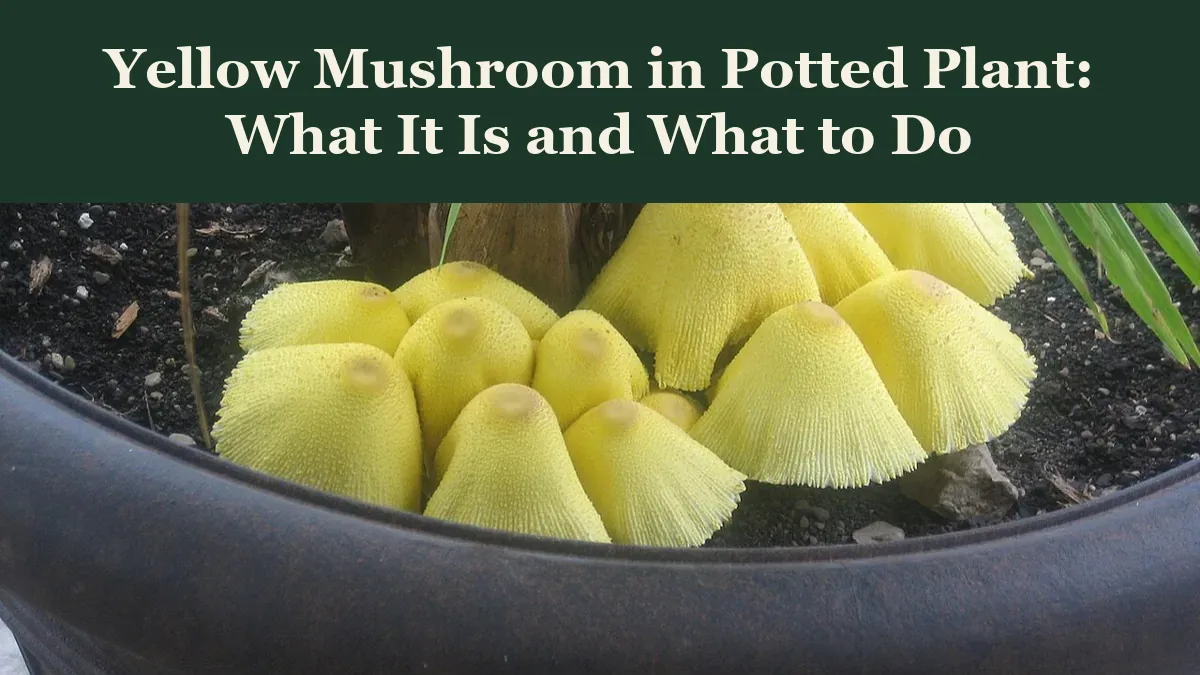
A yellow mushroom in a potted plant is almost always the flowerpot parasol, Leucocoprinus birnbaumii , a lemon-yellow mushroom that feeds on dead organic...