Poisonous Mushrooms in Washington State: Identification, Dangers, and Safety Guide

Nathan Cole
Mycologist · Author · Fungi Expert
Updated
Aug 22, 2026
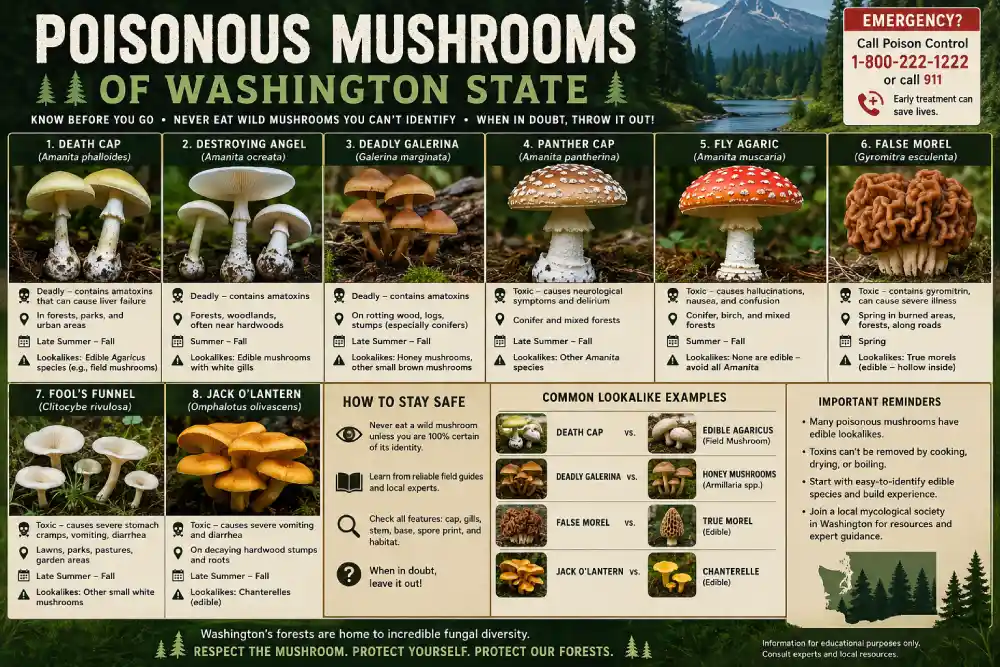
Washington State is home to some of North America's most dangerous wild mushrooms, including the Death Cap (Amanita phalloides), Destroying Angel (Amanita species), and Deadly Galerina (Galerina marginata). These toxic fungi grow throughout the state's forests, parks, and urban landscapes.
While many wild mushrooms are edible, several poisonous species closely resemble popular edible varieties, making proper identification essential for anyone interested in mushroom foraging.
Whether you're a beginner forager, outdoor enthusiast, or simply curious about Washington's fungal diversity, understanding which mushrooms are toxic can help prevent serious illness and potentially fatal poisoning.
What Are the Most Poisonous Mushrooms in Washington State?
The most poisonous mushrooms found in Washington State include:
| Common Name | Scientific Name | Primary Toxin | Risk Level |
|---|---|---|---|
| Death Cap | Amanita phalloides | Amatoxins | Extremely Deadly |
| Destroying Angel | Amanita spp. | Amatoxins | Extremely Deadly |
| Deadly Galerina | Galerina marginata | Amatoxins | Extremely Deadly |
| Panther Cap | Amanita pantherina | Muscimol, Ibotenic Acid | Highly Toxic |
| Fly Agaric | Amanita muscaria | Muscimol, Ibotenic Acid | Toxic |
| False Morel | Gyromitra esculenta | Gyromitrin | Potentially Fatal |
Many of these mushrooms can cause severe liver damage, kidney failure, neurological symptoms, or death. The greatest danger is that some poisonous species look remarkably similar to edible mushrooms commonly collected by foragers.
Why Washington State Has So Many Toxic Mushroom Species?
Washington's climate creates ideal conditions for fungal growth. The combination of moist forests, abundant rainfall, moderate temperatures, and extensive woodland ecosystems supports thousands of mushroom species throughout the year.
The state's diverse habitats include:
- Coastal rainforests
- Conifer forests
- Mixed hardwood forests
- Mountain ecosystems
- Urban parks and green spaces
- River valleys and riparian zones
Many toxic mushrooms form mycorrhizal relationships with trees such as Douglas fir, western hemlock, spruce, and oak. These underground partnerships allow fungi to exchange nutrients with trees while producing the mushrooms visible above ground.
The Pacific Northwest is widely regarded as one of North America's richest regions for mushroom diversity. Unfortunately, that diversity includes several species responsible for serious poisonings every year.
Climate Conditions That Favor Toxic Mushrooms
Several environmental factors contribute to the abundance of poisonous mushrooms in Washington:
- Consistent fall rainfall
- Mild winter temperatures
- Dense forest canopies
- Rich organic soils
- Large populations of host trees
These conditions allow toxic species to thrive alongside edible mushrooms, increasing the risk of mistaken identification.
Why Accurate Identification Matters?
A common misconception is that poisonous mushrooms have obvious warning signs. In reality, many deadly species look attractive and harmless.
For example:
- Death Caps can resemble edible puffballs when young.
- Deadly Galerinas can resemble honey mushrooms.
- False Morels may be confused with prized true morels.
Because visual similarities can be deceptive, identification should always rely on multiple characteristics rather than a single feature.
Most Dangerous Poisonous Mushrooms in Washington State
While hundreds of mushroom species grow throughout Washington, only a relatively small number are responsible for most severe poisonings. Understanding these species is the foundation of safe mushroom foraging.
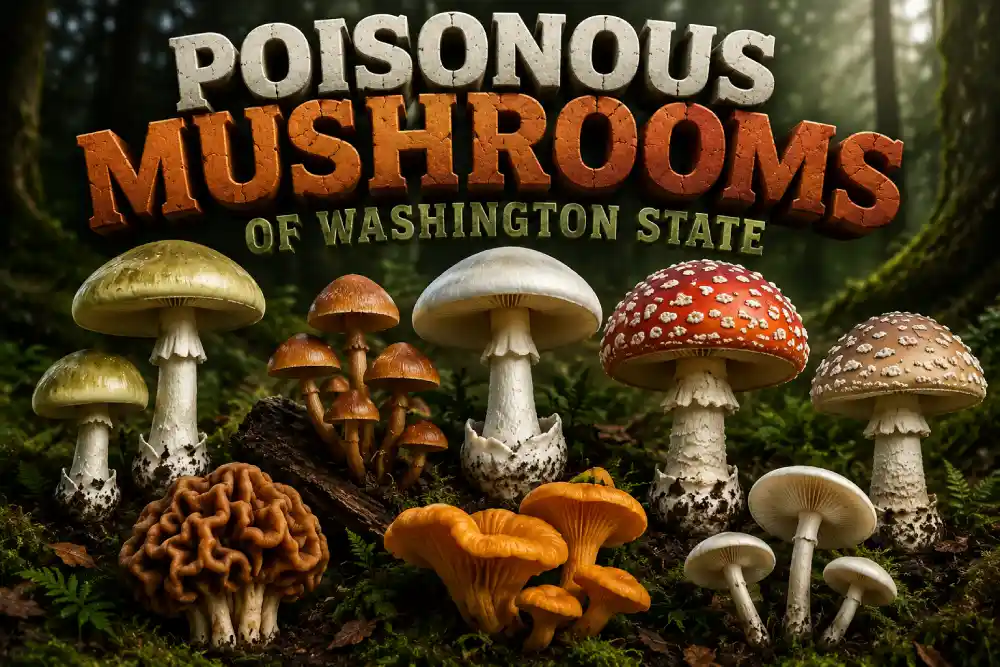
The most dangerous mushrooms generally fall into three categories:
- Liver-destroying mushrooms
- Neurotoxic mushrooms
- Gastrointestinal toxins
Among these, amatoxin-containing species pose the highest fatality risk because symptoms often appear only after significant organ damage has already begun.
Death Cap (Amanita phalloides)
The Death Cap is widely considered the most dangerous mushroom in the world and is responsible for the majority of fatal mushroom poisonings globally.
Identification Features
Key identifying characteristics include:
- Olive-green to yellow-green cap
- White gills
- White stem
- Distinctive ring on the stem
- Cup-like volva at the base
- White spore print
Young specimens often remain partially enclosed within a white universal veil, making them difficult for inexperienced foragers to recognize.
Habitat in Washington
Death Caps are increasingly reported throughout western Washington, particularly in:
- Urban landscapes
- Oak-associated habitats
- Parks
- Residential neighborhoods
- Woodland edges
The species often grows near ornamental trees introduced from Europe, which has helped expand its range.
Why It Is So Dangerous?
Death Caps contain amatoxins, among the most potent natural toxins known.
A typical poisoning progresses through several stages:
- Initial symptom-free period
- Severe vomiting and diarrhea
- Temporary improvement
- Liver failure and organ damage
Without rapid medical treatment, consumption can be fatal.
Common Lookalikes
Death Caps are frequently confused with:
- Young puffballs
- Edible Agaricus species
- Paddy straw mushrooms
- Other edible white mushrooms
This resemblance is one reason they remain so dangerous.
Destroying Angel (Amanita Species)
Destroying Angels belong to a group of all-white Amanita mushrooms that contain the same deadly amatoxins found in Death Caps.
Although beautiful in appearance, they are among the most lethal fungi in Washington forests.
Identification Features
Typical characteristics include:
- Pure white cap
- White gills
- White stem
- Prominent ring
- Large sac-like volva
- White spores
Their elegant appearance often leads inexperienced collectors to assume they are harmless.
Habitat and Distribution
Destroying Angels commonly occur in:
- Mixed forests
- Conifer forests
- Moist woodland soils
- Forest trails
- Moss-covered areas
They usually appear during late summer and fall when moisture levels increase.
Toxicity
Even small amounts may cause:
- Severe gastrointestinal distress
- Liver damage
- Kidney failure
- Death
The delayed onset of symptoms often causes victims to underestimate the seriousness of poisoning.
Dangerous Lookalikes
Destroying Angels are sometimes confused with:
- Meadow mushrooms
- Young edible Amanitas
- White Lepiota species
- Button-stage edible mushrooms
Because of this risk, many experts recommend avoiding all white-gilled mushrooms unless identification is absolutely certain.
Deadly Galerina (Galerina marginata)
The Deadly Galerina is one of Washington State's most overlooked poisonous mushrooms. Unlike the Death Cap or Destroying Angel, it lacks a dramatic appearance and is often mistaken for edible woodland mushrooms.
Unfortunately, it contains the same deadly amatoxins responsible for many fatal mushroom poisonings worldwide.
Identification Features
The Deadly Galerina is typically small and brown, making it easy to overlook.
Key characteristics include:
- Brown to yellow-brown cap
- Sticky cap surface when moist
- Rusty-brown spores
- Thin stem with a fragile ring
- Brown gills that darken with age
- Usually grows in clusters or small groups
Because appearance varies depending on moisture levels and age, identification can be challenging.
Habitat in Washington
This species is widespread throughout Washington's forests and is especially common in:
- Decaying conifer logs
- Fallen branches
- Rotten stumps
- Mossy woodland habitats
- Douglas fir forests
- Western hemlock forests
Unlike many Amanita species, Deadly Galerinas grow directly from wood rather than soil.
Toxicity and Symptoms
Deadly Galerinas contain amatoxins that attack the liver and kidneys.
Symptoms often follow a dangerous pattern:
- Delayed onset (6–24 hours)
- Severe vomiting and diarrhea
- Temporary improvement
- Organ failure
Because symptoms may not appear immediately, victims often delay seeking treatment.
Common Lookalikes
The greatest danger comes from confusion with edible mushrooms such as:
- Honey mushrooms (Armillaria species)
- Velvet shank (Flammulina velutipes)
- Other small brown woodland mushrooms
Foragers often refer to these species collectively as “little brown mushrooms,” a group responsible for many identification mistakes.
Panther Cap (Amanita pantherina)
The Panther Cap is another dangerous mushroom found in Washington forests. While it is less likely to cause death than amatoxin-containing species, it can produce severe neurological symptoms and dangerous intoxication.
Identification Features
Panther Caps are recognizable by:
- Brown cap with white wart-like patches
- White gills
- White stem
- Distinct ring
- Bulbous base with concentric ridges
- White spore print
The cap often resembles a darker version of the famous Fly Agaric.
Habitat and Distribution
Panther Caps grow throughout forested regions of Washington, particularly near:
- Douglas fir
- Pine trees
- Spruce forests
- Mixed woodland habitats
They form mycorrhizal relationships with tree roots and are commonly encountered during fall.
Toxic Effects
Unlike Death Caps, Panther Caps primarily affect the nervous system.
Symptoms may include:
- Confusion
- Hallucinations
- Dizziness
- Muscle twitching
- Agitation
- Loss of coordination
- Extreme drowsiness
Severe cases may require hospitalization.
Why Foragers Should Avoid It?
Although fatalities are uncommon, the unpredictable effects make Panther Caps extremely risky.
The concentration of toxins can vary significantly between individual mushrooms, making it impossible to predict the severity of symptoms.
Fly Agaric (Amanita muscaria)
The Fly Agaric is one of the world's most recognizable mushrooms. Its bright red cap with white spots appears in fairy tales, video games, and popular culture.
Despite its iconic appearance, it is toxic and should never be consumed without expert knowledge.
Identification Features
Fly Agaric mushrooms are relatively easy to identify.
Characteristics include:
- Bright red, orange-red, or yellow-orange cap
- White wart-like patches
- White gills
- White stem
- Large ring on the stem
- Bulbous base
Young specimens are often more vividly colored than mature mushrooms.
Habitat in Washington
Fly Agarics are common throughout Washington's forests, especially in association with:
- Douglas fir
- Spruce
- Birch
- Pine
- Hemlock
They often appear in large numbers during autumn.
Toxicity
The primary toxins include:
- Muscimol
- Ibotenic acid
These compounds affect the central nervous system rather than the liver.
Potential symptoms include:
- Altered perception
- Hallucinations
- Confusion
- Nausea
- Vomiting
- Loss of coordination
- Sleep disturbances
Common Misconceptions
Many online sources incorrectly suggest that Fly Agaric can be safely prepared for consumption.
In reality:
- Toxin concentrations vary widely.
- Preparation methods are inconsistent.
- Serious poisoning continues to occur.
For recreational and foraging safety, avoiding consumption remains the safest recommendation.
False Morel (Gyromitra esculenta)
False Morels are among the most deceptive poisonous mushrooms in Washington because they resemble highly sought-after true morels.
Every spring, experienced and beginner foragers alike encounter these mushrooms in forested areas.
Identification Features
Unlike true morels, False Morels have:
- Wrinkled, brain-like caps
- Irregular folds
- Lobed appearance
- Hollow or chambered interior
- Fragile flesh
Their distorted appearance is often described as resembling a walnut or brain.
Habitat in Washington
False Morels are commonly found:
- During spring
- In recently burned forests
- Near conifer trees
- Along forest roads
- In disturbed woodland soils
They may fruit in the same habitats where true morels are actively sought by foragers.
Toxicity
False Morels contain gyromitrin, a compound that converts into toxic substances within the body.
Potential effects include:
- Severe nausea
- Vomiting
- Headaches
- Seizures
- Liver damage
- Neurological complications
Some poisonings have resulted in fatalities.
False Morel vs True Morel
| Feature | False Morel | True Morel |
|---|---|---|
| Cap Shape | Brain-like folds | Honeycomb pits |
| Interior | Chambered or folded | Completely hollow |
| Shape | Irregular | Symmetrical |
| Toxicity | Poisonous | Edible when cooked |
Because confusion remains common, every collected morel should be cut lengthwise before consumption.
Fool's Funnel and Ivory Funnel (Clitocybe rivulosa and Clitocybe dealbata)
These small white lawn mushrooms are responsible for numerous poisonings because they often grow in areas where people do not expect dangerous fungi.
Although not usually fatal, they can cause severe illness.
Identification Features
These species generally display:
- White to cream-colored caps
- Funnel-shaped mature caps
- Crowded white gills
- Thin stems
- White spore prints
- Dense clusters in grassy areas
Their small size often causes them to be overlooked.
Habitat in Washington
Fool's Funnel and Ivory Funnel commonly occur in:
- Lawns
- Parks
- School grounds
- Pastures
- Urban green spaces
- Garden edges
Unlike many forest mushrooms, they thrive in developed environments.
Muscarine Poisoning
These mushrooms contain high concentrations of muscarine.
Symptoms typically begin within a few hours and may include:
- Excessive sweating
- Salivation
- Tearing
- Abdominal pain
- Vomiting
- Diarrhea
- Blurred vision
Medical treatment is often required to manage severe cases.
Why These Species Matter?
Many mushroom poisonings occur not in remote forests but in residential neighborhoods.
Children, pets, and inexperienced collectors are particularly vulnerable because these mushrooms frequently grow in places where people assume all mushrooms are harmless.
Jack O'Lantern Mushroom (Omphalotus olivascens)
The Jack O'Lantern Mushroom is one of the most commonly misidentified poisonous mushrooms in North America. Although not usually fatal, it causes severe gastrointestinal distress and is frequently mistaken for edible chanterelles.
Its bright orange coloration often attracts mushroom hunters searching for wild edible species.
Identification Features
Key characteristics include:
- Bright orange to yellow-orange cap
- Decurrent gills that run down the stem
- Thick clustered growth
- Tough flesh
- Central stem
- Orange interior
One unique feature is bioluminescence. In very dark conditions, the gills may emit a faint greenish glow, although this is usually difficult to observe in the field.
Habitat in Washington
Jack O'Lantern Mushrooms typically grow:
- On decaying hardwood stumps
- From buried roots
- In woodland areas
- Along forest edges
- In clusters rather than singly
Unlike chanterelles, they grow directly from wood.
Toxicity
Consumption can result in:
- Severe nausea
- Vomiting
- Diarrhea
- Abdominal cramping
- Dehydration
Symptoms generally begin within a few hours of ingestion and may persist for a day or longer.
Chanterelle Lookalike Risk
Many accidental poisonings occur because people confuse Jack O'Lanterns with edible chanterelles.
| Characteristic | Jack O'Lantern | Chanterelle |
|---|---|---|
| Gills | True gills | False ridges |
| Growth | Clusters on wood | Scattered on soil |
| Color | Bright orange | Golden yellow |
| Edibility | Poisonous | Edible |
Learning the difference between true gills and blunt chanterelle ridges is one of the most important identification skills for Pacific Northwest foragers.
How to Identify Poisonous Mushrooms?
There is no single feature that separates all poisonous mushrooms from edible ones. Safe identification requires examining multiple characteristics together.
Professional mycologists use a combination of morphology, habitat, spore prints, seasonality, and ecology to identify species accurately.
Examine the Cap
The cap provides valuable clues.
Look for:
- Shape
- Color
- Surface texture
- Warts or scales
- Margin characteristics
However, cap appearance alone should never be used for identification because many unrelated species look similar.
Check the Gills
Gills are among the most important identification features.
Observe:
- Gill color
- Attachment to stem
- Spacing
- Thickness
White gills are particularly important because many deadly Amanita species possess them.
Inspect the Stem
The stem often contains critical diagnostic features.
Look for:
- Rings (annulus)
- Stem texture
- Stem color
- Bulbous bases
Never pull only the cap. Carefully excavate the entire mushroom to inspect the base.
Look for a Volva
A volva is a cup-like structure at the base of certain mushrooms, especially Amanitas.
Because Death Caps and Destroying Angels possess volvas, finding one should immediately trigger caution.
Make a Spore Print
Spore prints help distinguish similar species.
To make a spore print:
- Remove the stem.
- Place the cap on paper.
- Cover with a bowl.
- Wait several hours.
Spore print colors may be:
- White
- Brown
- Pink
- Black
- Rust-colored
This simple technique often prevents dangerous mistakes.
Never Rely on Mushroom Myths
Common myths are unreliable and potentially dangerous.
False beliefs include:
- Poisonous mushrooms tarnish silver.
- Insects only eat edible mushrooms.
- Bright colors indicate toxicity.
- Animals safely eating a mushroom means humans can too.
None of these rules are scientifically valid.
Common Edible Lookalikes That Cause Dangerous Mistakes
Most serious mushroom poisonings occur because a toxic species is mistaken for an edible one.
Understanding lookalikes is just as important as learning poisonous species themselves.
Death Cap vs Edible Agaricus Species
Many edible Agaricus mushrooms have:
- White caps
- White stems
- Similar size
However, Death Caps possess:
- White gills that remain white
- A volva at the base
- Deadly amatoxins
This confusion can have fatal consequences.
Deadly Galerina vs Honey Mushrooms
Both species may:
- Grow in clusters
- Appear brown
- Grow on wood
Differences include:
- Galerina has rusty brown spores.
- Honey mushrooms have white spores.
Spore printing is often the safest way to distinguish them.
False Morel vs True Morel
This is one of Washington's most important foraging distinctions.
True Morels:
- Have honeycomb pits
- Are completely hollow inside
False Morels:
- Have folded, brain-like caps
- Possess chambered interiors
- Contain toxic compounds
Cutting every morel lengthwise is standard safety practice.
Jack O'Lantern vs Chanterelle
Beginning foragers frequently confuse these species.
Key differences include:
- Chanterelles have blunt ridges.
- Jack O'Lanterns have true gills.
- Chanterelles grow from soil.
- Jack O'Lanterns grow from wood.
Learning habitat preferences dramatically improves identification accuracy.
Why Lookalikes Cause Most Poisonings?
Many poisonous mushrooms evolved appearances similar to harmless species simply by coincidence.
The danger comes from:
- Incomplete identification
- Overconfidence
- Internet misidentification
- Reliance on photos alone
Expert confirmation remains one of the best safeguards.
Where Poisonous Mushrooms Grow in Washington State?
Poisonous mushrooms occur throughout Washington and can be found in both remote wilderness and urban environments.
Knowing where toxic species commonly occur helps foragers remain alert.
Olympic National Forest
The moist temperate rainforest conditions support enormous fungal diversity.
Common toxic species include:
- Death Caps
- Fly Agarics
- Panther Caps
- Deadly Galerinas
The combination of rainfall and dense forest cover creates ideal growing conditions.
Mount Baker-Snoqualmie National Forest
This extensive forest contains:
- Conifer woodlands
- Mixed forests
- Mountain ecosystems
Numerous Amanita species fruit during late summer and fall.
Gifford Pinchot National Forest
Known for its rich fungal diversity, this region supports:
- False Morels
- Fly Agarics
- Galerinas
- Funnel mushrooms
Burned areas can be particularly productive for spring-fruiting species.
Okanogan-Wenatchee National Forest
Eastern Washington forests host many of the same poisonous mushrooms found west of the Cascades.
Species distribution varies based on:
- Elevation
- Moisture
- Tree composition
Urban Parks and Residential Areas
Many people assume poisonous mushrooms only occur deep in forests.
In reality, dangerous species can grow:
- Under ornamental trees
- In lawns
- Along sidewalks
- In public parks
- Near schools
Death Caps are increasingly reported in urban landscapes throughout western Washington.
River Valleys and Riparian Habitats
Moist environments near rivers often support large mushroom populations.
Areas surrounding:
- Columbia River
- Skagit River
- Snoqualmie River
- Yakima River
may host a wide variety of both edible and poisonous fungi.
Mushroom Season in Washington State
Washington offers one of the longest mushroom seasons in North America.
Different poisonous species fruit at different times of year.
Spring (March–May)
Common species include:
- False Morels
- Early Amanitas
- Various toxic woodland fungi
Spring is also when confusion between true and false morels becomes most common.
Summer (June–August)
Although generally less productive, summer can still produce:
- Amanita species
- Funnel mushrooms
- Lawn mushrooms
Irrigated urban areas often continue producing mushrooms even during dry periods.
Fall (September–November)
Fall is the peak mushroom season in Washington.
Many dangerous species appear during this period, including:
- Death Caps
- Destroying Angels
- Fly Agarics
- Panther Caps
- Deadly Galerinas
This is also when foraging activity reaches its highest level.
Winter (December–February)
Mild coastal climates allow some mushrooms to continue fruiting throughout winter.
Species may still be found in:
- Coastal forests
- Low-elevation woodlands
- Urban landscapes
Winter mushroom hunting remains popular in parts of western Washington.
Seasonal Safety Considerations
During peak mushroom seasons:
- Never consume unidentified mushrooms.
- Verify every collection individually.
- Expect poisonous species to occur alongside edible species.
- Use multiple identification methods.
- Consult local mycological experts whenever uncertainty exists.
The fact that a mushroom grows during the same season as an edible species does not make it safe to eat.
Symptoms of Mushroom Poisoning
Mushroom poisoning symptoms vary depending on the species consumed, the amount eaten, and the toxins involved. Some mushrooms cause illness within minutes, while others may not produce symptoms for 24 hours or longer.
One of the most dangerous misconceptions is that delayed symptoms indicate a mild poisoning. In reality, the opposite is often true. Mushrooms containing amatoxins, such as Death Caps and Destroying Angels, may not cause noticeable symptoms until significant liver damage has already begun.
Early-Onset Symptoms
Certain toxic mushrooms primarily affect the digestive system.
Common symptoms include:
- Nausea
- Vomiting
- Diarrhea
- Stomach cramps
- Excessive sweating
- Salivation
- Dizziness
These symptoms may appear within 30 minutes to several hours after ingestion.
Neurological Symptoms
Species such as Fly Agaric and Panther Cap affect the nervous system.
Possible symptoms include:
- Confusion
- Hallucinations
- Disorientation
- Loss of coordination
- Drowsiness
- Mood changes
- Visual disturbances
The severity of these effects can vary significantly between individuals.
Delayed Symptoms
Amatoxin-containing mushrooms often produce symptoms in stages.
Stage 1: Silent Period
For 6–24 hours after ingestion, the individual may feel completely normal.
Stage 2: Gastrointestinal Distress
Symptoms suddenly appear and may include:
- Severe vomiting
- Watery diarrhea
- Intense abdominal pain
- Dehydration
Stage 3: False Recovery
Symptoms may temporarily improve, creating a dangerous sense of reassurance.
Stage 4: Organ Failure
Without prompt medical treatment, severe poisoning can progress to:
- Liver failure
- Kidney failure
- Internal bleeding
- Coma
- Death
When Symptoms Become a Medical Emergency?
Seek emergency medical care immediately if mushroom consumption is followed by:
- Persistent vomiting
- Severe diarrhea
- Confusion
- Hallucinations
- Difficulty breathing
- Seizures
- Loss of consciousness
Any suspected ingestion of a Death Cap, Destroying Angel, or Deadly Galerina should be treated as a medical emergency, even if no symptoms are present.
What To Do If You Eat a Poisonous Mushroom?
Quick action can significantly improve outcomes after mushroom poisoning.
Never wait for symptoms to appear before seeking help.
Step 1: Contact Emergency Services or Poison Control
If mushroom poisoning is suspected:
- Call emergency services if symptoms are severe.
- Contact a poison center immediately.
- Follow professional medical advice.
The sooner treatment begins, the better the chances of recovery.
Step 2: Preserve Mushroom Samples
Keep:
- Remaining mushrooms
- Food containing mushrooms
- Photographs of the mushrooms
- Collection location information
These materials can help experts identify the species involved.
Step 3: Do Not Attempt Home Remedies
Avoid:
- Inducing vomiting unless instructed by medical professionals
- Drinking alcohol
- Relying on internet remedies
- Waiting for symptoms to worsen
Many traditional remedies are ineffective and may delay proper treatment.
Step 4: Monitor Everyone Who Ate the Mushrooms
If multiple people consumed the same mushrooms:
- Monitor everyone closely.
- Seek medical advice for all exposed individuals.
- Remember that symptoms may appear at different times.
Why Fast Medical Treatment Matters?
For amatoxin poisoning, treatment is most effective when started before extensive liver damage occurs.
Early intervention can:
- Reduce toxin absorption
- Protect organs
- Improve survival rates
- Prevent long-term complications
Safety Tips for Mushroom Foragers in Washington
Washington is one of the best mushroom-foraging destinations in North America, but safe foraging requires caution, education, and patience.
Learn a Few Species Thoroughly
Rather than attempting to identify dozens of mushrooms, focus on mastering a small number of unmistakable edible species.
Many experienced foragers spend years refining their identification skills.
Use Multiple Identification Features
Never identify a mushroom based on:
- Color alone
- Cap appearance alone
- A single photograph
Instead examine:
- Cap characteristics
- Gills
- Stem
- Base
- Spore print
- Habitat
- Season
Avoid "Little Brown Mushrooms"
Many of the most dangerous identification mistakes involve small brown species.
Unless identification is certain, these mushrooms should be avoided.
Dig Up the Entire Mushroom
Important identification features often occur underground.
Always inspect:
- Bulbous bases
- Volvas
- Root-like structures
Removing only the cap can lead to dangerous mistakes.
Join Local Mycological Organizations
Washington has a strong mushroom community.
Benefits include:
- Identification workshops
- Field trips
- Expert consultations
- Educational resources
Learning from experienced mycologists dramatically improves safety.
Keep Species Separate
When collecting mushrooms:
- Use separate containers.
- Label collections.
- Avoid mixing species.
A single poisonous mushroom can contaminate an entire harvest.
Follow the Golden Rule
If there is any uncertainty whatsoever, do not eat the mushroom.
This simple rule prevents the vast majority of mushroom poisonings.
Ecological Role of Poisonous Mushrooms
Although toxic mushrooms pose risks to humans, they play essential roles in Washington's ecosystems.
Without fungi, forests would struggle to function properly.
Nutrient Recycling
Many poisonous mushrooms help decompose:
- Fallen logs
- Dead branches
- Leaf litter
- Organic debris
This process returns nutrients to the soil where plants can reuse them.
Mycorrhizal Partnerships
Many toxic species, especially Amanitas, form mycorrhizal relationships with trees.
These partnerships provide benefits to both organisms.
Fungi help trees absorb:
- Water
- Nitrogen
- Phosphorus
- Trace minerals
In return, trees supply carbohydrates produced through photosynthesis.
Supporting Forest Health
Fungal networks contribute to:
- Soil structure
- Nutrient movement
- Seedling establishment
- Forest resilience
Some researchers describe these underground fungal networks as a natural communication system within forests.
Food Source for Wildlife
While toxic to humans, some wildlife species interact with mushrooms differently.
Various animals consume fungi, including:
- Deer
- Rodents
- Insects
- Slugs
These interactions help distribute spores and support ecosystem diversity.
Why Toxic Mushrooms Should Not Be Destroyed?
A common misconception is that poisonous mushrooms should be removed from forests.
In reality, they provide valuable ecological functions and are a natural part of healthy ecosystems.
The safest approach is to appreciate them, photograph them, and leave them undisturbed.
Conclusion
Washington State is home to some of North America's most dangerous poisonous mushrooms, including the Death Cap, Destroying Angel, Deadly Galerina, Panther Cap, Fly Agaric, False Morel, Fool's Funnel, and Jack O'Lantern Mushroom. These species occur across forests, parks, river valleys, and even residential neighborhoods.
The greatest danger comes not from unusual-looking fungi but from toxic mushrooms that closely resemble edible species. Accurate identification requires examining multiple characteristics, understanding habitat preferences, recognizing seasonal patterns, and learning from reliable sources.
For anyone interested in mushroom foraging, education remains the most effective safety tool. By learning key identification features, understanding common lookalikes, and following conservative foraging practices, outdoor enthusiasts can enjoy Washington's remarkable fungal diversity while minimizing risk.
Frequently Asked Questions About Poisonous Mushrooms in Washington State
What is the most poisonous mushroom in Washington State?
The Death Cap (Amanita phalloides) is generally considered the most dangerous mushroom in Washington State because it contains amatoxins that can cause fatal liver failure.
Are Death Cap mushrooms common in Washington?
Yes. Death Caps are increasingly found throughout western Washington, particularly in urban landscapes, parks, and areas with ornamental trees.
Can touching a poisonous mushroom make you sick?
Most poisonous mushrooms are only dangerous when ingested. Simply touching them generally does not cause poisoning, although washing hands afterward is recommended.
What mushroom causes the most fatal poisonings?
Death Caps and Destroying Angels account for the majority of fatal mushroom poisonings worldwide because of their potent amatoxins.
How do I know if a mushroom is poisonous?
There is no universal test for mushroom toxicity. Proper identification requires examining the mushroom's physical characteristics, habitat, season, and spore print.
Are Fly Agaric mushrooms deadly?
Fly Agaric mushrooms are toxic and can cause serious neurological symptoms, but they are generally less deadly than amatoxin-containing species.
What should I do if I accidentally eat a poisonous mushroom?
Seek medical attention immediately, preserve mushroom samples for identification, and do not wait for symptoms to appear.
Where do poisonous mushrooms grow in Washington?
Poisonous mushrooms occur throughout Washington in forests, parks, lawns, river valleys, and urban landscapes.
When is mushroom poisoning most common?
Poisonings occur most frequently during the fall mushroom season when both mushroom growth and foraging activity reach their peak.
Are poisonous mushrooms important to the environment?
Yes. Toxic mushrooms help recycle nutrients, support forest ecosystems, form mycorrhizal partnerships with trees, and contribute to biodiversity.
Sign in to leave a comment and join the discussion.
 Species Guide
Alaska has many edible mushrooms, including morels, king boletes, golden chanterelles, hedgehogs, oyster mushrooms and bear’s head mushrooms. Most appear...
 Species Guide
Wisconsin is home to edible mushrooms such as morels, chanterelles, oyster mushrooms, hen of the woods, chicken of the woods and giant puffballs. Different...
 Species Guide
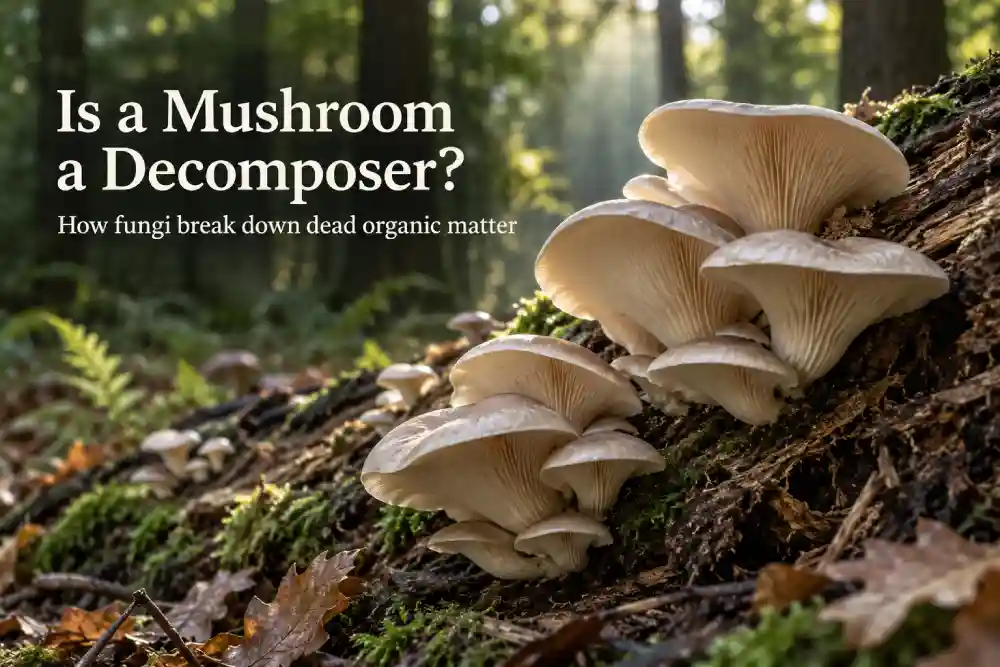
Is a Mushroom a Decomposer? Yes, many mushroom-forming fungi are decomposers. They break down dead wood, fallen leaves and other organic material, helping...