Top 10 Poisonous Mushrooms: Identification, Dangers, and Safety Guide

Nathan Cole
Mycologist · Author · Fungi Expert
Updated
Jun 3, 2026
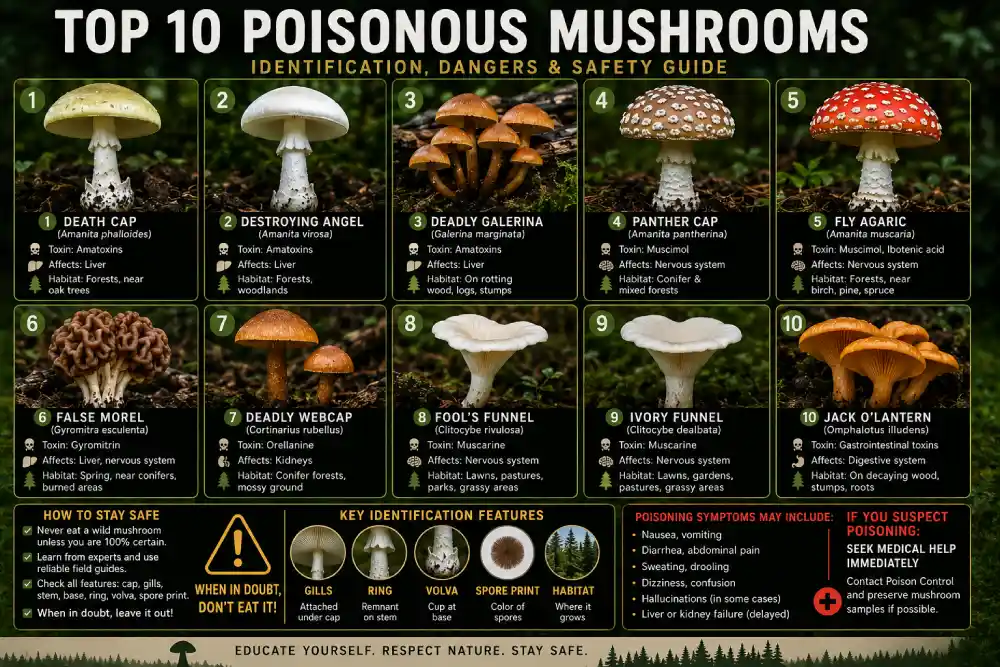
If you're wondering which mushrooms are the most dangerous to humans, the answer includes species such as the Death Cap (Amanita phalloides), Destroying Angel (Amanita virosa), Deadly Galerina (Galerina marginata), and False Morel (Gyromitra esculenta).
These mushrooms contain powerful toxins capable of causing liver failure, kidney damage, neurological symptoms, and even death.
Because many poisonous mushrooms closely resemble edible species, proper identification is essential for anyone interested in mushroom foraging or outdoor exploration.
What Are the Top 10 Most Poisonous Mushrooms?
The world's most poisonous mushrooms include:
| Rank | Common Name | Scientific Name | Primary Toxin | Risk Level |
|---|---|---|---|---|
| 1 | Death Cap | Amanita phalloides | Amatoxins | Extremely Deadly |
| 2 | Destroying Angel | Amanita virosa | Amatoxins | Extremely Deadly |
| 3 | Deadly Galerina | Galerina marginata | Amatoxins | Extremely Deadly |
| 4 | Panther Cap | Amanita pantherina | Muscimol | Highly Toxic |
| 5 | Fly Agaric | Amanita muscaria | Muscimol | Toxic |
| 6 | False Morel | Gyromitra esculenta | Gyromitrin | Potentially Fatal |
| 7 | Deadly Webcap | Cortinarius rubellus | Orellanine | Extremely Dangerous |
| 8 | Fool's Funnel | Clitocybe rivulosa | Muscarine | Toxic |
| 9 | Ivory Funnel | Clitocybe dealbata | Muscarine | Toxic |
| 10 | Jack O'Lantern | Omphalotus illudens | GI Toxins | Poisonous |
Although thousands of mushroom species exist worldwide, these ten are responsible for many of the most severe poisonings reported by toxicologists and mycologists.
Why Poisonous Mushrooms Are More Dangerous Than Most People Realize?
Many people assume poisonous mushrooms are easy to recognize because they appear unusual or brightly colored. In reality, some of the deadliest species look almost identical to edible mushrooms commonly collected by foragers.
A dangerous misconception is that taste, smell, insect activity, or color can determine whether a mushroom is safe to eat. None of these methods are reliable.
Several deadly species remain harmless-looking until consumed, making proper identification the only dependable safety measure.
How Mushroom Toxins Affect the Human Body?
Different poisonous mushrooms contain different toxins.
Some attack the liver:
- Amatoxins
- Phallotoxins
Others attack the kidneys:
- Orellanine
Others affect the nervous system:
- Muscimol
- Ibotenic acid
Still others cause severe digestive illness:
- Muscarine-containing species
- Jack O'Lantern mushrooms
The severity of poisoning depends on the toxin, dose consumed, and speed of medical treatment.
Why Misidentification Causes Most Poisonings?
Most mushroom poisonings occur because toxic species resemble edible mushrooms.
Common examples include:
- Death Cap mistaken for edible Agaricus mushrooms
- False Morel mistaken for True Morel
- Jack O'Lantern mistaken for Chanterelle
- Deadly Galerina mistaken for Honey Mushroom
Learning these lookalike relationships is often more important than memorizing long species lists.
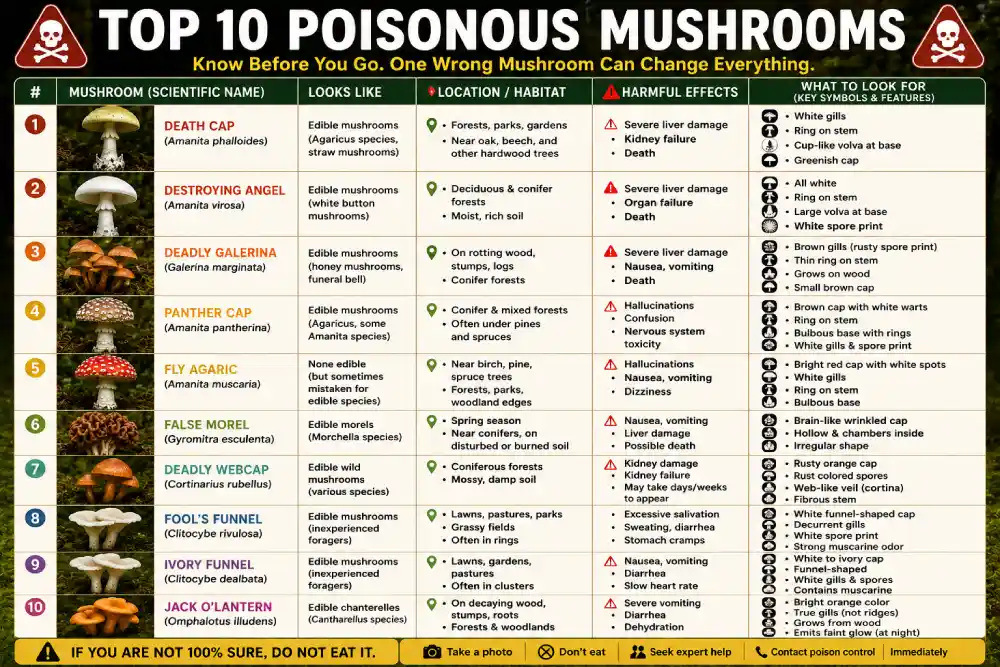
1. Death Cap (Amanita phalloides)
The Death Cap is widely considered the most dangerous mushroom in the world. It is responsible for the majority of fatal mushroom poisonings globally and continues to cause deaths every year.
Even a single mushroom may contain enough toxin to cause life-threatening liver failure.
Identification Features
Death Caps typically display:
- Olive-green cap
- Yellow-green cap variations
- White gills
- White stem
- Stem ring
- Cup-like volva at the base
- White spore print
Young specimens can look very different from mature mushrooms, increasing the risk of misidentification.
Habitat
Death Caps commonly grow:
- Near oak trees
- In mixed forests
- Along woodland edges
- In parks and gardens
- Near ornamental landscape trees
The species has spread far beyond its native range and is now found in many parts of North America.
Toxicity
Death Caps contain amatoxins that attack the liver.
Symptoms often follow four stages:
- Delayed symptom-free period
- Severe gastrointestinal illness
- Temporary recovery
- Liver and kidney failure
Without immediate treatment, poisoning can be fatal.
Dangerous Lookalikes
Death Caps are commonly confused with:
- Edible Agaricus species
- Paddy straw mushrooms
- Young puffballs
- Various edible white mushrooms
This similarity is a major reason why Death Caps remain so deadly.
2. Destroying Angel (Amanita virosa)
The Destroying Angel is another member of the deadly Amanita group. Despite its elegant appearance, it contains the same powerful amatoxins found in Death Caps.
Many experts consider it among the most dangerous mushrooms on Earth.
Identification Features
Key characteristics include:
- Pure white cap
- White gills
- White stem
- Hanging ring
- Large volva
- White spores
Its clean white appearance often causes beginners to underestimate the danger.
Habitat
Destroying Angels typically grow in:
- Deciduous forests
- Conifer forests
- Moist woodland habitats
- Forest trails
- Mossy areas
They often appear during late summer and autumn.
Toxic Effects
Consumption may lead to:
- Vomiting
- Severe diarrhea
- Liver failure
- Kidney failure
- Death
Like Death Caps, symptoms may not appear for several hours after ingestion.
Common Lookalikes
Destroying Angels are sometimes confused with:
- Meadow mushrooms
- Young button mushrooms
- White edible mushrooms
- Immature puffballs
The safest approach is to avoid consuming any white-gilled mushroom unless identification is absolutely certain.
3. Deadly Galerina (Galerina marginata)
Although much smaller than many Amanita species, the Deadly Galerina is equally dangerous.
This unassuming brown mushroom contains amatoxins and is responsible for numerous poisonings because it resembles several edible woodland species.
Identification Features
Typical characteristics include:
- Brown cap
- Sticky cap when moist
- Brown gills
- Thin stem
- Fragile ring
- Rust-brown spore print
Because it belongs to the group commonly called "little brown mushrooms," identification can be difficult.
Habitat
Deadly Galerinas usually grow on:
- Decaying logs
- Tree stumps
- Rotten wood
- Forest debris
- Conifer forests
They frequently appear in clusters.
Toxicity
Like Death Caps and Destroying Angels, Deadly Galerinas contain amatoxins.
Potential consequences include:
- Severe dehydration
- Liver failure
- Kidney damage
- Organ failure
- Death
The delayed onset of symptoms often makes treatment more difficult.
Dangerous Lookalikes
This species is often mistaken for:
- Honey mushrooms
- Velvet shank
- Other edible woodland mushrooms
Spore prints are often necessary for accurate identification.
4. Panther Cap (Amanita pantherina)
The Panther Cap is one of the most toxic mushrooms affecting the central nervous system. Although it is less likely to cause death than the Death Cap, it can trigger severe neurological symptoms and dangerous behavioral changes.
Its attractive appearance often causes inexperienced mushroom hunters to mistake it for a harmless woodland mushroom.
Identification Features
Panther Caps are recognized by:
- Brown cap
- White wart-like patches on the cap
- White gills
- White stem
- Stem ring
- Bulbous base with concentric ridges
- White spore print
The mushroom closely resembles other Amanita species, making proper identification essential.
Habitat
Panther Caps commonly grow:
- In conifer forests
- Under pine trees
- Near spruce trees
- In mixed woodlands
- Along forest trails
They form mycorrhizal partnerships with trees and often appear during late summer and fall.
Toxicity
Panther Caps contain:
- Muscimol
- Ibotenic acid
These compounds affect the brain and nervous system rather than the liver.
Symptoms may include:
- Hallucinations
- Delirium
- Confusion
- Muscle twitching
- Dizziness
- Aggressive behavior
- Loss of coordination
Why It Is Dangerous?
Unlike gastrointestinal poisoning, neurological poisoning can cause individuals to become disoriented and unable to make rational decisions.
This creates additional risks such as:
- Falls
- Accidents
- Exposure injuries
- Delayed medical treatment
5. Fly Agaric (Amanita muscaria)
The Fly Agaric is perhaps the most recognizable mushroom in the world. Its bright red cap with white spots appears in folklore, fairy tales, holiday artwork, and popular video games.
Despite its iconic appearance, it remains a toxic mushroom capable of causing significant illness.
Identification Features
Fly Agaric mushrooms typically display:
- Bright red cap
- Orange-red variations
- White wart-like patches
- White gills
- Thick white stem
- Hanging ring
- Bulbous base
Older specimens may lose some of their white spots after heavy rain.
Habitat
Fly Agarics grow throughout many temperate forests.
They are commonly found:
- Under birch trees
- Under pine trees
- Under spruce trees
- In mixed forests
- Along woodland edges
Toxicity
The primary toxins include:
- Muscimol
- Ibotenic acid
Potential symptoms include:
- Nausea
- Vomiting
- Hallucinations
- Drowsiness
- Confusion
- Visual distortions
- Impaired coordination
Common Misconceptions
Many internet sources suggest Fly Agaric can be safely prepared for consumption.
However:
- Toxin concentrations vary.
- Reactions vary greatly between individuals.
- Serious poisonings continue to occur.
Foraging experts generally recommend avoiding consumption entirely.
6. False Morel (Gyromitra esculenta)
False Morels are among the most deceptive poisonous mushrooms because they resemble highly prized edible morels.
Every spring, mushroom hunters accidentally collect False Morels while searching for true morels.
Identification Features
False Morels can be identified by:
- Brain-like cap
- Wrinkled folds
- Irregular lobes
- Chambered interior
- Distorted appearance
Unlike true morels, they do not have a symmetrical honeycomb structure.
Habitat
False Morels often grow:
- In spring
- Near conifer forests
- Along forest roads
- In disturbed soil
- In burned forest areas
They frequently appear in the same regions where true morels are found.
Toxicity
False Morels contain:
- Gyromitrin
Inside the body, this toxin converts into highly toxic compounds that affect multiple organs.
Potential symptoms include:
- Vomiting
- Diarrhea
- Headaches
- Dizziness
- Seizures
- Liver damage
Severe poisonings can be fatal.
False Morel vs True Morel
| Feature | False Morel | True Morel |
|---|---|---|
| Cap Surface | Brain-like folds | Honeycomb pits |
| Interior | Chambered | Completely hollow |
| Shape | Irregular | Symmetrical |
| Edibility | Poisonous | Edible when properly cooked |
Foragers should always cut morels lengthwise to inspect the interior.
7. Deadly Webcap (Cortinarius rubellus)
The Deadly Webcap is one of the most feared mushrooms among toxicologists because its symptoms often take days or even weeks to appear.
By the time poisoning is recognized, irreversible kidney damage may already have occurred.
Identification Features
Key characteristics include:
- Rusty-orange cap
- Fibrous stem
- Brown gills
- Rust-colored spores
- Web-like veil remnants
The species is often overlooked because it lacks the dramatic appearance of many famous poisonous mushrooms.
Habitat
Deadly Webcaps commonly grow:
- In conifer forests
- In mixed woodlands
- On mossy forest floors
- Near spruce and pine trees
They are most common during late summer and autumn.
Toxicity
The mushroom contains:
- Orellanine
Unlike amatoxins, orellanine primarily attacks the kidneys.
Symptoms may include:
- Extreme thirst
- Fatigue
- Headaches
- Nausea
- Kidney failure
Why Webcaps Are So Dangerous
The delayed onset of symptoms is the greatest threat.
People may not realize they have been poisoned until days or weeks later, when medical intervention becomes far more difficult.
8. Fool's Funnel (Clitocybe rivulosa)
The Fool's Funnel is a deceptively small mushroom capable of causing severe poisoning.
Because it often grows in lawns and grassy areas, it is sometimes encountered by children, pet owners, and casual mushroom collectors.
Identification Features
Typical characteristics include:
- White cap
- Funnel-shaped mature cap
- White gills
- Thin stem
- White spore print
- Dense growth clusters
The mushroom appears harmless but contains significant concentrations of muscarine.
Habitat
Fool's Funnels frequently grow:
- In lawns
- In parks
- In pastures
- Along grassy pathways
- In residential landscapes
Toxicity
The primary toxin is:
- Muscarine
Symptoms often develop quickly and may include:
- Excessive sweating
- Salivation
- Tearing
- Vomiting
- Diarrhea
- Abdominal cramps
- Blurred vision
Why It Is Frequently Overlooked
Unlike many forest mushrooms, Fool's Funnels grow in highly visible public spaces.
Many people mistakenly assume lawn mushrooms are harmless, increasing the likelihood of accidental exposure.
9. Ivory Funnel (Clitocybe dealbata)
The Ivory Funnel is closely related to the Fool's Funnel and contains the same dangerous toxin, muscarine. Because the two species are extremely similar, they are often discussed together by mycologists and toxicologists.
Despite their small size, Ivory Funnels can cause significant poisoning and should never be consumed.
Identification Features
Ivory Funnels generally have:
- White to cream-colored cap
- Funnel-shaped mature cap
- White gills
- Thin stem
- White spores
- Smooth cap surface
As the mushroom ages, the center of the cap often becomes depressed, creating the characteristic funnel shape.
Habitat
Ivory Funnels commonly grow:
- In lawns
- Public parks
- Gardens
- Pastures
- Grassy woodland edges
Unlike many dangerous mushrooms, they do not require deep forest habitats.
Toxicity
The primary toxin is:
- Muscarine
Symptoms can begin within a few hours and may include:
- Excessive sweating
- Increased saliva production
- Watery eyes
- Vomiting
- Diarrhea
- Stomach cramps
- Slow heart rate
Why Identification Matters?
Many small white mushrooms appear similar to beginners.
Foragers should avoid consuming unidentified white mushrooms growing in grassy areas because several toxic species share similar appearances.
10. Jack O'Lantern Mushroom (Omphalotus illudens)
The Jack O'Lantern Mushroom is responsible for numerous poisonings because it closely resembles one of the world's most popular edible mushrooms—the chanterelle.
Although rarely fatal, it can cause intense gastrointestinal distress.
Identification Features
Jack O'Lantern mushrooms are known for:
- Bright orange coloration
- True gills
- Thick clustered growth
- Tough flesh
- Central stem
- Orange interior
In very dark conditions, some species may exhibit faint bioluminescence.
Habitat
Jack O'Lantern mushrooms grow:
- On decaying wood
- On tree stumps
- From buried roots
- In woodland habitats
- Along forest edges
Unlike chanterelles, they always grow from wood.
Toxicity
Consumption may cause:
- Severe nausea
- Vomiting
- Diarrhea
- Abdominal pain
- Dehydration
Symptoms often begin within a few hours of ingestion.
Chanterelle Lookalike Risk
The confusion between Jack O'Lanterns and chanterelles is one of the most common mushroom identification mistakes.
Key differences include:
| Feature | Jack O'Lantern | Chanterelle |
|---|---|---|
| Gills | True gills | False ridges |
| Growth | On wood | On soil |
| Color | Bright orange | Golden yellow |
| Edibility | Poisonous | Edible |
Comparison Table of the Top 10 Poisonous Mushrooms
| Mushroom | Main Toxin | Primary Target | Fatal Potential |
| Death Cap | Amatoxins | Liver | Very High |
| Destroying Angel | Amatoxins | Liver | Very High |
| Deadly Galerina | Amatoxins | Liver | Very High |
| Panther Cap | Muscimol | Nervous System | Moderate |
| Fly Agaric | Muscimol | Nervous System | Moderate |
| False Morel | Gyromitrin | Liver & Nervous System | High |
| Deadly Webcap | Orellanine | Kidneys | High |
| Fool's Funnel | Muscarine | Nervous System | Moderate |
| Ivory Funnel | Muscarine | Nervous System | Moderate |
| Jack O'Lantern | GI Toxins | Digestive System | Low |
Common Edible Lookalikes That Cause Dangerous Mistakes
Many mushroom poisonings occur because people focus on what they hope a mushroom is rather than what it actually is.
Death Cap vs Edible Agaricus
Shared characteristics:
- White stem
- Similar size
- Pale cap
Critical difference:
- Death Caps possess a volva at the base and contain deadly amatoxins.
False Morel vs True Morel
Shared characteristics:
- Spring fruiting season
- Similar color
- Woodland habitat
Critical difference:
- True Morels are completely hollow inside.
- False Morels contain folds and chambers.
Deadly Galerina vs Honey Mushroom
Shared characteristics:
- Brown caps
- Clustered growth
- Wood-loving habitat
Critical difference:
- Deadly Galerina produces rusty-brown spores.
- Honey Mushrooms produce white spores.
Jack O'Lantern vs Chanterelle
Shared characteristics:
- Orange color
- Woodland habitat
Critical difference:
- Chanterelles have blunt ridges.
- Jack O'Lanterns have true gills.
Symptoms of Mushroom Poisoning
Symptoms vary depending on the species involved.
Early Symptoms
Many toxic mushrooms cause:
- Nausea
- Vomiting
- Diarrhea
- Stomach pain
Neurological Symptoms
Species such as Panther Caps and Fly Agarics may cause:
- Hallucinations
- Delirium
- Confusion
- Dizziness
- Loss of coordination
Delayed Symptoms
Amatoxin-containing mushrooms often produce:
- Symptom-free period
- Severe gastrointestinal illness
- Temporary improvement
- Organ failure
Delayed symptoms should always be treated as a medical emergency.
What To Do If You Eat a Poisonous Mushroom?
If poisoning is suspected:
Immediate Actions
- Seek emergency medical care.
- Contact poison control.
- Preserve mushroom samples.
- Photograph the mushroom.
- Record the collection location.
Avoid These Mistakes
- Do not rely on internet remedies.
- Do not induce vomiting unless instructed.
- Do not wait for symptoms.
- Do not assume a small amount is safe.
Early treatment dramatically improves outcomes.
Mushroom Foraging Safety Tips
Safe foraging begins with careful identification.
Best Practices
- Learn a few species thoroughly.
- Use multiple identification features.
- Examine the entire mushroom.
- Make spore prints when necessary.
- Consult field guides and local experts.
- Keep different species separated.
The Most Important Rule
If you are not 100% certain of identification, do not eat the mushroom.
This single rule prevents the vast majority of serious poisonings.
Conclusion
The world's most poisonous mushrooms include the Death Cap, Destroying Angel, Deadly Galerina, Panther Cap, Fly Agaric, False Morel, Deadly Webcap, Fool's Funnel, Ivory Funnel, and Jack O'Lantern Mushroom. While these species differ in appearance and toxicity, they share one important characteristic: they can cause serious illness or death when misidentified and consumed.
Understanding identification features, habitats, lookalikes, and toxicity patterns is essential for safe mushroom foraging. The most dangerous mushrooms are often not the strangest-looking ones but those that closely resemble edible species.
Education, caution, and proper identification remain the most effective tools for preventing mushroom poisoning.
Read also: Mushroom Identification Quiz
Frequently Asked Questions
What is the most poisonous mushroom in the world?
The Death Cap (Amanita phalloides) is widely considered the most poisonous mushroom in the world because it causes most fatal mushroom poisonings globally.
Which mushroom causes the most deaths?
Death Caps and Destroying Angels are responsible for the majority of fatal mushroom poisonings due to their amatoxin content.
Can touching a poisonous mushroom harm you?
Most poisonous mushrooms are safe to touch. Poisoning generally occurs through ingestion rather than skin contact.
Can cooking remove mushroom toxins?
No. Many deadly toxins, including amatoxins, survive cooking, drying, freezing, and other food preparation methods.
How long does mushroom poisoning take to appear?
Symptoms may appear within 30 minutes or may take 24 hours or longer, depending on the toxin involved.
What should I do if I accidentally eat a poisonous mushroom?
Seek immediate medical attention, contact poison control, preserve mushroom samples, and do not wait for symptoms to develop.
Which poisonous mushroom is most often mistaken for an edible species?
The Death Cap is frequently confused with edible mushrooms, while False Morels and Jack O'Lanterns are often mistaken for true morels and chanterelles.
Are all Amanita mushrooms poisonous?
No, but many of the world's most dangerous mushrooms belong to the Amanita genus, making extreme caution necessary when identifying them.
Where do most poisonous mushrooms grow?
Poisonous mushrooms grow in forests, grasslands, parks, gardens, and urban landscapes worldwide.
What is the safest mushroom-foraging rule?
Never eat a mushroom unless you are completely certain of its identification.
Sign in to leave a comment and join the discussion.
 Species Guide
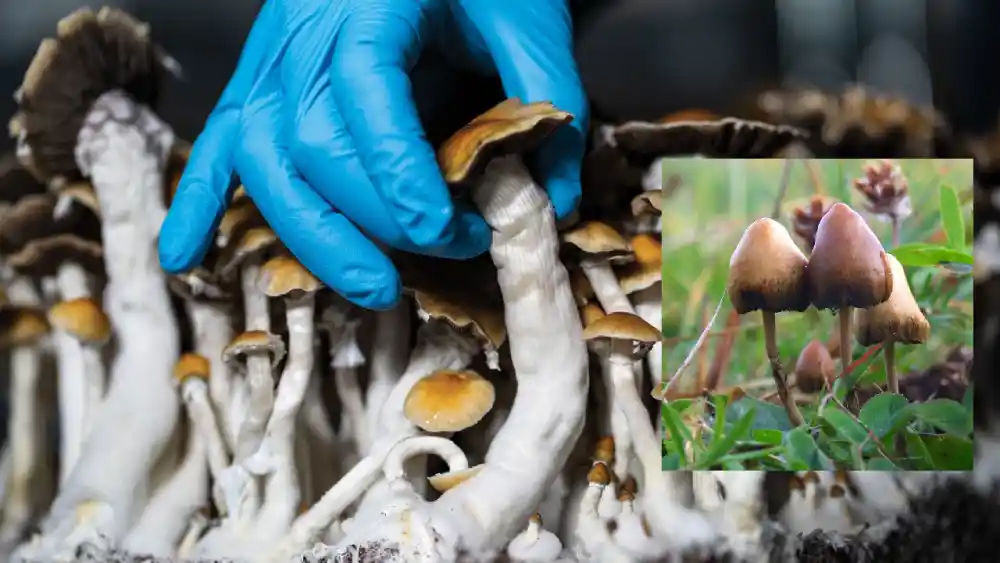
Psychedelic mushroom identification requires much more than recognizing a blue-staining mushroom or comparing a single photo online. Accurate identification...
 Species Guide
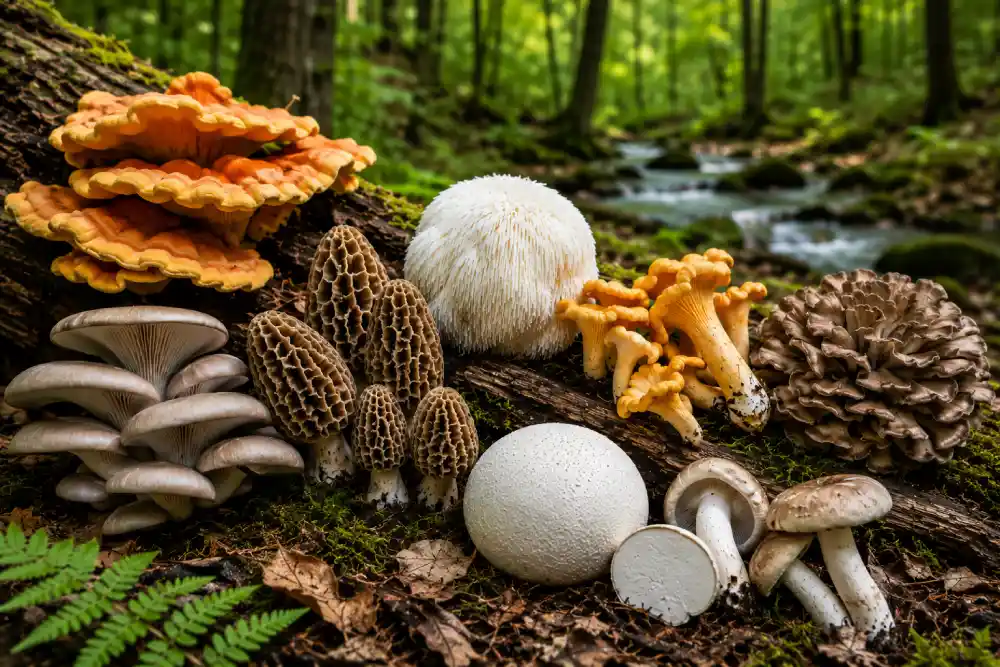
Missouri is home to a remarkable variety of edible wild mushrooms that thrive in the Ozark Mountains, Mark Twain National Forest, hardwood river valleys,...
 Species Guide
Maryland offers excellent opportunities for wild mushroom foraging thanks to its diverse landscapes, ranging from the Appalachian Mountains in the west to...