How to Grow Turkey Tail Mushrooms at Home
— views
You can grow turkey tail at home, but no ready-to-fruit turkey tail kit turned up on Amazon in November 2026. What Amazon sells is liquid culture for your own substrate or logs. That route needs sterile work or fresh hardwood logs, plus a long wait. Turkey tail (Trametes versicolor) is also too tough to eat like a normal mushroom, so anyone who wants food should start with an oyster kit.
Key Takeaways
- Amazon sells turkey tail liquid culture, not a ready-to-fruit kit, so you supply the substrate or the logs.
- A 2026 study fruited turkey tail on sawdust and wheat bran at about 73 to 77°F and 80 to 90% humidity.
- Extension log guides use dowel or sawdust spawn, so a syringe has to become spawn before it can start a log.
- We found no extension guide to growing turkey tail, and no university figure for time to harvest on logs.
- Turkey tail is a wild log fungus and a known competitor on shiitake logs, so identify any bracket that appears.
- This page makes no health claims. It covers growing and identification only.
Turkey Tail Growing Conditions Chart
No extension service we found publishes a turkey tail chart, so this one combines a peer-reviewed study with extension log guidance for similar wood fungi. The indoor column comes from a 2026 cultivation study from Iran. The log column follows the University of Kentucky.
| Factor | Indoor sterile sawdust | Outdoor hardwood log |
|---|---|---|
| Temperature | 24°C, plus or minus 1, in the fruiting room (about 73 to 77°F) | Outdoor weather. No university figure found |
| Substrate | Sawdust with wheat bran. A mix of 70% sawdust and 30% bran gave the best yield | Freshly cut, decay-free hardwood with intact bark. Turkey tail rarely grows on conifers |
| Humidity | 80 to 90% in the room, with substrate moisture held at 65% | A moist, shady stack. No percentage found for turkey tail |
| Time to harvest | About 30 days to first harvest on the slowest mix tested | No figure found. Kentucky gives six months to two years for reishi logs as the nearest guide |
| Difficulty | Hard. Our rating, because the work must stay sterile | Moderate work and a long wait. Our rating |
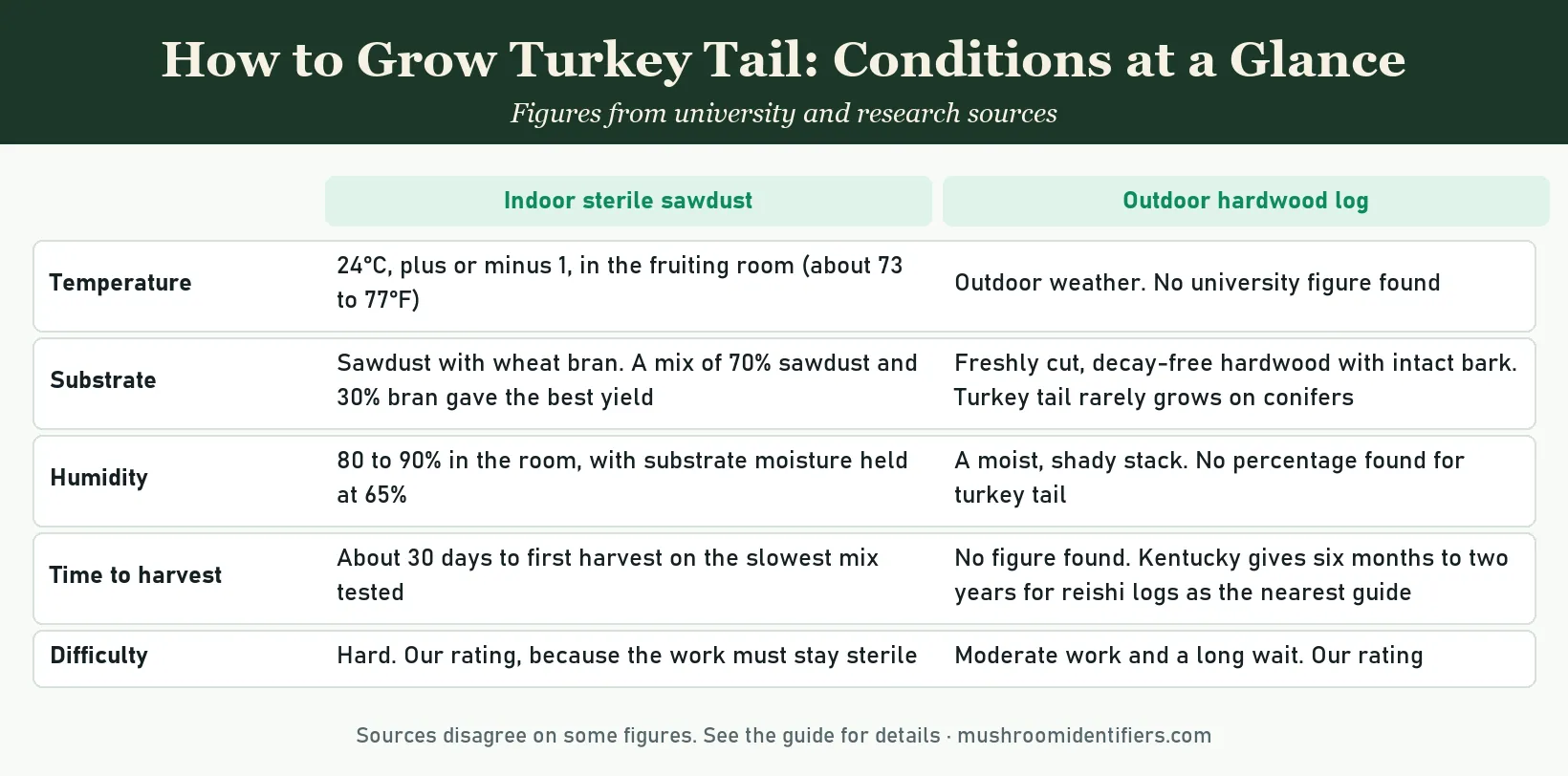
Read these numbers with care. The study used one wild strain in a controlled fruiting room, so a home result will differ. The 30-day figure is not a promise. A 2021 study from Vietnam found the best mycelial growth at 30°C (86°F) on lab medium. That is a warmer figure, but it measures mycelium, not fruiting.
Can You Grow Turkey Tail at Home?
Yes, you can grow turkey tail at home on sterile sawdust or hardwood logs, but neither route is quick or beginner-friendly. A North American field guide describes the fungus as saprobic on the deadwood of hardwoods, and rarely on conifer wood. It causes a white rot of the sapwood.
Fruiting on prepared substrate is documented. The Iranian study fruited it on sawdust and wheat bran. The Vietnamese study fruited wild strains on sawdust and rice husk with wheat bran.
Log growing has less evidence. We found no extension page that teaches it. Cornell Small Farms' outdoor guide does not list turkey tail among its log species, and it says only log shiitake can be reliably cultivated outdoors as a commercial crop. The log steps below are borrowed from guides for other wood fungi, so treat them as a reasoned starting point.
What Do You Need to Grow Turkey Tail?
You need a culture, a way to turn it into spawn, and either sterile sawdust or fresh hardwood logs. Amazon covers only the first item.
The Turkey Tail Liquid Culture is a 10 ml syringe of live mycelium, according to the listing.
The Mycology-Supply Turkey Tail Mushroom Liquid Culture is a second option.
Neither one is a kit. The listing facts used here give no timing or yield figure. You must supply everything else, and you need sterile technique to use either one.
For the Sawdust Route
- A pressure cooker. Utah State University Extension sterilizes grain at about 250°F and 15 psi for 120 minutes.
- Grain, hardwood sawdust and wheat bran.
- Bags with an injection port and gas exchange.
- Isopropyl alcohol, sterile gloves and a mask.
For the Log Route
- Sawdust spawn or dowel spawn, which you must make from the culture.
- Freshly cut hardwood logs.
- A drill, food-grade wax and a way to melt it safely.
- A moist, shady spot with a water source nearby.
How Do You Grow Turkey Tail Step by Step?
Turn the liquid culture into spawn first, then move that spawn onto sterile sawdust or into fresh logs. Both routes start the same way.
Make Grain Spawn
- Sterilize the grain. Utah State uses rye, millet, corn or wheat in a pressure cooker.
- Inject the culture. Wipe the port with isopropyl alcohol, heat the needle until red hot and let it cool. Utah State injects no more than 1 cubic centimeter per 1/2 pound of grain.
- Colonize. Keep the bag in a clean, dark place at 72 to 75°F. Utah State gives 2 to 4 weeks.
Grow on Sterile Sawdust
- Mix the substrate. The Iranian study got its best yield from 70% sawdust and 30% wheat bran, with moisture held at 65%.
- Sterilize it. Cornell Small Farms lists pressurized steam for supplemented sawdust. It says this material needs a lab-like setting for inoculation.
- Add the spawn. Utah State's tub method uses about 3 lb of spawn to 10 lb of substrate. We found no turkey tail figure.
- Incubate. Keep a hand's width between bags, as Cornell advises. Spawn running took about 22 days on the study's slowest mix.
- Fruit. The study held its fruiting room at about 75°F and 80 to 90% humidity. Cornell cuts bags to expose small areas for many species, but its guide does not cover turkey tail.
Grow on Hardwood Logs
- Make sawdust spawn. Kentucky says logs are inoculated with dowel or sawdust spawn. The Vietnamese study's best spawn mix was 79% sawdust, 20% rice grain and 1% calcium carbonate.
- Cut fresh logs. Kentucky uses logs about 3 to 8 inches across and 3 to 4 feet long, cut from decay-free live trees with intact bark. It says oaks seem to be preferred for reishi, maitake and lion's mane, and that beech or maple can also work.
- Inoculate right away. UF/IFAS says older logs may already hold naturally occurring mushrooms.
- Drill and fill. Mississippi State Extension drills about 40 holes per shiitake log in a diamond or spiral pattern. Its sawdust spawn holes are about 1 inch deep.
- Seal each hole. Kentucky uses hot cheese wax as a barrier against moisture loss, insects and contamination.
- Stack in shade. Keep logs moist and shaded, with gravel or fabric between the logs and the soil.
- Keep them moist and wait. Water logs in dry spells. Identify anything that fruits before you use it.
What Are the Common Problems When Growing Turkey Tail?
The common problems are contamination on sterile substrate, and on logs, drying out or competition from other fungi. The fixes below come from extension guides for other species, because we found none for turkey tail.
| Problem | Sign | What to do |
|---|---|---|
| Contaminated bag | Black, purple or green colors | Discard it quickly. Utah State says the bag was not fully sterilized |
| Trichoderma | Looks like mycelium at first, then turns black, green, pink or orange | Discard the substrate. Kentucky says logs with blue-green Trichoderma must be removed and destroyed |
| Dry log | A log left in sun or wind through a dry spell | Soak it for a few hours or use a sprinkler, as Cornell does for shiitake |
| Sun-heated log | Direct sun on the bark | Move it to shade. Cornell says sun can raise the internal temperature and favor Hypoxylon |
| Other fungi on the log | Crusts, gilled mushrooms or molds | Identify them, and remove a log with a serious competitor |
| Nothing fruits | No brackets after a year or more | Keep the log shaded and moist. We found no university timeline to judge it by |
Cornell's shiitake best practices guide says other wood fungi cannot be blocked completely, because their spores are carried in the air. Our tree mushroom identification guide helps with what else may appear.
How Does Turkey Tail Compare With an Easier Oyster Kit?
An oyster kit is far easier, because it arrives colonized and fruits within about 10 days. Turkey tail is a long hobby project that does not end in a meal. Our mushroom grow kit comparison covers beginner options, and our oyster mushroom grow kit guide covers care.
| Feature | Turkey tail from liquid culture | Oyster kit |
|---|---|---|
| What arrives | A syringe of culture | A colonized block or bag |
| First harvest | About 30 days in a study's fruiting room. No log figure found | About a week to 10 days, per UF/IFAS |
| Skills needed | Sterile work, or log inoculation as well | Daily care with water, air and light |
| On the plate | Too tough to eat as a normal mushroom | Cooks as food in stir fries and soups |
| Best for | Patient growers with some experience | First-time growers |
How Do You Harvest and Use Turkey Tail?
Cut fresh, flexible brackets from the wood, and do not expect a mushroom you can eat like an oyster. One species account describes fresh caps as 1 to 2 mm thick and flexible. Kentucky says specialty mushrooms are harvested with a sharp knife or by twisting them off at the base. A knife suits a thin bracket on wood. We found no source that gives a harvest stage for grown turkey tail.
Sources differ on the food label. MykoWeb says "too tough to try." The Missouri Department of Conservation lists it as edible and medicinal, and says it can be ground and used as a tea or in soup. Thin brackets dry easily, and our guide on how to dry mushrooms gives the method.
This page makes no health claims and gives no dosing advice. Memorial Sloan Kettering says turkey tail can interact with some medications. It says people who are pregnant or breastfeeding should avoid it until safety data are available. Talk to your healthcare provider before using it in any form.
What Are the Turkey Tail Look-Alikes?
The main look-alike is false turkey tail, and the underside separates the two: true turkey tail has pores, and false turkey tail is smooth. A log is open to wild spores, so a banded bracket may not have come from your spawn. Our turkey tail identification guide gives the full field check, and our false turkey tail guide covers the pore test.
| Feature | Turkey tail | False turkey tail |
|---|---|---|
| Scientific name | Trametes versicolor | Stereum ostrea |
| Underside | Whitish to pale brownish, with 3 to 6 or more tiny pores per mm | Smooth, whitish to grayish or pale reddish brown, with no pores |
| Cap surface | Densely hairy or velvety, with alternating zones of texture | Velvety or hairy at first, often smoother by maturity |
| Shape | Flat brackets in dense, overlapping clusters | Usually individual, funnel-shaped bodies |
Descriptions follow one field guide's pages on Trametes versicolor and Stereum ostrea. A standard reference also separates turkey tail from Trametes hirsuta, Trametes pubescens and Trametes ochracea. If terms such as pore surface are new, see our guide to the parts of a mushroom.
Common Mistakes
Treating a Syringe as a Kit
A syringe of liquid culture is only a starting point. It needs sterile substrate before anything can grow.
Putting Liquid Culture Straight Into a Log
The extension log guides we opened use dowel or sawdust spawn. None of them injects liquid culture into a log.
Using Old Logs
UF/IFAS says freshly cut logs are required, because older logs may already hold other fungi. A log already rotting is a poor starting point.
Stacking Logs in Direct Sun
Cornell says direct sun on bark can raise the internal temperature of a log. Keep logs shaded and out of drying wind.
Growing Turkey Tail Beside Shiitake Logs
Cornell says turkey tail competes directly with shiitake to be the first to colonize a log. Kentucky lists it, under the older name Polyporus versicolor, among threats to outdoor log production. Keeping the two apart is our own cautious reading of those warnings.
Assuming Every Banded Bracket Is Yours
Turkey tail is very common in the wild, according to Missouri. Other fungi copy its bands, so check the underside every time.
Frequently Asked Questions
Is there a turkey tail mushroom grow kit?
No ready-to-fruit turkey tail kit turned up on Amazon in November 2026. What Amazon sells is liquid culture for your own substrate or logs. You must supply the sterile substrate or the hardwood logs yourself.
How do you grow turkey tail on logs?
Make dowel or sawdust spawn, drill freshly cut hardwood logs, fill the holes and seal them with wax. Stack the logs in moist shade. We found no extension guide specific to turkey tail, so these steps come from guides for other wood fungi.
How long does turkey tail take to grow?
A 2026 study reached first harvest in about 30 days on its slowest sawdust mix, in a controlled room. We found no university figure for logs. Kentucky gives six months to two years for reishi logs, which is the nearest guide.
What wood does turkey tail grow on?
Turkey tail grows on the deadwood of hardwoods and rarely on conifers. Kentucky says oaks seem to be preferred for similar log fungi, and that beech or maple can also work. Use freshly cut wood with intact bark.
What temperature does turkey tail need?
A 2026 study held its fruiting room at about 73 to 77°F with 80 to 90% humidity. A separate study found the best mycelial growth at 86°F on lab medium. Those are different growth stages, and neither is a home figure.
Can you inject liquid culture directly into a log?
The extension guides we opened do not describe that method. Kentucky says logs are inoculated with dowel or sawdust spawn. Turn the liquid culture into spawn first.
Is turkey tail hard to grow?
Yes, compared with an oyster kit. The sawdust route needs sterile work, and the log route needs fresh logs and a long wait. No source we opened rates the difficulty, so this is our own judgment.
Can you eat turkey tail you grew?
Turkey tail is too tough to eat like a normal mushroom. MykoWeb says too tough to try, while Missouri says it can be ground and used as a tea or in soup. An expert should confirm the identification of anything from an outdoor log.
Will turkey tail hurt my shiitake logs?
It can reduce what those logs give you. Cornell says turkey tail competes with shiitake to colonize the log first, but does not attack the shiitake mycelium itself. Logs with a serious competitor may be worth removing.
How do I know my log grew turkey tail?
You cannot tell where a bracket came from by looking at it. You can only identify the species. Check for tiny pores underneath, a velvety cap and thin, flexible flesh.
Final Safety Reminder
A log outdoors can grow anything, so never assume a bracket is the species you planted. Never eat or brew a wild mushroom based on a chart, a photo or an app. Keep children and pets away from unknown mushrooms. For a second opinion, photograph the top, the underside and the wood, using our guide on how to photograph mushrooms for identification. Then check the pictures with our free mushroom identifier and a local expert. Put any contaminated bag in the trash.
About this guide: we compared current Amazon listings with university extension guidance and did not test these products. As an Amazon Associate, Mushroom Identifiers earns from qualifying purchases at no extra cost to you. Prices and availability are shown on Amazon.
Sign in to leave a comment and join the discussion.
 Guide
Most maple tree fungus is either a leaf spot that looks alarming but rarely hurts the tree, or a decay fungus fruiting from wood that is already rotting...
 Guide
Pine tree fungus identification starts with color and place: orange powder on a woody gall is a rust, brown dead shoot tips are a blight, a conk at the base...
 Guide
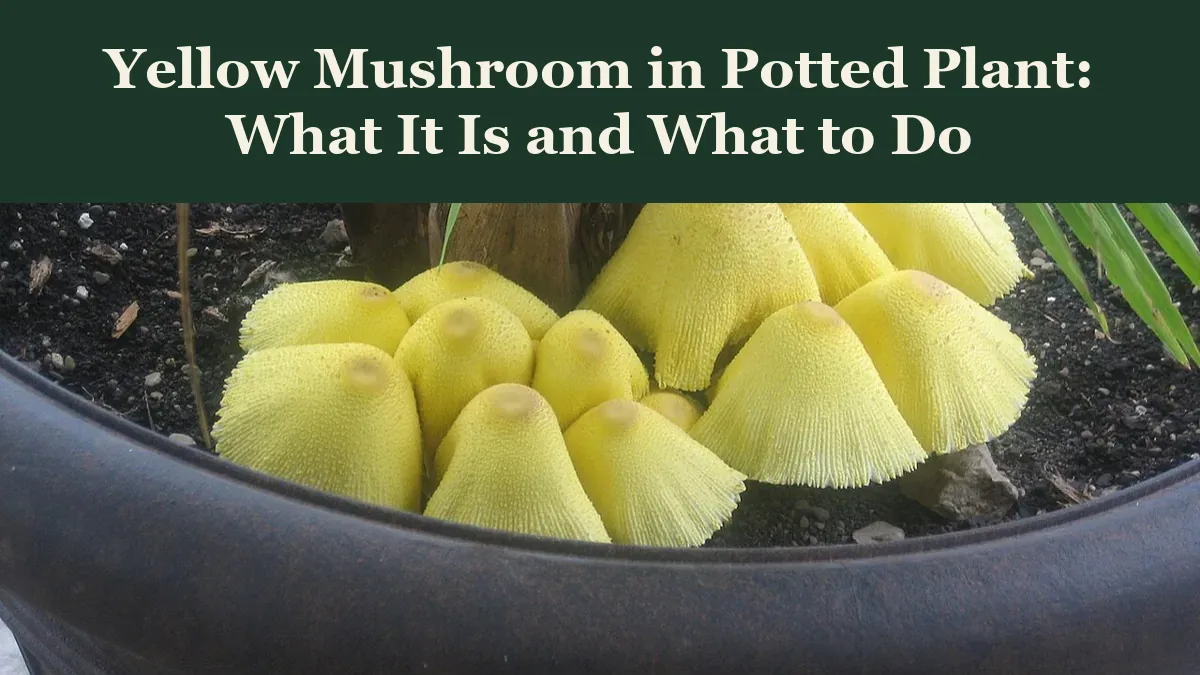
A yellow mushroom in a potted plant is almost always the flowerpot parasol, Leucocoprinus birnbaumii , a lemon-yellow mushroom that feeds on dead organic...