How to Grow Enoki Mushrooms at Home (No Kit Needed)
— views
No ready-to-fruit enoki kit turned up on Amazon in November 2026, so growing enoki at home means starting from liquid culture. That route needs a pressure cooker, sterile technique and a reliably cold place. It is much harder than an oyster kit. A Japanese college report shows that a household refrigerator can work, but its harvests were small. Most beginners should start with an oyster kit.
Key Takeaways
- Amazon showed enoki liquid culture in November 2026, not a ready-to-fruit kit. You supply everything else.
- Commercial enoki needs 59°F or below, according to a 2020 PLOS ONE paper, so most home growers need a refrigerator or a cold room.
- A Japanese trial colonized small bottles at 77°F, then fruited them in a household refrigerator at 41 to 50°F.
- Sawdust and bran must be sterilized, or the culture has to compete with established mold and bacteria.
- Expect about 6 to 9 weeks and a small harvest. The Japanese trial picked about 13 to 22 g per bottle.
- Cook enoki thoroughly. CDC says people at higher risk should not eat any raw enoki.
Enoki Growing Conditions Chart
Enoki colonizes at room temperature, then fruits in the cold on sterilized sawdust and bran. We found no US extension sheet for enoki, so this chart uses a college report, research papers and an FAO guide.
| Factor | What the sources report | Source |
|---|---|---|
| Colonizing temperature | 72 to 77°F (22 to 25°C) | Asahikawa report, Frontiers papers |
| Fruiting temperature | 59°F (15°C) or below in commercial growing. 41 to 50°F (5 to 10°C) in a household refrigerator | PLOS ONE, Asahikawa report |
| Range by strain | Brown strain 46 to 59°F. White strain 46 to 68°F | FAO |
| Substrate | Sterilized sawdust and rice bran at 65% water. Research mixes also use cottonseed hulls and wheat bran | Asahikawa report, Frontiers |
| Humidity | 90% until pins form, then 75% | Frontiers |
| Time to harvest | 42 to 45 days at 50°F. 56 to 63 days in a dark refrigerator. 51 days in a lab trial | Asahikawa report, Frontiers |
| Difficulty | Hard. No source rates it, so this is our summary | Our summary |
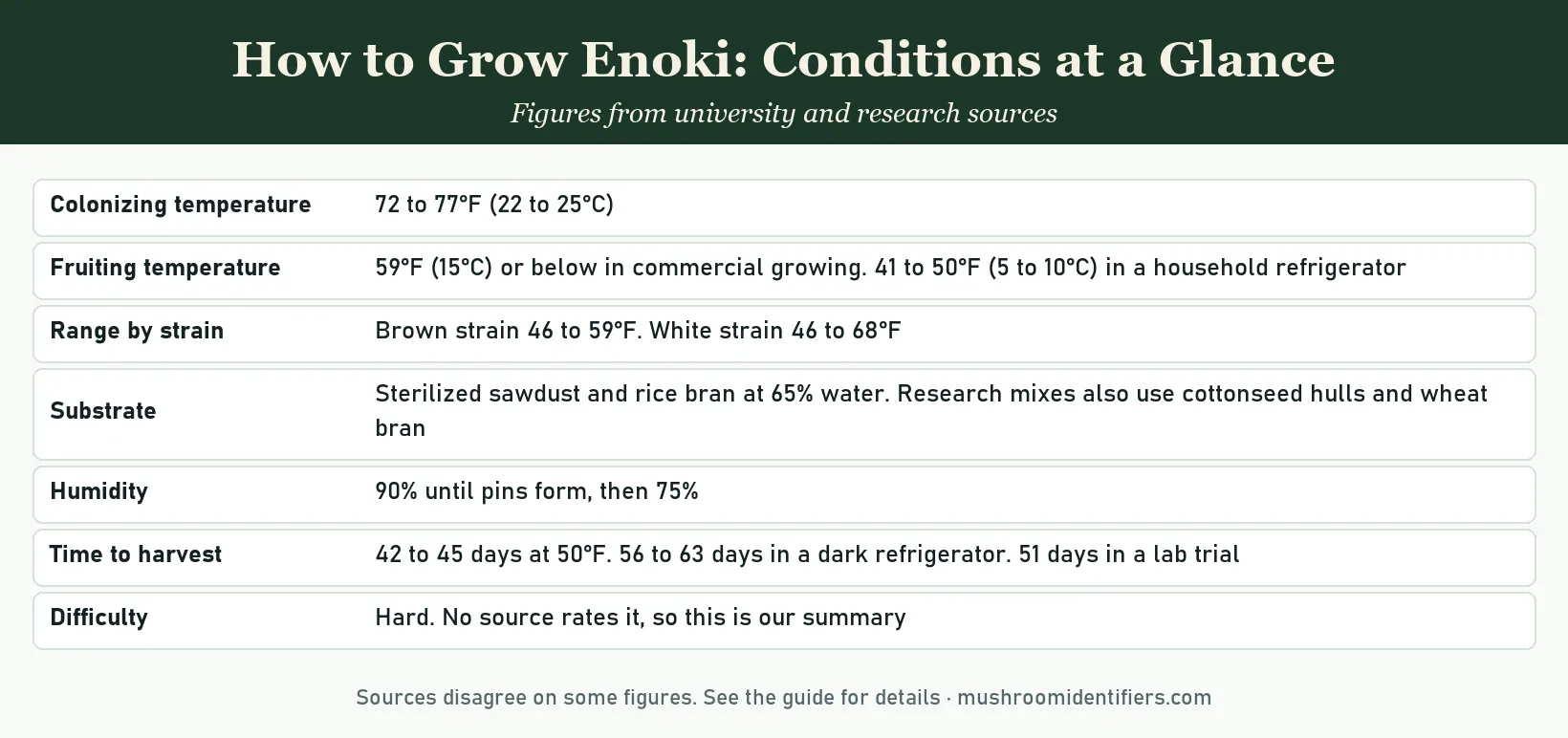
The figures come from a 2022 report from the National Institute of Technology, Asahikawa College, a 2020 PLOS ONE paper, a 2023 paper on enoki fruiting in Frontiers in Microbiology, a second 2023 paper in the same journal and an FAO growing guide.
The sources differ on the upper limit. PLOS ONE says commercial growing needs 59°F or below, while FAO lists white strains up to 68°F. PLOS ONE also describes one heat-tolerant strain that fruited at 73°F with 95% humidity. Strain matters, so ask the culture seller for its range.
Can You Grow Enoki Mushrooms at Home?
Yes, you can grow enoki at home, but only with sterile equipment and a reliably cold place. The best home evidence is the Asahikawa report. Its authors wrote a manual for public classes, using 200 ml glass bottles and a household refrigerator.
Enoki is a cold-weather mushroom. PLOS ONE says wild strains commonly fruit from late autumn to early spring. Tom Volk of the University of Wisconsin-La Crosse also describes its preference for fruiting in cold weather.
Two things make it harder than an oyster kit. A kit arrives already colonized, while liquid culture leaves that stage to you. Enoki also needs a cold stage that most living rooms cannot hold. Cornell Small Farms adds that supplemented sawdust requires steam sterilization. Utah State University Extension does not list enoki among its beginner species.
What Do You Need to Grow Enoki?
You need a clean culture, a pressure cooker, sawdust and bran, heat-safe bottles and a cold place. The list is longer than it looks, because everything has to stay clean.
- Culture: liquid culture, which you turn into spawn.
- Pressure cooker: Utah State sterilizes grain at about 250°F and 15 psi for 120 minutes.
- Grain and injection-port bags: these turn the liquid culture into grain spawn.
- Sawdust and rice bran: the Asahikawa report used 3 parts spruce sawdust to 1 part rice bran by volume.
- Heat-safe bottles: the report used 200 ml glass bottles with screw caps.
- Cleaning supplies: a face mask, gloves and 90% isopropyl alcohol.
- A cold place: a refrigerator or a room at about 41 to 59°F.
The sources conflict on sawdust. The Asahikawa report used spruce, while a Cornell Small Farms article on substrates says to avoid conifer sawdust and to check compatibility with your supplier. Ask the culture seller which sawdust suits the strain.
The culture that did turn up on Amazon is the Spawn Mycology White Enoki Liquid Culture, 20 mL. According to the listing, it is a clean liquid culture. It is not a kit, and nothing will grow until you supply the substrate. The listing facts used here give no yield figure.
How Do You Grow Enoki Step by Step?
Make spawn, sterilize a sawdust mix, colonize it at room temperature, then move it into the cold. These steps combine Utah State's spawn method with the Asahikawa bottle method. The report started from sawdust spawn, not liquid culture, and no source we opened tested this exact combination.
- Clean the space. Utah State says to wear a mask and gloves, wipe surfaces with 90% isopropyl alcohol, close windows and vents, and keep pets out.
- Make grain spawn. Sterilize the grain and let it cool. Utah State injects no more than 1 cc of liquid culture per half pound of grain. It incubates the bags at 72 to 75°F for 2 to 4 weeks.
- Mix the substrate. Combine 3 parts sawdust with 1 part rice bran by volume, at 65% water. The report filled each 200 ml bottle with 60 g and made a small air hole down the center.
- Sterilize the bottles. The report used 250°F for 20 minutes for these small bottles. Larger batches need longer, and Utah State uses 120 minutes for grain bags.
- Inoculate. Let the bottles cool to room temperature, then cover the surface with spawn. Sawdust spawn cut the wait for pins by about 7 to 17 days, compared with small agar discs. The authors suspect that spawn covering the whole surface holds moisture better.
- Colonize. Keep the bottles at about 77°F or below, ideally above 64°F, and out of direct sun. Loosen the cap slightly for air. Small bottles took 11 to 12 days. The Frontiers trials took 20 to 30 days.
- Scrape and water. Remove the old spawn and lightly scrape the surface. Pour on water, wait a few minutes and drain the excess. In the report, this raised the number of stems, mainly in the brown strain.
- Move to the cold. Put the bottles at 41 to 50°F. Take them out of a dark refrigerator now and then, so they get some light.
- Harvest. The report picked when the caps reached the bottle cap. Its conclusion gives about 45 days in total, if the bottles get occasional light.
What Goes Wrong When Growing Enoki?
Contamination is the main failure, followed by slow pinning in a dark refrigerator. Most problems come from the two stages an oyster kit skips: sterilizing and colonizing.
Green, Black or Purple Growth
Utah State says black, purple or green growth means the bag was not fully sterilized. Discard it promptly so it does not spread. Early Trichoderma, a green mold, can look like healthy mycelium at first.
No Pins After Weeks in the Cold
Darkness is the likely cause. In the Asahikawa report, pins took 31 to 34 days in a dark refrigerator. They took 16 to 20 days at 50°F with room light. Give the bottles some light, and confirm that you scraped and watered the surface.
Thin Stems and Tiny Caps
This is the normal look of enoki grown in the dark. MykoWeb says darkness produces long, slender, pale stems and tiny caps. The trade-off is real, because more light gives a faster start but a less store-like shape.
A Very Small Harvest
Small harvests are normal at this scale. The report picked about 13 to 22 g per bottle. It also reports a smaller second flush from one bottle.
How Does Enoki Compare With an Easier Oyster Kit?
An oyster kit is far easier, because the block arrives colonized and fruits in about a week to 10 days. Enoki from liquid culture takes about 6 to 9 weeks, plus the time to make spawn.
| Feature | Enoki from liquid culture | Ready-to-fruit oyster kit |
|---|---|---|
| Starting point | You make spawn and colonize the substrate | The block arrives colonized |
| Equipment | Pressure cooker, bottles, alcohol, gloves | A spray bottle |
| Fruiting temperature | About 41 to 59°F | 55 to 75°F (UGA Extension) |
| Time to first harvest | About 6 to 9 weeks | About a week to 10 days (UF/IFAS) |
| Main risk | Contamination during sterile work | Drying out or stale air |
The oyster figures come from UGA Extension and UF/IFAS Gardening Solutions, which calls a kit the easiest way to start. Our mushroom grow kit comparison lists ready-to-fruit options. Our oyster mushroom grow kit guide covers daily care. A first oyster kit teaches moisture, air and timing before you take on sterile work.
How Do You Harvest and Cook Enoki?
Harvest enoki when the caps reach the top of the bottle, and cook it thoroughly before eating. That harvest point comes from the Asahikawa report. Cooking matters here, because enoki has been linked to a Listeria outbreak.
CDC says to cook enoki thoroughly. It says Listeria can grow on foods kept in the refrigerator, but that high enough heat easily kills it. People who are pregnant, aged 65 or older, or have a weakened immune system should not eat any raw enoki.
The 2022 outbreak on that page caused 5 cases and 5 hospitalizations in 4 states, with no deaths. CDC's advice concerns commercial enoki, and we found no study of home-grown enoki. The same cooking rule is the sensible one.
Illinois Extension does not recommend eating specialty mushrooms raw, and it says an internal temperature of 145°F should be sufficient. CDC also says to keep raw enoki separate from foods that will not be cooked. Do not add raw enoki to a finished dish as a garnish.
What Are the Look-Alikes for Wild Enoki?
Wild enoki, called velvet foot, looks nothing like store enoki, and it can be confused with the deadly galerina. Wild velvet foot has a sticky tawny to reddish brown cap and a velvety stem that darkens toward the base. It grows in clusters on hardwood logs and stumps.
| Feature | Velvet foot | Deadly galerina |
|---|---|---|
| Spore print | White | Brown |
| Ring on the stem | None | Present, but may disappear with age |
| Gills | White to cream or yellowish | Yellowish to rusty brown |
The features come from the Missouri Department of Conservation, MykoWeb and Tom Volk, who says a spore print is essential. Our guide to mushroom parts explains the ring and gills. Our deadly galerina guide covers the dangerous one in detail.
The sources conflict on eating it. MykoWeb lists velvet foot as edible and of high quality. Missouri lists it as not recommended for eating, because it is easily confused with the deadly galerina. Treat any wild find as unsafe until an expert confirms it. Season differs too. Missouri gives October through May, and MykoWeb gives late fall to mid-winter for California.
The names can also confuse. PLOS ONE calls the cultivated mushroom Flammulina filiformis, formerly known as F. velutipes. Our guide on how to identify a mushroom you found gives the full process.
Common Mistakes
Treating Liquid Culture as a Kit
A syringe of culture will not fruit on its own. It is the first step of a project, not a finished block.
Shortening the Sterilizing Time
The 20 minutes in the Asahikawa report applies to 60 g in a small bottle. Do not apply it to a large bag or to grain, which Utah State sterilizes for 120 minutes.
Trying to Fruit in a Warm Room
Enoki fruits in the cold. A room in the 70s°F is for colonizing only, unless your seller says the strain tolerates heat.
Leaving Bottles in the Dark the Whole Time
Dark bottles pinned far later in the report. Occasional light speeds things up, even if the stems grow shorter.
Starting With a Full-Size Batch
The published home method uses small bottles. Start small, because one contaminated batch costs less that way.
Frequently Asked Questions
Is there an enoki mushroom grow kit?
No ready-to-fruit enoki kit turned up on Amazon in November 2026. What exists is liquid culture, which needs your own substrate and sterile technique. Beginners should start with an oyster kit instead.
How long does enoki take to grow?
A Japanese home-scale trial took 42 to 45 days at 50°F and 56 to 63 days in a dark refrigerator. Those times start after spawn is ready. Making spawn from liquid culture adds about 2 to 4 weeks.
Can you grow enoki in a refrigerator?
Yes. A Japanese college report fruited enoki in a household refrigerator at 41 to 50°F. It advises taking the bottles out now and then, because light helps the mushrooms form.
What temperature does enoki need?
Colonizing happens at about 72 to 77°F. A 2020 PLOS ONE paper says commercial fruiting needs 59°F or below. FAO lists white strains up to 68°F, so strain matters.
Why is store-bought enoki white and thin?
Commercial enoki is grown in the dark. MykoWeb says this produces long, slender, pale stems and tiny caps. Wild velvet foot looks very different, with a tawny cap and a dark stem.
Is enoki hard to grow?
Yes, compared with an oyster kit. You must sterilize substrate, avoid contamination and hold a cold temperature for weeks. Utah State does not list enoki among its beginner species.
Do you need a pressure cooker to grow enoki?
The home-scale method we opened sterilizes at about 250°F, which needs pressure. An FAO guide describes steaming bags at 208 to 212°F for 3 to 4 hours in a chamber or drum. A pressure cooker is the practical home option.
Can you eat enoki raw?
No. CDC says to cook enoki thoroughly, and it says people at higher risk should not eat any raw enoki. Illinois Extension does not recommend eating specialty mushrooms raw.
Is wild enoki safe to eat?
Treat it as unsafe until an expert confirms it. Wild enoki, or velvet foot, can be confused with the deadly galerina. A white spore print and no ring are key features, but neither replaces expert confirmation.
Final Safety Reminder
A clean bottle grows what you put in it, but a wild log can grow something deadly. Discard any bottle with green, black or purple growth. Cook all enoki thoroughly. Read our guide to poisonous vs edible mushrooms before you pick anything outdoors. Never eat a wild mushroom based on a chart, a photo or an app. If you find a clustered mushroom on a log, see our tree mushroom identification guide. Take clear pictures using our guide on how to photograph mushrooms for identification, then check them with our free mushroom identifier and a local expert.
About this guide: we compared current Amazon listings with university extension guidance and did not test these products. As an Amazon Associate, Mushroom Identifiers earns from qualifying purchases at no extra cost to you. Prices and availability are shown on Amazon.
Sign in to leave a comment and join the discussion.
 Guide
Most maple tree fungus is either a leaf spot that looks alarming but rarely hurts the tree, or a decay fungus fruiting from wood that is already rotting...
 Guide
Pine tree fungus identification starts with color and place: orange powder on a woody gall is a rust, brown dead shoot tips are a blight, a conk at the base...
 Guide
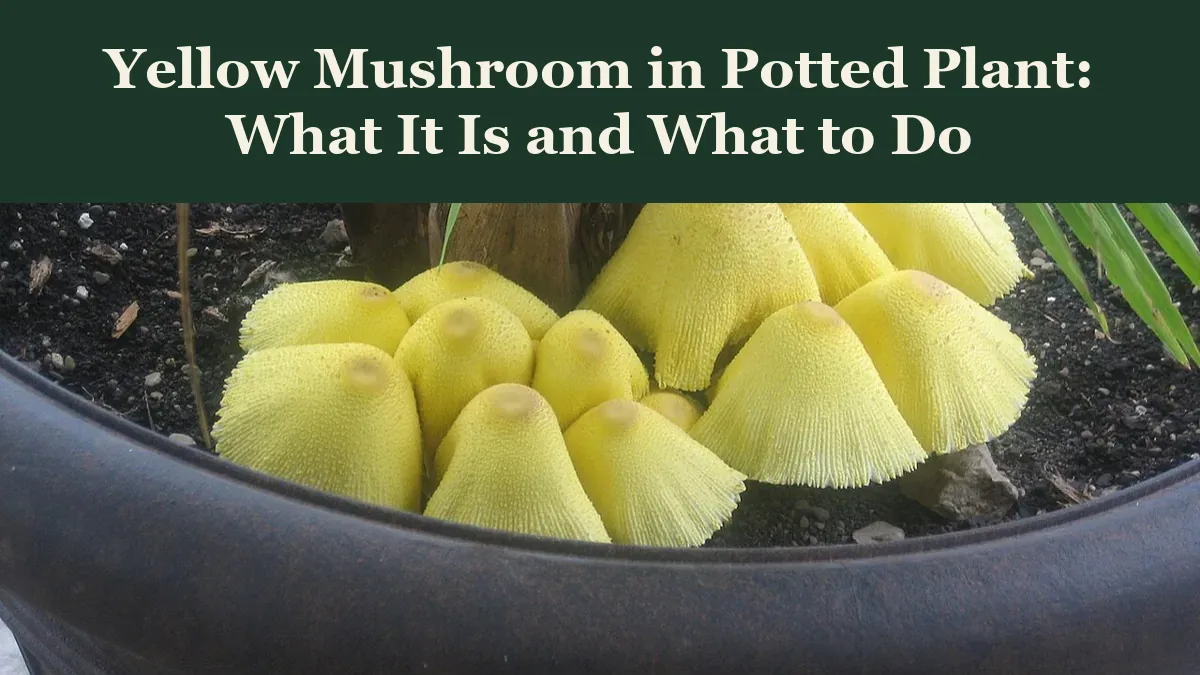
A yellow mushroom in a potted plant is almost always the flowerpot parasol, Leucocoprinus birnbaumii , a lemon-yellow mushroom that feeds on dead organic...