How to Grow Chestnut Mushrooms at Home
— views
You can grow chestnut mushrooms at home, but Amazon offers outdoor log plug spawn rather than a countertop ready-to-fruit kit. Chestnut here means Pholiota adiposa. Growing it on logs takes hardwood logs, a drill, wax and a long wait. The name also means brown Agaricus in the UK, so check the Latin name before you buy.
Key Takeaways
- Amazon offers chestnut plug spawn for outdoor logs, not a countertop kit, so you supply the logs and tools.
- In US grow guides, chestnut means Pholiota adiposa. UK recipes use the same name for brown Agaricus bisporus.
- This mushroom fruits cool. Two studies triggered fruiting at about 50 to 59°F, and heat cut fruiting at 86°F.
- We found no university figure for chestnut on logs. Kentucky's 6 to 18 months for shiitake logs is the nearest guide.
- Wood choice matters. A SARE-funded farm project got no mushrooms at all from mimosa logs.
- Anything outdoors needs identification, because deadly galerina also grows in clusters on wood.
Chestnut Mushroom Growing Conditions Chart
No extension service we found publishes a chestnut chart, so the indoor column comes from research papers and the log column from guides for related wood fungi. The papers are a study from Northeast China and Kaneko's 2003 study from Japan. The shiitake log figure comes from the University of Kentucky.
| Factor | Indoor sterile sawdust | Outdoor hardwood log |
|---|---|---|
| Temperature to colonize | About 72 to 77°F in the two studies. Best mycelial growth near 79°F | Outdoor weather. No university figure found |
| Temperature to fruit | 50 to 59°F in the China study. About 57°F in Kaneko | Cool weather. No figure found for logs |
| Substrate | Sawdust with supplements such as bran and corn stalk | Fresh hardwood. Found wild often on birch and alder, and on many other hardwoods |
| Humidity | Above 95% at fruiting in Kaneko | Moist shade. No percentage found for chestnut |
| Time to harvest | About 4 to 10 weeks to colonize, then about 2 weeks to mature mushrooms | No figure found. Kentucky gives 6 to 18 months for shiitake logs |
| Difficulty | Hard. Our rating, because the work must stay sterile | Moderate work and a long wait. Our rating |
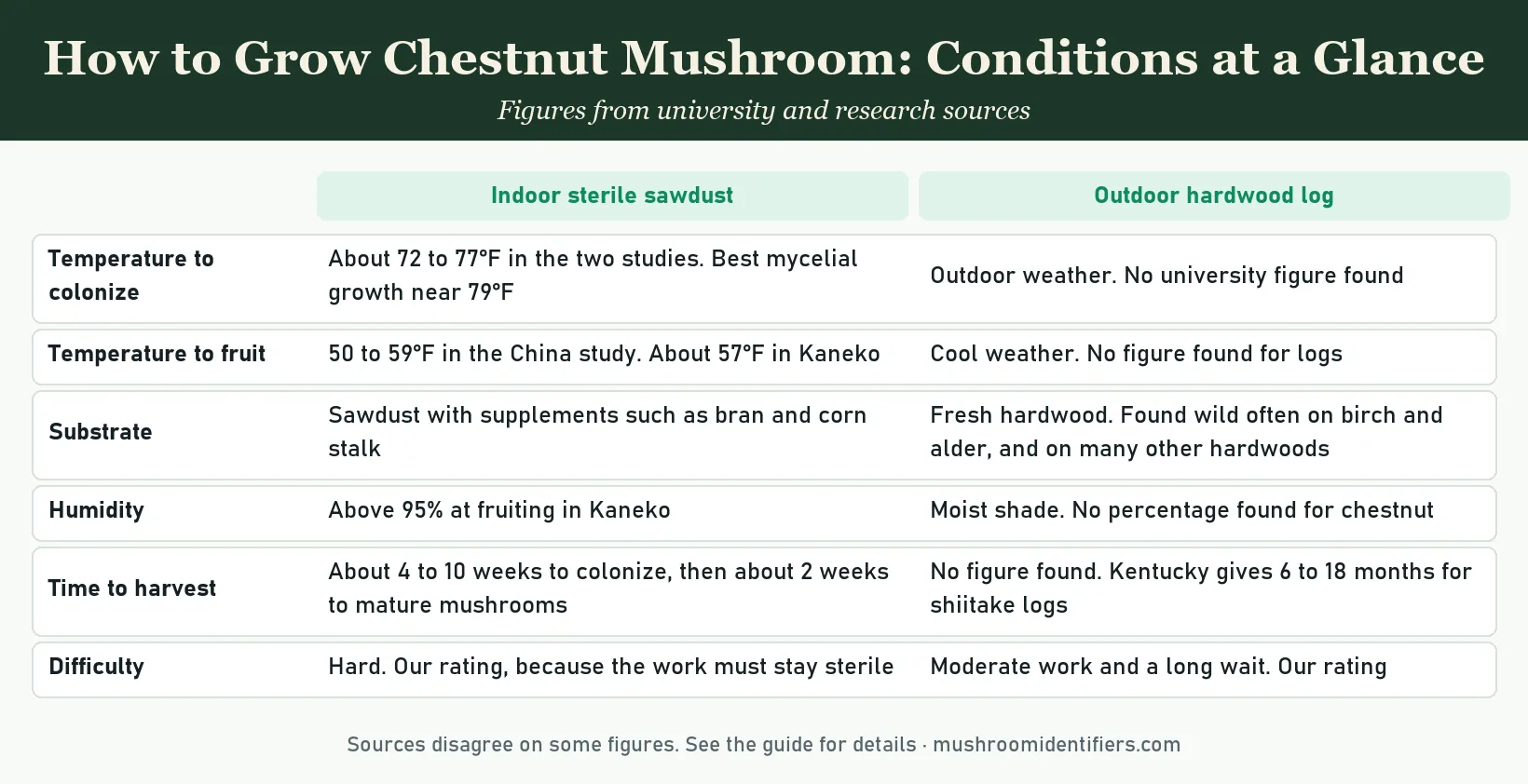
The sources differ in places. The China study colonized bags for 30 to 45 days, and Kaneko took about 10 weeks. Both ran under controlled conditions, and neither one is a home log.
Which Mushroom Is Called Chestnut?
Two different mushrooms share the name, and the one sold as log spawn is Pholiota adiposa. Research papers call P. adiposa the chestnut mushroom. Great British Chefs uses the same name for the compact brown mushroom also known as cremini or baby bella.
| Feature | Pholiota adiposa | Brown Agaricus bisporus |
|---|---|---|
| Where the name is used | US grow guides and research papers | UK recipes |
| Also called | Sometimes grouped with P. limonella and P. aurivella | Cremini, baby bella |
Great British Chefs says white button, chestnut and portobello mushrooms are all the same species. Log plugs will not grow that shop mushroom.
A second mix-up affects the search term. "Chestnut mushroom logs" means logs inoculated with the mushroom. It does not mean logs of chestnut wood.
Can You Grow Chestnut Mushrooms at Home?
Yes, you can grow chestnut mushrooms at home, most simply on outdoor hardwood logs, but treat it as an experiment. One species account describes the wild mushroom as saprobic and possibly parasitic. It grows alone or in clusters on deadwood, often on birch and alder.
Evidence for logs is thin. We found no extension page that teaches chestnut on logs. Cornell Small Farms' outdoor guide says only log shiitake can be reliably cultivated outdoors as a commercial crop.
Evidence for blocks is better. Cornell's farm guide says chestnut can easily be fruited from blocks outside. That advice assumes you already have a colonized block, and making one needs sterile technique.
What Do You Need to Grow Chestnut Mushrooms?
You need plug spawn, fresh hardwood logs, a drill, wax and a shady spot that you can water. Amazon covers only the spawn.
The North Spore Organic Chestnut Mushroom Spawn Plugs for Logs are USDA organic, according to the listing.
This is spawn, not a kit. You must supply your own hardwood logs. The listing facts used here give no timing or yield figure, so check the listing for the plug count and for what is included.
- Fresh hardwood logs, cut from healthy trees.
- A drill and a bit that matches the plugs. Mississippi State Extension uses a 5/16-inch hole for dowel plugs.
- A hammer for tapping in the plugs.
- Food-grade wax, a safe way to melt it and a dauber.
- A tag for each log.
- Shade, a base to keep logs off bare dirt and a water source.
How Do You Grow Chestnut Mushrooms on Logs Step by Step?
Cut fresh logs, drill them, tap in the plugs, seal the holes with wax, then keep the logs moist in shade. We found no university method for chestnut. These steps follow Mississippi State's shiitake method, because Cornell says nameko, another Pholiota, is inoculated in the exact same way as shiitake.
- Cut logs while the sap is down. Mississippi State cuts from November to March. It avoids dry, rotting or scarred wood and keeps the bark intact.
- Choose a manageable size. Mississippi State recommends logs 4 to 6 inches across and 2 to 3 feet long.
- Choose a suitable hardwood. The China study names willow and birch as wild hosts names birch and alder. Cornell uses black cherry or sugar maple for nameko. No source we opened compares woods for chestnut logs.
- Inoculate soon after cutting. UF/IFAS says freshly cut logs are required, because older logs may already hold naturally occurring mushrooms.
- Drill the holes. Mississippi State drills about 40 holes per log, 1 to 1 1/2 inches deep, in a diamond or spiral pattern.
- Tap in the plugs. Hammer each plug flush with the bark.
- Seal each hole. Melt food-grade wax and dab it over each hole. Mississippi State does not wax the cut ends.
- Tag and stack. Stack logs on pavers, a pallet or a mulched area, never on bare dirt.
- Keep them shaded and moist. Mississippi State gives 60 percent shade for shiitake. Keep a water source close, and water logs in dry spells.
- Watch in cool, wet weather. Cornell says nameko generally fruits in the fall gives summer and fall for wild chestnut.
What Are the Common Problems When Growing Chestnut Mushrooms?
The common problems are the wrong wood, dry logs, heat, competing fungi and mushrooms you did not plant. Most of the fixes come from shiitake guides, because we found none for chestnut.
| Problem | Sign | What to do |
|---|---|---|
| Unsuitable wood | No mushrooms from any log of one wood type | Change the wood next time. A SARE-funded project got nothing from mimosa |
| Dry logs | Logs left in sun or wind through a dry spell | Water them. Mississippi State runs a sprinkler on shiitake logs in summer |
| Heat | Few young mushrooms, or young mushrooms that shrink | Wait for cooler weather. The China study saw fewer at 86°F and die-off at 95°F |
| Trichoderma | Blue-green growth on a log | Remove and destroy the log, as the University of Kentucky advises |
| Pests | Chewed caps | Protect the logs. Kentucky names slugs, snails, birds, squirrels and deer |
| Unknown mushrooms | Anything that does not match the plugs you planted | Do not eat it. Have it identified |
The wood warning comes from a SARE-funded farm project that planned chestnut among its strains on mimosa and paper mulberry logs. Mimosa gave a median of 0 lb per log, and the report calls it not a viable substrate. The report does not break out results by strain, so it says nothing about chestnut on paper mulberry.
The University of Kentucky lists Trichoderma among threats to outdoor log production. Our tree mushroom identification guide helps with other fungi that appear on wood.
How Do Chestnut Mushrooms Compare With an Easier Oyster Kit?
An oyster kit is far easier, because it arrives colonized and fruits within about 10 days indoors. A chestnut log suits a gardener who enjoys a long project. Our mushroom grow kit comparison covers beginner options, and our oyster mushroom grow kit guide covers care.
| Feature | Chestnut plugs on logs | Oyster kit |
|---|---|---|
| Where it grows | Outdoors, in shade | Indoors, out of direct sun |
| What arrives | Plug spawn | A colonized block or bag |
| First harvest | No figure found. Plan for many months | About a week to 10 days, per UF/IFAS |
| Work | Cut, drill, plug, wax and water | Daily care with water, air and light |
| Best for | Patient gardeners with fresh logs | First-time growers |
How Do You Harvest and Cook Chestnut Mushrooms?
Harvest chestnut mushrooms as whole clusters, refrigerate them right away and cook them thoroughly. The China study says mushrooms take about 5 to 7 days to mature once they start to form, so check logs often. Kentucky says harvesting in clusters is easier and reduces handling damage. It says to cut with a sharp knife or twist at the base, and to refrigerate at once in vented containers.
Illinois Extension does not recommend eating specialty mushrooms raw. It says an internal temperature of 145°F should be sufficient. Kentucky says many specialty mushrooms can be dried, and our guide on how to dry mushrooms explains how.
Are Chestnut Mushrooms Edible?
Research papers treat cultivated P. adiposa as an edible mushroom. Kaneko calls it edible, and the China study says its use in food production is very extensive. A standard reference gives no edibility information.
The genus needs caution. Smith and Hesler's Pholiota monograph on MykoWeb says the genus may contain some species that are at least mildly poisonous. It says no one should eat a Pholiota without being sure it is identified accurately and that the species is known to be edible.
What Are the Chestnut Mushroom Look-Alikes?
The look-alike that matters most is deadly galerina, because it also grows in clusters on wood and has a brown spore print. Our deadly galerina guide covers it in detail. The Burke Herbarium calls it deadly and says it contains the same toxins found in the death cap.
| Feature | Chestnut (P. adiposa group) | Deadly galerina (Galerina marginata) |
|---|---|---|
| Cap | Sticky or slimy when fresh, yellow to orangish or brownish yellow, with small scales that wipe away | Honey yellow to cinnamon or brownish orange, fading as it dries |
| Growth | Alone or in clusters on deadwood | Usually in clusters on rotting hardwood or conifer wood |
| Stem ring | A flimsy ring or ring zone, often indistinct, on a scaly stem | Usually a thin, bracelet-like ring, sometimes only a ring zone |
| Spore print | Brown | Rusty brown |
| Risk | Eat only if an expert confirms it | Deadly |
The descriptions follow one field guide's pages on Pholiota adiposa and Galerina marginata. The spore prints are too close to be a safety test. The Burke Herbarium adds that deadly galerina can grow from buried wood, wood chips and other woody debris, so it could turn up near a log pile.
The wild chestnut group is also unsettled. A DNA study that found specimens named adiposa, limonella and aurivella to be one species, and it suggests treating them as an aggregate.
Common Mistakes
Buying the Wrong Chestnut
A recipe from the UK means brown Agaricus. Log plugs grow Pholiota adiposa, so check the Latin name.
Expecting a Countertop Kit
Amazon offers plug spawn for outdoor logs. Plugs need logs, tools and a long wait, and they will not fruit on a kitchen counter.
Using Whatever Wood Is Handy
Mimosa logs gave nothing in the SARE-funded project. Use fresh hardwood from healthy trees, and do not use old or rotting logs.
Stacking Logs on Bare Dirt
Mississippi State says to keep logs on pavers, a pallet or a mulched area. Kentucky wants a barrier such as gravel or fabric between logs and soil.
Assuming Everything on the Log Is Chestnut
An outdoor log is open to wild spores. A cluster on your log may not be what you planted. Follow our steps on how to identify a mushroom you found before anyone eats it.
Frequently Asked Questions
Is there a chestnut mushroom grow kit?
Amazon offers outdoor log plug spawn rather than a countertop ready-to-fruit kit. You supply the hardwood logs, a drill and wax. Cornell mentions fruiting chestnut from blocks, but those blocks need sterile production.
What is a chestnut mushroom?
In US grow guides and research papers, it is Pholiota adiposa, a wood-growing mushroom. In UK recipes, the same name means a brown strain of Agaricus bisporus. Check the Latin name before you buy.
Are chestnut mushrooms the same as cremini?
UK chestnut mushrooms are the same as cremini, according to Great British Chefs. Pholiota adiposa is a different mushroom. Log plugs grow Pholiota adiposa, not cremini.
How long do chestnut mushroom logs take?
We found no university figure for chestnut logs. Kentucky gives 6 to 18 months for shiitake logs, which is the nearest guide. Plan for many months and possibly more than a year.
What wood should I use for chestnut mushroom logs?
Use fresh hardwood from healthy trees. Wild chestnut is often found on birch and alder, and on many other hardwoods. Avoid mimosa, which gave no mushrooms in a SARE-funded project.
What temperature do chestnut mushrooms need?
Studies colonized the mushroom at about 72 to 77°F and triggered fruiting at about 50 to 59°F. Fruiting suffered at 86°F, and most young mushrooms died at 95°F. Those are indoor figures, not log figures.
Can you grow chestnut mushrooms indoors?
Researchers grow them indoors on sterile sawdust in bags and bottles. That needs a pressure sterilizer and clean technique, and the fruiting stage needs a cool room. Most home growers will find logs simpler.
Are chestnut mushrooms safe to eat?
Research papers treat cultivated Pholiota adiposa as edible. A Pholiota monograph warns that the genus may hold some mildly poisonous species. Cook what you grow, and have an expert confirm anything from an outdoor log.
Can a poisonous mushroom grow on a chestnut log?
Yes. Logs are open to wild spores, and deadly galerina grows in clusters on wood. Do not eat anything from a log until you are sure what it is.
Are chestnut mushrooms harder to grow than oysters?
Yes. An oyster kit fruits in about a week to 10 days, according to UF/IFAS. Chestnut plugs need log work and a wait of many months.
Final Safety Reminder
Plugs start one species, but an outdoor log is open to every fungus in the air. Never eat a wild mushroom based on a chart, a photo or an app. Do not assume that a cluster on your log is chestnut, because deadly galerina grows on wood too. Keep children and pets away from unknown mushrooms. For a second opinion, photograph the top, the underside and the base, using our guide on how to photograph mushrooms for identification. Then check the pictures with our free mushroom identifier and a local expert. Cook everything you grow.
About this guide: we compared current Amazon listings with university extension guidance and did not test these products. As an Amazon Associate, Mushroom Identifiers earns from qualifying purchases at no extra cost to you. Prices and availability are shown on Amazon.
Sign in to leave a comment and join the discussion.
 Guide
Most maple tree fungus is either a leaf spot that looks alarming but rarely hurts the tree, or a decay fungus fruiting from wood that is already rotting...
 Guide
Pine tree fungus identification starts with color and place: orange powder on a woody gall is a rust, brown dead shoot tips are a blight, a conk at the base...
 Guide
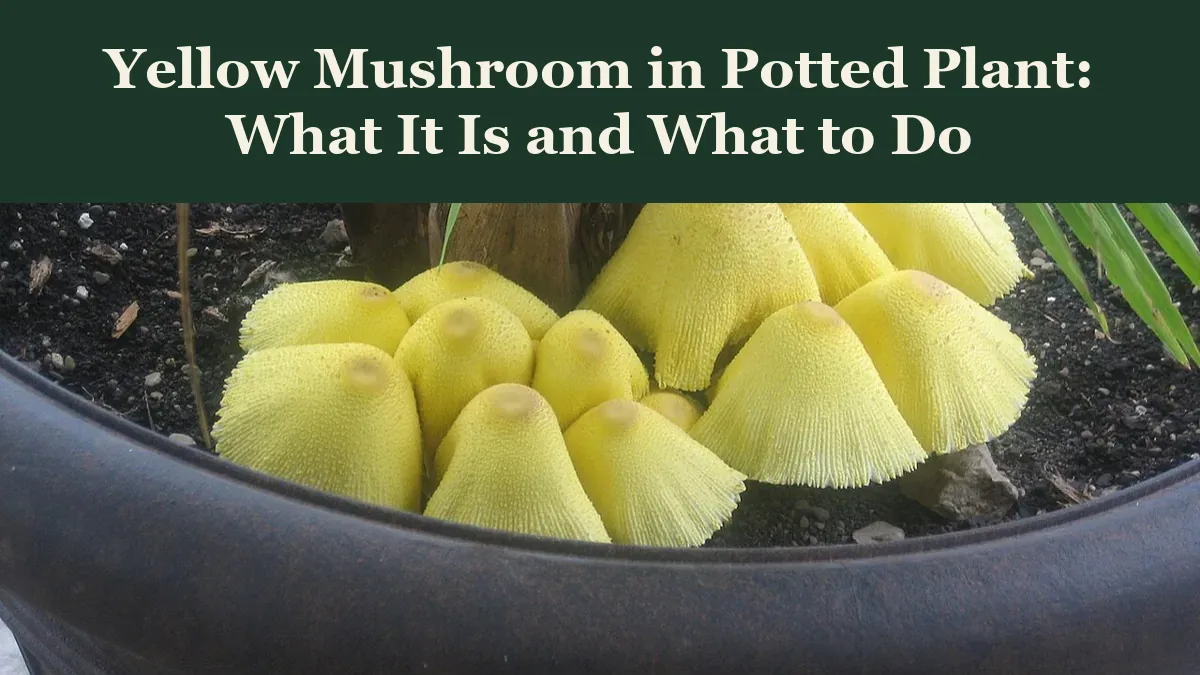
A yellow mushroom in a potted plant is almost always the flowerpot parasol, Leucocoprinus birnbaumii , a lemon-yellow mushroom that feeds on dead organic...