4 Best Blue Oyster Mushroom Grow Kits (November 2026)
— views
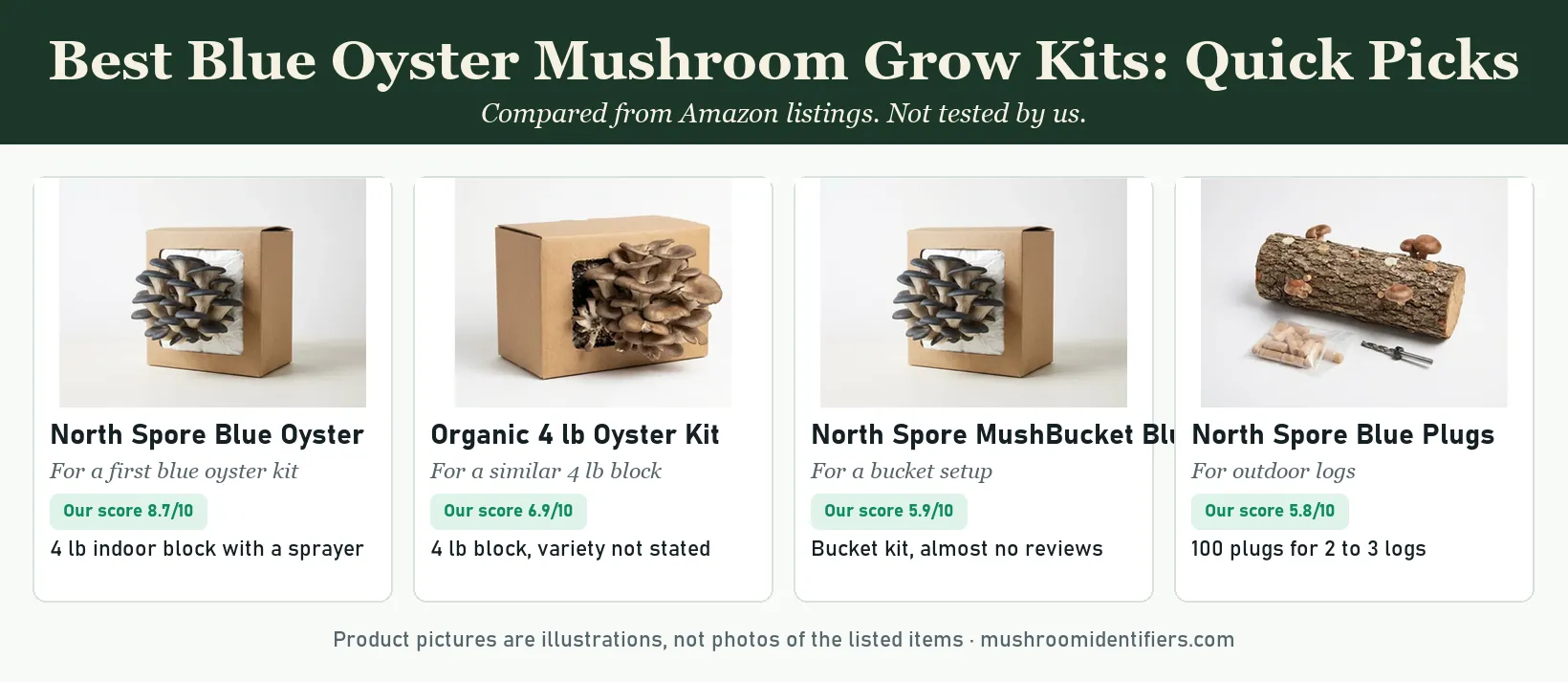
The best blue oyster mushroom grow kits include the North Spore Blue Oyster Mushroom Grow Kit, 4 lb for a first blue oyster kit, the Organic 4 lb Oyster Mushroom Growing Kit for a similar 4 lb block, and the North Spore MushBucket Blue Oyster Mushroom Bucket Grow Kit for a bucket setup.
The best blue oyster mushroom grow kit for most people is the North Spore Blue Oyster Mushroom Grow Kit, 4 lb, which is organic and includes a sprayer, according to the listing. The listing says the first harvest takes about 7 days and gives 0.5 to 1.5 lb.
Choose by format first, then by your room. A block is the simplest start, a bucket takes more space, and log plugs are a long outdoor project. Blue strains differ widely in temperature, so check the range on the card or listing. Our oyster mushroom grow kit guide covers general care, so this page sticks to what is specific to blue oysters.
A blue oyster is not a separate species. Ohio State University Mycology lists cold blue and warm blue as varieties of Pleurotus ostreatus, the same species as pearl oyster.
How We Chose Blue Oyster Mushroom Grow Kits
We compared current Amazon listings against university extension guidance and did not test these products. Each product then received a score out of 10, based on three weighted factors.
- Beginner ease, 40%: how forgiving the format is, per extension guidance.
- Review depth, 30%: how many buyers have reviewed the listing.
- Listing clarity, 30%: whether the listing states what you get and what to expect.
A score compares listings. It is not a lab result or a yield guarantee. Facts about a product come from its listing, so treat them as the seller's claims. Growing facts come from the university and research sources linked through this page.
| Product | Best for | Type | Our score |
|---|---|---|---|
| North Spore Blue Oyster Mushroom Grow Kit, 4 lb | A first blue oyster kit | Indoor block | 8.7/10 |
| Organic 4 lb Oyster Mushroom Growing Kit | A similar 4 lb block | Indoor block, variety not stated | 6.9/10 |
| North Spore MushBucket Blue Oyster Mushroom Bucket Grow Kit | A bucket setup | Bucket kit | 5.9/10 |
| North Spore Organic Blue Oyster Mushroom Spawn Plugs, 100 ct | Outdoor logs | Log plug spawn | 5.8/10 |
The Best Blue Oyster Mushroom Grow Kits for Different Needs
North Spore Blue Oyster Mushroom Grow Kit, 4 lb: Best for a first blue oyster kit
Our score: 8.7/10
- Organic, according to the listing.
- Includes a sprayer, according to the listing.
- About 7 days to the first harvest, according to the listing.
- 0.5 to 1.5 lb on the first harvest, according to the listing.
This kit suits a first-time grower who wants a real blue oyster block and a stated yield. UF/IFAS Gardening Solutions calls a kit the easiest way to start growing mushrooms at home. The sprayer means you need no extra equipment.
Pros
- The listed 7 days sits inside the week to 10 days that UF/IFAS gives for oyster kits.
- It is the only pick here with a yield range in the listing facts used.
- It is the only block on this page that is named as blue.
Cons
- The yield and timing are seller's claims. We found no extension figure for kit yields.
- The listing facts used here give no temperature range, and blue strains differ widely.
- Someone has to mist the block regularly.
Give the block a spot near the low 60s°F if you can. Cornell Small Farms says temperatures in the low 60s°F give the highest quality in its farm guide. UGA Extension recommends 55 to 75°F for oysters in general, out of direct sun.
The 4 lb in the name is the size of the kit, not the size of the harvest. If a flush gives more than you can eat fresh, our guide on how to dry mushrooms covers the extra.
Organic 4 lb Oyster Mushroom Growing Kit: Best for a similar 4 lb block
Our score: 6.9/10
- Organic, according to the listing title.
- A 4 lb block, according to the listing title.
- The listing does not say which oyster variety it grows.
This block suits a grower who wants a 4 lb oyster kit and does not mind which color appears. It sits on this page because of its size, not because it is confirmed as blue. Do not buy it if blue is the whole point.
Pros
- It is the same stated size as the first pick.
- The block format needs little space.
Cons
- The variety is not stated, so it may not grow blue oysters at all.
- An unknown variety means an unknown temperature range.
- The listing facts used here give no timing or yield figure.
Variety matters more than it sounds. Ohio State's oyster table runs from 35°F for cold blue up to 90°F for pink and golden. Read the card as soon as the block arrives, then choose the room.
Our full mushroom grow kit comparison covers other species if you would rather choose by color or flavor.
North Spore MushBucket Blue Oyster Mushroom Bucket Grow Kit: Best for a bucket setup
Our score: 5.9/10
- A bucket grow kit.
- Grows blue oyster mushrooms, according to the listing title.
- Almost no reviews so far.
This kit suits a grower who likes the bucket format and has floor space to spare. It is a poor choice for anyone who wants plenty of buyer feedback before ordering. With almost no reviews, it scores low on review depth.
Pros
- It is named as blue oyster, unlike the 4 lb block above.
- UW-Madison Extension describes bucket growing as a method aimed at oyster mushrooms.
Cons
- Almost no reviews so far, so there is little buyer feedback to read.
- The listing facts used here give no timing or yield figure.
- A bucket takes more room than a block.
UW-Madison's guidance is for a home-built bucket, so follow the card that comes with this kit first. Its method keeps the bucket at about 65 to 75°F, away from sunlight. It sprays the outside at least twice a day once pins form.
North Spore Organic Blue Oyster Mushroom Spawn Plugs, 100 ct: Best for outdoor logs
Our score: 5.8/10
- USDA organic, according to the listing.
- 100 plugs.
- Inoculates 2 to 3 logs, according to the listing.
- You supply the logs.
This is a project, not a quick kit. It suits a gardener with shade, fresh logs and a drill. It does not suit an apartment or anyone who wants mushrooms this season.
Pros
- The listing states how many logs the plugs cover.
- Cornell Small Farms' outdoor guide says oysters can fruit one to three times over the growing season.
- Ohio State says cold blue fruit takes no damage from freezing while attached to a log.
Cons
- You must find and cut your own logs.
- Cornell gives 4 to 12 months of incubation for oyster logs.
- Wild fungi can grow on the same wood.
Sources differ on the wood. Cornell's outdoor guide lists poplar, tulip poplar, willow and box elder for oysters. Ohio State says pearl oysters succeed outdoors on oak, sweetgum and poplar. Poplar is the one wood on both lists, so it is the safest first choice.
Use fresh wood. UF/IFAS warns that older logs may already host wild mushrooms. Our tree mushroom identification guide helps you see what else is growing on your wood.
What Temperature Blue Oysters Need
Blue oysters need the temperature of their strain, and Ohio State lists two very different blues. Warm blue fruits at 60 to 85°F. Cold blue fruits at 35 to 50°F and needs a cold shock. So the word "blue" does not always mean a cool-room mushroom.
| Type | Fruiting temperature | Colonizing temperature | Notes |
|---|---|---|---|
| Cold blue | 35 to 50°F | 70 to 75°F | Needs a cold shock. Fruit on a log is not damaged by freezing |
| Warm blue | 60 to 85°F | 70 to 75°F | Tolerates heat up to 95°F |
| Pearl, for comparison | 50 to 80°F | 70 to 75°F | Prolific, with many commercial strains |
The figures come from Ohio State's oyster table. The chart shows why a cool-room label needs checking. A warm blue block would sit below its range in a 50°F garage, and a cold blue block would sit above its range in a 70°F kitchen.
Cool growing is still the general advice for this group. Cornell's farm guide uses blue or pearl oysters in fall, winter and spring, then switches to phoenix oyster in summer. It says productivity falls below 50 to 55°F, and that many species decline above 75°F.
The sources conflict on two points. Cornell's lower limit sits above Ohio State's whole cold blue range. Cornell also says shocking methods are not typically used for oysters, while Ohio State says cold blue needs one. Cornell is describing farm rooms in general, and Ohio State is describing one cold strain, so follow the card for your kit.
If your block gives no range, 60 to 75°F is the overlap of Ohio State's warm blue range and UGA Extension's general oyster range. We found no extension source that tests a blue kit at home.
Why Some Blue Oysters Are Gray or Not Blue
Blue oysters often look gray because the color fades as they mature, and it also shifts with strain, light and temperature. Ohio State says warm blue starts blue and turns a light steel-blue to gray. A gray flush does not by itself mean the kit is wrong.
| Cause | Effect on color | Source |
|---|---|---|
| Age | Blue fades to steel-blue and gray as the mushroom matures | Ohio State |
| Strain | Colors vary by strain, and cap color is partly genetic | UF/IFAS, PLOS ONE |
| Light | Bluish-brown at 2 to 100 lux, grayish-brown above 500 lux | Inatomi and colleagues |
| Temperature | Gray to lead caps at 59°F. One strain stayed white at 82°F | Marino and colleagues |
The light figures come from a 2000 study of commercial oyster cultivation in Japan. The temperature figures come from a 2003 study of eight strains in Scientia Agricola. That study changed temperature and light together, so it cannot fully separate the two. Neither study used a home kit.
A 2024 PLOS ONE paper ties cap color to the amounts of two melanin pigments and to two or three major gene regions. It also notes that color can change quickly during growth. So two kits of different strains can look different in the same room.
Cooler or dimmer conditions gave bluer or darker caps in those two studies. That does not mean you should dim the room. Yield in the 2000 study was highest at 200 to 500 lux, and Cornell says low light gives skinny mushrooms with long stems. Picking young is the simpler way to see more blue, because the color fades with age.
Color does not identify a wild mushroom. Our oyster mushroom identification guide explains what to check on anything you find outdoors.
Block, Bucket or Logs
Most people should choose a block, because it needs the least space and the least setup. A bucket suits a grower with floor space. Logs suit a patient gardener with fresh wood and shade.
| Format | Where it grows | Time to mushrooms | Effort | Who it suits |
|---|---|---|---|---|
| Block | Indoors, out of direct sun | About a week to 10 days (UF/IFAS) | Low | First-time growers, apartments |
| Bucket | A shaded yard spot in spring or fall, or a dark room in winter | Check for pins after about 14 days (UW-Madison) | Moderate | Growers with floor space |
| Logs | Outdoors, in shade | 4 to 12 months of incubation (Cornell) | High at the start | Patient gardeners with fresh logs |
The effort ratings are our summary of the steps the sources describe. The bucket figure is for UW-Madison's home-built method, not for a boxed kit.
What a Bucket Involves
UW-Madison's method uses a 5-gallon bucket, 5 to 6 pounds of hardwood chips and 1 pound of grain spawn. The chips soak in hot water for 12 to 24 hours. Harvests run for about 4 weeks, or until the bucket stops producing. A boxed kit may skip some of these steps, so read what is included.
What Logs Involve
Cornell's outdoor guide prefers bolts or stumps for oysters, and it says totems work too. The University of Kentucky describes logs for other gourmet mushrooms, not oysters specifically. It uses logs of about 3 to 8 inches across and 3 to 4 feet long, cut from decay-free live trees. It seals holes with hot cheese wax and keeps logs off the soil.
We found no extension figure for how long a blue oyster log keeps producing. Treat the plugs as an experiment, not a promise.
Which Blue Oyster Mushroom Grow Kit Should You Choose?
Choose the option that matches your space and patience, using the list below.
- If you want your first blue oyster kit, choose the North Spore Blue Oyster Mushroom Grow Kit, 4 lb.
- If you want a 4 lb block and the color does not matter, choose the Organic 4 lb Oyster Mushroom Growing Kit.
- If you want a bucket and can accept almost no reviews, choose the North Spore MushBucket Blue Oyster Mushroom Bucket Grow Kit.
- If you have fresh logs, shade and patience, choose the North Spore Organic Blue Oyster Mushroom Spawn Plugs, 100 ct.
Our Top 3 Picks at a Glance
Frequently Asked Questions
What is a blue oyster mushroom?
A blue oyster is a variety of the common oyster mushroom, Pleurotus ostreatus. Ohio State lists a cold blue and a warm blue type. Warm blue starts blue and fades toward gray as it matures.
What is the best blue oyster mushroom grow kit?
The North Spore Blue Oyster Mushroom Grow Kit, 4 lb scores highest here at 8.7 out of 10. The score compares listings, not grown results. Check the temperature range before you choose a spot for it.
How do you grow blue oyster mushrooms at home?
The simplest way is a ready-made block. Follow the card, keep the block in the right temperature range for its strain, and mist it as directed. Keep it out of direct sun, as UGA Extension advises for oyster kits.
What temperature do blue oyster mushrooms need?
It depends on the strain. Ohio State lists warm blue at 60 to 85°F and cold blue at 35 to 50°F. Cornell says the low 60s°F give the highest quality in farm rooms.
How long does a blue oyster kit take?
UF/IFAS gives about a week to 10 days for oyster kits. One listing says about 7 days for a 4 lb blue oyster block. Your room temperature and strain can change that.
How much will a 4 lb blue oyster kit produce?
One listing says 0.5 to 1.5 lb on the first harvest. We found no extension figure for kit yields, so treat that as a seller's estimate. The 4 lb is the kit size, not the harvest.
Why are my blue oysters gray?
Gray is common, because Ohio State says the blue fades to steel-blue and gray as the mushroom matures. Strain, light and temperature can also change the color. Picking young shows more of the blue.
Do blue oysters need a cold shock?
Ohio State says cold blue needs a cold shock to fruit. Cornell says shocking is not typically used for oysters in general. Follow the card that comes with your kit.
Can you grow blue oysters on logs?
Yes, with plug spawn and logs you supply. Cornell gives 4 to 12 months of incubation for oyster logs. Cornell and Ohio State list different woods, and poplar appears on both lists.
Can you eat blue oyster mushrooms raw?
Illinois Extension does not recommend eating specialty or gourmet mushrooms raw. It says an internal temperature of 145°F should be sufficient. Cook blue oysters thoroughly.
Final Safety Reminder
A sealed block grows the labeled mushroom, but a log or a yard can grow anything. Illinois Extension says specialty mushrooms should be fully cooked, so cook what you grow. Wild mushrooms can fruit on your logs, so never assume that everything growing there is blue oyster. Read our guides on poisonous vs edible mushrooms and how to identify a mushroom you found. Never eat a wild mushroom based on a chart, a photo or an app. If something unexpected appears, take clear pictures using our guide on how to photograph mushrooms for identification, then check them with our free mushroom identifier and a local expert.
About this guide: we compared current Amazon listings with university extension guidance and did not test these products. As an Amazon Associate, Mushroom Identifiers earns from qualifying purchases at no extra cost to you. Prices and availability are shown on Amazon.
Sign in to leave a comment and join the discussion.
 Guide
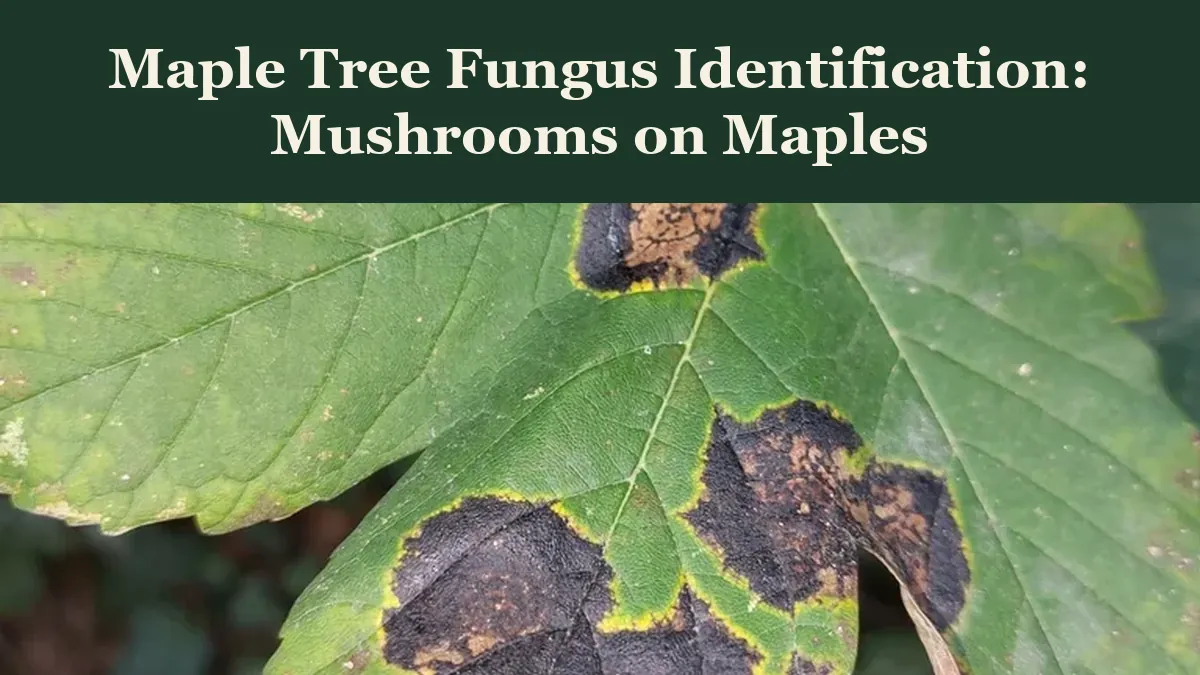
Most maple tree fungus is either a leaf spot that looks alarming but rarely hurts the tree, or a decay fungus fruiting from wood that is already rotting...
 Guide
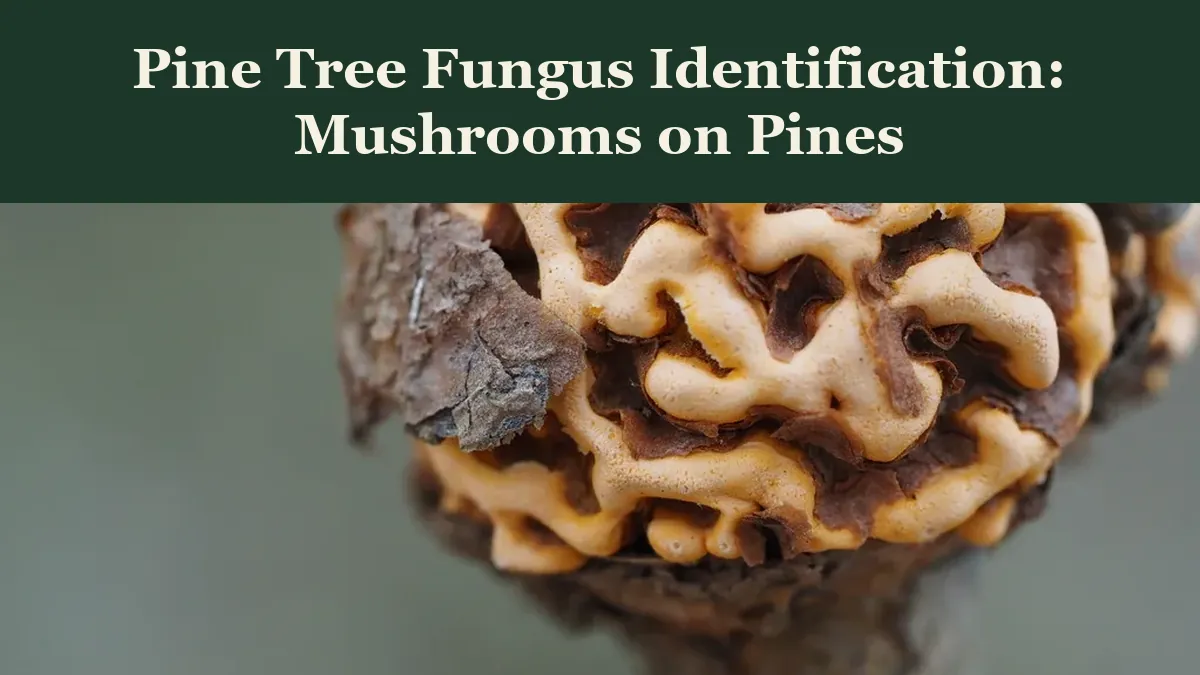
Pine tree fungus identification starts with color and place: orange powder on a woody gall is a rust, brown dead shoot tips are a blight, a conk at the base...
 Guide
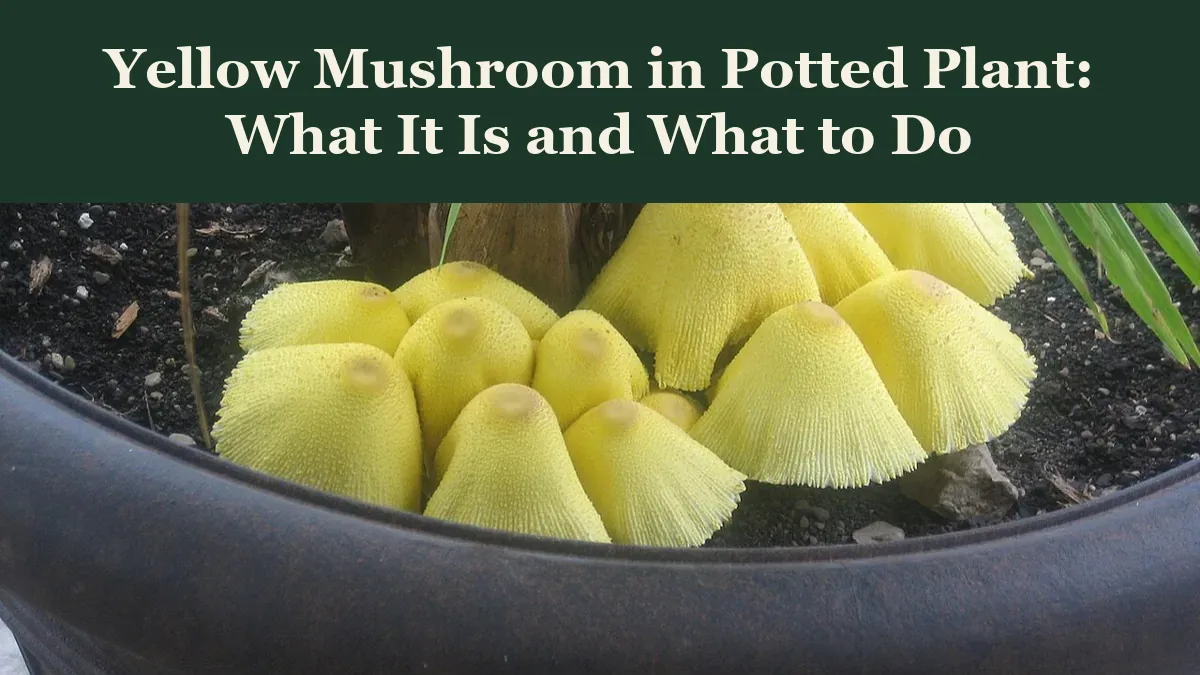
A yellow mushroom in a potted plant is almost always the flowerpot parasol, Leucocoprinus birnbaumii , a lemon-yellow mushroom that feeds on dead organic...