How to Grow King Oyster Mushrooms at Home
— views
No ready-to-fruit king oyster kit turned up on Amazon in November 2026, so growing this mushroom at home means making your own substrate from spawn. King oyster, also called king trumpet, fruits at about 60 to 65°F and needs high humidity. Ohio State calls it more particular about substrate and temperature. For a first grow, most people should start with another oyster kit, such as blue or pink.
Key Takeaways
- No ready-to-fruit king oyster kit turned up on Amazon in November 2026. The realistic choices are an easier oyster kit or a do-it-yourself grow.
- Ohio State lists 65 to 70°F for colonizing and 60 to 65°F for fruiting.
- Cornell Small Farms says king oyster needs higher humidity than other species, and sometimes scratching or casing.
- Supplemented sawdust requires steam sterilization, so a pressure cooker is the usual home tool.
- Casing raised yield by 141% in one Penn State study, although the mushrooms came out darker.
- Cook king oyster thoroughly. Ohio State says it keeps up to a week in the refrigerator.
King Oyster Growing Conditions Chart
King oyster colonizes in the upper 60s°F, then fruits in the low 60s°F at high humidity. We found no US extension figure for a home grow from start to harvest, so the timing comes from a research trial.
| Factor | What the sources report | Source |
|---|---|---|
| Colonizing temperature | 65 to 70°F | Ohio State |
| Fruiting temperature | 60 to 65°F. 54 to 63°F in a Bangladesh trial | Ohio State, Moonmoon and colleagues |
| Substrate | Steam-sterilized supplemented sawdust. Rice straw also worked in the trial | Cornell, Moonmoon and colleagues |
| Humidity | Higher than other species. Cornell's general oyster target is above 85% for 4 days, then about 80% | Cornell |
| Time to harvest | 26.5 to 30 days to first harvest on sawdust in the trial | Moonmoon and colleagues |
| Difficulty | More particular about substrate and temperature | Ohio State |
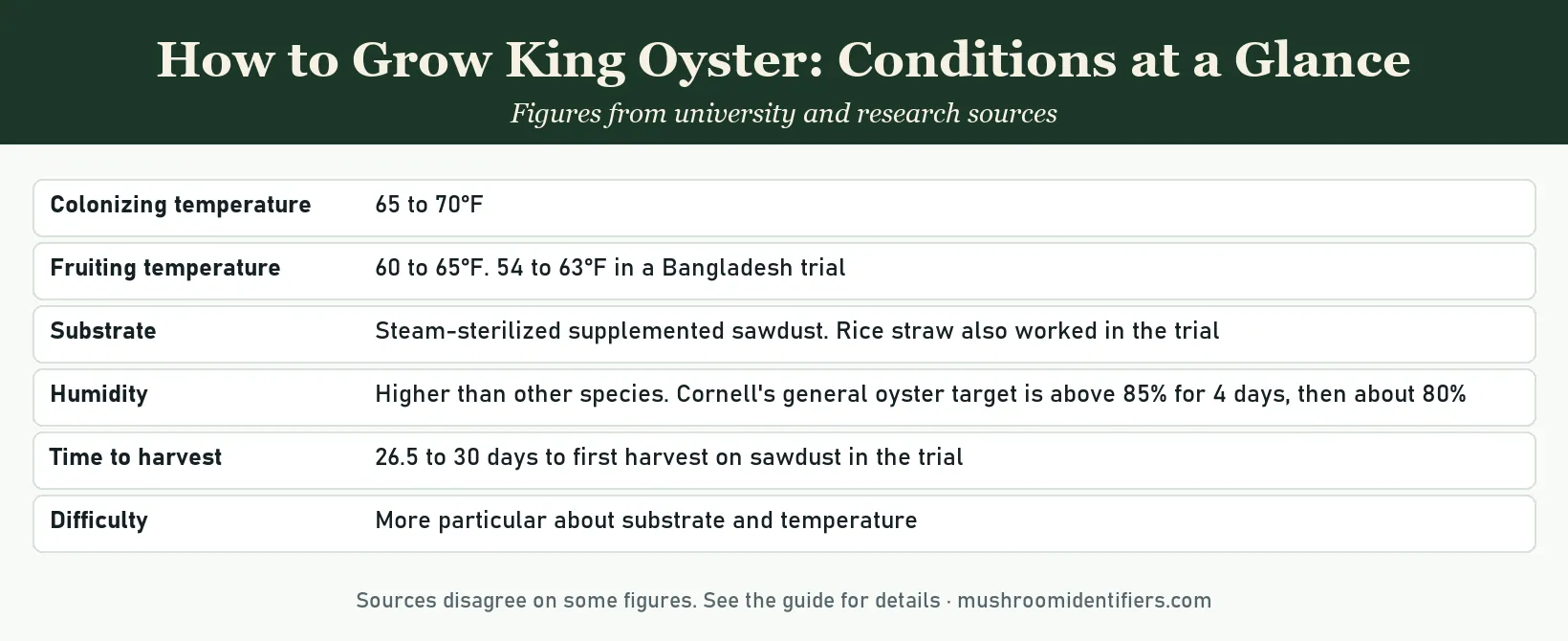
The figures come from Ohio State University Mycology, Cornell Small Farms and a 2010 trial in the Saudi Journal of Biological Sciences. Ohio State's range reaches higher than the trial's range. Both agree that this mushroom wants a cool room.
The trial also shows what warmth does. Its authors say wide cultivation in Bangladesh is very difficult without controlled conditions, because the average temperature is too high.
Can You Grow King Oyster Mushrooms at Home?
Yes, you can grow king oyster at home, but you have to build and colonize the block yourself. That is the difference from a kit. A kit does the slow, contamination-prone stages before it ships.
The sources conflict on difficulty. Utah State University Extension lists oyster mushrooms as a beginner species and names king among the oyster types. Ohio State says king oyster is more particular about substrate and temperature. Cornell adds higher humidity and extra steps to start fruiting.
For a first-time grower, Ohio State and Cornell give the more useful warning. With no ready-to-fruit block on Amazon, a beginner has no easy way in. A grower who has already finished a kit or two is in a better position to try.
What Do You Need to Grow King Oyster?
You need spawn, sawdust and bran, a pressure cooker, grow bags and a space that holds the low 60s°F. Every item below supports one job: keeping the substrate clean until the king oyster takes over.
- Spawn or culture: buy it from a mushroom supplier, and confirm that it is Pleurotus eryngii.
- Sawdust and bran: the 2010 trial used 2 parts sawdust to 1 part wheat bran by weight, with a little rice husk.
- Calcium carbonate: the trial added 0.2% to its mix.
- Pressure cooker: Utah State sterilizes grain at about 250°F and 15 psi for 120 minutes.
- Plastic grow bags: Cornell fruits king oyster from the top of the bag.
- Cleaning supplies: a face mask, gloves and 90% isopropyl alcohol.
- A cool, humid spot: about 60 to 65°F, with light and fresh air.
Check the sawdust before you buy it. A Cornell Small Farms article on substrates says to avoid conifer sawdust and to ask your supplier whether a sawdust suits the strain.
How Do You Grow King Oyster Step by Step?
Mix and sterilize the substrate, inoculate it, colonize it at 65 to 70°F, then open the top of the bag at 60 to 65°F. No single source we opened gives a full home method, so these steps combine Utah State, Cornell, Ohio State and the 2010 trial.
- Clean the space. Utah State says to wear a mask and gloves, wipe surfaces with 90% isopropyl alcohol, close windows and vents, and keep pets out.
- Mix the substrate. Combine sawdust, wheat bran and a little rice husk. Bring the mix to 65% moisture, as the trial did.
- Sterilize. Cornell says supplemented sawdust requires steam sterilization. A 2022 Frontiers in Microbiology study sterilized its bags at 275°F for 2.5 hours. That is a research setup, and a home pressure cooker runs cooler.
- Cool and inoculate. Let the bags reach room temperature, then add spawn in your clean space. Utah State uses 1 part spawn to 3 parts bulk substrate.
- Colonize. Hold the bags at 65 to 70°F, as Ohio State lists. Cornell gives 10 to 20 days for oysters on sawdust, and it gives no separate figure for king oyster.
- Open the top. Cornell cuts the top of the bag open and leaves 3 inches of plastic above the substrate. That raises humidity and lets a long stem develop.
- Hold fruiting conditions. Keep the room at 60 to 65°F and keep humidity high. Give fresh air and enough light to read a book comfortably.
- Scratch or case if nothing forms. Cornell says king oyster sometimes needs scratching or casing to start.
- Harvest. Pick while the cap edge still curls under.
Casing means covering the substrate with a layer that holds moisture. In a 2009 Penn State study, casing raised yield by 141% over non-cased substrates. Mushrooms from cased substrates were darker and had lower solids content. That was a research trial, so treat the number as a direction, not a promise.
What Goes Wrong When Growing King Oyster?
The usual failures are contamination, a room that runs too warm and pins that never form. The first happens during colonizing, and the other two happen during fruiting.
Green, Black or Purple Growth
Utah State says black, purple or green growth means the bag was not fully sterilized. Discard it promptly to prevent spread. Early Trichoderma, a green mold, can look like healthy mycelium at first.
No Pins
Check the temperature first, then the humidity. If both are right, scratch the surface or add a casing layer, as Cornell suggests.
The Room Is Too Warm
Ohio State's range stops at 65°F. Cornell says many species decline above 75°F. A warm summer room may not suit king oyster at all, so plan the grow for a cool season or a cool basement.
Long Stems With Small Caps
King oyster is meant to have a long stem, so this is only a problem when the cap stays tiny. Cornell says high carbon dioxide produces long stems and small caps. It keeps most rooms below 1,000 ppm and oyster rooms below 800 ppm. Give more fresh air.
A Small Harvest
Expect modest numbers at first. The 2010 trial got 90.5 to 141 g from a 550 g sawdust packet in the first flush, depending on the strain. On rice straw, it got 100 to 120.25 g.
How Does King Oyster Compare With an Easier Oyster Kit?
An easier oyster kit wins for a first grow, because the block arrives colonized and needs no sterilizing. King oyster offers an earthy, meaty mushroom, but it asks for more skill.
| Feature | King oyster, home-made block | Blue or pearl oyster kit |
|---|---|---|
| Starting point | You mix, sterilize, inoculate and colonize | The block arrives colonized |
| Fruiting temperature | 60 to 65°F | Pearl 50 to 80°F. Warm blue 60 to 85°F |
| Equipment | Pressure cooker, bags, alcohol, gloves | A spray bottle |
| Time to first harvest | About 4 weeks in one trial | About a week to 10 days (UF/IFAS) |
| Flavor | Earthy aroma, meaty flavor (Ohio State) | Mild (UF/IFAS) |
The kit figures come from Ohio State and UF/IFAS Gardening Solutions, which calls a kit the easiest way to start. Oysters with wider temperature ranges are far more forgiving than a mushroom that wants 60 to 65°F.
One easier option is the North Spore Blue Oyster Mushroom Grow Kit, 4 lb. The listing says about 7 days to the first harvest, which is a seller's claim. Its blue strain may also have a different temperature range from a king oyster, so check the card.
Our mushroom grow kit comparison covers other first kits. Our oyster mushroom grow kit guide explains daily care. A first kit also teaches you what healthy pins and fresh air look like before you try a harder species.
How Do You Harvest and Cook King Oyster?
Harvest king oyster while the cap edge still curls under, then refrigerate it and cook it thoroughly. That harvest cue is Cornell's guidance for oysters in general, because we found no king-specific extension figure. Our guide to mushroom parts shows the cap and gills. Cornell also says to harvest daily for the best quality and to handle oysters as little as possible.
Ohio State says king oyster keeps up to a week in the refrigerator. Cornell stores oysters at 34 to 37°F and says to cool them immediately. For extra mushrooms, see our guide on how to dry mushrooms.
Illinois Extension does not recommend eating specialty or gourmet mushrooms raw. It says an internal temperature of 145°F should be sufficient. It also advises against washing mushrooms until just before serving.
Can You Find King Oysters in the Wild?
King oyster is not a mushroom to look for in US woods, because the range source we opened lists Europe, Asia and Africa. A 2019 paper in Frontiers in Microbiology says the species naturally grows on the roots of plants such as Eryngium. That source does not mention North America.
A shelf of oyster-like mushrooms on a US tree is something else, so identify it on its own features. Our oyster mushroom identification guide covers the wild oysters. If mushrooms appear near a spent block, do not assume they came from it. Our article on why mushrooms grow in your yard explains the other causes.
Common Mistakes
Treating It Like a Pearl Oyster Kit
Pearl oyster tolerates 50 to 80°F. King oyster wants 60 to 65°F. A room that suits one may stop the other.
Skipping Sterilization on Sawdust
Supplemented sawdust feeds mold as well as mushrooms. Cornell's farm guide says it requires steam sterilization. Hot-water treatment is a method for other substrates, such as straw.
Cutting the Bag Like an Ordinary Oyster Block
Cornell cuts ordinary oyster bags on the broad side, but it usually fruits king oyster from the top. Leave 3 inches of plastic above the substrate.
Letting Humidity Drop
Cornell says king oyster needs higher humidity than other species. The plastic collar helps hold that humidity around the young mushrooms.
Eating It Raw
Illinois Extension does not recommend eating gourmet mushrooms raw. Cook king oyster thoroughly, even when it comes from your own clean block.
Frequently Asked Questions
Is there a king oyster mushroom grow kit?
No ready-to-fruit king oyster kit turned up on Amazon in November 2026. A beginner should start with another oyster kit instead. Experienced growers can make their own blocks from spawn.
What is a king trumpet mushroom?
King trumpet is another name for king oyster, Pleurotus eryngii. Ohio State lists it as the largest oyster type. It has an earthy aroma and a meaty flavor.
What temperature do king oysters need?
Ohio State lists 65 to 70°F for colonizing and 60 to 65°F for fruiting. A Bangladesh trial gives 54 to 63°F for fruiting. Both point to a cool room.
How long do king oysters take to grow?
A Bangladesh trial reached first harvest in 26.5 to 30 days on sawdust. We found no US extension figure for a home grow. Plan for several weeks, not the week to 10 days of a ready-made oyster kit.
Are king oysters hard to grow?
They are harder than most oyster kits. Ohio State calls them more particular about substrate and temperature, and Cornell says they need higher humidity. Utah State lists oysters as beginner species and names king among them, so the sources differ.
What substrate do king oysters grow on?
Sterilized sawdust with bran is the usual choice. A 2010 trial also got similar results on rice straw. Cornell says to avoid conifer sawdust.
Do king oysters need casing?
Not always. Cornell says king oyster sometimes needs scratching or casing to start. A Penn State study found that casing raised yield by 141%, although the mushrooms were darker.
How long do king oysters keep?
Ohio State says up to a week in the refrigerator. Cornell stores oysters at 34 to 37°F and cools them right after harvest.
Can you eat king oysters raw?
Illinois Extension does not recommend eating specialty or gourmet mushrooms raw. It says an internal temperature of 145°F should be sufficient. Cook king oysters thoroughly.
Final Safety Reminder
A clean block grows what you put in it, but an oyster-like mushroom on a tree is a wild mushroom. Discard any block with green, black or purple growth. Cook everything you grow. Read our guides on poisonous vs edible mushrooms and how to identify a mushroom you found before you pick anything outdoors. Never eat a wild mushroom based on a chart, a photo or an app. Take clear pictures using our guide on how to photograph mushrooms for identification, then check them with our free mushroom identifier and a local expert.
About this guide: we compared current Amazon listings with university extension guidance and did not test these products. As an Amazon Associate, Mushroom Identifiers earns from qualifying purchases at no extra cost to you. Prices and availability are shown on Amazon.
Sign in to leave a comment and join the discussion.
 Guide
Most maple tree fungus is either a leaf spot that looks alarming but rarely hurts the tree, or a decay fungus fruiting from wood that is already rotting...
 Guide
Pine tree fungus identification starts with color and place: orange powder on a woody gall is a rust, brown dead shoot tips are a blight, a conk at the base...
 Guide
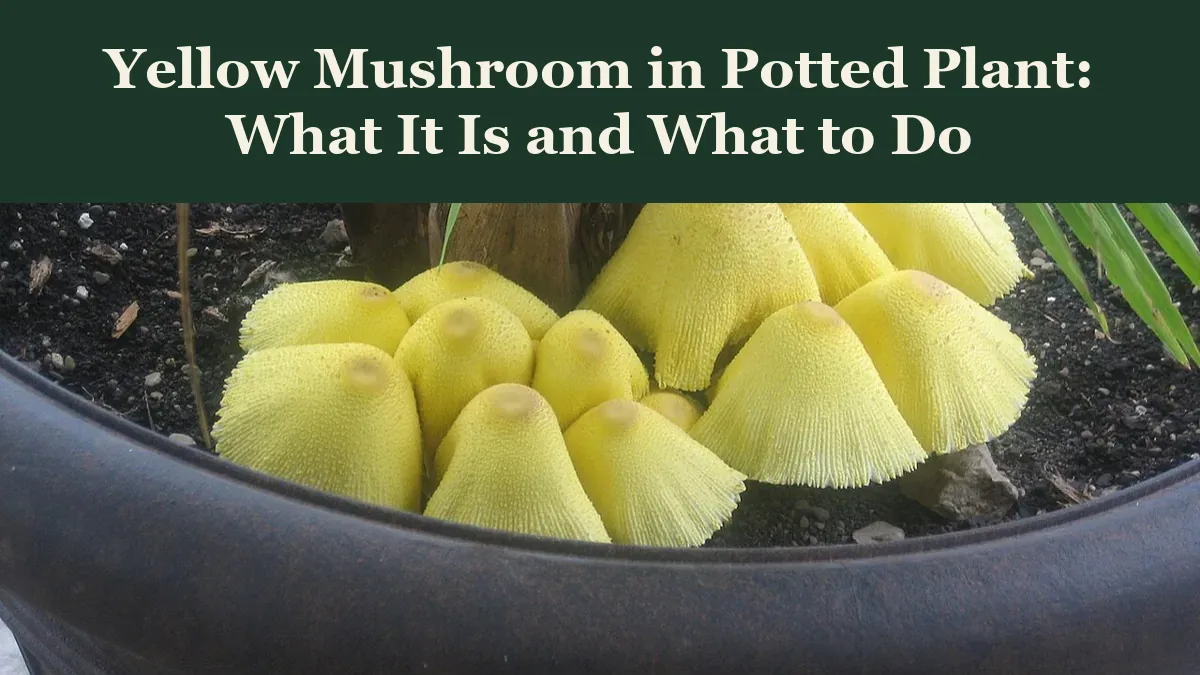
A yellow mushroom in a potted plant is almost always the flowerpot parasol, Leucocoprinus birnbaumii , a lemon-yellow mushroom that feeds on dead organic...