Artist's Conk Identification Chart With Pictures
— views
An artist's conk, also written artist conk, is a hard, woody shelf fungus with a dull brown top and a white pore surface that turns brown the moment it is scratched, so a drawing made on it stays. Its scientific name is Ganoderma applanatum. It is perennial, grows mostly on hardwoods across the United States and is not edible. On a living tree it signals white rot in the roots and lower trunk, which can make the tree a hazard.
This artist's conk identification chart with pictures covers the scratch test, the brown spore dust, the look-alikes (the reishi group, red-belted conk, tinder fungus, resinous polypore and Ganoderma brownii in the West) and what a conk means for a tree near a house.
Key Takeaways
- Scratch the underside. A fresh artist's conk is white below and darkens at once where it is scratched.
- Look at the top. It is a dull gray-brown crust, never shiny, and it is often dusted with brown spores.
- The conk is perennial. It adds a new layer of tubes each year and can live for decades.
- A shiny, varnished red cap points to the reishi group. A red-orange band with a white edge points to the red-belted conk.
- In California, Ganoderma brownii looks the same but has a white to yellowish pore surface.
- Artist's conk is woody and not edible.
- A conk on a living tree means internal decay. Have a qualified arborist inspect any such tree near a house.
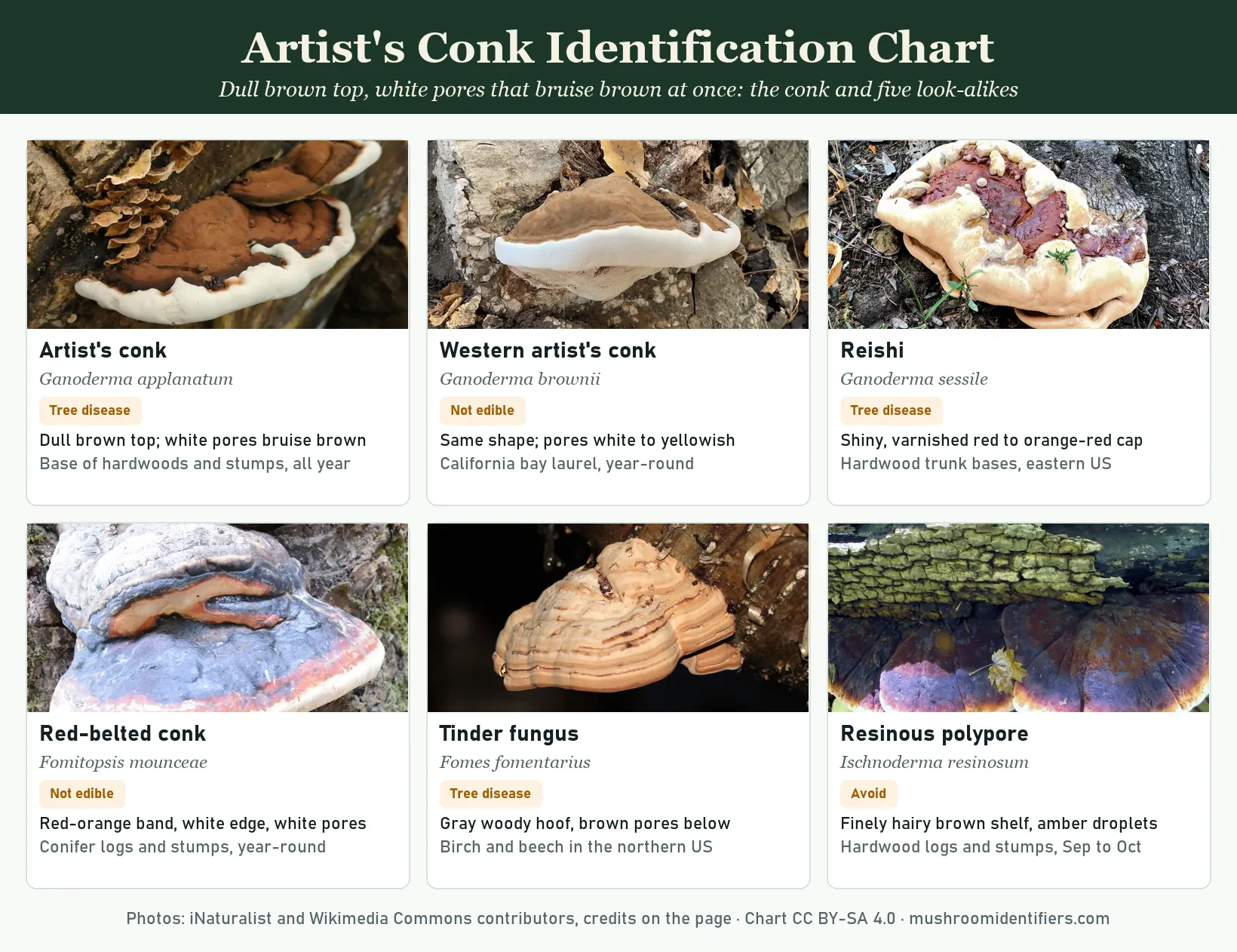
Artist's Conk Identification Chart
Scratch the white underside first, then check whether the top is dull or shiny. The five look-alikes below are also shelf fungi on trunks, stumps and logs. Each row gives the feature that separates that fungus from an artist's conk.
| Fungus | Key features | Where and when | Edibility or risk |
|---|---|---|---|
| Artist's conk (Ganoderma applanatum) | Dull gray-brown woody shelf, 2 to 30 in wide; white pores bruise brown at once; brown spore dust | Base of hardwoods, stumps and logs in every state; year-round | Not edible; white rot of roots and trunk |
| Western artist's conk (Ganoderma brownii) | Same dull, lumpy brown cap; pore surface white to yellowish white, darkens when injured | Mainly California bay laurel; year-round | Inedible and woody |
| Reishi (Ganoderma sessile) | Shiny, varnished cap, deep red to orange-red | Decaying wood of deciduous trees, such as the lower trunk and root flare; eastern US | Woody and hard; white rot decay |
| Red-belted conk (Fomitopsis mounceae) | Hoof-shaped; reddish to orange-brown band with a blunt white edge; pores bruise pale yellow to buff | Conifer logs and stumps, less often hardwoods; year-round | Inedible, too woody |
| Tinder fungus (Fomes fomentarius) | Gray hoof with a hard crust and ringed furrows; brown underside | Mostly birch and beech; northern half of the US; perennial | Woody; white spongy trunk rot |
| Resinous polypore (Ischnoderma resinosum) | Brown, finely hairy shelf, fleshy when young; amber droplets; whitish pores bruise darker | Logs and stumps of deciduous trees; September and October in Missouri | Not woody when young; needs expert confirmation |
Details come from MykoWeb, the Missouri Department of Conservation, University of California IPM and the other sources linked below. Compare your find with real photographs as well.
What Is an Artist's Conk?
The artist's conk is a perennial bracket fungus that decays the wood of living and dead trees. The fungus lives as mycelium inside the wood. The conk is its reproductive structure, and it releases spores from pores on the underside, as the Missouri Department of Conservation explains. Missouri spells the name "artist conk," and iNaturalist lists it as the artist's bracket. Older books use Fomes applanatus.
The species is very common. The University of Virginia's Mountain Lake Biological Station records it in every state and across most of North America. The station's species page adds that a new layer of pores grows each year, and that some conks have lived for dozens of years.
How Do You Identify an Artist's Conk?
An artist's conk is confirmed by three features together: a white underside that bruises brown at once, a dull brown crust that is never shiny, and a hard, woody body with no stalk. No single feature is enough, because a few other brackets also bruise.
| Check | Artist's conk result | What points elsewhere |
|---|---|---|
| 1. Scratch it | White pore surface turns brown at once and stays marked | Slow bruising to pale yellow or buff (red-belted conk); a brown underside (tinder fungus) |
| 2. Check the top | Dull gray to brown crust, lumpy and furrowed, often with brown spore dust | A shiny, varnished red surface (reishi group); a red-orange band with a white edge (red-belted conk) |
| 3. Press it | Hard and woody at every age | Soft, fleshy and oozing amber droplets when young (resinous polypore) |
| 4. Check the shape | Flat, fan-shaped shelf with no stalk, usually near the ground | A tall hoof on birch or beech (tinder fungus) |
Our guide to mushroom color changes and bruising explains why a staining test helps, and our parts of a mushroom guide covers the terms.
Cap
The cap is a hard crust in dull gray, gray-brown or brown. MykoWeb describes it as irregular, often furrowed, bumpy and zoned. The Missouri Department of Conservation gives brown to grayish black, sometimes warty, very hard and not shiny. The cap is fan-shaped to slightly convex and rarely hoof-like. The edge is rounded on young conks and thinner on old ones.
Pore Surface and the Scratch Test
The underside is white when fresh, with 4 to 6 tiny pores per millimeter. It bruises brown quickly when injured, according to MykoWeb. Missouri describes the bruise as dark gray to black. Either way, the change is immediate, and it is the fastest field check. An old or dried conk fades to pale yellowish buff and no longer marks well.
Spore Dust and Spore Print
The spores are brown. MykoWeb notes that the top of the cap is often dusted with brown spores. A spore print is brown. This separates the artist's conk from the red-belted conk, which has a pale yellow print, and from the resinous polypore, which has a white one.
Flesh, Tubes and Size
The flesh is brown, tough and corky, and up to 6 cm thick. Below it are brown tube layers, each 4 to 13 mm long. Counting the layers in a cut conk gives a rough age. University of California IPM gives the size as 2 to 30 inches wide and 1 to 8 inches thick. The Pacific Northwest Plant Disease Management Handbook notes that conks can exceed 2 feet across.
Why Does a Drawing Stay on an Artist's Conk?
A drawing stays because the fresh white pore surface turns dark brown wherever it is damaged, and the mark becomes permanent as the conk ages. A fingernail or a twig is enough to leave a line. The Mountain Lake Biological Station notes that new designs cannot be added once the conk has aged, and that a conk kept indoors can hold its artwork for years.
Think before you pick one. MykoWeb advises against collecting perennial polypores, because a single conk can live for decades. Check the rules of the land manager before collecting anything on public land.
Where and When Does Artist's Conk Grow?
Artist's conk grows year-round on dead wood and in the wounds of living trees, mostly hardwoods, and usually near ground level. Because the conk is perennial, there is no season to wait for.
- Hosts: University of California IPM lists a wide variety of landscape and forest trees, including alder, ash, birch, elm, maple, oak, pine and willow.
- West Coast: MykoWeb reports it on a variety of hardwoods, and commonly on conifers on the far north coast of California. The Pacific Northwest handbook names Oregon white oak.
- Position: Conks appear at the base of the tree or on trunk wounds, and on stumps and downed logs.
See what else grows on these hosts in our oak tree fungus identification guide and our maple tree fungus identification guide.
Artist's Conk and Its Common Look-Alikes in the US
Five other shelf fungi are confused with the artist's conk: a western twin, the varnished reishi group, the red-belted conk, the tinder fungus and the resinous polypore. The top surface and the scratch test separate all of them.
Artist's Conk (Ganoderma applanatum)
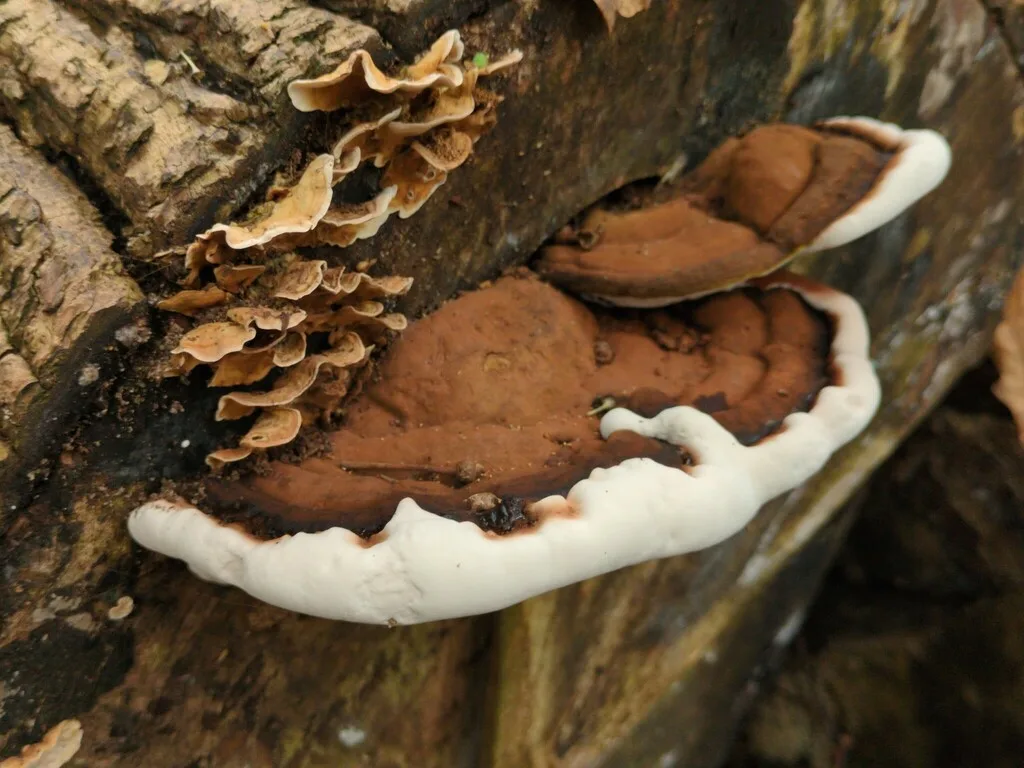
The artist's conk is the flat, dull brown shelf at the base of a hardwood or on a stump. It is woody, it has no stalk, and its white underside marks brown at a touch. It is found in every state.
Western Artist's Conk (Ganoderma brownii)
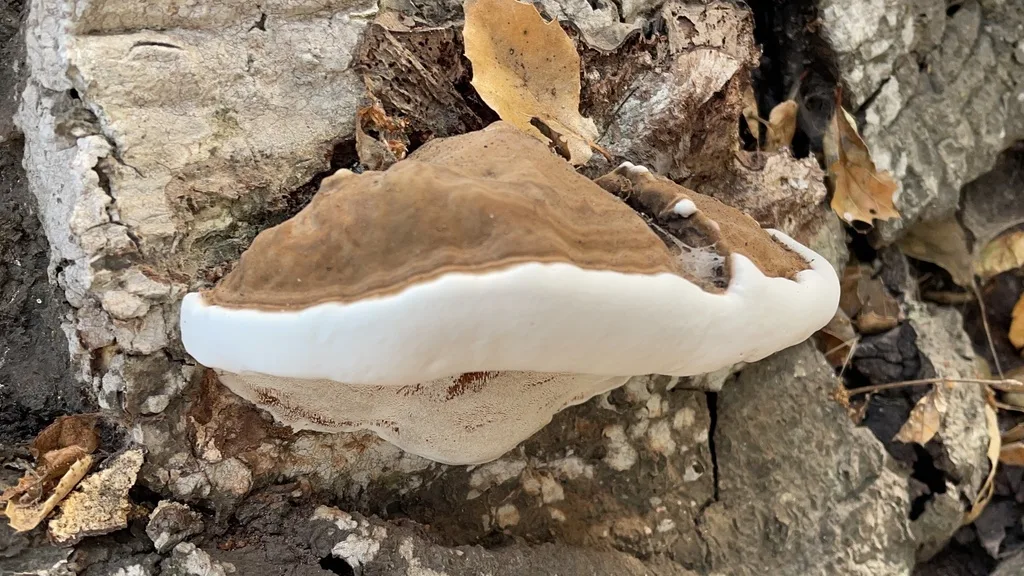
Ganoderma brownii is a western twin, and MykoWeb also calls it an artist's conk. This page adds "western" only to keep the two apart. It has the same dull, lumpy, brown to grayish-brown cap with brown spore dust. Its pore surface is white to yellowish white and darkens instantly when injured. It grows mainly on California bay laurel and is widely distributed in California. MykoWeb states that the two are often confused. The yellow cast and larger spores point to G. brownii, so a firm answer needs a microscope.
Reishi (Ganoderma sessile)
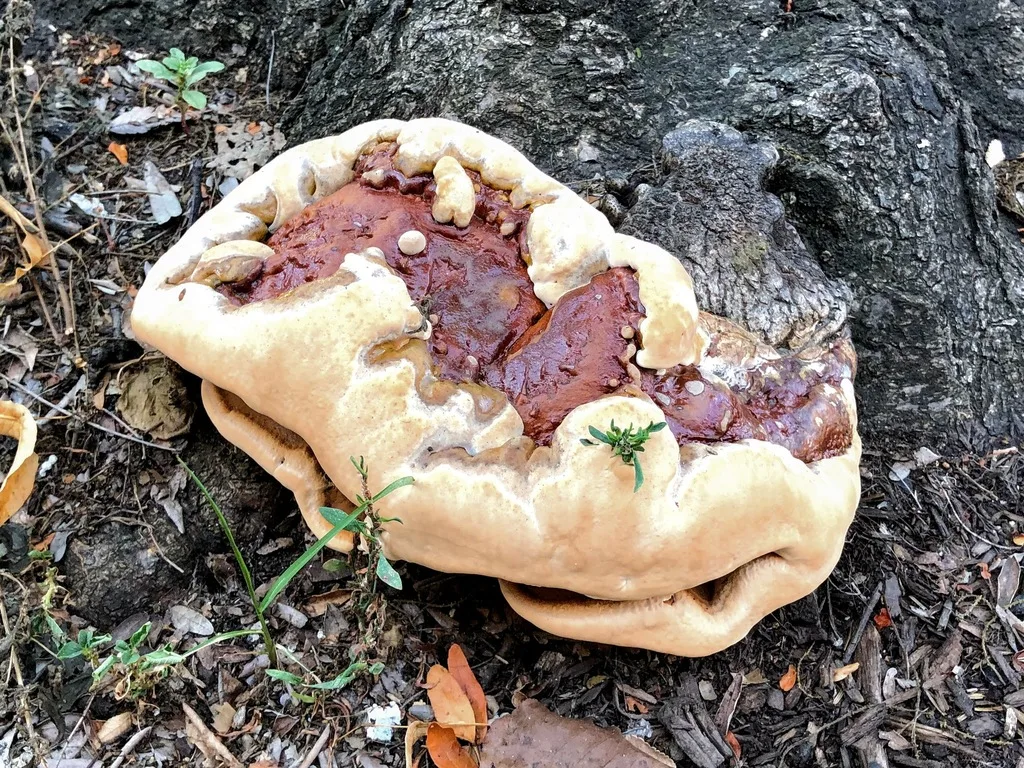
Reishi-type conks are the shiny ones. A 2018 study in PLoS ONE recognized twelve species of varnished, reishi-type conks in the United States. Ganoderma sessile is one of the most widespread in the East. Its cap is deep red to orange-red, and it grows on the decaying wood of deciduous trees. The study pictures it on the lower trunk and root flare of a honeylocust. Ganoderma tsugae grows mainly on eastern hemlock, and Ganoderma polychromum is a western species on hardwoods. The study found true Ganoderma lucidum only in small areas of northern Utah and California. Our Ganoderma lucidum group guide sorts them out.
Red-Belted Conk (Fomitopsis mounceae)
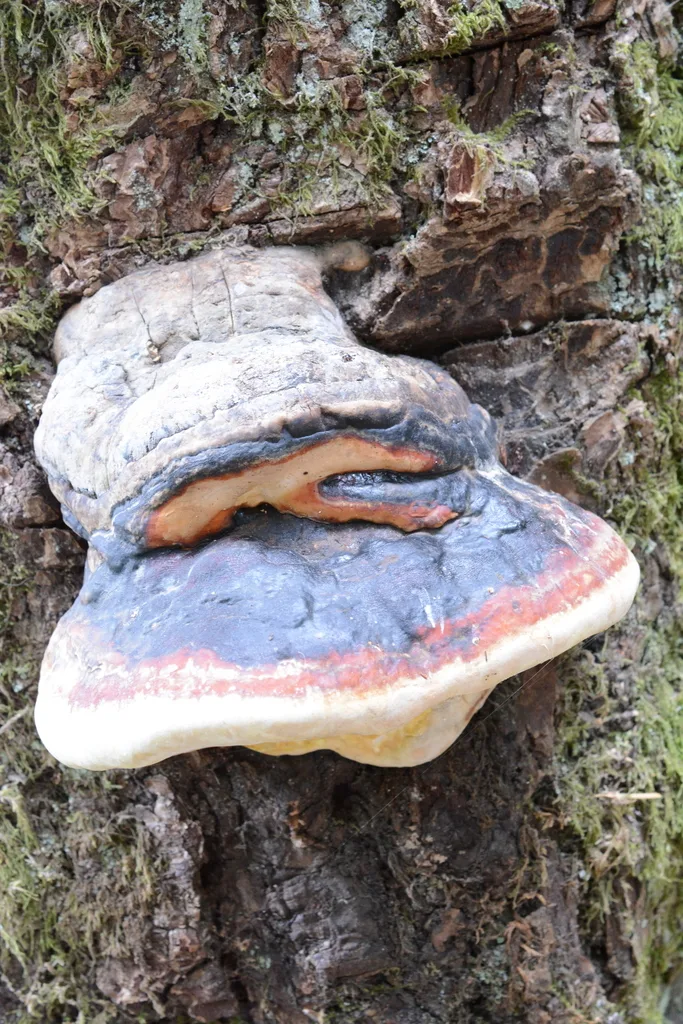
The red-belted conk is a hard, hoof-shaped bracket 5 to 25 cm across. MykoWeb describes a margin banded reddish to orange-brown with a blunt white edge. The white pores bruise pale yellow to buff, not brown, and fresh ones often ooze clear droplets. It grows on conifer logs and stumps and less often on hardwoods. The name is disputed. A 2019 study restricted Fomitopsis pinicola to Eurasia and named North American material F. mounceae and F. schrenkii, while MykoWeb still treats them as F. pinicola. See our pine tree fungus identification guide.
Tinder Fungus (Fomes fomentarius)
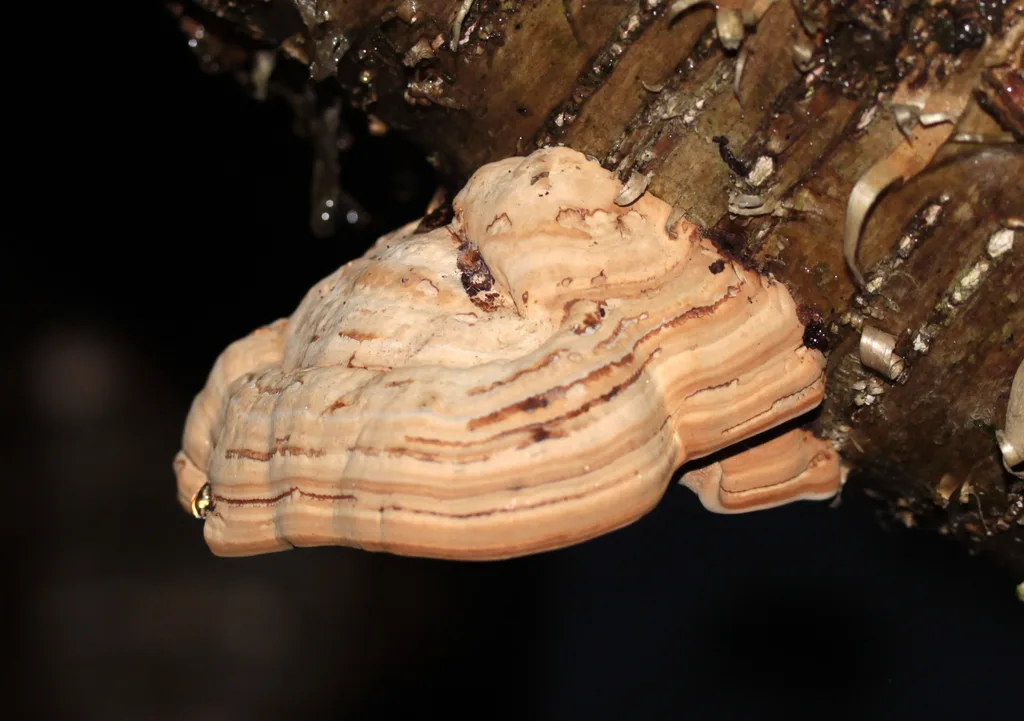
The tinder fungus is a gray hoof. Natural Resources Canada describes a conk up to 20 cm tall with a hard gray crust, concentric furrows and a brown underside. It is perennial and grows most often on birch and beech. The factsheet places it in the northern half of the United States.
Resinous Polypore (Ischnoderma resinosum)
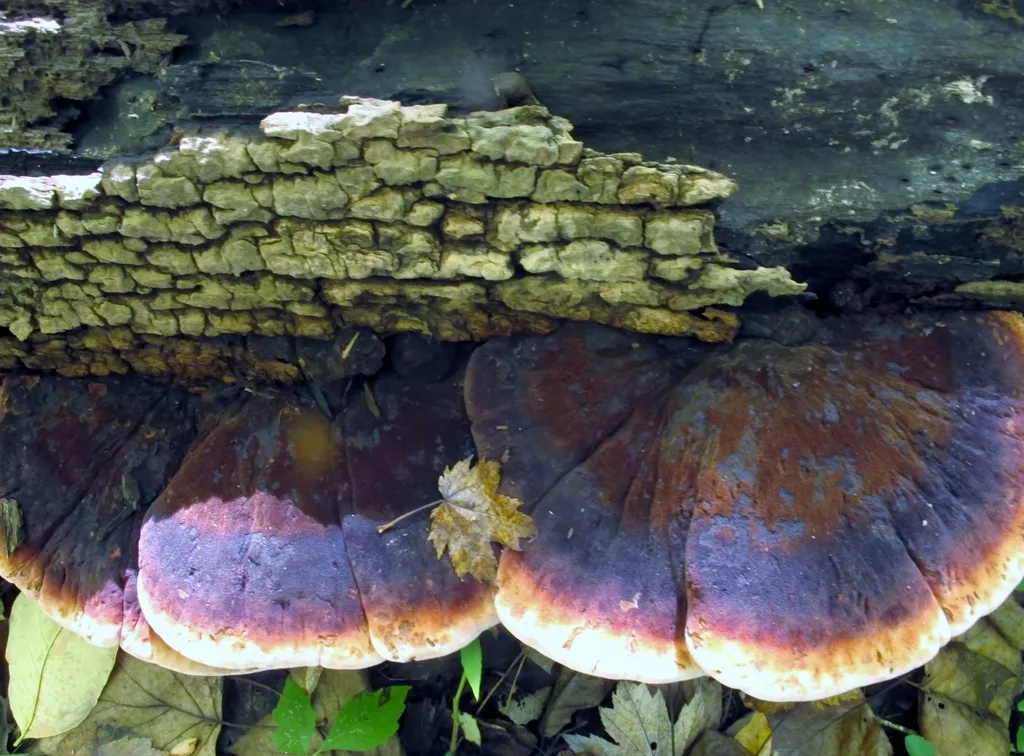
A young resinous polypore can pass for a small artist's conk. The Missouri Department of Conservation describes a cap 3 to 10 inches wide, ochre to dark brown, finely hairy and fleshy when young. Very young ones often ooze amber droplets. The whitish pores also bruise darker, which is why the scratch test alone is not enough. It fruits in September and October in Missouri, and its spore print is white. Missouri rates young, fresh ones as edible, with a warning to be absolutely sure of the identification.
Artist's Conk vs Look-Alikes: Side-by-Side Comparison
The top surface sorts them fastest: dull and brown for the artist's conk, shiny and red for reishi, red-banded for the red-belted conk, gray and hoof-shaped for tinder fungus. None of the sources opened for this page lists any of these six as a poisonous mushroom. The danger that comes with them is the decayed tree.
| Fungus | Top | Underside when scratched | Texture | Usual wood |
|---|---|---|---|---|
| Artist's conk | Dull gray-brown, lumpy | White, brown at once | Woody | Hardwoods, near the base |
| Western artist's conk | Dull brown, lumpy | White to yellowish, darkens at once | Woody | California bay laurel |
| Reishi | Shiny, varnished red | Judge by the varnished top instead | Woody and hard | Hardwoods in the East |
| Red-belted conk | Red-orange band, white edge | White, slowly pale yellow to buff | Woody | Conifers |
| Tinder fungus | Gray hoof, ringed furrows | Already brown | Woody | Birch and beech |
| Resinous polypore | Brown, finely hairy | Whitish, bruises darker | Fleshy when young | Hardwood logs and stumps |
Is Artist's Conk Edible?
No. Artist's conk is woody and is not eaten. The Missouri Department of Conservation lists it as not edible, and MykoWeb's verdict is "Inedible, woody." Some sources mention a tea made from it. No source opened for this page gives clinical evidence of a health effect, and this page makes no health claim.
Woody does not mean that every bracket is harmless. The North American Mycological Association lists a polypore, Hapalopilus rutilans, as a cause of kidney dysfunction and brain damage. It is a soft, cinnamon-colored bracket, not a hard conk. Never eat or brew a wild fungus without expert confirmation.
Is Artist's Conk Bad for the Tree?
Yes. Artist's conk causes a white rot of the roots and lower trunk, and a conk on a living tree usually means advanced decay inside. The fungus enters through wounds and can also spread through natural root grafts, according to University of California IPM.
| What the sources say | Source |
|---|---|
| White rot of sapwood and heartwood in roots and trunks | University of California IPM |
| Decay can extend as far as 15 feet above and below the conk | University of California IPM |
| A 10% loss of wood weight can mean a 70 to 90% loss of wood strength | University of California IPM |
| Large conks usually mean substantial internal decay, but the extent is hard to judge from outside | Pacific Northwest handbook |
| Thin foliage and dying limbs may appear, but not reliably | Pacific Northwest handbook |
What to Do About a Conk on a Tree Near a House
- Treat the conk as a warning sign, even if the crown still looks green.
- Have the tree assessed by a qualified arborist. University of California IPM advises regular inspection of trees near structures.
- Expect that removal may be needed. The Pacific Northwest handbook advises removing affected trees to avoid damage to surrounding property.
- Do not count on knocking the conk off. The fungus lives inside the wood, and the conk is only its fruiting body.
- Protect other trees from wounds. Mowers, poor pruning cuts and branch stubs are common entry points.
On a dead log or stump in the woods, the same fungus is a normal decomposer that returns nutrients to the soil. Compare other trunk fungi in our tree mushroom identification chart.
Common Identification Mistakes
Trusting the Scratch Test Alone
The resinous polypore and Ganoderma brownii also darken when scratched. Check the top surface and the texture as well.
Calling a Varnished Shelf an Artist's Conk
A shiny red or orange-red crust belongs to the reishi group. An artist's conk is never shiny.
Testing an Old, Dry Conk
The scratch test works on a fresh white pore surface. An aged or dried underside fades to yellowish buff and no longer takes a mark.
Assuming a Green Crown Means a Sound Tree
Dieback is not consistently linked to this decay. A tree can look healthy above while the lower trunk and roots are rotting.
Frequently Asked Questions
What is an artist's conk?
An artist's conk is a hard, perennial shelf fungus, Ganoderma applanatum. It has a dull brown top and a white pore surface that turns brown when scratched. It decays the wood of living and dead trees.
Is artist's conk edible?
No. The Missouri Department of Conservation lists it as not edible, and MykoWeb calls it inedible and woody. Never eat or brew a wild fungus without expert confirmation.
Why is it called artist's conk?
The fresh white underside turns dark brown wherever it is scratched. People draw on it, and the lines become permanent as the conk ages.
How do you identify an artist's conk?
Scratch the white underside and watch for an immediate brown mark. Then check for a dull, lumpy, gray-brown top with brown spore dust and a hard, woody body with no stalk.
Does artist's conk kill trees?
It can. It causes white rot of the roots and lower trunk, and the Mountain Lake Biological Station notes that parasitic conks gradually drain injured trees and eventually kill them. The bigger risk near a house is that the weakened tree falls.
Should I remove an artist's conk from my tree?
Removing the conk does not stop the decay, because the fungus lives inside the wood. Have a qualified arborist assess the tree instead.
How long does an artist's conk live?
It is perennial and adds a new layer of pores each year. The Mountain Lake Biological Station reports conks that have lived for dozens of years.
What is the difference between artist's conk and reishi?
Reishi-type Ganoderma have a shiny, varnished cap in red to orange-red. An artist's conk has a dull gray-brown crust and a white underside that bruises brown at once.
How is Ganoderma brownii different from artist's conk?
Ganoderma brownii has a white to yellowish pore surface and larger spores, and it grows mainly on California bay laurel. MykoWeb states that the two are often confused.
Final Safety Reminder
An artist's conk is easy to recognize once you have scratched one, but it is not food, and on a living tree it is a warning. Never eat or brew a wild fungus based on a chart, a photo or an app. Photograph the top, the underside, a scratch mark and the tree, then check your find with our free mushroom identifier and a local mycological club. If someone may have eaten a poisonous mushroom in the US, call Poison Control at 1-800-222-1222.
Sign in to leave a comment and join the discussion.
 Species Guide
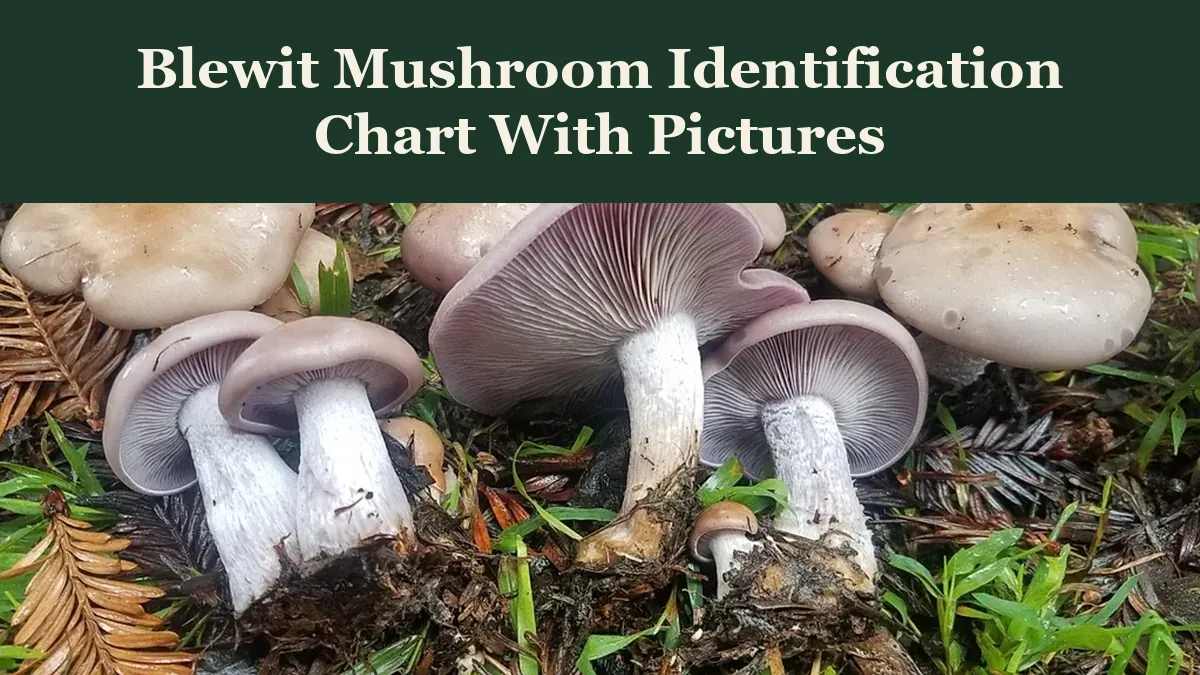
A blewit mushroom is a stocky lilac to tan gilled mushroom, now often listed as Collybia nuda , that fruits in leaf litter and mulch from fall into winter....
 Species Guide
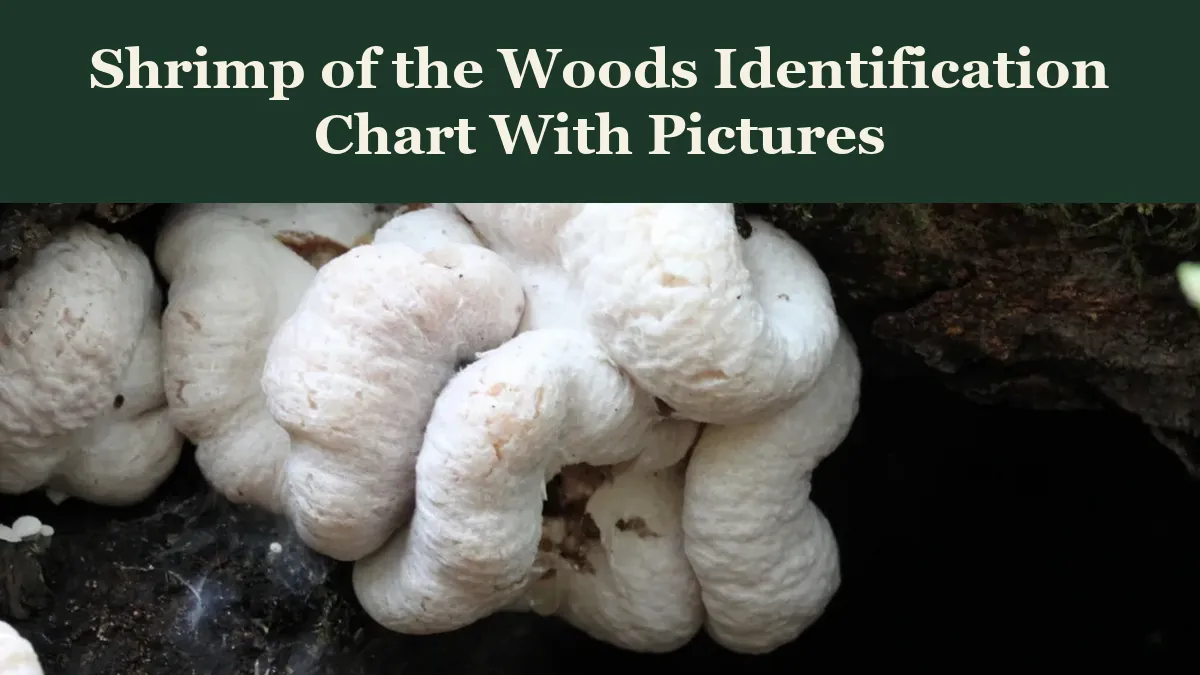
Shrimp of the woods is a common name for Entoloma abortivum , a fungus best known for the white, lumpy "aborted" form it makes near rotting hardwood in late...
 Species Guide
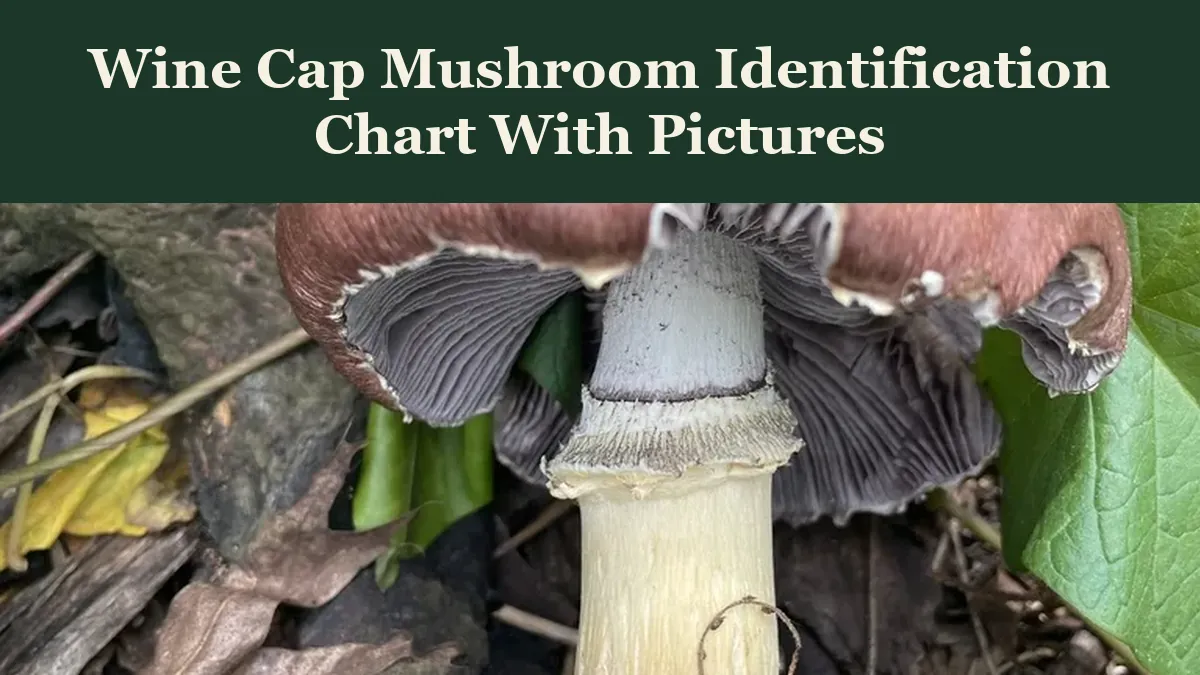
The wine cap mushroom ( Stropharia rugosoannulata ) is a large, wine-red mushroom that grows in wood chip beds, mulch and gardens from spring through fall....