Blewit Mushroom Identification Chart With Pictures
— views
A blewit mushroom is a stocky lilac to tan gilled mushroom, now often listed as Collybia nuda, that fruits in leaf litter and mulch from fall into winter. Its key test is a pale pinkish-buff spore print with no veil on the stem. Purple Cortinarius look-alikes leave a rusty brown print and have a cobweb veil. Blewits can cause stomach upset when raw, so no one should eat one before an in-person expert check.
This blewit mushroom identification chart with pictures covers the wood blewit, the field blewit and the sordid blewit, plus the purple look-alikes that share their woods. It gives a three-step flip, smell and print test, the peak months by US region, and the state of the name dispute.
Key Takeaways
- A blewit has crowded lilac gills, a stocky stem with no ring or cobweb veil, and a pale pinkish-buff spore print.
- A rusty or cinnamon brown spore print means a Cortinarius, not a blewit.
- The purple color fades to tan, so cap color alone never identifies a blewit.
- iNaturalist records show two US peaks: October in New York and January in California.
- Three genus names are in use for the same mushroom: Collybia, Lepista and Clitocybe.
- Blewits must be cooked. MykoWeb and First Nature both report stomach upset from raw or undercooked ones.
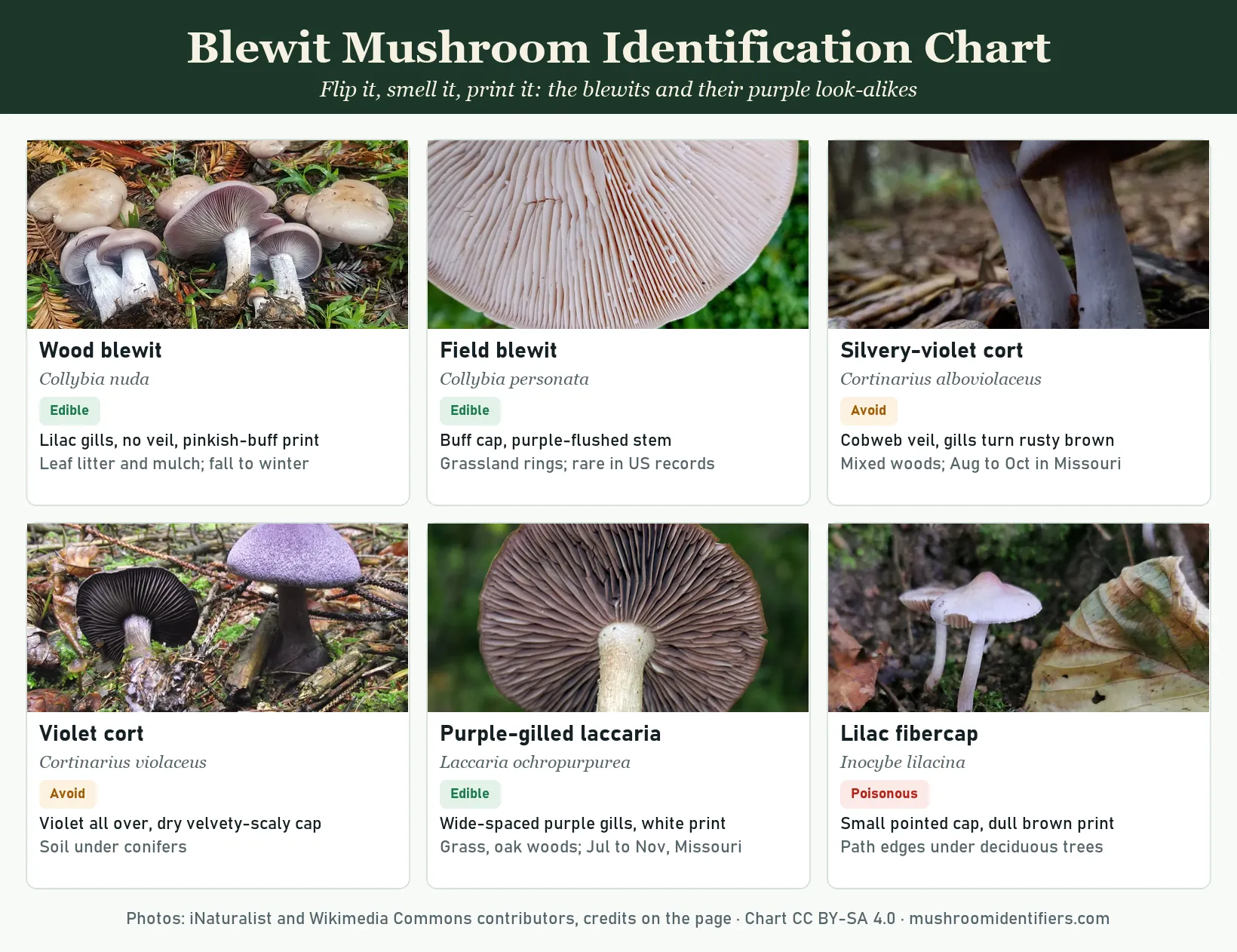
Blewit Mushroom Identification Chart
| Mushroom | Key features | Where and when | Edibility or risk |
|---|---|---|---|
| Wood blewit (Collybia nuda, also Lepista nuda, Clitocybe nuda) | Violet-lilac cap 1.5 to 6 in, fading to tan; crowded lilac gills; no veil; pinkish-buff print | Leaf litter, mulch, paths; August to October in Missouri, late fall to midwinter in California | Edible when cooked, after expert confirmation |
| Field blewit (Collybia personata) | Cream to buff cap, no violet; purple-flushed stem; pinkish-buff print | Grassland, fairy rings; mainly Europe, rarely recorded in the US | Edible when cooked, after expert confirmation |
| Sordid blewit (Collybia sordida) | Thin brown cap 2 to 6 cm, sometimes lilac-tinted; slender stem; pinkish-buff print | Rings in grass; late fall to midwinter in California | Listed as edible by MykoWeb; confirm first |
| Silvery-violet cort (Cortinarius alboviolaceus) | Silky grayish-violet cap; cobweb veil; gills turn rusty brown; rust print | Mixed woods; August to October in Missouri | Avoid: not recommended by MDC |
| Violet cort (Cortinarius violaceus) | Violet all over; dry, velvety-scaly cap | Soil under conifers; northern California | Avoid: sources conflict |
| Purple-gilled laccaria (Laccaria ochropurpurea) | Tannish-lavender cap; widely spaced purplish gills; white to pale violet print | Grass and oak woods; July to November in Missouri | Rated a good edible by MDC; confirm first |
| Lilac fibercap (Inocybe lilacina) | Small pointed lilac cap; gills turn clay brown; dull brown print | Path edges under deciduous trees, mixed woods | Poisonous: muscarine |
Use the chart to narrow a purple mushroom down, then confirm it with the gills, the stem and a spore print. Details come from the Missouri Department of Conservation (MDC), MykoWeb and First Nature. Seasons apply to the state or region named.
What Is a Blewit Mushroom?
A blewit is a lilac-gilled mushroom that lives on dead leaves and plant litter and fruits in the cold months. The name is thought to come from Old English words for "blue hat," according to MDC. The wood blewit is the species most people mean. It grows alone, in groups or in fairy rings under hardwoods and conifers, and MykoWeb calls it probably the most common edible mushroom of the San Francisco Bay Area.
The scientific name is unsettled. The species was described in 1790 as Agaricus nudus. It moved to Lepista in 1871 and to Clitocybe in 1969. A 2023 study in the journal Fungal Diversity moved it again, to Collybia. Sources have not caught up with each other. iNaturalist now uses Collybia nuda. MDC and First Nature use Lepista nuda. MykoWeb uses Clitocybe nuda.
All three names point to the same mushroom, so search all three when you compare photos. The question is not closed. MykoWeb describes the blewit as a species complex that still needs research to sort out its species and its genus.
How Do You Identify a Blewit Mushroom?
Flip it, smell it and print it: a blewit has lilac gills with no veil, a fragrant smell and a pale pinkish-buff spore print. The print is the deciding step, because the purple Cortinarius species that grow beside blewits drop rusty brown spores. Our guide to the parts of a mushroom explains the terms.
| Step | Blewit | Not a blewit |
|---|---|---|
| 1. Flip it | Crowded lilac gills, notched at the stem. No ring and no cobweb threads. | A cobweb veil on young caps, or rusty fibers on the stem: Cortinarius. |
| 2. Smell it | Fragrant, per MykoWeb. First Nature describes a faint aniseed odor. | A green-corn odor fits the lilac fibercap. A radish odor fits the lilac bonnet. |
| 3. Print it | Pale pinkish-buff | Rusty or cinnamon brown: Cortinarius. Dull brown: lilac fibercap. White: lilac bonnet or a Laccaria. |
The Central Texas Mycological Society notes that a blewit cap is smooth and never slimy, and that blewits do not grow in bunches or on dead wood.
Smell only supports the other steps, as our article on odor and texture in mushroom identification explains. Learn the print method in our spore print guide. Tom Volk at the University of Wisconsin gives the same split: a buff to pink print and no ring for the blewit, a cinnamon brown print and a cobweb veil for Cortinarius. A pinkish-buff print narrows the field. It does not confirm a blewit by itself.
When and Where Do Blewits Grow in the US?
Blewits fruit from fall into winter, with a peak in October in the Northeast and in January in California. Monthly iNaturalist counts show the split. About 17,400 US observations of the wood blewit were on iNaturalist on November 20, 2026, and three quarters of them fell between October and January.
| Region | Main months | Basis |
|---|---|---|
| Northeast (New York) | September to November, peak in October | iNaturalist: 406 of 731 New York observations are from October |
| Midwest (Missouri) | August to October | Missouri Department of Conservation |
| Central Texas | Fall and winter, after a hard frost or freeze | Central Texas Mycological Society |
| California | December to February, peak in January | iNaturalist: 3,631 of 8,095 California observations are from January. MykoWeb gives late fall to midwinter. |
| Whole US | October and January are the top two months | iNaturalist: 4,049 in October and 3,984 in January |
These counts are sightings logged by the public, and not every one has been confirmed by a second identifier. California supplies nearly half of the US records.
Blewits grow from the ground, not from logs. MDC lists open areas, mulch piles and path edges, and describes the blewit as a decomposer of leaf litter. MykoWeb reports heavy fruiting in urban parks, and First Nature adds garden compost heaps. A purple mushroom in a yard is not automatically a blewit, so run the same test. See why mushrooms grow in your yard and our guide to winter mushrooms for other cold-season finds.
Blewit Types and Look-Alikes in the US
Three blewits and four purple look-alikes are described below. The blewits share a pinkish-buff spore print. Each look-alike fails at least one step of the flip, smell and print test.
Wood Blewit (Collybia nuda)
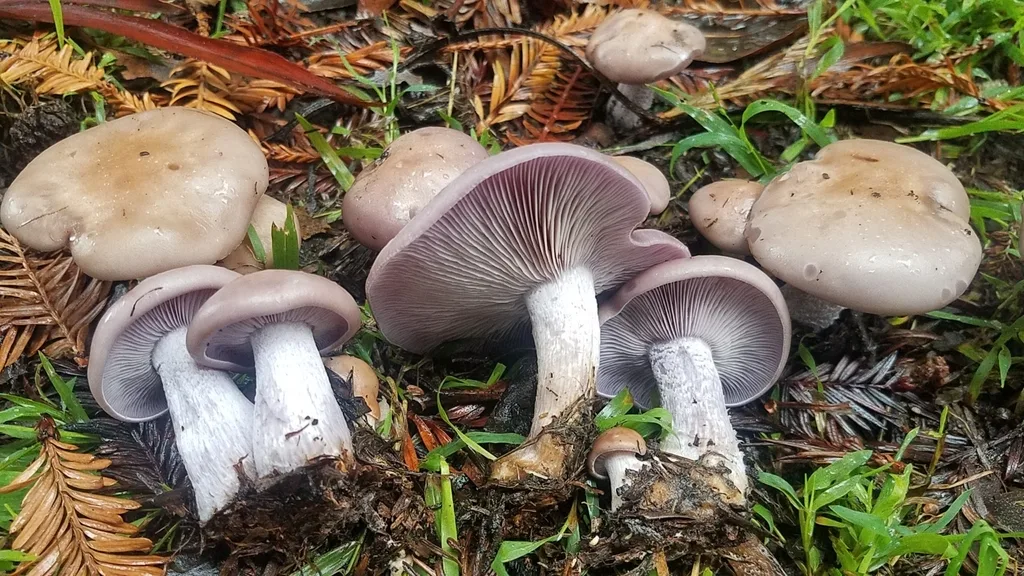
MDC gives the wood blewit a cap 1.5 to 6 inches wide that starts violet-lilac and fades to tan. The gills are broad, crowded and notched where they meet the stem. The stem is 1 to 3 inches long, often bulbous at the base, and has no ring. MykoWeb describes soft, pale lilac flesh and a fragrant odor.
Field Blewit (Collybia personata)
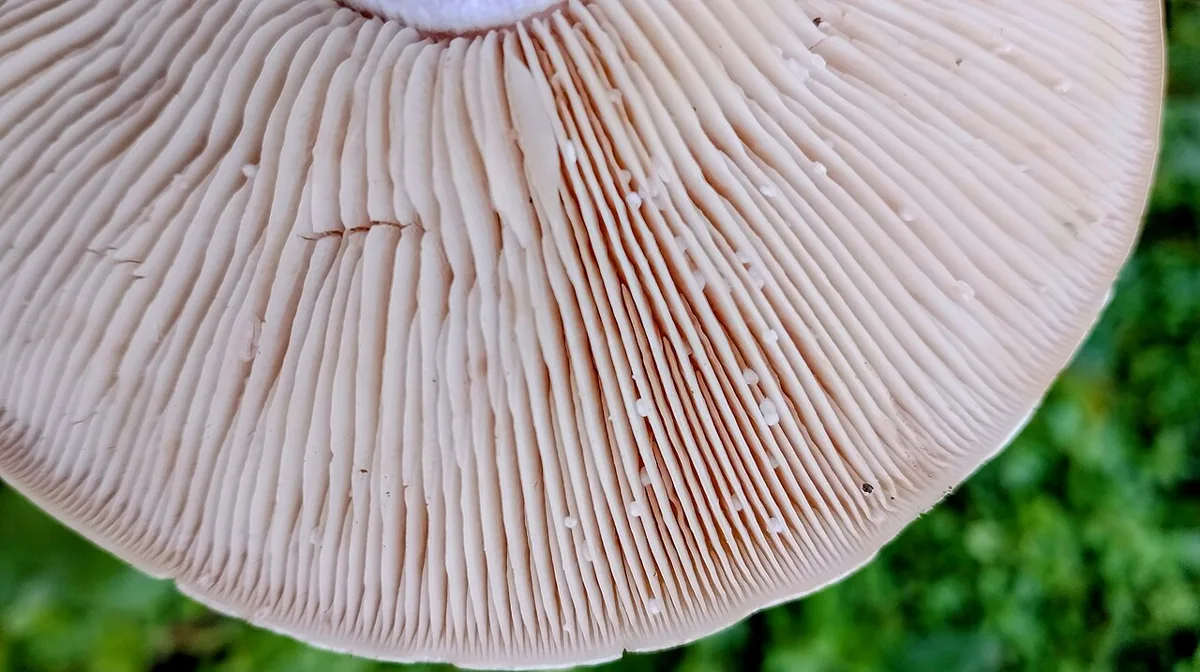
The field blewit has the build of a wood blewit without the violet cap. First Nature describes a cream to buff cap up to 15 cm across, gills that turn pinkish buff, and a fibrous stem flushed with purple. It grows in grassland, often in fairy rings. It is mainly a European mushroom. First Nature says it is also reported from North America, but iNaturalist held about 2,860 observations worldwide in November 2026 and only 30 in the United States. Older names are Lepista saeva and Lepista personata.
Sordid Blewit (Collybia sordida)
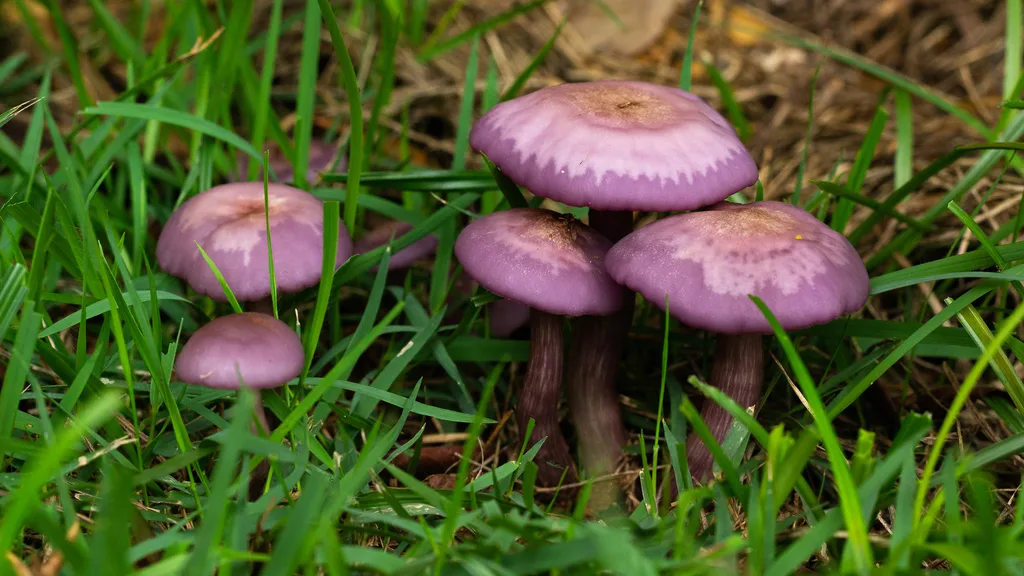
The sordid blewit is a thin, slender relative of the wood blewit. MykoWeb lists it as Clitocybe tarda, with Clitocybe sordida as a synonym. The cap is 2 to 6 cm wide and medium brown, sometimes with a lilac tint. The stem is only 3 to 7 mm thick. It forms arcs and fairy rings in grassy areas and often lacks lilac color altogether.
Silvery-Violet Cort (Cortinarius alboviolaceus)
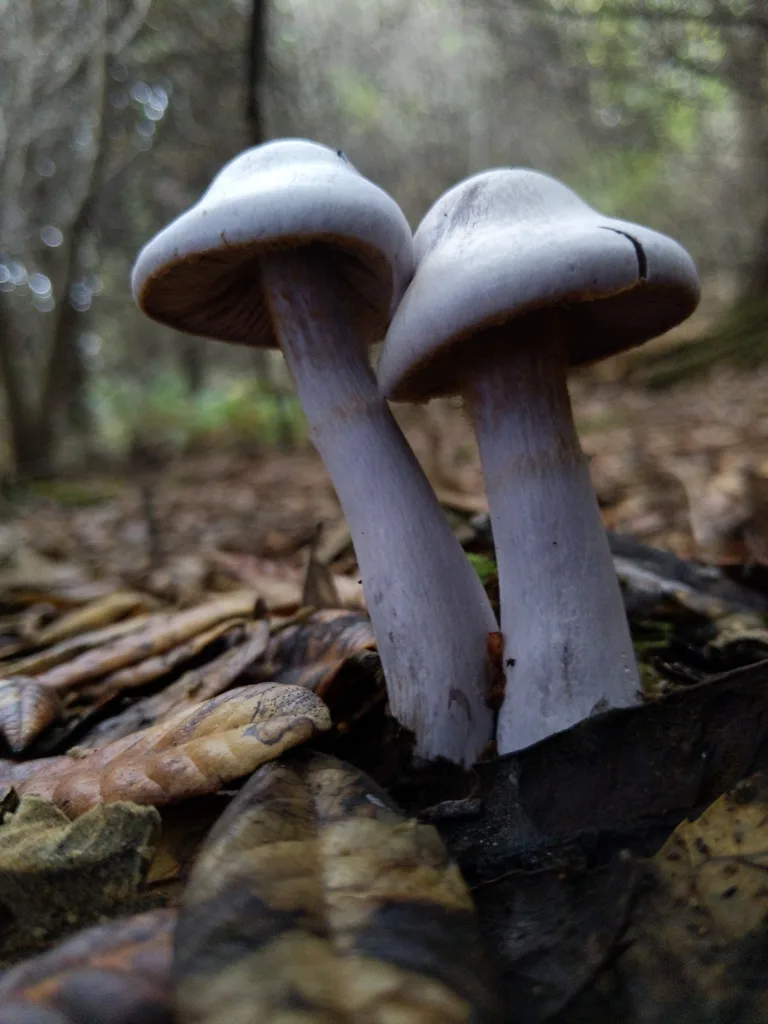
The silvery-violet cort is the look-alike that MDC names for the blewit. Its cap is bell-shaped, dry, silky and grayish violet, and 1.25 to 3 inches wide. Young caps have a fine cobweb veil that runs from the cap edge to the stem. The gills start pale violet and turn rusty or cinnamon brown. The spore print is rust. The Missouri Department of Conservation does not recommend eating it and warns that it could be confused with poisonous Cortinarius species.
Violet Cort (Cortinarius violaceus)
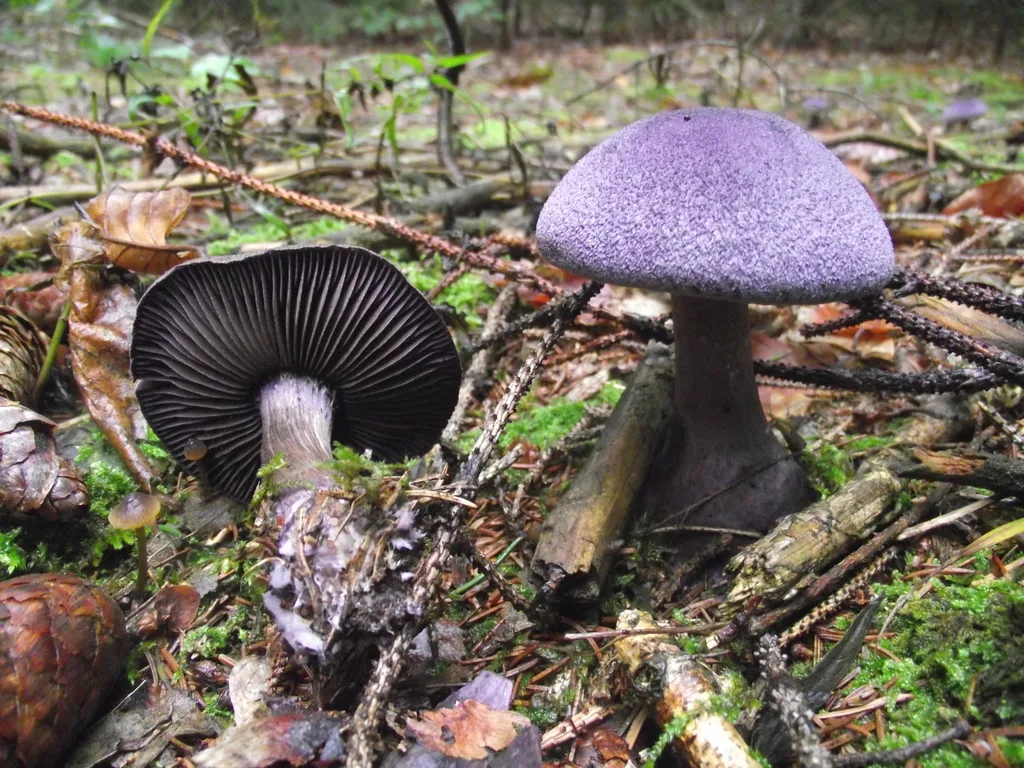
The violet cort is violet all over, with a dry, velvety-scaly cap and a dry, fibrous stem. A blewit cap is smooth, so the scaly surface is a quick first clue. MykoWeb records it in soil under conifers from Mendocino County northward in California. MykoWeb rates it edible but mediocre, while Tom Volk advises against eating any Cortinarius. Treat it as one to avoid.
Purple-Gilled Laccaria (Laccaria ochropurpurea)
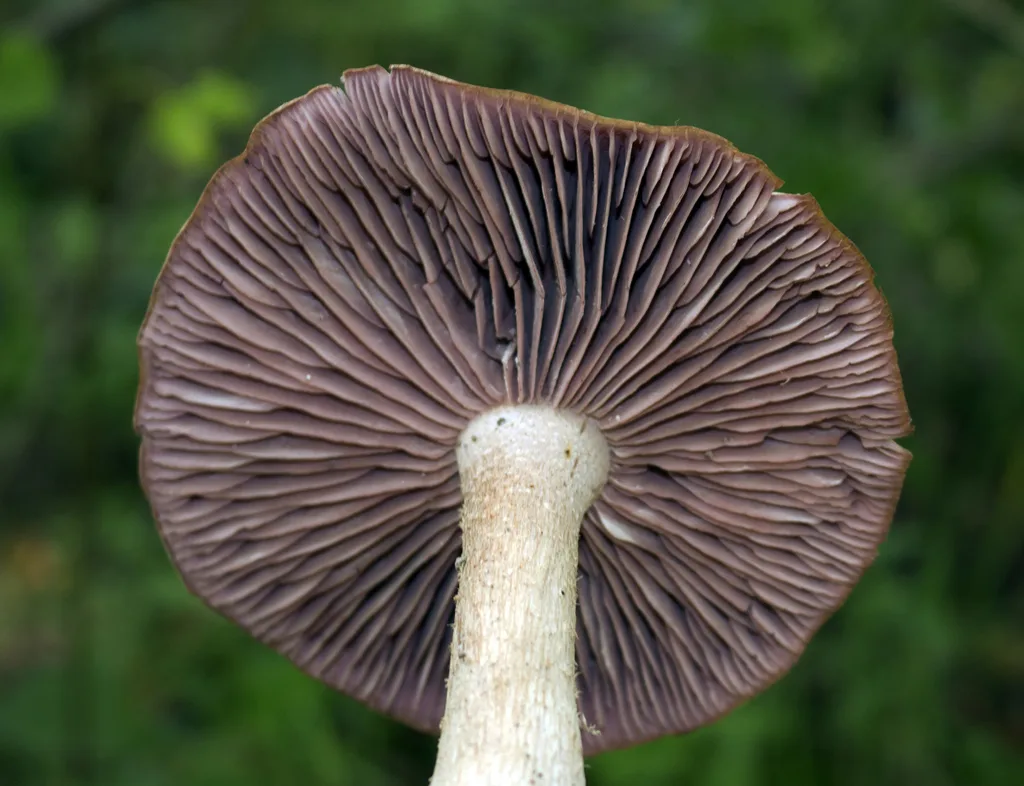
The purple-gilled laccaria often appears in large numbers in Missouri's oak woods in fall. Its cap is 2 to 8 inches wide and tannish lavender, fading to grayish white. The gills are purplish, broad and widely spaced, where blewit gills are crowded. The spore print is white to pale violet. The Missouri Department of Conservation lists it from July to November and considers it a good edible. On the West Coast, MykoWeb names Laccaria amethysteo-occidentalis as the similar species, with a distinctly fibrous stem.
Lilac Fibercap (Inocybe lilacina)
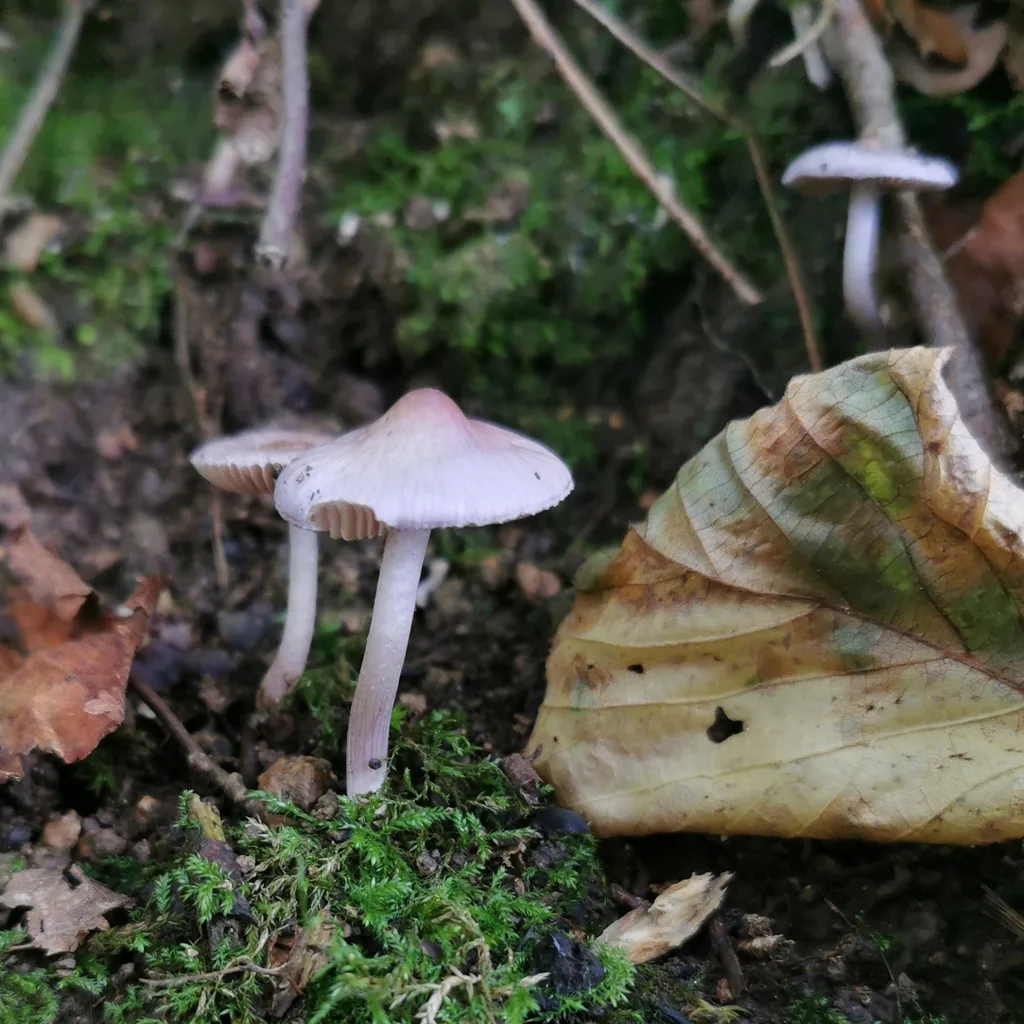
The lilac fibercap is the poisonous look-alike in this chart, and it is much smaller than a blewit. First Nature gives a cap of 1.5 to 3.5 cm that starts conical and usually keeps a pointed center. The gills start creamy gray and turn clay brown, and the stem is only 3 to 6 mm thick. The spore print is dull brown. Many sources list it as Inocybe geophylla var. lilacina. The lilac bonnet, Mycena pura, is another small purple mushroom. MykoWeb separates it by a lined cap edge, a radish odor and white spores, and calls its edibility questionable.
Blewit Look-Alikes: Side-by-Side Comparison
The purple Cortinarius species and the poisonous lilac fibercap are the look-alikes to rule out before anything is called a blewit. Only the blewit combines crowded lilac gills, no veil and a pinkish-buff print.
| Mushroom | Gills | Veil and stem | Spore print | Risk |
|---|---|---|---|---|
| Wood blewit | Lilac, crowded, fading to tan | No veil; stocky stem | Pale pinkish-buff | Edible cooked, after expert check |
| Silvery-violet cort | Pale violet, turning rusty brown | White cobweb veil when young | Rust | Avoid |
| Violet cort | Violet, like the whole mushroom | Cobweb veil; dry, fibrous stem | Cinnamon brown | Avoid |
| Lilac fibercap | Creamy gray, turning clay brown | Thin stem, 3 to 6 mm | Dull brown | Poisonous |
| Lilac bonnet | Pale lilac-buff | Hollow, fragile stem | White | Avoid |
| Purple-gilled laccaria | Purplish, widely spaced | No veil; long stem | White to pale violet | Edible per MDC, after expert check |
The veil is easy to miss on an old mushroom. Tom Volk explains that the cortina usually tears away as a Cortinarius matures, although remnants often stay on the stem. MDC suggests looking for a dusting of rusty spores on the stem, and adds that you may not see it. That is why the spore print matters more than the veil.
Are Purple Cortinarius Mushrooms Dangerous?
No purple Cortinarius should be eaten, because the genus contains deadly species and few of its members have been tested. The North American Mycological Association (NAMA) lists Cortinarius orellanus, Cortinarius rubellus and a few relatives as sources of orellanine, a toxin that causes kidney failure. Symptoms begin 36 hours to 3 weeks after the meal, with an average of about 8 days.
Those named species are not the violet corts in this chart, and the sources disagree about the purple ones. MykoWeb rates the violet cort as edible but mediocre. MDC does not recommend the silvery-violet cort. Tom Volk points out that relatively few species in the genus have been tested, and he recommends eating none of them. A rusty print ends the discussion. See our deadly webcap guide for the species behind the kidney cases.
The lilac fibercap carries a different poison. NAMA lists Inocybe species among the muscarine mushrooms, with heavy salivation, sweating and tears that usually start within 15 to 30 minutes. If anyone may have eaten a wild purple mushroom, call Poison Control at 1-800-222-1222, even if they feel fine.
Are Blewit Mushrooms Edible?
Blewits are widely eaten when thoroughly cooked, but raw ones can cause stomach upset, and the purple look-alikes make an in-person expert check essential. MDC rates the blewit a choice edible. MykoWeb is cooler: it says the taste varies greatly from place to place, from quite good to very poor. Nobody should eat a wild mushroom based on this page.
The sources give the same cautions for an expert-confirmed blewit:
- Cook it thoroughly. First Nature states that wood blewits must be cooked and never eaten raw. MykoWeb reports stomach upset from raw ones.
- Try a small amount first. MDC and First Nature both give this advice, because some people react to them.
- Expect that some people cannot eat them. First Nature notes that a minority of people find even thoroughly cooked wood blewits indigestible.
- Be absolutely sure of the identification. MDC adds that color varies a lot as blewits age.
None of these sources names the compound behind the raw reaction. They report the effect, not a toxin. Our poisonous vs edible mushrooms guide explains why simple rules of thumb fail.
Common Identification Mistakes
Trusting the Purple Color
Blewits fade from violet to tan, and several other mushrooms are purple when young. First Nature warns against using cap color alone. Our guide to mushroom color changes shows how much age alters a cap.
Skipping the Spore Print
The print separates a blewit from a Cortinarius more reliably than any other single feature. Pinkish-buff fits a blewit. Rusty or cinnamon brown does not.
Missing the Cobweb Veil on Older Mushrooms
The cobweb veil of a Cortinarius is clearest on young caps and tears away later. Check the youngest mushroom in the group, and look for rusty fibers on the stem.
Searching Only One Scientific Name
A guide that says Lepista nuda, a website that says Clitocybe nuda and an app that says Collybia nuda all describe the same mushroom. Search all three before deciding that two sources disagree.
Frequently Asked Questions
What is a blewit mushroom?
A blewit is a stocky mushroom with lilac gills that grows in leaf litter and mulch from fall into winter. The wood blewit is listed as Collybia nuda, Lepista nuda or Clitocybe nuda, depending on the source.
What does a blewit mushroom look like?
A fresh wood blewit has a smooth violet-lilac cap 1.5 to 6 inches wide, crowded lilac gills and a thick stem that is often bulbous at the base. It has no ring and no cobweb veil. The whole mushroom fades to tan with age.
What are the look-alikes of the blewit mushroom?
The main look-alikes are purple Cortinarius species, such as the silvery-violet cort and the violet cort. Others are the poisonous lilac fibercap, the lilac bonnet and the purple-gilled laccaria. A spore print separates all of them from a blewit.
What color is a blewit spore print?
A blewit spore print is pale pinkish-buff. Purple Cortinarius species leave a rusty or cinnamon brown print, and the lilac fibercap leaves a dull brown one.
Are blewit mushrooms edible?
Blewits are widely eaten when thoroughly cooked, and the Missouri Department of Conservation rates them a choice edible. Purple Cortinarius look-alikes grow in the same places, so an experienced identifier must confirm every find in person.
Can you eat blewits raw?
No. First Nature states that wood blewits must be cooked and never eaten raw, and MykoWeb reports stomach upset from raw ones.
When is blewit season?
Blewit season runs from fall into winter. iNaturalist records peak in October in New York and in January in California, and the Missouri Department of Conservation lists August to October for Missouri.
Is the blewit Lepista nuda, Clitocybe nuda or Collybia nuda?
All three names refer to the same mushroom. A 2023 study moved it to Collybia, and iNaturalist now uses Collybia nuda. The Missouri Department of Conservation still uses Lepista nuda, and MykoWeb uses Clitocybe nuda.
What is the difference between a wood blewit and a field blewit?
The wood blewit has a violet-lilac cap and grows in leaf litter. The field blewit has a cream to buff cap with no violet, a purple-flushed stem, and grows in grassland. It is mainly European and is rarely recorded in the United States.
Final Safety Reminder
A blewit is easy to like and easy to get wrong, because the purple fades and the look-alikes fruit beside it. Never eat a wild mushroom based on a chart, a photo or an app. Take a spore print, then photograph the cap, the gills, the stem and the base using our guide on how to photograph mushrooms for identification. Check the pictures with our free mushroom identifier and with an experienced local identifier or mycological club. If someone may have eaten a poisonous mushroom in the US, call Poison Control at 1-800-222-1222.
Sign in to leave a comment and join the discussion.
 Species Guide
Shrimp of the woods is a common name for Entoloma abortivum , a fungus best known for the white, lumpy "aborted" form it makes near rotting hardwood in late...
 Species Guide
The wine cap mushroom ( Stropharia rugosoannulata ) is a large, wine-red mushroom that grows in wood chip beds, mulch and gardens from spring through fall....
 Species Guide
A cup fungus is a mushroom shaped like a cup, saucer or goblet, with no gills, that makes its spores on the inner surface. The most common US cups are red...