Edible Mushrooms in California: Identification Chart
— views
The best-known edible mushrooms in California are the golden chanterelle, candy cap, black trumpet and king bolete, and most of them fruit near the coast from November to March. The deadliest look-alike is the death cap (Amanita phalloides), which grows under the same coast live oaks in the same months. No wild mushroom should be eaten until a qualified person confirms it in hand.
This page covers edible mushrooms in California by month and by region: the North Coast, the Bay Area and Central Coast, the Sierra Nevada and Southern California. It then covers the poisonous mushrooms in California that matter most, the rules for collecting on public land, and where to get a find checked. Start with the chart, then read the season table.
Key Takeaways
- Winter is the main season on the California coast. Of 2,151 research-grade iNaturalist records of the California golden chanterelle, 1,789 fall from December to March.
- The Sierra Nevada runs on a spring clock. Of 770 natural black morel records, 756 fall from April to June.
- Death cap records peak from November to January, with 4,687 of 5,841 California records in those three months.
- The western jack-o'-lantern has 14,912 California records against 2,151 for the golden chanterelle. That is about seven look-alike records for every chanterelle record.
- California counted 47 amatoxin poisonings, four deaths and four liver transplants between November 2025 and mid-May 2026.
- California state parks bar mushroom picking unless a park posts an authorization. Salt Point State Park allows 2 pounds per person per day.
- If anyone eats an unknown mushroom, call the California Poison Control System at 1-800-222-1222.
Edible Mushrooms in California: Identification Chart
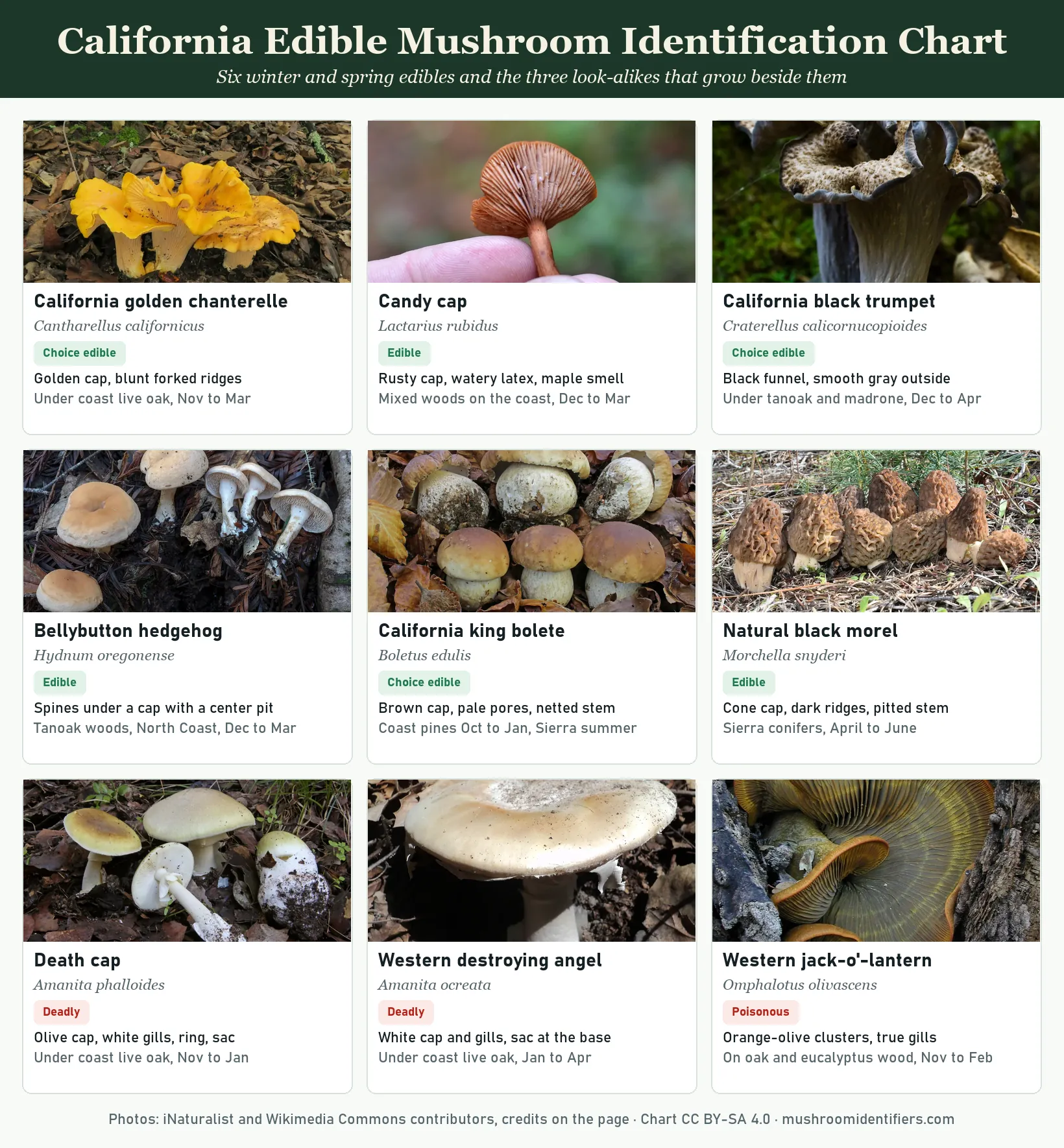
Match the tree and the month first, then check the features and rule out the look-alike. Features come from MykoWeb's California Fungi pages. Months come from a count of research-grade iNaturalist records for California, pulled in November 2026. A place on this chart means a species is recorded in California, nothing more.
| Species | Key features | Where in California | Months | Look-alike to rule out |
|---|---|---|---|---|
| California golden chanterelle (Cantharellus californicus) | Golden-yellow cap 3 to 11 cm, blunt forked ridges, pale yellow spore print | Under coast live oak. Bay Area, Central Coast, Southern California | November to March | Western jack-o'-lantern |
| Pacific golden chanterelle (Cantharellus formosus) | Yellowish orange to salmon cap, slender stem, ridges often tinged pink | Under Douglas-fir, western hemlock and Sitka spruce. Marin County northward | September to January | Western jack-o'-lantern, false chanterelle |
| Candy cap (Lactarius rubidus) | Rusty-brown cap 1.5 to 4.5 cm, watery latex, maple syrup smell when dried | Mixed hardwood and conifer woods. Bay Area, Central Coast, North Coast | December to March | Reddish milk caps with white latex, deadly galerina |
| California black trumpet (Craterellus calicornucopioides) | Dark gray to black funnel 3 to 9 cm tall, smooth pale gray outside, no gills | Under tanoak and madrone. North Coast, Bay Area, Central Coast | December to April | MykoWeb names no toxic look-alike |
| Bellybutton hedgehog (Hydnum oregonense) | Cream-buff cap 2.5 to 5 cm with a central pit, spines under the cap | Under tanoak and madrone, sometimes Douglas-fir. North Coast | December to March | Other hedgehogs. Check for spines, not gills |
| California king bolete (Boletus edulis) | Brown cap 7 to 25 cm, whitish pores that turn olive-yellow, white net on the upper stem | Bishop pine and Monterey pine on the coast. Conifers in the Sierra | Coast October to January. Sierra July to October | Satan's bolete, western bitter bolete |
| Spring king bolete (Boletus rex-veris) | Pinkish to reddish-brown cap 9 to 18 cm, pores that do not stain, netted upper stem | Under mountain pines and firs. Sierra Nevada | May to June | Blue-staining boletes |
| Natural black morel (Morchella snyderi) | Cone-shaped cap, lengthwise pits, smoky brown to black ridges, pitted stem | Unburned mountain conifers: Douglas-fir, ponderosa pine, white fir | April to June | False morels |
iNaturalist counts show when people photograph mushrooms, not how many grow. Research grade means the community agreed on a name, not that a lab confirmed it.
California Mushroom Season by Month
California has two mushroom calendars: a rain-fed coastal season from October to March and a snowmelt season in the Sierra Nevada from April to June. The table groups the record months by region. Rain decides the real start each year, so treat every range as an estimate.
| Months | North Coast | Bay Area and Central Coast | Sierra Nevada | Southern California |
|---|---|---|---|---|
| October to November | King bolete peak. Pacific golden chanterelle | First king boletes and chanterelles after soaking rain. Death caps begin | Last king boletes of the mountain season | Few edible records. Western hardwood sulphur shelf peaks |
| December to January | Black trumpet, bellybutton hedgehog, candy cap | Peak for golden chanterelle, candy cap and pine-woods king bolete. Death cap peak | Few edible records | First golden chanterelle records |
| February to March | Black trumpet and hedgehog continue | Chanterelle and candy cap taper off. Woodchip morels start. Western destroying angel peak | Few records beyond the oak foothills | Golden chanterelle, southern candy cap, woodchip morel |
| April to June | Black trumpets taper off in April | Woodchip morels until May | Natural black morel, burn morels, then spring king bolete | Woodchip morels taper off |
| July to September | Pacific golden chanterelle records begin | Scattered king boletes and chanterelles from fog drip | King bolete records run from July | Green-spored parasol on watered lawns. It is poisonous |
The fog-drip note comes from MykoWeb, which reports sporadic summer fruitings on the coast. Every other cell rests on iNaturalist months for the species named.
Edible Mushrooms in Northern California vs Southern California
Northern California holds most of the state's forest edibles, while Southern California has a short winter season and far fewer records. The regional counts on this page come from four approximate map boxes drawn on the iNaturalist data. The North Coast box lies north of latitude 38.3, and the Southern California box lies south of latitude 34.9. The Sierra box takes in the range and its oak foothills.
- North Coast: The box holds 1,053 of 1,135 Pacific golden chanterelle records, 954 of 1,460 black trumpet records and 257 of 305 bellybutton hedgehog records.
- Bay Area and Central Coast: The box holds 1,783 of 2,151 California golden chanterelle records and 1,538 of 2,076 candy cap records. It also holds 4,458 of 5,841 death cap records.
- Sierra Nevada: The box holds 343 of 655 spring king bolete records and 363 of 770 natural black morel records.
- Southern California: The box holds 109 golden chanterelle records, and 82 of them fall from January to March. It holds no black trumpet or bellybutton hedgehog records and 2 king bolete records.
Southern California has its own list. The southern candy cap (Lactarius rufulus) has 377 records in the southern box, with a February peak, and MykoWeb treats it as an edible, larger candy cap. The western hardwood sulphur shelf (Laetiporus gilbertsonii) has 3,767 southern records, mostly from September to November. The NAMA poisoning summary for 2006 to 2017 lists California cases of vomiting after people ate that species, so it is not a beginner's mushroom.
Common Edible Mushrooms in California
Eight species stand out in California records, and each one has a host tree and a season that narrow the search. Each still needs an in-person check by someone qualified.
California Golden Chanterelle (Cantharellus californicus)
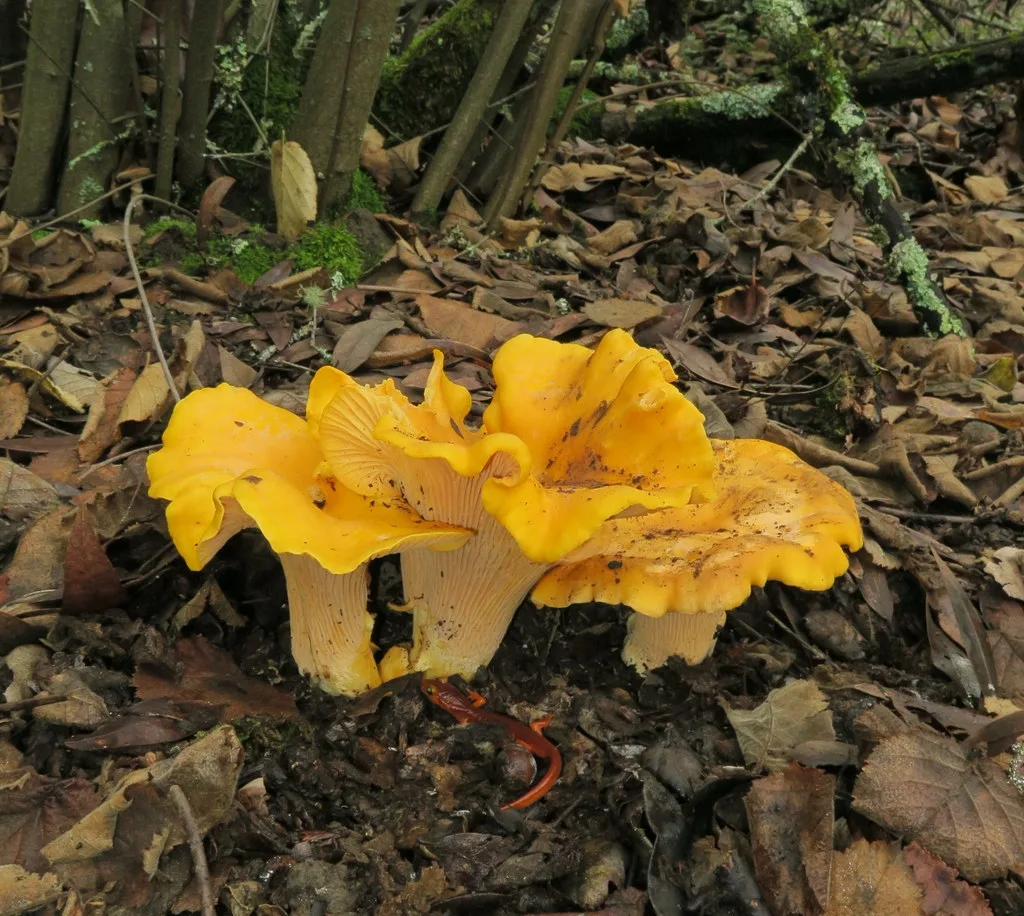
This is the oak chanterelle of the Bay Area and Central Coast. MykoWeb describes a golden-yellow cap 3 to 11 cm across and shallow, forked ridges in place of gills. The spore print is pale yellow. It grows in duff under coast live oak, often in thick poison oak. The western jack-o'-lantern is the look-alike. That species has true gills, olive tones and a habit of clustering on wood. Our chanterelle guide shows the difference between ridges and gills.
Pacific Golden Chanterelle (Cantharellus formosus)
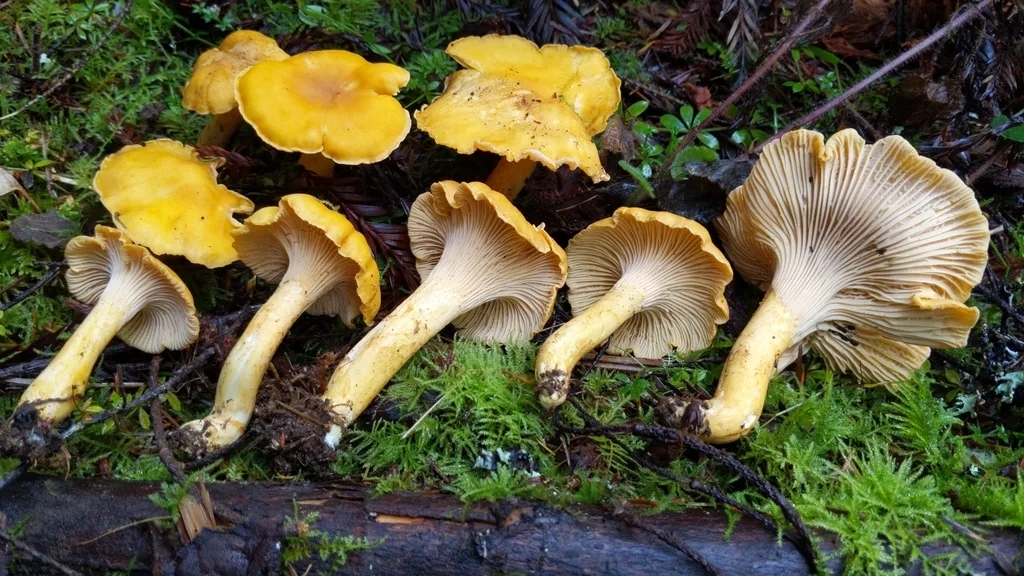
This is the conifer chanterelle of the North Coast. MykoWeb describes a yellowish orange to salmon cap, a slender stem and ridges often tinged pink. It grows in moss and duff under Douglas-fir, western hemlock and Sitka spruce. MykoWeb calls it common from Marin County northward on the coast. Records run from September to January.
Candy Cap (Lactarius rubidus)
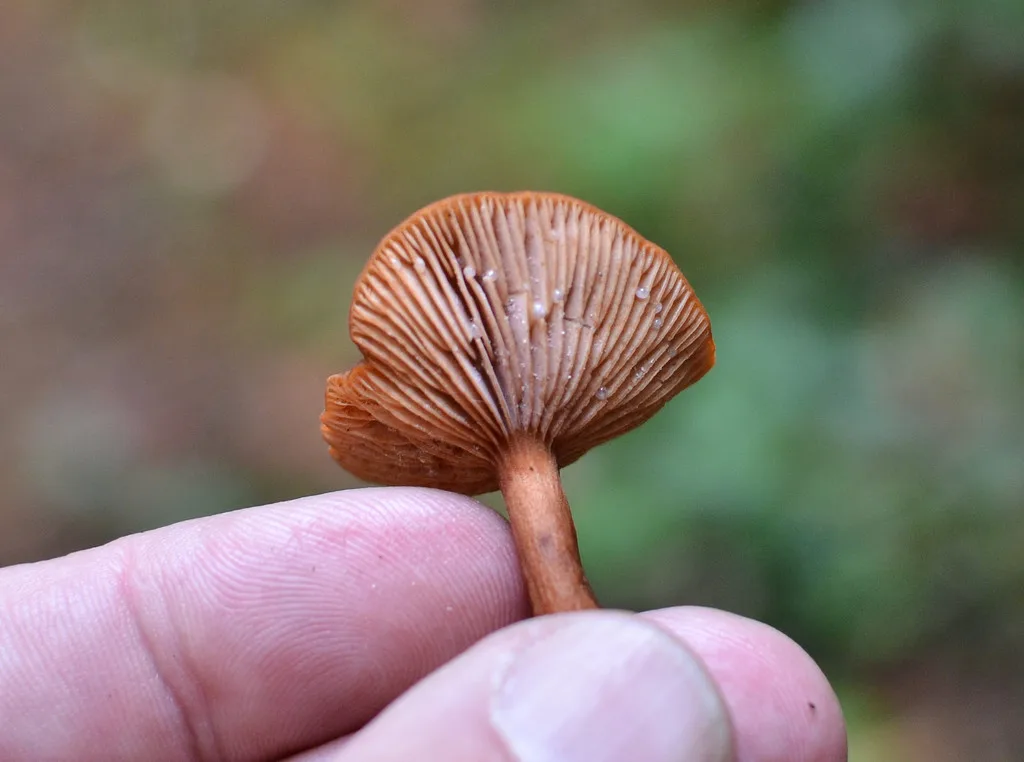
The candy cap is a small rusty-brown milk cap, 1.5 to 4.5 cm across. MykoWeb says the flesh and gills bleed a watery latex. Dried caps smell strongly of maple syrup and fenugreek. The spore print is cream-buff. Other reddish milk caps in the same woods show white latex when first cut. MykoWeb advises caution with look-alikes, because some are not edible.
California Black Trumpet (Craterellus calicornucopioides)
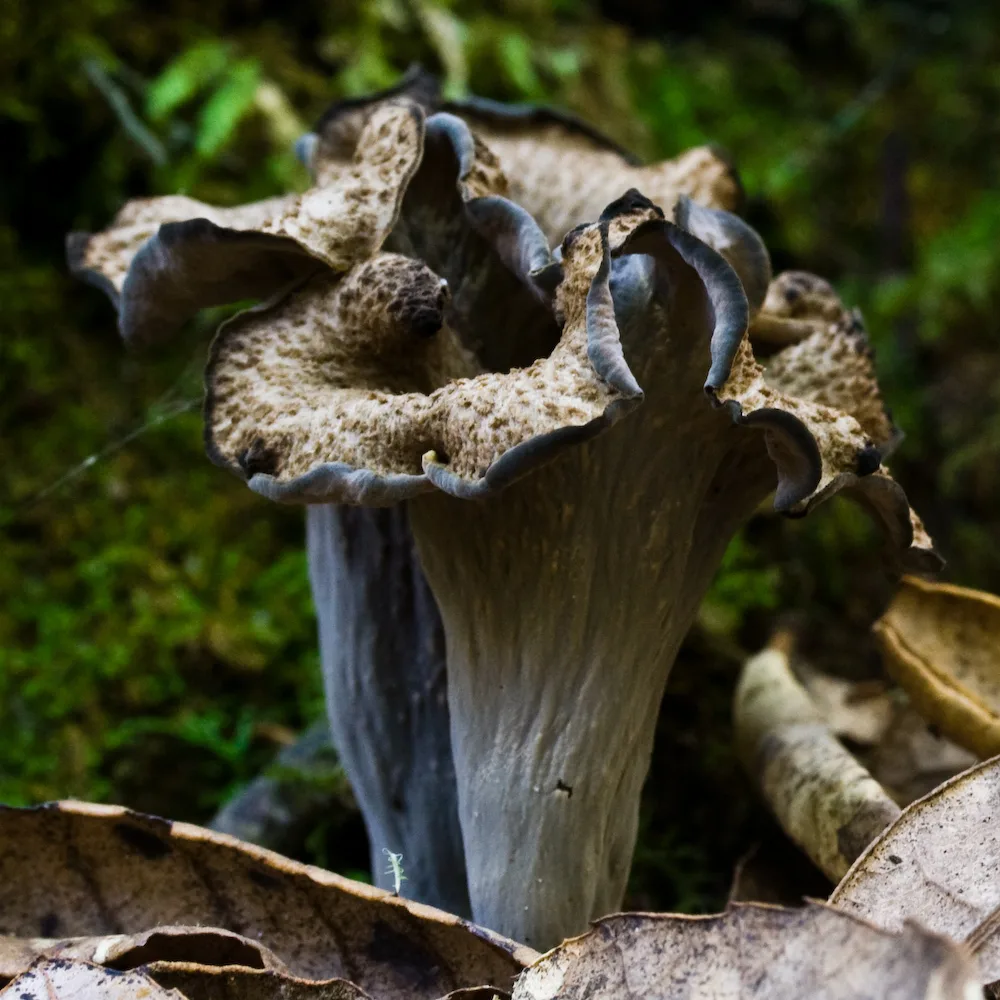
California's black trumpet was named as its own species in 2015. Older books call it Craterellus cornucopioides. MykoWeb describes a dark gray to blackish funnel, 3 to 9 cm tall. The outer surface is pale gray and smooth to slightly wrinkled. It grows from midwinter to spring, especially under tanoak and madrone. Our black trumpet guide covers the group.
Bellybutton Hedgehog (Hydnum oregonense)
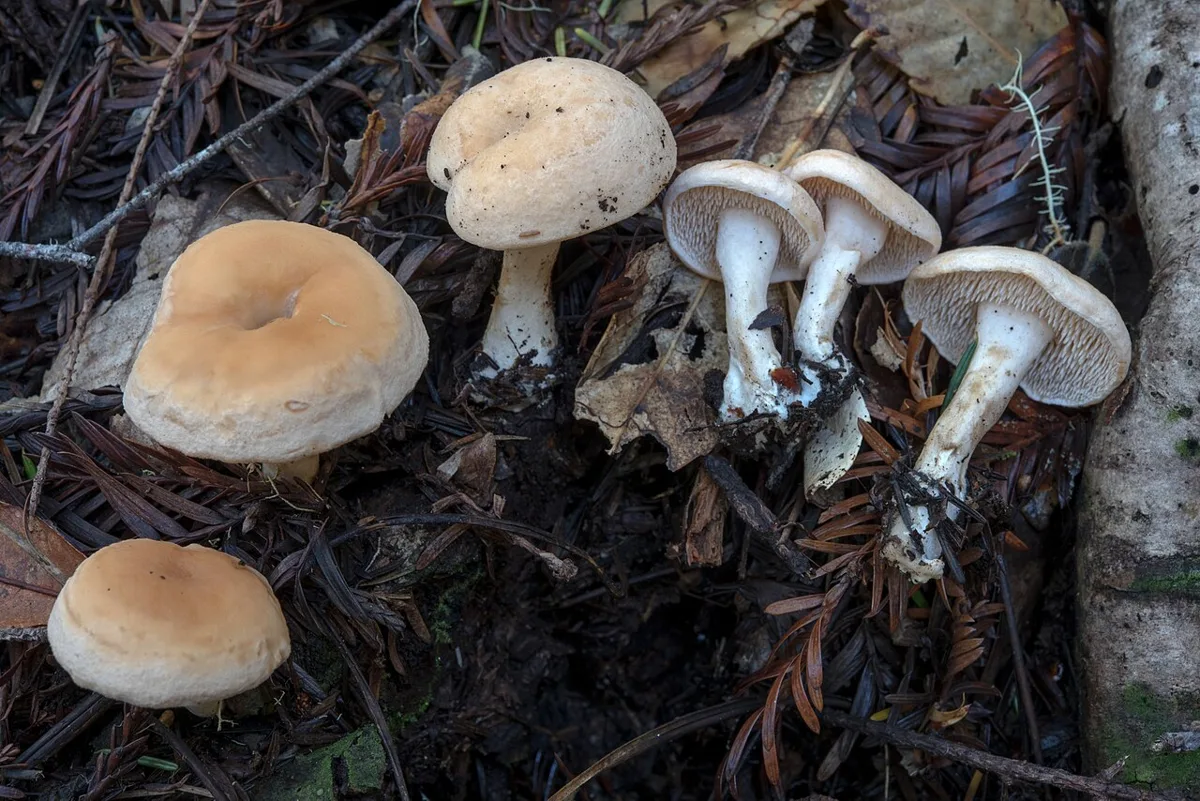
This hedgehog has a cream-buff to tawny cap, 2.5 to 5 cm wide, with a pit in the center. Spines 5 to 7 mm long hang under the cap in place of gills. The spore print is white. MykoWeb notes that California books long used the name Hydnum umbilicatum, which belongs to a species that does not occur in western North America. It is often common under tanoak from mid-winter to early spring. See our hedgehog mushroom chart for the larger species.
California King Bolete (Boletus edulis)
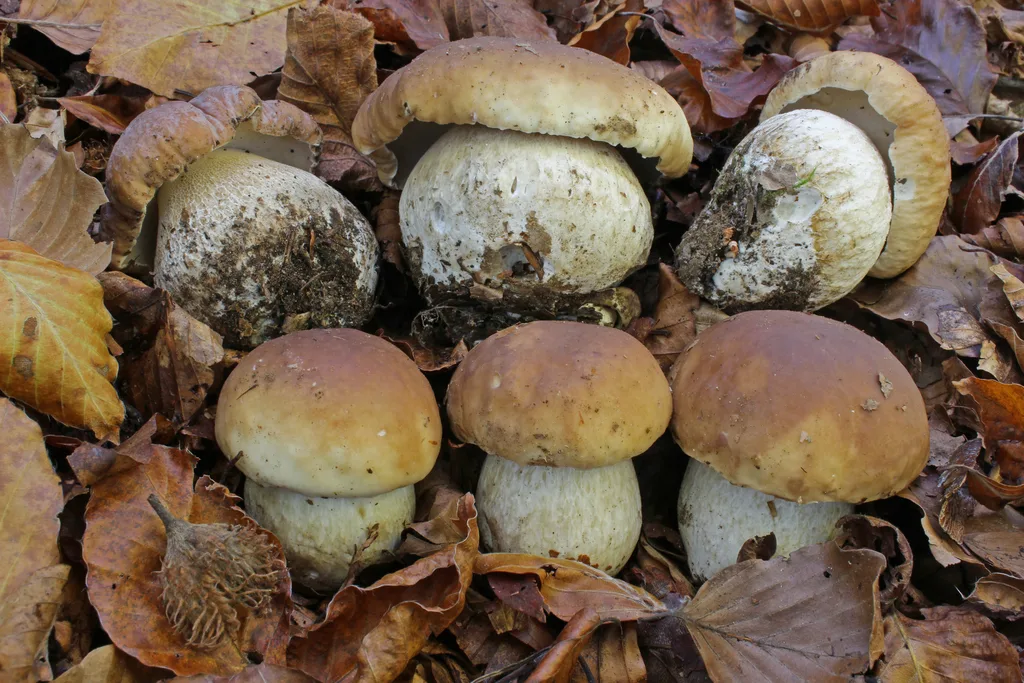
Californians call this mushroom porcini. MykoWeb files the coastal form as Boletus edulis var. grandedulis. The cap is 7 to 25 cm across and yellow-brown to reddish-brown. The pores start whitish and turn dull yellow, then olive. A white net covers the upper stem, and the flesh does not change color. It grows mainly with Bishop pine and Monterey pine, and the big fruitings follow the first soaking rains of autumn. Satan's bolete (Rubroboletus eastwoodiae) grows under coast live oak in the same season. It has dark red pores, turns blue where cut and is described as toxic. Our king bolete guide covers the stem net.
Spring King Bolete (Boletus rex-veris)
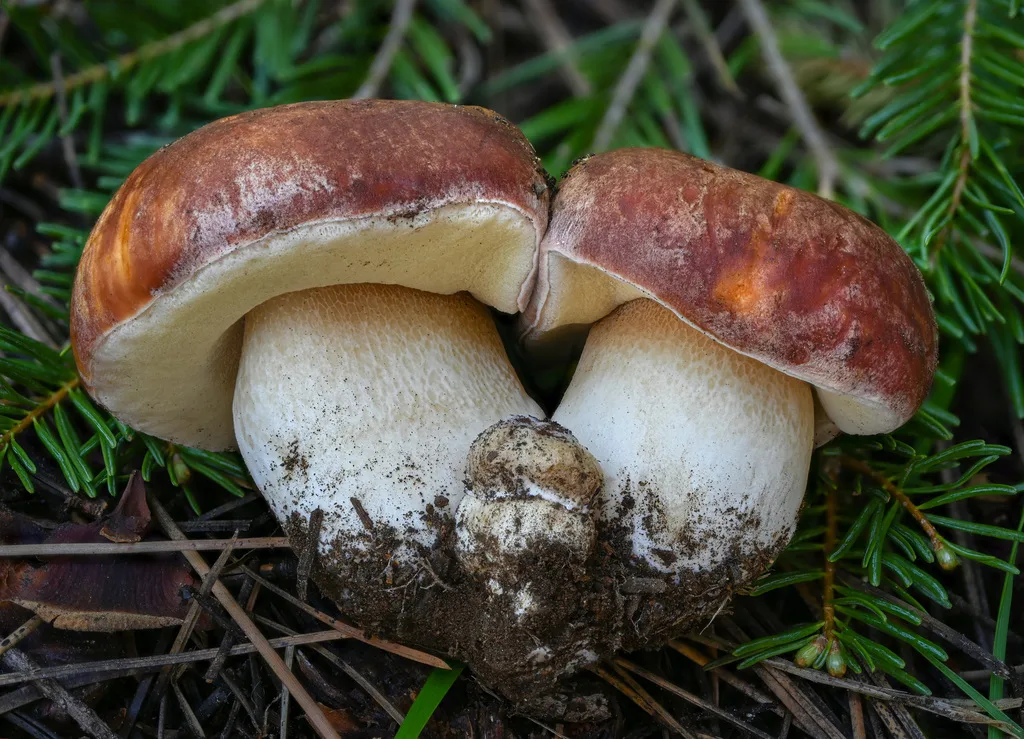
The spring king is the Sierra's porcini. MykoWeb describes a cap 9 to 18 cm across that flushes pinkish, then turns reddish-brown. The pores are white, then yellowish olive, and they do not stain when bruised. It grows under mountain pines and firs in late May or early June, often as the morel season ends. Of 655 California records, 543 fall in May and June.
Natural Black Morel (Morchella snyderi)
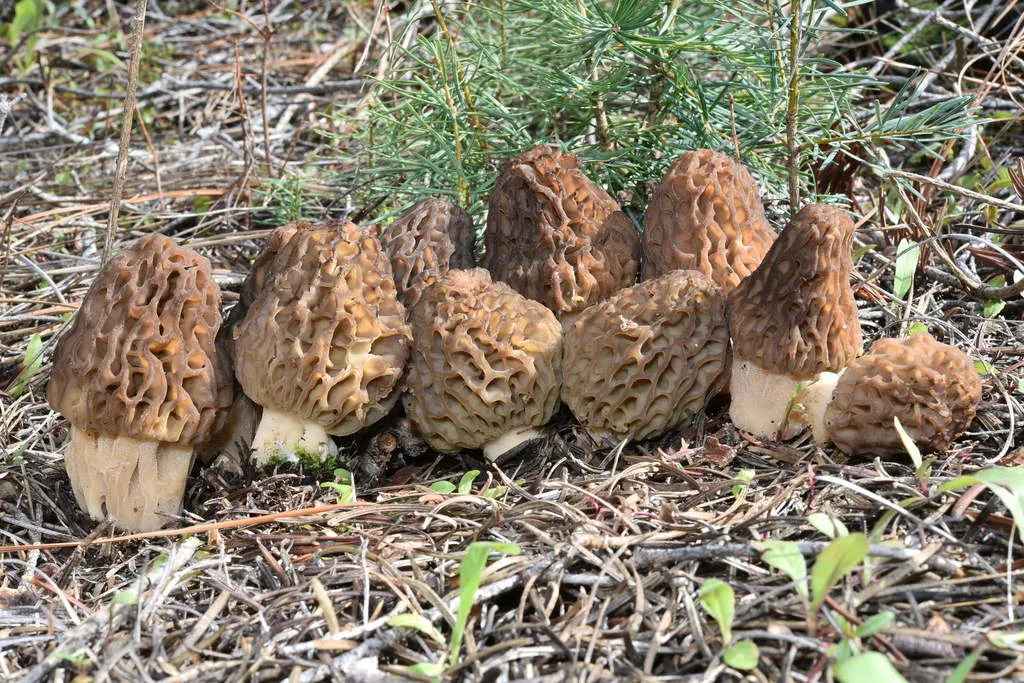
This is the morel of unburned mountain forest. MykoWeb describes a cone-shaped cap with lengthwise pits, smoky brown to black ridges and a pitted stem. It grows under Douglas-fir, ponderosa pine and white fir from April through June. MykoWeb adds that all morels should be well cooked. Our morel guide explains the hollow interior, and our false morel guide covers the look-alike.
Two other morel settings matter in California. Burn morels fruit in conifer forest the spring after a wildfire. A University of Washington report describes a May 2014 survey of 1,119 plots in Yosemite forest burned by the 2013 Rim Fire. The researchers estimated that burned white fir and sugar pine forest could yield more than one million morels a year in the park. The woodchip morel (Morchella rufobrunnea) is the lowland species. It has 1,601 California records, with a peak in March and April, and 796 of them sit in the Southern California box.
Poisonous Mushrooms in California
Three poisonous mushrooms cause most of the trouble for California foragers: the death cap, the western destroying angel and the western jack-o'-lantern. The first two carry amatoxins, which destroy the liver. The CDC reported 14 death cap poisonings in Northern California in December 2016, with three liver transplants. A larger outbreak began in November 2025. San Mateo County Health reported 35 cases, three adult deaths and three liver transplants statewide by January 6, 2026. Food Safety News put the count at 47 cases and four deaths by mid-May 2026.
Death Cap (Amanita phalloides)
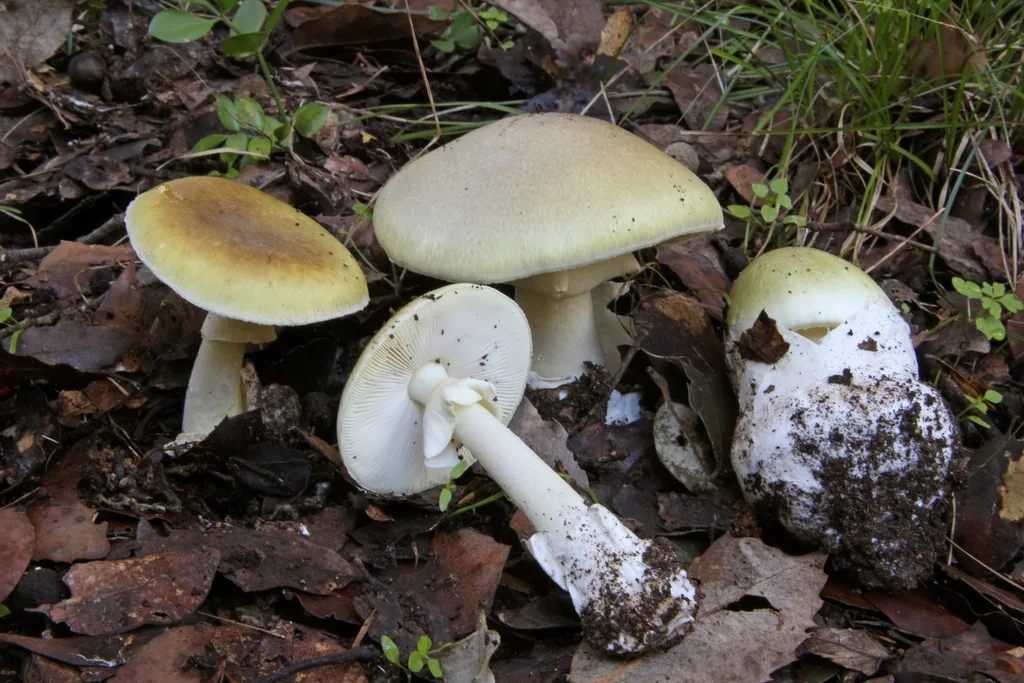
The death cap has an olive to yellowish-brown cap, white gills, a hanging ring and a white sac at the base. MykoWeb places it under coast live oak and calls it very abundant in the Bay Area. It shares that tree with the golden chanterelle. See our death cap identification guide.
Western Destroying Angel (Amanita ocreata)
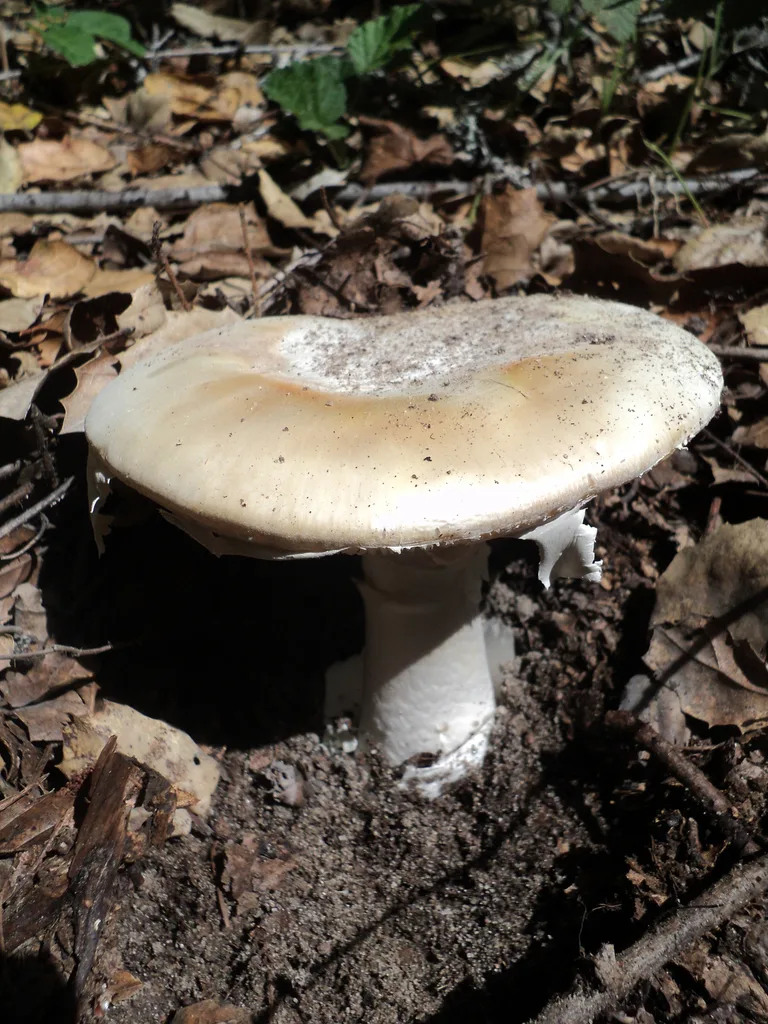
This white to cream Amanita grows under coast live oak from late winter to spring. Of 1,486 California records, 1,371 fall from January to April. The ring often collapses, so dig up the base and look for the sac. Our Amanita ocreata guide has the details.
Western Jack-o'-Lantern (Omphalotus olivascens)
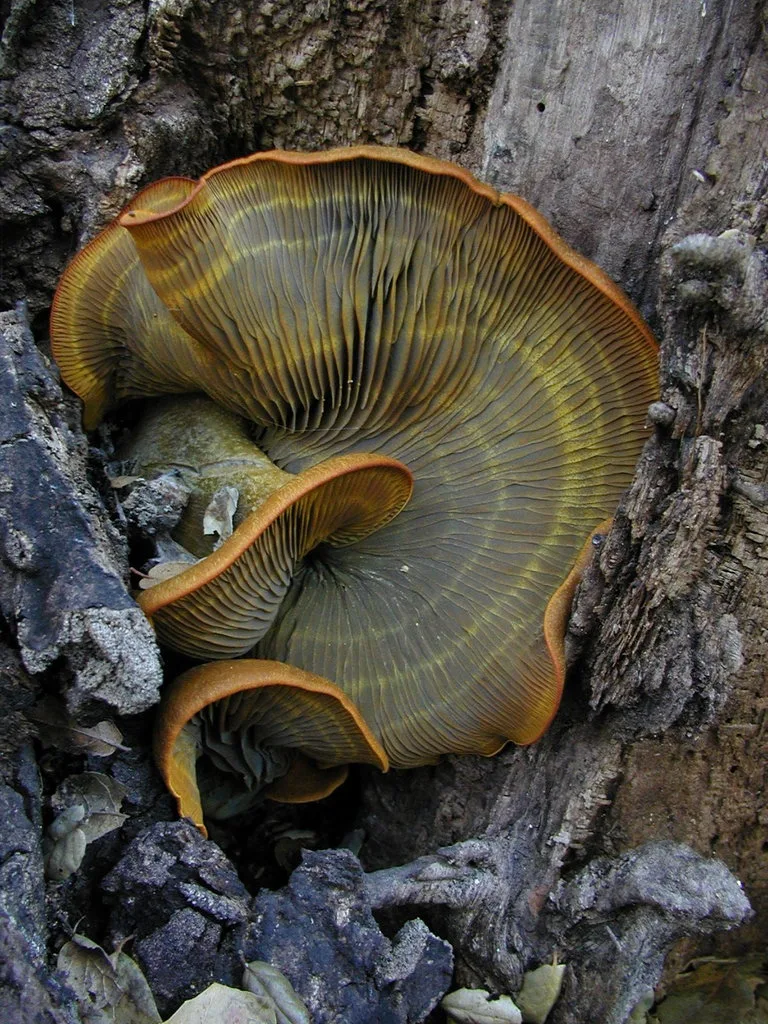
This orange to olive mushroom grows in clusters from hardwood stumps and buried roots, mostly oak and eucalyptus. MykoWeb says it causes severe stomach upsets and names it as the species confused with true chanterelles.
Two more belong on the list. Deadly galerina (Galerina marginata) is a small brown mushroom on rotting wood that carries amatoxins. Our deadly galerina guide shows its rusty spore print. The green-spored parasol (Chlorophyllum molybdites) fruits on watered lawns in summer, and 4,486 of its 5,525 California records sit in the Southern California box.
Where Can You Legally Pick Mushrooms in California?
Most California public land is closed to mushroom picking by default, and the open places set their own limits. The table states what each rule page says.
| Land | What the source says | Before you collect |
|---|---|---|
| California State Parks | Title 14, section 4306 bars picking plants and plant parts. It allows mushroom gathering only in park units where an authorization is posted at the unit headquarters, and only for non-commercial use. | Ask the park whether an authorization is posted |
| Salt Point State Park | The park page sets a maximum of 2 pounds per day per person. Collecting for sale is not permitted. Fort Ross State Historic Park and Kruse Rhododendron Reserve are closed to gathering. Organized groups and groups larger than 10 people must get a Special Event Permit. | Park in day use lots and stay out of campgrounds |
| Point Reyes National Seashore | The park regulations allow 2 gallons plus 1 mushroom per adult per day, for personal use only. | Check for area closures |
| Yosemite National Park | The 2016 University of Washington report gave the park limit as 1 pint per person per day. The current park rule page was not opened for this article. | Confirm the current limit with the park |
| East Bay Regional Park District | The district states that mushroom collecting is not allowed anywhere in its parks. | Take photos only |
| National forests | The Forest Service permit pages for California forests would not load for this article, so no rule is stated here. Rules differ from forest to forest. | Call the ranger district and ask about a forest product permit |
This table is not legal advice. Confirm the current rule with the land manager before each trip.
How to Get a California Find Identified
The most reliable route is an in-person check at a California mycological society meeting, foray or fair. Photos and apps are a starting point only. University of California IPM states that no simple test identifies poisonous mushrooms.
- Mycological Society of San Francisco: Founded in 1950. General meetings begin with mushroom identification, and the society holds a Fungus Fair each winter. It also gives identification help to the California Poison Control System.
- Sonoma County Mycological Association: Its forays are almost always on Saturdays in November, December, February and March at Salt Point State Park.
- Los Angeles Mycological Society: Founded in 1971. Monthly meetings in Glendale run from October to May, are free and include identification sessions. Its Wild Mushroom Fair is held in February.
- Bay Area Mycological Society: It meets at UC Berkeley and organizes the Point Reyes fungus fairs.
Bring the whole mushroom, including the base, and note the date, the county and the nearest tree. If anyone has eaten an unknown mushroom, call Poison Help at 1-800-222-1222 right away, and call 911 for serious symptoms.
Common Identification Mistakes
Calling Every Orange Mushroom Under Oak a Chanterelle
The western jack-o'-lantern outnumbers the golden chanterelle about seven to one in California records. In the Southern California box the gap is 3,631 records to 109. Check for blunt ridges and growth from soil.
Eating an Amanita Because It Resembles an Edible One
MykoWeb notes that pale forms of the coccora and the springtime Amanita can be confused with the western destroying angel and the death cap. It advises non-experts to avoid them. Coccora records peak in November and December, when death cap records also peak.
Picking Candy Caps by Color Alone
MykoWeb lists candy caps on humus, moss and rotting wood, and deadly galerina on well-decayed wood. A small brown cap on a mossy log in January fits both descriptions. Of 1,117 California galerina records, 873 fall in December and January. Check for watery latex and the sweet smell on every cap.
Carrying the Coast Calendar Into the Mountains
Coastal species fruit with winter rain, and Sierra species fruit with snowmelt. A pitted cap in the Sierra in April may be a morel or a false morel. California has 133 records of Gyromitra esculenta, and 119 of them fall from March to May.
Frequently Asked Questions
What edible mushrooms grow in California?
Species people collect in California include the California golden chanterelle, candy cap, black trumpet, bellybutton hedgehog, king bolete, spring king bolete and morels. All are recorded in the state. None should be eaten without confirmation from a qualified person.
When is mushroom season in California?
On the coast the season runs from about October to March, after the winter rains begin. In the Sierra Nevada the main season runs from April to June, with king boletes again from July. Rain and snowmelt set the real dates each year.
What edible mushrooms grow in Northern California?
Northern California records include Pacific golden chanterelles, black trumpets, hedgehogs and king boletes on the North Coast, and golden chanterelles and candy caps around the Bay Area. Death caps are most recorded in the same Bay Area woods. Have every find confirmed in person.
What edible mushrooms grow in Southern California?
Southern California has a short season from about January to March. Records include the California golden chanterelle under coast live oak, the southern candy cap and the woodchip morel. Western jack-o'-lanterns and western destroying angels are recorded there far more often than chanterelles.
Are there poisonous mushrooms in California?
Yes. The death cap and the western destroying angel both grow under coast live oak and can cause fatal liver failure. California counted 47 amatoxin poisonings and four deaths between November 2025 and mid-May 2026.
When is morel season in California?
Natural black morels in the mountains are recorded from April to June, with a May peak. Burn morels fruit the spring after a wildfire. Woodchip morels in lowland landscaping peak in March and April.
Is it legal to forage mushrooms in California state parks?
Not by default. State regulation bars it unless a park posts an authorization at its headquarters, and then only for personal use. Salt Point State Park allows 2 pounds per person per day.
Where do chanterelles grow in California?
The California golden chanterelle grows in duff under coast live oak, mostly around the Bay Area and Central Coast. The Pacific golden chanterelle grows under conifers from Marin County northward. Jack-o'-lanterns grow on wood near the same oaks.
Final Safety Reminder
California's edible mushrooms share oak woods with two of the deadliest mushrooms in the world. Cooking, boiling and drying do not remove amatoxins. Never eat a wild mushroom based on a chart, a photo or an app. Keep children and pets away from unknown mushrooms. For a first opinion, try our free mushroom identifier, then have a local mycological society confirm the find in person.
Sign in to leave a comment and join the discussion.
 Guide
The fungus people notice most on a palm tree is Ganoderma butt rot, a lethal trunk decay with no cure, or a leaf problem that is cosmetic or not caused by a...
 Guide
Most maple tree fungus is either a leaf spot that looks alarming but rarely hurts the tree, or a decay fungus fruiting from wood that is already rotting...
 Guide
Pine tree fungus identification starts with color and place: orange powder on a woody gall is a rust, brown dead shoot tips are a blight, a conk at the base...