Mushrooms Growing in the House or Bathroom: ID Chart
— views
Mushrooms growing in a bathroom, a wall, a carpet or a basement mean that something in the house has stayed wet for a long time. A fungus only fruits indoors where a leak, condensation or a wet floor keeps feeding it. The usual finds are a tan cup fungus, an inky cap, oyster mushrooms on wet wood and, rarely, dry rot. Never eat an indoor mushroom. Remove it, then find and fix the water.
This page shows the six fungi most often behind mushrooms growing in bathroom walls, floors, carpets and basements, what each one says about the leak, what CDC and EPA say about damp homes, and what to do first.
Key Takeaways
- A mushroom indoors is the fruiting body of a fungus that is already living in wet wood, plaster, carpet or potting mix.
- The domicile cup fungus, Peziza domiciliana, is the classic house mushroom. It grows on damp plaster, cement, walls and carpets.
- Mushrooms that come out of wood are decay fungi. A USDA Forest Products Laboratory review states that wood kept below 20 percent moisture content does not decay.
- The same review notes that early decay can cut some strength properties of wood by about 20 percent before it can be reliably seen.
- CDC and EPA guidance covers the dampness and mold that come with indoor mushrooms. Both agencies say to fix the moisture problem.
- EPA advises drying water-damaged areas within 24 to 48 hours. It says most people can clean moldy areas smaller than about 10 square feet themselves.
Indoor Mushroom Identification Chart
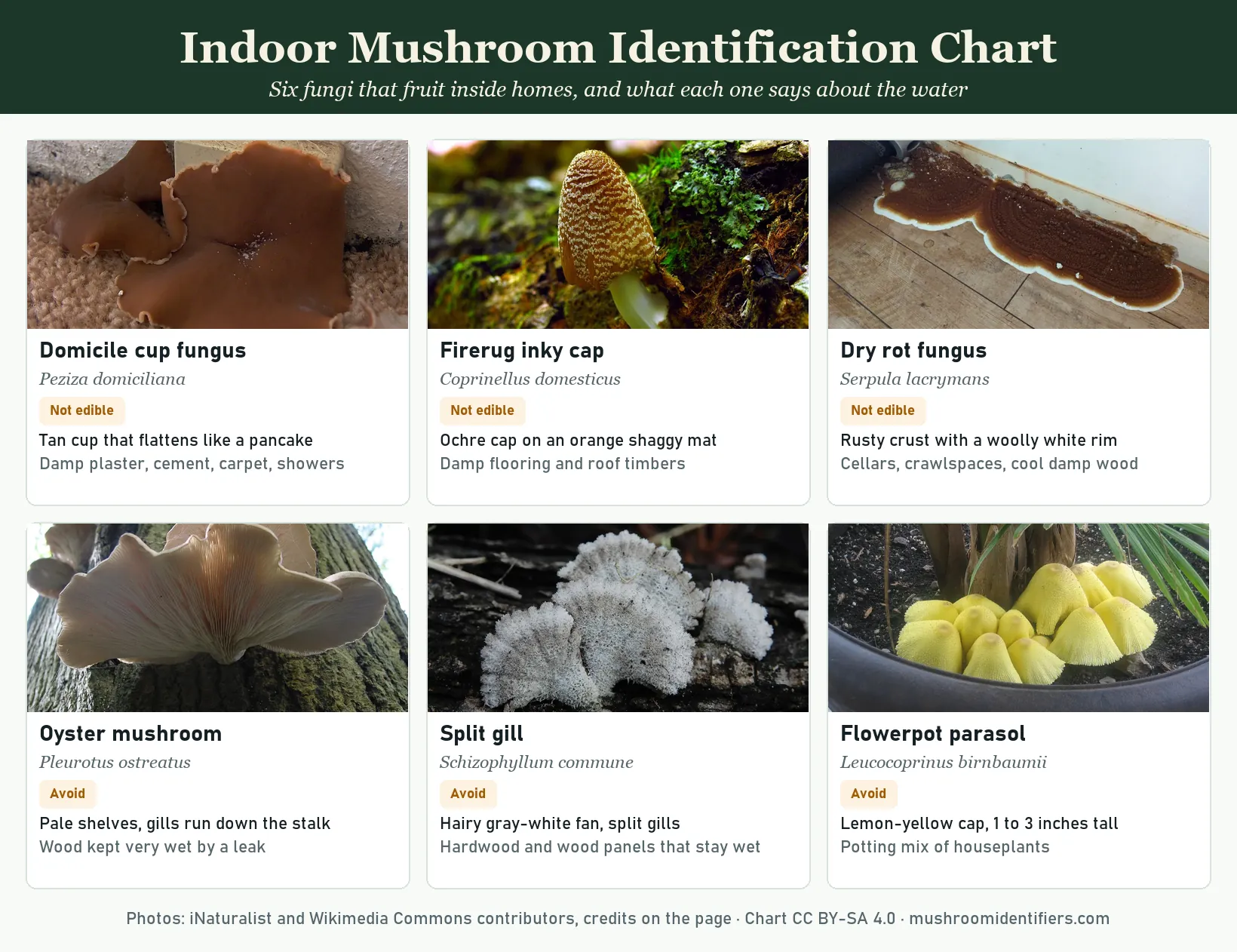
Match the shape and the material it grows from, then read what that fungus says about the water. The material matters as much as the mushroom. A cup on plaster and a shelf on a door frame point to different problems.
| Mushroom | What it looks like | Where it grows indoors | What it tells you | Risk |
|---|---|---|---|---|
| Domicile cup fungus (Peziza domiciliana) | Yellowish to brownish cup 2 to 10 cm wide that flattens like a pancake | Damp plaster, cement, walls, carpets, shower stalls | Constant moisture in a porous surface | Do not eat |
| Firerug inky cap (Coprinellus domesticus) | Honey-ochre bell cap 3 to 7 cm, often on an orange shaggy mat | Damp flooring and roof timbers | Wet, decaying wood | Do not eat |
| Dry rot fungus (Serpula lacrymans) | Rusty brown crust with a woolly white rim, thick strands | Cellars, crawlspaces, cool damp wood | Serious brown rot that can spread | Structural damage |
| Oyster mushroom (Pleurotus ostreatus) | Pale shelves in clusters, gills running down a side stalk | Wood kept very wet by a leak | Soaked framing or trim | Do not eat indoor finds |
| Split gill (Schizophyllum commune) | Hairy gray-white fan 1 to 3.5 cm, split gills | Hardwood and wood panels that stay wet | Wood that is wetted again and again | Do not eat |
| Flowerpot parasol (Leucocoprinus birnbaumii) | Lemon-yellow mushroom 1 to 3 inches tall | Potting mix of houseplants | Moist potting mix, not a leak | Treat as poisonous |
Details come from the sources named in each section below. Photos cannot confirm an indoor fungus, so use the chart to narrow the options.
Why Are Mushrooms Growing in My House?
Mushrooms grow in a house when a fungus finds steady moisture, a food source and mild temperatures in the same spot. A USDA Forest Products Laboratory review lists four needs for wood-inhabiting fungi: favorable temperature, oxygen, adequate moisture and a suitable food supply. A heated home supplies three of them all year. Water is the one that is normally missing.
The review puts the best temperatures for most decay fungi at 21 to 32°C, about 70 to 90°F. It puts the moisture they need above fiber saturation, usually around 25 to 30 percent moisture content. Wood that is wetted briefly and dries again does not decay. That is why a mushroom points to a long-running source and not to one spilled bucket. Our page on whether a mushroom is a decomposer explains the biology.
What Do Mushrooms in a Wall, Carpet or Basement Mean?
The place a mushroom comes out tells you which material is wet, and that tells you where to look for the water. Use the table as a starting point. It lists only what the sources document.
| Where it is growing | Fungi recorded there | What the sources tie it to |
|---|---|---|
| Bathroom wall or shower stall | Domicile cup fungus | Wayne's Word records it on a bathroom wall fed by a leaking water pipe |
| Carpet, rug or baseboard | Domicile cup fungus, firerug inky cap | Wet rugs, a carpeted hallway baseboard, damp flooring |
| Out of a wall, trim or wood floor | Oyster mushrooms, inky caps | UF/IFAS: wood kept very wet by leaks |
| Basement or crawlspace | Dry rot, cup fungi | The Forest Products Laboratory says water-conducting decay typically begins there |
| Around a sink or tub drain | Not recorded by species in these sources | Look for wet wood or other organic material beside the drain |
| Houseplant pot | Flowerpot parasol | Moist potting mix; the building is not involved |
Hidden damage is common. EPA notes that mold may be hidden on the back side of drywall, wallpaper or paneling and on the underside of carpets and pads. The Forest Products Laboratory review traces decay inside wood-frame walls to a past or current water leak from outside or to wood touching soil.
Common Mushrooms That Grow Indoors
Six fungi cover most reports of mushrooms growing in a house: a cup fungus, an inky cap, dry rot, oyster mushrooms, the split gill and the yellow houseplant mushroom. Five of them feed on the building or its contents. The sixth lives in potting mix.
Domicile Cup Fungus (Peziza domiciliana)
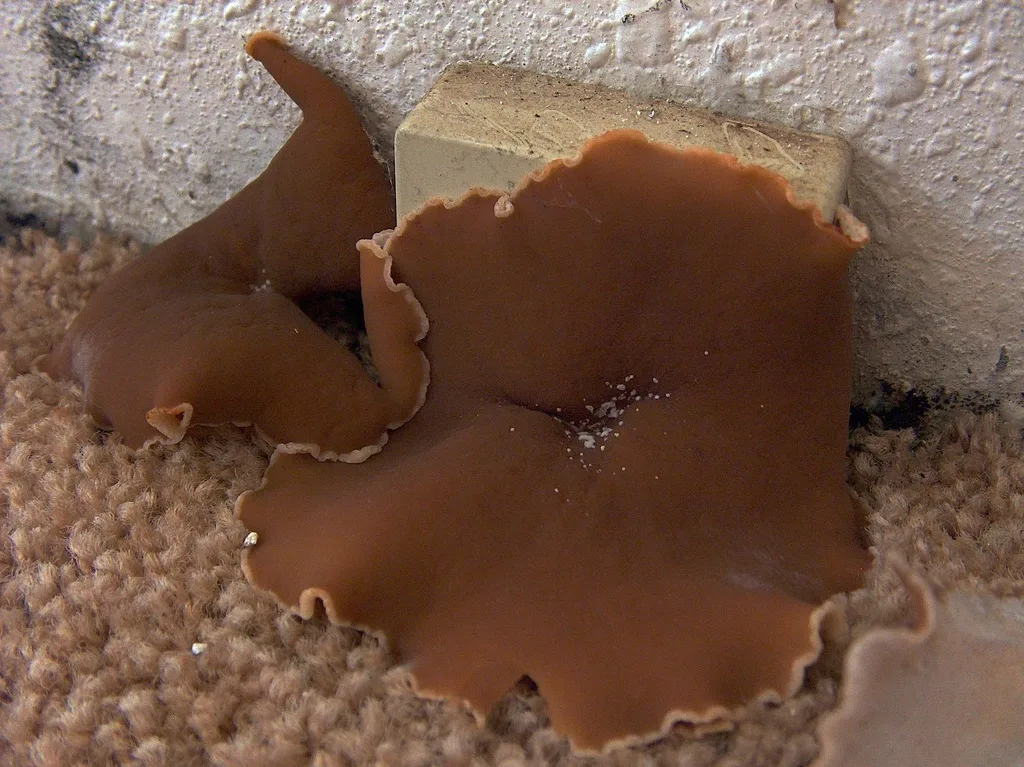
Wayne's Word describes young cups that flatten and turn wavy with age, with a central dip and a short stalk. The flesh is fragile and hard to remove in one piece. The Scottish Fungi profile gives a width of 2 to 10 cm and a yellowish to brownish color that recalls a pancake. It grows on sand, cement, plaster, coal dust and walls wherever there is constant moisture and a porous surface. Wayne's Word adds cellars, greenhouses, damp closets, wet rugs and the space behind refrigerators. Our cup fungus chart shows its outdoor relatives.
Firerug Inky Cap (Coprinellus domesticus)
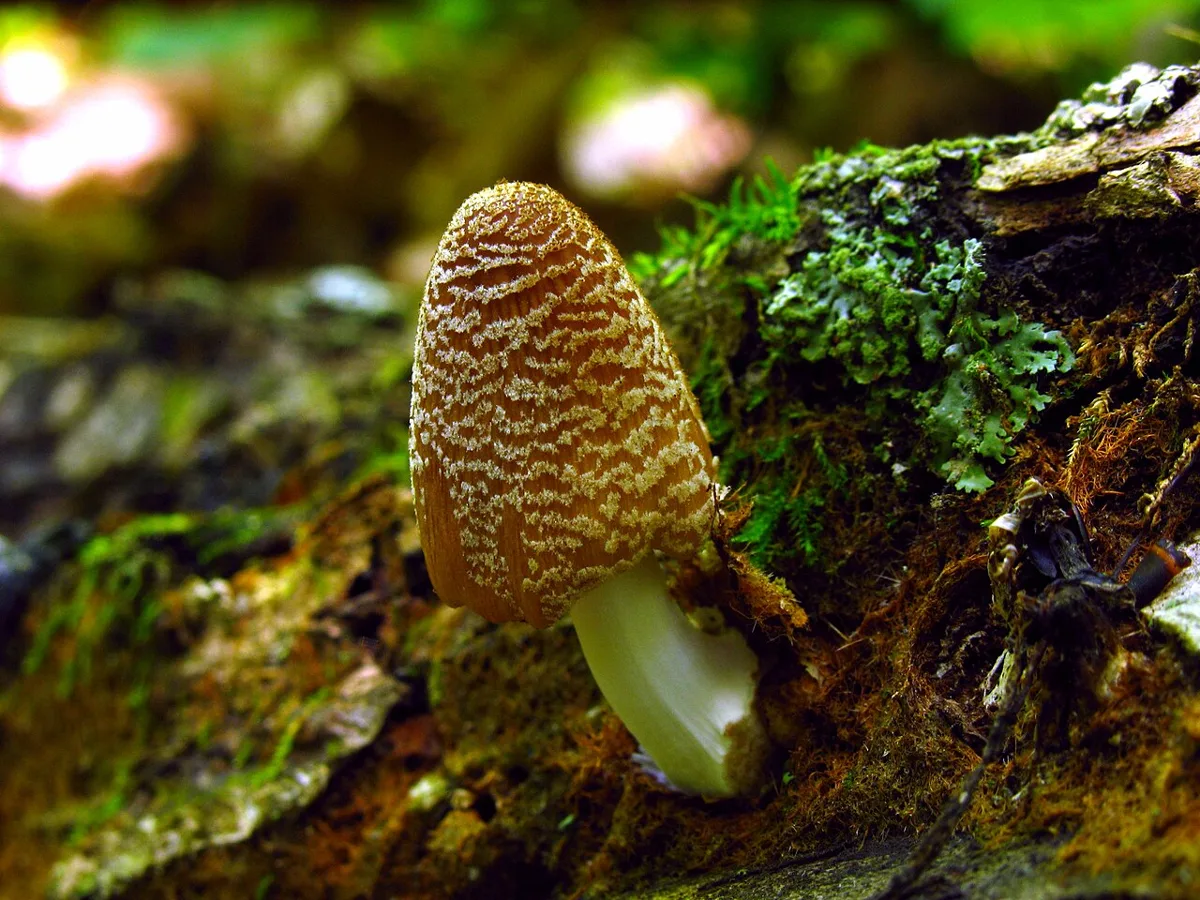
First Nature describes a honey-ochre cap 3 to 7 cm across, dusted with pale veil fragments, on a white stem 4 to 10 cm long. The gills turn from white to gray to black and dissolve. Its best clue is the ozonium, an orange shaggy carpet of fungal threads around the stem bases. The mat outlasts the mushrooms, so it can be the only thing visible on wet wood. First Nature notes that the species sometimes appears on damp flooring or roof timbers, which explains the name domesticus. It is recorded in parts of North America. See our inky cap mushroom chart for the group.
Dry Rot Fungus (Serpula lacrymans)
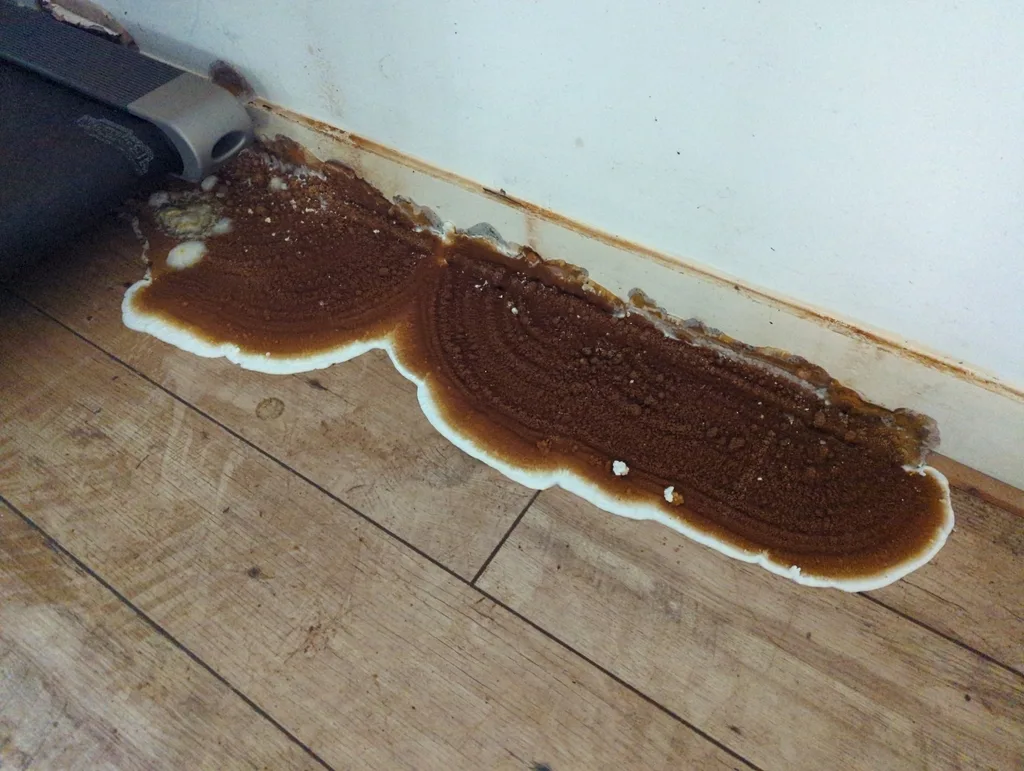
Dry rot is the indoor fungus with the worst reputation. The Naturalis Biodiversity Center describes a leathery crust with a net-like, mustard-yellow to rusty brown surface and a woolly white rim. A 2012 review in Fungal Biology Reviews gives a size from a few centimeters to more than a meter, with rust-colored spores. Its thick strands carry water and nutrients and can grow several meters across materials that are not wood. It favors high humidity, still air and temperatures below 25°C, conditions usually met in cellars.
The review records it in buildings in temperate regions worldwide, including northeastern North America. The Forest Products Laboratory still calls decay of houses by water-conducting fungi rare. It also names a North American species, Meruliporia incrassata. Brown rot from these fungi darkens the wood, shrinks it and breaks it into cubes that crumble easily.
Oyster Mushroom (Pleurotus ostreatus)
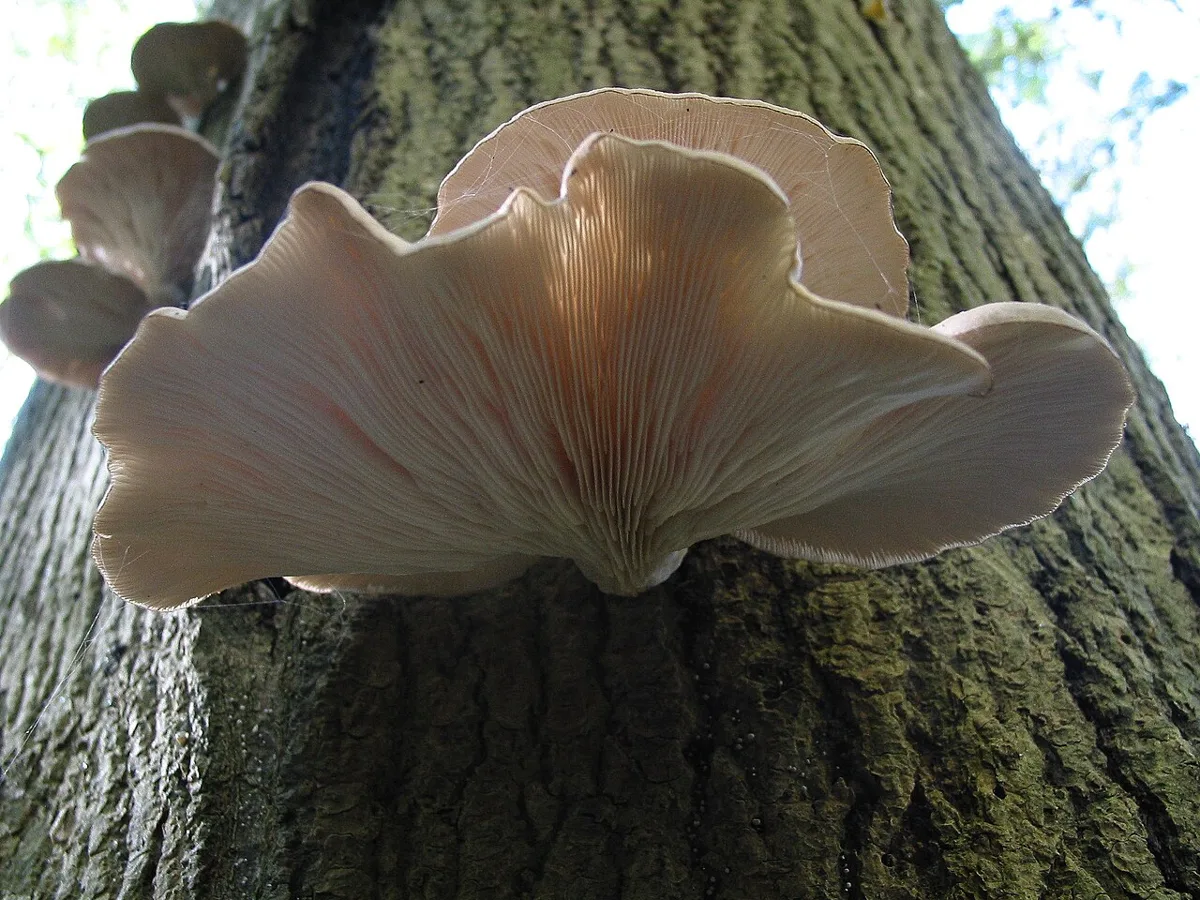
Oyster mushrooms are the large pale shelves that sometimes grow from wet wood at the base of a wall. A University of Florida IFAS Extension publication states that oyster mushrooms have occasionally been observed in Florida as problematic decay fungi on wood inside houses, particularly where leaks keep the wood very wet. It describes soft, shelf-like clusters in white, gray or light brown, with a stalk at the side and gills that run down it. The spore print is white or pale. Oysters always grow from wood. The publication's indoor photos are labeled only as Pleurotus species. It also warns that look-alikes exist, so an indoor find is not food. Compare the features in our oyster mushroom identification guide.
Split Gill (Schizophyllum commune)
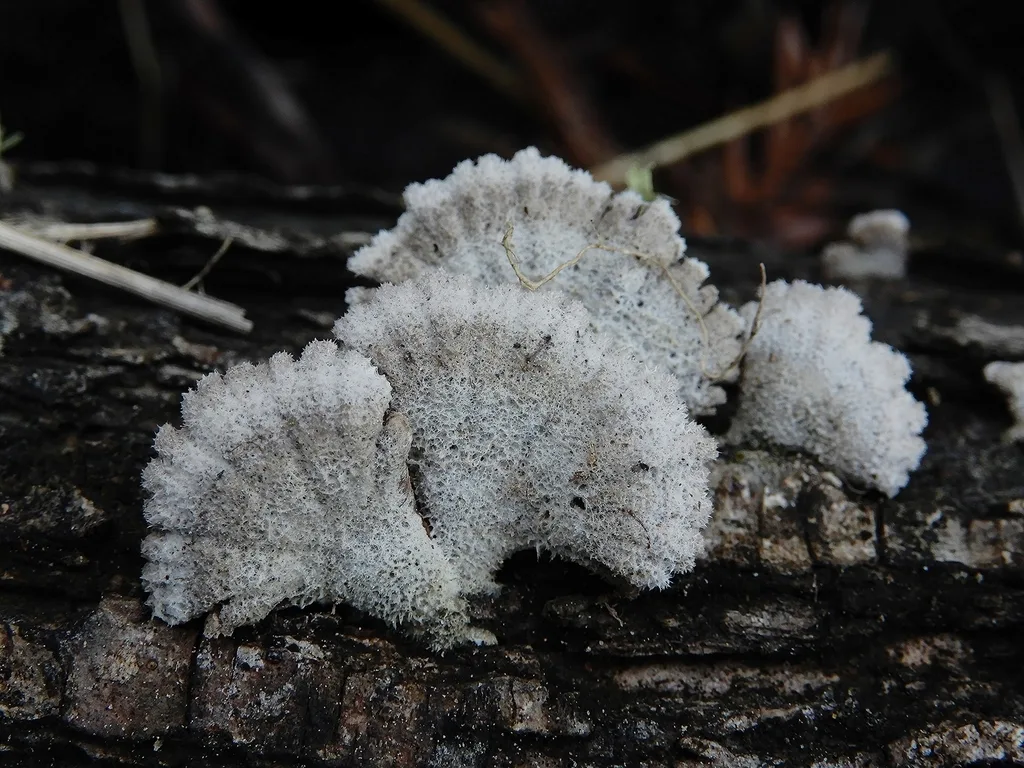
MykoWeb describes a leathery, fan-shaped bracket 1 to 3.5 cm wide with a densely hairy top. It is grayish brown when moist and ashy gray to white when dry. The underside has widely spaced gills that are split lengthwise. It shrivels in dry weather and revives when wetted. MykoWeb lists hardwood logs and branches as its home, which includes firewood stored indoors. The Forest Products Laboratory review records it on painted aspen waferboard panels in outdoor tests. We found no agency source that documents it inside homes, so treat small hairy fans on wet wood as a likely match, not a confirmed one.
Flowerpot Parasol (Leucocoprinus birnbaumii)
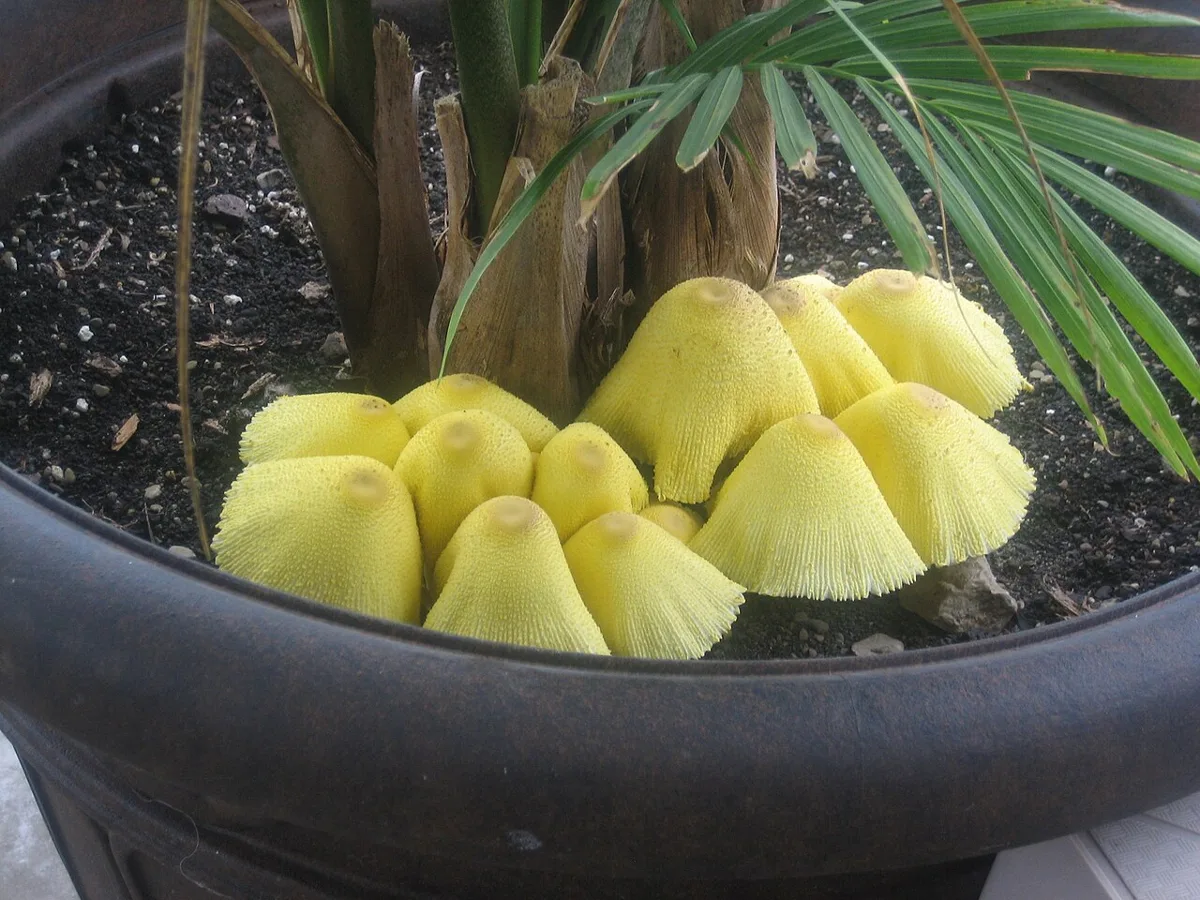
A lemon-yellow mushroom in a houseplant pot is a different case. Iowa State University Extension describes mushrooms 1 to 3 inches tall with caps 1 to 2 inches across. The fungus arrives in the potting mix or as an airborne spore and feeds on dead organic matter in the pot. It does not harm living plants. Iowa State considers it poisonous to people and animals, while Tom Volk's fungi pages call it not known to be poisonous. Treat it as poisonous. Our page on the yellow mushroom in a potted plant covers it in full.
Mold, Mushrooms or Dry Rot: Side-by-Side Comparison
Mold, wood-decay mushrooms and dry rot all follow water, but only the decay fungi weaken wood, and Serpula lacrymans is the one that can spread. The differences come from the Forest Products Laboratory review.
| Feature | Surface mold | Wood-decay mushrooms | Dry rot (Serpula lacrymans) |
|---|---|---|---|
| What you see | Fuzzy or stained patches | Caps or shelves growing from wood | Rusty crust, white rim, thick strands |
| What it feeds on | Surface nutrients and stored material in wood cells | The wood cell walls | The wood cell walls |
| Moisture it needs | Surface humidity around 80 percent | Wood above about 25 to 30 percent moisture content | A water source; strands carry water to dry wood |
| Effect on wood strength | Little | Loss of strength | Severe; can spread through a building |
| What stops it | Drying and cleaning | Keeping wood below 20 percent moisture content | Removing the water source and repairing the wood |
The review also notes that some decay fungi survive in dry wood for as long as a decade and revive when the wood is wetted again. Drying a wall stops decay. It does not remove the fungus or put back the wood it has digested.
Are Mushrooms Growing in the House a Health Risk?
Eating one is the clear hazard, and the dampness that grows mushrooms also grows mold, which CDC and EPA link to breathing symptoms. The CDC and EPA pages used here discuss mold and dampness, not mushrooms. The advice still applies, because the conditions are the same.
- CDC states that for some people mold can cause a stuffy nose, sore throat, coughing or wheezing, burning eyes or a skin rash.
- CDC adds that people with asthma or mold allergies may have severe reactions. Immunocompromised people and people with chronic lung disease may get lung infections from mold.
- CDC also says that exposure to damp and moldy environments may cause a variety of health effects, or none at all.
- EPA states that mold exposure can irritate the eyes, skin, nose, throat and lungs of both mold-allergic and non-allergic people.
Spores from the mushrooms are less studied. The Scottish Fungi profile calls the question of allergic reactions to cup fungus spores open and notes that no research has looked at them specifically. Keep children and pets away from any indoor mushroom. If a child eats one, call Poison Control at 1-800-222-1222. If a pet does, follow our steps for what to do if your dog ate a mushroom.
What to Do About Mushrooms Growing in the House
Remove the mushroom, find the water, dry the area fast, and replace what stayed wet. CDC says you do not need to know the type of mold, and it does not recommend mold testing. The same logic fits a mushroom. The fix is the same whatever the species.
- Photograph it, then remove it. Wear gloves and bag it. EPA suggests an N-95 respirator, long gloves and goggles for mold cleanup.
- Find the water. EPA advises fixing plumbing leaks and other water problems as soon as possible. Check pipes, shower walls, the roof above and the floor below.
- Dry it fast. EPA says to dry water-damaged areas and items within 24 to 48 hours. Keep indoor humidity below 60 percent, ideally 30 to 50 percent. Run the bathroom fan or open a window.
- Replace what cannot be cleaned. EPA notes that absorbent materials such as ceiling tiles and carpet may have to be thrown away. Wood that has darkened and cracked into cubes, or gone pale and stringy, has decayed.
- Do not cover it up. EPA says not to paint or caulk moldy surfaces.
- Be careful with bleach. CDC gives a limit of 1 cup of household bleach in 1 gallon of water and warns never to mix bleach with ammonia or other cleaners.
When to Call a Professional
EPA says most people can clean a moldy area smaller than about 10 square feet, a patch roughly 3 feet by 3 feet. For larger areas or heavy water damage, it points to its remediation guidance and to contractors with mold cleanup experience. Get an inspection as well when a mushroom grows out of framing, a subfloor or a joist, because the wood may be weaker than it looks. A rusty crust with thick strands in a basement or crawlspace needs a check for dry rot. Renters should report the growth to the landlord, since the leak is a building repair.
Common Identification Mistakes
Pulling the Mushroom and Calling It Fixed
The mushroom is only the fruiting body. The fungus stays in the wet material and fruits again until the water stops.
Calling Every Indoor Fungus Mold
Mold has little effect on the strength of wood. A mushroom or shelf growing from wood is a decay fungus, and decay does affect strength.
Blaming Shower Steam for a Wall Mushroom
EPA ties recurring shower mold to poor ventilation. A mushroom needs material that stays wet, so check for a leak as well as running the fan.
Eating an Indoor Oyster
The University of Florida publication stresses that many mushrooms share the oyster's shape and habitat. A cluster from a wall has not been identified by anyone.
Frequently Asked Questions
Why are mushrooms growing in my bathroom?
Something in the bathroom stays wet, often from a leak behind a wall or under the floor. Fungi need steady moisture and a food source such as wood or damp plaster. Find the water before anything else.
What does it mean when mushrooms grow in your house?
It means a fungus has been living in wet material long enough to fruit. A USDA Forest Products Laboratory review says wood kept below 20 percent moisture content does not decay. A mushroom shows that the wood or wall has been much wetter than that.
Are mushrooms growing in the house dangerous?
Never eat one, and keep children and pets away. The larger concern is the dampness, because CDC and EPA link damp, moldy homes to coughing, wheezing and irritation in some people. Decay fungi can also weaken wood.
What kind of mushroom grows out of a wall?
Tan cups on plaster or drywall are often the domicile cup fungus, Peziza domiciliana. Pale shelves from wood can be oyster mushrooms, which a University of Florida publication records on wood kept wet by leaks. Photos alone cannot confirm either.
Why is a mushroom growing from my carpet?
The carpet or the floor under it has stayed wet. The domicile cup fungus is recorded on wet rugs and along the baseboard of a carpeted hallway. Lift the carpet and check the pad and subfloor for a leak.
Why are mushrooms growing in my basement?
Basements and crawlspaces are cool and damp, and wood there often sits close to soil or masonry. The Forest Products Laboratory says decay by water-conducting fungi typically begins in these spaces. Reduce the moisture and have any decayed wood inspected.
Can mushrooms grow in a sink or shower drain?
Mushrooms cannot feed on metal or porcelain. One that appears at a drain is growing from wet wood or other organic material beside it. The sources used here do not record a particular species at drains.
How do I get rid of mushrooms growing in my house?
Remove the mushroom, fix the leak, dry the area within 24 to 48 hours and replace materials that stayed wet. Cleaning alone does not work while the water continues. EPA says most people can handle moldy areas under about 10 square feet themselves.
Is a mushroom in the house the same as mold?
Both are fungi and both follow moisture. Mold grows on damp surfaces and has little effect on wood strength. A mushroom growing from wood is a decay fungus that digests the wood itself.
Final Safety Reminder
Mushrooms growing in the house are a message about water, and the water is the part to act on. Never eat a mushroom that grew indoors, and do not judge one from a single photo. To put a name on it, follow our guide on how to identify a mushroom you found and check your pictures with our free mushroom identifier. Then fix the leak, dry the area and replace what decayed. If someone may have eaten one, call Poison Control at 1-800-222-1222.
Sign in to leave a comment and join the discussion.
 Guide
The most common poisonous mushroom in Florida yards is the green-spored parasol ( Chlorophyllum molybdites ), a big white lawn mushroom that causes severe...
 Guide
The best-known edible mushrooms in California are the golden chanterelle, candy cap, black trumpet and king bolete, and most of them fruit near the coast...
 Guide
The fungus people notice most on a palm tree is Ganoderma butt rot, a lethal trunk decay with no cure, or a leaf problem that is cosmetic or not caused by a...