Edible Mushrooms in Oregon: Identification Chart
— views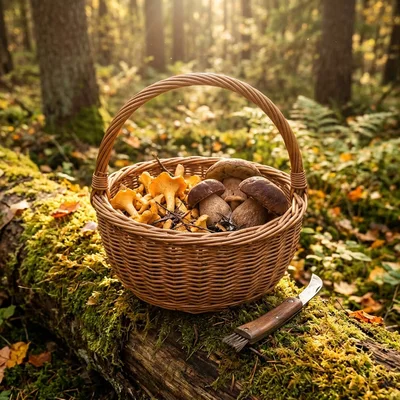
Edible mushrooms in Oregon peak in fall, when Pacific golden chanterelles, matsutake, king boletes and hedgehogs fruit from September into winter, and the deadliest look-alike in the state is the death cap of the Willamette Valley. The Coast Range, the Cascades and the dry east side each keep a different calendar. No wild mushroom should be eaten until a qualified person confirms it in hand.
This page lists the edible mushrooms in Oregon by month and region, using Oregon records instead of a national list. It also covers the poisonous mushrooms in Oregon, the collecting rules on state and federal land, and where to get a mushroom identification in Oregon checked in person.
Key Takeaways
- The Pacific golden chanterelle is Oregon's state mushroom. Of 1,088 research-grade iNaturalist records in Oregon, 792 fall from October to December.
- Oregon has two morel windows. Records west of the Cascade crest peak in April, and east-side records peak in May.
- Death cap records cluster in the Willamette Valley. That area holds 111 of 145 Oregon records, and the east side holds none.
- Smith's amanita is the matsutake look-alike. A case series from Oregon Health Sciences University describes four people who needed dialysis after eating it as matsutake.
- Oregon state parks allow one gallon of mushrooms per person per day unless a park posts otherwise. The limit was five gallons until March 12, 2025.
- State forests in northwest Oregon allow one gallon or less per vehicle with no permit.
- If anyone eats an unknown mushroom, call the Oregon Poison Center at 1-800-222-1222.
Edible Mushrooms in Oregon: Identification Chart
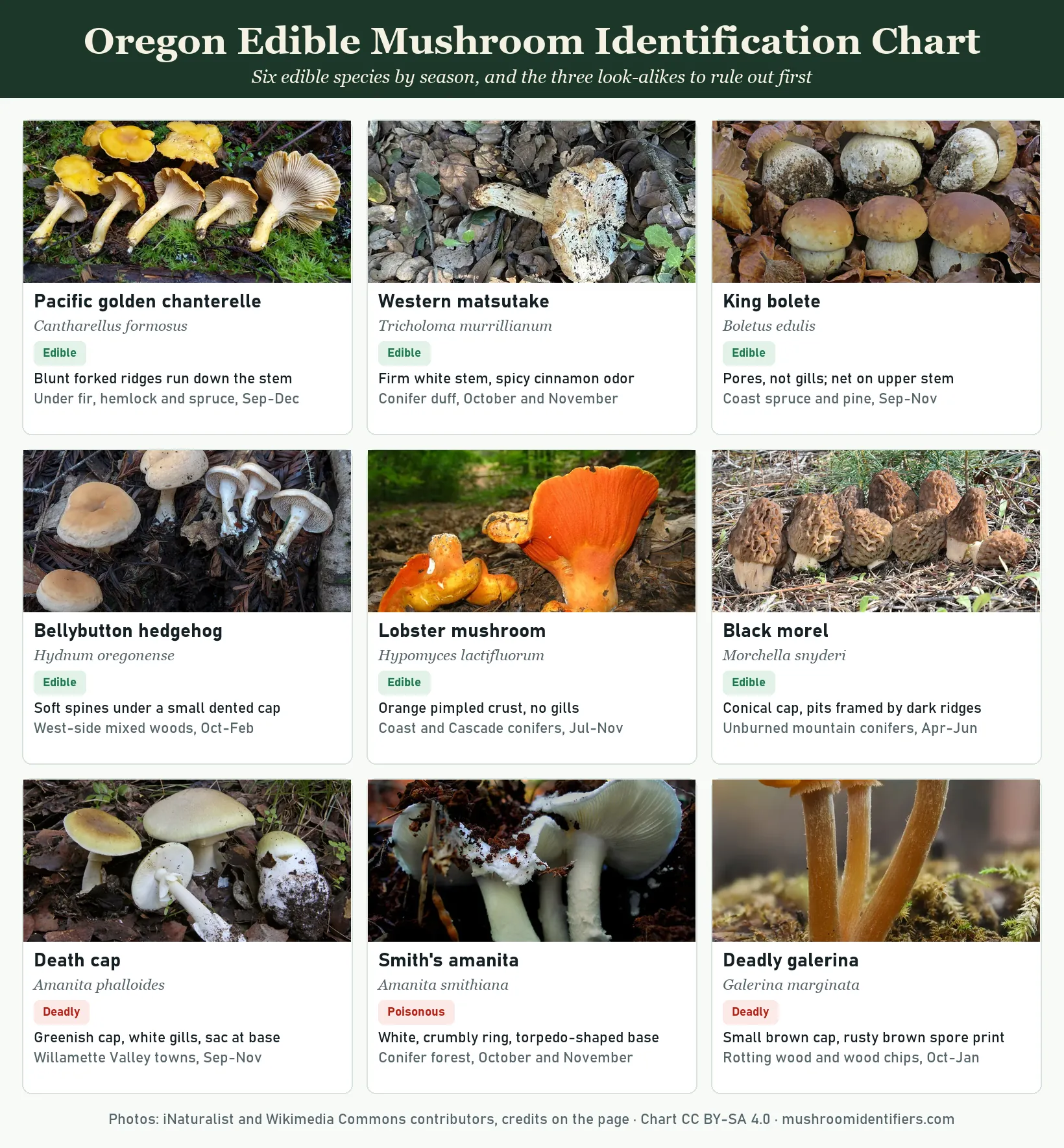
| Species | Key features | Where in Oregon and which trees | Months | Look-alike to rule out |
|---|---|---|---|---|
| Pacific golden chanterelle (Cantharellus formosus) | Yellow to yellow-orange cap. Blunt, forked ridges run down the stem. No ring. | Soil under Douglas fir, western hemlock and Sitka spruce, mostly on the coast side. | September to December, peak in October | Scaly chanterelle, false chanterelle |
| Western matsutake (Tricholoma murrillianum) | White cap with brownish scales. Ragged ring. Firm stem, narrow at the base. Spicy odor. | Conifer duff under pines, Douglas fir and hemlock, in all three regions. | October and November | Smith's amanita |
| King bolete (Boletus edulis) | Bun-shaped brown cap. Pores, not gills, that do not turn blue. Net on the upper stem. | Under spruce, pine, hemlock and fir. Coast side: 688 of 1,107 records. | September to November on the coast, July to October on the east side | Red-pored boletes, gilled Cortinarius |
| Spring king bolete (Boletus rex-veris) | King bolete build, fruiting in spring after morels. | East side: 197 of 291 records. | May and June | Same as king bolete |
| Western bellybutton hedgehog (Hydnum oregonense) | Small cream-buff to tawny cap with a dented center. Soft spines under the cap, not gills. | Mixed hardwood and conifer woods, mostly west of the Cascade crest. | October to February, peak in January | Any tan cap with gills or pores |
| Lobster mushroom (Hypomyces lactifluorum) | Orange pimpled crust over a distorted white mushroom. No gills. Firm white flesh. | Spruce, Douglas fir and hemlock forest. Coast side: 1,225 of 1,707 records. | July to November, peak in October | Old purple, soft or fishy lobsters |
| Yellowfoot (Craterellus tubaeformis) | Small brown trumpet cap, often with a hole in the center. Blunt, widely spaced ridges. | Soil, moss and rotten wood in conifer woods. | October to February | Deadly galerina on the same rotten wood |
| Black morel (Morchella snyderi) | Conical cap. Pits framed by ridges that turn smoky brown to black. | Unburned mountain conifer forest. | April to June, peak in May | False morel |
Months come from a count of research-grade Oregon records on iNaturalist, pulled in November 2026. Features come from Mushrooms Up, the Beaty Biodiversity Museum guide to Pacific Northwest species, and from MykoWeb. A place on this chart means a species is recorded in Oregon. It does not make any single find edible.
Oregon Mushroom Season by Month
Oregon's mushroom year starts with morels in March and April, peaks with chanterelles, boletes and matsutake in October, and runs through winter with yellowfoot and hedgehogs. The table splits the state into three bands by longitude. The coast band lies west of 123.3 degrees west. The middle band holds the Willamette Valley and the west slope of the Cascades. The east band starts at 121.9 degrees west, near the Cascade crest. The bands are approximate. Every month range is an estimate from record counts.
| Month | Coast and Coast Range | Willamette Valley and west Cascades | East side |
|---|---|---|---|
| January | Yellowfoot, hedgehog, last chanterelles | Yellowfoot, hedgehog | Few records |
| February | Yellowfoot, hedgehog | Yellowfoot, hedgehog | Few records |
| March | Last yellowfoot, first morels | First morels | Few records |
| April | Morels, in small numbers | Morel peak | First morels |
| May | Last morels | Morels, first spring king boletes | Morel peak, spring king bolete |
| June | Quiet | Spring king bolete peak, last morels | Spring king bolete peak, morels |
| July | First lobsters and chanterelles | Quiet | Last morels, first king boletes |
| August | Lobster, chanterelle | First lobsters and chanterelles | King bolete |
| September | Lobster, chanterelle, king bolete | Lobster, white chanterelle, chanterelle | King bolete, white chanterelle, first matsutake |
| October | Peak for king bolete, lobster and chanterelle. Matsutake starts. | Peak for chanterelle, lobster and white chanterelle. Matsutake, king bolete. | Matsutake peak, king bolete |
| November | Matsutake peak, chanterelle, king bolete, yellowfoot | Chanterelle, matsutake, king bolete, cauliflower mushroom | Last matsutake |
| December | Chanterelle, yellowfoot, last matsutake | Chanterelle, yellowfoot | Few records |
King bolete records show the split. The coast band has 396 records in October. The east band has 70 in August and none in November. iNaturalist counts show when and where people photograph mushrooms, not how many grow. Research grade means the community agreed on a name, not that a lab confirmed it. Rain and elevation move every date. Our Pacific Northwest edible mushroom guide covers the wider region.
Common Edible Mushrooms in Oregon
Seven edible species stand out in Oregon's records, and each has a look-alike that must be ruled out first. The notes below give the features sources agree on. They do not replace an in-person check.
Pacific Golden Chanterelle (Cantharellus formosus)
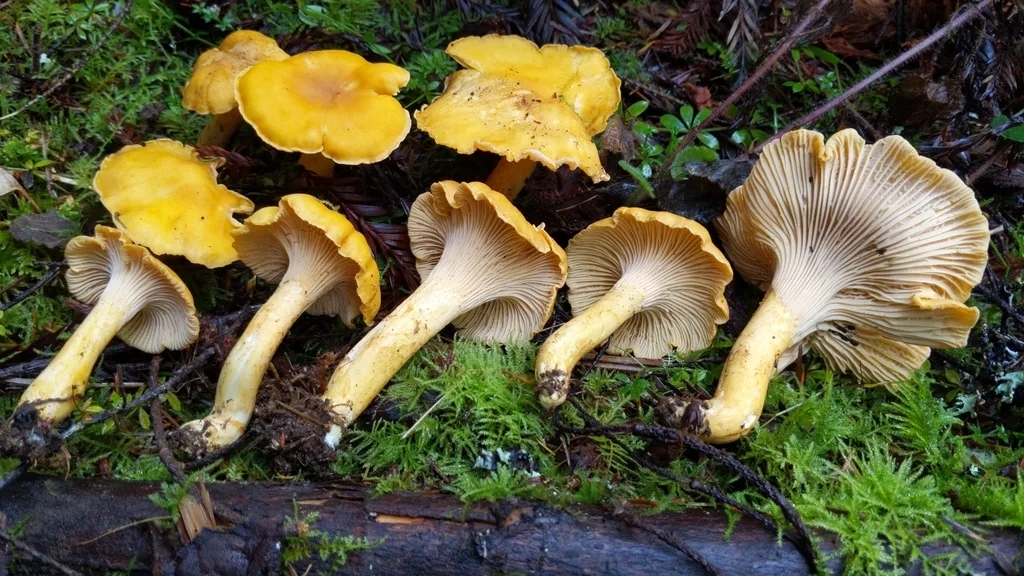
The 1999 Legislature made this species the state mushroom, according to the Oregon Blue Book. Mushrooms Up describes a yellow to yellow-orange cap, 2 to 14 cm wide. The underside has forked ridges that run down the stem. The ridges are thicker and farther apart than gills. It grows from soil with Douglas fir, western hemlock and Sitka spruce. The coast band holds 702 of Oregon's 1,088 records. The white chanterelle (C. subalbidus) is pale overall. Our chanterelle guide shows ridges next to gills.
Western Matsutake (Tricholoma murrillianum)
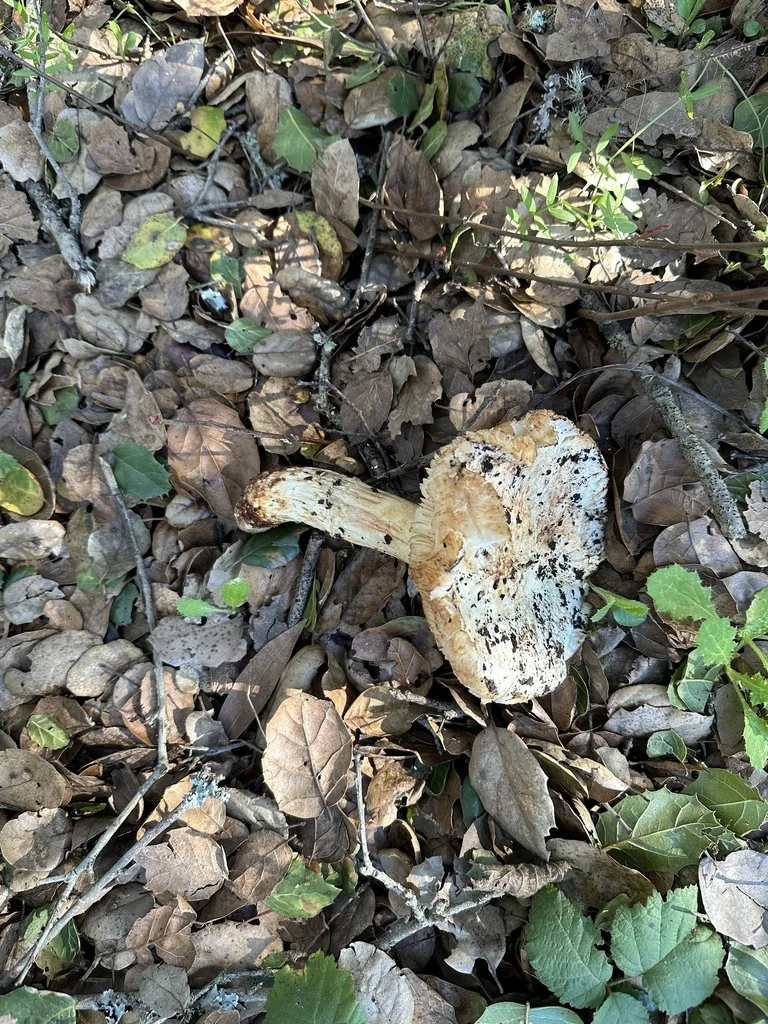
Older books call this mushroom Tricholoma magnivelare. Mushrooms Up reports that a 2017 study separated the western species from the eastern one. The cap is white with brownish scales and 6 to 20 cm wide. The ring droops like a ragged skirt. The firm stem narrows toward the base. The odor is spicy, like cinnamon. Oregon has 444 records, and 367 fall in October and November. Every matsutake needs a check against Smith's amanita.
King Bolete (Boletus edulis)
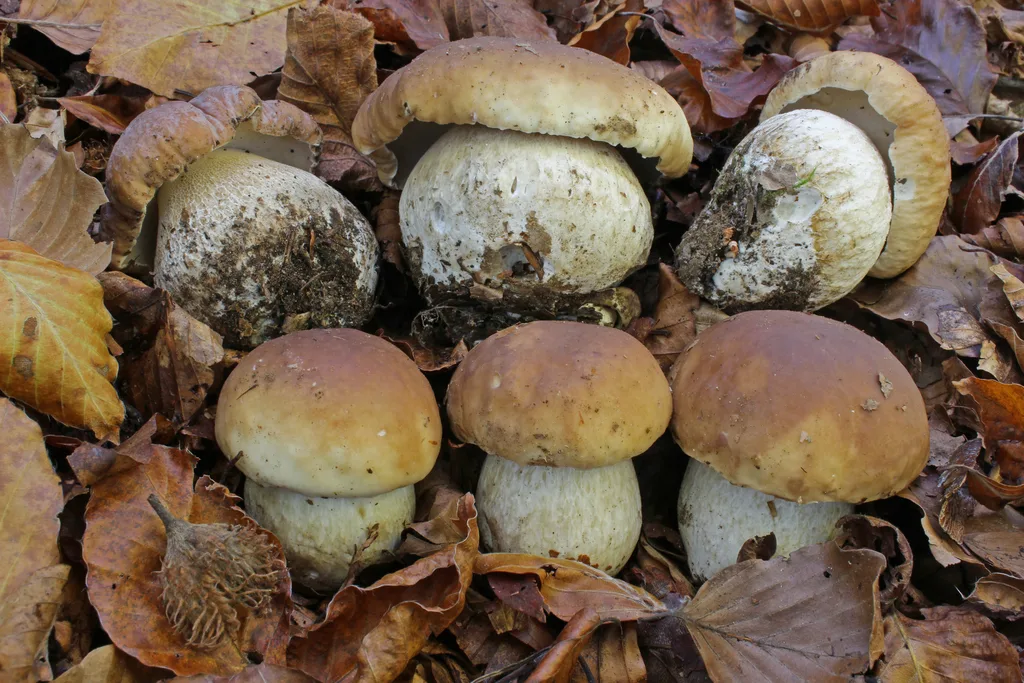
The king bolete has pores under the cap, never gills. Mushrooms Up describes a pale beige to reddish brown cap, 5 to 30 cm wide. Young pores look stuffed with white cotton and turn yellowish with age. The pores do not turn blue or brown when rubbed. A fine net covers the top third of the stem. The spring king bolete (Boletus rex-veris) fruits in May and June. Our king bolete guide covers the group.
Western Bellybutton Hedgehog (Hydnum oregonense)
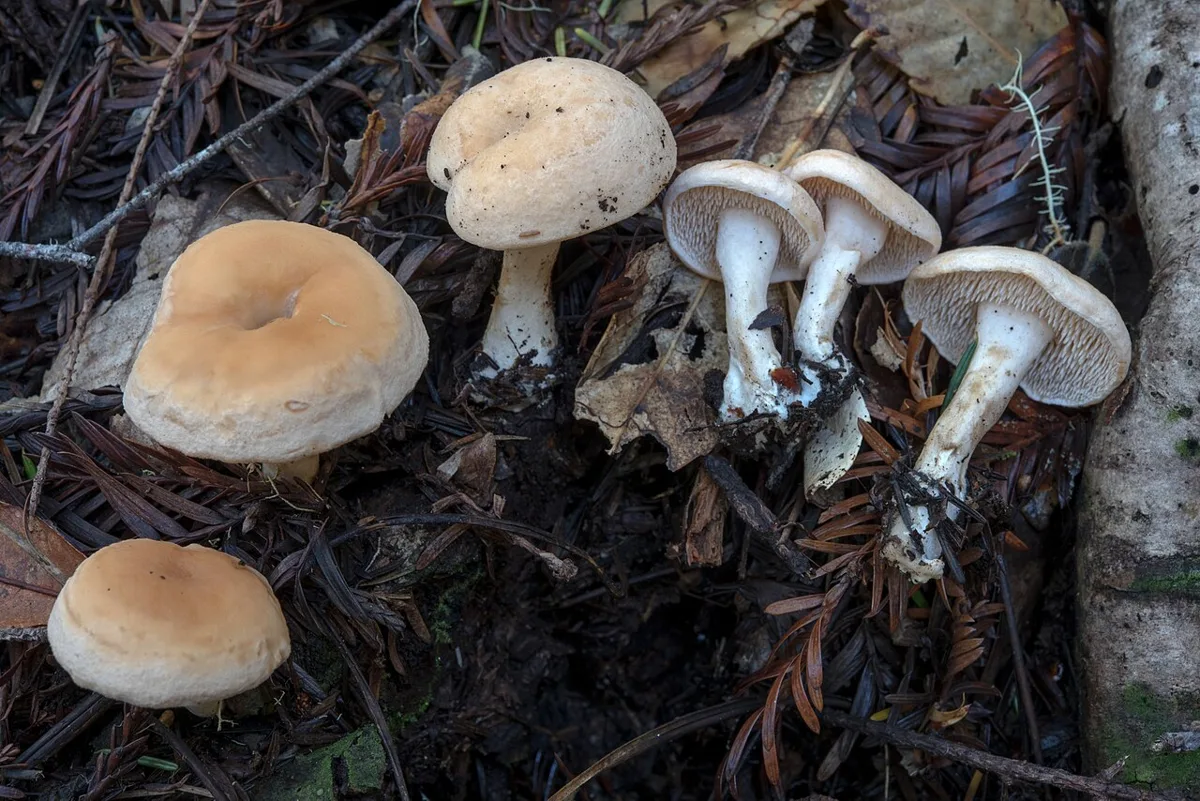
Hedgehogs carry soft spines where other mushrooms have gills. MykoWeb describes a cream-buff to tawny cap, 2.5 to 5 cm wide, with a dented center. West Coast books long called it Hydnum umbilicatum, a species MykoWeb says does not occur in western North America. Oregon has 101 records, and January and February hold 41 of them. iNaturalist files Oregon's larger hedgehogs under names such as H. washingtonianum. Our hedgehog mushroom guide explains the name changes.
Lobster Mushroom (Hypomyces lactifluorum)
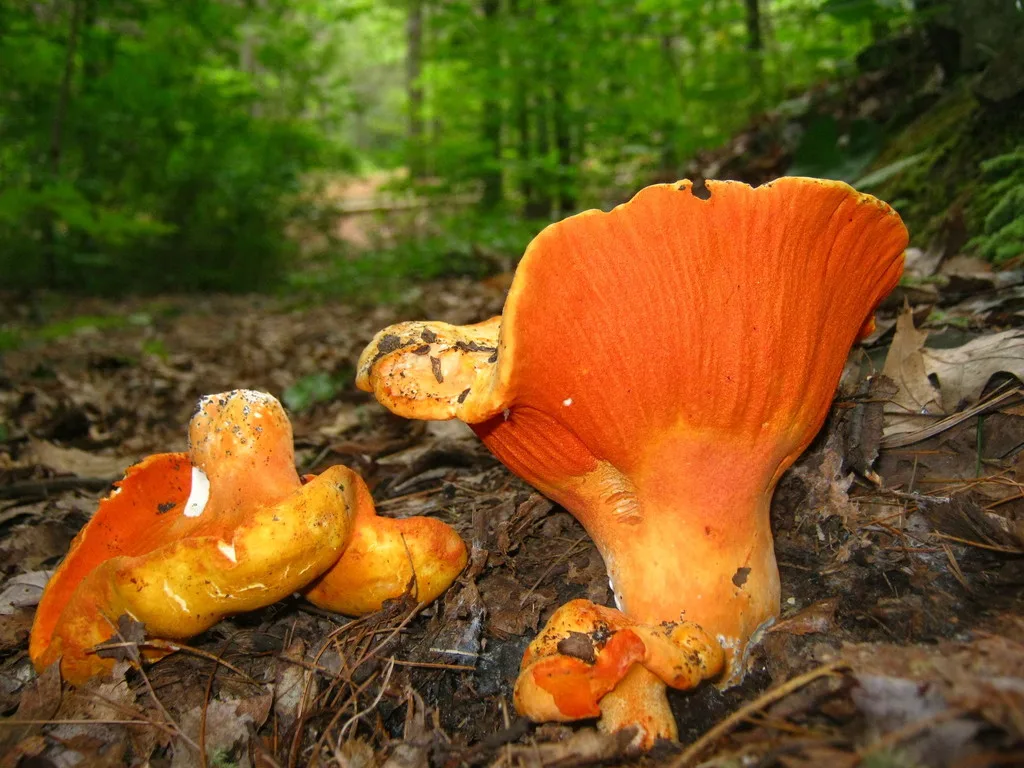
The lobster mushroom is a parasite growing on another mushroom. Mushrooms Up names the short-stalked russula (Russula brevipes) as the usual host. The orange crust is pimpled, and the host's gills disappear. The flesh inside is firm and white. It is the most recorded species on this chart, with 1,707 Oregon records and 584 in October. Mushrooms Up says to leave old specimens that have turned purple, gone soft or smell strongly fishy.
Yellowfoot (Craterellus tubaeformis)
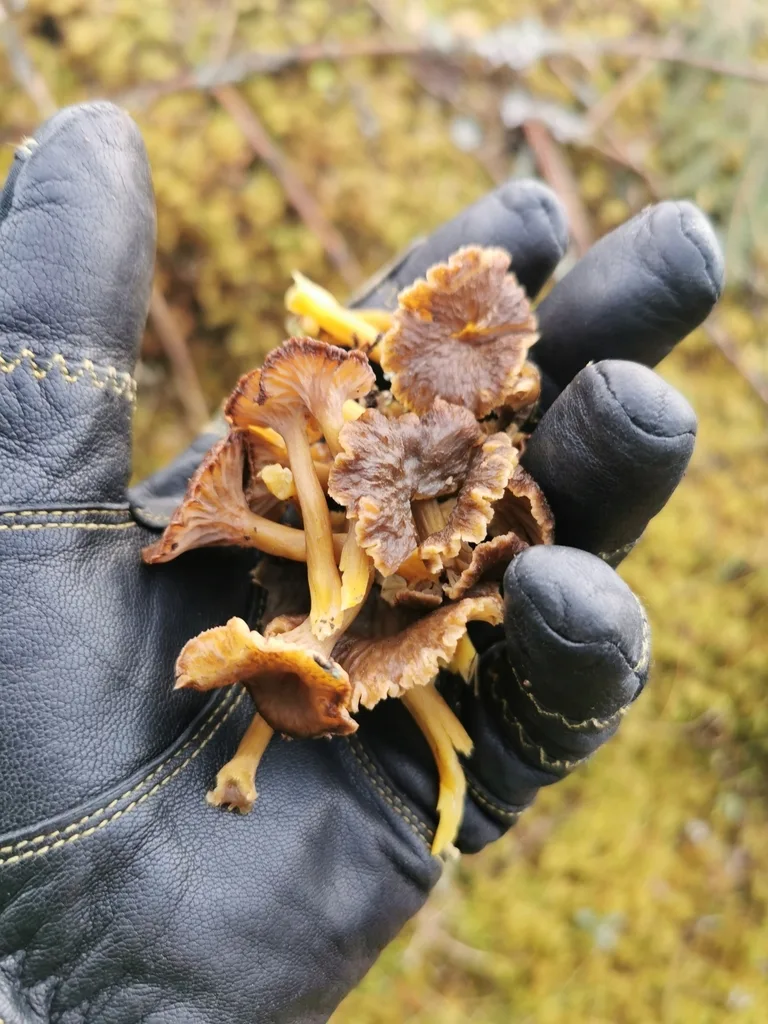
Yellowfoot is the winter chanterelle. MykoWeb describes a brown to yellowish-brown cap, 2 to 4 cm wide, that becomes trumpet-shaped and sometimes hollow in the center. The ridges are blunt, widely spaced and run down the stem. It grows on soil, moss and rotten wood in conifer woods. Oregon has 686 records, and 468 fall from November to February. Deadly galerina fruits on rotten wood in the same months, so check each mushroom, not the patch.
Black Morel (Morchella snyderi)
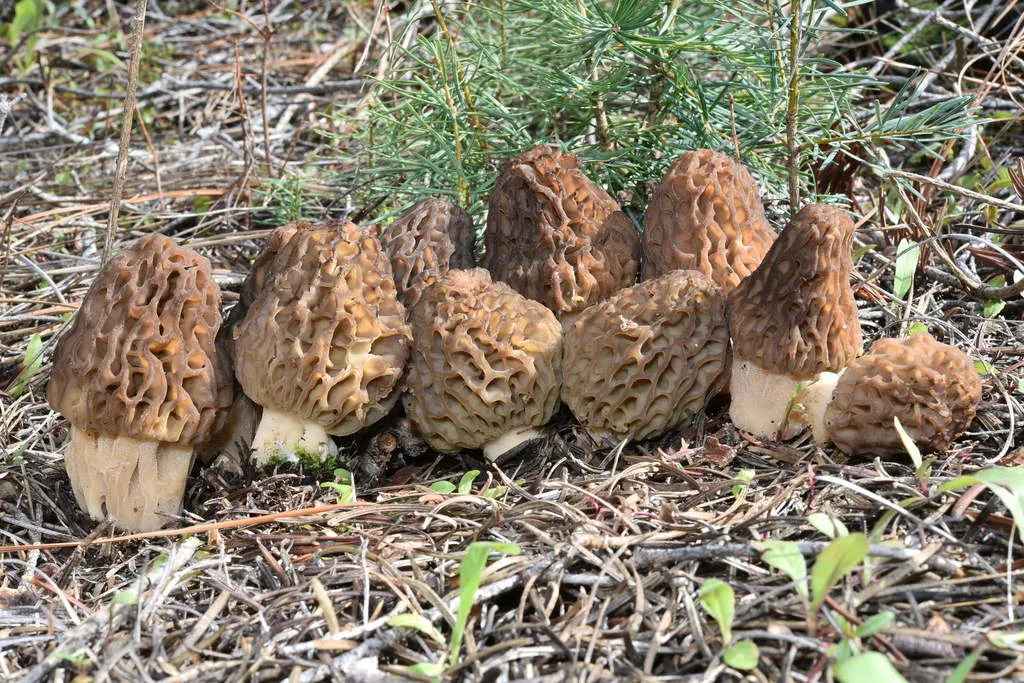
This morel was named in 2012, when a revision split North American morels into 19 species. MykoWeb places it under unburned mountain conifers, including Douglas fir, ponderosa pine and white fir, from April to June. The cap is conical, with ridges that turn smoky brown to black. Oregon has 271 records under this name, and 190 fall in May. MykoWeb says all morels should be well cooked. Our morel guide covers the true morel structure.
Poisonous Mushrooms in Oregon
The most dangerous poisonous mushrooms in Oregon are the death cap, Smith's amanita and deadly galerina, and each one resembles a mushroom people collect. The Oregon Health Authority says emergency visits and Poison Center calls for mushroom illness rise each fall. It also warns that cooking does not remove the danger.
Death Cap (Amanita phalloides)
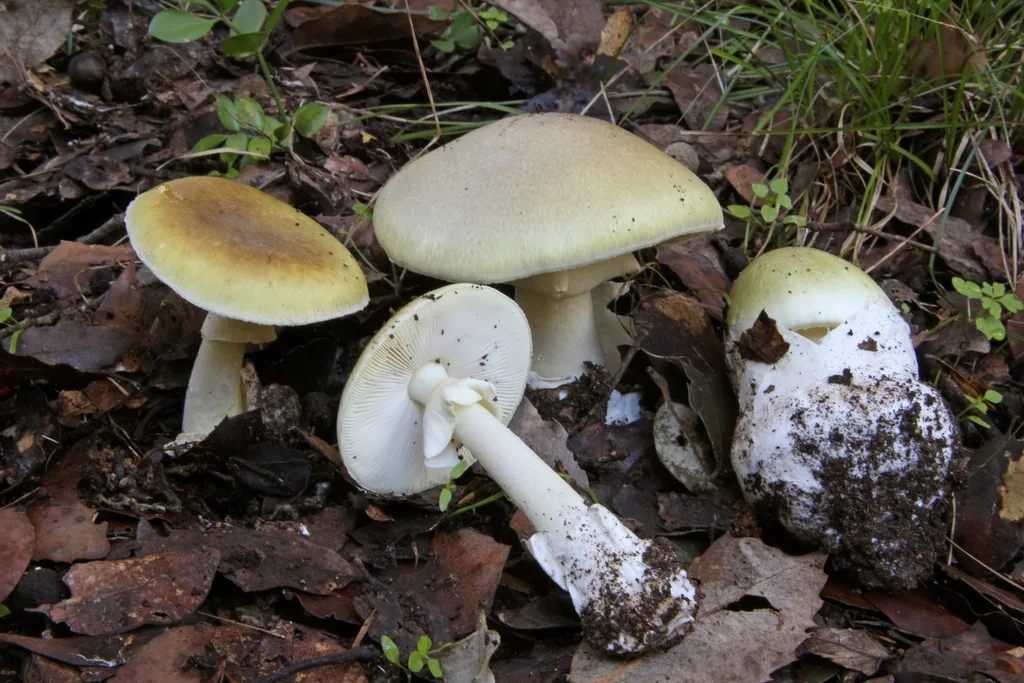
The death cap is mistaken for puffballs at the button stage and for straw mushrooms. Mushrooms Up describes an olive to brownish cap with a greenish hue, white gills, a skirt-like ring and a white sac at the base. The sac often stays buried. The species arrived from Europe with planted trees and grows in cities and suburbs. Oregon has 145 records. A box drawn over the Willamette Valley holds 111 of them, including 73 around Portland. A box over the Rogue and Umpqua valleys holds 24. All but four records fall from September to November. The Oregon Health Authority reports that death caps left five Oregon residents seriously ill in 1988, and four needed liver transplants. The CDC says amatoxins cause more than 90% of mushroom poisoning deaths worldwide and are not inactivated by cooking. Our death cap identification guide shows every stage.
Smith's Amanita (Amanita smithiana)
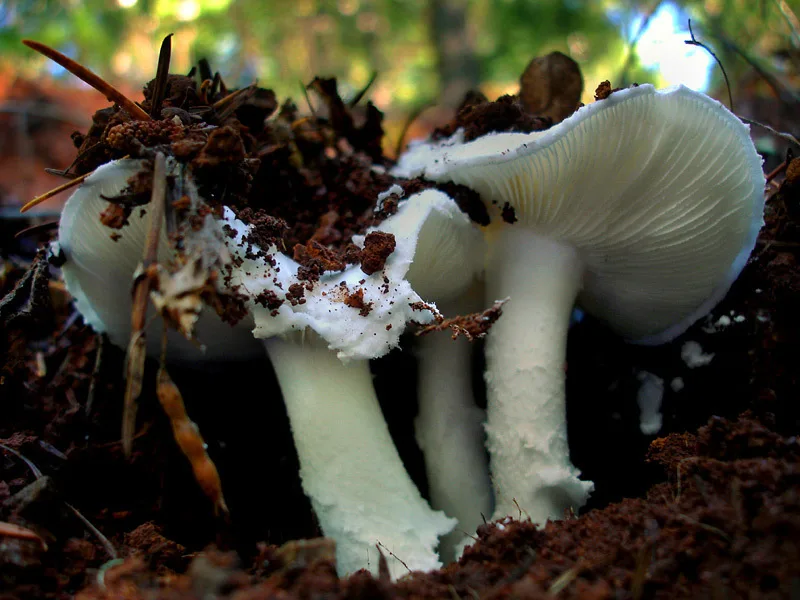
Smith's amanita is mistaken for matsutake. Mushrooms Up describes a white to light tan cap, a crumbly ragged ring and a stem base shaped like a torpedo or turnip. The stem is widest at or below the soil line. A matsutake stem is widest above ground. A Smith's amanita stem shatters under firm pressure, and a matsutake stem does not. The odor is mild or unpleasant, not spicy. A 1998 case series from Oregon Health Sciences University describes four patients who thought they ate matsutake. Stomach symptoms began 20 minutes to 12 hours after the meal. Kidney failure appeared 4 to 6 days later, and all four needed dialysis. Oregon has 58 records, and 56 fall in October and November.
Deadly Galerina (Galerina marginata)
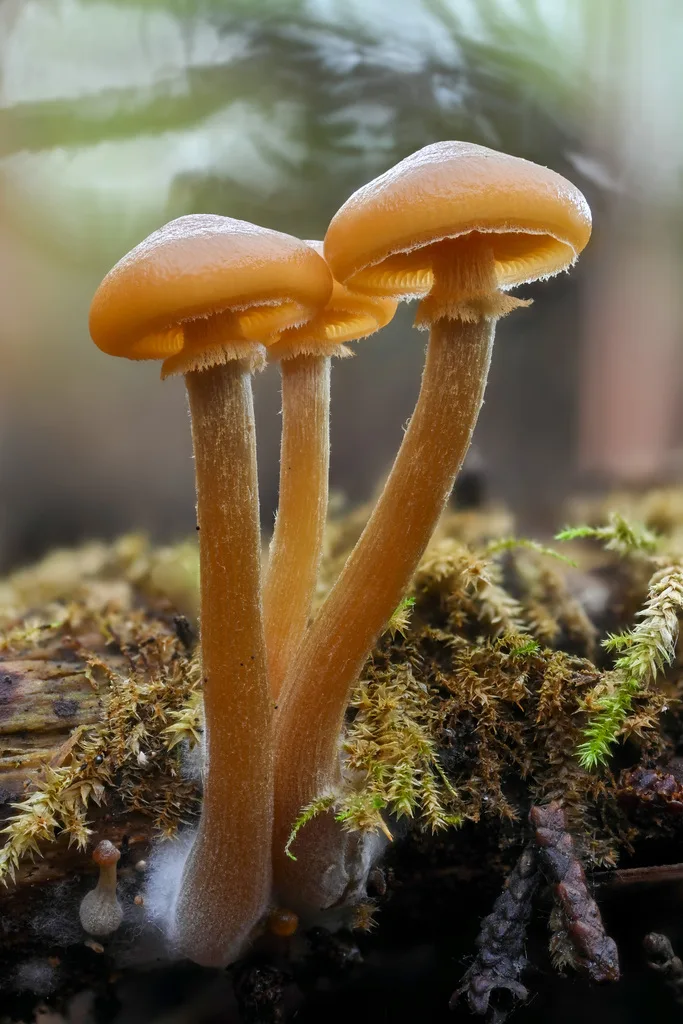
Deadly galerina is mistaken for honey mushrooms. Mushrooms Up describes a small ochre to orange-brown cap, 1.5 to 5 cm wide, and a thin ring near the top of the stem. Older specimens often lose the ring. The spore print is rusty brown, while honey mushrooms print white. It grows on rotting wood and on wood chips in towns. It carries amatoxins, the death cap toxins. Oregon has 200 records, and 184 fall from October to January. Our deadly galerina guide shows the ring and the print.
False Morel (Gyromitra esculenta)
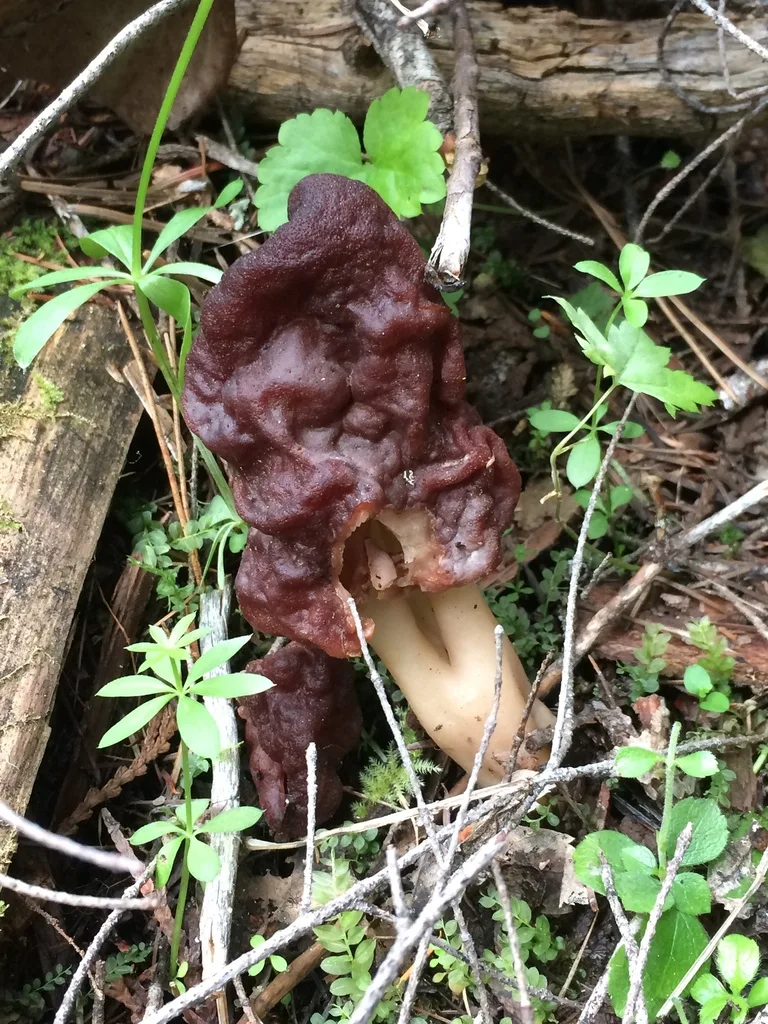
The false morel is mistaken for true morels. Mushrooms Up says its cap has rounded lobes or wrinkles, not pits with distinct rims. A lengthwise cut shows air chambers between the cap surface and the stem. Symptoms begin 6 to 12 hours after eating, and severe cases can damage the liver and kidneys. Oregon has 266 records, and 233 fall from April to June, inside morel season. Our false morel guide compares the two.
Scaly Chanterelle (Turbinellus floccosus)
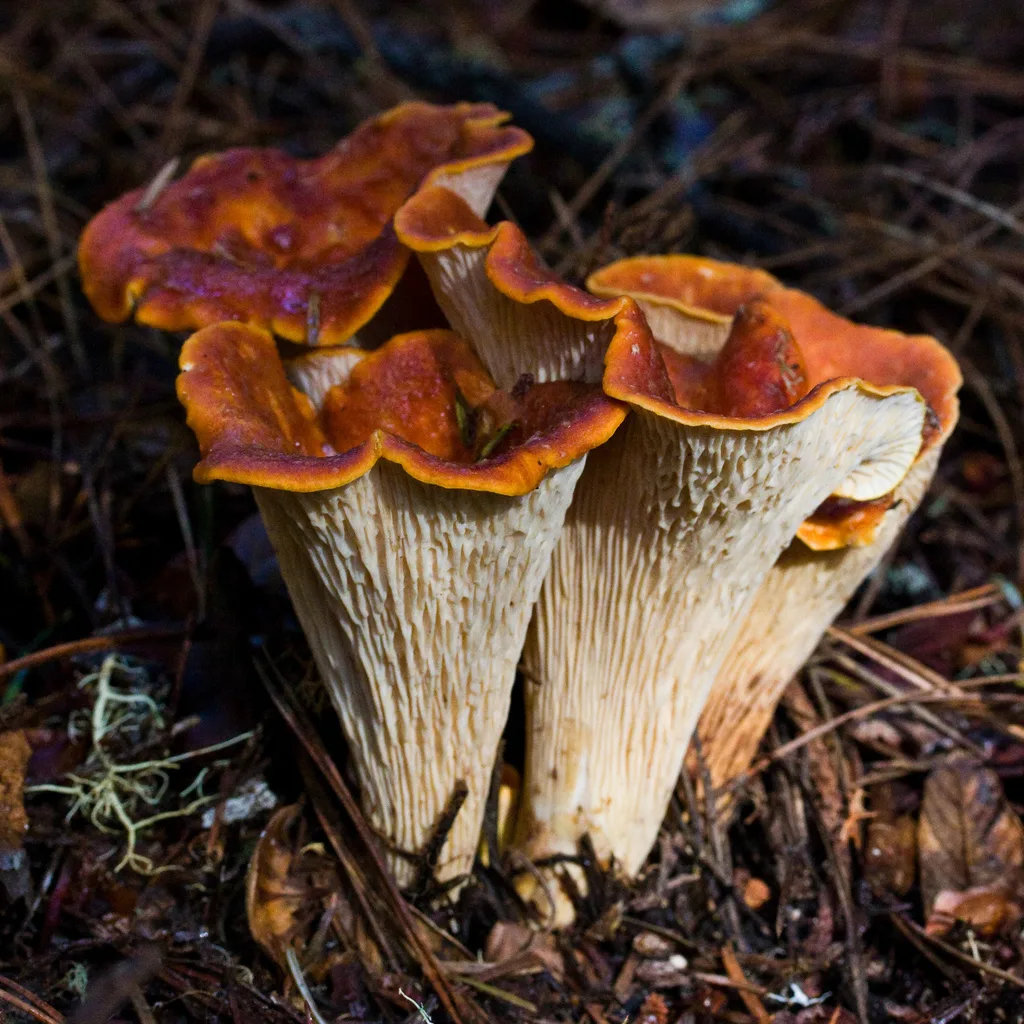
The scaly chanterelle is mistaken for the golden chanterelle. Mushrooms Up describes a deeper trumpet shape, a brighter orange scaly cap and whitish to dingy yellow wrinkles. It says the species is not recommended as an edible and may cause stomach cramps. Oregon has 652 records, and 340 fall in October. The false chanterelle (Hygrophoropsis aurantiaca) has 586 records, thinner brighter orange gills and may be mildly poisonous. The western jack-o'-lantern has no research-grade Oregon records on iNaturalist.
Where Can You Legally Pick Mushrooms in Oregon?
Personal-use picking is legal on most public forest land in Oregon, usually up to one gallon a day, but the limit and the permit change with the land manager. The table states what each source says. The national forest and Bureau of Land Management rows come from the Cascade Mycological Society permit summary, last reviewed September 3, 2026, not from the agencies themselves. Confirm each one with the ranger district.
| Land | What the source says | Before you pick |
|---|---|---|
| Oregon State Parks | OAR 736-010-0055 lets a person gather mushrooms for personal consumption, up to one gallon per person per day, "unless otherwise posted." The rule was amended effective March 12, 2025. Older copies still show five gallons. | Look for posted limits at the park |
| State forests | The Oregon Department of Forestry sheet, revised June 11, 2026, requires no permit for personal use in the Astoria, Tillamook, Forest Grove, North Cascade and West Oregon districts. The limit is one gallon or less of mushrooms per vehicle. Truffles carry the same limit. Larger amounts and commercial use need a permit. | Call the district office for other districts |
| Siuslaw National Forest | The society's summary lists no permit or fee for less than one gallon per person per day. It lists up to six matsutake per day for non-commercial use. | Call the ranger district |
| Willamette National Forest | The summary says no permit is needed for up to one gallon per day of mushrooms other than matsutake. Offices issue free permits for up to two gallons per day. Permits expire December 31. | Call the ranger district |
| Deschutes National Forest | The summary lists a free use permit shared with the Willamette, Umpqua and Fremont-Winema forests. Matsutake needs a commercial permit, and the 2026 season ran from September 8 to November 8. | Get the permit before the trip |
| Bureau of Land Management | The summary lists no permit for personal use, with up to one gallon per person per day. | Call the district office |
| Crater Lake National Park | The park compendium, approved December 30, 2025, lists four kinds of berries for hand gathering, at one quart per person per day. Mushrooms are not on the list. | Do not collect |
| Private land | The Oregon Department of Forestry says a separate permit is required for collecting special forest products from private property. The permit must include the owner's approval. | Get the owner's written permission |
Rules change, and this table is not legal advice. Wilderness areas, experimental forests and fire closures can carry extra limits. Confirm the current rule with the land manager before each trip.
How to Get an Oregon Find Identified
The most reliable route is an in-person check through a mycological society, backed by notes and a spore print. The Oregon Mycological Society describes itself as a volunteer-led group with monthly speakers, field trips and mycology camps. It also promotes MycoMatch, a free program for identifying Pacific Northwest mushrooms. The Cascade Mycological Society is a second Oregon club. The Oregon Health Authority and the Oregon Poison Center both point people to the Oregon Mycological Society for classes. Oregon State University Extension also answers mushroom questions online, but an online reply is a starting point, not an in-hand identification.
- Dig up the whole mushroom, including the base. The death cap's sac and the Smith's amanita bulb sit at or below the soil line.
- Note the date, the county and the nearest tree.
- Take a spore print on white and dark paper.
- Cut any round white button in half lengthwise. A puffball is uniform and white inside. A death cap egg shows developing gills.
- Save one whole specimen and any leftover food. Mushrooms Up says this helps confirm the identification if someone falls ill.
- If anyone ate an unknown mushroom, call the Oregon Poison Center at 1-800-222-1222 right away. Call 911 for serious symptoms.
Common Identification Mistakes
Trusting a Matsutake by Color Alone
Matsutake and Smith's amanita are both white, both grow under conifers and both peak in October and November in Oregon. Check the stem shape, squeeze the stem and smell it. Mushrooms Up says to check each and every mushroom.
Calling Every Orange Funnel a Chanterelle
Oregon has more records of the scaly chanterelle and the false chanterelle together than of the Pacific golden chanterelle. Flip the mushroom. Thin, crowded, bright orange gills or a scaly orange cap rule out the golden chanterelle.
Using Rules From Another Region or Country
The Oregon Poison Center warns that mushrooms vary by region. People who move to the Pacific Northwest should learn local species first. A mushroom that resembles a straw mushroom here is probably a death cap, according to Mushrooms Up.
Frequently Asked Questions
What edible mushrooms grow in Oregon?
Species people collect in Oregon include the Pacific golden chanterelle, western matsutake, king bolete, hedgehogs, lobster mushroom, yellowfoot and morels. All are recorded in the state. None should be eaten without expert confirmation.
When is mushroom season in Oregon?
October is the peak month for chanterelles, king boletes, lobster mushrooms and matsutake. Morels fruit from March to June, and yellowfoot and hedgehogs carry on through January and February. Rain and elevation move the dates each year.
Are there poisonous mushrooms in Oregon?
Yes. Oregon records include the death cap, Smith's amanita, deadly galerina and the false morel. The death cap and deadly galerina carry amatoxins, which can cause liver failure and are not destroyed by cooking.
Do death caps grow in Oregon?
Yes. iNaturalist holds 145 research-grade Oregon records, and 111 sit in the Willamette Valley. The Oregon Health Authority reports that death caps left five Oregon residents seriously ill in 1988, and four needed liver transplants.
When is morel season in Oregon?
Oregon morel records run from March to July. Records west of the Cascade crest peak in April, and east-side records peak in May. False morels fruit in the same months, so every find needs checking.
Is it legal to forage mushrooms in Oregon state parks?
Yes, within limits. The state rule allows one gallon per person per day for personal consumption unless the park posts otherwise. The limit was five gallons before March 12, 2025.
Do you need a permit to pick mushrooms in Oregon national forests?
It depends on the forest. The Cascade Mycological Society lists no permit for under one gallon a day on the Siuslaw and Willamette, and a free use permit on the Deschutes. Matsutake has separate rules, so call the ranger district first.
What is Oregon's state mushroom?
The Pacific golden chanterelle, Cantharellus formosus. The Oregon Blue Book says the 1999 Legislature recognized it as the state mushroom. More than 500,000 pounds are harvested each year.
Final Safety Reminder
Oregon's edible species share the same forests and months as mushrooms that can destroy a liver or the kidneys. Never eat a wild mushroom based on a chart, a photo or an app. Keep children and pets away from unknown mushrooms. If you want a first opinion, try our free mushroom identifier, then have a local identifier confirm the find in person.
Sign in to leave a comment and join the discussion.
 Guide
The big white mushroom in a Texas yard after rain is most often the green-spored parasol ( Chlorophyllum molybdites ), a poisonous lawn species that Texas...
 Guide
Mushrooms growing in a bathroom, a wall, a carpet or a basement mean that something in the house has stayed wet for a long time. A fungus only fruits...
 Guide
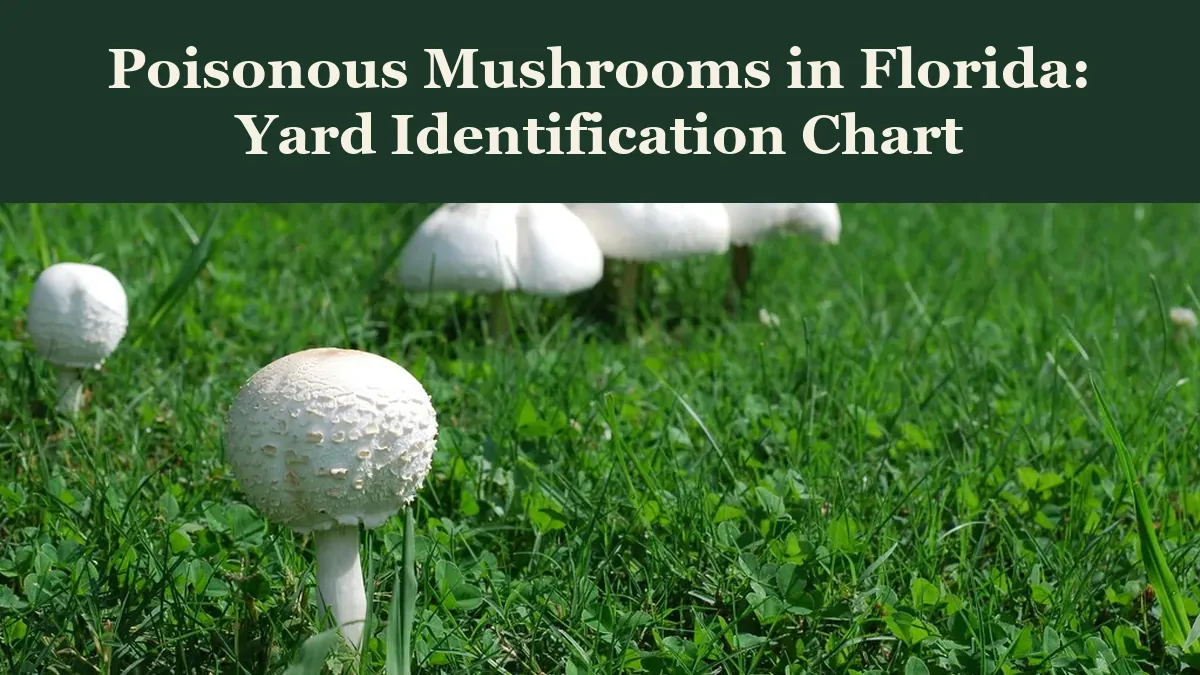
The most common poisonous mushroom in Florida yards is the green-spored parasol ( Chlorophyllum molybdites ), a big white lawn mushroom that causes severe...