Edible Mushrooms in Florida: Identification Chart
— views
The best-known edible mushrooms in Florida are chanterelles, which peak in the summer rains from June to September, and the deadliest look-alike risk in the state is the destroying angel (Amanita bisporigera). Indigo milk caps, chicken of the woods, oysters and lion's mane fill the rest of the year. No wild mushroom belongs on a plate until a qualified person has confirmed it in hand.
This page covers edible mushrooms in Florida by month and by region, using University of Florida sources and Florida records instead of a national list. It then covers poisonous mushrooms in Florida, the collecting rules on public land, and where to get a find identified.
Key Takeaways
- About three quarters of Florida's chanterelle records on iNaturalist fall from June to September (2,477 of 3,235).
- Lion's mane is a north Florida winter mushroom. Of 294 records, 277 sit north of latitude 29 and 267 fall from November to February.
- The southern jack-o'-lantern peaks from November to January, not in chanterelle season. In Florida it overlaps the ringless honey mushroom instead.
- UF/IFAS calls the green-spored parasol the most common cause of mushroom poisoning in the United States. It fruits in Florida lawns from about April to November.
- Florida poison centers logged 2,995 mushroom exposures from 2014 to 2024, including three deaths.
- Florida's state park, state forest and wildlife management area rules bar removing plant life without written permission. None of them names mushrooms, so ask the land manager first.
Edible Mushrooms in Florida: Identification Chart
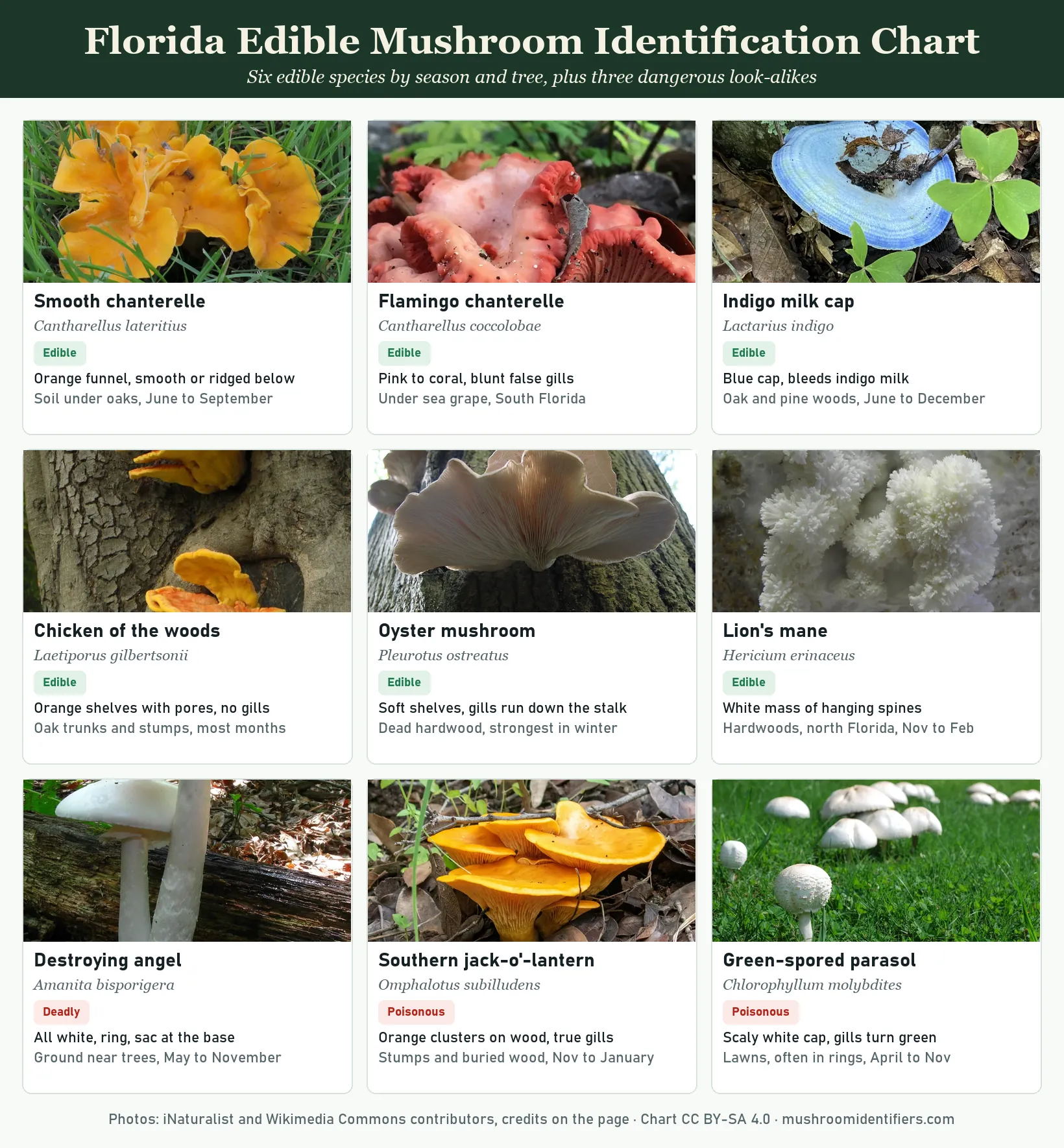
Start with the season and the tree, then rule out the look-alike in the last column. Months come from our count of Florida fungi records on iNaturalist, pulled in November 2026. A place on this chart means a species is recorded in Florida, not that any single mushroom is fit to eat.
| Species | Key features | Where in Florida | Months | Rule out |
|---|---|---|---|---|
| Smooth and golden chanterelles (Cantharellus lateritius, C. tenuithrix) | Yellow to orange funnel, blunt ridges or a smooth underside, grows from soil | Under oaks and pines, mostly north and central | June to September, some May to October | Southern jack-o'-lantern |
| Flamingo chanterelle (Cantharellus coccolobae) | Pink to coral or reddish orange, blunt false gills | Under sea grape and pigeon plum, South Florida only | August to October | Other small red or orange mushrooms |
| Black trumpet (Craterellus fallax) | Dark gray to black thin funnel, smooth underside | Soil near oaks and other host trees, north and central | July to September | Other dark funnels |
| Indigo milk cap (Lactarius indigo) | Blue cap and gills, deep blue milk that turns green | Oak and pine woods, statewide | June to December, peak September to November | Silver-blue milk cap |
| Chicken of the woods (Laetiporus gilbertsonii and relatives) | Orange to yellow overlapping shelves, pores underneath, no gills | Oak trunks, stumps and roots, north and central | Every month, most from September to January | Jack-o'-lantern, which has gills |
| Oyster mushrooms (Pleurotus ostreatus, P. pulmonarius) | Soft shelf clusters on wood, gills run down a side stalk, pale spore print | Dead hardwood, statewide | Every month, strongest in winter and after summer rain | Crepidotus, tough Lentinus |
| Lion's mane (Hericium erinaceus) | White mass of hanging spines, no cap | Living and dead hardwoods, north Florida | November to February | Comb tooth |
| Ringless honey mushroom (Desarmillaria caespitosa) | Honey-brown scaly caps in dense clusters, no ring, white spore print | Oak bases, stumps and buried roots, lawns | October and November | Southern jack-o'-lantern, deadly galerina |
Species counts are research-grade records. Chanterelle and chicken of the woods totals are genus counts, which include records not yet named to species. Counts show when people photograph mushrooms, not how many grow.
Florida Mushroom Season by Month
Florida has two mushroom seasons: a long summer season driven by rain and a short winter season in the cooler months. A University of Florida fungi expert told UF/IFAS News that summer mushrooms can appear from March to November and winter mushrooms from about late November through February. He added that water limits Florida's mushrooms more than cold does.
The table splits the state into three bands. North Florida means north of latitude 29, roughly Ocala northward, including the Panhandle. Central Florida runs from latitude 27 to 29. South Florida is south of latitude 27, roughly Lake Okeechobee southward. The month ranges are estimates from iNaturalist counts.
| Months | North Florida | Central Florida | South Florida | Dangerous species active |
|---|---|---|---|---|
| January to February | Lion's mane, oysters, chicken of the woods | Oysters, chicken of the woods | Oysters, few others | Southern jack-o'-lantern, peach-colored fly agaric |
| March to April | Quietest months in the counts. Oysters, a few chicken of the woods | Oysters, a few chicken of the woods | Oysters | Green-spored parasol starts in April |
| May to June | Chanterelles begin, indigo milk cap | Chanterelles begin in June | First flamingo chanterelles in June | Green-spored parasol, destroying angel |
| July to August | Chanterelle peak, black trumpets, indigo milk cap | Chanterelles, black trumpets, summer oysters | Flamingo chanterelle from August | Green-spored parasol, destroying angel |
| September to October | Chanterelles through September, ringless honey in October | Chanterelle peak in September, indigo milk cap, ringless honey in October | Flamingo chanterelle peak | Green-spored parasol peak in September, destroying angel |
| November to December | Ringless honey, lion's mane, oysters, indigo milk cap | Ringless honey, indigo milk cap, chicken of the woods | Indigo milk cap, last chanterelles | Southern jack-o'-lantern, peach-colored fly agaric |
The regional split is sharp. All but 5 of the 324 flamingo chanterelle records sit in the South Florida band. Lion's mane has no record there. Chicken of the woods has 27 genus records in the south, against 529 in the north and 563 in the center.
Common Edible Mushrooms in Florida
Eight species or groups, each backed by a University of Florida publication or by Florida records, cover most of what people look for. UF/IFAS repeats one rule in every fact sheet quoted below: never eat a wild mushroom you cannot positively identify, and when in doubt, throw it out.
Smooth and Golden Chanterelles (Cantharellus lateritius and Relatives)
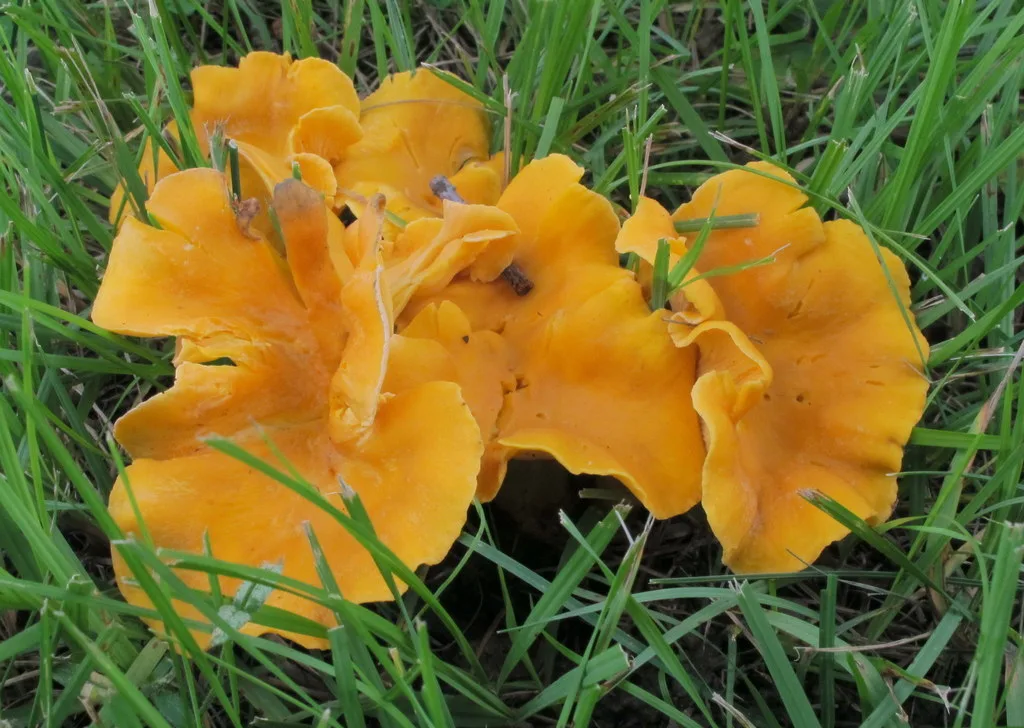
The UF/IFAS chanterelle fact sheet says chanterelles are most prolific in Florida from May to September. They grow from soil near oaks and pines and never fruit directly from wood. The underside has blunt false gills that run down the stalk and cannot be plucked one by one. Cantharellus lateritius has a smooth or faintly ridged underside. UF/IFAS notes that C. cibarius is a European species and that Florida's golden chanterelles include C. tenuithrix. Our chanterelle guide covers the general features.
Flamingo Chanterelle (Cantharellus coccolobae)
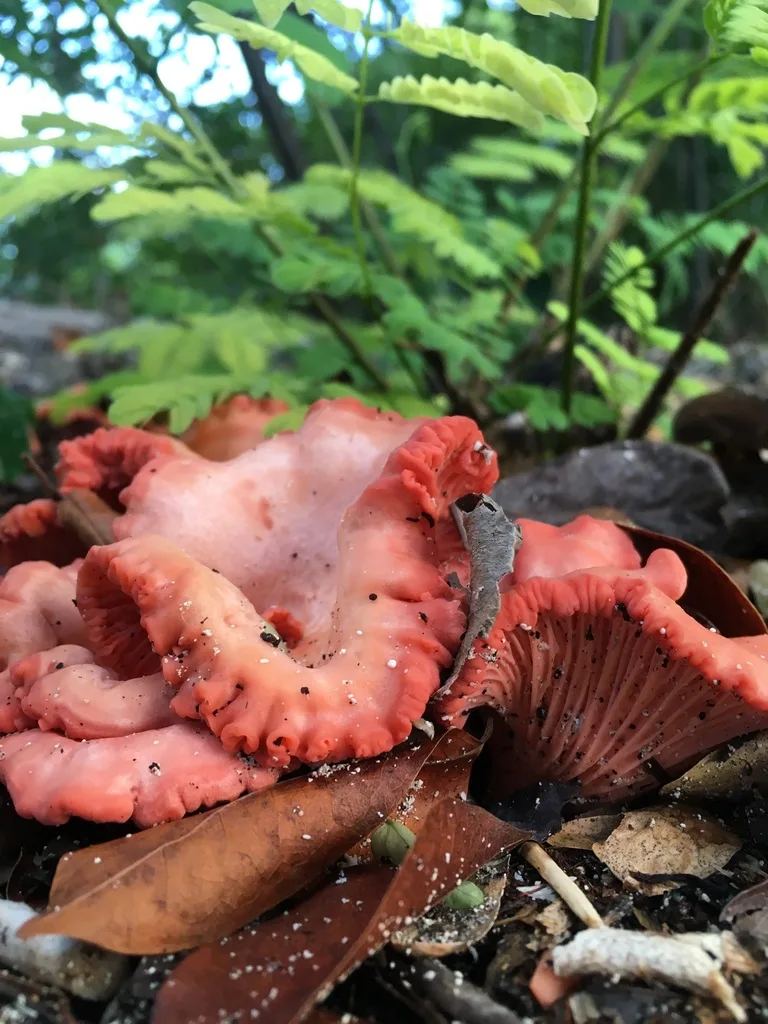
This pink to coral chanterelle is the South Florida specialty. UF/IFAS says it is found only in southern Florida with sea grape and pigeon plum, in sandy soil near the beach, in rockland hammocks or under planted trees. Florida records peak in September and October, later than the chanterelles of the north.
Black Trumpet (Craterellus fallax)
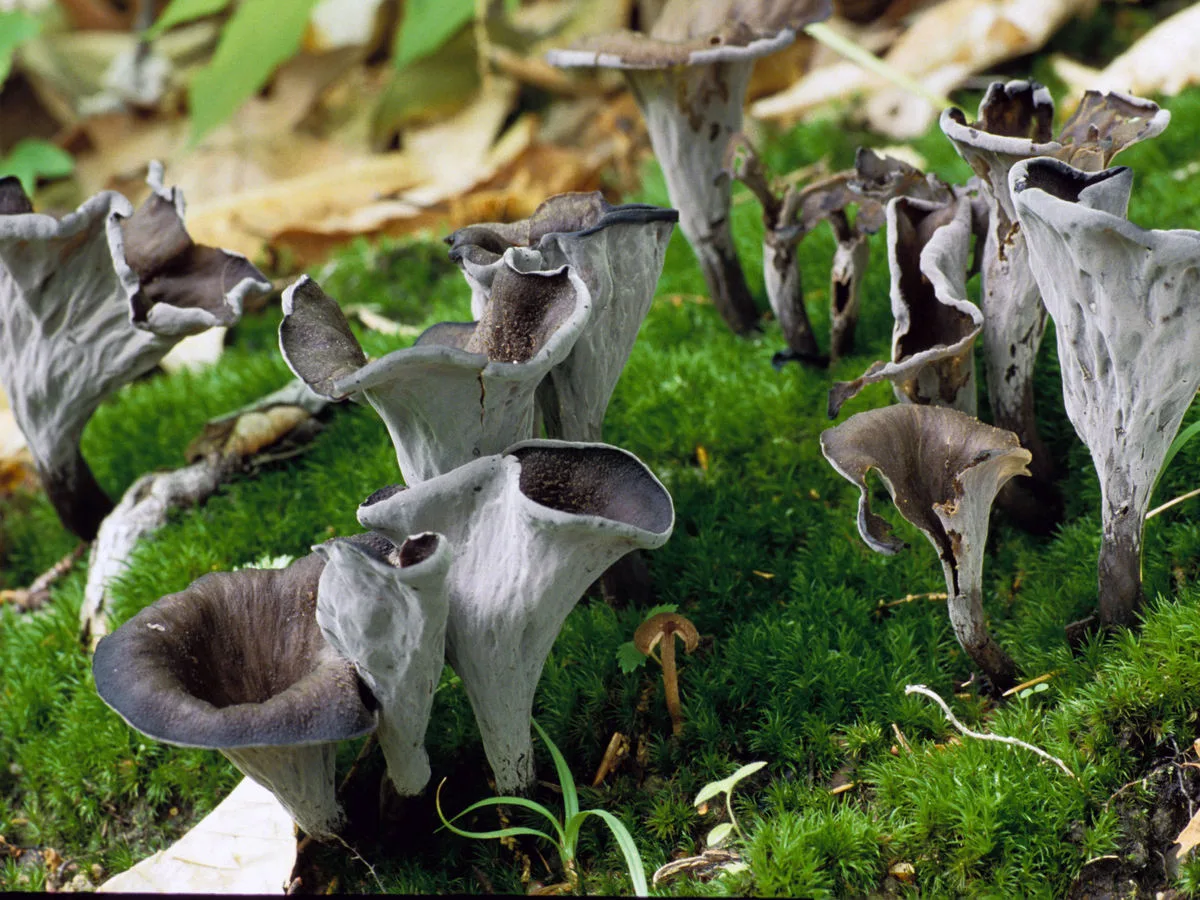
UF/IFAS describes a dark gray to black funnel with thin flesh, no clear line between cap and stalk, and a smooth underside. It stands 7.5 to 15 cm tall. Florida has 83 records, 65 of them from July to September, and none in the South Florida band. See our black trumpet guide for look-alikes.
Indigo Milk Cap (Lactarius indigo)
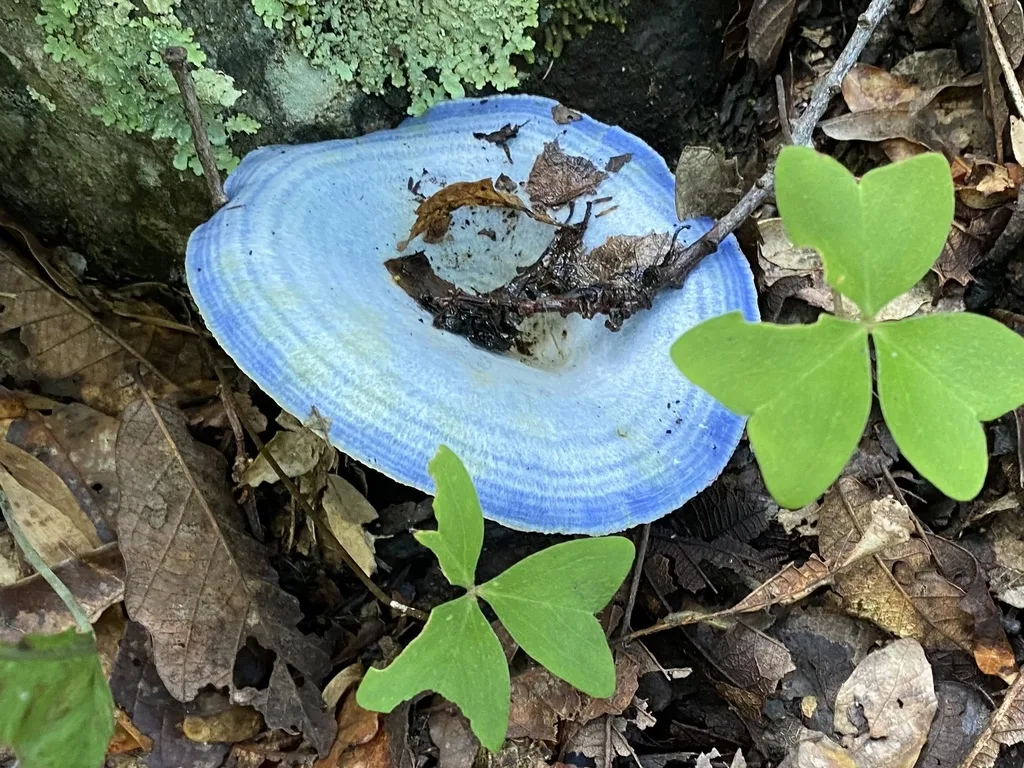
Break a gill and the mushroom bleeds deep indigo milk that slowly turns dark green. The Missouri Department of Conservation describes a blue cap that fades to grayish blue with green bruises, a cream spore print, and a home in oak and pine woods. It rates the species an excellent edible but tells readers to be absolutely sure of the identification. Florida has 665 records spread across all three bands. Nearly half fall from September to November.
Chicken of the Woods (Laetiporus gilbertsonii and Relatives)
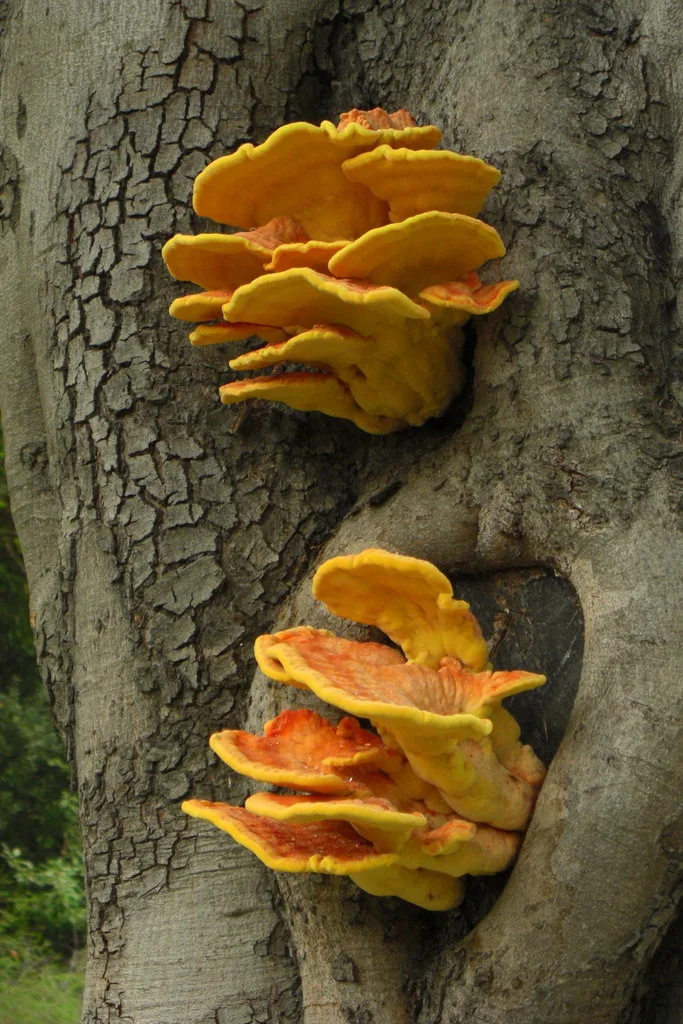
These are bright yellow to orange shelves with a soft, suede-like surface and pores instead of gills. The UF/IFAS chicken of the woods fact sheet says three species are reported in Florida: L. sulphureus, L. gilbertsonii and L. cincinnatus. Only L. gilbertsonii has been confirmed with DNA from Florida specimens. Oaks are the main hosts. UF/IFAS warns that raw or undercooked specimens have been reported to cause stomach problems and that some people are allergic. Our chicken of the woods guide covers the group.
Oyster Mushrooms (Pleurotus ostreatus and Pleurotus pulmonarius)
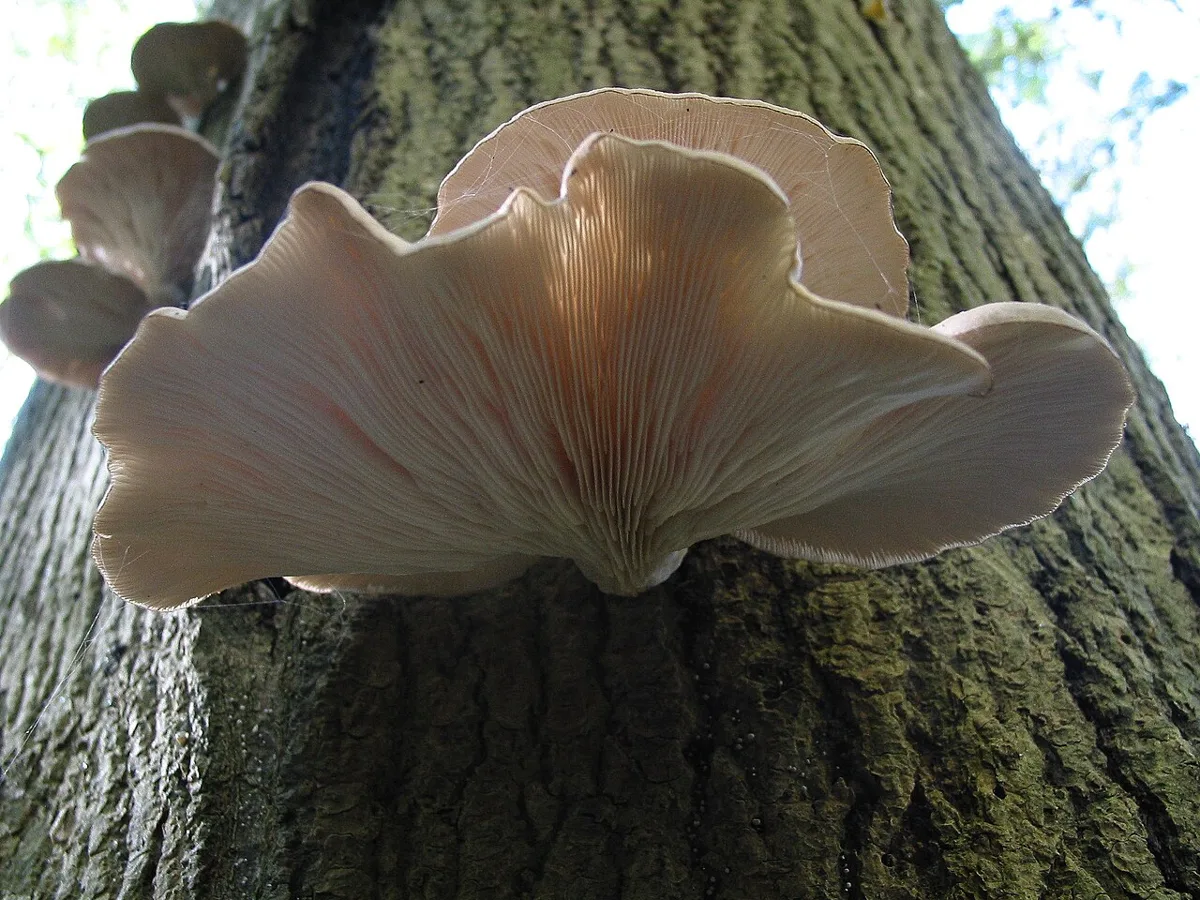
The UF/IFAS oyster mushroom fact sheet says oysters grow year-round in Florida on fallen logs and standing dead wood, never from soil. Look for soft, fleshy shelves, a stalk off to one side, gills that run down the stalk and a light-colored spore print. UF/IFAS lists brown-spored Crepidotus, tough Lentinus and pored Favolus as Florida look-alikes. Compare shelf mushrooms in our oyster mushroom identification guide.
Lion's Mane (Hericium erinaceus)
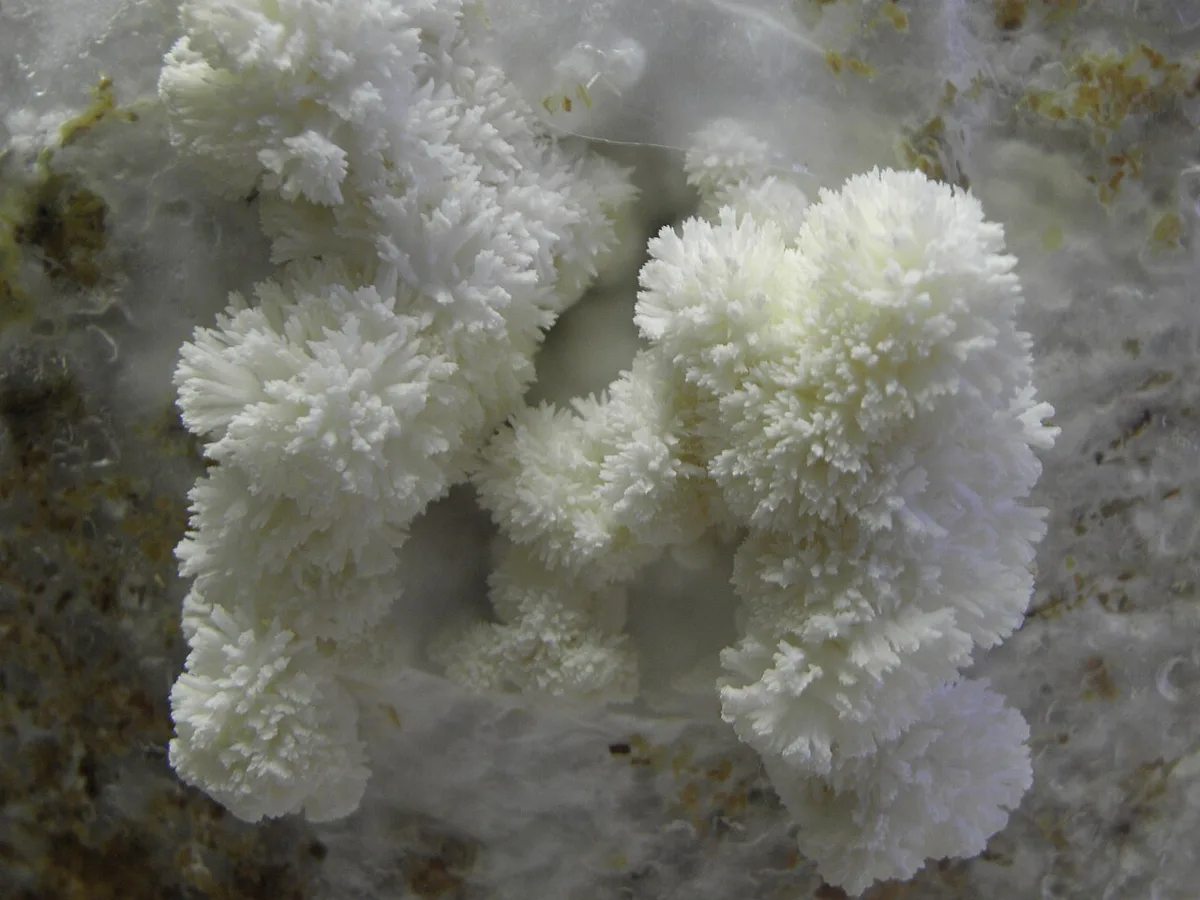
A UF/IFAS Extension Escambia County article describes a white mass 3 to 15 inches across with rows of hanging tooth-like spines. It grows on rotting wood of dead and living trees, often fairly high up. Florida records cluster in the Panhandle and north peninsula in the cool months. The branched comb tooth is the usual mix-up. Our lion's mane guide shows both.
Ringless Honey Mushroom (Desarmillaria caespitosa)
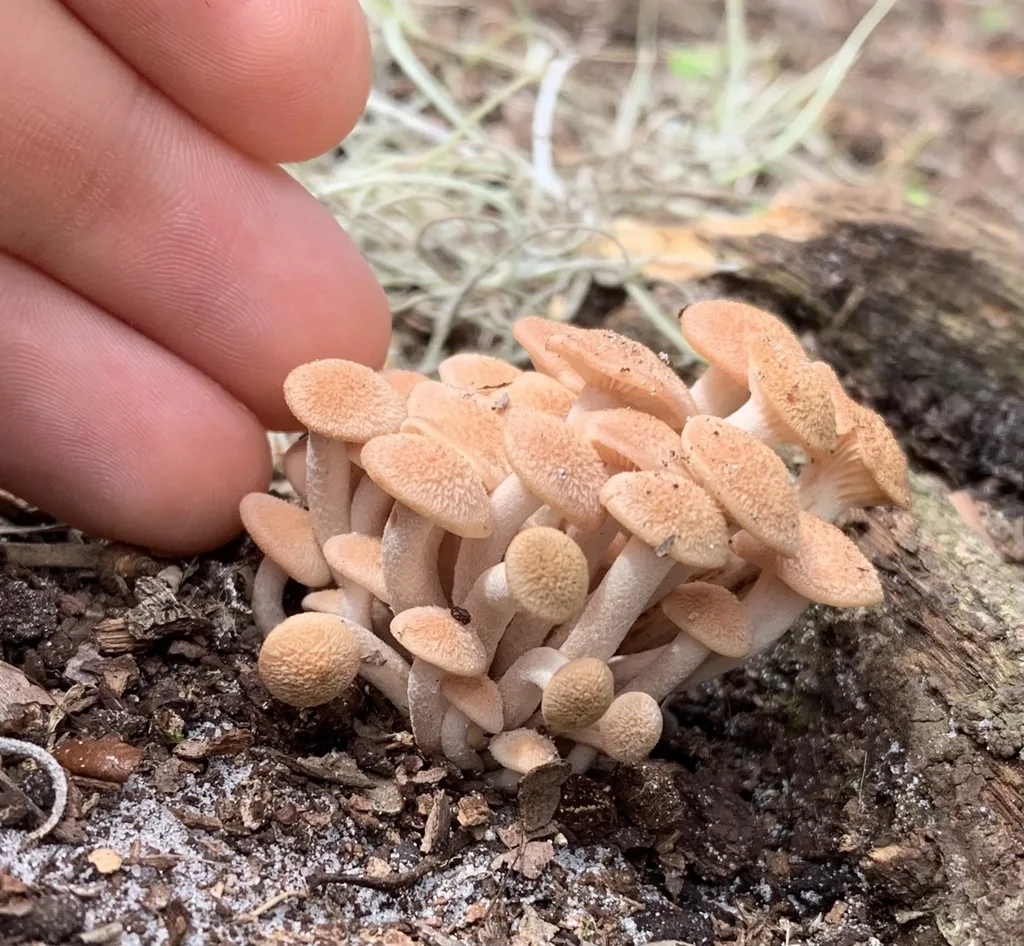
This is the most recorded gilled mushroom in Florida, with 3,035 records. October and November hold 2,284 of them. UF/IFAS Gardening Solutions uses the older name Armillaria tabescens and calls it the most common species infecting trees and shrubs in Florida. The Missouri Department of Conservation describes honey-brown scaly caps, no ring, a white spore print and stalks fused at the base.
Treat this one with extra caution. The Missouri agency says it must be cooked thoroughly or it can cause serious stomach upset, and it advises a small amount the first time. NAMA lists the honey mushroom group among species that cause stomach distress in susceptible people. Our honey mushroom guide covers the look-alikes.
Poisonous Mushrooms in Florida
Three poisonous mushrooms in Florida matter most to anyone looking for edible species: the destroying angel, the southern jack-o'-lantern and the green-spored parasol. A study in the Western Journal of Emergency Medicine counted 2,995 mushroom exposures reported to the Florida Poison Information Center Network from 2014 to 2024. The mushroom was never identified in 76.7% of them. Thirty-nine fell in the amatoxin group. Three people died.
Destroying Angel (Amanita bisporigera)
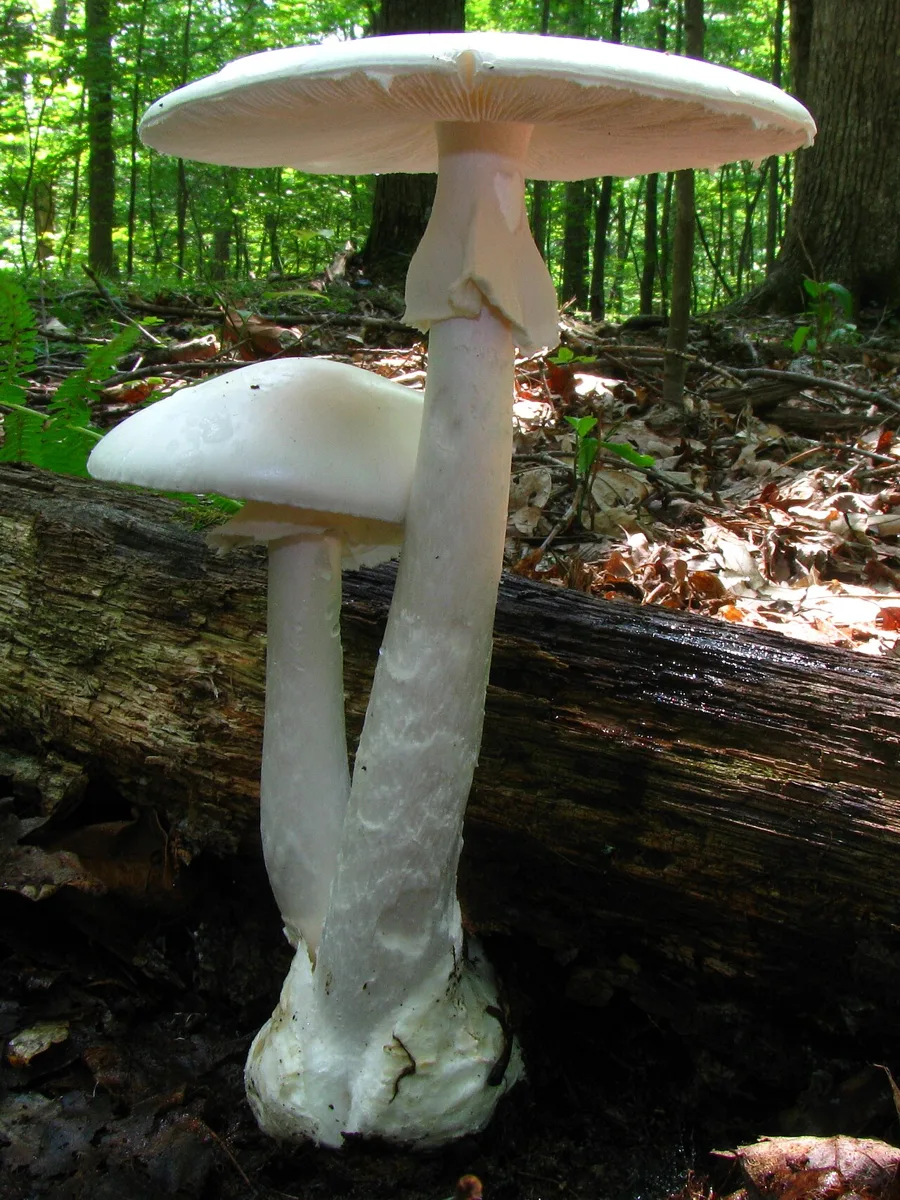
The destroying angel is all white, with a skirt-like ring and a sac-like cup at the base that can hide underground. The Missouri Department of Conservation says it grows on the ground in woods and in grass near trees, and that people confuse it with the meadow mushroom. Florida has 74 records, 66 of them from May to November. NAMA says amatoxin symptoms start 6 to 24 hours after the meal and that liver and kidney failure can follow. See our destroying angel guide.
Southern Jack-o'-Lantern (Omphalotus subilludens)
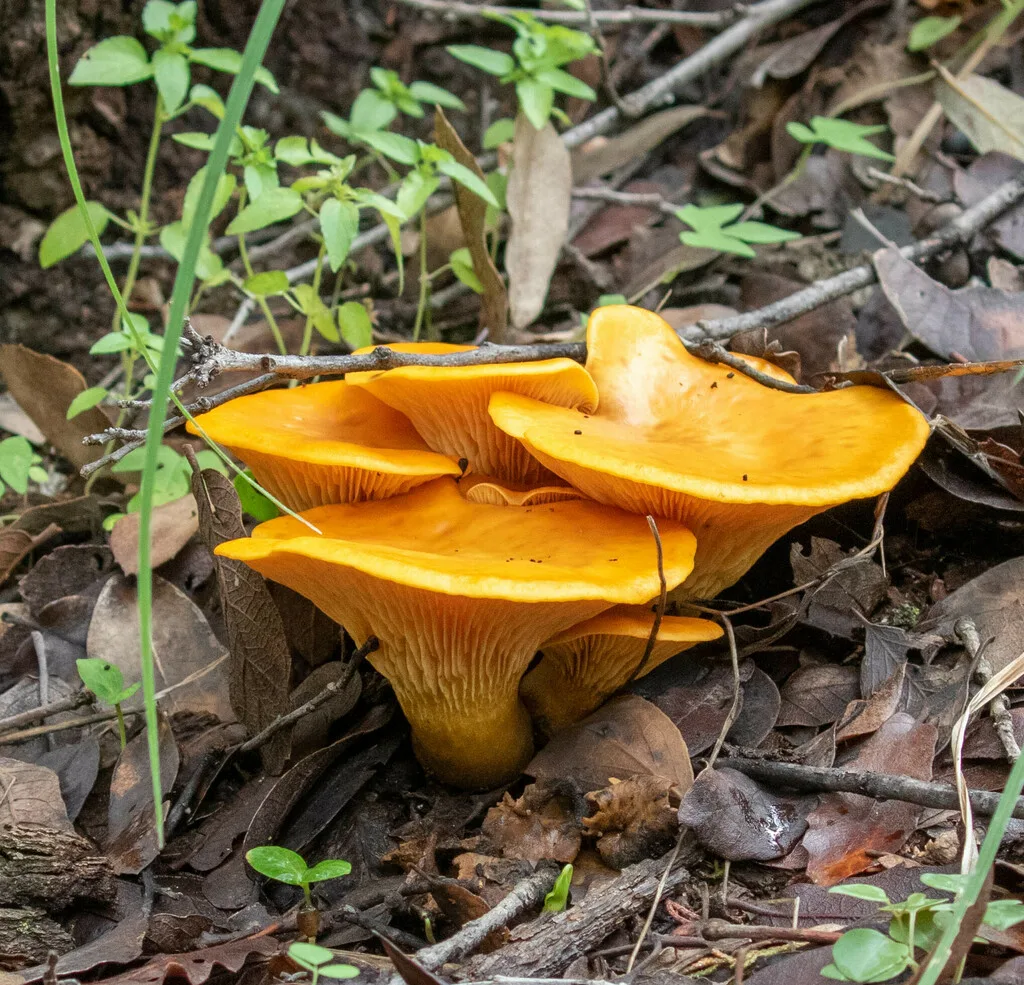
UF/IFAS names this orange mushroom as a chanterelle look-alike in Florida. It grows on wood, has sharp true gills and often forms clusters fused at the base. Buried wood can make it seem to grow from soil. Of 452 Florida records, 372 fall from November to January. NAMA reports nausea in 90% of jack-o'-lantern cases, usually one to three hours after the meal.
Green-Spored Parasol (Chlorophyllum molybdites)
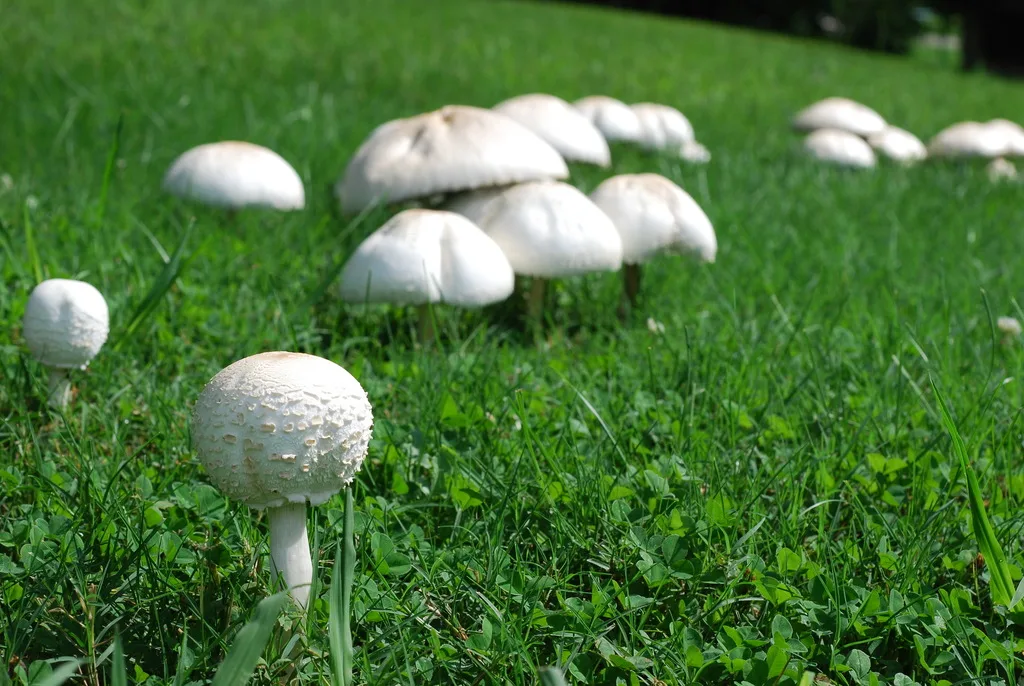
The UF/IFAS fact sheet on this species says it is easily confused with edible parasols and shaggy parasols. It is a large white lawn mushroom with brownish scales, a ring, and gills that turn green as the spores mature. The spore print is green. Symptoms start one to two hours after eating and include vomiting and diarrhea. Our green-spored parasol guide has the full checks.
One more to know by sight is the peach-colored fly agaric (Amanita persicina). Florida has 1,168 records. Most sit in the north band, and most fall from November to February. NAMA lists the fly agaric group under ibotenic acid and muscimol poisoning, so treat this relative as poisonous.
Where Can You Legally Pick Mushrooms in Florida?
We found no Florida rule that names mushrooms, and the plant rules on state land are strict, so assume you need permission. The table states what each rule page says. Rules written for plants may not settle the question for fungi. Ask the land manager before you collect.
| Land | What the source says | Before you collect |
|---|---|---|
| Florida State Parks | Rule 62D-2.013 says no person shall remove any plant life from any park. Collecting permits are issued for scientific or educational purposes. The rule does not name mushrooms or fungi. | Ask the park manager. Expect a no for food collecting. |
| Florida State Forests | Rule 5I-4.005 bars removing any plant life from managed lands. Written permission is granted only for an educational or research purpose. The rule does not name mushrooms or fungi. | Call the local Florida Forest Service office |
| Wildlife Management Areas | Rule 68A-15.004 bars removing plants or other natural resources without written authorization where the Fish and Wildlife Conservation Commission is the landowner or lead manager. It does not name mushrooms. | Ask the Commission or the lead land manager |
| Apalachicola, Osceola and Ocala National Forests | Federal rule 36 CFR 261.6 prohibits removing any forest product except as authorized by a permit, contract or federal regulation. The forests' own permit page would not open for us, so no Florida mushroom rule was found. | Call the ranger district |
| Everglades National Park | The natural resource section of the 2026 park compendium allows dead wood to be collected for campfires. The part we read lists no allowance for gathering mushrooms. | Treat collecting as not allowed unless a ranger says otherwise |
| Private land | We did not find a mushroom-specific Florida rule. | Get the landowner's permission |
Rules change, and this table is not legal advice.
How to Get a Florida Find Identified
For Florida mushroom identification, start with the University of Florida and a local club, and use the poison line for any suspected poisoning. Photos and apps are a first step only. The UF fungi expert quoted above warns that identification apps are prone to error.
- UF/IFAS Plant Pathology: the department's fungal identification services page says its lab identifies mushrooms at any time, free of charge, when the health of a person or a pet may be at risk. It coordinates with Florida Poison Control.
- County Extension offices: UF/IFAS asks for fresh specimens, several if possible, with photos of the cap, the full stalk, the underside and the material the mushroom grew on.
- Florida Mycological Society: the society runs mushroom meet-ups on the first weekend of each month.
- Gulf South Mycological Society: this regional society offers guided mushroom walks in Gulf Coast habitats and online lectures.
- Poison Help: call 1-800-222-1222 if anyone has eaten an unknown mushroom. Call 911 for serious symptoms.
Before you ask for help, dig up the whole mushroom, note the nearest tree, and take a spore print. A green print points to the green-spored parasol.
Common Identification Mistakes
Calling a Fall Orange Cluster a Chanterelle
Florida chanterelles are summer mushrooms that grow singly or scattered from soil. An orange or honey-colored cluster at a tree base from October to January is far more likely a ringless honey mushroom or a southern jack-o'-lantern. Both grow from wood, even when the wood is buried.
Treating a White Lawn Mushroom as a Parasol or Meadow Mushroom
The green-spored parasol is one of the most common lawn mushrooms in Florida, and its gills stay pale until the spores mature. Destroying angels also come up in grass near trees. Check the spore print and dig for a sac at the base.
Using a Northern Calendar
Field guides written for the North put lion's mane in fall and build spring around morels. In Florida, lion's mane is a winter find, and iNaturalist shows a single morel record for the whole state. Hen of the woods has no Florida record at all in our count.
Frequently Asked Questions
What edible mushrooms grow in Florida?
Species recorded in Florida include chanterelles, black trumpets, indigo milk caps, chicken of the woods, oyster mushrooms, lion's mane and ringless honey mushrooms. None should be eaten without expert confirmation in hand.
When is mushroom season in Florida?
Florida has a long summer season from about March to November and a winter season from late November through February. Chanterelles peak from June to September, ringless honey mushrooms in October and November, and lion's mane from November to February. Rain matters more than the date.
Are there poisonous mushrooms in Florida?
Yes. Florida has destroying angels, which carry amatoxin and can cause fatal liver failure, plus the southern jack-o'-lantern and the green-spored parasol, which cause severe vomiting and diarrhea. Florida poison centers recorded 2,995 mushroom exposures from 2014 to 2024, including three deaths.
When is morel season in Florida?
Florida has no real morel season. iNaturalist shows a single verifiable morel record for the state, from March.
Is it legal to forage mushrooms in Florida state parks?
Assume it is not. The state park rule says no person shall remove any plant life from a park, and collecting permits are issued for scientific or educational purposes. The rule does not name mushrooms, so ask the park manager for a clear answer.
Do chanterelles grow in Florida?
Yes. UF/IFAS describes several chanterelle species in the state, mostly under oaks and pines, with the best fruiting from May to September. The southern jack-o'-lantern is the look-alike to rule out.
Does lion's mane grow in Florida?
Yes, mainly in north Florida in the cool months. Of 294 Florida records on iNaturalist, 277 sit north of latitude 29, and 267 fall from November to February.
Are ringless honey mushrooms edible?
Sources list them as edible when young and thoroughly cooked, but honey mushrooms cause stomach upset in some people. The Missouri Department of Conservation warns of serious stomach upset from undercooked specimens. They also resemble the poisonous jack-o'-lantern, so expert confirmation is needed.
Can you eat mushrooms growing in a Florida lawn?
Do not eat them. The green-spored parasol, the most common cause of mushroom poisoning in the United States according to UF/IFAS, is one of the most common lawn mushrooms in Florida. Destroying angels also grow in grass near trees.
Final Safety Reminder
Florida's edible mushrooms share oak roots, logs and lawns with species that can put you in the hospital, and destroying angels can kill. Never eat a wild mushroom based on a chart, a photo or an app. For a first opinion, try our free mushroom identifier, then have a local expert confirm the find in person. If someone may have eaten a poisonous mushroom, call Poison Help at 1-800-222-1222 right away.
Sign in to leave a comment and join the discussion.
 Guide
The big white mushroom in a Texas yard after rain is most often the green-spored parasol ( Chlorophyllum molybdites ), a poisonous lawn species that Texas...
 Guide
Edible mushrooms in Oregon peak in fall, when Pacific golden chanterelles, matsutake, king boletes and hedgehogs fruit from September into winter, and the...
 Guide
Mushrooms growing in a bathroom, a wall, a carpet or a basement mean that something in the house has stayed wet for a long time. A fungus only fruits...